Publication – « Le roi et ses langues: communication et impérialité », éd. Fulvio Delle Donne et Benoît Grévin

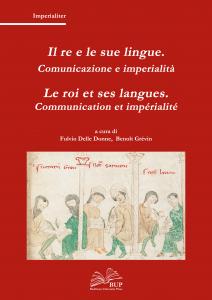
È mai esistita un’ideologia imperiale connessa con la comunicazione linguistica nell’Europa del tardo Medio Evo e della prima modernità? E, in tal caso, all’esterno dell’impero germanico o bizantino, vi furono sovrani che tentarono di definire o imporre una “imperialità linguistica”? Attraverso l’esplorazione dal recupero in diversi contesti di una “sintassi” imperiale latina, greca o anche araba, questo volume offre un’indagine approfondita sulla gestione del multilinguismo negli spazi politici posti fuori o ai margini dell’Impero. Dalla Sicilia all’Inghilterra, dalla Polonia ai confini serbo-ungheresi, dal xii al xvii secolo, sono percorse le linee frastagliate dei complessi rapporti dialettici tra usi pragmatici e rappresentazioni ideologiche delle lingue che cooperano, sul lungo periodo, alla costruzione di suggestive forme di imperialità “derivata” o “seconda”.

Table des matières :

Benoît Grévin, Le roi de langues et l’empereur. Y a-t-il eu un modèle «impérial» de gestion linguistique au bas Moyen Âge et à l’époque moderne (1100-1700/1792)?: 7

Guido Cappelli – Fulvio Delle Donne, Considerazioni sul Latino come lingua imperiale (secc. XII-XVI): 31

Lars Boje Mortensen, L’auto-rappresentazione imperiale nella letteratura occidentale (1050-1200 ca.): 51

Benoît Grévin, Ampleur et limite d’une impérialisation: les modèles rhétoriques impériaux et leurs réemplois royaux en Europe occidentale et centrale (fin XIIIe-début XVe siècle): 69

Annick Peters-Custot, Langue(s) d’Empire et langue(s) impériale(s) dans le royaume Hauteville de Sicile: 105

Aude Mairey, Langues et impérialité seconde dans les îles Britanniques à la fin du Moyen Âge: 123

Benjamin Landais, Langues de gouvernement et gouvernement des langues: l’allemand face aux langues ‘nationales’ dans les confins orientaux de la monarchie habsbourgeoise au XVIIIe siècle: 147

Informations pratiques :

Le roi et ses langues: communication et impérialité, éd. Fulvio Delle Donne et Benoît Grévin, Potenza, Basilicata University Press, 2023 ; 1 vol., 176 p. (Imperialiter, 2). ISBN : 978-88-31309-20-2. Accès en ligne : ici

Source : Basilicata University Press

Publié dans Publications | Laisser un commentaire

Offre d’emploi – Postdoctoral Research Assistant in Archaeology

Closes: 8th March 2023

The post holder will be a key researcher within the AHRC-funded project: ‘The Medieval Ritual Landscape’ (MeRit), led by Professor Roberta Gilchrist. The project aims to shed new light on everyday religion in the English Middle Ages (c.1000-1600 CE) by bringing together medieval public finds (recorded by the Portable Antiquities Scheme, PAS) with excavated evidence.

The post holder will bring a strong understanding of later medieval archaeology and material culture, medieval beliefs and social identities. They will help shape research priorities, collect and analyse data, author reports for both academic and public audiences, contribute to conferences organised by the project, and support engagement activities with citizen scientists and academic partners.

MeRit is a collaborative project with Portable Antiquities Scheme (British Museum) and the PDRA will have a placement opportunity to work at the British Museum.

Interviews will be held on 20 March 2023

Informal contact details
Contact role: Principal Investigator
Contact name: Professor Roberta Gilchrist
Contact email: r.l.gilchrist@reading.ac.uk

Applications from job seekers who require sponsorship to work in the UK are welcome and will be considered alongside all other applications. By reference to the applicable SOC code for this role, sponsorship may be possible under the Skilled Worker Route.  Applicants should ensure that they are able to meet the points requirement under the PBS.  There is further information about this on the UK Visas and Immigration Website.

The University is committed to having a diverse and inclusive workforce, supports the gender equality Athena SWAN Charter and the Race Equality Charter, and is a Diversity Champion for Stonewall, the leading LGBT+ rights organisation. Applications for job-share, part-time and flexible working arrangements are welcomed and will be considered in line with business needs.

Source : Jobs.ac.uk

Publié dans Offre d'emploi | Laisser un commentaire

Appel à contribution – Benedicamus Domino

Thursday 7 and Friday 8 September 2023
University of Oslo

Deadline: 15 March 2023

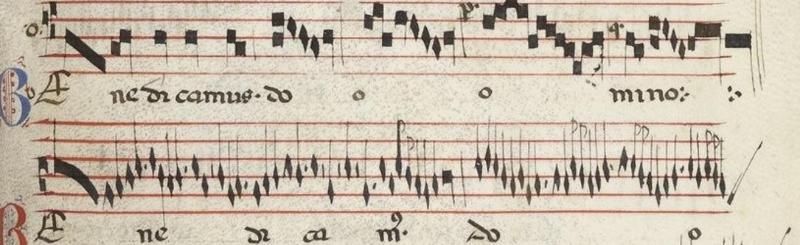
For more than a millennium, the exclamation « Benedicamus Domino » (‘Let us bless the Lord’) has sounded in song several times a day, with various liturgical and ritual functions. This two-day conference explores the history of the Benedicamus versicle, its musical and poetic embellishments, and its sacred, secular, and material contexts across the fullest extent of the versicle’s wide chronological and geographical span.

We invite papers that intersect specifically with the « Benedicamus Domino » or its broader or parallel frames of reference. Themes include but are not limited to:
– New sources, new centres
– Theological and liturgical perspectives
– Poetic elaboration and troping
– Ritual contexts (e.g. processions, comparable versicles)
– Unwritten traditions and their written traces
– Female communities
– Medievalism and carols
– Young singers and pedagogy
– ‘Simple’ polyphony
– Analytical case studies and approaches

Presentations may take the form of either a 20-minute individual paper or a 10-minute lightning paper (focused on a specific source or musical example). This is an English-language and in-person conference.

Please send abstracts of maximum 300 words to benedicamus-conference@imv.uio.no by 15 March 2023, with contact details and affiliation (if applicable). Notification of acceptance will be given by 31 March.

Organising committee:
Dr Nicholas David Yardley Ball (n.d.y.ball@imv.uio.no)
Dr Manon Louviot (manon.louviot@imv.uio.no)
Prof. Catherine A. Bradley (c.a.bradley@imv.uio.no)
James R. Tomlinson (j.r.tomlinson@imv.uio.no)

benedicamus-conference@imv.uio.no

Source : University of Oslo

Publié dans Appel à contributions | Laisser un commentaire

Colloque – The Future of Medieval France | UCLA Center for Early Global Studies Conference

“The Future of Medieval France” is an international conference on the past, present, and future of medieval studies in Europe presented in honor of John W. Baldwin. Organized by Professor Meredith Cohen (Art History, UCLA) and Professor Zrinka Stahuljak (CMRS-CEGS Director, UCLA). 

Bringing together scholars of medieval France from the Anglophone and Francophone worlds, this conference honors the legacy of John W. Baldwin who bridged the two and looks into the future of medieval France in the global context. What does it mean to study medieval France today, when academic research and funding trends increasingly seem to decenter France? While this conference focuses on France, the reflection is relevant for all of Europe. Why and how, then, should we study medieval France and Europe? How can we reform or decolonize the medieval European fields from within while remaining true to the time period, its geographies, mentalities, and connectivities?

The conference will be held on Feb. 23 and 24. Please join us remotely via ZOOM: https://cmrs.ucla.edu/conference/the-future-of-medieval-france/registration/

Conference speakers include:

  • Patrick Boucheron – History, Collège de France
  • Mary Channen Caldwell – Musicology, University of Pennsylvania
  • Florent Coste – Medieval Literature, Université de Lorraine
  • Michael T. Davis – Professor emeritusDepartment of Art History and Architectural StudiesMount Holyoke College
  • Beate Fricke – Institute of Art History, Universität Bern
  • Marisa Galvez – French and Italian, Stanford University
  • Sarah Guérin – Art History, University of Pennsylvania
  • William Chester Jordan – History, Princeton University
  • Shirin Khanmohamadi – Comparative Literature, San Francisco State University
  • Katarina Livljanić – Voice, Schola Cantorum Basiliensis / Ensemble Dialogos
  • Robert A. Maxwell – Institute of Fine Arts, New York University
  • Carol Symes – History, Theater and Medieval Studies, University of Illinois at Urbana-Champaign

For a full schedule see: https://cmrs.ucla.edu/conference/the-future-of-medieval-france/schedule/

Source : UCLA

Publié dans Colloque | Laisser un commentaire

Colloque – Hearing with all Senses. Interdisciplinary Approaches to a Multisensory Phenomenon (ca. 500–1500)

Hearing occupies a prominent place within the medieval hierarchy of senses. The New Testament pericopes « In the beginning was the Word » (John 1.1) and « Faith comes from hearing » (Romans 10.17) had an immense impact in late antiquity and in the Middle Ages. For example, based on this, the ideas of the conceptio per aurem, according to which Mary conceived by hearing, develop. Exploring the medieval sensory worlds no longer from the primacy of seeing, but rather from hearing, opens up new and surprising perspectives for the evaluation and understanding of actions and rituals, media and narratives. But one sense rarely stands alone. Perception – especially in the Christian-Latin Middle Ages – is fundamentally figured as a fluid, situation-dependent mutual interrelation of the senses. The aim of the conference is to trace the special significance of hearing within multisensory structures and related patterns of perception and contexts of meaning within their specific communication contexts. This not only addresses genuine questions of the historical sciences and humanities, but also calls for interdisciplinary approaches (e.g., in the field of psychoacoustics or the neurosciences). Furthermore, it is important to question the terminology of the sensory crossing of borders (such as synesthetic, multi- or intersensory, multi- or cross-modal) regarding contemporary categories of interpretation.

The conference is organized as part of the interdisciplinary DFG-funded network « Lautsphären des Mittelalters » and takes place in hybrid form. Please register until March 22, 2023 for participation (in presence or via zoom) at: hoeren@histinst.rwth-aachen.de. Access information for participation via zoom will be communicated in due time.

Programme :

Donnerstag, 23. März 2023

Ort: Seminarhaus der Universität (SH), Raum 5.101

13.00 Uhr       Begrüßung durch die Geschäftsführende Direktorin des
Kunstgeschichtlichen Instituts, Mechthild Fend (Frankfurt am Main)

13.05 Uhr       Einführung in das Thema
Joanna Olchawa (Frankfurt am Main) & Julia Samp (Aachen)

Sektion 1:      Inszenierungen

Moderation:  Martin Clauss (Chemnitz)

13.20 Uhr       Klaus Pietschmann (Mainz)
                       O salutaris hostia. Strategien und Funktionen der Verklanglichung der
                       Elevation in der Messe um 1500

14.00 Uhr       Margret Scharrer (Bern)
Auf Messers Klinge – intersensorische Inszenierungen von Benedictio mensae und Gratiarum actio in spätmittelalterlichen Banketten

14.40 Uhr       Kaffeepause

Sektion 2:      Imaginationen
Moderation: Christoph Schanze (Gießen)

15.00 Uhr       Heike Schlie (Krems an der Donau)
Auditive Imagination und Virtualität

15.40 Uhr       Marta Battisti (Grenoble)
Hearing with the Inner Mouth. Holy Inspiration in Medieval and Early Modern Christian Visual Culture

16.20 Uhr       Kaffeepause

Abendvortrag und Abendführung
Moderation: Joanna Olchawa (Frankfurt am Main) & Julia Samp (Aachen)

Ort: Campus Westend, Casino, Renate von Metzler-Saal, Cas 1.801 und Städel Museum

17.00 Uhr       Frank Hentschel (Köln)
Abendvortrag: Musik mit den Augen geschmeckt: Synästhetische Aspekte in der mittelalterlichen Musiktheorie

19.00   Uhr      Corinna Gannon (Frankfurt am Main)
                        Abendführung: „Mit allen Sinnen“ durch das Städel Museum (für die 
                        Vortragenden und Netzwerkmitglieder)

Freitag, 24. März 2023

Ort: Seminarhaus der Universität (SH), Raum 5.101

Sektion 3:      Ritualität
Moderation: Julia Samp (Aachen)

9.00 Uhr         Nina-Maria Wanek (Wien)
Einstimmigkeit als Herausforderung und Chance. Byzantinische Klangwelten zum Sehen, Hören und Angreifen

9.40 Uhr         Marie-Emmanuelle Torres (Marseille)
A Glimpse of Heaven’s Throne. “Aural-Visual” Theophany in Byzantine Imperial Ritual (IXth–XIIth c.)

10.20 Uhr       Kaffeepause

Sektion 4:      Bedeutungswandel
Moderation: Christian Jaser (Klagenfurt)

10.50 Uhr       Thomas Greene (Dahlonega, Georgia, USA)
“The World Sings these Deeds”: Sound, the Sensorium, and Regime Change in Ninth-Century Francia

11.30 Uhr       Boris Gübele (Göttingen)
Die Posaune Gottes? Zur Bedeutung der Akustik sowie der vox im Schaffen Hildegards von Bingen

12.10 Uhr       Jörn R. Christophersen (Berlin)
Akustische Alteritätskonstruktionen und audiovisuelle Exklusion? Multisensorik und Bedeutungszuschreibung bei Ausgrenzungsvorgängen im ausgehenden Mittelalter

12.50 Uhr       Mittagspause

Sektion 5:      Textualität

Moderation: Almut Schneider (Göttingen)

14.30 Uhr       Hannah Potthoff (Chemnitz)
Klirren, bis die Funken sprühen. Audiovisuelle Eindrücke in der hochmittelalterlichen Literatur

15.10 Uhr       Morgan Powell (Zürich)
Acoustic Transgressions: the Ear as Locus of Sexual Penetration in Richard of Fournival’s Bestiaire d’amours

15.50 Uhr       Daniela Wagner (Tübingen)
Abschlussdiskussion

Publié dans Colloque | Laisser un commentaire

Appel à contribution – “I quaderni del m.ae.s.” XXI-2023

La rivista “I quaderni del m.ae.s. – Journal of m.ae.s.” ricerca contributi scientifici in vista della
pubblicazione del fascicolo XXI prevista per il 30 novembre 2023.

I quaderni, fondati nel 1998, sono ospitati dal servizio AlmaDL Journals, il sistema di pubblicazione
digitale per riviste peer-reviewed dell’Università di Bologna. Pertanto garantiscono di operare
tramite un sistema di double blind peer-review e seguendo una politica di Open Access che
contribuisce allo sviluppo del dibattito e della conoscenza scientifica.

La rivista ha come interesse principale l’approfondimento di tematiche legate all’arco cronologico
compreso tra il V e il XVI secolo. Essa è aperta a contributi non limitati a un più classico taglio storico
ma anche a studi artistici, letterari, antropologici, filologici, di genere, etc. Coscienti dell’importanza
di una conversazione che travalichi i limiti nazionali, la rivista accetta contributi redatti in italiano,
inglese, francese e spagnolo.

La rivista è interessata anche a proposte di sezioni monografiche, frutto della ricerca di più autori,
che desiderino approfondire una tematica attraverso un lavoro corale. Questo tipo di sezione si
propone di pubblicare ricerche presentate in panel durante convegni e giornate di studio. In questo
caso, gli interessati sono invitati a contattare la Redazione della rivista per presentare la loro
proposta.

Si sollecita l’invio di possibili contributi che abbiano valenza scientifica (articoli o recensioni di libri)
entro il 30 giugno 2023.

Le modalità e le norme redazionali per l’invio della propria proposta sono rintracciabili all’indirizzo:
https://maes.unibo.it/about/submissions.

Si ricorda che i contributi che non rispetteranno tali linee guida non verranno presi in considerazione.
Per ulteriori informazioni il Comitato Editoriale è raggiungibile all’indirizzo email maes@unibo.it.

Source : m.ae.s

Publié dans Appel à contributions | Laisser un commentaire

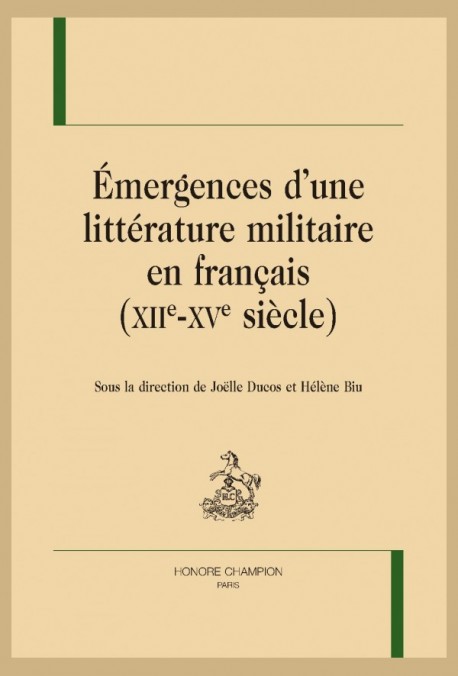
Publication – « Émergences d’une littérature militaire en français (XIIe-XVe siècle) », dir. Joëlle Ducos et Hélène Biu

Combats et batailles sont au Moyen Âge des lieux obligés dans les chansons de geste, les romans et chroniques, car ils contribuent à une glorification des héros et de leurs exploits. Mais la littérature qui décrit une science de la guerre n’est véritablement écrite en français qu’à la fin du Moyen Âge, dans des traités ou d’autres formes et témoigne de la lente structuration d’une culture militaire du monde laïque. Ce livre, par des contributions de philologues, d’historiens et de littéraires, montre comment s’élaborent écrits et savoirs sur la guerre à la fois au contact des sources antiques transmises, lues et traduites par des clercs et de l’expérience d’hommes de guerre devenus écrivains, dans des écrits où se mêlent traditions, autorités et pratiques et par quels jalons naît une littérature militaire en français.

Table des matières : ici

Hélène Biu, archiviste-paléographe et maîtresse de conférences à Sorbonne Université, mène des travaux sur les textes didactiques et juridiques en Moyen Français et a notamment effectué une thèse sur l’Arbre des Batailles d’Honorat Bouvet.

Joëlle Ducos, professeure à Sorbonne Université et directrice d’études à l’École Pratique des Hautes Études, mène des recherches sur la vulgarisation des savoirs en français au Moyen Âge.

Informations pratiques :

Émergences d’une littérature militaire en français (XIIe-XVe siècle), dir. Joëlle Ducos et Hélène Biu, Paris, Honoré Champion, 2022 ; 1 vol., 392 p. (Bibliothèque du XVe siècle, 90). ISBN : 978-2-74535-820-2. Prix : € 65,00.

Source : Honoré Champion

Publié dans Publications | Laisser un commentaire

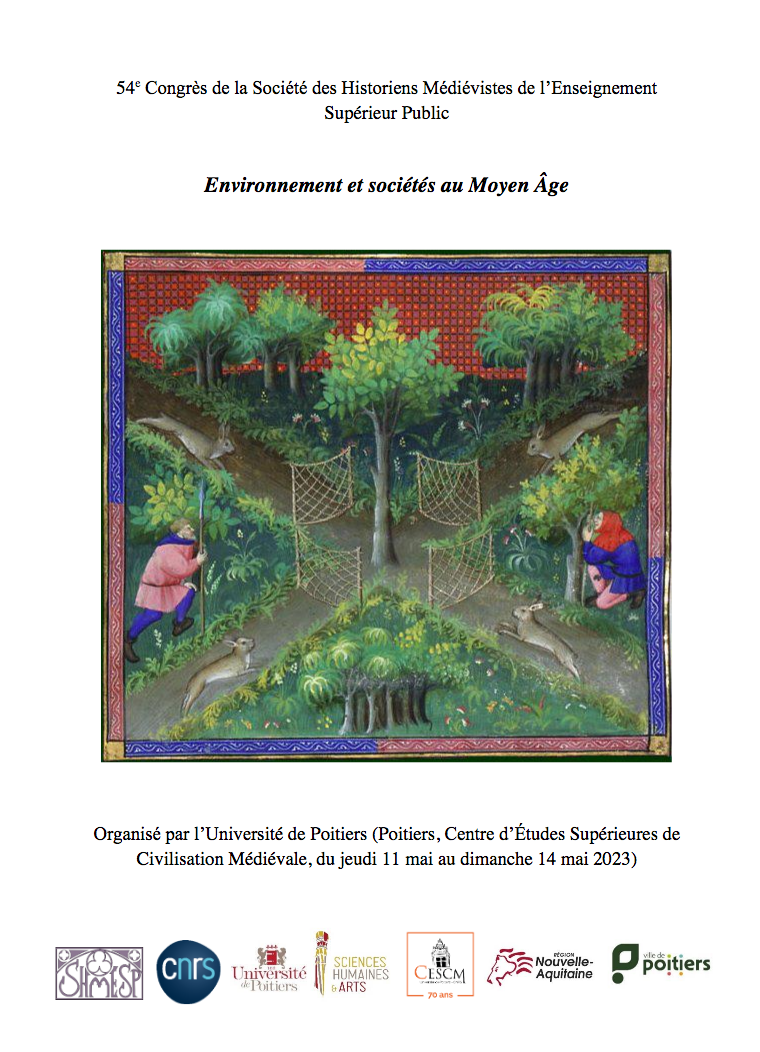
Colloque – Environnement et sociétés au Moyen Âge. 54e Congrès de la Société des historiens médiévistes de l’enseignement supérieur public

Le 54e Congrès de la Société des historiens médiévistes de l’enseignement supérieur public se tiendra au CESCM à Poitiers, du 11 au 14 mai 2023 sur le thème « Environnement et sociétés au Moyen Âge ».

Sur inscription uniquement, à renvoyer avant le 5 mars 2023, en priorité par mail à tresorier@shmesp.fr, ou par courrier à :
Alexis CHARANSONNET
2, rue des Olivettes
92220 Bagneux

Programme et résumé des communications : ici

Voir bulletin d’inscription : inscription Poitiers 2023_défHD

Prise de conscience des dérèglements climatiques, menace de crises écologiques majeures, débat sur le concept d’Anthropocène ont donné ces dernières décennies une dimension nouvelle à l’intérêt déjà bien établi des sciences humaines et sociales pour l’étude des relations entre l’homme et son environnement. C’est ce champ de recherche transdisciplinaire et dynamique que la SHMESP entend investir pour son 54e congrès dédié aux rapports entre Environnement et sociétés au Moyen Âge,  dans les espaces occidentaux, byzantins et arabo–musulmans, aussi bien que nordiques et slaves non chrétiens.

Les communications sont organisées en cinq demi-journées, du jeudi après-midi au samedi après-midi. Les sessions proposées visent à aborder le thème sous des angles variés, allant de l’approche culturelle (représentations de l’environnement) à l’analyse écologique (modalités environnementales des crises et phénomènes naturels), en passant par les pratiques sociales qui établissent le rapport entre l’homme et le milieu, et ce aussi bien en Occident qu’en Orient.

 Le dimanche, l’excursion mènera les congressistes dans des lieux majeurs du haut Moyen Âge et de l’art roman : la nécropole mérovingienne de Civaux, la cité médiévale de Chauvigny (collégiale Saint-Pierre et châteaux) et en point d’orgue, l’abbatiale de Saint-Savin-sur-Gartempe, inscrite au patrimoine mondial de l’Unesco pour ses peintures romanes. De la vallée de la Vienne à celle de la Gartempe, le trajet en car permettra également de découvrir des paysages qui, au Moyen Âge, ont été profondément modifiés par les aménagements humains.

Source : CESCM

Publié dans Colloque | Laisser un commentaire

Offre d’emploi – 1 doctoraatsonderzoeker (m/v/x) : “A Pragmatic Reality: The Performance and Codification of Collective Agency in the ‘Age of Freedom’ of Urban Communities in the Southern Low Countries and Northern France (late 11th – early 13th Centuries)”

Universiteit Gent – Vakgroep Geschiedenis werft aan:
1 doctoraatsonderzoeker (m/v/x) voor het FWO Senior Onderzoeksproject

A Pragmatic Reality: The Performance and Codification of Collective Agency in the ‘Age of Freedom’ of Urban Communities in the Southern Low Countries and Northern France (late 11th – early 13th Centuries)

BESCHRIJVING VAN HET PROJECT EN VAN DE TE BEGEVEN FUNCTIE

Het onderzoek naar de vroege ontwikkeling van stedelijke gemeenschappen in West-Europa is lang bepaald door een politiek-institutionele benadering van de vrijheden, wetten en gewoonten die deze gemeenschappen van hun heren ontvingen in zgn. ‘keures’. Deze eenzijdige benadering heeft geleid tot een gebrekkige kennis over de pragmatische context waarin deze rechten werden onderhandeld en neergeschreven, over de socio-economische omstandigheden die de acties van de betrokken sociale groepen bepaalden en over hoe juridische concepten geënt waren op ideeën rond rechtssystemen.

Dit project stelt een interregionale vergelijkende studie voor van een 150-tal typologisch variërende vrijheidscharters toegekend aan steden en communes in de Zuidelijke Nederlanden en Noord-Frankrijk tijdens de pioniersfase van hun ontwikkeling. De methodologie bestaat uit drie benaderingen die vanuit een antropologisch perspectief verbanden zullen onderzoeken tussen mensen, documenten en contexten:

1) een pragmatischdocumentaire analyse, met als doel de context waarin wetten en vrijheden werden opgetekend te reconstrueren tijdens de experimentele fase van pragmatische geletterdheid en document-gebaseerd bestuur;
2) een politieksocio-economische analyse, met de intentie de ‘collectiviteit’ van vroegstedelijke gemeenschappen te doorgronden;

3) een rechtshistorische analyse, waarin vrijheidscharters worden beschouwd als de consolidatie van rechtsprincipes in de machtsstrijd tussen heersers en onderdanen.

Het onderzoek wordt deels op zelfstandige basis en deels in samenwerking met de projectleiders gevoerd, en zal leiden tot meerdere (co-)publicaties. Daarnaast wordt de doctoraatsonderzoeker verwacht de onderzoeksresultaten te presenteren tijdens wetenschappelijke bijeenkomsten in binnen- en buitenland.

Het project wordt geleid vanuit de Universiteit Gent (Els De Paermentier en Jan Dumolyn, Vakgroep Geschiedenis en Dirk Heirbaut, Vakgroep Metajuridica, Privaat- en Ondernemingsrecht) in samenwerking met de Vrije Universiteit Brussel (Georges Declercq en Bart Lambert, Vakgroep Geschiedenis). De standplaats van de doctoraatsonderzoeker is de Universiteit Gent (Sint- Pietersnieuwstraat 35, Gent).

FUNCTIEOMSCHRIJVING

Het gaat om een voltijdse onderzoekspositie van vier jaar (één jaar, verlengbaar met drie jaar na een positieve tussentijdse evaluatie) die gefinancierd wordt door het Fonds Wetenschappelijk Onderzoek (FWO) Vlaanderen. De precieze datum van indiensttreding wordt in onderling overleg met de gekozen kandidaat bepaald en zal uiterlijk op 1 oktober 2023 ingaan. De onderzoeker zal de mogelijkheid hebben om deel te nemen aan (inter)nationale wetenschappelijke bijeenkomsten en zal nauwe contacten onderhouden met de collega’s van het Henri Pirenne Instituut voor Middeleeuwse Studies (UGent), de HOST onderzoeksgroep voor Stadsgeschiedenis (VUB) en het Instituut voor Rechtsgeschiedenis (UGent).

PROFIEL

– Je bent houder van een diploma van Master in de Geschiedenis en hebt een uitgesproken interesse in middeleeuwse stadsgeschiedenis, sociaal-politieke en rechtsgeschiedenis.

– Je hebt aantoonbare ervaring in het werken met originele documentaire (administratief- bestuurlijke) middeleeuwse bronnen. Kennis van de hulpwetenschappen diplomatiek en paleografie strekt daarbij tot aanbeveling.

– Je beschikt over voldoende kennis van het Latijn en bent bereid deze tijdens de duurtijd van het project bij te schaven.

– Je kan zowel zelfstandig als in team werken, je werkt nauwkeurig en planmatig en beschikt over een kritische geest.

– Je beschikt over goede mondelinge en schriftelijke communicatievaardigheden in zowel het Nederlands, het Engels als het Frans.

HOE TE SOLLICITEREN

– Solliciteer uiterlijk op vrijdag 31 maart via e-mail naar els.depaermentier@ugent.be met de volgende documenten (aan te leveren in pdf):

• Motivatiebrief
• Curriculum vitae • Masterscriptie

De kandidaten zullen kort na het verstrijken van de deadline op de hoogte worden gebracht van de uitslag van de eerste selectieronde. De interviews voor de tweede selectieronde zullen plaatsvinden in de week van 24-28 april 2023.

Wie meer informatie wenst kan zich wenden tot Els De Paermentier (els.depaermentier@ugent.be).

Source : Vlaamse Werkgroep Mediëvistiek

Publié dans Offre d'emploi | Laisser un commentaire

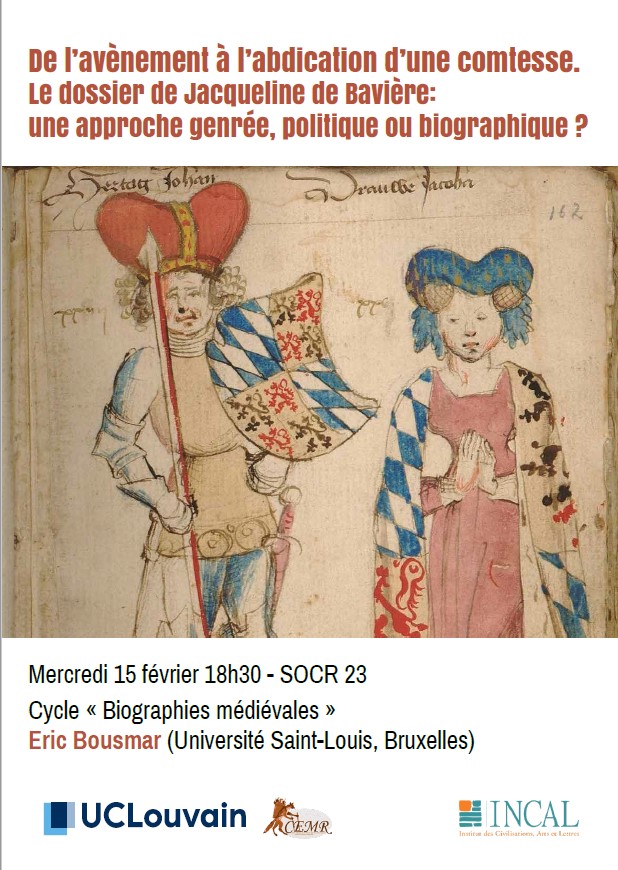
Conférence – Éric Bousmar, « De l’avènement à l’abdication d’une comtesse. Le dossier de Jacqueline de Bavière: une approche genrée, politique ou biographique ? »

Jacqueline Bavière a-t-elle réellement révolutionné les couleurs du jeu d’échecs? Avait-elle réellement un lion rouge et un autre noir comme animaux de compagnie? Autant de questions auxquelles répondra (peut-être) Eric Bousmar lors de la prochaine séance du cycle « Biographies médiévales », intitulée « De l’avènement à l’abdication d’une comtesse. Le dossier de Jacqueline de Bavière:
une approche genrée, politique ou biographique ? ».

Informations pratiques :

Eric Bousmar (Université Saint-Louis – Bruxelles)
Cycle « Biographies médiévales »
UCLouvain (Louvain-la-Neuve) – SOCR 23
15 février, 18h30

Publié dans Colloque | Laisser un commentaire