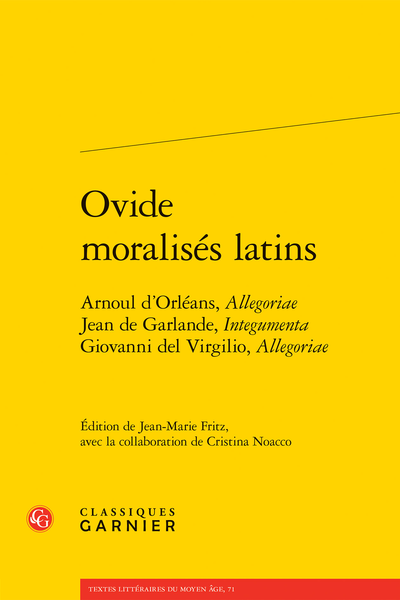
Publication – « Ovide moralisés latins. Arnoul d’Orléans, Allegoriae Jean de Garlande, Integumenta Giovanni del Virgilio, Allegoriae », éd. Jean-Marie Fritz

Ce volume propose une nouvelle édition et la première traduction de trois commentaires allégoriques des Métamorphoses : Allegoriae en prose d’Arnoul d’Orléans (Orléans, v. 1170), Integumenta en vers de Jean de Garlande (Paris, v. 1225) et Allegoriae, prosimètre de Giovanni del Virgilio (Bologne, 1323).

Table des matières : ici

Informations pratiques :

Ovide moralisés latins. Arnoul d’Orléans, Allegoriae Jean de Garlande, Integumenta Giovanni del Virgilio, Allegoriae, éd. Jean-Marie Fritz, Paris, Classiques Garnier, 2022 ; 1 vol., 606 p. (Textes littéraires du Moyen Âge, 71 ; Ovidiana textes, 4). ISBN : 978-2-406-13292-9. Prix : € 59,00.

Source : Classiques Garnier

Publié dans Publications | Laisser un commentaire

Offre d’emploi – A. W. Mellon Junior Faculty Fellowship in Medieval Studies

A. W. Mellon Junior Faculty Fellowship in Medieval Studies at the University of Notre Dame’s Medieval Institute

Application Deadline: February 1, 2023

The Medieval Institute at the University of Notre Dame invites applicants for a one-year Mellon Postdoctoral Fellowship in Medieval Studies. This Fellowship is designed for junior faculty who currently hold a position in a North American university as an assistant professor. It is open to qualified applicants in all fields of Medieval Studies. The fellowship holder will pursue research in residence at Notre Dame’s famed Medieval Institute during the academic year (this is a nine-month position).

The intent of this Fellowship is to enable its holders to complete research and writing on a book manuscript in advance of tenure. The Fellowship carries no teaching responsibilities, but holders are expected to participate in the multidisciplinary intellectual life of the Institute and to reside in South Bend. The Fellow will be provided with a private carrel in the Medieval Institute, enjoy full library and computer privileges, and have access to all the Institute’s research tools.

In addition, towards the conclusion of their residency the Fellow’s work will be at the center of a half-day conference. Three senior scholars, chosen in cooperation with the Medieval Institute, will be invited to campus for a half-day public seminar treating the subject matter of the Fellow’s research. The senior scholars will also read and discuss a draft version of the Fellow’s work in an extended private session, a one-to-one conversation following a close reading of the draft, with a view to improving the manuscript before its submission to a press.

Eligibility: Applicants must hold a tenure-track appointment at a U.S. institution, obviously with a completed Ph.D., and should not be more than six years beyond receiving their Ph.D. at the time of application.

Stipend: $50,000 (paid directly to Fellow’s home institution).

Start Date: approximately August 22, 2023 | End Date: approximately May 11, 2024

Application procedure: Applicants should submit a letter of application (cover letter), a project proposal of no more than 2500 words, a current C.V., and three confidential letters of recommendation. Submit applications via Interfolio via https://dossier.interfolio.com/apply/116913. Further details regarding materials are available at https://medieval.nd.edu/research/grants-fellowships/#Mellon-fellowship.

Source : The Medieval Academy Blog

Publié dans Offre d'emploi | Laisser un commentaire

Offre d’emploi – Ingénieur en traitement et analyses de données (H/F)

Référence : UPR841-ANDBIN-002 Lieu de travail : AUBERVILLIERS Date de publication : vendredi 2 décembre 2022 Type de contrat : CDD Technique/Administratif Durée du contrat : 12 mois Date d’embauche prévue : 1 mars 2023Quotité de travail : Temps complet Rémunération : entre 2280 et 2898 euros bruts mensuels selon expérience Niveau d’études souhaité : Bac+5 Expérience souhaitée : Indifférent

Missions

– Développer un référentiel pour les manuscrits de l’Orient chrétien et byzantin- Mettre en œuvre l’interopérabilité entre les bases de l’équipe de recherche et au sein d’un réseau de partenaires national et international

Activités

1/ Assister les responsables dans le développement et le suivi technique des bases de données :- Concevoir des adaptations fonctionnelles et techniques nécessaires à l’évolution des bases de données – Participer à la rédaction de cahiers des charges- Suivre les phases de développement et de mises à jour des bases de données et de leurs applications, en coordination avec les techniciens et développeurs- Assurer une veille technique sur les nouveaux outils, nouveaux langages, nouveaux processus disponibles dans le domaine des humanités numériques2/ Activité 2 : Développer l’interopérabilité afin d’aboutir à un référentiel pour le domaine des textes et manuscrits de l’Orient méditerranéen (en particulier grec, syriaque et arabe) :- Réaliser un état des lieux des référentiels (en particulier personnes et cotes) des bases de l’équipe (Pinakes, RIMG, mss.catalog, e-ktobe) et d’autres partenaires (réseau Biblissima+, réseau Diktyon, réseau Syriaca, etc.), ainsi que de l’interopérabilité existante- Mettre en place (ou améliorer lorsqu’elle existe) l’interopérabilité entre les bases de l’équipe et avec les autres partenaires- Coordonner et mettre en œuvre l’alignement pérenne des données et des listes d’autorités3/ Activité 3 : Collaborer à la révision et à la saisie dans les bases des données- Dépouiller et traiter de l’information scientifique (catalogues, publications, fichiers, manuscrits) – Saisir les données résultantes dans une ou plusieurs bases de données de l’équipe- Participer à la formation des vacataires ou stagiaires travaillant sur les bases de données4/ Activité 4 : Participer à la coordination et au pilotage de projets incluant des partenaires à l’international (mise en réseau, interopérabilité, humanités numériques)- Participer à la coordination avec les réseaux internationaux auxquels les bases de données sont liées (rédaction de courriers, organisation de réunions, etc.)- Participer au développement des réseaux auxquels sont intégrées les bases de l’équipe et à leur élargissement (identification de nouveaux partenaires, prise de contacts, présentation des projets dans des manifestations scientifiques, etc.)- Participer à l’élaboration des demandes de financements nécessaires au développement ou à l’alimentation des différentes bases de données, et au développement des réseaux- Participer à la formation des partenaires internationaux aux outils d’interopérabilité mis en place

Compétences

Publié dans Offre d'emploi | Laisser un commentaire

Offre d’emploi – Assistant Professor of Medieval History (1,0 FTE) (University of Leiden)

Faculty of Humanities, Institute of History is looking for a: Assistant Professor of Medieval History (1,0 FTE) Vacancy number: 22-783 13213

Start date 1 August 2023

Work

  • Developing and providing education in the field of medieval history in both Dutch and English.
  • The willingness to participate in the first-year overview course of Ancient History.
  • Co-organizing the education within the section Medieval History.
  • Conducting research in the field of medieval history.
  • Participating in the research programme of the specialisation ‘Europe 1000-1800’ of the History Research Institute.
  • Performing tasks in the field of governance and management.
  • Active recruitment of research and/or teaching grants at national and international institutions.
  • Sharing research results outside the academic world

Selection criteria

  • You are a driven teacher with demonstrable didactic qualities (preferably evident from recent educational evaluations), and experience in providing university education at different levels (BA and MA).
  • You have been promoted on a topic from medieval history, followed by publications in this field in accordance with this moment in your career. Your follow-up research is in line with the research group’Europe, 1000-1800′.
  • You have the ability to acquire research and teaching grants.
  • You have affinity with and capacity for teamwork and collegiality in an intercultural work environment.
  • You are willing and able to attend the Institute of History in person very frequently.
  • With a view to education in the BA and MA phase, you will speak both English and Dutch. If you do not yet speak Dutch, you are expected to learn it within two years. The institute has resources available to follow Dutch lessons.

Upon appointment, if you do not yet have a Basic Teaching Qualification (BKO) or have the equivalent thereof, you must be prepared to obtain it within two years.

About our organisation

Leiden University has built up an international reputation in the field of excellent teaching and research since its foundation in 1575. With over 800 employees

the Faculty of Humanities provides 26 bachelor’s and 27 master’s programmes for more than 7200 students at locations in the historic city centre of Leiden and in The Hague.

The Institute of History is home to a vibrant community of researchers and faculty. All researchers of the Institute of History are affiliated with one of the six research specialisations: The Unification of the Mediterranean World (400 BC – 400 AD), Collective Identities and Transnational Networks in Medieval and Early Modern Europe, 1000-1800, Political Culture and National Identities, Colonia land Global History, Cities, Migration and Global Interdependence and History and International Studies. More information can be found on our website: https://www.universiteitleiden.nl/en/humanities/institute-for-history.

Diversity and Inclusion

The Institute of History of Leiden University attaches great importance to diversity and is looking for candidates who contribute to a working environment in which students and staff of all identities and backgrounds feel supported. We strongly encourage individuals with underrepresented and/or marginalized backgrounds to apply.

We offer

Appointment (1.0 fte) takes place in accordance with the Collective Labour Agreement for Dutch Universities, initially for the duration of one and a half years (1 August 2023 to 31 January 2025) with the prospect of a permanent employment after positive evaluation. The position corresponds to the position of Assistant Professor in the University System of Job Profiles (UFO). The salary is, depending on education and work experience, a minimum of €3557 (scale 10-4) to a maximum of €6181 (scale 12).

In addition, Leiden University has good employment conditions. For example, there is an end-of-year bonus (8.3%), holiday allowance (8%), excellent training facilities, paid parental leave and the possibility to choose tailor-made employment conditions via a choice model. We have set up a dual career programme for international spouses. Candidates from outside the Netherlands may be eligible for a significant tax benefit. More on https://www.universiteitleiden.nl/en/working-at/job-application-procedure-and-employment-conditions.

Information For more information about this position, please contact Prof. Philippe Buc (p.buc@hum.leidenuniv.nl)

Applications Applications, in English or Dutch, can be submitted via the blue button in our application system. Applications can be submitted, stating the vacancy number, as a single PDF file with your last name/medieval history as the file name.

Your application must consist of:

  • a motivation letter
  • a curriculum vitae (education and employment history, publications, language skills, invited lectures and presentations, and courses given)
  • a statement of research (max. 1000 words)
  • two publications
  • an example of a lecture description for a working group of 2nd-year students
  • name, position and contact details of two referees (letters are not required at this stage)

The deadline for applications is 20 January 2023. The interviews will take place (online or on campus) in week 8.

Source : Jobs.ac.uk

Publié dans Offre d'emploi | Laisser un commentaire

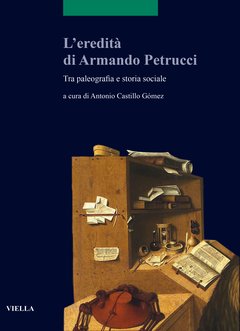
Publication – « L’eredità di Armando Petrucci. Tra paleografia e storia sociale (con un inedito di Armando Petrucci) », éd. Antonio Castillo Gómez

Armando Petrucci (1932-2018) è stato un grande paleografo e uno storico della scrittura di fama internazionale, il cui apporto alle relative discipline, per lui strettamente legate se non coincidenti, ha rappresentato un’autentica rivoluzione. Questo volume raccoglie una serie di saggi scritti da studiosi di diverse generazioni e nazionalità che si riconoscono nel suo insegnamento. Essi analizzano il suo metodo di lavoro, che partiva dal principio di studiare le testimonianze scritte a prescindere da epoca, modalità e materiali. Documenti pubblici, lettere private, iscrizioni di apparato, graffiti murali: nessuna manifestazione scritta gli è stata estranea e a ciascuna ha rivolto sei ben note domande (che cosa, quando, dove, come, chi, perché).

In appendice un testo inedito in cui Petrucci illustra la cultura grafica degli artisti italiani del Rinascimento.

Table des matières :

Antonio Castillo Gómez, Presentazione

1. La fabbrica dell’erudizione

Attilio Bartoli Langeli, La paleografia dopo Armando Petrucci. Ricordando un maestro

Francisco M. Gimeno Blay, Armando Petrucci: el maestro de la doble mirada

Marco Palma, La descrizione del manoscritto secondo Armando Petrucci

Roger Chartier, Paléographie et histoire de la culture écrite

2. Cultura grafica e filologia

Maddalena Signorini, Armando Petrucci e gli studi sul volgare

Vittorio Formentin, Com’è stata scritta la letteratura italiana. Per un libro di Armando Petrucci

Antonio Ciaralli, Cultura grafica e filologia: categorie e forme dell’eredità intellettuale di Armando Petrucci negli studi sulla tradizione letteraria italiana

Raul Mordenti, Armando Petrucci: il modello etico-politico di un professore del tutto diverso

3. Cultura scritta e società

Antonio Castillo Gómez, En los márgenes del archivo: Armando Petrucci y la cultura escrita de las clases subalternas

Charles M. Radding, La categoria petrucciana di “inesperienza grafica” nei manoscritti legali del pieno medioevo. Una prospettiva storica

Verónica Sierra Blas, Scrivere e no … cartas. ¿Una práctica de escritura en extinción?

4. Appendice. Un inedito

Armando Petrucci, Scrittura e cultura negli artisti del Rinascimento italiano (con Introduzione e Note di Luisa Miglio)

Indice dei nomi

Indice dei luoghi

Indice delle testimonianze manoscritte

Informations pratiques :

L’eredità di Armando Petrucci. Tra paleografia e storia sociale (con un inedito di Armando Petrucci), éd. Antonio Castillo Gómez, Rome, Viella, 2022 ; 1 vol., 274 p. (Scritture e libri del medioevo, 22). ISBN : 978-8-83313-720-9. prix : € 29,00.

Source : Viella

Publié dans Publications | Laisser un commentaire

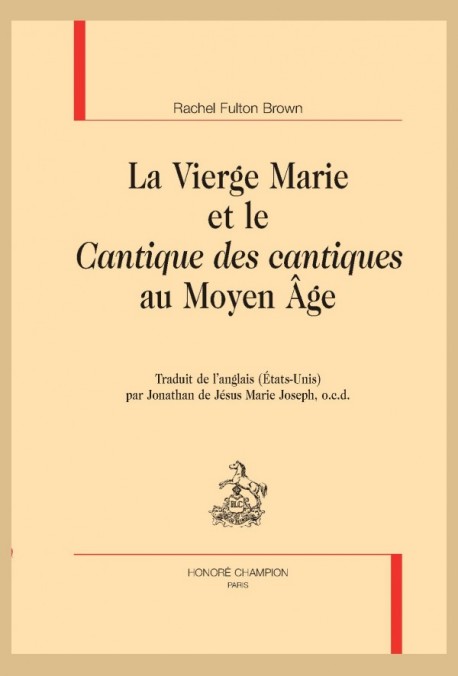
Publication – Rachel Fulton-Brown, « La Vierge Marie et le Cantique des cantiques au Moyen Âge », trad. Jonathan de Jésus Marie Joseph, o.c.d.

Livre abondamment commenté par les Pères, le Cantique des cantiques, magnifique poème d’amour contenu dans le canon biblique, a tôt fait l’objet d’interprétations mystiques. L’une d’entre elles reste peu étudiée, qui trouve son origine dans la liturgie : l’application du Cantique à la Vierge. Elle fait l’objet du présent volume, des sermons carolingiens jusqu’aux commentaires marials de la fin du Moyen Âge, avec une insistance particulière sur les XIIe et XIIIe siècles. L’ouvrage – The Virgin Mary and the Song of Songs in the High Middle Ages, thèse de l’Université Columbia (1994) restée inédite jusqu’à la présente publication – est complété de la traduction d’études auxquelles il se réfère (Alfonso Rivera, Johannes Beumer, E. Ann Matter, Ann W. Astell), toutes inédites en français et certaines devenues peu accessibles. L’ensemble constitue une somme sans équivalent sur le Cantique marial et un apport conséquent à la connaissance de la mariologie médiévale. À la croisée de l’exégèse et la théologie, l’histoire et l’ecclésiologie, ses thèmes (Marie « épouse » du Christ, Marie « cou » entre le Christ-Tête et l’Église-Corps, etc.) sont parmi les plus riches illustrations du mystère de la « compénétration » entre Marie et l’Église.

Associate Professor à l’Université de Chicago, Rachel Fulton Brown est l’auteure de deux livres devenus classiques, sur la dévotion médiévale au Christ crucifié et à la Vierge Marie (From Judgment to Passion, Colombia University Press, 2002 ; Mary and the Art of Prayer, ibid., 2017). Traduit de l’anglais (États-Unis) par le frère Jonathan (Kocan) de Jésus Marie Joseph, carme déchaux au couvent de Toulouse.

Table des matières : ici

Informations pratiques :

Rachel Fulton-Brown, La Vierge Marie et le Cantique des cantiques au Moyen Âge, trad. Jonathan de Jésus Marie Joseph, o.c.d., Paris, Honoré Champion, 2022 ; 1 vol., 728 p. (Mystica, 18). ISBN : 978-2-74535-816-5. Prix : € 100,00.

Source : Honoré Champion

Publié dans Publications | Laisser un commentaire

Appel à contribution – Patristic Sermons in the Middle Ages

Rome, 17-20 October 2023

THE CONFERENCE

On 17-20 October 2023, the ERC-funded project PASSIM (Patristic Sermons in the Middle Ages), based at Radboud University Nijmegen, will organise an international conference on the medieval reception and transmission of patristic sermons and the collections in which they are compiled. The conference will take place at the Royal Netherlands Institute in Rome (KNIR).

The sermons preached by the Latin Church Fathers – Augustine, Leo, Gregory, and their contemporaries – had a dynamic afterlife. Throughout the medieval period, they were widely copied, manipulated, and (re)organised in a wide array of collections. These processes of transmission are important not only because they reveal medieval attitudes to the patristic heritage, but also because the medieval mediation of this corpus has greatly impacted which sermons survived and in what shape they reached modern times. When, why and how were patristic sermons combined, (re)organised, and adapted to their medieval contexts?

The conference aims to give due attention to the mediators in the transmission of patristic sermons in the middle ages: the often-inconspicuous compilers and scribes whose creative intellectual activities formed crucial conduits for the transmission of late-antique sermons to new audiences. We intend to go beyond the reconstruction of the original form and context of individual sermons, and to focus mainly on medieval collections and manuscripts in their own right, as well as the practices of compilation that shaped them.

MAIN PERSPECTIVES

To understand the compiler’s work, we need insights into both the philological aspects of sermons and sermon collections – their texts, sources and organisation – and the compilers’ and manuscripts’ historical context. As such, the conference aims to bring together philological, historical, theological, and literary perspectives.

We encourage speakers to combine multiple perspectives in their presentations. In addition, we aim to include papers that examine the processes of compilation in specific manuscripts or sermon collections, as well as studies that reflect on (digital) tools and methodologies to understand how sermon compilation worked in practice. While we mainly concentrate on Latin sermons, we are also interested in comparative studies of compilation practices in other traditions.

We welcome proposals on a wide range of topics, including (but not limited to) the following:

  • –  Individual manuscripts and collections
    • individual manuscripts and sermon collections, their content, context, and materiality
    • the origins, organisation and evolution of late-antique sermon collections
    • points of contact and connections between sermon collections
  • –  Understanding the compiler
    • the compiler and his motives, resources, and context
    • tangible evidence of mediators (e.g. prologues, annotations, user marks)
    • the tools and support structures for compilation (e.g. libraries, catalogues, networks)
  • –  Practices of sermon compilation
    • authorial attribution and anonymity in sermon collections
    • collections that illustrate how the medieval and the patristic meet
    • comparative perspectives in other languages, genres or religious traditions
  • –  Approaches to the study of compilations
    • sermon collections and the tradition of textual criticism of patristic sermons
    • methodologies to chart and analyse compilation practices
    • digital tools and approaches to the study of sermon compilations CONFIRMED SPEAKERS Emanuela Colombi; Moshe Lavee; Rosamond McKitterick; Clemens Weidmann PRACTICALITIES The conference will take place at the Royal Netherlands Institute in Rome (KNIR). We aim to cover the expenses in terms of accommodation and meals for the speakers. More practical information will follow upon acceptance. The conference will include a publicly accessible keynote lecture on Tuesday 17 October 2023 as well as an (optional) hands-on workshop to explore the PASSIM research tool and database. It is our intention to publish the proceedings of the conference afterwards. Interested scholars are requested to send in an abstract (max. 300 words) and a short CV (max. 1 page) to iris.denis@ru.nl. Deadline for submissions is 15 January 2023; acceptance will be communicated within six weeks of the deadline. Early career researchers are particularly encouraged to apply.

      CONTACT Please do not hesitate to contact us (via iris.denis@ru.nl) for any further information.

      ORGANISING COMMITTEE
      Dr. Shari Boodts (PI, Radboud University Nijmegen)
      Dr. Riccardo Macchioro (Università degli Studi di Milano)
      Dr. Gleb Schmidt (Radboud University Nijmegen)
      Iris Denis MA (Radboud University Nijmegen)
      Elisa Furlan MA (Università degli Studi di Padova)

      Source : IRHT
Publié dans Appel à contributions | Laisser un commentaire

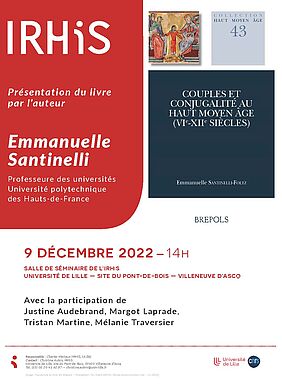
Conférence – Présentation du livre « Couples et conjugalité au Haut Moyen Âge (VIe-XIIe siècles) »

Vendredi 9 décembre 2022, 14h
salle de séminaire de l’IRHiS, Université de Lille, Campus du Pont-de-Bois, Villeneuve d’Ascq

Présentation du livre Couples et conjugalité au Haut Moyen Âge (VIe-XIIe siècles) par l’auteur, Emmanuelle Santinelli

Avec la participation de Justine Audebrand, Margot Laprade, Tristan Martine, Mélanie Traversier.

Source: IRHiS

Publié dans Publications | Laisser un commentaire

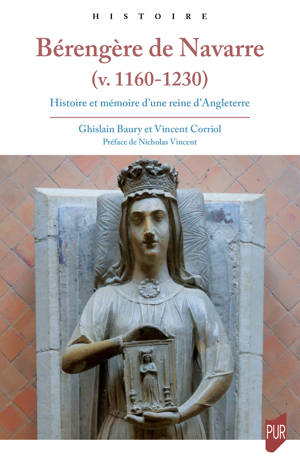
Publication – « Bérengère de Navarre (v. 1160-1230). Histoire et mémoire d’une reine d’Angleterre », dir. Ghislain Baury et Vincent Corriol

La vie de la reine Bérengère de Navarre possède quelque chose de romanesque : princesse hispanique, aînée de l’une des dynasties les plus modestes de la péninsule, elle devient l’épouse de l’un des souverains les plus célèbres d’Angleterre. Les épisodes d’une trajectoire hors norme, depuis la rencontre avec Richard à Messine, le mariage à Limassol suivi de son couronnement, enfin le séjour en Orient jusqu’à son retour en Europe, marqué par la longue captivité du roi, constituent autant de péripéties qui ont fasciné les contemporains, puis, après eux, historiens, artistes et hommes de lettres jusqu’à aujourd’hui.

La mort du roi Richard la place dans la situation d’isolement dévolue aux reines veuves et sans héritier, dont le retrait au couvent constitue souvent le seul horizon. Elle choisit cependant de se démarquer en élisant une vie active, assumant le gouvernement et l’administration de la ville du Mans et de ses environs.

Bérengère n’a ainsi pas connu l’effacement dans l’anonymat que connaissent nombre de personnages féminins de cette époque. Tout autant que les étapes de sa vie, les étapes de la construction mémorielle du souvenir de la souveraine constituent un objet d’attention, d’abord parce que Bérengère s’est attachée elle-même à construire et organiser la perpétuation de sa mémoire, au moyen du monument mémoriel que constitue l’abbaye de l’Épau. Si elle n’est pas la seule reine à fonder un couvent destiné à abriter sa sépulture, son geste demeure atypique puisque la fondation n’est dédiée qu’à elle-même. Le gisant qu’abrite l’abbaye est devenu le catalyseur d’une mémoire plurielle, bien vivante aujourd’hui, tant au Mans qu’en Navarre, à Chypre ou en Angleterre.

Table des matières : ici

avec le soutien du Conseil départemental de la Sarthe et de Le Mans Université

Ghislain Baury est professeur agrégé en histoire médiévale à l’université du Mans et membre du laboratoire TEMOS (UMR CNRS 9016).

Vincent Corriol est maître de conférences en histoire du Moyen Âge à l’université du Mans et membre du laboratoire TEMOS (UMR CNRS 9016).

Informations pratiques :

Bérengère de Navarre (v. 1160-1230). Histoire et mémoire d’une reine d’Angleterre, dir. Ghislain Baury et Vincent Corriol, Rennes, Presses universitaires de Rennes, 2022 ; 1 vol., 368 p. (Histoire). ISBN ; 9782753591936. Prix : € 25,00.

Source : Presses universitaires de Rennes

Publié dans Publications | Laisser un commentaire

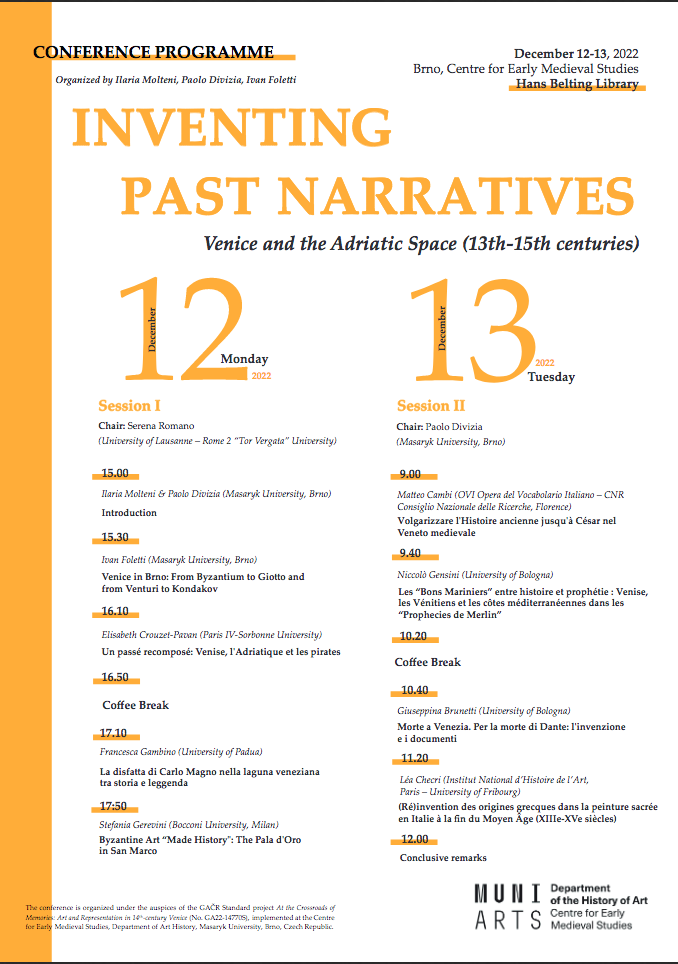
Journée d’étude – Inventing Past Narratives. Venice and the Adriatic Space (13th-15th centuries)

This conference aims to explore the dialogue between Venice and the Adriatic area from a specific perspective: the construction of the past. We would like to create a dialogue between specialists from various disciplines and also examine the validity of interdisciplinary approaches at the intersection of different cultural fields: textual and visual, material, and historiographic. The chronological and geographical perspective chosen covers the late Middle Ages and the early modern age and focuses on the interaction between Venice and other centres in the Adriatic space. This will indeed enable us to describe how the past is used to explore the mechanism of memory and recognition through which, when looking at artifacts or reading texts staging Venetian past, beholders are reminded of the shared values this past embodies.

Programme :

Brno, Centre for Early Medieval Studies, Hans Belting Library

Monday, December 12, 2022

Session I

Chair: Serena Romano (University of Lausanne – Rome 2 “Tor Vergata” University)

  • 15.00 Ilaria Molteni & Paolo Divizia (Masaryk University, Brno) Introduction
  • 15.30 Ivan Foletti (Masaryk University, Brno) Venice in Brno: From Byzantium to Giotto and from Venturi to Kondakov
  • 16.10 Elisabeth Crouzet-Pavan (Paris IV-Sorbonne University) Un passé recomposé: Venise, l’Adriatique et les pirates

16.50 Coffee Break

  • 17.10 Francesca Gambino (University of Padua) La disfatta di Carlo Magno nella laguna veneziana tra storia e leggenda
  • 17.50  Stefania Gerevini (Bocconi University, Milan) Byzantine Art “Made History »: The Pala d’Oro in San Marco

Tuesday, December 13, 2022

Session II

Chair: Paolo Divizia (Masaryk University, Brno)

  • 9.00 Matteo Cambi (OVI Opera del Vocabolario Italiano – CNR Consiglio Nazionale delle Ricerche, Florence) Volgarizzare l’Histoire ancienne jusqu’à César nel Veneto medievale
  • 9.40 Niccolò Gensini (University of Bologna) Les Bons Mariniers entre histoire et prophétie : Venise, les Vénitiens et les côtes méditerranéennes dans les Prophecies de Merlin

10.20 Coffee Break

  • 10.40 Giuseppina Brunetti (University of Bologna) Morte a Venezia. Per la morte di Dante: l’invenzione e i documenti
  • 11.20 Léa Checri (Institut National d’Histoire de l’Art, Paris – University of Fribourg) (Ré)invention des origines grecques dans la peinture sacrée en Italie à la fin du Moyen Âge (XIIIe-XVe siècles)
  • 12.00 Conclusive remarks

Informations pratiques :

Brno, Centre for Early Medieval Studies, Hans Belting Library

12-13 Décembre 2022

The conference is organized under the auspices of the GAČR Standard project At the Crossroads of Memories: Art and Representation in 14th-century Venice (No. GA22-14770S), implemented at the Centre for Early Medieval Studies, Department of Art History, Masaryk University, Brno, Czech Republic.

Source : Calenda

Publié dans Colloque | Laisser un commentaire