Offre d’emploi – PhD Studentship: The Archaeology, History & Heritage of Sherborne Abbey. Department of Archaeology & History.

University of Exeter
Faculty of Humanities, Arts and Social Sciences
Closes: 12th December 2022

Applications are invited for a fully-funded PhD studentship, beginning in January 2023, to work with the University of Exeter and Sherborne Abbey on a research project considering the archaeology, history and heritage of Sherborne Abbey. 

This project will establish a new understanding of the building history and medieval and post-Reformation heritage of Sherborne Abbey (Dorset). Sherborne’s abbey church presents some of the finest Perpendicular architecture in South-West England and it also preserves fragments of Norman and even the Saxon buildings. The origins of the church and its site can be traced back to the eighth century and their phases of development can be followed through periods of political, cultural and social change from the era of the Saxon kings of Wessex to the Tudors and beyond. For more than seven centuries the church at Sherborne was the centre-point of a large and influential monastery. After the Tudor Reformation it became the town’s main parish church and the old buildings of the monastery became a school. In the mid-19th century the abbey church was subject to systematic restoration and redecoration under the direction of the Gothic revival architect, Richard Cromwell Carpenter. Today, Sherborne is the showcase for more than ten centuries of church history, architecture and art. 

This new study is prompted by a plan for the enhancement of the buildings and their setting for the use of the parish, the surrounding community and for heritage visitors. The doctoral project will engage with this plan, incorporating conservation and curation priorities among its’ principal research questions, to identify and interpret the successive churches of Sherborne and to evaluate their significance in the context of medieval, early modern and later religious life and culture. 

The research methods will be interdisciplinary, involving archaeological surveys of the buildings and immediate grounds (including geophysical prospection) as well as a systematic investigation of the surviving archival records in regional and national repositories (e.g. Dorset History Centre, National Archives, etc.). Alongside an academic study, the project will provide the parish with a Conservation Management Plan (CMP). The doctoral researcher will be expected to compile the CMP in conjunction with the completion of their dissertation. 

The doctoral researcher will be based in Exeter’s Department of Archaeology & History. Their primary academic supervisors will be James Clark, a specialist in England’s medieval monasteries, and Oliver Creighton, a specialist in the historical archaeology of medieval England. They will also benefit from advice and assistance from Sherborne Abbey’s Consultant Conservation Architect.

The doctoral researcher will be given appropriate training in both archaeological and historical research methods; they will also be provided with training in Latin and palaeography necessary for research with medieval and early modern archives. 

They will be expected to travel to Sherborne when necessary for surveys of the archaeology and standing buildings. They will also be required to visit regional and national archives and libraries.

As a PhD student in the Faculty of Humanities, Arts and Social Sciences, a personal research allowance will be available to assist with the costs of research training. 

This unique research opportunity is ideally suited for a doctoral candidate with interests in medieval or early modern architecture, religious, cultural and social history and for those aiming to pursue an applied research career in the heritage sector.

Source : Jobs.ac.uk
Publié dans Offre d'emploi | Laisser un commentaire

Bourse – Bourse Mabillon (2023)

Pour contribuer au développement des études dans son champ d’activité (histoire religieuse et monastique), la Société Mabillon attribue en 2023 des bourses de recherche en faveur de jeunes chercheuses et chercheurs de toutes nationalités. Ces bourses, d’un montant de 500 à 1 000 €, sont destinées à apporter une aide financière à des recherches dans les archives et bibliothèques, notamment pour la préparation d’articles. Elles sont  attribuées à des chercheuses ou chercheurs préparant le doctorat ou titulaires de celui-ci depuis moins de quatre ans à la date de candidature. Exceptionnellement, pourront aussi être retenues des candidatures n’entrant pas dans ces catégories.

Les dossiers de candidature, rédigés en français, sont à adresser avant le 31 janvier (prolongé jusqu’au 31 janvier 2023) à la Société (aux deux adresses suivantes : stella.querol@cnrs-orleans.fr et sebastien.barret@cnrs-orleans.fr). Ils comporteront :

a.    Un curriculum vitae de la candidate ou du candidat, incluant une liste de ses travaux et publications antérieurs ;
b.    Une note de présentation du projet pour lequel elle ou il sollicite une bourse (max. 5000 signes) ;
c.    Une évaluation des coûts prévus pour la réalisation du projet ;
d.    Une attestation du directeur de thèse ou d’une personnalité scientifique appuyant le projet.

Le Bureau de la Société confie l’examen de chaque dossier de candidature à un membre du Conseil d’administration, qui rédige un rapport écrit. La décision d’attribution des bourses appartient à un comité composé du Bureau de la Société, du directeur de la Revue et du responsable de la Rédaction. Les décisions, qui ne peuvent faire l’objet de réclamations ou de recours, sont notifiées aux intéressés avant le 30 avril suivant.

Les bénéficiaires d’une bourse fourniront à la Société (mêmes adresses que les dossiers de candidature), avant le 31 janvier suivant la date d’attribution, un compte rendu scientifique et financier d’utilisation de la somme allouée. Ils sont invités à accorder une priorité à la Revue Mabillon pour publier une étude éventuellement issue des travaux financés par la bourse. Cet article sera soumis aux procédures ordinaires d’évaluation en vigueur pour les textes proposés à la Revue, qui pourra ou non le retenir.

Source : Revue Mabillon

Publié dans Bourse | Laisser un commentaire

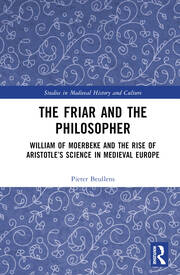
Publication – Pieter Beullens, « The Friar and the Philosopher. William of Moerbeke and the Rise of Aristotle’s Science in Medieval Europe »

William of Moerbeke was a prolific medieval translator of Aristotle and other ancient philosophical and scientific authors from Greek into Latin, and he played a decisive role in the acceptance of Aristotelian philosophy in the Latin world. He is often criticized for an allegedly deficient translation method.

However, this book argues that his approach was a deliberate attempt to allow readers to reach the correct understanding of the source texts in accordance with the medieval view of the role of the translator. William’s project to make all genuine works of Aristotle – and also of other important authors from Antiquity – available in Latin is framed against the background of intellectual life in the 13th century, the deliberate policy of his Dominican order to reconcile Christian doctrine with worldly knowledge, and new trends in book production that influenced the spread of the new translations. William of Moerbeke’s seemingly modest acts of translation started an intellectual revolution, the impact of which extended from the Middle Ages into the early modern era.

The Friar and the Philosopher will appeal to researchers and students alike interested in Medieval perceptions of Aristotle, as well as other works from Antiquity.

Pieter Beullens (b.1967) studied classics and philosophy at the universities of Antwerp and Leuven (Belgium). He published the critical edition of Aristotle’s History of Animals in the Latin translation by William of Moerbeke (with Fernand Bossier, two volumes, 2000-2020). His PhD-research centred on the working methods of late medieval translators (A Methodological Approach to Anonymously Transmitted Medieval Translations of Philosophical and Scientific Texts. The Case of Bartholomew of Messina; KU Leuven, 2020). He currently works as a postdoctoral research fellow of the Research Foundation – Flanders at the KU Leuven (2021-2024).

Table des matières :

Chapter 1: Model
Chapter 2: Precursors
Chapter 3: Project
Chapter 4: Order
Chapter 5: Network
Chapter 6: Diplomat
Chapter 7: Success
Chapter 8: Fall

Appendix I: Chronological guide
Appendix II: Guide to the translations by William of Moerbeke and their contents

Informations pratiques :

Pieter Beullens, The Friar and the Philosopher. William of Moerbeke and the Rise of Aristotle’s Science in Medieval Europe, Londres, Routledge, 2022 ; 1 vol., 170 p. (Studies in Medieval History and Culture). ISBN : 978-1-03230-521-9. Prix : GBP 120,00.

Source : Routledge

Publié dans Publications | Laisser un commentaire

Publication – « Le Livre de Babur. Le Babur-nama de Zahiruddin Muhammad Babur », trad. Jean-Louis Bacqué-Grammont

« Au mois de ramazan de l’année 1494, je devins roi dans le pays de Ferghana à l’âge de douze ans. »

Ce texte, traduit du turc tchaghatai, constitue les mémoires de l’empereur Babur, premier Grand Moghol des Indes (1494-1529), cas presque unique d’autobiographie dans la littérature musulmane médiévale. Il nous permet d’entrer dans le quotidien de cet homme à la destinée incroyable, fondateur d’un immense empire, fin stratège, guerrier impitoyable, poète et grand mécène qui nous a transmis des informations capitales sur son époque, les régions qu’il a traversées et les peuples qu’il a croisés. Outre son intérêt historique, cette somme vaut autant pour ses enseignements sur l’art de gouverner que pour ses célèbres descriptions de la faune et de la flore indiennes, ainsi que des villes fondées dans le nord de l’Inde par les premiers souverains musulmans.

Il est constitué de trois grandes parties chronologiques : d’abord Babur jeune souverain mis à l’épreuve en Asie centrale, ensuite l’installation de son pouvoir sur le territoire de l’actuel Afghanistan, puis le célèbre livre indien où Babur franchit l’Indus et va jusqu’au Bengale.

Informations pratiques :

Le Livre de Babur. Le Babur-nama de Zahiruddin Muhammad Babur, trad. Jean-Louis Bacqué-Grammont, Paris, Les Belles Lettres, 2022 ; 1 vol., 832 p. ISBN : 978-2-25145-370-5. Prix : € 27,90.

Source : Les Belles Lettres

Publié dans Publications | Laisser un commentaire

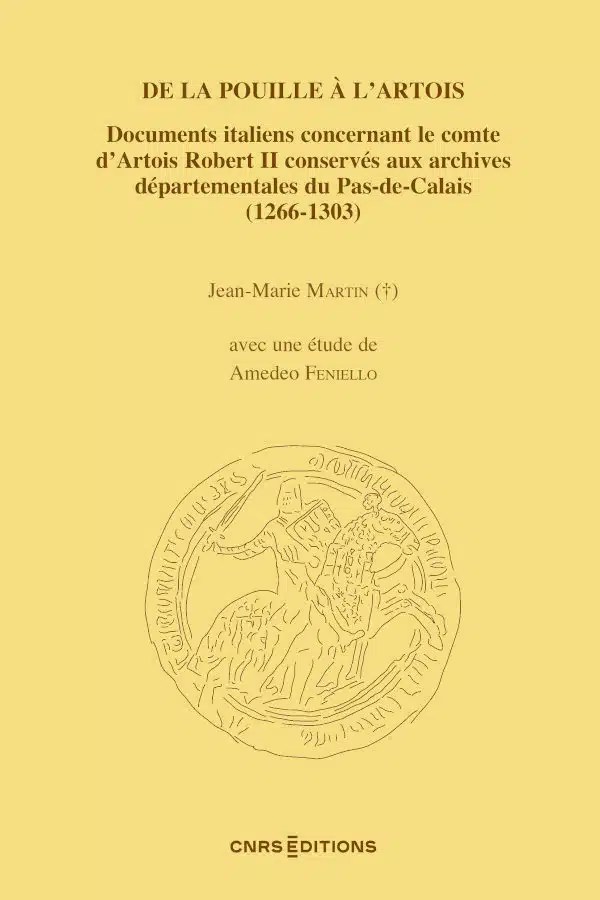
Publication – « De la Pouille à l’Artois. Documents italiens concernant le comte d’Artois Robert II conservés aux Archives départementales du Pas-de-Calais (1266-1303) », éd. Jean-Marie Martin

Robert d’Artois (1248-1302), neveu de saint Louis, a fait au moins deux séjours en Italie méridionale, dont il fut le quasi-souverain pendant près d’une dizaine d’années, entre 1282 et 1291. Chef de guerre, administrateur, son action a donné lieu à la production d’une abondante documentation dont quelques témoins ont été conservés au sein de ses archives personnelles. Peu connues des spécialistes, les vingt-six pièces éditées et commentées relèvent pour l’essentiel du domaine judiciaire – le procès d’Adenolfo d’Aquino, comte d’Acerra, en 1286) – et du domaine économique. La plus importante est assurément le cahier de reddition des comptes des massarie du comte d’Artois établi en 1300, qui met en lumière les détails de la gestion des exploitations confiées à Robert II pour sa rémunération ou plutôt pour l’apurement de la dette contractée envers lui par la monarchie sicilienne, et dont il bénéficia jusqu’à son décès. La nature de la production – principalement céréales et élevage de chevaux – et son extension géographique, les équipements agricoles, la description de l’actif et du passif, de la main-d’œuvre et son coût, le comportement face aux aléas épidémiques sont autant d’éléments sur lesquels le Quaternus rationum livre de précieuses informations, dont la présente édition permet l’étude critique. Il ne s’agit pas seulement de lever le voile sur un pan de l’économie apulienne de la fin du XIIIe siècle, mais aussi de mesurer l’apport des institutions angevines sur l’administration seigneuriale en Artois, dont Robert appliqua les usages à son retour dans le royaume de France. L’ouvrage est augmenté d’un itinéraire de Robert II dans le royaume de Sicile et d’une prosopographie des quelque 80 personnages cités dans les documents.

Informations pratiques :

De la Pouille à l’Artois. Documents italiens concernant le comte d’Artois Robert II conservés aux Archives départementales du Pas-de-Calais (1266-1303), éd. Jean-Marie Martin, Paris, CNRS Édiyions, 2022 ; 1 vol., 208 p. (Documents, études et répertoires). ISBN : 978-2-27114-032-6. Prix : € 70,00.

Source : CNRS Éditions

Publié dans Publications | Laisser un commentaire

Publication – « The Routledge Handbook of Public Taxation in Medieval Europe », dir. Denis Menjot, Mathieu Caesar, Florent Garnier et Pere Verdés Pijuan

Beginning in the twelfth century, taxation increasingly became an essential component of medieval society in most parts of Europe. The state-building process and relations between princes and their subject cities or between citizens and their rulers were deeply shaped by fiscal practices. Although medieval taxation has produced many publications over the past decades there remains no synthesis of this important subject.

This volume provides a comprehensive overview on a European scale and suggests new paths of inquiry. It examines the fiscal systems and practices of medieval Europe, including essential themes such as medieval fiscal theory and the power to tax; royal and urban taxation; and Church taxation. It goes on to survey the entire European continent, as well as including comparative chapters on the non-European medieval world, exploring questions on how taxation developed and functioned; what kinds of problems authorities encountered assessing their fiscal power; and the circulation of fiscal cultures and practices across cities and kingdoms. The book also provides a glossary of the most important types of medieval taxes, giving an essential definition of key terms cited in the chapters.

The Routledge Handbook of Public Taxation in Medieval Europe will appeal to a large audience, from seasoned scholars who need a comprehensive synthesis, to students and younger scholars in search of an overview of this critical subject.

Table des matières :

  1. General introduction (Denis Menjot, Mathieu Caesar, Florent Garnier and Pere Verdés Pijuan)
  2. The History of Taxation in Medieval Europe: Sources, Historiography and Methods (Denis Menjot, Pere Verdés Pijuan and Mathieu Caesar)
  3. The Right to Tax and its Justifications (Lydwine Scordia and Florent Garnier)
  4. Church Taxation (Jordi Morelló Baget)
  5. Crown of Aragon: Catalonia, Aragon, Valencia and Majorca (Mario Lafuente and Albert Reixach)
  6. Kingdoms of Castile and Navarre (Pablo Ortego and Iñigo Mugueta)
  7. Kingdoms of Sicily (Serena Morelli and Alessandro Silvestri)
  8. Northern Italy: Cities and Regional States (Patrizia Mainoni)
  9. The Church Lands: a long Term Overhaul (1200-1550) (Armand Jamme)
  10. Kingdom of France (with Brittany and Dauphiné) (Jean-François Lassalmonie)
  11. The Burgundian Low Countries (Marc Boone)
  12. Medieval German Holy Roman Empire (Laurence Buchholzer )
  13. Provence and Savoy (Michel Hébert and Mathieu Caesar)
  14. Kingdom of England (Maureen Jurkowski)
  15. The Scandinavian kingdoms (Thomas Lindkvist)
  16. Kingdom of Poland and the Grand Duchy of Lithuania (Piotr Guzowski and Urszula Sowina)
  17. Russia from the Mongol invasion to the death of Ivan the Terrible (1242-1584) (Pierre Gonneau)
  18. The Byzantine Empire (Anastasia Kontogiannopoulou)
  19. Muslim Worlds (Ángel Galán Sánchez, Alejandro Garcia Sanjuan and Kate Fleet)

Informations pratiques :

The Routledge Handbook of Public Taxation in Medieval Europe, dir. Denis Menjot, Mathieu Caesar, Florent Garnier et Pere Verdés Pijuan, Londres, Routledge, 2022 ; 1 vol., 512 p. (Routledge History Handbooks). ISBN : 9780367903367. Prix : GBP 190,00.

Source : Routledge

Publié dans Publications | Laisser un commentaire

Appel à contribution – Organisation de la journée d’étude des jeunes chercheurs de la section française de la Société Internationale Arthurienne

La 3e journée d’étude de la section française de la SIA consacrée aux jeunes chercheurs est prévue le vendredi 9 juin 2023 à l’université Rennes 2 et sera organisée par Federica Butto et Lucie Blouin.

Les étudiants de Master 2, doctorants et jeunes docteurs dont les recherches portent, dans le domaine arthurien, sur les littératures et langues médiévales (françaises ou étrangères) ou sur la réception du Moyen Âge, et qui sont membres de la section française de la Société Internationale Arthurienne, sont invités à venir présenter, au choix :

– leur thèse
– un sujet de recherche en rapport avec leur thèse ou un point de leur thèse – un sujet arthurien au choix.

Pour chaque orateur sont prévues 30 mn de parole + 15 mn de discussion. Huit interventions pourront être proposées au cours de la journée.

Les candidats devront solliciter leur laboratoire ou leur école doctorale pour la prise en charge des frais de déplacement. L’université Rennes 2 et la section française de la SIA prendront en charge le repas et l’organisation. En cas de difficulté pour le transport ou l’hébergement, les personnes concernées peuvent néanmoins solliciter les organisateurs.

Les propositions sont à adresser au comité organisateur pour 15 décembre 2022, sous la forme d’un résumé d’une dizaine de lignes accompagné d’un bref CV précisant notamment le titre de la thèse, le nom du directeur ou de la directrice, l’université de rattachement :

Damien de Carné : damien.de-carne@univ-lorraine.fr
Hélène Bouget : helene.bouget@univ-brest.fr
Christine Ferlampin-Acher : christine.ferlampin-acher@univ-rennes2.fr Federica Buttò : fede.cas89@hotmail.it
Lucie Blouin : lucie.blouin@univ-rennes1.fr

Les textes issus des communications seront publiés en ligne sur le site de la section française de la SIA où sont consultables les actes des deux précédentes journées (2019 et 2021): https://siafrance.hypotheses.org/actes

Publié dans Appel à contributions | Laisser un commentaire

Journée d’étude – Traductions monastiques du Nord-Est de l’espace d’oïl au XIIe siècle

La section Romane de l’IRHT organise une journée d’étude lundi 5 décembre 2022 (9h30-18h15) au campus Condorcet (Centre de colloques).

Campus Condorcet (Aubervilliers)
Centre de colloques, Auditorium 250

Programme :

9h30 – Fabio Zinelli (EPHE, PSL) et Piero Andrea Martina (IRHT CNRS), Accueil et introduction

10h –Présidence : François Bougard (IRHT CNRS)

  • Gilles Roques (ATILF), Commentaires sur quelques mots typiques des traductions de textes religieux du Nord-Est autour de 1200
  • Maria Careri (Università G. D’Annunzio Chieti-Pescara), Livres et écritures des traductions monastiques d’oïl du XIIe siècle

Discussion et pause-café

11h30 – Présidence : Sylvie Lefèvre (Paris Sorbonne Université)

  • Dominique Stutzmann (IRHT-CNRS, Humboldt-Universität zu Berlin), A la recherche d’un modèle latin : les sermons De laudibus Virginis matris de Bernard de Clairvaux
  • Ilaria Lavorato (La Sapienza Università di Roma), Remarques sur la syntaxe de la traduction du De diligendo Deo

Discussion et pause

14h30 – Présidence : Stefano Asperti (La Sapienza Università di Roma)

  • Michel Zink (Académie Française, AIBL), Amour et roman. Énigmes d’un recueil sans doute cistercien

Présidence : Marie-Laure Savoye (IRHT CNRS)

  • Cédric Giraud (Université de Genève – EPHE, PSL), La diffusion des textes spirituels latins en France du Nord dans la seconde moitié du XIIe siècle : bilan et questions
  • Maria Teresa Rachetta (Università di Napoli Federico II), “Ne sai que translation vaille / Qui semble as oyans devinaille” : un débat possible entre traducteurs au XIIe siècle

Discussion et pause-café

17h Présidence : Fabio Zinelli (EPHE, PSL)

  • Marie-Pascale Halary (Université Lumière Lyon2), Un lexique spécialisé en langue dite vulgaire ?
  • Piero Andrea Martina (IRHT CNRS), Les traductions des homélies de Grégoire le Grand

Discussion

  • Stefano Asperti (La Sapienza Università di Roma), Conclusion

Comité scientifique

Stefano Asperti (La Sapienza Università di Roma), Geneviève Hasenohr (EPHE, PSL), Sylvie Lefèvre (Paris Sorbonne Université), Marie-Laure Savoye (IRHT-CNRS), Richard Trachsler (Universität Zürich)

Contact : piero-andrea.martina@irht.cnrs.fr / fabio.zinelli@ephe.psl.eu

Source : IRHT

Publié dans Le réseau | Laisser un commentaire

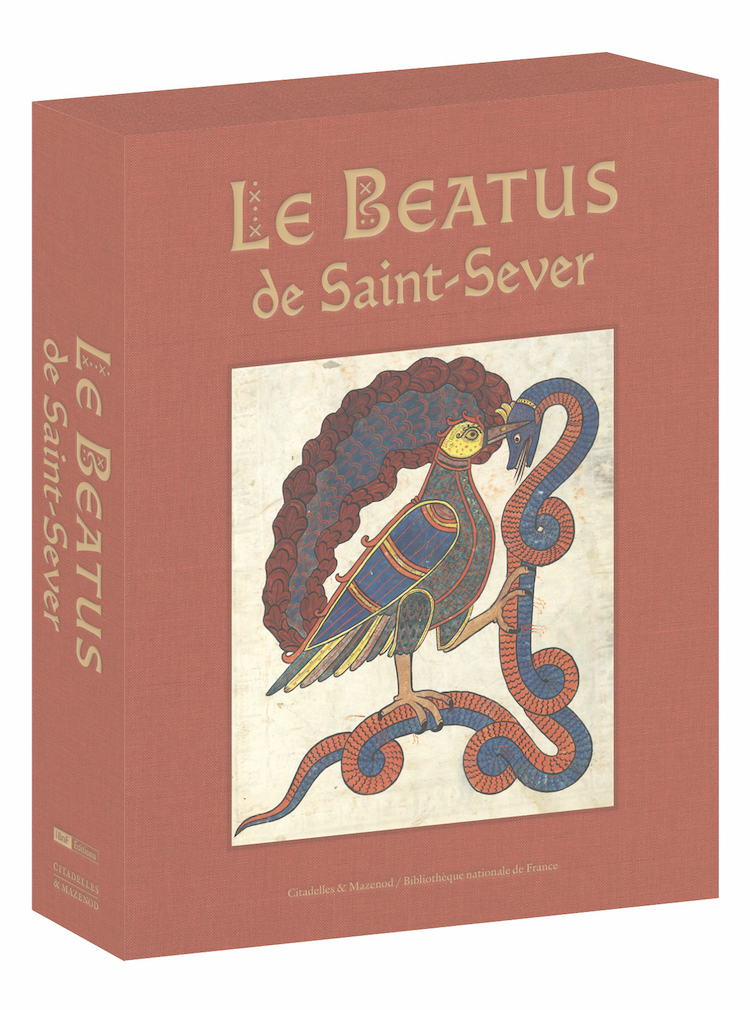
Publication – Le Beatus de Saint-Sever

Le Beatus de Saint-Sever (Paris, BnF latin 8878) est l’un des manuscrits les plus fascinants du Moyen Âge, aussi bien par l’ampleur de son programme iconographique et le chromatisme éclatant de ses peintures que par l’ambition du projet artistique de son commanditaire, Grégoire de Montaner. Le destin de cet homme et de l’œuvre qu’il a conçue s’est forgé au sein de l’abbaye gasconne de Saint-Sever, que Grégoire dirigea de 1028 à 1072, à une époque où la Gascogne vivait une histoire mouvementée, entre le royaume capétien, Al-Andalus et les luttes féodales entre les seigneurs locaux. Récit à la fois textuel et visuel de l’Apocalypse de saint Jean commentée, ce testament artistique de l’abbé de Saint-Sever s’adressait prioritairement à ses moines : il s’agissait d’assurer leur salut en même temps que d’asseoir l’autorité spirituelle et temporelle de l’abbaye. À travers ses textes et ses images, ce sont tous les débats, conflits et luttes d’influence de l’époque qui se dessinent en toile de fond. Plus largement, au-delà du fait religieux, cet ouvrage aborde un thème universel fondamental, celui du destin de l’humanité. C’est pourquoi sa fortune fut et demeure immense, tant auprès des chercheurs qui l’ont scruté que des artistes qui s’en sont nourris.Les éditions Citadelles & Mazenod inaugurent un partenariat avec la Bibliothèque nationale de France pour consacrer à ce manuscrit une nouvelle édition restituant l’objet dans ses moindres détails à partir de sa numérisation en haute définition. Ce fac-similé s’accompagne d’une étude de spécialistes du sujet qui, par leurs lectures croisées, posent un regard neuf sur le manuscrit. S’appuyant sur les recherches antérieures et l’analyse matérielle qui a été, pour la première fois, menée sur le manuscrit au moyen des technologies les plus avancées par le C2RMF et le CRC, ceux-ci se sont attachés à éclairer les strates multiples de lecture et la compréhension profonde de ce chef-d’œuvre, ainsi que ses vies à travers les siècles.

Table des matières :

Introduction (Charlotte Denoël)
Le monde de Beatus (Pascale Bourgain)
Saint-Sever et son « noble abbé » Grégoire de Montaner (Charlotte Denoël)
La mappemonde du manuscrit de Saint-Sever. Géographie et exégèse au xie siècle (Emmanuelle Vagnon)
Le laboratoire de l’oeuvre (Charlotte Denoël)
L’esthétique picturale (Charlotte Denoël)
L’image altomédiévale et les Beatus(Isabelle Marchesin)
Langage et signification des images (Isabelle Marchesin)
Les enjeux théologiques des images (Isabelle Marchesin)
Remarques finales : pourquoi une telle oeuvre à Saint-Sever ?  (Charlotte Denoël et Isabelle Marchesin)
La réception du Beatus de Saint-Sever dans l’art moderne (Maria Stavrinaki)
Conclusion (Xavier Barral i Altet)

Informations pratiques :

Le Beatus de Saint-Sever, Paris, BnF-Citadelles Mazenod, 2022 ; 2 vol., 592 p. + 296 p. ISBN : 978-2-85088-896-0. Prix : € 890.

Volume de Commentaires sous la direction de Charlotte Denoël, avec les contributions de : Isabelle Marchesin, Pascale Bourgain, Emmanuelle Vagnon, Maria Stavrinaki, et une conclusion de Xavier Barral i Altet.

Source : Citadelles & Mazenod

Publié dans Publications | Laisser un commentaire

Colloque – Artists, Agents and Patrons from the Low Countries in the Iberian World

Traditionally, it is argued that from the 15th century onwards, Iberian art was transformed by the arrival of artists and art objects from the Low Countries. Numerous studies demonstrate the influence of great Flemish artists such as Jan Van Eyck, Michiel Coxcie, Peter Paul Rubens and Jacob Jordaens.

However, the contribution of lesser-known artists, agents and patrons who moved, worked and exchanged between these European regions and with Latin America has not yet been sufficiently covered in a comprehensive manner. Nor has the intermediary role of other Netherlandish migrants such as merchants, soldiers, courtiers and priests.

Furthermore, this study day will reexamine the dynamics and models of cultural exchange between Netherlandish artists and the Iberian world, that is too often considered to have been produced in one direction only. It will address the impact of itinerant artists and the dissemination of ideas, styles and artworks, as well as the problems of migration and the transfer of materials, techniques, iconography, and production and commercial strategies.

The study day will bring together international researchers from academic and scientific institutions in France, Poland, Spain and Belgium. Presentations and discussion will take place in four different sections:

  • Migrant artists for the court and the high nobility
  • Netherlandish art in Iberia: an object-based approach
  • Agents, merchants and patrons
  • Spain and the Americas.

The meeting will complement and nuance the traditional accounts of the artistic relations between the two territories, highlighting the complexity of the global interactions and exchanges that linked the Iberian world and the Low Countries to each other, but also to Europe and the rest of the world.

Please find below the full programme. The entrance is free, but registration is required.

Programme :

9.00 – Onthaal / Accueil / Welcome

9.30 – Inleiding / Présentation / Introduction | Valentine Henderiks (Université libre de Bruxelles)

  • Session 1: Migrant artists for the court and the high nobility

9.45 A Picard in Castile: Felipe Morros (Philippon Mauroux) as a painter and courtier of Isabella of Castile | Oskar Rojewski, University of Silesia

10.00 Jean Mone et l’Espagne | Géraldine Patigny, Royal Institute for Cultural Heritage

10.15 The Cueman family: a stylistic dialogue between Brabant and Spain | Oliver Kik, Royal Institute for Cultural Heritage

10.30 Discussie / Échanges / Discussion

10.45 Koffiepauze / Pause-café / Coffee break

  • Session 2: Flemish art in Iberia: an object-based approach

11.10 Ambrosius Benson et l’Espagne : la question du Maître de Ségovie | Sacha Zdanov, Université libre de Bruxelles

11.25 Dans l’entourage des Rois catholiques : le succès des modèles de Christ couronné d’épines boutsiens en Espagne | Thomas Unger, Université libre de Bruxelles

11.40 A Puzzle Piece from Juan de Flandes’s Altarpiece for the University Chapel in Salamanca | Bart Fransen, Royal Institute for Cultural Heritage

11.55 Discussie / Échanges / Discussion

12.15 Middagpauze / Pause de midi

  • Session 3: Agents, merchants and patrons

14.00 El cardenal Granvella como agente de pintores flamencos en la Península ibérica | Almudena Pérez de Tudela, Patrimonio Nacional

14.15 Joan Gregori : marchand et agent d’Alphonse le Magnanime en Flandre | Elsa Espín, Musée du Louvre

14.30 The glass-maker Teodoro de Holanda | Ana Diéguez-Rodríguez, Universidad de Burgos/Instituto Moll

14.45 Discussie / Échanges / Discussion

15.00 Koffiepauze / Pause-café / Coffee break

  • Session 4: Spain and the Americas

15.30 The painter Simon Pereyns in Mexico | Reinout Reybrouck, Vrije Universiteit Brussel

15.45 Priest painters of Flemish origin in Spain and America: the case of Juan de Roelas | Eduardo Lamas, Royal Institute for Cultural Heritage

16.00 Discussie / Échanges / Discussion

16.30 Afsluiting van de zitting / Clôture des travaux / Closing remarks

Informations pratiques :

09 December 2022, 09:00 – 17:30
Royal Institute for Cultural Heritage (KIK-IRPA), Brussels

Registration : here

Organised by the Royal Institute for Cultural Heritage (KIK-IRPA, Brussels) in collaboration with the Université Libre de Bruxelles.

Organising committee: Eduardo Lamas, Géraldine Patigny, Bart Fransen, Valentine Henderiks.

This programme has been made possible with the financial support of the Embassy of Spain in Belgium.

It is under the auspices of the Royal Academy of Archaeology of Belgium (ARAB-KAOB) and the Belgian Committee for Art History.

Source : KIK-IRPA

Publié dans Colloque | Laisser un commentaire