Colloque – The Queen’s Resources: Examining the Lands, Revenues, Networks, and Economic Power of Premodern Royal Women

University of Winchester
04.09.2022 – 06.09.2022

The conference ‘The Queen’s Resources: Examining the lands, revenues, networks, and economic power of premodern royal women’, to be held at the University of Winchester on 4-6 September 2022 in hybrid form (in person or remote participation), seeks to examine the economic agency and activity of royal women across premodern Europe.

The conference brings together the themes of previous workshops on lands, resources, affinities, and administration, and covers other areas related to the financial practices of royal women. The conference will also include a workshop where participants will work together to map the next phase of the project and develop an application for funding for future plans for collaborative research.
Registration for the conference is now open: https://store.winchester.ac.uk/conferences-and-events/external-conferences-events/conferences/the-queens-resources-conference

There are a range of options including residential packages to stay onsite at the university, day attendance options if you live locally or want to source your own accommodation, or virtual options to attend online only (rates are calculated at cost, with different rates for staff/faculty and student/early career/independent). Both the full packages, residential and day, include the conference dinner but if you book individual days only, you need to add the conference dinner if you want to join in for that evening event. The virtual attendance charge is a flat fee which covers ALL days of the conference.
Programme :

Sunday, 4 September 2022
1:30-2:00 WELCOME/COFFEE

2:00-2:30 INTRODUCTION
Ellie Woodacre

2:30–4:00 SESSION 1: Account Books as Sources
Chair: TBA
Elysia Cains: A Psychological Reading of the Financial Activities of Eleanor of Castile
Chris Woolgar: Treasure, Wealth, and Two Fourteenth-Century English Queens
Isabel Escalera Fernández: The Account Books as Testimonies of the Promotion of Jewellery by Queen Isabel la Catolica

4:00–4:30 COFFEE

4:30–5:30 LIGHTNING ROUND 1: Tudor Queens
Chair: TBA
Valerie Schutte: Anne of Cleves and the Brockehouse Affair
Elizabeth Norton: Jane Seymour as Lady of the Manor
Nicola Clark: Tudor Queens Consort and ‘Household Economy’: a Two-Way Street?
Andrea Silen-McMillin: The Lands of the Tudor Queens

5:45–6:45 KEYNOTE
Katrin Keller: Of Donations, Debts and Domains. Economy and Finance as Spaces of Agency for Princely Women in the Holy Roman Empire

6:45–7:30 WINE RECEPTION

Monday, 5 September 2022
8:30–9:00 WELCOME/COFFEE

9:00-10:30 SESSION 2: Queens’ Lands and Administration
Chair: TBA
Anaïs Waag: A Year in the Life: Petronila of Aragon in the Comital Accounts of Provisioning at Vilamajor (June 1156–April 1157)
Katia Wright: The Queen’s Administration: The Case of Philippa of Hainault’s Estates
Inês Olaia: Tax Collecting in the Portuguese Queens’ Lands: Double the Trouble?

10:30–11:00 COFFEE

11:00–12:30 SESSION 3: Administration and Finances
Chair: TBA
Manuela Santos Silva: The Administration of the Queens’ Town of Óbidos (Portugal, 1387–1437)
Jan Vojtíšek: Administration of the Queen’s Domain in Fourteenth-Century Bohemia
Lledó Ruiz Domingo: The Queen’s Treasury: Queenship, Resources, and Administration in the Crown of Aragon during the Fourteenth and Fifteenth Century

12:30-1:30 LIGHTNING ROUND 2: Provisions for Death and Widowhood
Chair: TBA
Ana Maria Rodrigues: “With All My Wisdom and Health”: Queens’ Wealth and its Distribution at the Time of Death
Zsolt Simon: The Hungarian Queen’s Lands and Revenues in the Middle Ages
Charlotte Backerra: Dowagers’ Challenge: Hessian Landgravines and their Dowers
Laura Rehrmann: “She shouldn’t have more than other noble widows”: Dower in the Context of Security, Appreciation, and Male Power

1:30–2:30 LUNCH

2:30-4:00 SESSION 4: Dowers and Dowries
Chair: TBA
Paula Del Val Vales: Mapping Thirteenth-Century Queens’ Dower Lands in Castile, Aragon, and England
Zita Rohr: Unrealized Assets and Blue-Sky Opportunities: Dowers and Dowries in Late Medieval Aragon and France
Silvia Z. Mitchell: Leaning-In Habsburg Style: Mariana of Austria’s Pension and Economic Resources in Widowhood, 1676–1696

4:00–4:30 COFFEE

4:30–6:00 SESSION 5: Credit
Chair: TBA
Emily Rose: The Queen and her Moneyman: Eleanor of Castile and Hagin fil. Cress in the Thirteenth-Century Real Estate Market
Cristina Garcia Garcia: Gifts and Credit: An Economic Perspective for Studying Royal Affinities from Observations of the Royal Household of Juan I
Ruben Gonzalez Cuerva: Bankrupting your Banker: Empress Maria of Austria, Constantino Magno, and the Limits of Moneylending

6:00–7:00 LIGHTNING ROUND 3: Power, Councils, and Households
Chair: TBA
Isabela Alberquerue: Anglo-Saxon Queens and the Exercise of Political Power: Possibilities of Analysis
Clara Kaleogérakis: “para sustentación de su Casa”: When the Economy of a Household Sealed the Fate of Joanna of Castile (1496)
Alexander Isaacson: To Be and Remain Her Majesty’s Faithful, Obedient, and Loyal Subjects: Multiple Sources of Authority of Queen Dowager Kristina in Early Seventeenth-Century Sweden
Maria Hayward: Serving the Queen: The Role of Catherine of Braganza’s Council

7:00 DINNER

Tuesday, 6 September 2022
8:30–9:00 WELCOME/COFFEE

9:00–10:30 SESSION 6: Economic Resources
Chair: TBA
Fabian Persson: The Island and the Spider: Networks of Early Modern Queens
Ben James: Dona Maria (1644–1693): Economic Resources and Power of an Illegitimate Royal
Patrik Paštrnák: Reconstructing the Financial Background of the Bridal Journeys: Festival and Agency

10:30–11:00 COFFEE

11:00–12:30 ROUNDTABLE: Database Projects
Chair: Cathleen Sarti
Anna Jagos: Regesta reginarum: House Luxembourg
Jason Sadler: GeoData, University of Southampton
Stefan Dumont: Telota, BBAW (to be confirmed)
Tracy Chapman Hamilton: Mapping the Premodern Women, Sweet Briar (US)
Anna Foka & Dann Wu: Centre for Digital Humanities, Uppsala

12:30–1:00 CLOSING REMARKS
TBA

1:00 LUNCH

END OF CONFERENCE

Source : H-Soz-Kult
Publié dans Colloque | Laisser un commentaire

Appel à contribution – Masculin et féminin en poésie latine : voix, stratégies et mises en scène

Lyon / Saint-Étienne, 19-20 octobre 2023

Appel à contributions
Date limite : 01/10/2022


L’objectif de cette rencontre sera d’analyser la dialectique entre les polarités masculine et féminine chez les poètes latins et de mieux cerner comment ces derniers les exploitent pour, par exemple :
• donner voix aux personnages
• construire un personnage et sa psychologie
• structurer un intrigue, une œuvre
• tisser des liens intertextuels
• manipuler des images et des représentations


Dans une optique strictement littéraire, on proposera de nouvelles analyses sur la circulation des symboliques entre le masculin et le féminin, sur les constructions et mises en scène et sur les espaces spécifiques ou communs à ces deux pôles. On s’attachera également à décrypter les intentions poétiques, les stratégies et les enjeux de cette thématique dans les différents genres poétiques latins, de Catulle à l’Antiquité tardive.
Informations pratiques :
-Les propositions de communication (titre et 15 lignes maximum de présentation, dans une des principales langues européennes) sont à adresser avant le 01/10/2022 à F. Garambois-Vasquez et D. Vallat (florence.garambois.vasquez[at]univ-st-etienne.fr; Daniel.Vallat[at]univ-lyon2.fr).
-La durée de chaque intervention est fixée à 30 minutes maximum (25 + 5 min de discussion).
-L’organisation du colloque ne pourra prendre en charge que les frais de séjour ; les frais de transport seront à la charge des participants.
-La publication des Actes du colloque est prévue après expertise des contributions, qui devront être impérativement remises avant le 01/02/2024.

Lieu de la manifestation : St-Étienne ; Lyon
Organisation : Florence Garambois et Daniel Vallat

Source : Compitum

Publié dans Appel à contributions | Laisser un commentaire

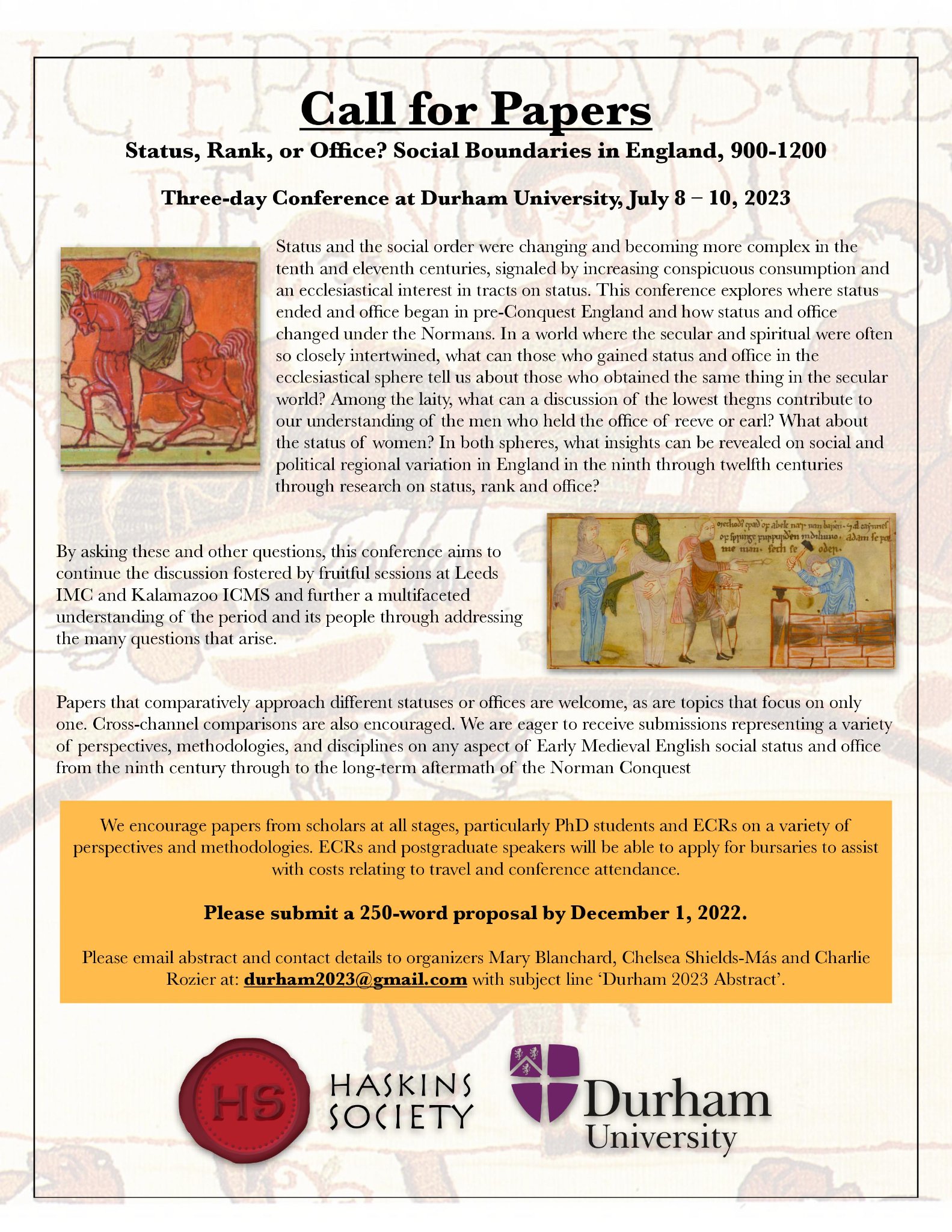
Appel à contribution – Status, Rank, or Office? Social Boundaries in England, 900-1200

Call for Papers:

« Status, Rank, or Office? Social Boundaries in England, 900-1200, » a 3-day conference at Durham University, July 8–10, 2023

ABSTRACT DEADLINE: December 1, 2022.

Status and the social order were changing and becoming more complex in the tenth and eleventh centuries, signaled by increasing conspicuous consumption and an ecclesiastical interest in tracts on status. This conference explores where status ended and office began in pre-Conquest England and how status and office changed under the Normans. In a world where the secular and spiritual were often so closely intertwined, what can those who gained status and office in the ecclesiastical sphere tell us about those who obtained the same thing in the secular world? Among the laity, what can a discussion of the lowest thegns contribute to our understanding of the men who held the office of reeve or earl? What about the status of women? In both spheres, what insights can be revealed on social and political regional variation in England in the ninth through twelfth centuries through research on status, rank and office?

By asking these and other questions, this conference aims to continue the discussion fostered by fruitful sessions at Leeds IMC and Kalamazoo ICMS and further a multifaceted understanding of the period and its people through addressing the many questions that arise.

Papers that comparatively approach different statuses or offices are welcome, as are topics that focus on only one. Cross-channel comparisons are also encouraged. We are eager to receive submissions representing a variety of perspectives, methodologies, and disciplines on any aspect of Early Medieval English social status and office from the ninth century through to the long-term aftermath of the Norman Conquest

We encourage papers from scholars at all stages, particularly PhD students and ECRs on a variety of perspectives and methodologies. ECRs and postgraduate speakers will be able to apply for bursaries to assist with costs relating to travel and conference attendance.

Please submit a 250-word proposal by December 1, 2022.

Please email abstract and contact details to organizers Mary Blanchard, Chelsea Shields-Más and Charlie Rozier at: durham2023@gmail.com with subject line ‘Durham 2023 Abstract’.

Publié dans Appel à contributions | Laisser un commentaire

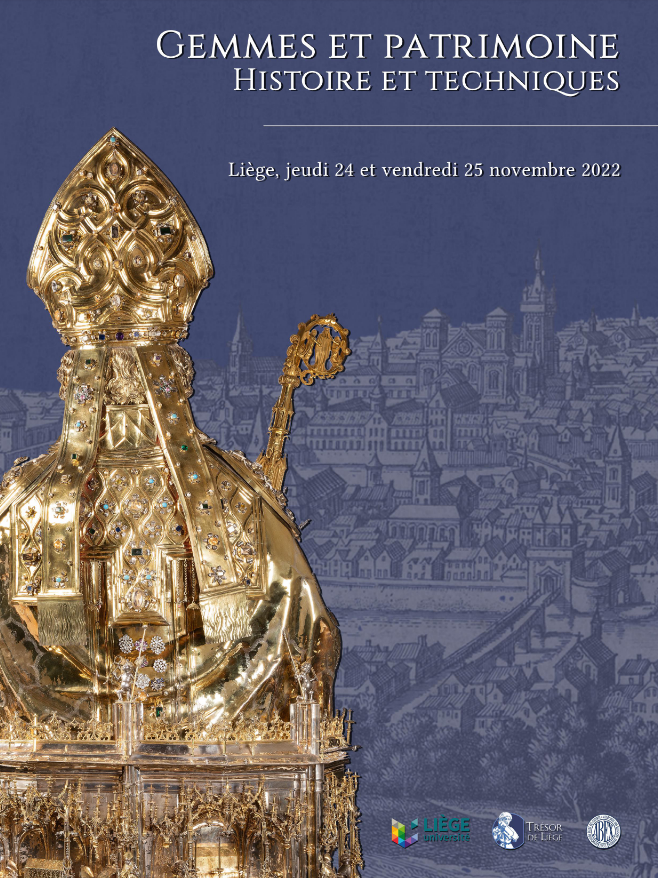
Colloque – Gemmes et patrimoine. Histoire et techniques

Colloque international

ULiège, jeudi 24 et vendredi 25 novembre 2022

Programme : ici

Le jeudi 24 et le vendredi 25 novembre 2022 se tiendra à l’Université de Liège, place du XX Août, 7 à B-4000 Liège un colloque international intitulé « Gemmes et patrimoine. Histoire et techniques » organisé par l’ULiège, le Trésor de la cathédrale de Liège et l’Association belge des experts. Sur base de recherches effectuées récemment par le Service de minéralogie de l’ULiège (Professeur Frédéric Hatert) sur les gemmes, pierres et verres décorant, entre autres, le buste-reliquaire de saint Lambert et la couronne-reliquaire du Trésor de la cathédrale de Namur, les matinées de ces deux journées d’études seront consacrées, le jeudi, à la question des techniques d’identification et, le vendredi, aux techniques de certification et d’évaluation des gemmes, pierres et verres. Le jeudi après-midi sera organisée une visite des locaux de recherche au Service de minéralogie de l’ULiège au Sart-Tilman avec démonstration des appareils. Ce même jour, en soirée, aura lieu l’inauguration au Trésor de la cathédrale de Liège de l’exposition découlant de ces travaux de recherche dirigés par le Professeur Frédéric Hatert. Le vendredi après-midi, les congressistes pourront découvrir le Trésor de la collégiale de Huy, sous la conduite de sa Conservatrice, Mme Marylène Laffineur, et le Trésor et Musée diocésain de la cathédrale de Namur, sous la conduite de Mme Hélène Cambier, Conservatrice. Un repas de clôture sera servi à la Brasserie François, place Saint-Aubain à Namur. Trois ouvrages en lien avec ces études sortiront également de presse à cette occasion.

Renseignements et réservation : www.tresordeliege.be ou www.abex.be

Publié dans Le réseau | Laisser un commentaire

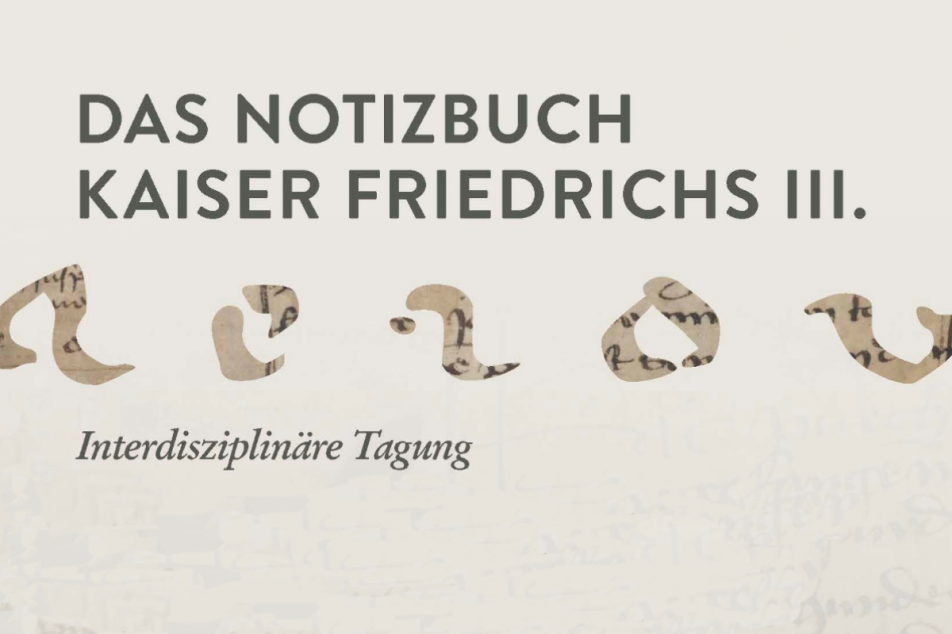
Colloque – The Notebook of Emperor Frederick III

Announcing an Interdisciplinary Conference to be jointly hosted by the Department for the Study of the Historische Grundwissenschaften at the LMU Munich (Prof. Martin Wagendorfer) and the Monumenta Germaniae Historica

The so-called „notebook“ of Emperor Frederick III, which he began writing in 1437 at the age of 21, is a very singular medieval source with an unique contentual and formal arrangement and highly diverse entries. The parchment manuscript has been the object of many studies, but to date there has been no systematic examination of its material and contentual details. Gathering specialist expertise from various disciplines, the conference aims to achieve a complete analysis of this unique manuscript.

Thursday 17 and Friday 18 November 2022

Internationales Begegnungszentrum der Wissenschaft, Amalienstr. 38, Munich

Programme :

Thursday 17.11.22

15:00Opening speech and introduction by Prof Dr. Dr. h.c. Martina Hartmann (president of the MGH)
15:15Österreichische Nationalbibliothek, cvp. 2674 – Kodikologie, Paläographie und (Editions-) Geschichte  Prof. Dr Martin Wagendorfer (Munich)
16:00Das AEIOV im Notizbuch und andernorts als individuell-persönliches Zeichen Friedrichs III. Prof. Dr Jörg Schwarz (Innsbruck)
16:45Coffee break
17:15Die lateinischen Majuskelalphabete im Notizbuch Friedrichs III. Dr Franz-Albrecht Bornschlegel (Munich)
18:00Kryptographie schon bei Kaiser Friedrich III.? Anwendung oder Spielerei? Mag. Anton Walder (Innsbruck)
18:45Refreshments
19:00Schrift, Bilder, Zahlen: Zur Selbstthematisierung im Spätmittelalter Evening lecure by Prof. Dr Daniela Rando (Pavia)
20:00End of the first conference day

Friday 18.11.22

09:00Wie der Vater so der Sohn. Zwei Habsburger auf Jerusalemfahrt Prof. Dr Achim Hack (Jena)
09:45Das Notizbuch Kaiser Friedrichs III. – Landesherrschaft im gedenken des Landesherrn Dr Gabriele Annas (Frankfurt/Main)
10:30Coffee break
11:00Des Kaisers Urkundentruhe 1456 Prof. Dr Christian Lackner (Vienna)
11:45Josep Jud geit XL gulden all jar – Das Notizbuch Friedrichs III. im Kontext seiner Judenpolitik PD Dr Eveline Brugger (Vienna)
12:30Lunch break
14:00samad, seiden guldener tucher – Textilien im Notizbuch Kaiser Friedrichs III. Dr Tanja Kohwagner-Nikolai (Munich)
14:45Drei italienische Rezepte Prof. Dr Claudia Märtl (Munich)
15:30Coffee break
16:00Frömmigkeit und Heiligenverehrung bei Friedrich III. Prof. Dr Franz Fuchs (Würzburg)
16:45Sinnsprüche und Zitate im Notizbuch Friedrichs III. Prof. Dr Johannes Helmrath (Berlin)
17:30Closing speech Prof. Dr Martin Wagendorfer

To attend the conference, please register in advance via e-mail to annette.marquard-mois@mgh.de

Please note that seating is limited. After registration, you will receive a confirmation e-mail (under the proviso of further Corona restrictions), and shortly before the event further information on the currently valid Corona measures.

Source : Monumenta Germaniae Historica

Publié dans Colloque | Laisser un commentaire

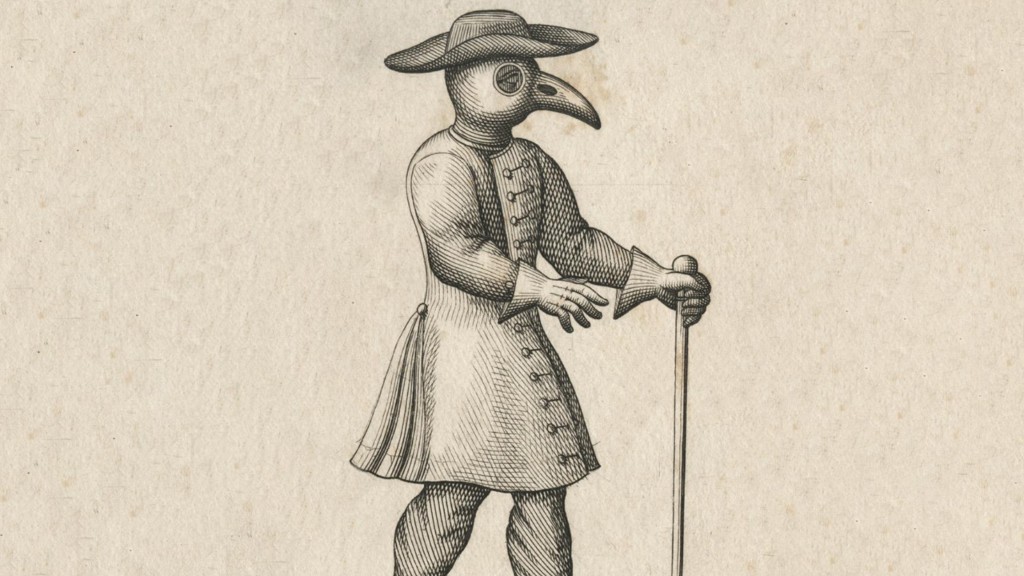
Conférence – Geneviève Xhayet, « À propos des remèdes contre la peste : entre prévention et soins, médications et magie »

Cette causerie/conférence clôture l’exposition Mortalitas. Vivre et représenter la peste aux Temps modernes présentée au Musée Wittert jusqu’au 27 août. 

Entre les XIVe et XVIIIe siècles, les épidémies de peste déchirent l’Europe. On croit la maladie due à un « venin » disséminé dans l’air. Comment se protéger de cet air empoisonné ? Comment préserver les lieux de vie de ses effets ? Quels secours apporter aux pestiférés ? Le fléau met le corps médical au défi. Les remèdes balancent entre médication stricte, l’administration d’antidotes à base de simples, et magie :  procédés de transferts ou de sympathies. Le recours à ces procédés occultes s’explique d’autant mieux que la peste relève des « secrets de nature », dont il convient de s’accommoder tout en renonçant à en percer les mystères.

Conférencière : Dr Geneviève Xhayet (ULiège, Agrégée de la Faculté de Philosophie et Lettres, département des Sciences historiques / UR Traverses), commissaire scientifique de l’exposition Mortalitas.

Le jour de la conférence, l’exposition sera accessible jusqu’à 20h.

Informations pratiques :

26 août 2022

Université de Liège (salle Wittert)

Place du 20-Août, 7
4000 Liège Horaires
18h

Source : Musée Wittert

Publié dans Colloque | Laisser un commentaire

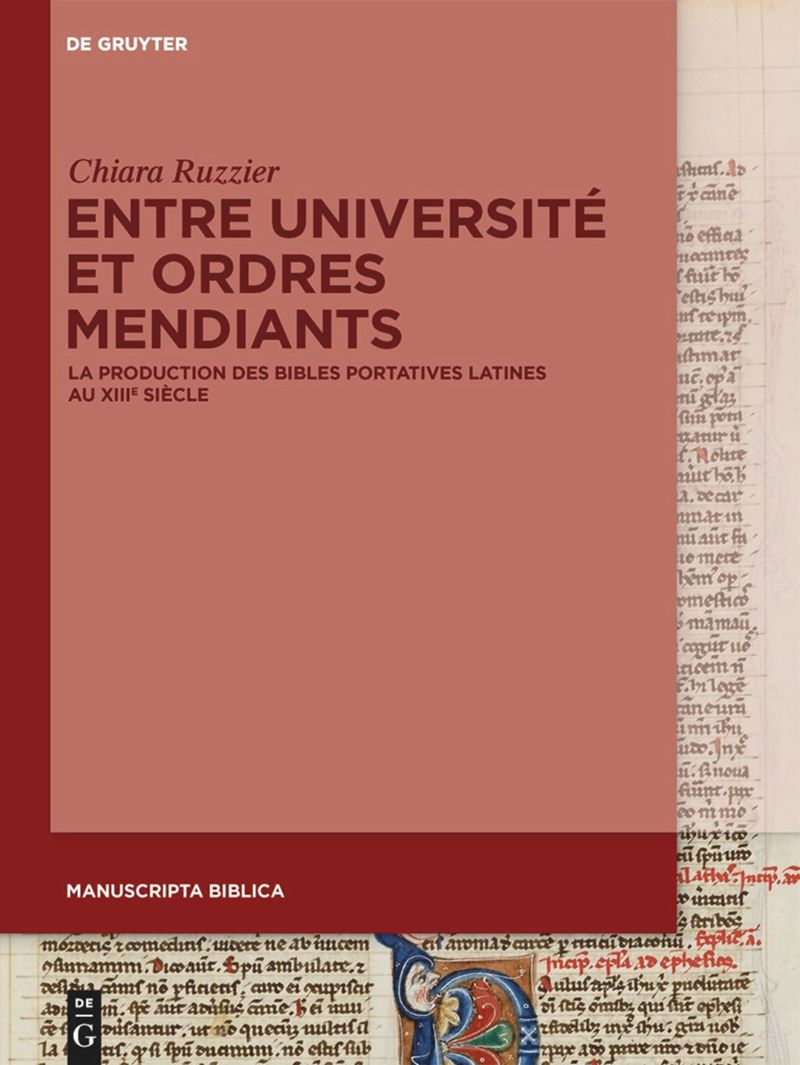
Publication – Chiara Ruzzier, « Entre Université et ordres mendiants. La production des bibles portatives latines au XIIIe siècle »

Most 13th century Latin Bibles are portable Bibles produced in Paris and other towns hosting a medieval university. These manuscripts were intended for personal use and their dimensions also made them ideal preaching tools for the mendicant friars. This volume explores the production systems of these Bibles, their material and paratextual aspects, as well as their use, with a focus on the different technical solutions devised to miniaturise the Bible. Most 13th century Latin Bibles are portable Bibles produced in Paris and other towns hosting a medieval university. These manuscripts were intended for personal use and their dimensions also made them ideal preaching tools for the mendicant friars. This volume explores the production systems of these Bibles, their material and paratextual aspects, as well as their use, with a focus on the different technical solutions devised to miniaturise the Bible.

Chiara Ruzzier, Université de Namur, Belgium.

Table des matières : ici

Informations pratiques :

Chiara Ruzzier, Entre Université et ordres mendiants. La production des bibles portatives latines au XIIIe siècle, Boston–Berlin, De Gruyter, 2022 ; 1 vol, XIV–336 p. (Manuscripta Biblica, 8). ISBN : 978-3-11075-719-4. Prix : € 123,95.

Source : De Gruyter

Publié dans Publications | Laisser un commentaire

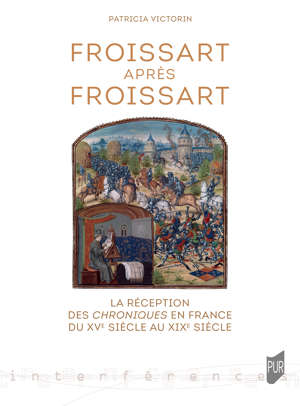
Publication – Patricia Victorin, « Froissart après Froissart. La réception des Chroniques en France du XVe siècle au XIXe siècle »

Cette étude propose une histoire de la réception française des Chroniques de Froissart du XVe siècle au XIXe siècle, explorant les processus de fabrique de Froissart et de son œuvre, entre érudition et fiction. L’analyse des usages historiographiques, idéologiques et littéraires souligne combien ces Chroniques représentent un riche terrain d’expérimentation, d’interrogation et un lieu commun à partir duquel penser la discipline historique et le roman historique.

Si le nom de Froissart n’est que ponctuellement mentionné chez les auteurs de la fin du Moyen Âge, il bénéficie d’une surreprésentation au XIXe siècle, cette période romantique de redécouverte et d’invention du Moyen Âge. Froissart, sous l’impulsion de Walter Scott, accompagne le renouveau du discours historique au cours du XIXe siècle sur fond de rivalité entre les tenants de l’école narrative, l’école philosophique ou le courant positiviste.

Ce livre esquisse une histoire littéraire, certes lacunaire, mais il donne une idée des goûts, des attentes selon les époques, et envisage les interpénétrations entre l’érudition et la littérature. Enfin, travailler sur la réception des Chroniques de Froissart est une invitation au voyage dans la littérature et les bibliothèques intérieures des auteurs, de Montaigne à Sollers, en passant par le marquis de Sade, Flaubert, Chateaubriand, Nerval, Michelet, Dumas, Giono ou Céline.

Patricia Victorin est professeure de langue et littérature du Moyen Âge à l’université Bretagne Sud. Elle est rattachée au laboratoire HCTI.

Table des matières : ici

Informations pratiques :

Patricia Victorin, Froissart après Froissart. La réception des Chroniques en France du XVe siècle au XIXe siècle, Rennes, Presses universitaires de Rennes, 2022 ; 1 vol., 492 p. (Interférences). ISBN : 978-2-75358-602-4. Prix : € 28,00.

Source : Presses universitaires de Rennes

Publié dans Publications | Laisser un commentaire

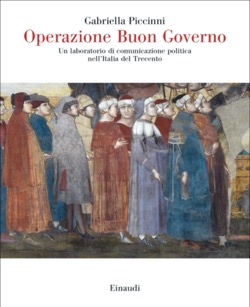
Publication – Gabriella Piccinni, « Operazione Buon Governo. Un laboratorio di comunicazione politica nell’Italia del Trecento »

Il ciclo del Buon Governo, dipinto nel 1338 da Ambrogio Lorenzetti nel palazzo del Comune di Siena, è in assoluto una delle opere piú celebri dell’arte italiana, da sempre oggetto di attenzione da parte di studiosi del pensiero politico, dell’arte, della società, della letteratura, della moda, delle istituzioni, del diritto. Ma quei 36 metri di pittura, intrecciati con i 62 versi di una Canzone che poteva essere cantata e ballata, innovarono anche il linguaggio della comunicazione politica.

All’analisi di questa innovazione, chiamata qui «Operazione Buon Governo», è dedicato questo libro. Essa prese forma dalla volontà di governare con il consenso una società non pacificata e un’economia in trasformazione, mentre il governo dei mercanti, committente dell’opera, chiedeva la fiducia sul suo programma politico, e le leggi del Comune venivano rinnovate in un imponente testo statutario che si richiamava al diritto romano.

Gli affreschi si presentano dunque come il prodotto non solo dell’artista ma anche dell’humus culturale della comunità civica e politica di cui Lorenzetti fu erede e protagonista. Con la sua magnifica inventiva, la sua abilità tecnica e una notevolissima perizia retorica, l’artista seppe rappresentare ogni aspetto della tumultuosa realtà sociale dell’epoca, dove i principî, le virtú e i vizi della politica generavano simbolicamente i loro «civili effetti».

Informations pratiques :

Gabriella Piccinni, Operazione Buon Governo. Un laboratorio di comunicazione politica nell’Italia del Trecento, Rome, Einaudi, 2022 ; 1 vol., XII–324 p. (Saggi). ISBN : 978-8-80625-372-1. Prix : € 55,00.

Source : Einaudi

Publié dans Publications | Laisser un commentaire

Offre d’emploi – Andrew W. Mellon Postdoctoral Fellowship in the Humanities

The Wolf Humanities Center awards five (5) one-year Andrew W. Mellon Postdoctoral Fellowships each academic year to junior scholars in the humanities who are no more than five years out of their doctorate. Preference will be given to candidates not yet in tenure track positions whose proposals are interdisciplinary, who have not previously enjoyed use of the resources of the University of Pennsylvania, and who would particularly benefit from and contribute to Penn’s intellectual life.

The programs of the Wolf Humanities Center are conceived through yearly topics that invite broad interdisciplinary collaboration. For the 2023–2024 academic year, our topic will be Revolution.

The Wolf Humanities Center is keen to support projects that contribute to the dismantling of all forms of racial, gender, and other discrimination as they exist within the humanities. We know that such efforts can take an infinite variety of forms, and we encourage you to include in the course of your application an explanation of how your scholarship contributes to this effort if it does.

The 2023–2024 Fellowship appointment is twelve months (July 1, 2023–June 30, 2024) and carries a stipend of $62,750 plus a $3000 research fund and single-coverage health insurance (fellows are responsible for coverage for any dependents). Fellows teach one undergraduate course in addition to conducting their research.


Call for Applications, 2023–2024 

Topic: Revolution
Application Deadline: November 1, 2022
Submit application materials via Interfolio

  • The PhD (and its international equivalent, such as the DPhil) is the only eligible terminal degree, and applicants must be humanists or those in such allied fields as anthropology or history of science. Ineligible categories include an MFA or any other doctorate such as EdD, social scientists, scholars in educational curriculum building, and performing artists (note: scholars of performance are eligible).
  • Scholars who received or will receive their PhD between June 30, 2018 and June 30, 2023 are eligible to apply.
  • The fellowship is open to all scholars, national and international, who meet eligibility requirements. International scholars outside of North America are appointed under a J-1 visa (Research Scholar status). Scholars seeking to hold an H-1B visa during the fellowship year at Penn are ineligible (no exceptions can be made). The Wolf Humanities Center reserves the right to revoke the offer if the recipient is unable to meet this condition. 
  • Applicants who have not completed all requirements for the PhD by April 30, 2023 must submit a letter from their Department Chair certifying that they will have the PhD in hand by June 30, 2023 of that year. Failure to meet this deadline will result in offers being withdrawn.
  • Fellows are required to be in residence for the term of the fellowship.
  • During their appointment, Fellows are required to teach one course rostered in one or more of the humanities departments or programs in Penn’s School of Arts & Sciences (not the Wolf Humanities Center), and must also participate in the Center’s weekly Mellon Research Seminar (Tuesdays, 12:00–1:30), presenting their research at one of those seminars. Fellows also collaborate on the planning of a symposium on the topic of Revolution, participate in professional development workshops, and are appointed a faculty mentor.

Source : Wolf Humanities Center

Publié dans Offre d'emploi | Laisser un commentaire