Offre d’emploi – Contrat doctoral en archéologie – INRAP

Dans le cadre du plan en faveur des sciences humaines et sociales promu par le Ministère de l’Enseignement supérieur, de la Recherche et de l’Innovation (MESRI), l’Inrap offre deux contrats doctoraux d’une durée de trois ans, dont un réservé à un jeune chercheur en archéologie externe à l’institut.

Ces contrats devront permettre la réalisation d’une thèse de doctorat, réalisée en collaboration avec l’école doctorale d’une université partenaire, ayant pour objet les données de l’archéologie préventive.

Le candidat retenu se verra ainsi allouer un CDD d’une durée de trois ans à compter du 1er janvier 2023.

Ce financement vient s’ajouter au contingent dont dispose chaque école doctorale. Il constitue donc à la fois un renforcement de l’aide portée à la recherche en archéologie par le MESRI et une opportunité d’élargissement des partenariats entre l’Inrap et les universités françaises.
Conditions de candidatures

Les candidats doivent être titulaires d’un master avec la mention Très Bien obtenu depuis moins de deux ans.

Le courriel de candidature devra être accompagné d’un projet doctoral de 5 pages maximum mettant clairement en avant des problématiques en lien avec l’archéologie préventive et d’une lettre d’un directeur de recherche (HDR) s’engageant à encadrer ce travail doctoral.

Le dossier ainsi constitué devra être adressé au directeur scientifique et technique de l’Inrap, Marc Bouiron (marc.bouiron@inrap.fr),

avant le jeudi 23 juin 2022 à 16h (heure de Paris).

Modalités de sélection

La procédure de sélection sera effectuée par un jury présidé par le Président de l’Inrap, Dominique Garcia, et constitué de la vice-présidente du CNRA, Anne Lehoërff, du Directeur scientifique et technique, Marc Bouiron et de personnalités scientifiques sélectionnées en fonction de leurs domaines de compétences respectifs.

Contact

Pour tout renseignement, les personnes intéressées par ce dispositif peuvent s’adresser au directeur scientifique et technique, Marc Bouiron (marc.bouiron@inrap.fr), et la directrice adjointe, Giulia De Palma (giulia.depalma@inrap.fr).

Source : Calenda
Publié dans Offre d'emploi | Laisser un commentaire

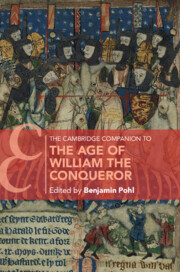
Publication – « The Cambridge Companion to the Age of William the Conqueror », dir. Benjamin Pohl

This Cambridge Companion offers readers a comparative cultural history of north-western Europe in the crucial period of the eleventh century: the age of William the Conqueror. Besides England, Normandy, and northern France, the volume also explores Scandinavia, the North Sea world, the insular world beyond the English Channel, and various parts of Continental Europe. This Companion features essays designed specifically for those wishing to advance their knowledge and understanding of this important period of European history using a holistic and contextual perspective, deliberately shifting the focus away from William the man and onto the rich and fascinating culture of the world in which he lived and ruled. This was not the age created by William, but the age that created him. With contributions by leading international experts, this volume provides an inclusive and innovative study companion that is both authoritative and timely.

Benjamin Pohl is Senior Lecturer in Medieval History at the University of Bristol. He specialises in the writing of history, manuscript studies, the history of the book, monasticism, and cultural memory studies. He is the author of numerous journal articles and book chapters, and his books include Dudo of Saint-Quentin’s Historia Normannorum: Tradition, Innovation and Memory (2015) and The Bristol Merlin: Revealing the Secrets of a Medieval Fragment (2021).

Table des matières :

Prologue: Studying the Age of William the Conqueror Benjamin Pohl

Part I. Home and Away:

  1. Normandy and the continent Alheydis Plassmann
  2. England and the insular world Alex Woolf and Neil McGuigan
  3. Scandinavia and the North Sea world Michael H. Gelting

    Part II. Space and Society:
  4. Landscape and settlement Katherine Weikert
  5. Church and society Richard Allen
  6. Trade and travel Eljas Oksanen

    Part III. Individuals and Institutions:
  7. Family and kinship Laura L. Gathagan
  8. Nobility and aristocracy Daniel Booker and S. D. Church
  9. Kingship and consensus Björn Weiler
  10. Law and justice Emily Tabuteau

    Part IV. Cultural Perspectives:
  11. Warfare and violence Matthew Strickland
  12. History and memory Benjamin Pohl and Elisabeth van Houts
  13. Language and literacy Keith Busby
  14. Schools and education Mia Münster-Swendsen
    Epilogue: The legacy of William the Conqueror and his age today David Bates.

Informations pratiques :

The Cambridge Companion to the Age of William the Conqueror, dir. Benjamin Pohl, Cambridge, Cambridge Unievrsity Press, 2022 (Cambridge Companions to Culture). 350 p. ISBN : 9781108728478. Prix : GBP 22,99.

Source : Cambridge University Press

Publié dans Publications | Laisser un commentaire

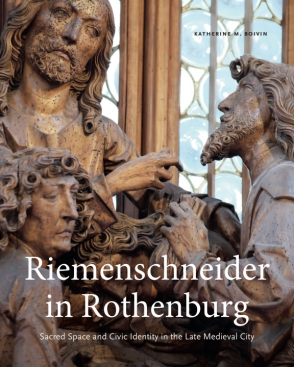
Publication – Katherine M. Boivin, « Riemenschneider in Rothenburg. Sacred Space and Civic Identity in the Late Medieval City »

The concept of the medieval city is fixed in the modern imagination, conjuring visions of fortified walls, towering churches, and winding streets. In Riemenschneider in Rothenburg, Katherine M. Boivininvestigates how medieval urban planning and artistic programming worked together to form dynamic environments, demonstrating the agency of objects, styles, and spaces in mapping the late medieval city.

Using altarpieces by the famed medieval artist Tilman Riemenschneider as touchstones for her argument, Boivin explores how artwork in Germany’s preeminent medieval city, Rothenburg ob der Tauber, deliberately propagated civic ideals. She argues that the numerous artistic pieces commissioned by the city’s elected council over the course of two centuries built upon one another, creating a cohesive structural network that attracted religious pilgrims and furthered the theological ideals of the parish church. By contextualizing some of Rothenburg’s most significant architectural and artistic works, such as St. James’s Church and Riemenschneider’s Altarpiece of the Holy Blood, Boivin shows how the city government employed these works to establish a local aesthetic that awed visitors, raising Rothenburg’s profile and putting it on the pilgrimage map of Europe.

Carefully documented and convincingly argued, this book sheds important new light on the history of one of Germany’s major tourist destinations. It will be of considerable interest to medieval art historians and scholars working in the fields of cultural and urban history.

Katherine M. Boivin is Assistant Professor of Art History at Bard College.

Table des matières :

List of Illustrations

Acknowledgements

List of Abbreviations

Introduction

1. The City as Patron

2. A Pilgrimage Environment

3. The Urban Complex

4. Remapping the City

Epilogue: The Modern Medieval City

Notes

Bibliography

Index

Informations pratiques :

Katherine M. Boivin, Riemenschneider in Rothenburg. Sacred Space and Civic Identity in the Late Medieval City, PSU PRess, 2022. $99.95. ISBN: 978-0-271-08778-8. 248 pages. 77 color/20 b&w illustrations.

Source : PSU Press

Publié dans Publications | Laisser un commentaire

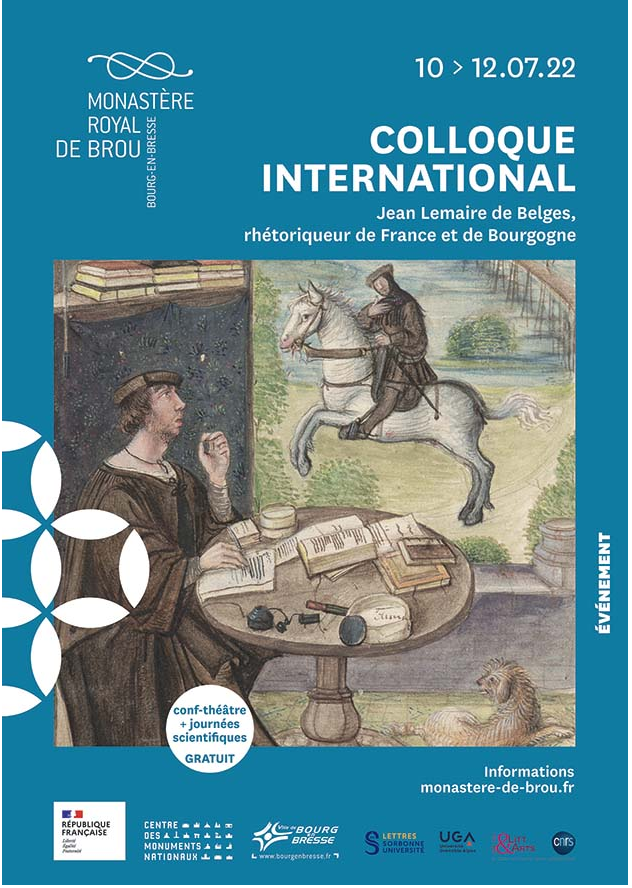
Colloque – Jean Lemaire de Belges, rhétoriqueur de France et de Bourgogne

Poète et historiographe des cours de Bourgogne puis de France au début du 16e siècle, découvrez l’œuvre de Lemaire dans son contexte historique, littéraire et artistique. Universitaires français, américains, italiens, allemands, autrichiens, israéliens, suisses et anglais se réunissent pendant deux jours pour vous faire découvrir ce personnage hors du commun, son œuvre ainsi que ses liens avec le monastère royal de Brou et Marguerite d’Autriche. 

Programme : ici

Informations pratiques :

10 juillet 2022 > 12 juillet 2022

Lieu : Colloque organisé dans les bâtiments administratifs du monastère royal de Brou (côté jardins).

Renseignements auprès de brou@bourgenbresse.fr 

Source : Monastère de Brou

Publié dans Colloque | Laisser un commentaire

Appel à contribution – Digital Diplomatics 2022: From Digital to Distant Diplomatics?

28. bis 30. September 2022
Universität Graz, Zentrum für Informationsmodellierung – Austrian Centre for Digital Humanities

As early as the 1970s, diplomatics, i.e. research on mediaeval documents, noticed the benefits of the computer for the indexing and editing of mediaeval charter collections. In the following decades, numerous relevant research projects were initiated that explored and clarified the potential of a connection between digital humanities and the methods of historical auxiliary sciences. They have found expression in the series of conferences on the topic of « Digital Diplomatics » (in particular Munich 2007, Naples 2011 and Paris 2013), in which the digitisation of charters, their publication on the web, and the digital analysis of document corpora in cooperation between archives, diplomatics, historians and computer scientists were discussed.

The ERC Advanced Grant project « From Digital to Distant Diplomatics » takes up this tradition and wants to take stock of the different projects and approaches to the topic of « digital diplomatics » with the conference « Digital Diplomatics 2022 ».

The international conference in Graz is intended to offer all scholars interested in this complex of topics the opportunity for discussion and exchange, from questions about digital support in the formal and content analysis of documents, to the planning and implementation of digitisation projects in archives and libraries, to the future direction of this new research field.

In principle, the organisers of this conference welcome all contributions from the broad field of digital diplomatics, but would like to draw particular attention to the following topics:

  • ●  digitisation and web presence of document corpora
  • ●  digital edition of charters
  • ●  the usefulness of digital images for diplomatics, especially for the study of graphic symbols, layout, authentication and palaeography
  • ●  Computer vision with mediaeval and early modern charters
  • ●  Machine learning and digital diplomatics
  • ●  Computer linguistic and stylometric analysis of charter texts
  • ●  The problem of mass, e.g. digital diplomatics and late mediaeval charters
  • ●  Advanced statistical methods in diplomatics
  • ●  Digital sphragistics
  • ●  Digital diplomatics in university teaching
  • ●  New diplomatic insights gained with digital methods
  • ●  How can diplomatics open to other disciplines by digital means?
  • ●  The future of digital diplomatics Proposals for posters or talks (minimum 500, maximum 750 words with bibliographical references and short biographical information on the authors) are welcome by e-mail at: didip@uni-graz.at The conference committee consists of Georg Vogeler (chair), Tamas Kovacs, Daniel Luger, and Anguelos Nicolaou. It will decide on acceptance of the proposals in consultation with the scientific advisory board of the ERC project DiDip. Deadline for abstracts: 3rd July 2022

In the event of an invitation to speak, the organisers may contribute towards travel and accommodation costs. Please provide an estimate of your support needs with your application.

Presentations should not exceed 20 minutes of speaking time and may be given in English, French, German or Italian.

We plan to publish written versions of the conference papers in the context of the journal « Archiv für Diplomatik, Schriftgeschichte, Siegel- und Wappenkunde » (AfD), which has been published annually since 1956, in a single blind review process. Paper submission is due by end of 2022.

Further information at: https://didip.hypotheses.org/conference-2022

Publié dans Appel à contributions | Laisser un commentaire

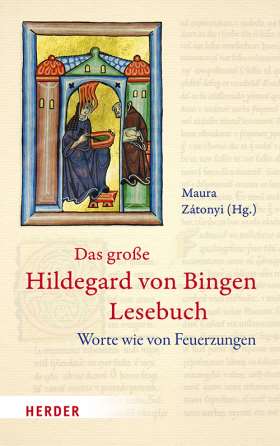
Publication – « Das große Hildegard von Bingen Lesebuch. Worte wie von Feuerzungen », dir. Maura Zátonyi OSB

Hildegard von Bingen (1098–1179) ist eine der faszinierendsten Persönlichkeiten des Mittelalters. Ihre Visionen beschäftigen sich mit den fundamentalen Fragen unseres Lebens: Wie lässt sich die Welt deuten? Wie gelangt der Mensch zum erfüllten Leben? Die Werke der rheinischen Äbtissin verdeutlichen dabei: Die Themen, die uns heute bewegen, waren den Menschen schon vor mehr als 800 Jahren vertraut. Hildegards Schriften erfordern jedoch eine sprachliche wie auch gedankliche Vermittlung in das Heute. Nicht nur der große Umfang, sondern die verschlüsselte Bildersprache und die Fremdheit der mittelalterlichen Kultur hindern bei der Lektüre. Im vorliegenden Lesebuch sind Texte ausgewählt, die bei heutigen Leserinnen und Lesern auf Resonanz stoßen. Vor jedem Text steht eine Erläuterung, die zum Verstehen beiträgt und einlädt, aus den Texten Impulse für die persönliche Lebensgestaltung zu gewinnen. So bietet das Lesebuch einen Zugang zur Gedankenwelt Hildegards und zu deren gewinnbringender Anwendung im Leben des Einzelnen. Der vorliegende Querschnitt durch das gesamte Werk dieser Kirchenlehrerin ermöglicht den Reichtum und die spirituelle Kraft ihres Denkens zu entdecken.

Maura Zátonyi ist Benediktinerin der Abtei St. Hildegard in Eibingen. Geboren 1974 in Ungarn, studierte sie Klassische Philologie in Budapest, wurde in Mainz in Philosophie promoviert und absolvierte das Theologiestudium in Sankt Georgen/Frankfurt. 2011 bis 2012 hat sie an den theologischen Gutachten für das Verfahren der Heiligsprechung und der Erhebung Hildegards von Bingen zur Kirchenlehrerin, der sogenannten „Positio“, mitgearbeitet. Sie ist die Vorsitzende der 2018 gegründeten „St. Hildegard-Akademie Eibingen e.V. Zentrum für Wissenschaft, Forschung und europäischen Spiritualität“. Im Rahmen ihrer wissenschaftlichen Forschungen hat sie mehrere Übersetzungen und Publikationen vorgelegt.

Informations pratiques :

Das große Hildegard von Bingen Lesebuch. Worte wie von Feuerzungen, dir. Maura Zátonyi OSB, Fribourg, Herder Verlag, 2022. 320 p. ISBN: 978-3-451-39166-8. Prix : 25 euros.

Source : Herder Verlag

Publié dans Publications | Laisser un commentaire

Appel à contribution – Lire le moyen français après le moyen français. La réception postmédiévale de la littérature française des XIVe et XVe siècles

Colloque de l’Association internationale des études sur le moyen français (AIEMF)

24, 25 et 26 mai 2023
UCLouvain (Louvain-la-Neuve) & Université Saint-Louis (Bruxelles)

Lire le moyen français après le moyen français

La réception postmédiévale de la littérature française des XIVe et XVe siècles

En 2018, le 7e colloque de l’AIEMF fut consacré au bilan de cinquante années de recherches sur l’histoire de la littérature et de la langue en moyen français ainsi qu’aux perspectives de ce champ d’études.

Pour sa 9e édition, le colloque de l’AIEMF se propose d’envisager le moyen français dans le contexte de sa réception postmédiévale, du XVIe jusqu’à la Deuxième Guerre mondiale. Sans négliger des contextualisations historiographiques, il s’agira avant tout d’interroger la manière dont les textes originaux en moyen français ont participé à la dimension créative et imaginative après le XVe siècle.

Sans être limitative, voici une liste de sujets et d’approches qui pourront être envisagés :

– Les travaux des érudits, bibliographes et littérateurs des XVIe, XVIIe et XVIIIe siècles ;

– Les éditions, les réimpressions et les traductions ;

– La diffusion auprès du grand public et dans l’enseignement ;

– Les lectures et notes de lectures d’exemplaires anciens ;

– La réception et la réappropriation par les écrivains, chanteurs, etc.

Les propositions de communication (d’une dizaine de lignes maximum) sont à renvoyer pour le 30 septembre au plus tard à l’adresse suivante : olivier.delsaux@uclouvain.be.

Les doctorantes et doctorants travaillant sur le moyen français sont chaleureusement invités à présenter librement leur recherche doctorale, sans se sentir contraints par la problématique du colloque.

Comité organisateur : Sarah Delale, Olivier Delsaux, Tania Van Hemelryck, Martine Willems.

Comité scientifique : Elisabetta Barale, Paola Cifarelli, Sarah Delale, Olivier Delsaux, Matthieu Marchal, Tania Van Hemelryck.

Source : AIEMF

Publié dans Appel à contributions | Laisser un commentaire

Colloque – Ligues et alliances interurbaines en Europe (XIIe-XVIe siècle)

Le colloque de Rome, qui clôt un programme quinquennal de rencontres sur la diplomatie urbaine au Moyen Âge et l’époque moderne, se propose la question singulière des ligues urbaines qui n’a pas fait l’objet de synthèses comparatives régionales. Si l’on excepte quelques cas bien documentés, notamment en Italie, en Empire ou en Flandres, le sujet a peu retenu l’attention des chercheurs, alors même qu’il porte à l’extrême les enjeux de la diplomatie des villes par l’intensification des réseaux que ces alliances induisent ou par la nature même des objectifs parfois vitaux pour les cités qui en sont à l’origine. La première et la seconde ligues lombardes en sont un bel exemple, mais nullement le seul. Les échelles d’intervention, de méthodes ou d’organisation de ces ligues tout le long de la période considérée restent des questions ouvertes.

La rencontre sera l’occasion de compléter par des études de cas la constitution, les écueils et les limites de cette dynamique inter-urbaine qui posait les organismes urbains en acteurs majeurs de leur histoire, parfois en opposition même aux souverains (comme ce fut le cas lors des Comunidades dans l’Espagne de Charles Quint, en 1520-1522). Le programme s’intéressera aux modalités de création de ces alliances, à leur fonctionnement quotidien (gouvernance, budget, programme) autant qu’à leurs résultats directs ou indirects (hiérarchisation entre les cités, renégociation éventuelle des rapports avec les souverains, etc.). La rencontre de Rome fournira ainsi l’une des premières synthèses à l’échelle européenne sur ces dispositifs inter-urbains dont on ne connaît souvent que les exemples les plus emblématiques, alors même qu’ils ont été une modalité fréquente et flexible des relations entre les cités tout autant qu’un moyen de s’affirmer comme acteurs territoriaux.

Programme : ici

Informations pratiques :

École française de Rome, Piazza Navona, 62
Du 23/06/2022 à 15 h 00 au 24/06/2022 à 19 h 00

Org. Armand Jamme (CIHAM), Paolo Cammarosano (Università degli studi di Trieste), Patrick Gilli (Université de Montpellier)

Partenaires : CIHAM (UMR 5648), Centro Europeo di Ricerche Medievali (Trieste), CEMM (EA 4583)

Source : École française de Rome

Publié dans Colloque | Laisser un commentaire

Colloque – Transformative Bodies in the Premodern World: Experiences and Materials

The theme of this workshop is the transformation of bodies through, with or in relation to experiences and materials. Eight speakers will be in exploring the ways in which past peoples engaged with objects and materials from a variety of disciplinary and geographical backgrounds. The presentations will engage with practices (e.g. ritual, artistic, medicinal) that affected an actual or perceived change (in/of the body of the practitioner or the materials used), for example practices involving the body and/or objects that could act as protection against something or charge objects or materials with apotropaic abilities, but also practices that could act as transformative in other ways. The goal of the workshop is to combine the ritualistic, the religious, the magical and the medicinal understanding of bodies in order to expand our understanding of the premodern way(s) of experiencing and engaging with the sensorial and material realities. While the temporal framework is what in Western historical writing is referred to as the medieval and early modern periods, the geographical framework stretches beyond the Eurocentric scope in order to widen our perspectives and further enrich the debate. The scope of the workshop is highly interdisciplinary and speakers have backgrounds in fields as diverse as the history of science, musicology, archaeology, art history, material culture, history, and religious studies.

Organised by Mads Heilskov (The Courtauld) and Zuzanna Sarnecka (University of Warsaw).

Programme :

13.00: Welcome (Lecture Theatre 2)

13.10: Session 1: Gender and Thing-power

Montserrat Cabré, Universidad de Cantabria: Adorning the female body: divergence and accord in 15th century women’s thinking

Don C. Skemer, Princeton University: Solomon and Faust: Magic Encircling the Body

Luciana Carvalho, University of Oxford: Red for Rebirth! The use of cinnabar by the Sicans

Zuzanna Sarnecka, University of Warsaw: Moisture and dryness: Fictive materiality of glazed terracotta sculptures in Renaissance Italy

15.10: Break

15.30: Session 2: Devotion and the Body

Jessica Maratsos, University of Cambridge: The Saintly body: Art, Anatomy, and Reanimation

Antonio Chemotti, KU Leuven (Alamire Foundation) / KBR: Hearing heavenly music during exequies in post-Tridentine Italy

Louisa McKenzie, The Warburg Institute: Making yourself in wax: the metamorphic potential of the wax ex-voto

Mads Heilskov, The Courtauld Institute of Art: Life-Lines: Stylus, Pen, Chisel, Paintbrush

17.30: Closing Remarks

17.45: Wine reception (Research Forum Seminar Room)

Informations pratiques :

1:00pm, 27 Jun 2022

Monday 27th June 2022, 1pm – 7pm BST

Free, booking essential

Lecture Theatre 2, Vernon Square

Booking will close 30 minutes before the event start time

Source : The Courtauld

Publié dans Colloque | Laisser un commentaire

Colloque – Remembratio codicum : Fragments, de manuscrits en archives…

Deux journées d’étude sont organisées jeudi 23 et vendredi 24 juin 2022 à Tours et Angers par l’IRHT (section de musicologie), les Archives départementales d’Indre-et-Loire et du Maine-et-Loire, avec le concours des Archives Nationales, des Bibliothèques municipales d’Angers et de Tours, le soutien du Ministère de la Culture (SLL– Patrimoine Écrit).

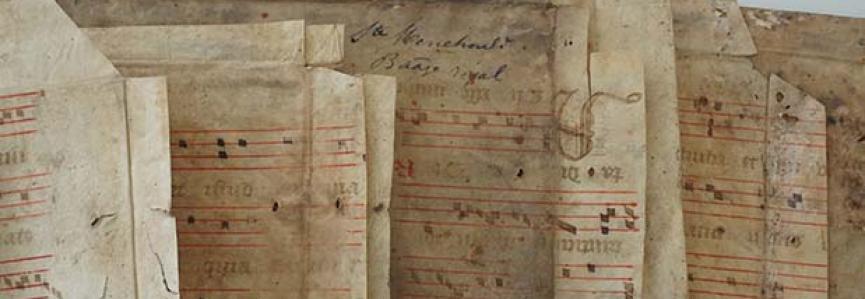
L’intérêt pour les fragments et les défets de reliures trouvés dans les feuillets de garde des manuscrits ou dans les couvrures de liasses d’archives, en particulier issus de livres liturgiques pourvus de notations musicales, n’a cessé de croître ces dernières décennies dans les milieux de la recherche sur les manuscrits médiévaux, notamment avec le programme Fragmentarium mené par l’Université de Fribourg en Suisse.

Ces années 2021-2022, l’Institut de recherche et d’histoire des textes, notamment la section de musicologie (Pôle Quadrivium), a pu mettre en œuvre un programme de recherche et de valorisation de ces fragments d’ouvrages démembrés qui furent souvent ces livres d’usage pratique comme les antiphonaires, les livres de chant, dont les statistiques à travers toute l’Europe apportent ces documents par milliers, migrés aussi bien vers les fonds d’Archives, les Bibliothèques et les collections publiques ou privées. Ces démembrements ont commencé au Moyen Âge lui-même, quand les livres d’usages ne répondaient plus aux besoins du moment (changements liturgiques, évolution des pratiques, de notation musicale…). Les moments forts de destruction-remploi se situent bien à la charnière de deux mondes, celui de la fin du Moyen Âge et le début de l’imprimerie, avec un pic aux XVIIe et XVIIIe siècles, quand les instances civiles comme les notaires privés, pouvaient se procurer des parchemins vendus au poids.

En deux pôles importants de la conservation de telles sources, ces journées d’étude souhaitent établir un premier bilan de prometteuses recherches, partagées avec d’autres collègues européens, musicologues et liturgistes. Réunissant autour d’une même table différents acteurs du patrimoine écrit, des ateliers thématiques permettront de croiser les disciplines (écrits archivistiques, codicologie, médiévistique, conservation, restauration, médiation culturelle et valorisation, photographie, humanités numériques, philologie, liturgie, musicologie) pour mettre au point des méthodologies d’approche de ce phénomène singulier dans l’histoire du livre, du document d’archive et du patrimoine écrit, du remploi ou recyclage de manuscrits séculaires voire millénaires, en parchemin.

Programme :

Jeudi 23 juin, Tours, Archives Départementales-Salle Victor Laloux

  • 9h30 – Accueil
  • 10h – Atelier 1 : Origines et pratiques du remploi des livres liturgiques
  • 14h15 – Atelier 2 : exploitation scientifique, médiation et valorisation
  • 17h30 – Concert-lecture (Site des Ursulines)
  • 17h50 – Visite commentée de quelques pièces des Archives d’Indre-et-Loire

Avec les interventions de : Alexis Douchin (Archives Nationales), Lydiane Gueit-Montchal (Archives d’Indre-et-Loire), Gilles Kagan, Jean-François Goudesenne (IRHT), Dominique Gatté, Susana Zapke (Wien Universität), Lucie Moruzzis, Isabelle Scappazzoni (Archives Nationales), Claire Nalin, (Institut national du patrimoine, master), Anna Zakova (doctorante Prague, Université Carlova/IRHT post-doc).

Vendredi 24 juin, Angers, Archives Départementales

  • 9h30 – Accueil aux Archives Départementales
  • 9h45 – Atelier 3 : catalographie et inventaires Atelier 4 : exploitation scientifique, médiation et valorisation
  • 12h15 – Visite commentée de quelques pièces des Archives du Maine-et-Loire

Avec les interventions de : Luc Forlivesi (Ministère de la Culture, Inspection des Patrimoines), Floriana Bardoneschi / Paul-Henri Lecuyer (Archives dép. 49), Gionata Brusa (Vercelli, Biblioteca capitolare / Würzburg Universität), Marc Edouard Gautier (BM Angers).

  • 14h15 Bibliothèque municipale Toussaint Atelier 5 : prospection
  • 15h30 Table-ronde conclusive

Informations pratiques :

23-24 juin 2022

Tours, Archives Départementales-Salle Victor Laloux

Angers, Archives Départementales/Bibliothèque municipale Toussaint

Source : IRHT

Publié dans Publications | Laisser un commentaire