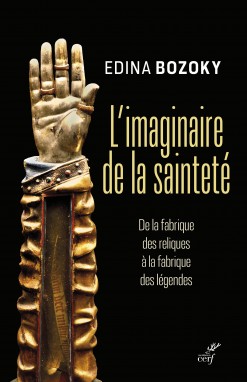
Publication – Edina Bozoky, « L’Imaginaire de la sainteté »

Dans l’imaginaire de la sainteté chrétienne, il est peu de cultes et de légendes qui ne soient liés à la présence de reliques. À partir du ive siècle, la croyance en leur pouvoir miraculeux favorise les découvertes – inventions – des tombeaux des saints oubliés ou peu connus, et la reconnaissance officielle de leur sainteté quand des miracles sont attestés. Le processus de la « fabrique » de légendes se met alors en marche, à grand renfort de récits sur l’histoire des saints présumés, et sur la translation miraculeuse de leur corps retrouvé en un lieu inattendu.

De l’Antiquité tardive à l’époque moderne en Occident, de saint Jacques de Compostelle aux saints inconnus des catacombes romaines, en passant par Marie Madeleine à Vézelay et à Saint-Maximin, Edina Bozoky nous offre la première grande synthèse de la genèse des cultes de sainteté liés aux inventions de reliques, assortie d’une iconographie inédite.

Maître de conférences émérite de l’université de Poitiers, et membre du Centre d’études supérieures de civilisation médiévale, Edina Bozoky est spécialiste de l’histoire religieuse du Moyen Âge.

Informations pratiques :

Edina Bozoky, L’Imaginaire de la sainteté, Paris, Éditions du Cerf, 2021. 288 p., 15,5 x 24 cm. ISBN : 9782204147262. Prix: 24 euros.

Source : Éditions du Cerf

Publié dans Publications | Laisser un commentaire

Offre d’emploi – Assistant Professor of History c.950-c.1250

Closes: 26th January 2022

We are looking for a scholar of exceptional ability to join our internationally renowned Department of History as Assistant Professor of History in the period c.900-c.1250 (CE), with a focus upon the Islamicate World (including North Africa, Sicily and al-Andalus, the Levant, Arabian Peninsula, Iran, Khorosan and northern India). We particularly want to hear from applicants whose work will complement and expand the department’s current strengths. Applications from historians whose research draws connections between multiple geographical regions or takes a transcultural approach within the Islamicate World and with neighbouring cultures, and who share the department’s commitment to decolonising the curriculum, are therefore especially encouraged.

The Department of History has an outstanding and long established reputation in the medieval field, and now has one of the largest concentrations of period specialists in the country. Our research spans the entire period from the late Roman Empire to the sixteenth century, ranging across, and far beyond, medieval Europe. The Department is closely involved in the interdisciplinary Institute of Medieval and Early Modern Studies, which brings together colleagues from across the University. Our medievalists maintain strong links with Durham’s interdisciplinary Centres for Visual Arts and Cultures, Catholic Studies, Ancient and Medieval Philosophy, and for the Study of the Ancient Mediterranean and Near East. We also have close ties with the departments of Classics and Ancient History, Theology and Religion, English Studies, and ! with the School of Modern Languages and Cultures (notably with Arabic, Spanish, Italian, French and German).

The successful candidate will have the opportunity to exploit Durham’s outstanding and wide-ranging resources for the study of pre-modern history, which include the manuscript collections at Durham Cathedral and the University (which form part of the Priory Library digitisation project), the Cathedral Priory Archive and the collections of the Oriental Museum.

Medieval history at Durham continues to go from strength to strength, and we invite you to join our team. The post offers an exciting opportunity to make a major contribution to the development of internationally excellent research and teaching while allowing you unrivalled opportunities to progress and embed your career in an exciting and progressive institution.

Source : Jobs.ac.uk

Publié dans Offre d'emploi | Laisser un commentaire

Publication – Sarah Fourcade, « La noblesse à la conquête du livre. France, v. 1300-v. 1530 »

Comment le livre, objet a priori étranger à la vocation guerrière du second ordre, est-il devenu, dans les derniers siècles du Moyen Âge, l’un des outils privilégiés de la noblesse laïque francophone ? S’inscrivant dans une démarche résolument synthétique et fondé sur un corpus composé de près de neuf cents individus (possesseurs de manuscrits, écrivains, poètes et rédacteurs d’écrits privés), cet ouvrage ambitionne de retracer les grandes lignes de cette conquête. Il établit l’existence d’une large noblesse lettrée, instruite et encouragée à s’instruire, élaborant par ses lectures et ses écrits une culture complexe et originale, adaptée à ses besoins, ses goûts et ses compétences, et mettant tout en œuvre pour intégrer les usages du livre au mode de vie et à l’idéal nobiliaires.

Sarah Fourcade, ancienne pensionnaire de la Fondation Thiers, est agrégée d’histoire, docteur de l’Université Paris-Sorbonne et maître de conférences en histoire médiévale à l’Université Paris-Est Créteil.

Table des matières : ici

Informations pratiques :

Sarah Fourcade, La noblesse à la conquête du livre. France, v. 1300-v. 1530, Paris, Honoré Champion, 2021 (Études d’Histoire Médiévale, 17). 718 p., ISBN : 9782745355911. Prix : 95 euros.

Source : Honoré Champion

Publié dans Publications | Laisser un commentaire

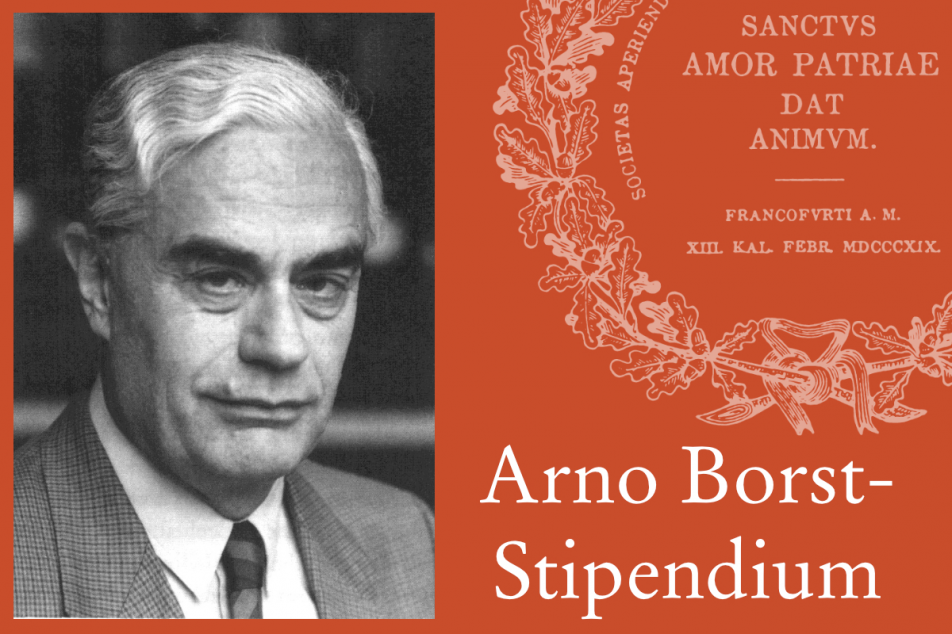
Offre d’emploi – Arno Borst-Stipendium für den wissenschaftlichen Nachwuchs (Post-Doktoranden-Stipendium)

Der herausragende Mediävist Arno Borst (1925–2007) hat 1996 die „Arno-Borst-Stiftung zur Förderung der mediävistischen Geschichtswissenschaften“ gegründet, deren Erträge seitdem den Monumenta Germaniae Historica zugutekommen. In der Zukunft möchten die MGH aus den Mitteln dieser Stiftung den wissenschaftlichen Nachwuchs (Post-Doktoranden) durch Vergabe von Stipendien für die Dauer von drei Jahren unterstützen: Das erste dieser Stipendien wird zum 1. Februar 2022 vergeben. Die Höhe des Postdoc-Stipendiums bemisst sich an den entsprechenden DFG-Richtlinien (derzeit 2.000 € monatlich).

Die Bewerberinnen und Bewerber müssen im Fach Mittelalterliche Geschichte oder Historische Hilfswissenschaften promoviert worden sein, idealer Weise zu einem editorischen Thema. Voraussetzung für die Bewerbung ist zudem ein zum Programm der MGH passendes Editionsprojekt oder eine entsprechende überlieferungsgeschichtliche Studie.

Ihre Bewerbung sollte neben den üblichen Unterlagen (Lebenslauf, Zeugnisse, Publikationsliste) eine Projektskizze im Umfang von maximal 5 Seiten umfassen.

Bitte senden Sie Ihre Bewerbungsunterlagen (zusammengefasst in einer PDF-Datei) per Mail bis spätestens 31.12.2021 an die Präsidentin der MGH, Prof. Dr. Dr. h.c. Martina Hartmann (martina.hartmann@mgh.de).

Die MGH treten für die Geschlechtergerechtigkeit ein und streben eine Erhöhung des Anteils von Frauen in der Forschung an. Bewerbungen von Frauen sind daher ausdrücklich erwünscht; Frauen werden bei gleicher Eignung, Befähigung und fachlicher Leistung bevorzugt berücksichtigt, sofern nicht in der Person von MitbewerberInnen liegende Gründe überwiegen.

Arno_Borst-Stipendium_2022.pdf

Source : Monumenta Germania Historica

Publié dans Offre d'emploi | Laisser un commentaire

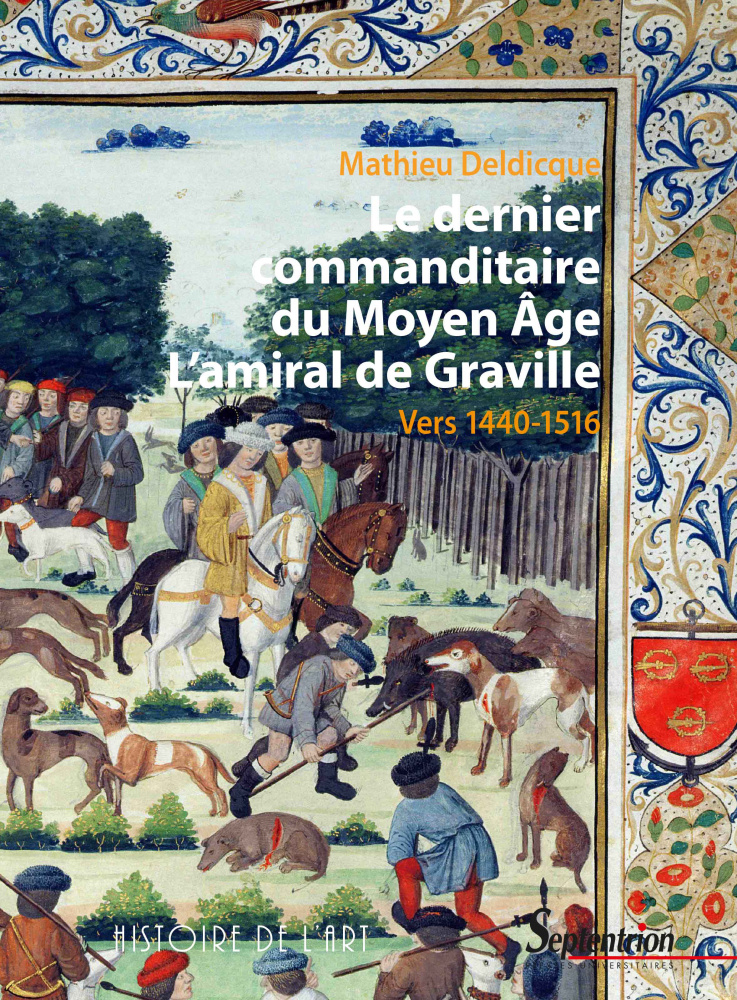
Publication – Mathieu Deldicque, « Le dernier commanditaire du Moyen Âge. L’amiral de Graville. Vers 1440-1516 »

Amiral de France à partir de 1487, Louis Malet de Graville (vers 1440-1516), est un oublié de l’histoire. Ce riche seigneur à la longue carrière politique est pourtant l’un des piliers des cours de Louis XI, de Charles VIII et de Louis XII. Mieux, c’est l’un des commanditaires laïcs les plus actifs de cette longue fin du Moyen Âge pendant laquelle le renouveau de la Renaissance est en germe.

En explorant toute l’étendue de la commande artistique de l’amiral de Graville, celle, ordinaire, attendue pour un seigneur aussi important, mais celle aussi, plus intime, qui révèle ses originalités, cette étude met à l’honneur une personnalité unique et attachante. Elle apporte un nouvel éclairage sur les modalités et les enjeux de la commande nobiliaire autour de 1500. Manuscrits superbement enluminés, fiers châteaux gardiens de l’identité familiale, églises rurales insoupçonnées de style flamboyant, mais aussi vitraux, sculptures, tapisseries, portraits peints ou dessinés, c’est, par le prisme l’amiral de Graville, tout un pan de l’histoire de l’art qui ressurgit.

Informations pratiques :

Mathieu Deldicque, Le dernier commanditaire du Moyen Âge. L’amiral de Graville. Vers 1440-1516, Villeneuve d’Ascq, Presses universitaires du Septentrion, 2021. 526 p., ISBN : 978-2-7574-3359-1. Prix : 36 euros.

Source : Presses universitaires du Septentrion

Publié dans Publications | Laisser un commentaire

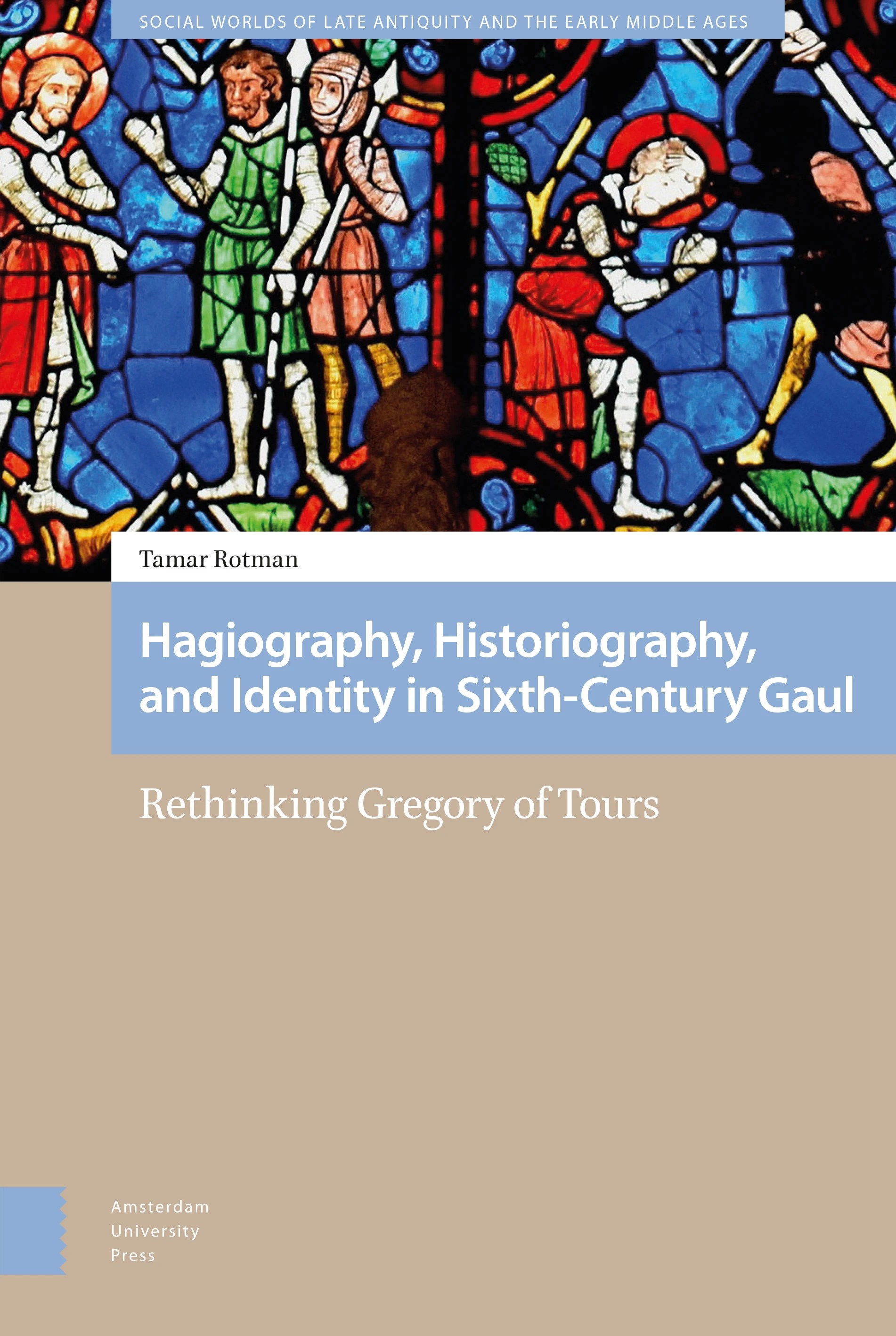
Publication – Tamar Rotman, « Hagiography, Historiography, and Identity in Sixth-Century Gaul. Rethinking Gregory of Tours »

Gregory of Tours, the sixth-century Merovingian bishop, composed extensive historiographical and hagiographical corpora during the twenty years of his episcopacy in Tours. These works serve as important sources for the cultural, social, political and religious history of Merovingian Gaul. This book focuses on Gregory’s hagiographical collections, especially the Glory of the Martyrs, Glory of the Confessors, and Life of the Fathers, which contain accounts of saints and their miracles from across the Mediterranean world. It analyses these accounts from literary and historical perspectives, examining them through the lens of relations between the Merovingians and their Mediterranean counterparts, and contextualizing them within the identity crisis that followed the disintegration of the Roman world. This approach leads to groundbreaking conclusions about Gregory’s hagiographies, which this study argues were designed as an « ecclesiastical history » (of the Merovingian Church) that enabled him to craft a specific Gallo-Christian identity for his audience.

Tamar Rotman specializes in late antique and early medieval history. Her research focuses on the role of hagiography and the cults of saints in the identity discourse of the early Middle Ages, giving special attention to the transmission of knowledge and cultural practices in the Mediterranean sphere. She is a Fulbright and a Rothschild scholar and a visiting scholar at Columbia University.

Informations pratiques :

Tamar Rotman, Hagiography, Historiography, and Identity in Sixth-Century Gaul. Rethinking Gregory of Tours, Amsterdam University Press, 2021 (Social Worlds of Late Antiquity and the Early Middle Ages). 196 p., 23,5 x 15,5 cm. ISBN : 9789463727730. Prix : 85 euros.

Source : Amsterdam University Press

Publié dans Publications | Laisser un commentaire

Publication – Colette Dufossé, « Les théories de la vision dans les mondes grecs et latins du IVe au XIIe siècle. Entre permanence et renouveau »

Du IVe au XIIe siècle, entre la fin de l’Antiquité et l’arrivée en Occident des textes arabes, aucun traité d’optique novateur n’est produit. La présente étude a pour but de mettre au jour les traditions intellectuelles, continues depuis l’Antiquité tardive, sans lesquelles la réapparition de cette science au XIIIe siècle paraîtrait inexplicable. Au croisement de problématiques multiples, les théories de la vision couvrent un champ du savoir plus large que l’optique, qui implique, outre la physiologie et la médecine, les mathématiques, la géométrie et la physique, ainsi que la philosophie, la psychologie et la théologie. À travers les recueils doxographiques, traités et commentaires philosophiques, ouvrages d’anatomie et d’anthropologie chrétienne, commentaires à la Genèse, lexiques et encyclopédies, se dessinent les étapes d’un cheminement qui, loin de se cantonner à la sauvegarde de l’héritage antique, prépare et influence l’éclatante réapparition de l’optique au XIIIe siècle.

Archiviste paléographe, agrégée de grammaire et docteur, Colette Dufossé est actuellement chercheuse membre du projet Ptolemaeus arabus et latinus de la Bayerische Akademie der Wissenschaften de Munich.

Table des matières : ici

Informations pratiques :

Colette Dufossé, Les théories de la vision dans les mondes grecs et latins du IVe au XIIe siècle. Entre permanence et renouveau, Paris, Honoré Champion, 2021. 606 p., 23,5 x 15,5 cm. ISBN : 9782745356154. Prix : 85 euros.

Source : Honoré Champion

Publié dans Publications | Laisser un commentaire

Publication – « Books of Knowledge in Late Medieval Europe. Circulation and Reception of Popular Texts », dir. Pavlína Cermanová et Václav Žůrek

This book provides a series of studies concerning unique medieval texts that can be defined as ‘books of knowledge’, such as medieval chronicles, bestiaries, or catechetic handbooks. Thus far, scholarship of intellectual history has focused on concepts of knowledge to describe a specific community, or to delimit intellectuals in society. However, the specific textual tool for the transmission of knowledge has been missing. Besides oral tradition, books and other written texts were the only sources of knowledge, and they were thus invaluable in efforts to receive or transfer knowledge. That is one reason why texts that proclaim to introduce a specific field of expertise or promise to present a summary of wisdom were so popular. These texts discussed cosmology, theology, philosophy, the natural sciences, history, and other fields. They often did so in an accessible way to maintain the potential to also attract a non-specialised public. The basic form was usually a narrative, chronologically or thematically structured, and clearly ordered to appeal to readers. Books of this kind could be disseminated in dozens or even hundreds of copies, and were often available (by translation or adaptation) in various languages, including the vernacular.

In exploring these widely-disseminated and highly popular texts that offered a precise segment of knowledge that could be accessed by readers outside the intellectual and social elite, this volume intends to introduce books of knowledge as a new category within the study of medieval literacy.

Pavlína Cermanová and Václav Žůrek are historians and researchers at the Centre for Medieval Studies, Institute of Philosophy of the Czech Academy of Sciences, Prague. In her research, Pavlína Cermanová focuses on the medieval apocalyptic thinking and intellectual history, Václav Žůrek focuses on the medieval historiography and royal representation.

Table des matières :

Preface vii

Abbreviations ix

Books of Knowledge – Late Medieval Central Europe and Beyond

PAVLÍNA CERMANOVÁ and VÁCLAV ŽÙREK 1

The Pseudo-Aristotelian Secret of Secrets: Encyclopedia or Book of Knowledge?

STEVEN J. WILLIAMS 11

A Handbook for Everyone? Thomas of Cantimpré’s Book of Bees and Its Circulation in Late Medieval Europe

JULIA BURKHARDT 35

Chess, Moral Principles, and Ancient Stories: The Success of Jacobus de Cessolis’s Liber de moribus and Other Classicising Works in Medieval Bohemia

VÁCLAV ŽŮREK 59

The Pseudo-Bernhardine Epistola de cura rei familiaris and its Reception in Medieval Bohemia and Moravia

PAVEL BLAŽEK and BARBORA ŘEZNÍČKOVÁ 85

From Manual to Best-Seller: The History of Honorius Augustodunensis’s Elucidarium

GLEB SCHMIDT 137

From Theology to Universal Knowledge: The Story of the Elucidarium and its Vernacular Adaptations in the Czech lands (Fourteenth-Fifteenth Centuries)

JAROSLAV SVÁTEK 165

A ‘Book of Knowledge’? The De tribus punctis christianae religionis (1316) by Thomas Hibernicus and its Heyday in Late Medieval Bohemia

LUCIE DOLEŽALOVÁ 183

Patterns of Knowledge in Late Medieval Historiography: The Chronologia Magna of Paolino Veneto

NADINE HOLZMEIER 203

Reading the Early Church: A Witness from Kutná Hora of the Chronicon pontificum et imperatorum by Martin of Opava

VOJTĚCH BAŽANT 229

The Physiologus Theobaldi: A Most Successful Bestiary in Medieval Schools and Monasteries

BAUDOUIN VAN DEN ABEELE 247

Christian of Prachatice’s Latin Herbarium and its adaptations in Old Czech literature

DANA STEHLÍKOVÁ 275

The Aims of Perspectiva in 1360s Paris: Investigating Texts Written in the Hand of Reimbotus de Castro

LUKÁŠ LIČKA 299

Sharing Academic Knowledge: Commentaries on the Secretum secretorum

PAVLÍNA CERMANOVÁ 331

Indices of Manuscripts, Placenames, and Personal Names 361

Informations pratiques :

Books of Knowledge in Late Medieval Europe. Circulation and Reception of Popular Texts, dir. Pavlína Cermanová et Václav Žůrek, Turnhout, Brepols, 2021 (Utrecht Studies in Medieval Literacy, 52). XIV+376 p., 22 b/w ill., 1 b/w tables, 156 x 234 mm, 2021 ISBN: 978-2-503-59463-7. Prix : 100 euros.

Source : Brepols

Publié dans Publications | Laisser un commentaire

Publication – « Genèses et filiations dans l’œuvre de Christine de Pizan », dir. Dominique Demartini et Claire Le Ninan

Sous la plume de Christine de Pizan se dessinent des filiations réelles ou imaginaires, des arborescences complexes qui mettent en lumière une pensée de la genèse et de la filiation. « Naître et hériter », « engendrer et transmettre », « parentés et communautés », trois fils conducteurs permettent de saisir cette pensée.

Table des matières : ici

Informations pratiques :

Genèses et filiations dans l’œuvre de Christine de Pizan, dir. Dominique Demartini et Claire Le Ninan, Paris, Classiques Garnier, 2021 (Rencontres, n° 516 / Civilisation médiévale, n° 43). 442 p., ISBN : 978-2-406-11890-9. Prix : 39 euros.

Source : Classiques Garnier

Publié dans Offre d'emploi | Laisser un commentaire

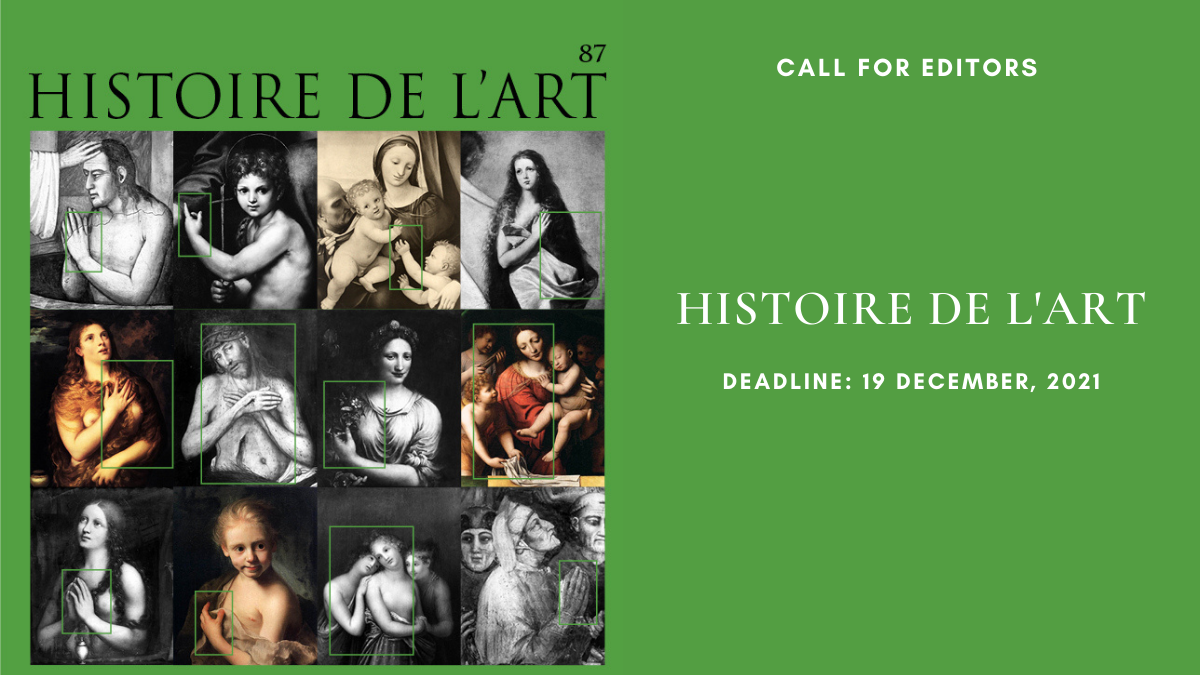
Appel à candidature – Histoire de l’art Editorial Board

The journal Histoire de l’art is looking for a member specializing in medieval art history and a member specializing in modern art history for its editorial board. The journal is dedicated to the publication of articles by young researchers, thus established in a dialogue with more experienced researchers who support them. Along with the other members of the editorial board, the two new members will participate in the life of Art History , which publishes two thematic issues per year as well as varia ( on the Apahau blog ). These articles cover all fields of art history, from Antiquity to the 21st century (see the list of published issues ).The expected involvement of the new members of the editorial board concerns:- participation in the drafting of calls for contributions within the framework of thematic issues (see for example the last call to date);- reading and participating in the evaluation of the proposals submitted by the authors to the various sections as well as participating in the final choices of the articles selected;- an investment in a writing collaboration with these young authors who are thus guided and supported in the improvement of their articles;- participation in the life of the journal (presentation of issues, exhibitions, etc.).The committee meets approximately 4 times a year.

Founded in 1988, the journal is edited by Apahau with the support of the Direction générale des patrimoines, the Center national du livre, the École du Louvre, the Institut national d’histoire de l’art and the Center German art history. The editorial board now has seventeen members, teacher-researchers and curators; since 2018, its editor-in-chief has been Dominique de Font-Réaulx, general curator at the Louvre museum. The journal is published in 600 copies; issues are between 200 and 300 pages long.

For an overview of the history of the journal, see the 30-year anniversary issue , published in 2018.
For more information on the journal, see the article presenting the journal on this blog .

People (research professors or heritage curators) who would be interested in participating in the editorial committee are requested to send by December 19 at the latest a brief presentation of their background and their motivations (about half a page). addressed to the editor-in-chief Dominique de Font-Reaulx ( dominique.de-font-reaulx [a] louvre.fr ) with a copy to the editorial office ( revueredachistoiredelart [a] gmail.com ) indicating the title of the email: Committee editorial review Art History accompanied by the mention of the specialty (Middle Ages or Modern Period).

For more information, click here.

Source: Medieval Art Research

Publié dans Appel à contributions | Laisser un commentaire