Offre d’emploi – 2023 Postdoctoral Fellowships – Migration and Mobility, University of Tübingen

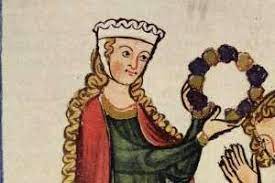
The Centre for Advanced Studies “Migration and Mobility in Late Antiquity and the Early Middle Ages” at the University of Tübingen, Germany invites applications for resident fellowships starting in 2023. The fellowships are available for a duration between one and twelve months.

The Centre for Advanced Studies, funded by the German Research Foundation (DFG), brings together scholars from a wide range of disciplines working on migration and mobility in Europe and the Mediterranean between 250 and 900 CE. The overall aim of the Centre is to explore new approaches to migration and mobility in this period and to set the scholarly debate in the field on a new footing.

Fellowships are available for scholars at all stages of their academic career who have completed their doctoral degree and established an independent research profile. Applicants should be engaged in a research project in any relevant discipline that is related to the Centre’s interests in migration and mobility in the period and area in question. The Centre also welcomes applications from scholars working on migration and mobility in the contemporary world whose research has a strong focus on theoretical and methodological issues.

Fellows are required to reside in Tübingen, where they pursue their own research project while also participating in the colloquia held at the Centre. For the duration of their stay fellows receive a stipend covering  accommodation, travel, and/or living expenses in accordance with their needs and the pertinent regulations of Tübingen University and the DFG.

Applications should include a CV, a research proposal for the project to be pursued at Tübingen (2000 words), an indication of the months the applicant would like to spend at the Centre and the kind of financial support they require. All materials should be sent in a single pdf document to luisa.luiz@uni-tuebingen.de by March 31, 2022.

Should you have any questions pertaining to the details of the fellowship program or the application, please contact the coordinator Thomas Kohl (Thomas.kohl@uni-tuebingen.de).

Source : Medieval Art Research

Publié dans Offre d'emploi | Laisser un commentaire

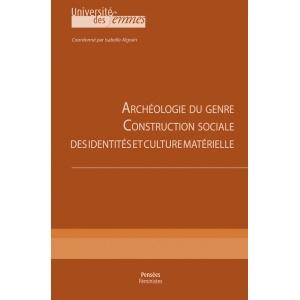
Publication – « Archéologie du genre. Construction sociale des identités et culture matérielle », dir. Isabelle Algrain

L’archéologie du genre, bien présente dans la recherche anglophone depuis plus de quarante ans, semble avoir enfin trouvé, depuis quelques années, un terrain fertile dans le monde francophone. Cette archéologie, qui étudie la construction sociale des identités au moyen de la culture matérielle, vise à développer notre conscience critique des structures normatives de genre propres à notre société occidentale moderne et, surtout, à identifier leur influence sur notre interprétation du passé. Les contributions rassemblées dans ce volume ont pour objectif, d’une part, de mettre en avant l’influence de ces structures normatives à la fois sur la théorie et la pratique archéologiques et, d’autre part, de proposer une nouvelle approche dans l’interprétation des preuves matérielles et biologiques des cultures passées.

Table des matières :

Introduction. Pourquoi une archéologie du genre? Isabelle ALGRAIN

  • Genre, corps, sexe… et matérialité : quand les sciences sociales questionnent l’objet « féminin » ou « masculin » en archéologie, Chloé BELARD
  • Approche archéo-anthropologique d’ensembles funéraires : question de sexe biologique ou de genre? Alexandra BOUCHERIE
  • Pratiques funéraires, mobilier funéraire et genre : état des lieux des études mérovingiennes dans le bassin parisien, Clara BLANCHARD
  • Genre, statut social et pouvoir dans la Macédoine archaïque, Vivi SARIPANIDI
  • Les femmes et l’offrande d’étoffes dans les sanctuaires grecs. Une enquête sur la participation des femmes à la vie religieuse des cités archaïques et classiques, Vicky VLACHOU
  • Une préhistoire du sein en Mésoamérique : entre fertilité, vie domestique et maternité, Estelle PRAET
  • Le genre au haut Moyen Âge : une approche par l’objet, Justine AUDEBRAND
  • Le féminisme et la question du genre en archéologie : de la théorie à la pratique, Laura MARY

Informations pratiques :

Archéologie du genre. Construction sociale des identités et culture matérielleArchéologie du genre. Construction sociale des identités et culture matérielle, dir. Isabelle Algrain, Bruxelles, Université des Femmes, 2020. Prix : 20 euros.

Source : Université des Femmes

Publié dans Publications | Laisser un commentaire

Offre d’emploi – PhD Scholarship–Early Irish Hands

1IRC-SFI Pathway PhD Scholarship–Early Irish Hands
Post Description:

The Department of History, School of Histories and Humanities, is pleased to advertise a PhD scholarshipto join Dr Nicole Volmering on her SFI-IRC Pathway Programme project ‘Early Irish Hands: The Development of Writing in Early Ireland’from September 2022.

The project studies early Irish palaeography and writing techniques based on manuscripts from the earliest stratum of Irish writing (550-900). Itaims at contributingto a better understanding of the writing techniques used in earlyIrish scriptoria and to enable more accurate dating of early manuscripts through an improved understanding of variations in Irish script. In addition, it lays the groundwork for research into Irish-Continental script. This is important because palaeography is one of very few methods available that can help identify where and how a manuscript was made or read. The project takes an inclusive approach to the analysis of writing techniques and underpins traditional graph analysis with research on the material aspects of the manuscript. With this approach the project seeks to place palaeographical analysis on a surer footing and to contribute to the understanding of regional manuscript-making techniques in their insular and European context.

The PhD student will be working on Strand 3 of the project, which involves a case study of the use of Irish script on the continent based on a group of manuscripts from Reichenau.The aim of this Strand is to study the ranges and types of variation in script and writing techniques in the manuscripts selected.The award provides a unique opportunity to engage in frontier research on manuscript studies carried out at Trinity College Dublin. The successful candidate will be enrolled in the Structured 4-year PhD Programme in theDepartment of History.


The Award consists ofa stipend of €18,500 annually plus a travel budget and a €5,750 contribution towards fees.

The successful applicant should have the following qualifications:

Essential:

A Master’s degree / diploma (awarded or pending) or international equivalent (German Staatsexamen, etc.) in a relevant academic area (relevant areas include but are not limited to: Classics,Early Irish,Medieval Studies, History, Manuscript Studies, Digital Humanities, Celtic Studies)
Evidence of solid knowledge ofLatin
Excellent command of English (as per Trinity’s general requirements)

Desirable:
Evidence of engagement with manuscript studies
Evidence of experience with medieval (Latin and/or insular) palaeography
Evidence of experience withDigital Humanities
Reading knowledge of German

Application:

Candidates are invited to apply for this position by sending their application documents to the Department of History by the deadline of 5pm on Monday6 June 2022.Applicants should send their documentsina single PDF file to Dr Nicole Volmering (volmern@tcd.ie)AND to Eilís Dunne(pghishum@tcd.ie).Applications will not be considered complete until refereeshave submitted their references.

The following documents are required (see also these general application guidelines)

A motivation letter addressing how you intend to approach the research topic
Two letters of recommendation
Certified academic transcripts for all degreesCertified degree certificates for all degrees
A detailed CV
A writing sample (an academic essay, an article, a chapter from a dissertation, or the like)

The application maybe followed up by an online interview in the second half of June.Applicants will be notified of the outcome of their application in earlyJuly.

Important Information

Please notethat all applicants must meet the general requirementsfor a PhD at Trinity College Dublin (TCD).

For non-native English speakers without a degree from an English-speaking institution, a language test is required (TOEFL or IELTS); the application can be submitted without the test, but any offer made will be conditional until the required test results are submitted.

The successful candidatewillfurther have to apply for their place through the TCD systemseparately.

Applications have to be submitted by followingthe link for Doctor in Philosophy, History (Full Time –4 years) under September 2022 entryhere.For any questions or informal discussions, please do not hesitate to contact Dr Nicole Volmering (volmern@tcd.ie)

Source : Trinity College Dublin

Publié dans Offre d'emploi | Laisser un commentaire

École d’été – Changement climatique, paléoenvironnement et archéologie

6JUIN – 10JUIN 2022

MADRID

École thématique

Date limite d’inscription
20 avril 2022 (minuit, heure de Madrid)

Coordination scientifique :Dirce MARZOLI (Deutsches Archäologisches Institut, Madrid) et Gwladys BERNARD (EHEHI-Casa de Velázquez, Madrid)
Organisation : Deutsches Archäologisches Institut (Madrid), École des hautes études hispaniques et ibériques (Casa de Velázquez, Madrid)


Inscriptionobligatoire
À travers le formulaire en ligne
 

Lieux :
Instituto Arqueológico Alemán, C/ Serrano 159, 28002 Madrid
Casa de Velázquez, C/ de Paul Guinard 3, 28040 Madrid

Nombre de places : 15

L’école thématique s’inscrit dans le cadre de la collaboration scientifique entre l’Institut archéologique allemand de Madrid et l’École des hautes études hispaniques et ibériques (Casa de Velázquez, Madrid) et s’est convertie en un rendez-vous de renommée internationale. En 2020 et 2021, cette activité a été suspendue en raison de la pandémie, mais nous sommes confiantes quant à la tenue de cette quatorzième édition.

L’atelier met à disposition des jeunes chercheurs un cadre idéal qui favorise un dialogue ouvert, critique et constructif.

La thématique de l’atelier pour 2022 concernera le changement climatique et ses répercussions sur l’environnement et les sociétés antiques. Cette thématique, profondément ancrée dans l’actualité, se voit reflétée dans le renouvellement de l’approche historique qui intègre désormais la question du changement climatique à celles des changements historiques et culturels, sociaux et politiques, ainsi qu’à d’autres aspects de la vie individuelle et collective. Les méthodes interdisciplinaires de l’archéologie accompagnent ce renouvellement de l’approche. Analyses géologiques, géographiques, archéobotaniques, archéozoologiques ou anthropologiques, en lien avec les analyses archéologiques et historiques, sont autant d’opportunités pour la détection des causes des multiples changements dans l’environnement : déplacements ou diminutions de populations, changements de régimes alimentaires, maladies et décès, dérivent, de manière directe ou indirecte, de ces changements climatiques. Les catastrophes naturelles (inondations, sécheresses, tempêtes, tremblements de terre, tsunamis, pandémies…) ont laissé des traces que l’archéologie permet de contextualiser et de dater.
 

Plusieurs thématiques seront ainsi abordées, telles que :

  • Le dialogue entre les sciences naturelles et l’archéologie
  • La documentation concernant le changement climatique paléoenvironnemental dans des contextes archéologiques et leurs environs
  • Les répercussions des changements climatiques sur les développements culturels, sociaux et démographiques
  • Climat et changements de l’environnement abordés dans les sources antiques
  • Changements climatiques et développement de nouvelles archéologies (arctique, déserts, glaciers, haute montagne zones littorales marines)
  • Changements climatiques et patrimoine culturel

Cette école thématique cherche à susciter une réflexion scientifique et méthodologique et s’adresse spécialement aux doctorants en histoire antique, en archéologie, en architecture et en sciences de la Vie et de la Terre en lien avec les sciences humaines, issus d’universités et des centres de recherche de toute l’Europe et du Maghreb. Elle vise à créer des espaces d’échanges d’expériences, et d’analyse des pratiques et méthodologies dans les différentes traditions de la recherche.

Chaque participant·e sera ainsi invité·e à s’impliquer activement dans l’enrichissement des échanges en présentant son thème de recherche doctorale (en lien avec l’atelier), en prolongeant la réflexion collective, avec le soutien de spécialistes confirmés de renommée internationale.

L’atelier se déroulera en alternance au Deutsches Archäologisches Institut et à la Casa de Velázquez.
 

15 doctorant·e·s seront sélectionné·e·s parmi les candidat·e·s en fonction de la qualité de leur projet de recherche doctorale.

Des chercheurs d’envergure internationale participeront à cette école thématique en tant qu’encadrants scientifiques et représenteront de multiples disciplines : histoire antique, archéologie classique, archéologie de l’Antiquité tardive et médiévale, géoarchéologie, géographie, archéobotanique, dendochronologie et anthropologie, apportant ainsi leur expérience et expertise dans les disciplines abordées :
 

  • Manuel Álvarez Martí-Aguilar
    Département des sciences historiques, Université de Málaga
  • Ferran Antolín
    Département de sciences naturelles, Institut archéologique allemand, Berlin
  • Helmut Brückner
    Département de Géographie, Université de Cologne
  • Ingo Heinrich
    Département de de sciences naturelles, Institut archéologique allemand, Berlin
  • Oliva Rodríguez
    Département de Préhistoire et d’Archéologie, Université de Séville
  • Philipp von Rummel
    Secrétariat Général, Institut archéologique allemand, Berlin


Conditions pratiques

Il n’y a pas de frais d’inscription.

Les candidats devront s’inscrire via ce formulaire en ligne jusqu’au 20 avril 2022 (minuit, heure de Madrid).

La sélection ou non des candidatures sera notifiée par courrier électronique à partir du 27 avril 2022.

La Casa de Velázquez accueillera les candidat·e·s retenu ·e·s qui le souhaitent et ne résident pas à Madrid pour les nuits du 5 au 10 juin 2022 (6 nuits) en chambre simple (petit-déjeuner inclus). Le déjeuner sera offert à tous les participants, à la Casa de Velázquez et au DAI.

Le voyage de et vers Madrid et les dîners demeurent à la charge des participants.

La Casa de Velázquez et le DAI-Madrid offrent trois bourses d’un montant maximal de 350 euros (pour le voyage) à des étudiant·e·s inscrit·e·s dans des établissements supérieurs du Maghreb qui en feraient la demande.

Langues de l’atelier : espagnol, français, allemand, anglais, portugais et italien.

Source : Casa de Velazquez

Publié dans École d'été | Laisser un commentaire

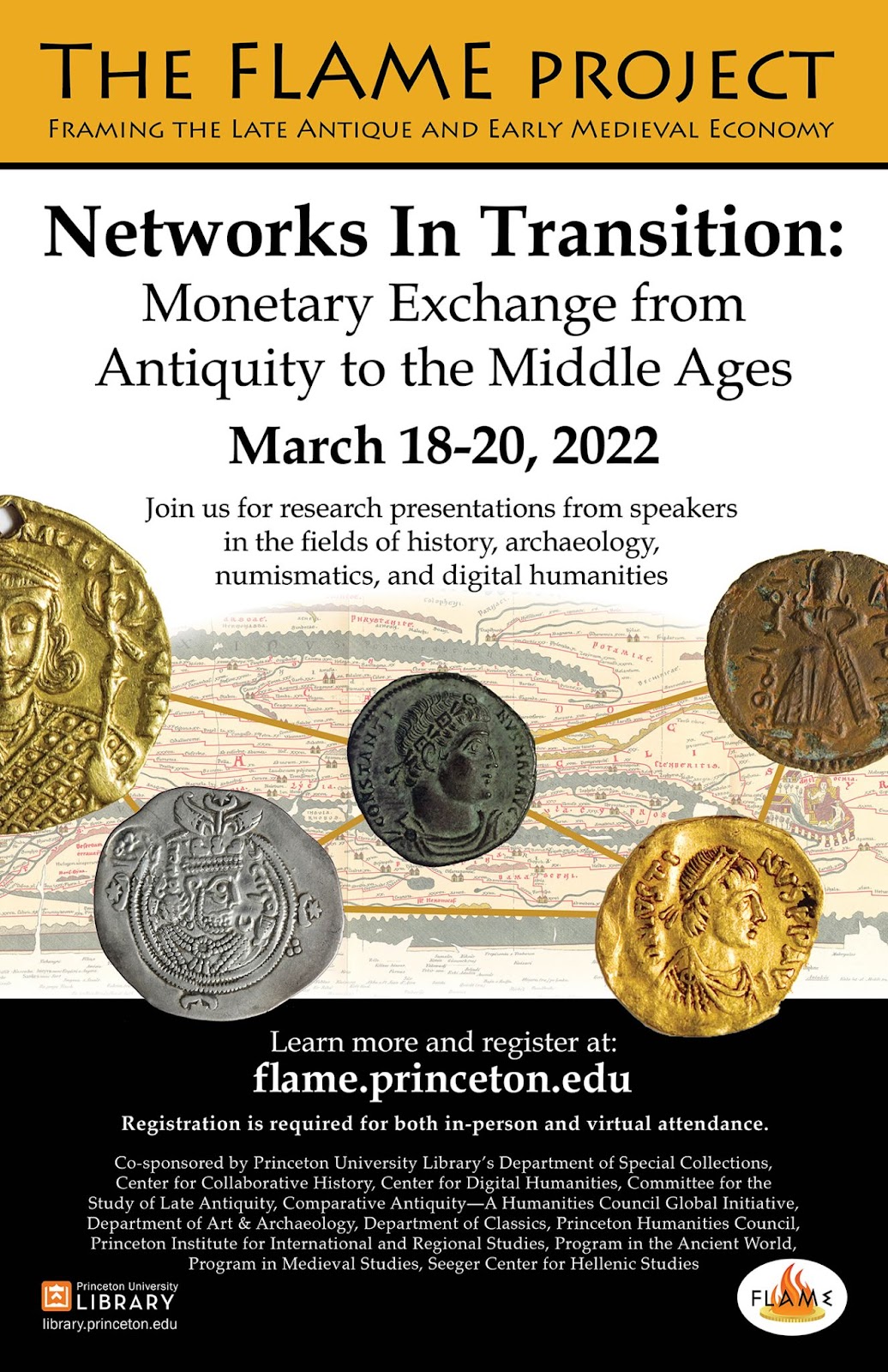
Colloque – Networks in Transition: Monetary Exchange from Antiquity to the Middle Ages

On March 18, 2022, numismatics scholars and enthusiasts from many nations will gather in Princeton for “Networks in Transition: Monetary Exchange from Antiquity to the Middle Ages,” a conference organized by the FLAME Project at Princeton University. FLAME – which stands for Framing the Late Antique and early Medieval Economy – looks to reconstruct the early medieval economy (CE 325-725) in the Mediterranean region and Western Asia.

The conference will present a rare opportunity for scholars – both those who have been involved with FLAME previously, and those who are not currently involved – to meet one another and share the results of their research on this wide-ranging topic.

Speakers from the Czech Republic, Germany, Greece, Italy, North Macedonia, Spain, Turkey, Ukraine, the United Kingdom and the U.S. are expected to attend. They will join FLAME project leaders to share their insights and expertise, and help shape a new consensus about the Late Antique to Medieval transition. 

Keynote speakers include: Rory Naismith, University of Cambridge; Khodadad Rezakhani, Leiden University; Florin Curta, University of Florida; and Stefan Heidemann, Universität Hamburg.

“This is exactly the sort of event to welcome the scholarly community back into real-world dialogue. It brings together a superb selection of scholars, new and established,” said Naismith. “I am looking forward very much to a few days of productive discussion that will stimulate work on the significance of coined money in late antiquity.”

Organized by the Princeton University Library’s Numismatic Collection, FLAME involves an international group of scholars investigating the process of change in the economy of the Mediterranean and surrounding regions during the transitional period from antiquity to the early Middle Ages in the Byzantine, Islamic and European spheres, by using coinage as a proxy. FLAME’s website includes two mapping applications for evidence of minting and coin circulation, including downloadable charts and an extensive bibliography of coin more than 65,000 finds illustrating the circulation of over 750,000 coins. The data underlying the project is continuously being vetted and cleaned. 

“This event is going to bring together a diverse group. Scholars of the Latin West, for example, typically do not regularly share insights with scholars of the Islamic East,” said Alan Stahl, Chair of FLAME and Curator of Numismatics at Princeton University Library. “This will be a great opportunity for such dialogue. FLAME is trying, moreover, to push its reach further into Central and East Asia, and this will be a good opportunity for scholars with the relevant knowledge (some of whom we have invited as speakers) to provide input on the project in a concrete way.”

Conference organizers hope to provide scholars of the field with wider perspectives by exposing them to scholars and scholarship from other countries and regions. Scholars of digital humanities will also have the opportunity to get an in-depth look at workings of FLAME’s custom-designed applications. « In particular, scholars of digital humanities will have the opportunity to participate in discussions about data reliability, comprehensiveness, and problems of working with incomplete data in the humanities, » said Mark Pyzyk, the database coordinator for FLAME.

The aim of the conference will be to highlight some of the historical insights generated by the FLAME web tools that have been published online over the last few years. Conference participants will discuss how numismatic data on this scale informs our views on the collapse of the western Roman empire, the consolidation of the Byzantine empire in the east, and the rise of Islam. 

Data and web tools from the project are freely available and shared on an open-data basis. Talks will be live-streamed and the recordings will form part of the record on this topic.

Regisration is required to attend “Networks in Transition: Monetary Exchange from Antiquity to the Middle Ages.” There is no cost to attend (in-person or virtually). Register here.
  
For more information about the FLAME Project, please visit: flame.princeton.edu

Visit the Princeton University Numismatics Collection to learn more about our academic coin collection – one of only a few in the United States.

Written by: Stephanie Oster, Publicity Manager

Media Contact: Barbara Valenza, Director of Library Communications

Source : The Flame Project

Publié dans Le réseau | Laisser un commentaire

Appel à contribution – Die Ehe im Früh- und Hochmittelalter

Deadline : 25.03.2022
Philipps-Universität Marburg (29.09.2022 – 30.09.2022).

Tagung des Arbeitsgebiets für Mittelalterliche Geschichte der Philipps-Universität Marburg und der Akademie der Wissenschaften und der Literatur Mainz, Projekt „Regesta Imperii“. Marburg, Donnerstag 29. bis Freitag 30. September 2022.

Die Ehe im Früh- und Hochmittelalter

Das Konzept „Ehe“ existiert seit jeher über unzählige Kultur- und Epochengrenzen hinweg. Sie wird romantisiert und emotionalisiert, aber – gerade im Mittelalter – auch als rechtliches und politisches Mittel genutzt. Dabei hat sich unser Bild von der Ehe im Früh- und Hochmittelalter in den letzten 15 bis 20 Jahren wesentlich geändert. Zentrale Aspekte des Themas Ehe, wie die Ausweitung des Inzestverbots, das „Konkubinat“ und die „Friedelehe“ wurden einer Neubewertung unterzogen und wirkmächtige Forschungskonstrukte revidiert. Daran knüpft unsere Tagung an, die sich der „Ehe“ in der Zeit von ca. 500 bis 1250 widmen und methodisch und inhaltlich neue Perspektiven entwickeln möchte.

Der Begriff „Ehe“ oder auch „Ehelichkeit“ wird dabei weit gefasst, um eine vielfältige Bandbreite an Fragen aufzugreifen. Untersuchungsfelder sind die Ehe als Mittel politischer Allianzen, die Strategien und Planungen von Eheschließungen sowie die daran beteiligten Akteure und Netzwerke. Des Weiteren sollen auch Aspekte untersucht werden, die soziale und rechtliche Normen betreffen wie beispielsweise Bigamie, außereheliche Beziehungen und Ehebruch, Scheidung und Wiederheirat. Schließlich sollen auch ethische Fragen nach der sexuellen Enthaltsamkeit und Keuschheit sowie die bewusste Entscheidung für Ehelosigkeit, etwa im Rahmen des Priesterzölibats, diskutiert werden.

Wir laden Sie herzlich ein, zu diesen Untersuchungsfeldern Vorschläge für Vorträge (auf Deutsch oder Englisch) von ca. 30 Minuten einzureichen. Bitte senden Sie uns ein Abstract Ihres geplanten Vortrags im Umfang von ca. 200-300 Wörtern zusammen mit einem kurzen Lebenslauf bis Freitag, 25. März 2022 zu.

Die Tagung wird vom 29.–30. September 2022 an der Philipps-Universität Marburg stattfinden, die anschließende Publikation der Beiträge ist vorgesehen.

Kontakt

Magdalena-Maria Berkes,
Philipps-Universität Marburg
Wilhelm-Röpke-Straße 6
35032 Marburg
E-Mail: magdalena-maria.berkes@uni-marburg.de

Source : H-Soz-Kult

Publié dans Appel à contributions | Laisser un commentaire

Conférence – Julien Adam, « L’adaptation de l’architecture castrale aux exigences militaires, résidentielles et politiques. Le cas de Moha (Xe-XIVe siècle) »

14 mars 2022

Mis sur pied en 2014, les Midis du CRHiDI sont l’occasion de donner la parole aux chercheur·e·s du centre (ou d’institutions extérieures) afin de présenter une recherche en cours. Ils doivent permettre de montrer l’actualité des recherches en histoire du droit, des institutions et de la société telles qu’elles sont menées actuellement.

Cycle thématique : « Codes, normes et traditions sociales en Occident antique et médiéval »

Intervenant : Julien Adam (Les Amis du château médiéval de Moha ASBL)

Modération : Éric Bousmar (USL-B/CRHiDI)

Bâtie entre le Xe et le XIVe siècle sur un éperon rocheux situé à la confluence de la Mehaigne et de la Fosseroule, la forteresse de Moha fut occupée successivement par les Comtes de Moha, par la puissante famille de Dasbourg et par les Princes-Evêques de Liège. Loin d’être homogène, son architecture a significativement évolué au fil du temps, empreinte de normes régionales ou d’influences extérieures nouvelles, dans le but de répondre aux exigences militaires, résidentielles et politiques de ses propriétaires. Plus que cela, elle deviendra également un formidable symbole du pouvoir et de l’autorité épiscopale après son annexion à la Principauté de Liège sous Hugues de Pierrepont. Par l’étude conjointe des documents d’archives et des données archéologiques récemment acquises, cette communication vise à faire le point sur les grandes phases de construction et de transformation de la forteresse de Moha, en éclairant les raisons qui auraient pu pousser ses propriétaires successifs à optimiser les structures existantes ou entreprendre de nouveaux aménagements.

Informations pratiques :

Université Saint-Louis – Bruxelles

Bvd du Jardin Botanique, 43

1000 Bruxelles

14/03/2022

Local 4015

12h30-14h

Accueil et présentation de l’intervenant – Exposé – Discussion modérée par le Prof. Eric Bousmar

Des sandwiches seront prévus. 

La participation aux Midis et au lunch est gratuite, mais sur inscription via ce FORMULAIRE, pour le 09/03/2022.

Attention : L’organisation de ce Midi du CRHiDI sera soumise aux dernières mesures sanitaires alors en vigueur à l’Université Saint-Louis – Bruxelles.

Source : CRHiDI

Publié dans Colloque | Laisser un commentaire

Publication – « Mémoire morcelée – 150 ans d’archéologie en Île-de-France », dir. Christian Landes et Bertrand Triboulot

Ce titre est le premier d’une nouvelle collection des Éditions du patrimoine : « Mémoire morcelée » ; chaque titre dresse le bilan de la recherche archéologique dans une région française, du paléolithique au XXe siècle. Sites et objets remarquables y sont étudiés et reproduits. La collection s’adresse aux professionnels, aux amateurs et aux curieux. Plusieurs niveaux de lecture y sont proposés, afin de toucher le plus large lectorat possible. L’archéologie fait rêver le grand public et c’est l’un des objectifs de cette collection que d’être le vecteur de ce rêve. De sorte que, si le propos est rigoureusement scientifique, le style et la forme y sont aussi séduisants qu’accessibles.

Avec ce premier titre, 150 ans d’archéologie en Île-de-France, c’est tout un pan méconnu de l’histoire de cette région qui est ressuscité. Au fil du sommaire, seront présentés les époques paléolithique, néolithique et chalcolithique, l’âge du bronze, l’âge du fer, l’époque gallo-romaine, le Haut Moyen Âge, le Moyen Âge avec les exemples de Paris et de Saint-Denis, et enfin la période moderne.

Christian Landes est conservateur en chef du patrimoine honoraire. Il a également été l’administrateur des sites archéologiques de Montcaret et Montmaurin dont il a écrit les « Itinéraires ».

Bertrand Triboulot est un archéologue français du ministère de la Culture, diplômé de l’École pratique des hautes études (EPHE). Son domaine de spécialité est la protohistoire et plus précisément le premier âge du fer (Hallstatt). Il a travaillé en Allemagne et en Suisse, mais surtout dans l’est et le sud de la France. Aujourd’hui, cet ingénieur d’études exerce les fonctions de responsable territorial du département des Yvelines au sein de la DRAC d’Île-de-France – Service régional de l’archéologie. Il est également chercheur associé au CNRS. Il concourt au développement des nouvelles technologies en archéologie (LIDAR, photogrammétrie, réalité augmentée, tomographie, etc.).

Table des matières :

Avant-propos

Introduction

Christian Landes et Bertrand Triboulot

·        Présentation des cartes, Laurence Moreno

Archéologie en Ile-de-France

·        Histoire de l’archéologie en Île-de-France, Jean-Paul Guillaumet

·        Les acteurs de l’archéologie en Île-de-France, Bruno Foucray

Le paléolithique

·        Le paléolithique ancien et moyen, Jean-Marc Gouédo

·        Le paléolithique supérieur ancien, Pierre Bodu

·        Le paléolithique supérieur récent, Grégory Debout

·        Le mésolithique, Boris Valentin

Le néolithique,

Richard Cottiaux, Cynthia Domenech-Jaulneau & Jean-Gabriel Pariat

L’âge du bronze,

Anne-Marie Adam

L’âge du fer

·        Le premier âge du fer, Laurent Olivier

·        Le second âge du fer, Stéphane Marion

L’époque gallo-romaine,

Danielle Magnan & Christian Landes

Le haut Moyen Âge,

Bruno Foucray

Le Moyen Âge, les exemples de Paris et Saint-Denis

·        L’exemple de Paris, Marc Viré

·        L’exemple de Saint-Denis, Nicole Rodrigues

Archéologie des périodes moderne et contemporaine, Yves Roumegoux

Annexes

Informations pratiques :

Mémoire morcelée – 150 ans d’archéologie en Île-de-France », dir. Christian Landes et Bertrand Triboulot, Paris, Éditions du Patrimoine, 2022. 320 p., 298 ill. ISBN : 9782757705193. Prix : 59 euros.

Source : Éditions du Patrimoine

Publié dans Publications | Laisser un commentaire

Publication – »North Sea Crossings The Literary Heritage of Anglo-Dutch Relations 1066–1688″, ed. Sjoerd Levelt and Ad Putter

North Sea Crossings sheds new light on the literature and art of a pivotal period in European history by exploring the cultural relationship between speakers of Dutch and speakers of English in England and the Dutch Low Countries.

This richly illustrated book tells the story of cultural exchange between the people of the Low Countries and England in the Middle Ages and the Early Modern period, revealing how Anglo-Dutch connections changed the literary landscape on both sides of the North Sea.

Ranging from the Norman Conquest of 1066 to the “Glorious Revolution” of 1688, North Sea Crossings uncovers the lasting impact of contacts and collaborations between Dutch and English speakers on historical writing, map-making, manuscript production, and early printing. The literary heritage of Anglo-Dutch relations is explored and lavishly illustrated through a unique collection of manuscripts, early prints, maps, and other treasures from the Bodleian Library.

Informations pratiques :

North Sea Crossings The Literary Heritage of Anglo-Dutch Relations 1066–1688, ed. Sjoerd Levelt and Ad Putter, Chicago, The University of Chicago Press, 2022. 304 pages | 100 color plates | 9 1/4 x 10 1/4. Prix: USD 65.

Source : The University of Chicago Press

Publié dans Publications | Laisser un commentaire

Publication – Julie De Groot, « At Home in Renaissance Bruges. Connecting Objects, People and Domestic Spaces in a Sixteenth-Century City »

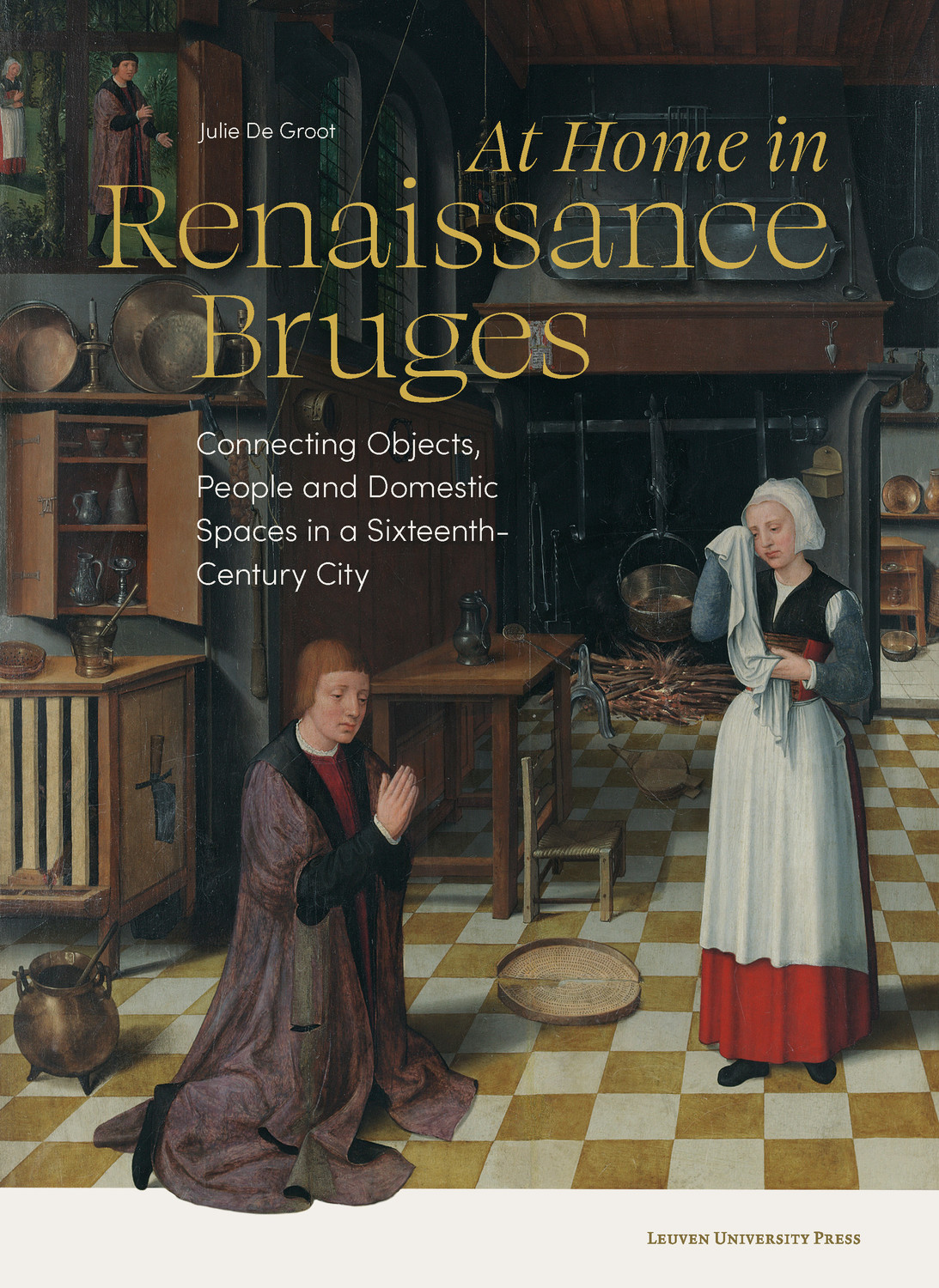
How did citizens in Bruges create a home? What did an ordinary domestic interior look like in the sixteenth century? And more importantly: how does one study the domestic culture of bygone times by analysing documents such as probate inventories? These questions seem straightforward, yet few endeavours are more challenging than reconstructing a sixteenth-century domestic reality from written sources. This book takes full advantage of the inventory as a source and convincingly frames household objects in their original context of use. Meticulously connecting objects, people and domestic spaces, the book introduces the reader to the rich material world of Bruges citizens in the Renaissance, their sensory engagement, their religious practice, the daily activities of men and women, and other social factors. By weaving insights from material culture studies with urban history, At Home in Renaissance Bruges offers an appealing and holistic mixture of in-depth socio-economic, cultural and material analysis. In its approach the book goes beyond heavy-handed theories and stereotypes about the exquisite taste of aristocratic elites, focusing instead on the domestic materiality of Bruges’ middling groups. Evocatively illustrated with contemporary paintings and images of furniture and textiles from Bruges and beyond, this monograph shows a nuanced picture of domestic materiality in a remarkable European city.

Table des matières :

GENERAL INTRODUCTION 

The Spatial Turn 

Reclaiming Domesticity 

At Home in Renaissance Bruges 

Sources and Challenges 

The Structure of the Book 

PART 1

CROSSING THE THRESHOLD: THE ORGANISATION OF DOMESTIC SPACE

INTRODUCTION 

Functional Specialisation: A Subject of Discussion 

What’s in a Name? The Nomenclature of Domestic Space 

CONNECTING THE HOUSE TO THE STREET? THE SHOP AND WORKSHOP 

Introduction 

‘Historians and the Nation of Shopkeepers’ 

Shops and Shopping in Bruges 

Similarities and Differences: The Broader Picture 

THE MERCHANT IN THE CONTOOR 

Introduction 

The Contoor in Bruges 

Similarities and Differences: The Broader Picture 

AT THE HEART OF THE HOME: ROOMS AT THE HEART OF DOMESTIC CULTURE 

The Kitchen in Bruges 

Dining Room and Salette 

The Elusive Realm of Sleep: Sleeping Rooms 

Similarities and Differences: The Broader Picture 

PART 2

DOMESTIC OBJECTS IN CONTEXT

INTRODUCTION 

DEVOTION ON DISPLAY? PAINTINGS IN DOMESTIC INTERIORS 

Introduction 

What’s in a Name? 

Possessing Paintings in Fifteenth- and Sixteenth-Century Bruges 

Canvas and Panel Paintings 

Paintings and Iconographical Themes 

Devotion on Display 

Conclusions 

FOR PUBLIC ELEGANCE AND PRIVATE COMFORT: TEXTILES AND FURNITURE 

Introduction 

Comfort and the Textile Environment 

The Seat of Authority? The Design and Social Character of Seating Furniture 

Show Me Your Bed and I’ll Tell You Who You Are! 

Keeping Up Appearances? Tapestry in the Domestic Interior 

A Colourful Interior 

Exposing or Storing Textiles: The Garderobe and the Cleerschaprade 

Conclusions 

GENERAL CONCLUSIONS 

APPENDIX 1: INVENTORY HOLDERS WHO WORKED AT HOME 

APPENDIX 2: INVENTORIES WITH ‘CONTOOR’ 

NOTES 

BIBLIOGRAPHY 

PLATES 

Informations pratiques :

Julie De Groot, At Home in Renaissance Bruges. Connecting Objects, People and Domestic Spaces in a Sixteenth-Century City, Louvain, Leuven University Press, 2022. 320 p., 23 x 17 cm. ISBN : 9789462703179. Accessible en open access.

Source : Leuven University Press

Publié dans Publications | Laisser un commentaire