Publication — « La vie de saint Didier, évêque de Cahors (630-655). Introduction, édition, traduction et notes », éd. et trad. Élisabeth Carpentier, Georges Pon et Keith Bate

La Vita de saint Didier, évêque de Cahors au VIIe siècle, rédigée peut-être à la fin de ce siècle et remaniée par la suite avec adjonction d’une série de miracles post mortem, est connue par deux manuscrits principaux, le ms. lat. 17002 de la Bibliothèque nationale de France qui date du début du XIe siècle et le ms. 136 de la Bibliothèque royale de Copenhague, du XIVe ou XVe siècle. Nous en présentons ici, après celles de René Poupardin en 1900 et de Bruno Krusch en 1902, une nouvelle édition critique. Cette nouvelle édition est accompagnée de sa première traduction française qui permettra au plus grand nombre d’accéder à un texte qui se démarque de la plupart des vies des saints évêques du haut Moyen Âge par son enracinement historique exceptionnel.

Issu de la plus haute aristocratie de la Gaule méridionale, Didier est formé au Palais des rois mérovingiens. Protégé des rois Clotaire II et Dagobert Ier dont il est le trésorier, son accession à l’évêché de Cahors est un parfait exemple du fonctionnement des institutions politico-religieuses du royaume mérovingien. Installé à Cahors dans des circonstances difficiles, Didier n’est pas seulement un évêque modèle par sa piété, la valeur de son enseignement, son attachement au culte divin et son amour des pauvres. Il est aussi un aristocrate, un grand propriétaire terrien, gestionnaire d’immenses biens qui sont soigneusement énumérés dans la Vita et dont il fait don à son Eglise.

Cette richesse sert sa vocation particulière, celle d’un grand bâtisseur qui a transformé et enrichi, dans la tradition romaine, les monuments civils et religieux de sa ville de Cahors. La description de ces travaux, unique en son genre, est un des plus précieux apports de ce texte.Une Vita d’un style vivant qui s’adresse aussi bien aux hagiographes et aux historiens qu’aux linguistes et aux archéologues.

Cet ouvrage est issu d’un atelier de traduction de textes médiévaux du Centre d’études supérieures de Civilisation médiévale de Poitiers. L’introduction, l’édition et la reprise de la traduction ont été mises en œuvre par Elisabeth Carpentier, Georges Pon et Keith Bate.

Elisabeth Carpentier, professeure honoraire, et Georges Pon, maître de conférences honoraire d’histoire médiévale à l’Université de Poitiers, collaborent depuis plusieurs années pour éditer et traduire des sources narratives et hagiographiques médiévales.

Keith Bate, spécialiste de l’édition des textes médiolatins, a enseigné le latin l’université de Reading et fut associé aux universités de Poitiers et de Rennes.

Table des matières :

Avant-propos de Cécile Treffort, professeure à l’Université de Poitiers 

Introduction

I. Le texte manuscrit
1. Les manuscrits
2. Corrections, lacunes, additions
3. Capitulation

II. L’auteur, ses méthodes et la date de rédaction du texte
1. Date de rédaction et langue de la Vita
2. La date de rédaction des Miracula
3. L’auteur, ses sources, ses methodes

III. La Vita sancti Desiderii
1. La formation d’un saint au Palais
2. L’accession de Didier à l’épiscopat
3. La construction de la cite chrétienne
4. La mort de Didier et la naissance de son culte 

IV. L’intérêt historique de la Vita sancti Desiderii
1. L’état, la cité et l’évêque
2. L’évêque et la société
3. La richesse d’un grand propriétaire
4. L’évêque et la vie religieuse dans le diocèse de Cahors
5. La « fièvre bâtisseuse » de Didier

Conclusion

V. Principes d’édition Édition, traduction et notes

Informations pratiques :

La vie de saint Didier, évêque de Cahors (630-655). Introduction, édition, traduction et notes, éd. et trad. Élisabeth Carpentier, Georges Pon et Keith Bate, Turnhout, Brepols, 2021 (Hagiologia, 16). 280 p., 4 colour ill., 156 x 234 mm. ISBN: 978-2-503-59145-2. Prix : 85 euros.

Source : Brepols

Publié dans Publications | Laisser un commentaire

École d’été – Scales of Knowledge. From Cosmos to Book

Date et lieu: 18- 22 Octobre 2021, Université de Gand
Organisateur: H. Pirenne Institute for Medieval Studies (Ghent) with Center for Medieval Studies (Fordham), Centre for Medieval Literature (Odense and York) and Centre for Medieval Studies (York)

The move in Medieval Studies away from nationalising and Eurocentric paradigms toward the ‘Global Middle Ages’ raises pressing and fascinating intellectual questions about scales of knowledge. How do we negotiate these scales as we move between the micro and the macro? What are the appropriate macro scales, geographical and chronological, for studying the period defined for ‘Europe’ as ‘The Middle Ages’? These same questions of scale were also challenging a millennium ago, especially in the years around 1100, in the wake of the 1st Crusade, which transformed Latin Europe’s relationship with the Afro-Eurasian space.

Taking the 12th-century Liber Floridus, a manuscript created at a specific time and place, as its touchstone, this Autumn School will address the challenge of scales of knowledge in times of rapid geopolitical change. The Liber Floridus is an intensely richly illustrated encyclopedia, produced by Lambert, a canon in the Flemish city of St Omer, working in the early decades of the twelfth century.

This Autumn School is organized for PhD- and MA-students in Medieval Studies. It will be organized in a blended way, allowing distance participation for both tutors and students and for the whole programme to move online if necessary.

Venue: Ghent University Library, Rozier 9, 9000 GHENT, BELGIUM (for all Ph.D. students)

Center for Medieval Studies (Fordham University), 441 E. Fordham Rd., FMH 405B, Bronx, NY 10458, U.S.A. (only for Ph.D. students affiliated with Fordham University)

Programme : ici

Informations pratiques :

This Autumn School is organized for PhD- and MA-students in Medieval Studies. It will be organized in a blended way, allowing distance participation for both tutors and students and for the whole programme to move online if necessary. Instructions for registration.

The time schedule is given in CET (Brussels, Paris, Madrid). Morning sessions will be live and pre-recorded; afternoon sessions will be live and streamed, allowing interaction between students online and on campus. For information about practicalities and timetable at Fordham please contact medievals@fordham.edu and todonnell12@fordham.edu.

At Ghent, lunches and coffee breaks are provided by the organizers. Dinners are not included. There is an extra charge for attending the conference dinner.

Participants will be invited to prepare the sessions. Online material will be made available in due time.

Registration : here

Source : Henri Pirenne Institute for Medieval Studies – UGent

Publié dans École d'été | Laisser un commentaire

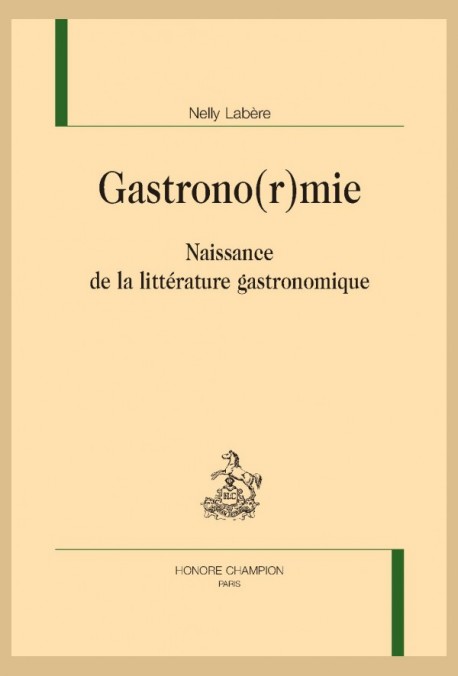
Publication – Nelly Labère, « Gatrono(r)mie. Naissance de la littérature gastronomique »

Cet essai est une hypothèse. Celle de la naissance d’une gastrono(r)mie. Elle part d’un constat : à partir du XIIIe siècle, les livres de cuisine et les livres de fiction « explosent » (B. Laurioux). À l’inverse, les fictions se passionnent pour l’alimentation. Il s’agit dans cet essai de comprendre comment, par la littérarisation des livres de cuisine et par la technique culinaire des textes de fiction, se constitue progressivement un nouveau genre : la littérature gastronomique. Personnage, destinataire et prescriptrice, la femme est au centre de son dispositif textuel. C’est elle qui fournit l’argumentaire descriptif, normatif ou satirique de cette nouvelle littérature de bouche qui interroge, par la chair, la chère. Entre ordre et désordre, gula et luxuria, elle offre aux auteurs une nouvelle voix pour explorer les possibles textuels et définir l’essence de cette littérature gastronomique : le goût des mets et des mots.

Nelly Labère est maître de conférences habilitée à diriger des recherches à l’Université Bordeaux Montaigne et membre de l’Institut Universitaire de France. Ses travaux portent sur les formes du discours au Moyen Âge. Elle est l’auteur, aux éditions Honoré Champion, de Défricher le jeune plant. Étude du genre de la nouvelle au Moyen Âge (2006) et a dirigé le collectif Obscène Moyen Âge ? (2015).

Table des matières : ici

Informations pratiques :

Nelly Labère, Gatrono(r)mie. Naissance de la littérature gastronomique, Paris, Honoré Champion, 2021 (Bibliothèque du XVe siècle, 88). 392 p., 15 x 22 cm. ISBN : 9782745355379. Prix : 48 euros.

Source : Honoré Champion

Publié dans Publications | Laisser un commentaire

Colloque (en ligne) — The 44th Battle Conference on Anglo-Norman Studies 2021

The format of the conference will be much as it is in person. There will be substantial papers lasting 40-45 minutes with a significant question time allotted to each paper. After each question time, the session will remain open for delegates to stay and talk informally with one another before the next session starts.  The zoom meeting will run continuously for the whole of each day. There will also be a poster session and any postgraduate students who wish to give a poster should email the address below.   In order to book your place, please register via the email address: battlewebsite@gmail.com  You will then be sent the details of the zoom meeting which we would be most grateful if you would not circulate. Only those applying via the conference email will receive a zoom link, and the use of an existing invitation by another person won’t be permitted.   But do encourage those who you know will be interested to contact me directly for the zoom link.   When you join the zoom meeting, you will need to be joining us with the recognisable name by which you booked your place, otherwise you won’t be admitted to the session.   If you do not yet have a zoom account, please join by following this link: https://zoom.us/freesignup/    This year there will be no charge for joining the Battle conference. The Allen Brown Committee, which has oversight of the conference, has made the decision that the Allen Brown Memorial Trust will cover the cost of the zoom account and the administrative burden of organising and putting on the conference.    We hope that by offering the conference free of charge, the Anglo-Norman community across the world will feel able to join with us in celebrating the wealth of talent that we have lined up for this year’s conference.    The Trust is an educational charity with the objective of supporting the study of the Anglo-Norman past, broadly defined. If you felt that you wished to support our endeavours with a financial contribution, please contact me. If you wish to give a sum which will ensure that a lecture is given annually in your name, then please do talk to me about it.    You may wish to note that the 2022 conference will take place (pandemic allowing) in Bonn between 21 and 26 July. More details will follow soon.

Programme :

Friday 23 July

1.30 Welcome and opening remarks by the conference director.

1.40 The Allen Brown Memorial Lecture
Professor Lindy Grant, ‘”Avalterre’ and “Affinitas Lotharingorum”: Mapping cultural production, cultural connection and political fragmentation in the ‘Grand Est’ in the High Middle Ages’
Chair: Prof. Liesbeth van Houts

2.30 Formal question time

3.00 Informal discussion time. Delegates are invited to remain to talk informally with one another before the next session starts.

3.30 Prof. Chelsea Shields-Más, ‘The sheriffs of Edward the Confessor’
Chair: Dr Chris Lewis

4.15 Formal discussion time

4.45 Informal discussion time. Delegates are invited to remain to talk informally with one another before the next session starts.

5.15 Poster Session.
As in previous years, we plan to hold a poster session. This year, we will open a number of rooms, in each one will be the person offering their poster. You’ll have 15 minutes to look at the poster and then the session will be opened up to questions. Each session will last 30 minutes, so you should be able to get to three sessions in total.

As usual, the winner of the poster session will be offered a prize. The winner will be chosen by a committee of the Trustees led by the Trust’s chair, Prof. Grant.

Saturday 24 July

1.30 The Des Seal Memorial Lecture
Dr Kathleen Thompson, ‘The Perspective from Ponthieu: Count Guy and his Norman neighbour’
Chair: The conference director

2.15 Formal question time

2.45 Informal discussion time. Delegates are invited to remain to talk informally with one another before the next session starts.

3.15 Prof Heather Tanner, ‘The Early Angevin Kings and the northern French Nobles’
Chair: Prof. Lindy Grant

4.00 Formal question time

4.30 Informal discussion time. Delegates are invited to remain to talk informally with one another before the next session starts.

5.00 Dr Leonie Hicks and Dr Michael Bintley, ‘Landscapes of concealment in the Brut narratives: Geoffrey of Monmouth, Wace and Layamon’.
Chair: Dr Mark Hagger

5.45 Formal question time

6.15 Informal discussion time. Delegates are invited to remain to talk informally with one another before the next session starts.

Sunday 25 July

1.30 The Marjorie Chibnall Memorial Lecture
Dr Amy Devenney, ‘Demons and Incidents of Possession in the Miracles of Norman Italy’
Chair: Prof Lindy Grant, Chair of the Allen Brown Memorial Trust.

2.15 Formal question time

2.45 Informal discussion time. Delegates are invited to remain to talk informally with one another before the next session starts.

3.15 PD Dr Christoph T. Maier, Crusaders and Jews: the York Massacre of 1190 Revisited’
Chair: the conference director

4.00 Formal question time

4.30 Informal discussion time. Delegates are invited to remain to talk informally with one another before the next session starts.

5.00 Dr Anaïs Waag, ‘Rulership, Authority, and Power in the Middle Ages: the Case of the Queen Regnant’
Chair: Prof. Heather Tanner

5.45 Formal question time

6.15 Informal discussion time. Delegates are invited to remain to talk informally with one another before the next session starts.

Monday 26 July

1.30 The Christine Mahany Memorial Lecture
Prof Rob. Liddiard, ‘Wild, Wild Horses: Equine Landscapes of the 11th and 12th centuries’
Chair: Dr Leonie Hicks

2.15 Formal question time

2.45 Informal discussion time. Delegates are invited to remain to talk informally with one another before the next session starts.

3.15 Prof. Alan Cooper, ‘Poverty in London in the 1190s: Some Possibilities’.
Chair: The conference director

4.00 Formal question time

4.30 Informal discussion time. Delegates are invited to remain to talk informally with one another.

Source : Battle Conference

Publié dans Colloque | Laisser un commentaire

Podcast – Joëlle Ducos, « Des chiffres et des lettres au Moyen Âge »

En amont de la journée « Des chiffres et des lettres au Moyen Âge », prévue le 7 octobre 2021 dans le cadre de l’Atelier interdisciplinaire de master du CESCM (sous la responsabilité de P.-M. Joris), Joëlle Ducos proposera une conférence préparatoire qui permettra de présenter les principales orientations de la recherche et les questionnements auxquels cette dernière est confrontée. Si la journée d’octobre se veut l’occasion de montrer comment la pratique des nombres et des chiffres s’effectue entre le XIIe et le XVe siècles, aussi bien dans l’art de compter, dans l’écriture des chiffres au gré des manuscrits savants ou vernaculaires, que dans la littérature et ses jeux sur le nombre, la conférence préparatoire de janvier abordera un premier ensemble de questions : comment le Moyen Âge utilisait-il les chiffres et les nombres ? En mathématiques ainsi que dans d’autres domaines y compris la littérature. Qui étaient les mathématiciens du Moyen Âge ? Peut-on parler de culture(s) mathématique(s) ? Quelles représentations et quels usages le Moyen Âge avait-il des chiffres ? De premières indications bibliographiques seront données et les questions du public seront les bienvenues.

Dans le cadre des journées « Histoire des sciences et des techniques au Moyen Âge ». Organisées à l’Espace Mendès France avec le Centre d’études supérieures de civilisation médiévales (CESCM) – CNRS (UMR 7302), université de Poitiers.

Source : CESCM

Publié dans Podcast | Laisser un commentaire

Publication – Kathleen Ashley, « The Cults of Sainte Foy and the Cultural Work of Saints »

Bringing together artifacts, texts, and practices within an interpretive framework that stresses the cultural work performed by saints, Kathleen Ashley presents a comparative study of the cults of the medieval Sainte Foy at a number of the sites where she was especially venerated.

This book analyzes how each cult site produced the saint it needed, appropriating or creating whatever was required to that end. Ashley’s approach is thoroughly interdisciplinary, incorporating visual, religious, medieval, and women’s and gender studies as well as literary studies and social history. She uses the theoretical framework of « cultural work » to analyze how the cult of Sainte Foy was sponsored and received by specific groups in different locales in Europe. The book is comprehensive in terms of historical as well as geographical range, tracing the history of the cult from the early Middle Ages into the present day. It also includes historiographical analysis, examining the way the cults of Sainte Foy have been represented in various historical accounts. Ashley’s narrative challenges the boundary between « elite » and « popular » culture and complicates the traditional vernacular vs. Latin language binary. A chief aim of the study is to show how « art » objects always operated in conjunction with other cultural texts to construct a saint’s cult. The volume is heavily illustrated, showing artifacts such as stained-glass windows and wall paintings which are not readily available from any other source.

This book will be of special interest to scholars in art history, medieval history, gender studies, and religion.

Kathleen Ashley is Professor of English (Emerita) at the University of Southern Maine, USA.

Table des matières :

Introduction : appropriation and the cultural work of saints
1 Conques: creation of a ritual center
2 Sainte Foy and ecclesiastical agendas
3 The saint as patron of individuals
4 Celebrating noble patronage of Foy’s cults
5 The saint in popular piety

Informations pratiques :

Kathleen Ashley, The Cults of Sainte Foy and the Cultural Work of Saints, Routledge, 2021. 226 p., 81 ill. ISBN : 9780754657330. Prix : GBP 96,00.

Source : Routledge

Publié dans Publications | Laisser un commentaire

Podcast — « Rathier de Vérone. Lecteur, remanieur et centonisateur. Conversation with François Dolbeau »

In questo libro l’analisi della figura di Raterio e del suo profilo intellettuale ma anche un esempio interessante di strumento metodologico. L’importanza della ricerca delle fonti e il ruolo fondamentale dei testi patristici.

Source : YouTube – SISMEL

Publié dans Podcast | Laisser un commentaire

Appel à contribution – The (Un)Needed Sciences: Perspectives of Discussion Among Archaeology, Cultural Anthropology, and History

La scienzia in(utile). Prospettive di riflessione e confronto tra archeologia, antropologia culturale e storia. Workshop organizzato nell’ambito del corso di Dottorato in Scienze Storiche e Archeologiche. Memoria, Civiltà e Patrimonio. Scadenza per la presentazione dei papers: 25 luglio 2021.

‘In the framework of the multidisciplinary PhD Program in History and Archaeology. Studies on Heritage, Memory and Cultures (Department of History and Cultures – DISCI, University of Bologna), the 35th cycle PhD students are organising a workshop with the aim to connect researchers embracing a variety of methodological approaches. We would like to address the problems pertaining the importance of social sciences and humanities and their role in the ongoing global situation.

How could historical, archaeological and anthropological researches be useful? Which social, ethical, relational function might social sciences and humanities fulfill? Which are the possible perspectives of the critical study of our past, while living in a future-oriented society? How could social sciences and humanities contribute to the discussion and understanding of contemporary issues?

The aim of the workshop is to discuss, in an informal and thought-provoking way, the role played by archaeological, historical and anthropological research and its ways of inter-acting or communicating with the society. Young researchers, PhD students, Post- Doctoral fellows and independent scholars are invited to submit their proposals focusing on their personal experience. The research areas should be (but are not restricted to) Archaeology, Ancient, Medieval and Modern History, Cultural Anthropology.’


General topics might be related to:
• Utility and social value of the research activities;
• Resilience and crisis adaptation;
• Gender balance: beyond the gender equality idea;
• Cultural heritage and museums: what challenges to be addressed?
• Public History, public archaeology and digital humanities.

The workshop will be held via Teams (hosted by the University of Bologna) on 5th – 6th October 2021. Participation is free and open to everyone.


The university asks all those interested in participating to submit their proposals for papers suitable for 15 minutes presentations. Please send abstracts to disci.scienzainutile- phdworkshop@unibo.it. The deadline will be 25th July 2021 and notification of acceptance will be sent by 5th September 2021.


Proposals must contain:
– Name of the applicant
– Institution (if present)
– A brief CV
– A proposed title for the paper
– Abstract (max 250 words)


We accept papers in Italian, English and Spanish.


Papers will be organised in panels, according to common topics or areas of interest. At the end of the workshop, a round table will allow the general discussion and the results will be finalised in a report and through a mindmap, which will contribute in the public debate concerning the topics of the workshop.


For further information please contact us by sending an email to: disci.scienzainutile- phdworkshop@unibo.it

Source : Medieval Art Research

Publié dans Appel à contributions | Laisser un commentaire

Publication — « Droit, pouvoir et société au Moyen Âge. Mélanges en l’honneur d’Yves Sassier », éd. Emmanuelle Chevreau, Gilduin Davy, Olivier Descamps et Frédérique Lachaud

Professeur émérite de Sorbonne Université, Yves Sassier s’est imposé comme l’un des meilleurs spécialistes français de l’histoire du droit et des institutions au Moyen âge central, mais aussi, à la croisée des disciplines, de l’histoire de la pensée politique médiévale et de la France capétienne. Les vingt-trois contributions réunies dans le présent volume viennent faire écho à ses travaux : du monde picte à la péninsule Ibérique et à l’Italie, du Moyen Âge à nos jours, il s’agit ici d’inscrire la réflexion sur la norme juridique en regard d’autres thématiques, comme la question de la figure du prince dans les textes juridiques et politiques, la culture des cours et des écoles, ou encore les questions liées à la paix, à la diplomatie et aux frontières.

Table des matières :

Envoi

Publications d’Yves Sassier

Première partie – La norme juridique

Eric Bournazel, La « guerre à droit ». Réflexions sur la guerre et le droit d’après la chanson Raoul de Cambrai

Elsa Marguin-Hamon, Sit pro ratione voluntas… Fortune médiévale d’un adage (XIe-XVe siècle)

Élisabeth Crouzet-Pavan, Construction de la norme juridique et jeux sociaux : transmettre et protéger les biens immobiliers dans la Venise de la fin du Moyen Âge

Thierry Dutour, Existe-t-il un droit français au Moyen Âge ?

Virginie Lemonnier-Lesage, L’article 18 de la Charte aux Normands : fondement des débats sur la notion de juge naturel des Normands,

Gilduin Davy, La tentation nordique des historiens du droit normand. Du provincialisme juridique au régionalisme nostalgique,

Olivier Descamps, Les origines médiévales de la responsabilité civile délictuelle du droit français

Deuxième partie – Le prince

Jean-Pierre Poly, Dans les livres des Pictes. Autorité des femmes et royauté des hommes au nord de l’île de Bretagne

Luc Guéraud, Les qualités du Prince à travers les préambules royaux (XIe-XIIe siècles)

Frédérique Lachaud, Comment déposer le tyran : la chute de Guillaume de Longchamp (octobre 1191) d’après le Liber de promotionibus et persecutionibus Gaufridi Eboracensis archiepiscopi de Giraud de Barry

Jacques Krynen, Philippe le Bel : considérations sur la personne du roi,

Jean-Marie Moeglin, Le voeu-défi des rois

Troisième partie – Cours et universités

Michel Sot, La rhétorique, malaimée des arts libéraux, entre Antiquité et Moyen Âge

Christophe Grellard, De la théologie au droit, et retour : la question du scandale chez Pierre Abélard

Jean-Yves Tilliette, Du festin d’Évandre à celui de Baucis : Jean de Hauville lecteur du Policraticus

Martin Aurell, L’idée du politique dans le roman arthurien (1175-1225)

Jacques Verger, Nativa libertas : l’université peut-elle disposer d’elle-même ? Note à propos du manifeste de l’université de Paris Radix amaritudinis du 2 octobre 1255

Quatrième partie – Paix, diplomatie et frontières

Dominique Barthélemy, Le pacte de paix de 1033 évoqué par Raoul Glaber (Histoires IV. 14-17)

Philippe Sénac, Note sur la « frontière » dans l’Espagne du XIe siècle

Albert Rigaudière, Du « commun de la ville » à la « plus grande et saine partie des habitants d’icelle » dans les chartes de franchises bourbonnaises (XIIIe-XVe siècle)

Alain Tallon, Conflits et médiations dans la politique internationale de la papauté au XVIe siècle

Isabelle Dasque, La diplomatie lazariste au secours du protectorat français en Orient au temps du « discordat » : entre Paris, Rome et Constantinople (1904-1914),

François Saint-Bonnet, La religion, la Révolution et la liberté d’expression. Remarques d’un historien du droit sur les temps présents

Informations pratiques :

Droit, pouvoir et société au Moyen Âge. Mélanges en l’honneur d’Yves Sassier, éd. Emmanuelle Chevreau, Gilduin Davy, Olivier Descamps et Frédérique Lachaud, Limoges, Presses universitaires de Limoges, 2021. 396 p., format 16 x 24 cm. Prix de souscription : 28 € (Offre valable jusqu’au 15 avril 2021). Prix public : 32 €.

Source : Portail universitaire du droit

Publié dans Publications | Laisser un commentaire

Publication – « Past and Future. Medieval Studies Today », dir. Maarten Hoenen et Karsten Engel

There was a time, not so long ago, when Medieval Studies constituted a major pillar for the understanding of the history of human civilization. Today, things are different. While the medieval contribution to the project of humanity remains beyond doubt, the challenges facing those interested in history have changed definitively. Currently, different responses to the new situation are under discussion, each with its own potential and challenges: e.g., global medievalism, digital humanities, comparative history, rethinking the cultural narrative. In this volume, specialists from the fields of Digital Humanities, History, Literary Studies, Philosophy, and Theology share with the readers their views about the possible futures of Medieval Studies. They evince the vitality and multi-perspectivism characteristic of the field today, showing that Medieval Studies looks to a future that, while different from the past, promises to be at least as rich and creative.The papers collected here were first presented and discussed at the 6th European Congress of Medieval Studies of the Fédération Internationale des Instituts d’Etudes Médiévales (FIDEM), which was held at the University of Basel, Switzerland, 2–5 September 2018.

Maarten Hoenen is Professor of Ancient and Medieval Philosophy at the University of Basel, and President of the Fédération Internationale des Instituts d’Etudes Médiévales (FIDEM). He specializes in late medieval intellectual history.

Karsten Engel is a research assistant at the Department of Philosophy at the University of Basel. He is currently working on his doctorate on the history of logic in the late 15th century.

Table des matières :

Maarten J.F.M. HOENEN – Karsten ENGEL, Preface

Introductory Perspectives
Matteo NANNI (Justus-Liebig-University Gießen), Medieval Past, Medieval Future
 Hilde DE WEERDT (Leiden University), On the Future of Medieval Studies. A (Chinese) Historian’s Perspective

Digital Humanities
Gabriel MÜLLER (University of Basel) – Ueli ZAHND (University of Geneva), Open Scholasticism. Editing Networks of Thought in the Digital Age
Xavier-Laurent SALVADOR (University Sorbonne Paris), De la page numérisée aux sens révélés. Vers une prise en charge automatique du corpus Bible Historiale
Maria Amélia ÁLVARO DE CAMPOS (University of Coimbra), Humanités Numériques et l’étude de la ville médiévale. Le cas de Coimbra
Paul TOMBEUR (Catholic University of Louvain-la-Neuve), L’angoissante question de la fiabilité de nos instruments de travail et particulièrement de beaucoup de bases de données

History
Vytautas VOLUNGEVIČIUS (Vilnius University), European barbaricum? Non-simultaneity of the Middle Ages: Germanic, Slavic and Baltic Societies
Antonio ESPIGARES PINILLA (Complutense University Madrid), San Agustín en el Vademecum del Conde de Haro
Montserrat JIMÉNEZ SAN CRISTÓBAL (Complutense University Madrid), La Carta de Léntulo al senado de Roma en el Vademecum del conde de Haro
 Beatriz FERNÁNDEZ DE LA CUESTA (Complutense University Madrid), Pasajes revisitados del primer Conde de Haro en el Vademecum del ms. BNE 9522
Luca POLIDORO (University of Florence), Medieval Studies and Public History. A Challenge for the Present

Literature
Seraina PLOTKE (University of Bamberg), Chances and Opportunities – Medieval Texts and Modern Cultural Paradigms: A Postcolonial Queer Reading of the Medieval Crusade Narrative Herzog Ernst
Monica RUSET OANCA (University of Bucharest), Interpretation of Medieval Texts between Literature and Theology in La Queste del Saint Graal
Irene VILLARROEL FERNÁNDEZ (National Distance Education University of Madrid), La colección de Miracula Beatae Mariae Virginis del ms. 9289 de la Biblioteca Nacional de España

Philosophy and Theology
Isabela GRIGORAȘ (University of Fribourg/ University of Bucharest), Editing Alcuin’s Disputatio de uera philosophia and Ars grammatica. New Findings, Methodology, and Problems
Florin CRÎȘMĂREANU (University of Iaşi), Analogie et anagogie dans les écrits de Maxime le Confesseur. Essai sur une «herméneutique eucharistique»
Nadia BRAY, Anaxagoras in the Late Middle Ages (University of Salento). A Doxographical Study of Thomas of York’s Sapientiale
Constantin TELEANU (University Sorbonne Paris), Le progrès des traductions françaises de l’œuvre de Raymond Lulle du Moyen Âge aux temps modernes
Nicolás MARTÍNEZ BEJARANO (National University of Colombia, Bogotá), With Feet on the Ground. Some Remarks about Vulgarization of Christian Thought on Nueva Granada (1758-1767)

Informations pratiques :

Past and Future. Medieval Studies Today, dir. Maarten Hoenen et Karsten Engel, Turnhout, Brepols, 2021 (Textes et Etudes du Moyen Âge, 98). XIX+392 p., 8 b/w ill. + 13 colour ill., 165 x 240 mm. ISBN: 978-2-503-59470-5. Prix : 65 euros.

Source : Brepols

Publié dans Le réseau | Laisser un commentaire