Appel à contribution – Alabaster as a Material for Medieval & Renaissance sculpture

The 8th ARDS annual colloquium, which celebrates new research in the field of renaissance and medieval sculpture will focus on alabaster as a material for European sculpture from the 14th until the 17th century.

Much research has been carried out on this subject over the past few decades in several European countries, both in universities and in laboratories, and in particular on the occasion of restorations carried out in museums and historic monuments. New analysis methods have improved our knowledge of the origin of alabaster and the quarries exploited during this period, supply and trade circuits – often long distance – have been brought to light, restorations have enabled to specify the implementation of the material. The results have been the subject of seminars, study days and major publications.

In order to present the general public with a summary of the current state of our knowledge, M Leuven and the Musée du Louvre have decided to jointly organize an international exhibition on this theme in 2022, showing how and why alabaster was used for sculpture in Western Europe during the late Middle Ages, Renaissance and Baroque period. This exhibition will bring together high-quality sculptures, small-format objects with monumental achievements, from the Louvre and M’s collections, as well as from numerous public and private collections. About a year before the exhibition, the Paris colloquium aims to bring together specialists in this material, whether they are geologists, restorers, historians or art historians. The scientific committee of the conference invites researchers to submit papers on:

  • Identifying the provenance of alabaster, quarries, quarrying and trade in alabaster
  • Recent restorations implementing new analysis methods and providing information on the use of alabaster (cutting and polishing, polychromy and surface treatments, framing, association with other materials, etc.)
  • Significant achievements in alabaster
  • The meaning of alabaster from the 14th to the 17th century

The conference committee consists of Sophie Jugie (Musée du Louvre), Peter Carpreau (M Leuven/Ards), Marjan Debaene (M Leuven/Ards), Pierre Yves le Pogam (Musée du Louvre)

Would you like to submit a paper for this conference?

Your proposal can be of an art-historical, historical as well as historiographical, technical or scientific in nature. Multidisciplinarity is encouraged. Case studies as well as papers providing a broader view and/or of a more reflective nature are welcomed. Priority will be given to speakers presenting new research findings and contributions relevant to the specific conference theme. Submissions that are not selected for presentation in plenum, can still be taken into consideration for a (digital) poster presentation. The organisation will publish acta colloquia in postprint after the conference.

How to submit your proposal?

  • Write an abstract in English in word or pdf; max. 500 words (excl. authors name(s) and contact details).
  • Include a short CV.
  • E-mail to Marjan Debaene via info(a)ards.be

Practical info

  • Call for papers Deadline: 15.12.20
  • Successful applicants will receive a notification by 31.01.21
  • The languages used during these days are French and English.
  • The lectures, illustrated by PowerPoint presentation, will last 20 minutes.
  • Discussion moments will be provided at the end of each session of 3 or 4 presentations.
  • Transport and / or accommodation costs are the responsibility of the selected communicators.

Organising committee : Sophie Jugie (Paris, Louvre Museum, Sculptures Department), Isabelle Haquet (Louvre Museum, Auditorium), Peter Carpreau (M Leuven / ARDS), Marjan Debaene (M Leuven / ARDS), Anne Liefsoens (M Leuven / ARDS)

Scientific committee: Peter Carpreau (M Leuven / ARDS), Marjan Debaene (M Leuven / ARDS), Sophie Jugie (Paris, Louvre Museum), Pierre-Yves Le Pogam (Paris, Louvre Museum), Lise Leroux (Paris, Historical Monuments Research Laboratory), Aleksandra Lipinska (Munich, Ludwig-Maximilians- University, Wolfram Klopmann (Orleans, Bureau of Geological and Mining Research), Carmen Morte Garcia (Zaragoza, University of Zaragoza), Kim Woods (London, Open University UK).

Questions or more information? Please contact Marjan Debaene via info@ards.be

Disclaimer: Should there arise problems or new restrictions regarding travel to Paris due to a possible new wave of COVID-19, the conference will be held online via webinar presentations (and if so unfortunately without the in situ visits).
Therefore the final program will only be compiled and communicated in the spring of 2021.

Source : Medieval Art Research

Publié dans Appel à contributions | Laisser un commentaire

Journée d’étude – Bernhard Blumenkranz et après ? L’histoire des juifs médiévaux en France du Nord aujourd’hui

Le Lundi 14 décembre 2020 l’atelier « Bernhard Blumenkranz et après? L’histoire des juifs médiévaux en France du Nord aujourd’hui » organisé par la Nouvelle Gallia-Germania Judaica (Johannes Heil/Imen Ben Temelliste), la Nouvelle Gallia Judaica (Claire Soussen) et l’Institut historique allemand de Paris (Amélie Sagasser). L’atelier aura lieu en ligne. Les invitations zoom avec le mot de passe seront communiquées sur demande auprès de claire.soussen@wanadoo.fr

Les interventions seront en anglais et en français.

Programme :

Claire Soussen (Nouvelle Gallia Judaica Paris)/Amelie Sagasser (DHI Paris): Introduction
Johannes Heil/Imen Ben Temelliste (Hochschule für Jüdische Studien Heidelberg): Présentation du

Philippe Blanchard (Inrap- Paris) : La fouille archéologique des cimetières juifs en Europe: Problématique contraintes et perspectives. L’exemple de Châteauroux
Pause

Judith Kogel (Irht- Paris) : La version française du Maqre-dardeqe (BNF Hébreu 1243)
Pause déjeuner

Hannah Schachter (Hebrew University of Jerusalem) : „Picturing Jewish-Royal Relations: Jews and Royal Women in Parisian Manuscript Illuminations of the 13th Century“
Pause

Danièle Sansy (Université Le Havre) : La représentation des juifs dans l’enluminure parisienne à la fin du Moyen Âge
Pause

Robert Chazan (New York University) : The Special Circumstances of Medieval Northern French Jewry Johannes Heil (Hochschule für Jüdische Studien Heidelberg): Clôture

Informations pratiques :

14 décembre 2020 – atelier en ligne

Johannes Heil/Imen Ben Temelliste (Hochschule für jüdische Studien Heidelberg)
Amélie Sagasser (Institut historique allemand Paris)
Claire Soussen (Nouvelle Gallia Judaica/Université du Littoral Côte d’Opale Boulogne sur Mer) Modalités de participation

En raison de la situation sanitaire, l’atelier aura lieu en ligne par zoom. Les personnes désireuses d’assister à l’atelier se feront connaître auprès de Amélie Sagasser (asagasser@dhi-paris.fr) et Imen Ben Temelliste (imen.bentemelliste@hfjs.eu). Les invitations avec le mot de passe seront communiquées sur demande.

Source : Société des Études juives

Publié dans Colloque | Laisser un commentaire

Publication – « La muerte de los príncipes en la Edad Media. Balance y perspectivas historiográficas », éd. Fermín Miranda García, María Teresa López de Guereño Sanz

Siguiendo un claro enfoque multidisciplinar, este libro presenta un balance historiográfico sobre la muerte de los príncipes en la Edad Media, tanto hispana como francesa, entendiendo el término «príncipes» en su sentido más amplio. No solo se examinan casos particulares relativos a los miembros de la familia regia, sino que se profundiza también en los diversos ámbitos de la aristocracia eclesiástica, militar y urbana. Desde la ritualización funeraria —liturgia, música—, la memoria cronística y documental, las obras de arte o su reflejo en la literatura, hasta la antropología física, los estudios presentados se enfocan a calibrar la relación de la muerte y su tratamiento con la imagen del poder que dichas élites proyectan y su emulación por parte de los restantes grupos sociales.

Table des matières :

Fermín Miranda García, María Teresa López de Guereño Sanz – La muerte de los príncipes en la Edad Media: un análisis desde la pluridisciplinariedad
Ariel Guiance – Veinte años de historiografía sobre la muerte: un balance y un nuevo comienzo

I. EL BIEN MORIR, EL MAL MORIR

Érika López Gómez – La muerte en las fuentes manuscritas medievales. Apuntes sobre el Arte de bien morir (ms. 6485) conservado en la Biblioteca Nacional
Filipe Alves Moreira – Morte, espetáculo e encenação de poderes em relatos de execuções «políticas». Fontes e modelos comparativos
Hermínia Vasconcelos Vilar – Crime e perdão: a morte de dois bispos no Portugal do século XIV

II. EL CUERPO

Armando González Martín, Óscar Cambra-Moo, María Molina Moreno, Josefina Rascón Pérez, Manuel Campo Martín – Una revisión de algunos antecedentes en el estudio antropológico y paleopatológico de enterramientos singulares. Límites y posibilidades
Margarita Cabrera Sánchez – Cuerpo regio y embalsamamiento durante el Medievo en los reinos hispánicos. Fuentes para su estudio

III. EL RITUAL, EL DOLOR, LA PÉRDIDA

Juan Carlos Asensio – Música, liturgia y paraliturgia en las exequias regias
Eloísa Ramírez Vaquero – Materiales para analizar las prácticas funerarias del príncipe en Navarra
Agathe SultanRazós de plorar. Pour une réflexion sur le rythme des planhs (XIIe-XVe s.)

IV. EL REPOSO

Isabel Ruiz de la Peña González – Espacios monásticos y enterramiento del poderoso en el reino de León en los siglos del románico. Fuentes y métodos de investigación
Ignacio González Cavero – Enterramientos y ámbitos funerarios en al-Ándalus (Murcia, siglos XI y XIII). Reflexiones y modelos de comparación
Stefano M. Cingolani – Rituales funerarios y mausoleos reales en la Corona de Aragón (1196-410). Posibilidades de una investigación global
María Teresa López de Guereño Sanz – Ámbitos funerarios y sepulcros de la colegiata de Covarrubias (Burgos) en la Edad Media. Nuevas propuestas de estudio

V. LA MEMORIA

Vincent Debiais – La muerte del príncipe en las inscripciones medievales. Cifras y preguntas (Francia-Navarra, siglos X-XIII)
J. Santiago Palacios Ontalva – La muerte del príncipe en al-Ándalus. Arquitectura religiosa y memoria en un contexto islámico
Diego Rodríguez-Peña – La muerte del rey en las crónicas (Castilla y León, ss. XII-XIII)
Carmen Benítez Guerrero – Los caminos de la muerte en la historiografía castellana del primer XIV. El ejemplo de la Crónica de tres reyes
Clara Marías – Poesía cortesana y tradicional para la historia de las muertes de las élites en la época de los Reyes Católicos
Véronique Lamazou-Duplan – Enterrer les Foix-Béarn-Navarre à la fin du Moyen Âge : entre fama et silences. Matériaux et perspectives de recherche
Haude Morvan – Sépultures cardinalices et mémoire communautaire

Informations pratiques :

La muerte de los príncipes en la Edad Media. Balance y perspectivas historiográficas, éd. Fermín Miranda García, María Teresa López de Guereño Sanz, Madrid, Casa de Velazquez, 2020. ISBN : 9788490962572. XVI-426 p. 17 x 24 cms. Prix : 25 euros.

Source : Casa de Velazquez

Publié dans Publications | Laisser un commentaire

Appel à contribution – Power, Patronage & Production: Book Arts from Central Europe (ca. 800–1500) in American Collections

On January 13–15, 2022, the Index of Medieval Art (Princeton University), the Pierpont Morgan Library & Museum (New York), and the Department of Art and Archaeology at Princeton University will host a conference to accompany the exhibition, “Imperial Splendor: The Art of the Book in the Holy Roman Empire, 800–1500,” presented at the Morgan Library from October 15, 2021 to January 23, 2022. The conference will include two days of papers as well as a study day at the Morgan Library. For each paper, 30 minutes of speaking time, followed by 15 minutes of discussion, will be allotted. In addition to a viewing of the exhibition, the study day will include an opportunity to view other, unexhibited materials in the Morgan’s collections.

Despite its scope, the exhibition cannot comprehend all the relevant material in American collections. Nor can the accompanying book treat all the exhibited items in depth. With this in mind, we solicit proposals for papers. Pending the usual peer-review process, the contributions will be published.

Paper proposals, no more than one page in length, should fall into one of the following categories or address one of the following topics:

– in-depth monographic discussion of a single manuscript in an American collection, whether or not it is included in the exhibition. Please contact Joshua O’Driscoll (jodriscoll@themorgan.org) for a list of objects that will be discussed in the book accompanying the exhibition (many but not all of which will be exhibited) and a list of all relevant materials in the Morgan Library’s collections. More information on many of these manuscripts, also those in other American collections, can be found at Digital Scriptorium: https://digital-scriptorium.org/.

– thematic treatment of one of a number of broader issues relevant to the exhibition’s concerns; these include but are by no means limited to the following:

  • Art & the politics of empire
  • Art & reform/Reformation
  • Borders of empire
  • Cosmopolitan contacts and exchanges
  • Geographic foci (e.g., Helmarshausen, Prague, Salzburg, Weingarten)
  • Humanism in Central Europe
  • Imperial patronage
  • Monastic networks
  • Manuscript illumination and the other arts
  • Paper, parchment & pen-drawing/production techniques
  • Patrician patronage in imperial cities
  • Panel painting
  • Psalters
  • Reception/collecting of German medieval art in the United States
  • Urbanism & the art of the book
  • Visualization & the vernacular

Proposals should be submitted to Prof. Jeffrey F. Hamburger, Harvard University (jhamburg@fas.harvard.edu) by February 1, 2021. A response indicating whether or not any given proposal has been accepted will be forthcoming by April 1, 2021. Finalized abstracts, which will be circulated to all participants, would then be due by August 1, 2021. The organizers will do their best to accommodate all relevant proposals within the confines of the program, the scope and format of which will be determined by the funding available and the current public health situation. In the event that an in-person meeting is feasible, speakers’ costs for travel and accommodation in Princeton and New York will be covered. Colleagues submitting proposals are asked to indicate their interest in presenting a paper by video call, should travel not be possible.

Source : Medieval Art Research

Publié dans Appel à contributions | Laisser un commentaire

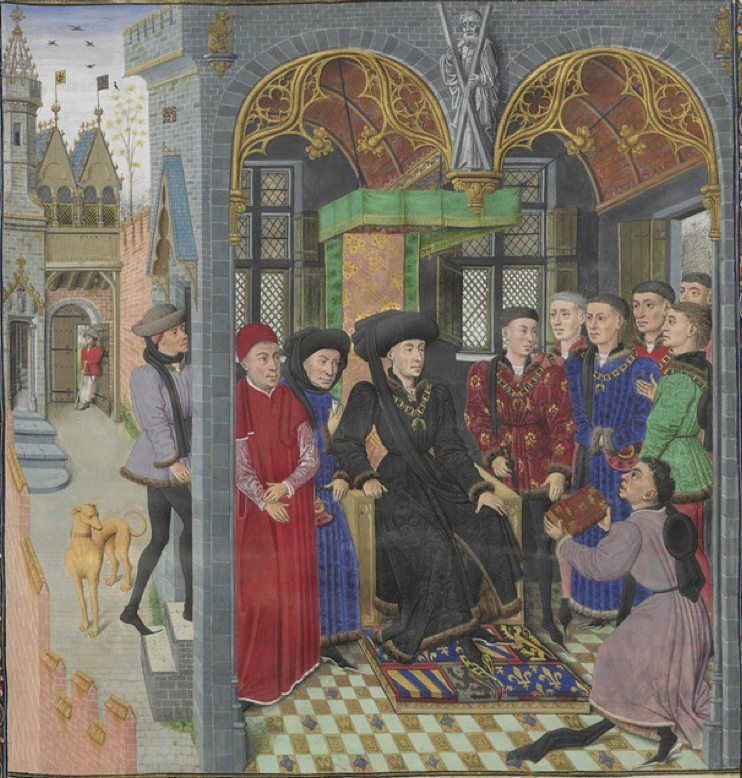
Publication – Sébastien Cazalas, « Jean Juvénal des Ursins, prélat engagé (1388-1473). Étude des épîtres politiques »

Spectateur meurtri par les drames de la fin de la guerre de Cent Ans et l’état de déréliction morale du royaume, Jean Juvénal des Ursins (1388-1473) entreprend un long dialogue avec le roi de France. Ses épîtres politiques constituent une tentative d’avertir Charles VII, puis Louis XI, des carences et des erreurs de leur gouvernement. Au-delà du commentaire de l’actualité, c’est un puissant engagement moral qui s’affirme, enraciné dans une conception chrétienne et humaniste des devoirs du prince. Afin de convaincre celui-ci de la nécessité d’une reformation du royaume, le propos s’organise pour gagner en force de persuasion. Les discours de l’évêque accueillent une grande variété de traditions littéraires (épopée, motif courtois, apologue animalier, prophétie, étymologie, généalogie et plaidoyer, etc.). Le souci d’une mise en scène de soi est particulièrement remarquable : l’évêque, inséparable de sa famille, se nimbe de l’ethos du prophète et travaille à l’affirmation d’une nouvelle noblesse, les gens de robe, maîtres d’oeuvre d’une monarchie restaurée par les pouvoirs de l’ymaginacion.

Sébastien Cazalas, docteur ès Lettres, est professeur agrégé à l’Université de Nantes.

Table des matières : ici

Informations pratiques :

Sébastien Cazalas, Jean Juvénal des Ursins, prélat engagé (1388-1473). Étude des épîtres politiques, Paris, Honoré, Champion, 2020 (Bibliothèque du XVe siècle, 85). 730 p., 15 x 22 cm. ISBN : 9782745354099. Prix : 85 euros.

Source : Honoré Champion

Publié dans Publications | Laisser un commentaire

Publication – « Modus Vivendi. Religious Reform and the Laity in Late Medieval Europe », dir. Miri Rubin

Modus Vivendi is a collection of essays by scholars who seek to discover lay men and women within the projects of reform and renewal in later medieval Europe. Religious life was never without change, yet religious orders, preachers, and institutions of learning proclaimed their desire to make religious life more sincere. In doing so, they occasionally developed a mission to lay people alongside professional religious. Such encounters with the laity – through the writing of theology in the vernacular, in the delivery of charismatic preaching, in the operation of inquisition into heresy, in the composition of new liturgies, and through networks of patronage – created modes of living religion – modus vivendi – of creativity as well as discipline. They contributed to religious life beyond the routine provisions of parish life, and often included women in novel ways.

Table des matières :

Miri Rubin, Modus Vivendi: An Introduction

Stephen Mossman, Hatred of University Lecturers and the Inspired Word in the Fourteenth Century: Ruusbroec – Tauler – Merswin
Marika Räsänen, The Cult of St Thomas Aquinas, Reform and the Laity in Late Medieval Italy
Reima Välimäki, Bona docere et mala dedocere. Inquisition of Heresy and Communication with the Lay Population
Mathilde van Dijk, Inventing Secular Devotion: Dirc of Herxen, and Dionysius the Carthusian on the Life of Married People
Antonín Kalous, Mendicants and the Reform of Religious Life in Late Medieval Bohemia and Moravia
Cécile Caby, Santa Giustina of Padua in Santa Fiora of Arezzo: Reform between Literary Invention and Social Demand in a Fifteenth-Century Tuscan Abbey
Meri Heinonen, The Books of the Laity and the Observant Dominican Reform in Nuremberg at the Turn of the Fifteenth Century

Index
Notes on Contributors

Informations pratiques :

Modus Vivendi. Religious Reform and the Laity in Late Medieval Europe, dir. Miri Rubin, Rome, Viella, 2020. pp. 152, 15,5×23 cm, hardback. ISBN: 9788833137063. Prix : 39 euros.

Source : Viella

Publié dans Publications | Laisser un commentaire

Publication (en ligne) – « De la clôture à la fortification des monastères », dir. Sébastien Bully et Christian Sapin

Hors-série n° 12 | 2020
De la clôture à la fortification des monastères. Actes des 5èmes journées d’études monastiques, Auxerre, 1-2 septembre 2016

Accès : ici

Table des matières :

Christian Sapin – Introduction : les premiers monastères, entre clôtures et fortifications

Ronan Pérennec et Annie Bardel – Barrières, clôtures et murailles à Landévennec : juxtaposition et évolution
Jacques Bujard – Clôtures et fortifications monastiques en Suisse
Frédéric Chantinne – Fortification et fonctions militaires des abbayes et chapitres dans l’Entre-Sambre-et-Meuse aux IXe-XIe siècles
Isabelle Cochelin – Regards monastiques sur la double clôture de Cluny (XIe siècle)
Eleonora Destefanis – Limites et enjeux spatiaux dans les monastères du haut Moyen Âge italien
Fabrice Henrion – La Charité-sur-Loire, la ville, le prieuré et son enclos : un aperçu des connaissances et un état des lieux
Jacques Le Maho et Gilles Deshayes – Limites et clôtures à Jumièges (VIIe-XIIe s.)
Christian Sapin – De la clôture à la fortification des abbayes en Bourgogne avant le XIIIe siècle
Jean-Michel Picard Septum monasterii : clôtures et monastères en Irlande médiévale (VIe-IXe siècles)
François Blary –  La question des clos symboliques et fortifiés des établissements cisterciens (XIIIe-XVe s.)
Luc BourgeoisClaustrum versus castrum : réalités et ambiguïtés des enclos monastiques

Source : BUCEMA

Publié dans Le réseau | Laisser un commentaire

Conférence – Robert Gramsch-Stehfest, « Networks of political and clerical actors in the Middle Ages: new insights in medieval history with the help of digital methods” »

Considered the current situation related to the spread of Covid-19, for 2020 the seminars will take the form of a webinar, hosted on the VUB LifeSize platform (as it appears to be more stable than Teams). If the sanitary situation allows it, the series will take the form of a standard presential seminar in 2021. 

The seminars will take place during lunch time, from 12:00 to 13:30.

15/12 – Robert Gramsch-Stehfest (University of Jena): “Networks of political and clerical actors in the Middle Ages: new insights in medieval history with the help of digital methods”

Source : DigiResearch – VUB

Publié dans Colloque | Laisser un commentaire

Publication (en ligne) – « Rethinking Scholastic Communities & Ideologies of Translation, II » (Medieval Worlds, 12, 2020)

medieval worlds
Volume 12. 2020
ISSN Online: 2412-3196
ISBN-13 Online: 978-3-7001-8852-0

Table des matières :

Preliminaries

Pascale Hugon – Birgit Kellner – Rethinking Scholastic Communities in Medieval Eurasia: Introduction

Constant J. Mews – Rethinking Scholastic Communities in Latin Europe: Competition and Theological Method in the Twelfth Century
José Ignacio Cabezón – Rethinking Buddhist Scholastic Communities Through a Socio-Historical Lens
Cathy Cantwell – Myang ral Nyi ma ’od zer (1124-1192): Authority and Authorship in the Coalescing of the rNying ma Tantric Tradition
Bénédicte Sère – Between disputatio and Polemics: Dialectics as Production of Knowledge in the Middle Ages
Jonathan Samuels – The Tibetan Institutionalisation of Disputation: Understanding a Medieval Monastic Practice
Réka Forrai – Hostili praedo ditetur lingua latina: Conceptual Narratives of Translation in the Latin Middle Ages
Jan Odstrčilík – Multilingual Medieval Sermons: Sources, Theories and Methods
Herbert Schendl – Multilingual Texts as a Reflection of Code-Switching in Medieval England: Sermons and Beyond
Nicole Bériou – Orality in its Written Traces: Bilingual reportationes of Sermons in France (Thirteenth Century)
Carlo Delcorno – Bilingualism in Medieval Italian Preaching: The Case of Angelo da Porta Sole (d. 1334)
Lidia Negoi – Bilingual Strategies in Fourteenth-Century Latin Sermons from Catalonia
Tom ter Horst – Typology and Spectrum of Latin-Irish and Latin-English Codeswitches in Medieval Sermon Literature
Roy Flechner – Review Article: How Far is Global?

Source : Medieval Worlds

Publié dans Publications | Laisser un commentaire

Appel à contribution – Perspective – Habiter n°2021 – 2

English version below

Pour son prochain numéro, la revue Perspective souhaite poser la question de ce que c’est qu’habiter: habiter un espace, un territoire, sa maison ou son corps, qu’il s’agisse de confins extrêmes ou des frontières de l’intime ; habiter sa vie, sa (ses) société(s), son temps, pour ce qu’habiter, c’est aussi être au monde, être présent à autrui, se confronter à un étant donné. À l’heure où, partout sur la planète, des populations entières sont assignées à domicile, la revue invite à revenir sur les imaginaires plastiques de l’habiter: «occuper habituellement un lieu», comme le suggère le dictionnaire, où se glisse l’idée de l’habitude, des cadres, de la répétition et de la régularité, mais encore «occuper quelqu’un», l’habiter, l’animer, l’émouvoir.

Habiter n’est, en effet, pas uniquement une question spatiale. L’âme d’un lieu en rend compte, qui ouvre la question poétique de l’être habité: hanter, être hanté, posséder un lieu ou un être, être possédé par lui, comme l’on possède des idées, des valeurs et des croyances qui, à leur tour, nous habitent. Le temps et l’invisible, ici, s’immiscent dans les matérialités: habiter parle de ce que l’on construit – maçonneries, toits, maisons, frontières – mais aussi de ce dont on hérite, des présences immatérielles, des représentations intimes et des espaces mentaux – de ce qui nous tient, nous retient et nous relie. Habiter articule in fine l’individuel et le collectif, les partages et les frontières, les mouvements et les clôtures, les lieux et les non-lieux, et pose la question des communs, du monde que nous avons, précisément, en partage : de l’écologie, donc, au sens propre du terme, qui renvoie, en tant que science de l’habitat (oikos, la «maison»), à la manière dont s’entrelacent les formes multiples de nos existences et de nos voisinages.

Ainsi la revue Perspective souhaite-t-elle consacrer son prochain numéro aux manières dont les artistes, les historiens de l’art, ainsi que leurs collègues des disciplines voisines, s’emparent de ces questions et témoignent des multiples manières d’habiter et d’être habité. Ce thème appelle une diversité d’approches, thématiques autant que disciplinaires. Elles seront les bienvenues, pourvu que les propositions répondent aux lignes éditoriales de la revue. Les regards portés vers l’histoire de l’architecture, de l’urbanisme, du paysagisme et des arts visuels ne sauraient exclure des explorations liées à la muséologie, à l’ethnologie, à l’anthropologie, aux visual studies et aux humanités numériques, ainsi que vers les champs des arts décoratifs et du design, de la mode, des arts de la scène ou du cinéma

Contribuer

Prière de faire parvenir vos propositions (un résumé de 2000 à 3000 signes, avec un titre provisoire, une courte bibliographie sur le sujet, et une biographie de quelques lignes) à l’adresse de la rédaction (revueperspective@inha.fr) avant le 10 janvier 2021. Perspective prenant en charge les traductions, les projets seront examinés par le comité de rédaction du numéro quelle que soit la langue. Les auteurs des propositions retenues seront informés de la décision du comité au mois de février 2021, tandis que les articles seront à remettre pour le 15 juin 2021. Les articles soumis, d’une longueur finale de 25000 ou 45000 signes selon le projet envisagé, seront définitivement acceptés à l’issue d’un processus anonyme d’évaluation par les pairs.

Inhabiting n°2021 – 2

For its coming issue, the journal Perspective asks the question of what it means to inhabit : to inhabit a space, a territory, one’s home or one’s body, whether we are dealing with far away frontiers, or the outlines of intimacy; to inhabit one’s life, one’s society/ies, one’s epoch, in what inhabiting means in terms of being present in one’s world, for and with one another, to face circumstances as they stand. In a time when, across the globe, entire populations are confined to their homes, Perspective issues an invitation to revisit the visual and imaginary plasticity of inhabiting: “to occupy a place of settled residence or habitat,” so states the dictionary, suggesting habit, repetition, regularity; but also occupying persons, inhabiting them, animating them, moving them.

Inhabiting is not only a question of space. When we speak of “the spirit of a place”, it opens the poetic question of being inhabited: to haunt, to be haunted, to possess a place or a being, to be possessed, as one may possess an idea, values or beliefs which, in turn, inhabit us. Thus, both time and intangibility find their way into the material world: inhabiting refers to what is built (masonry, roofs, buildings, frontiers), but it also refers to what we inherit, immaterial presences, intimate representations and mental spaces – finally, it refers to what holds us up, holds us back, or holds us together. In fine, inhabiting articulates the individual and the collective, what is shared and what is separated, what is movement and what is closure, places and non-places, and brings forth the question of the Commons: in our world, what do we share? This inevitably brings us to the question of ecology, in its original meaning; the science of the habitat (oikos, the “home”), to how our multiple forms of existence and coexistence interweave.

In this manner, Perspective endeavours to dedicate its coming issue to the ways in which artists, art historians, and their colleagues from various neighbouring disciplines, take on these interrogations and bring forth the multiple ways in which one can inhabit or be inhabited. This subject calls for a wide variety of approaches, both in terms of thematic and fields of study. All proposals will be studied as long as submissions remain in line with the journal’s editorial policy. Investigations into the fields of history of architecture, urbanism, landscaping, visual arts, but also museology, ethnology, anthropology, visual studies, and digital humanities, as well as decorative arts, design, fashion, performing arts and cinema shall all be welcome.

Call for papers

Bibliography on the subject, and a biography of a few lines) to the editorial office (revue-perspective@inha. fr) before January 10, 2021. As Perspective will manage translations, projects will be examined by the issue’s editorial board regardless of language. The authors of selected proposals will be informed of the committee’s decision in February 2021, and articles must be submitted by June 15, 2021. Submitted articles, with a final length of 25,000 or 45,000 characters depending on the project, will be definitively accepted after the anonymous peerreview process. 

Source : INHA

Publié dans Le réseau | Laisser un commentaire