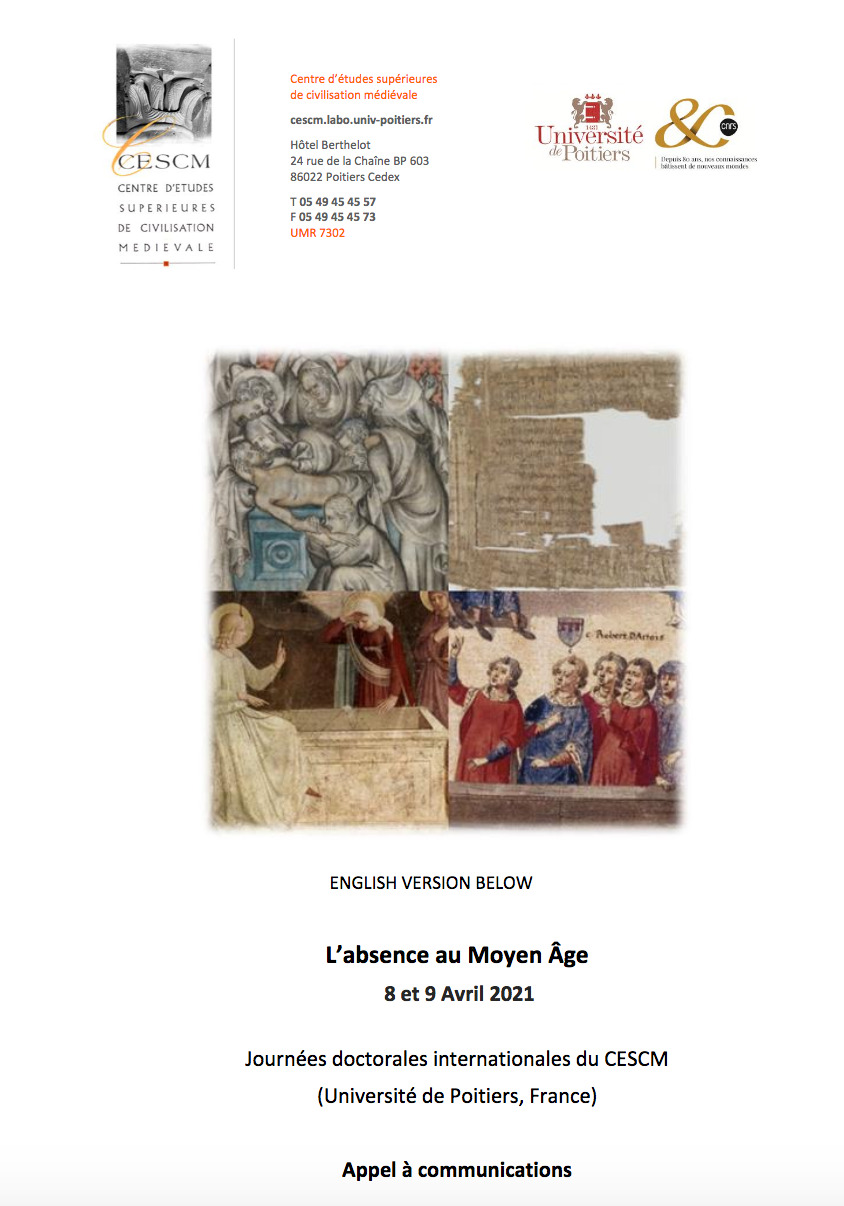
Un appel à communications est lancé pour un colloque sur le thème de l’absence au Moyen Âge. Organisé par les doctorantes et les doctorants du Centre d’études supérieures de civilisation médiévale, le colloque se tiendra à Poitiers en avril 2021. La manifestation prolongera les rencontres doctorales mises sur pied à Liège, en février dernier, et en constitueront le deuxième volet. Le troisième volet aura lieu à York, au sein du Centrer for medieval literature.
Longtemps considéré comme un âge sombre et de ce fait méprisé, le Premier Moyen Âge recouvre plus d’un demi-millénaire qui suivit la chute de Rome. Cette période se révèle aujourd’hui petit-à-petit, à travers l’Europe, en bonne partie grâce à l’archéologie et à des vestiges souvent peu spectaculaires, mal conservés et d’interprétation difficile, mettant au jour des sociétés riches de sens, en perpétuel mouvement, aux lentes inflexions.
En quoi la déposition de Romulus Augustule, le dernier empereur d’Occident, en 476, aurait influé sur les structures sociales ? Si sous certains aspects le début de cette période peut être envisagé comme dernière séquence de l’Antiquité tardive, d’autres montrent de véritables ruptures avec le monde romain. Mais on est loin de la vision de l’historiographie ancienne qui voulait que les invasions barbares aient tout détruit sur leur passage.
De même il paraît illusoire de trouver les indices matériels d’une fracture nette entre l’époque mérovingienne et l’époque carolingienne, puisque cette prétendue césure historique n’est due qu’à la déposition, par Pépin le Bref, en 751, du dernier roi mérovingien. Pas plus qu’il n’y eut de rupture de l’An Mil.
Ce monde, entre la volonté de prolonger l’héritage de l’Antiquité et une forte capacité d’innovation et de renouvellement, fut riche d’échanges, de partages, tant économiques, commerciaux qu’intellectuels. Un monde connecté où circulent tant les idées que les matières premières et l’artisanat. C’est ce que met en exergue l’exposition Crossroads, au Musée Art et Histoire du Cinquantenaire, que nous aurons l’occasion de visiter durant notre journée d’étude qui s’y déroulera le 19 mars 2020. La diversité des objets présentés illustre à merveille ces contacts, ces échanges, entre les populations et offre un bel éclairage sur un pan méconnu de l’Histoire, pourtant aux fondements des sociétés européennes actuelles.
Programme :
13h15 : accueil
13h30 : Mot d’introduction
13h35 : Bruno Dumézil – Construire le barbare : de Clovis à Conan
14h20 : Inès Leroy – Quentovic, un emporium sur la Canche. Implantation, échanges et axes de communication 14h55 : Lise Saussus, Amélie Vallée et Line Van Wersch – Artisans mérovingiens du bassin de la Meuse moyenne, réseaux d’échanges matériels et immatériels 15h30 : pause
15h45 : Valentine Jedwab – Les pourparlers entre Rome et les « Barbares » dans le nord de l’Empire. Réflexions sur l’installation des Francs en Toxandrie (IVe siècle) 16h20 : Guillaume Wymmersch – Rupture et continuité dans l’évangélisation et la christianisation du bassin mosan au Ve siècle 16h55 : Conclusions
Répondants : Britt Claes (MRAH) et Étienne Renard (UNamur)
Informations pratiques :
Vendredi 23 octobre 2020.
La rencontre se tiendra en ligne, via Zoom. Pour obtenir le lien et le mot de passe permettant de se connecter, merci d’envoyer un courriel à info.rmblf@gmail.com le jeudi 22 octobre au plus tard.
L’objectif de l’ouvrage est de proposer une enquête sur la représentation politique dans les sociétés médiévales et d’Ancien Régime, avant que n’émerge, au XVIIIe siècle, l’idée d’un « peuple souverain » et d’un gouvernement représentatif. Par delà la diversité des lieux institutionnels étudiés et des acteurs évoqués, ressortent de cette enquête la force et la pérennité de certains instruments de représentation. Dès le XIIIe siècle, les formes de délégation du pouvoir et les pratiques d’assemblée ont en effet reposé sur le même type d’instruments juridiques (lettres de provision, de commission, d’instruction ou de convocation). Cet ouvrage montre qu’il n’est plus possible de faire l’histoire des théories modernes de la représentation sans les articuler aux pratiques elles-mêmes. Se pose en effet désormais la question de l’efficacité des instruments de représentation, des usages parfois détournés qui en furent faits et des résistances qui leur furent opposées, jusqu’à ce que vienne le temps des assemblées se réclamant du peuple.
Arnaud FOSSIER est maître de conférences en histoire médiévale à l’université de Bourgogne Franche-Comté. Dominique LE PAGE est professeur d’histoire moderne à l’université de Bourgogne Franche-Comté. Bruno LEMESLE est professeur d’histoire médiévale à l’université de Bourgogne Franche-Comté.
Informations pratiques :
La représentation politique et ses instruments avant la démocratie. Moyen Âge – Temps modernes, dir. Arnaud Fossier, Dominique Le Page, Bruno Lemesle, Dijon, Éditions universitaires de Dijon, 2020 (Histoires). 282 p., 15 x 23 cm. ISBN : 978-2-36441-369-6. Prix : 20 euros.
Parmi les 1000 mètres de documents qu’elles conservent, les archives de Saint-Omer recèlent de véritables trésors. Cette exposition exceptionnelle vous présente ainsi 10 siècles d’histoire à Saint-Omer, du Moyen Age au XXème siècle, à travers une sélection de documents d’archives : des chartes sur parchemin, des plans, des photographies, etc.
Vous pourrez notamment découvrir le plus ancien document des archives, daté de 1052, mais aussi la figure du cours de l’Aa, un dessin de plus de 3 mètres de long réalisé en 1459, ou encore l’acte de capitulation de la ville en 1677, signé par le roi Louis XIV !
A NOTER : Cette exposition s’accompagne de deux visites guidées thématiques et d’un atelier Jeunesse, en partenariat avec Villes & Pays d’Art et d’Histoire. Renseignements complémentaires ICI
Organisé par la Bibliothèque d’Agglomération du Pays de Saint-Omer (BAPSO) Du Vendredi 18 septembre 2020 au Mercredi 06 janvier 2021 Aux jours et horaires d’ouverture de la BAPSO Lieu : 40 rue Gambetta – 62500 Saint-Omer
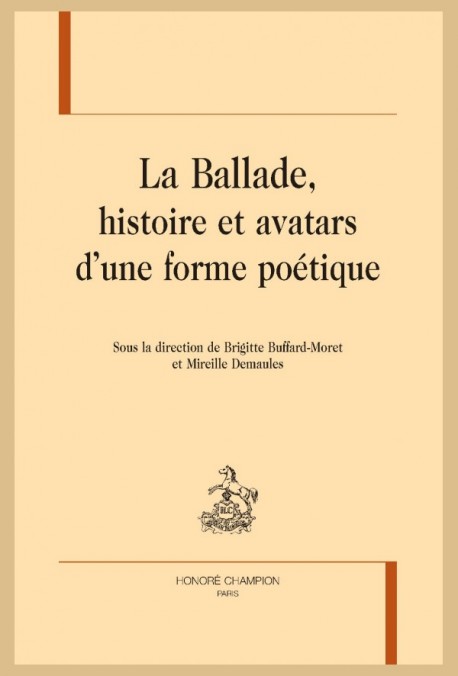
Liée au chant et à la danse, la ballade serait apparue au XIIIe siècle dans la littérature du Nord de la France et a joui d’un incontestable prestige dans la poésie de la fin du Moyen Âge. Proscrite par les poètes de la Pléiade, elle a cependant résisté au XVIIe et au XVIIIe siècles, pour renaître sous une forme complètement différente, non fixe, dont la thématique, empruntée notamment à la ballade anglaise, s’inspire de la légende, de l’histoire et de la complainte ; elle connaît un grand succès au XIXe siècle tant en France que dans la littérature européenne. De nos jours, la ballade a investi le domaine de la chanson, continuant une tradition populaire, d’extension européenne, sans lien apparent avec le genre aristocratique médiéval. Que peuvent avoir en commun, à part la dénomination, une ballade médiévale, une ballade romantique, une ballade en prose et une ballade chantée de nos jours ?
Avec le souci d’allier une perspective comparatiste à l’étude de cette forme poétique, dix-huit spécialistes reconsidèrent cette question, et d’autres attenantes, permettant des découvertes insolites sur les surprenantes métamorphoses de la ballade.
Brigitte Buffard-Moret est professeure de langue française et de stylistique à l’université d’Artois. Ses travaux de recherche portent sur les formes de la poésie française héritées de la chanson. Elle a notamment publié un Précis de versification (Paris, Dunod, 2001, rééd. revue et augmentée, Armand Colin, 2017), et La Chanson poétique du XIXe siècle, origines, statut et formes (Rennes, Presses Universitaires de Rennes, 2006, Prix Louis Barthou de l’Académie française 2007).
Mireille Demaules est professeure de littérature française du Moyen Âge à l’université d’Artois. Spécialiste du récit de rêve dans la littérature romanesque et allégorique du XIIe au XVe siècle, elle est l’auteure d’un essai sur le sujet, La Corne et l’Ivoire (Paris, Honoré Champion, 2010), et a dirigé un volume collectif intitulé Expériences oniriques dans la littérature et les arts du Moyen Âge au XVIIIe siècle (Paris, Honoré Champion, 2016).
La ballade, histoire et avatars d’une forme poétique, dir. Brigitte Buffard-Moret et Mireille Demaules, Paris, Honoré Champion, 2020. 15,5 X 23,5 cm, 366 p. ISBN : 9782745353641. Prix 49 euros.
A. Zelwerowicz National Academy of Dramatic Art – Branch Campus in Bialystok, Poland and University of Bergen, Norway
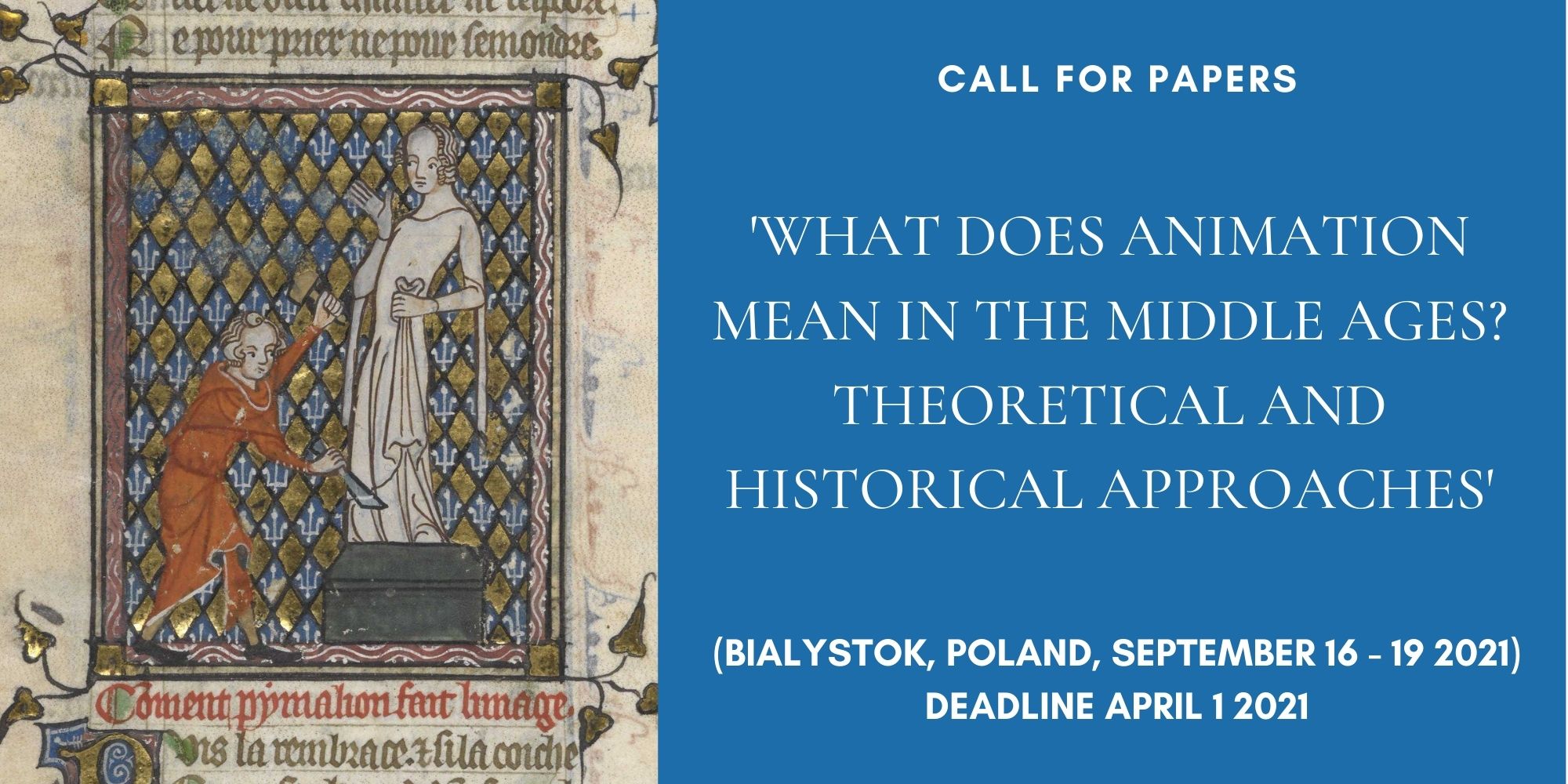
This conference is concerned with the agency and life of material objects and evolves around the investigation of two interlaced objectives. First, the project will shed light on understudied aspects of medieval visual culture, focusing in particular on the agency of images and material objects. Second, it will provide new cutting-edge theoretical reflections and methodologies concerning the study of material agency and “living images” today. We argue that the cultural use of and interaction with images may be regarded as more than mere historically or culturally specific phenomenon. Rather, it concerns the ontology of images and constitutes a fundamental aspect of our life with images, in the premodern as well as in the contemporary. It is our contention that images are embedded in social interaction and that animation is deeply constitutive of the production of meaning. Animation, we argue, is not only located in the mind of the beholder, but in the epistemology, creation, interaction and materiality of images. Furthermore, we will argue that medieval animation may inform contemporary views on animation and provide us with a more precise vocabulary to capture current phenomena for instance in the digital world. The conference aim to be interdisciplinary and transhistorical in its perspective. The conference targets scholars of visual studies, material studies, study of religions, anthropology, medieval studies and theology. It is also relevant more generally for current discussions about the life and agency of seemingly dead matter.
There are four main topics of the conference: – Physical animation of art-works and other artefacts (sculptures, reliquaries, paintings etc.) – Mental “animations” of objects (art-works, and other artefacts) – Animation in a theatrical context (mystery-plays, liturgical plays and staging’s, puppets and other theatrical use of figures and sculptures) – Medieval and Early Modern animation in the 20th Century and contemporary theatrical practices.
The Conference takes as its point of departure the work of the newly organized international research-project: The Living Image (LIMA): On the ontology, agency and personhood of living images and objects – medieval and modern. This project is coordinated from the University of Bergen, Norway, and consists of a group of researchers from Belgium, Denmark, Ireland, Norway, Poland, United Kingdom, and USA, and the work of the international research network: The European Network on the Instruments of Devotion – ENID: https://enid.w.uib.no/
The conference in Bialystok is designed to be a platform for the exchange of opinions, ideas, and historical documentation, as well as the starting point for a publication. We plan to publish a collection of articles offering an interdisciplinary academic survey of the topic of animation in the Middle Ages, and its reception in the 20th Century.
Confirmed key-note speakers: Peter Dent, Ph.D., University of Bristol, GB; Prof. Cynthia Hahn, The City University of New York, USA; Prof. Hans Henrik Lohfert Jørgensen, University of Aarhus, Denmark; Amy Whitehead, Ph. D., Massey University, New Zealand
The language of the conference is English. Each contributor will be given 20 minutes to present his/her paper. Please send abstracts of no longer than 500 words, together with a short CV and personal data at the following email: medievalanimation@gmail.com
Deadline: April 1, 2021.
Conference fee: 25 Euros (15 Euros for Ph.D. students)
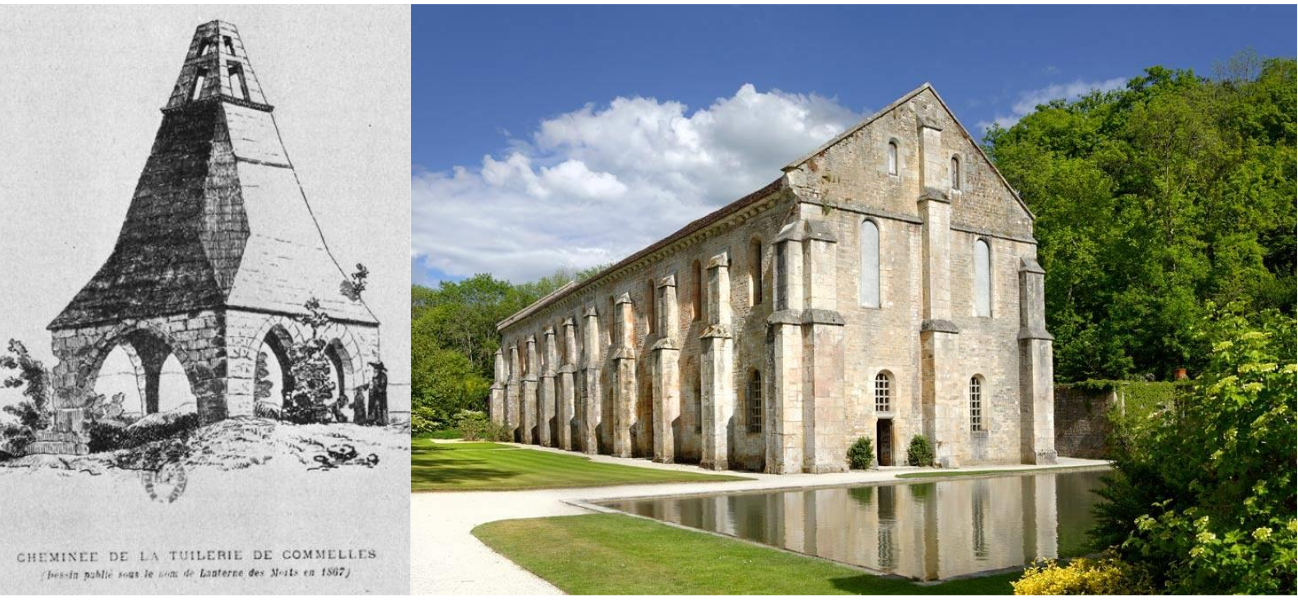
Voici le programme de la journée d’étude, « Les cisterciens et l’exploitation des ressources », qui aura lieu le jeudi 15 octobre 2020,
à l’Université de Paris 1, Panthéon, salle 216 – 12, place du Panthéon, 75005 PARIS.
En raison d’un nombre de places limité, les personnes qui souhaitent assister à la journée doivent le signaler auprès de Danielle Arribet-Deroin, danielle.arribet@univ-paris1.fr
Programme :
10h : Introduction par Danielle Arribet-Deroin et Benoit Rouzeau
Session 1 : Nouvelles recherches en cours
10h30-11h : L’abbaye de Vaucelles, par Sandrine Conan et Michel Dubois Discutant : Philippe Bernardi 11h-11h30 : les granges cisterciennes bretonnes sur le temps long, XIIe-XVIIIe siècle, par Fadila Hamelin Discutant : François Blary 11h30-12h : La métallurgie de Clairvaux et des abbayes du sud de la Champagne, par Denis Eve Discutante : Danielle Arribet-Deroin
12h30-14h : pause méridienne
Session 2 : Les types de sources écrites disponibles ?
14h-14h30 : Le boursier de Cîteaux comme source pour l’industrie et l’artisanat, par Coraline Rey 14h30-15h : Les cisterciens et l’exploitation d’une ressource particulière : les hommes, par Didier Panfili
Session 3 : La mise en place du cartulaire de l’industrie
15h-16h : débat « créer et développer une base de données », par Pierre Brochard, Eliana Magnani et Benoit Rouzeau
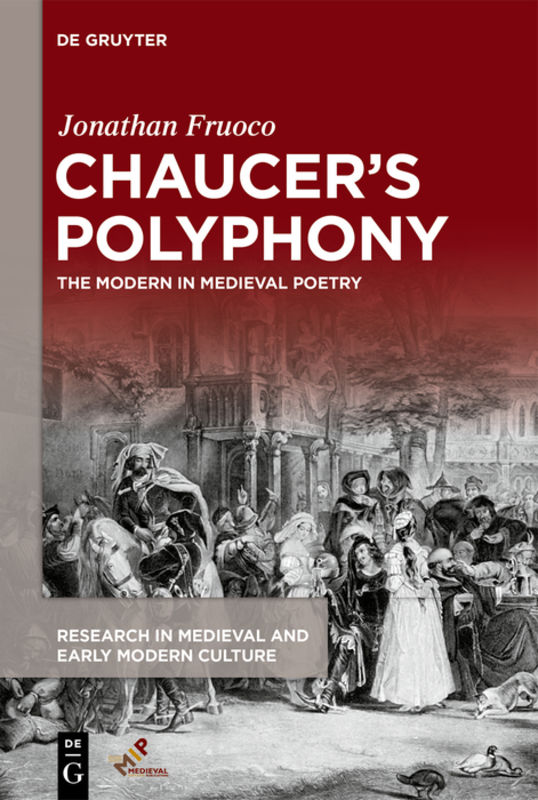
Geoffrey Chaucer has long been considered by the critics as the father of English poetry. However, this notion not only tends to forget a huge part of the history of Anglo-Saxon literature but also to ignore the specificities of Chaucer’s style. Indeed, Chaucer’s decision to write in Middle English, in a time when the hegemony of Latin and Old French was undisputed (especially at the court of Edward III and Richard II), was consistent with an intellectual movement that was trying to give back to European vernaculars the prestige necessary to a genuine cultural production, which eventually led to the emergence of romance and of the modern novel. As a result, if Chaucer cannot be thought of as the father of English poetry, he is, however, the father of English prose and one of the main artisans of what Mikhail Bakhtin called the polyphonic novel.
Jonathan Fruoco, Chaucer’s Polyphony. The Modern in Medieval Poetry, Berlin–Kalamazoo, De Gruyter, Medieval Institute Publications, 2020 (Research in Medieval and Early Modern Culture, 29). 228 p., 23.0 x 15.5 cm. ISBN : 978-1-5015-1849-2. Prix : 86,95 euros.
Das Historische Institut der Universität Bern schreibt insgesamt bis zu vier Anschubfinanzierungen für am Beginn stehende Doktoratsprojekte bzw. Early Postdoc- oder Habilitationsprojekte aus (75% Promotions- bzw. 80% Early Postdoc-Stelle).
Die Anstellung dient der Vorbereitung eines Forschungsantrags, der beim Schweizerischen Nationalfonds oder einer anderen Forschungseinrichtung eingereicht werden soll. Ihre regelmässige Anwesenheit in Bern wird ebenso erwartet wie die Durchführung einer Lehrveranstaltung für Bachelorstudierende im Frühlingssemester 2021.
Anstellungsdauer: 1.1. bis 31.12.2021 Anforderungen Voraussetzung für die Bewerbung ist ein Doktorat in Geschichtswissenschaften, welches bei Stellenantritt nicht mehr als drei Jahre zurückliegt. Es bestehen keine Vorgaben hinsichtlich Epoche, regionaler oder thematischer Ausrichtung. Wir bieten
Verantwortungsvolle und abwechslungsreiche Tätigkeit
Arbeitsplatz im Berner Länggassquartier
Attraktive Anstellungsbedingungen
Bewerbung Bitte richten Sie Ihre Bewerbung mit Motivationsschreiben, Lebenslauf (mit Veröffentlichungsliste), einer Skizze des Forschungsvorhabens (4-5 Seiten) und einer Kopie des Promotionszeugnisses (alles in einer gemeinsamen pdf-Datei) bis zum 14. Oktober 2020 zuhanden von Prof. Dr. Julia Richers. Fügen Sie Ihrer Nachricht bitte zusätzlich eine Arbeitsprobe in Aufsatzlänge (ca. 20-25 Seiten) in einer separaten pdf-Datei bei.
Die Skizze des Forschungsvorhabens muss auch eine Darlegung zum potentiellen Förderungsgefäss enthalten, welche Angaben dazu enthält, ob der Bewerber bzw. die Bewerberin für das entsprechende Gefäss antragsberechtigt ist. Falls solche Angaben nicht vorgelegt werden oder offensichtlich falsch sind, kann eine Bewerbung nicht weiter berücksichtigt werden.
Bitte klicken Sie auf den unterstehenden Link Jetzt bewerben, um sich zu bewerben.
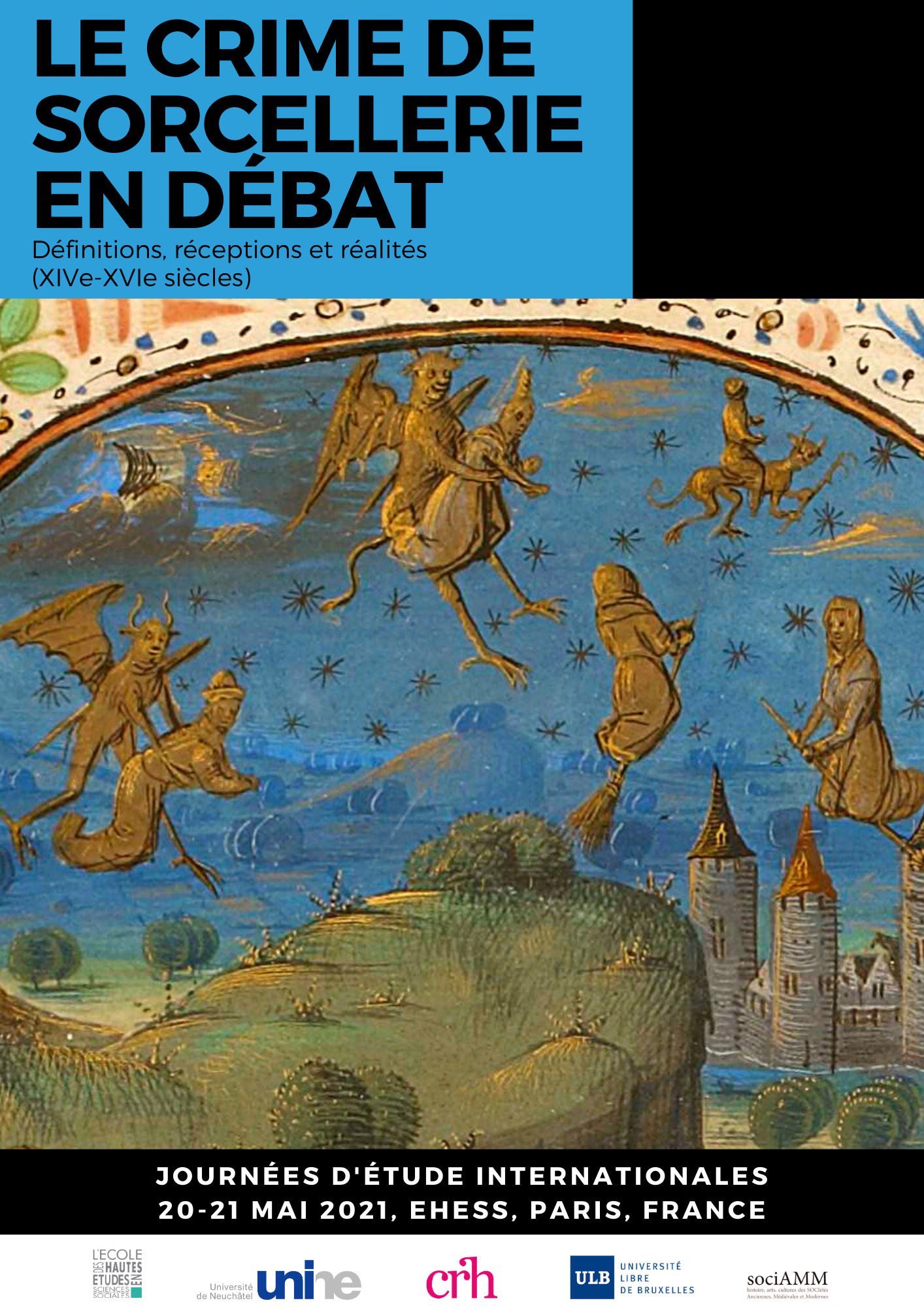
Journées d’étude (20-21 mai 2021) École des Hautes Études en Sciences Sociales, Paris
La multiplication des travaux ces dernières décennies dans le champ des Witchcraft Studies a permis de profondément renouveler les approches et les modèles d’étude de la répression de la sorcellerie à la fin du Moyen Âge et au début de l’époque moderne. Par là même, la recherche a grandement précisé les modalités et les configurations (idéologiques, politiques et doctrinales) qui concourent à la genèse de la « chasse aux sorcières ». La recherche a également montré que la répression de la sorcellerie pouvait revêtir des formes très différentes en fonction des contextes et des espaces envisagées, des sources étudiées et des objectifs prêtées à celle-ci, soulignant ainsi l’extrême plasticité de l’accusation de sorcellerie et des catégories de ce crime. Les journées d’étude se proposent ainsi d’orienter les réflexions et les discussions autour de trois axes principaux : la définition du crime de sorcellerie, ses différentes réceptions et la question de sa réalité.
L’objet des journées d’étude sera également de mettre en débat le crime de sorcellerie, en valorisant notamment les nouveaux terrains de la recherche et les dossiers inédits sur cette question, dans le but d’examiner et de débattre de la variété des définitions, des modalités de réception et des différentes réalités que le crime de sorcellerie pouvait revêtir à la fin du Moyen Âge et au début de l’époque moderne (XIVe-XVIe siècle).
Définir le crime de sorcellerie : enjeux, concepts et débats
L’historiographie a souvent souligné la richesse du lexique mobilisé dans les sources médiévales et modernes pour désigner la sorcellerie, et ceux qui la pratiquent. Ce foisonnement typologique est notamment à mettre en relation avec la diversité des espaces dans lesquels s’est développée la répression du crime de sorcellerie, à partir de la fin du XIIIe siècle. Les travaux les plus récents, portant notamment sur l’espace alpin, sur l’espace pyrénéen ainsi que sur le royaume de France, ont montré les différentes spécificités et les particularités régionales du vocabulaire employé pour définir la sorcellerie. De plus, le crime de sorcellerie apparaît comme une catégorie criminelle à la définition plastique et mobile dont la formulation est intimement liée aux types de sources mobilisés par l’historien. Ainsi, l’étude de la sorcellerie semble activement témoigner que ce crime est un concept en construction et en débat à la fin du Moyen Âge. Si aujourd’hui les données sont relativement bien connues, la synthèse dans une perspective comparatiste reste à faire. La confrontation de différents terrains d’enquête, mobilisant des matériaux diversifiés (sources judiciaires, normatives, théologiques, pratiques gracieuses, littérature, prédication) et mettant en évidence des milieux de production différents (laïcs, ecclésiastiques, inquisitoriaux) permettrait de conduire une réflexion globale sur les modalités de configuration du crime de sorcellerie à la fin Moyen Âge. Elle permettrait également de préciser les enjeux de la mobilisation d’un type de vocabulaire ou d’un autre en mettant en évidence d’éventuels jeux d’échelles en fonction d’unités régionales et politiques différentes. Enfin, la démarche comparatiste permettrait également de préciser les modalités de diffusion et de circulation des mots qui définissent le crime de sorcellerie en mettant en évidence les conditions de leurs réceptions et leurs possibles influences sur les pratiques répressives à l’encontre de la sorcellerie.
Réceptions du crime de sorcellerie : entre adhésion et résistance
Au-delà de sa définition se pose la question de la réception du crime. Il est certain qu’avant le début de la chasse aux sorcières, il préexiste une conception de la sorcellerie qui diffère en fonction des classes sociales et des régions. Celle-ci ne correspond que partiellement avec le concept du sabbat qui émergent dans les tribunaux à partir du XVe siècle. On le voit notamment à travers les débats des théologiens sur la réalité ou la fiction du vol nocturne, mais également à travers les dénonciations qui ciblent généralement des individus et non des groupes perçus comme agissant secrètement et collectivement. La question du rôle de la population dans la répression est un élément clé de la compréhension du phénomène, que ce soit par l’impact de la vision populaire de la sorcellerie ou dans des actions individuelles. Si la répression de la secte diabolique peut, dans certains cas, être instrumentalisée par des individus pour satisfaire leur propre agenda, des oppositions au concept du sabbat ou à des procès spécifiques existent. Elles sont bien souvent difficiles à saisir puisque la justice est exercée par les dominants. Ceux qui voudraient la contester, sauf révolte ouverte, doivent se contenter d’actions voilées pour éviter la sanction. Néanmoins, l’étude des comptabilités médiévales ou modernes permet d’apporter des éléments à la question de l’adhésion des populations au phénomène de la répression.
Réalités du crime de sorcellerie : l’accusation en tension
Au sein de l’historiographie, il existe un consensus important pour dire que le sabbat et la plupart des crimes qui sont reprochés aux accusées n’ont pas réellement eu lieu. Partant de cette hypothèse largement démontrée depuis les années 1970, la plupart des historiens se posent la question de la réalité qui se trouve derrière le crime. Si l’essentiel des charges retenues contre les individus accusés de sorcellerie ne peuvent être considérées comme avérées, quelles informations peut-on extraire de ces documents ? Les points de vue sont nombreux. Faut-il lire les procès en cherchant à isoler les éléments qui sortent du cadre attendu de leur production ? Croiser ces informations avec d’autres sources qui nous renseignent sur les tensions sociales ou politiques des communautés, ou les agendas des juges ? Et enfin, quelle est l’influence de la conservation des sources sur notre vision propre du phénomène ?
Des communications en lien avec ces différentes thématiques seront particulièrement remarquées.
Les langues des journées d’étude seront le français et éventuellement l’anglais.
Il s’agit de journées d’étude qui sont également ouvertes aux jeunes chercheurs et donc aux doctorants, post-doctorants ainsi qu’aux masterants avancés.
Comment candidater :
Pour candidater, envoyer un mail à cet appel à communication (à l’adresse suivante : maxime.perbellini@ehess.fr) le 30 novembre 2020 au plus tard avec un titre et un court résumé (max. 300 mots) de la communication envisagée. Les communications devront être d’une durée de 20min.
Informations pratiques :
Les journées d’étude sont organisées par Maxime Gelly-Perbellini (doctorant à l’EHESS et à l’Université Libre de Bruxelles, ATER à l’Université de Reims Champagne-Ardenne) et Olivier Silberstein (doctorant à l’Université de Neufchâtel). Elles sont portées par l’Ecole des Hautes Etudes en Sciences Sociales. Elles se tiendront dans les locaux de l’Ecole des Hautes Etudes en Sciences Sociales les 20 et 21 mai 2021. Les journées d’étude débuteront le 20 mai à 14H00 et s’achèveront le 21 mai à 17H00.
Questioning the Crime of Witchcraft, Definitions, Receptions and Realities (14th-16th Centuries)
In the last decades, the multiplications of works in the field of Witchcraft Studies made it possible to profoundly renew the approaches and the study designs of the repression of witchcraft in the late Middle Ages and in the beginning of the Early Modern Era. Consequently, research has substantially specified the methods and configurations (ideological, political and doctrinal) that contribute to the genesis of the “witch-hunt”. Research also uncovered that the repression of witchcraft could take a number of different forms depending on the contexts, the spaces studied, the sources and the aims they seem to pursue. It underlines the extreme plasticity of the accusation of witchcraft and the categories of such a crime. Hence, the conference aims to focus the discussions on three main areas: the definition of the crime of witchcraft, its different receptions and the question of its reality.
The goal of the conference is also to discuss the crime of witchcraft by highlighting new fields of research and unstudied sources. The variety of definitions, the modalities of reception and the different realities that the crime of witchcraft had undergone in the late Middle Ages and at the beginning of the Early Modern Era (14th-16th centuries) will be addressed and debated.
Defining the crime of witchcraft: issues, concepts and debates
Historiography has frequently emphasized the richness of the lexicon involved in medieval and early modern sources to name witchcraft and those who practice it. Such a typological abundance is to be seen in the context of the numerous areas where the repression of the crime of witchcraft expanded, starting at the end of the 13th century. The most recent work, in particular those concerning the Alpine region, the Pyrenees and the Kingdom of France, have shown the specific features and the distinctive regional identities of the vocabulary used to define witchcraft.
Moreover, the crime of witchcraft appears as a criminal category with a flexible and dynamic definition where the wording is closely tied to the studied sources. Therefore, the study of witchcraft seems to bear witness that this crime is a concept under construction and in debate at the end of the Middle Ages. If these elements are relatively understood today, a comprehensive review from a comparative perspective remains to be done. The confrontation of various terrains of study mobilizing various materials (judicial, normative, theological sources, pardons, literature, predication) and highlight different production backgrounds (laypersons, clergy, inquisition) would enable us to lead a global reflection on the modalities of the emergence of the crime of witchcraft in the late Middle Ages. It would also help us to clarify the issues of the use of a certain type of vocabulary by highlighting what is at stake depending on the different regional or political units.
Finally, this comparative approach could enable to point out the modalities of diffusion and circulation of the words defining the crime of witchcraft. Therefore, it could permit us to specify the conditions of their reception and their possible influences of the repressive practices against witchcraft.
Reception of the crime of witchcraft: between support and resistance
Beyond its definition, a crime can be diversely received. It is clear that before the beginning the European witch hunt a notion of witchcraft preexists and differs depending on social classes or regions. It corresponds only partially with the concept of Sabbath that emerges in courts starting in the 15th century. It can be seen in the debates of theologians on the reality or fiction of nocturnal flights. It can also be seen in the denunciations generally targeting individuals instead of groups which could be perceived as acting secretly and collectively.
The question of the role of the population in repression is a key element to understand the phenomenon, both in the impact of the popular perception of witchcraft, and in individual actions. If the repression of the diabolical sect could, in certain cases, be exploited by individuals to satisfy their own agenda, oppositions to the concept of Sabbath or to specific trials existed. They are generally difficult to grasp since justice is exercised by the dominant. Those who wanted to contest, to avoid an open revolt, had to accept disguised ways to dodge any sanction. Nevertheless, the study of medieval and early modern bookkeeping enables us to provide elements to understand the adherence of populations to the phenomenon of repression.
Realities of the crime of witchcraft: accusations under tension
In historiography, there exists broad consensus stating that the Sabbath as well as most crimes of which the defendants were accused did not actually occur. Based on this hypothesis generally demonstrated since the 1970s, most historians are now asking the question of the reality which lies behind the crime. If most of the charges against the individuals accused of witchcraft cannot be proven, what pieces of information can be extracted from these documents? The points of view are many. Should the trials be read in a way that picks out elements falling outside the expected framework of their production? Should this information be compared with other sources informing us about social and political tensions within the communities or about the agenda of judges? And finally, what is the influence of the conservation of certain sources on our own vision of the phenomenon?
Papers with topics related to these different themes are particularly welcomed.
The conference will be in French and in English.
The conference is open to young researchers, PhD students, Post-doctoral researchers as well as advanced graduate students.
Submission: You are invited to submit a 300-word abstract with key words in either English or French by November 30th, 2020 to the following email address: maxime.perbellini@ehess.fr. Please include: a brief résumé, the title of your presentation, as well as your name and your academic affiliation. Please send any additional questions you may have to the aforementioned email address. The presentations will have to be 20 minutes long maximum.
Practical information:
The conference is organized by Maxime Gelly-Perbellini (PhD student at the School for Advanced Studies in the Social Sciences (EHESS, Paris, France) and at the Free University of Brussels, Belgium, Research and Teaching Assistant at the University of Reims Champagne-Ardennes, France) and Olivier Silberstein (PhD student at the University of Neufchâtel, Switzerland). It is sponsored by the School for Advanced Studies in the Social Sciences (EHESS, Paris, France). It will take place on the premises of the School for Advanced Studies in the Social Sciences (EHESS, Paris, France) on May 20th-21st 2021. The conference would start on May 20th at 2pm and would end on May 21st at 5pm.
Avec le soutien du FNRS, du CRHiDI (UCLouvain – Saint-Louis, Bruxelles), d'INCAL (UCLouvain), de PraME (UNamur), de sociAMM (ULB) et de Transitions (ULiège)










Vous devez être connecté pour poster un commentaire.