Publication – Bruno Lemesle, « Le gouvernement des évêques. La charge pastorale au milieu du Moyen Âge »

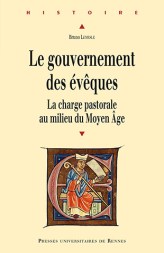
Ce livre apporte des éclairages neufs sur la conception du gouvernement des évêques (XIIe-XIIIe siècles). Les lettres pontificales se sont imposées comme une des sources majeures, en raison de l’unicité de leur provenance, et parce qu’elles étaient le moyen de gouverner sur les longues distances. Les travaux des canonistes auxquels sont jointes les quaestiones des maîtres des écoles épiscopales qui exposaient de véritables « cas pratiques » à partir des normes juridiques forment l’autre source essentielle de cette étude.

1447084745

Avec le soutien de l’Institut universitaire de France.

Table des matières : ici

Informations pratiques :
Bruno Lemesle, Le gouvernement des évêques. La charge pastorale au milieu du Moyen Âge, Rennes, Presses Universitaires de Rennes, 2015 (Histoire). Format : 15,5 x 24 cm. Nombre de pages : 248 p. ISBN : 978-2-7535-4267-9. Prix : 18,00 €.

Source : Presses universitaires de Rennes

Publié dans Publications | Laisser un commentaire

Appel à contribution – Représentations de l’ordinaire dans les périodes médiévale et moderne

Date limite: 4 Janvier 2016
Date et lieu du colloque: 19-20 février 2016, Durham, Duke University

Brueghel l’Ancien, Noces de paysansThe 16th Annual North Carolina Colloquium in Medieval and Early Modern Studies invites graduate students to submit proposals for twenty-minute paper presentations that investigate representations of everyday life––mimetic, descriptive, or prescriptive––from late antiquity through early modernity. How are the particularities of ordinary experience shown, shaped, distorted, or elided in poetry, prose, visual art, architecture, music, drama, and other forms of creative endeavor? For that matter, what constitutes the concept of the ordinary, and how does the history of this concept interweave with the development of realism, alongside other modes of representation?

In short, we shall explore what is at stake in representing the ordinary. For whether the representation works toward a form of distinction or a claim to community, it cannot be neutral. We encourage participants to explore an array of topics within this region of inquiry. (See list below. Note that it does not purport to be comprehensive. All pertinent concerns are welcome.)

The NC Colloquium in Medieval and Early Modern Studies is a cooperative venture between UNC-Chapel Hill’s and Duke University’s programs in Medieval and Renaissance Studies. We seek contributions from a broad range of humanistic and social-scientific disciplines––including, but not limited to History, Philosophy, Theology, Literary Studies, Linguistics, Cultural Studies, Political Theory, Sociology, Anthropology, Art History, Gender Studies, Sexuality Studies, and Food Studies.

Interested graduate students should submit 250-word abstracts to representingtheordinary@gmail.com no later than Monday, January 4, 2016 . The body of the email should include the presenter’s name, institutional affiliation, and contact information, but the abstract itself should be attached as a PDF or MS Word Document. Decisions will be announced by Monday, January 18, 2016.

Possible Subjects :

  • Temporalities of the everyday, the diurnal
  • The ordinary in its tragic/comic aspects; mystery plays
  • Liturgical practice, parishional variety, guilds
  • Agency, habit, praxis
  • Commerce and the quotidian, homo economicus
  • Play, the aleatory, homo ludens
  • Jokes and insults
  • Song and dance
  • Visions of language––ordinary and ideal, private and universal
  • The body, gesture, physiognomy, materialities of communication
  • Pedagogy and learning
  • Rise of the vernacular, semantic shift, lexicography
  • Reading practices, history of reading, marginalia
  • Gender, sexuality, and desire
  • Manuals and guides for agrarian, domestic, or courtly life
  • Households, lords and servants; the oikos and the polis
  • The ordinary and modernity; everyday life, pre/postmodern
  • The place of death and grief in life
  • Representations of reality in writing
  • Realism in painting and sculpture
  • Realism and nominalism; the generic and the particular
  • Common spaces, urban and rural
  • The built environment, orientation
  • Imposed structures, functional objects
  • Mechanization and machinery
  • Print, mass production and dissemination

Source : blog de l’ApAhAu

Publié dans Appel à contributions | Laisser un commentaire

Publication – Térence Le Deschault de Monredon, « Le décor peint de la maison médiévale. Orner pour signifier avant 1350 en France »

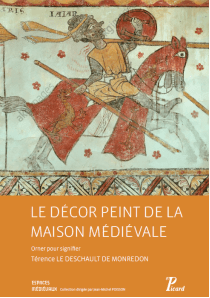
Cet ouvrage propose une vue d’ensemble de la peinture murale figurative dans l’habitat médiéval en France avant les années 1350, marquées par le début de la guerre de Cent Ans. Ce vaste sujet a été nourri par de nombreuses découvertes récentes, en grande partie dues à l’essor de l’archéologie du bâti, la plupart effectuées dans des habitations privées peu accessibles au public.

Décor peint

À travers l’organisation du décor, son emplacement, les thèmes choisis, l’auteur révèle l’atmosphère que pouvait dégager l’intérieur d’une maison médiévale. Les nombreux décors (plus de 55) mis au jour en France, dont le plus fameux est sans doute celui de la tour Ferrande (Vaucluse), permettent de mettre en lumière les thématiques abordées, lesquelles font une large place au mode de vie aristocratique.

La riche iconographie rassemblée pour illustrer ce panorama permet d’appréhender la diversité des solutions adoptées pour les décors conservés dans les maisons tant urbaines que rurales. Renouvelant la connaissance du décor peint ainsi que la compréhension de la société médiévale des XIIe, XIIIe et XIVe siècles, l’auteur laisse entrevoir la vie des élites médiévales en étudiant un aspect culturel intime et méconnu de la sphère laïque.

Informations pratiques :
Térence Le Deschault de Monredon, Le décor peint de la maison médiévale. Orner pour signifier avant 1350 en France, Paris, Picard, 2015. 17 x 24 cm, 352 pages, 225 illustrations en couleurs. ISBN : 978-2-7084-0990-3. Prix : 39 euros.

Publié dans Le réseau | Laisser un commentaire

Offre d’emploi – Assistant professor in Later Medieval History (University of Amsterdam)

Job description

The History Department at the University of Amsterdam is seeking candidates for a regular position of Assistant professor in Later Medieval History, 1000-1500. Given the department’s desire to expand beyond its current geographical coverage, applicants with a research and teaching focus outside the Low Countries and Italy are strongly encouraged to apply, especially those interested in social, cultural and urban history. Command of the Dutch and English language or a strong indication of being able to hone them in the near future is essential.

The appointment will be temporary for two years. Positive assessment and evaluation can be expected to lead to a permanent appointment of 0,8 fte. In the first two years at least the appointment will be extended to 1,0 fte.

New staff members follow a full programme of professional integration and can expect significant feedback on their work. Additional didactical training is also part of the appointment. Based on the candidate’s educational portfolio, previously acquired competences will be taken into consideration. The introductory programme includes earning the ‘basic teaching qualification’.

Amsterdam

Tasks

Pursuing external funding for research, notably funding from research councils;
supervising BA and MA theses;
active contribution to the development and improvement of the broader teaching programmes, regarding didactics and the contents of the programmes, and their evaluation;
supervising and training students;
taking part in committees and working groups, and carrying out administrative tasks.

Requirements

Eligible candidates will have earned their PhDs in History (or a field directly relevant to the advertised position) by the date of the appointment;
a research network, preferably international, in the research area concerned;
demonstrated teaching experience in higher education;
Dutch Basic Teaching Qualification (BKO), or willingness to acquire this within a relatively short time-frame;
experience of digital and audiovisual teaching facilitie;
a good team worker, capable of multidisciplinary co-operation;
proven organizational experience and skills.

Conditions of employment

The appointment will be temporary for two years. Positive assessment and evaluation can be expected to lead to a permanent appointment. The appointment will commence on 1 August 2016 or as soon as possible thereafter.
The gross monthly salary will range from €3,399 (scale 11) to €5,288 (scale 12), based on 38 hours a week and depends on relevant experience in teaching and research. The Collective Labour Agreement for Dutch Universities is applicable.

Organisation

University of Amsterdam

With over 5,000 employees, 30,000 students and a budget of more than 600 million euros, the University of Amsterdam (UvA) is an intellectual hub within the Netherlands. Teaching and research at the UvA are conducted within seven faculties: Humanities, Social and Behavioural Sciences, Economics and Business, Law, Science, Medicine and Dentistry. Housed on four city campuses in or near the heart of Amsterdam, where disciplines come together and interact, the faculties have close links with thousands of researchers and hundreds of institutions at home and abroad.

The UvA’s students and employees are independent thinkers, competent rebels who dare to question dogmas and aren’t satisfied with easy answers and standard solutions. To work at the UvA is to work in an independent, creative, innovative and international climate characterised by an open atmosphere and a genuine engagement with the city of Amsterdam and society.

Department

Faculty of Humanities

In the Department of History, European Studies and Religious Studies, the History section is responsible for the BA and MA programmes in History. The History section is made up of six ‘chair-groups’: Ancient History, Medieval History, Early Modern History, Modern History, Dutch History and American Studies. There are about 1,000 students following History programmes.

The Medieval History group within the History Department contributes to all aspects of the program’s teaching at the BA and MA levels. At the BA level you will be expected to teach, develop and help administer the general survey in medieval history (c.500-1500), general sources and methods classes and electives that may be broadly thematic or period-specific. At the MA level you will be required to contribute to the taught and research programs through offering elective courses and tutorials to advanced students. Both programs have set as their goal a continuous reflection on the study of the past as a gateway to conceptualizing present-day circumstances.

The Amsterdam School of History (ASH) is the research home of all historians at the University of Amsterdam. You will be expected to participate fully in its intellectual life, including but not limited to the Center for Medieval and Renaissance Studies Amsterdam (CMRSA) and the History Research Seminar. The School is seeking to further its particular strengths in social, cultural and urban history, from Antiquity to the present, by attracting scholars working beyond the Low Countries and Italy. Ample opportunities for cross-disciplinary research exist and are strongly encouraged within and beyond the Humanities Faculty.

The Faculty of Humanities offers assistant professors the opportunity to collaborate with leading researchers at research institutes that – partly as a result of their multidisciplinary approach – are world-renowned. Moreover, you will be teaching in a dynamic context in which new educational methods are being developed.
Additional information

For further information you can contact:

Prof. Guy Geltner, Chair of Medieval History

Source : Academic Transfer

Publié dans Offre d'emploi | Laisser un commentaire

Séminaire – Administrer par l’écrit au Moyen Âge et à l’époque moderne : classer, contrôler, négocier

Archives nationales, salle d’Albâtre
11 rue des Quatre-Fils
75003 Paris

Contact :
isabelle.bretthauer[at]uvsq.fr
m.helias[at]irht.cnrs.fr

Ce séminaire, dont la première séance se tient lundi 11 janvier 2016 aux Archives nationales, a pour objectif de mettre en lumière l’évolution des formes et des usages de l’écrit au cours des XIIIe et XIVe siècles et de comprendre ses prolongements par-delà le Moyen Âge, dans un contexte où l’écrit devient de plus en plus foisonnant.

Prolongeant les journées de recherche organisées par le LAMOP et DYPAC en janvier 2015 sur ce thème au Moyen Âge, il entend examiner sur la longue durée (XIIIe-XVIIIe siècle) la place et le rôle de l’écrit dans les pratiques administratives, comptables et marchandes, en prêtant une attention particulière aux conditions de production, d’utilisation et de réutilisation de l’écrit.

Trois thèmes seront au centre des réflexions. Le premier concerne le classement des écrits produits et leur transformation progressive en documents d’archives. Certaines formes d’organisation sont en effet nécessaires pour faire face à l’augmentation exponentielle des documents et en permettre l’éventuelle réutilisation. Une attention particulière sera également portée sur le contrôle des biens et des hommes par le biais d’écrits qui mettent en scène des structures sociales déjà existantes ; dans le même temps, un tel encadrement n’est pas sans effet sur les biens ainsi gérés et les hommes ainsi gouvernés. Enfin, nous n’oublierons pas que l’administration par l’écrit n’est pas réservée aux autorités et aux institutions qui en émanent : ainsi en va-t-il des pratiques comptables mises en œuvre dans le monde marchand. La systématisation de telles méthodes à l’échelle des individus est un phénomène de la fin du Moyen Âge qu’il convient d’interroger sur le long terme.

Le séminaire est organisé de manière mutualisée par cinq institutions : les Archives nationales, l’École nationale des chartes, le LAMOP (université Paris I), DYPAC (université de Versailles-Saint-Quentin), et l’IRHT. Il est ouvert aux étudiants de master et de doctorat, ainsi qu’aux chercheurs. Pour cette première année, trois séances sont organisées et complétées par une journée d’étude le 1er juin 2016.

valenciennesbm536f14v

Programme :

Séance 1 : lundi 11 janvier 2016 : « Les comptabilités de cours aux époques médiévale et moderne » (Archives nationales, 14h-17h)

Bruno Laurioux (DYPAC/UVSQ) : « Entre cour et jardin : les comptes alimentaires des maisons royales, princières et seigneuriales entre XIIe et XVe siècle »
Pauline Lemaigre-Gaffier (DYPAC/UVSQ) : « Classer, archiver et engager : les comptes de la Maison du Roi au xviiie siècle »

Séance 2 : vendredi 12 février 2016 : « La fabrique de l’écrit » (Archives nationales, 14h-17h) (mutualisé avec le séminaire d’Histoire de Paris de l’IRHT)

Olivier Canteaut (Centre Jean-Mabillon/École nationale des chartes), « Quand le roi de France écrit à ses sujets : de quelques difficultés matérielles du gouvernement à distance (fin XIIIe s.-début XIVe s.) »
Anne Jolly (Institut national du patrimoine), « La production comptable des trésoriers et ingénieurs des Ponts-et-Chaussées au XVIIIe siècle : quel impact sur la détermination de la politique routière monarchique ? »

Séance 3 : mercredi 16 mars 2016 : « Gérer ses affaires par l’écrit » (Archives nationales, 14h-17h)

Mélanie Morestin-Dubois (LAMOP/Université Paris 1), « Les archives privées de Jean Teisseire, marchand du XIVe siècle: une administration de l’écrit, par l’écrit »
Julien Villain (IDHES/Université Paris 1) : « Des instruments de contrôle des flux de crédit : les comptabilités des marchands grossistes et des boutiquiers lorrains au XVIIIe siècle »

Journée d’étude : Mercredi 1er juin 2016 : « Administrer par les archives » (IRHT, Centre Félix Grat, 9h-17h15)

Source : IRHT

Publié dans Séminaire | Laisser un commentaire

Appel à contribution – Wonder Aspects and Approaches

The Twelfth Oxford Medieval Graduate Conference
St. Edmund Hall, Oxford
8-9th April 2016

We are pleased to open the Call for Papers for the Twelfth Oxford Medieval Graduate Conference, sponsored by the Society for the Study of Medieval Languages and Literature. The conference is aimed at early career scholars and graduate students working in Medieval Studies.

Contributions are welcomed from diverse fields of research such as History of Art and Architecture, History, Theology, Philosophy, Anthropology, Literature and History of Ideas.

We are delighted to announce that the keynote address will be given by: Prof. Helen Cooper (Magdalene College, Cambridge)

Papers should be a maximum of 20 minutes. Please email 250-word abstracts (text only, no attachments) to oxgradconf@gmail.com by 24th January 2016. Suggested topics might include, but are not limited to:

The Wondrous Other:
– Wondrous Beasts, Beings, Monsters
– Wondrous Countries and Peoples

Filled with Wonder:
– Power and Display
– Marvels, Miracles, Curiosities

Wonder and the Medieval Imagination:
– The Psychology of Wonder
– Daring to Wonder: Medieval Doubt

Wondering Minds:
– Scripts and Scribes
– Curiosity: Secular, Heterodox, and Heretical

The Wonders of the Medieval World:
– Art and Architecture
– The Natural World and the Environment

The Wonders of Science:
– The Human Body and Medieval Medicine
– Celestial Bodies and their Motion

The registration fee (including a wine reception) is expected to be £10. There will be a conference dinner on the first night of the conference; it is hoped that this will cost in the region of £30. All updates and further information, including details of travel bursaries, can be obtained from the conference website: mediumaevum.modhist.ox.ac.uk/wonder

Follow us on Twitter @OxMedGradConf

Wonder CFP_ updated

We are pleased to extend the Call for Papers for the Twelfth Oxford Medieval Graduate Conference to include a Call for Posters for our first Poster Competition! The OMGC is aimed at early career scholars and graduate students working in any area of Medieval Studies.

Poster contributions are welcomed from all students across any field of medieval research, including (but not limited to) History of Art and Architecture, Music, History, Theology, Philosophy, Anthropology, Literature and History of Ideas.

Posters can be on any topic of research, whether a Masters Dissertation, an aspect, chapter, or the entirety of a PhD thesis, or a new postdoctoral research project. The poster should be A2, A1 or A0 in format, and will be on display for the duration of the conference. The creator of the poster is expected to attend the conference, at which there will be an opportunity to discuss it with other delegates and academics. There will be a prize for the best poster.

To take part, please email oxgradconf@gmail.com by 8th March 2016 providing:
– Your name and institution
– Your project title

Please note that we will be unable to print any posters.

Publié dans Appel à contributions | Laisser un commentaire

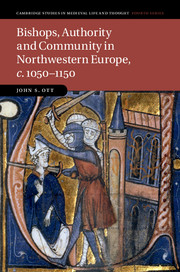
Publication – John S. Ott, « Bishops, Authority and Community in Northwestern Europe, c.1050–1150 »

This important new study of episcopal office and clerical identity in a socially and culturally dynamic region of medieval Europe examines the construction and representation of episcopal power and authority in the archdiocese of Reims during the dynamic and sometimes turbulent century from 1050 to 1150. Drawing on a wide range of diplomatic, hagiographical, and other narrative sources, John S. Ott considers how bishops conceived of and projected their authority collectively and individually. In examining episcopal professional identities and notions of office, he explores how prelates used textual production and their physical landscapes to craft historical narratives and consolidate local and regional memories around ideals that established themselves as not only religious authorities but cultural arbiters. This study reveals that, far from being reactive and hostile to cultural and religious change, bishops regularly grappled with and sought to affect, positively and to their advantage, new and emerging cultural and religious norms.

9781107017818

Table des matières :

1. The bishop and his authority
2. Becoming bishop: clerical culture and episcopal formation in the archdiocese of Reims around 1100
3. Restless flocks: the challenges to episcopal authority
4. Band of brothers: episcopal networks in the archdiocese of Reims
5. Personal histories: the revival of archiepiscopal historiography at Reims in the eleventh century
6. Sanctity and history in a border diocese: the vita of Lietbert of Cambrai (1051–76)
7. Urban space, memory, and episcopal authority: the bishops of Amiens in peace and conflict, 1073–1164
8. Bishops and the word
9. Toil and togetherness in the vineyards of the Lord
10. Conclusion
Bibliography
Index.

Informations pratiques :
John S. Ott, Bishops, Authority and Community in Northwestern Europe, c.1050–1150, Cambridge, Cambridge University Press, 2015 (Cambridge Studies in Medieval Life and Thought, Fourth Series). ISBN : 9781107017818. Available from October 2015. Prix : 65,00 £.

Source : Cambridge University Press

Publié dans Publications | Laisser un commentaire

Colloque – Dante and the Knowledge of His Time

10.12.2015
Freie Universität Berlin
Habelschwerdter Allee 45
Sitzungsraum Friedrich-Schlegel-Graduiertenschule
JK 33/121

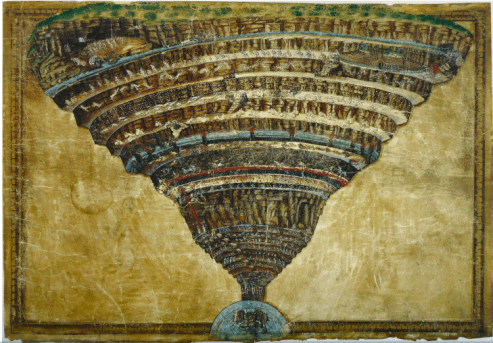
The workshop offers seven different perspectives on Dante: from his formation in Florence to the new poetics of the Vita nova; from the foundation of a new science in the Convivio and the De vulgari eloquentia to Dante’s dialogue with Brunetto Latini and Arnaut Daniel in the Commedia; from the hermeneutics of Dante’s otherworldly realms to Botticelli’s illustrations of the poem.

By inviting scholars to discuss Dante’s oeuvre in its historical, philosophical, and literary contexts, the Freie Universität wishes to mark the 750th anniversary of the birth of Dante Alighieri.

Capture d’écran 2015-12-08 à 07.59.04

Programme :

09:15-10:15 Gerhard Regn (Ludwig-Maximilians – Universität München)
La segnicità dell’oltretomba

10:30-11:30 Franziska Meier (Georg-August-Universität Göttingen)
Scienza nova? Dante’s Expectations of the Vernacular

11:30-12:30 Igor Candido (Johns Hopkins University / Freie Universität Berlin)
Notes for Rereading the Vita Nova: the First Dream Vision

14:00-15:00 Zygmunt G. Baranski (University of Notre Dame / University of Cambridge)
Studying Dante’s Intellectual Formation: Problems rather than Solutions

15:15-16:15 Gaia Gubbini (Freie Universität Berlin)
La “radice” di Francesca e la speranza di Arnaut: Dante e il problema dell’amore

16:15-17:15 Andreas Kablitz (Universität zu Köln)
The First Canto of Dante’s Commedia and the Tesoretto by Brunetto Latini

17:15-18:15 Joachim Küpper (Freie Universität Berlin)
Dante and Botticelli

Organizers: Igor Candido, Gaia Gubbini

Publié dans Colloque | Laisser un commentaire

Appel à contribution – Les cultures de la décision dans l’espace bourguignon : acteurs, conflits, représentations

Les prochaines rencontres du Centre européen d’Études bourguignonnes (CEÉB) se dérouleront les 22-24 septembre 2016 en Allemagne, à Münster, à l’invitation de l’Université du lieu et en collaboration avec le Sonderforschungsbereich 1150 « Les cultures de la décision ». Le thème portera sur « Les cultures de la décision dans l’espace bourguignon : acteurs, conflits, représentations ». Le sujet sera envisagé dans une perspective très large, y compris interdisciplinaire.

Armoiries

Dans un espace bourguignon de la fin du Moyen Âge qui se caractérise par une structure politique complexe, diversifiée et influencée en partie par des intérêts contradictoires et des cultures politiques différentes, il s’agira d’étudier les acteurs, les concepts et pratiques de la décision, et la mise en scène du processus qui conduit à la prendre. Quatre questions clés guideront les communicants : quelles questions font l’objet d’une prise de décision par les contemporains et comment expriment-ils qu’une décision a été prise ? De quelles manières les décisions sont-elles prises ? Comment les processus de prise de décision sont-ils mis en scène ? Par quel(s) concept(s) ou récit(s) sont-ils exprimés ? Outre ceux qui prennent, contribuent ou assistent à la prise de décision, aucun domaine de la recherche ne sera exclu, qu’il s’agisse de la législation, de la politique religieuse, de l’économie, mais aussi de la littérature et de l’art – commanditaires, processus de décision et d’élaboration d’une œuvre, du choix à la réalisation, contrats, etc.

Même si le thème se veut ici considéré dans une acception plus large, le contributeur pourra trouver des idées intéressantes dans La prise de décision en France (1525-1559), éd. R. Claerr et O. Poncet, Paris, 2008.

Les propositions de communication (comprenant titre et quelques lignes de résumé) sont à soumettre pour le 20 janvier au plus tard auprès du Secrétaire général, Alain Marchandisse (alain.marchandisse@ulg.ac.be).

Publié dans Appel à contributions | Laisser un commentaire

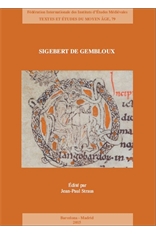
Publication – Jean-Paul Straus (éd.), « Sigebert de Gembloux »

Actes des  » Journées Sigebert de Gembloux » 2012

Sigebert de Gembloux (1028 env. – 5 octobre 1112) s’est illustré en des genres littéraires très divers, le point culminant de son œuvre étant sans conteste sa Chronique qui constitue, comme l’écrit très justement M. Chazan, « un des sommets de l’historiographie médiévale ».

La recherche à son sujet ne cesse d’évoluer, et l’ouvrage qu’on présente ici en est sans conteste un précieux jalon. Il est la conclusion d’une rencontre qui se tint à Bruxelles et à Gembloux les 5 et 6 octobre 2012. Point de départ plus qu’aboutissement, cette rencontre a ouvert des perspectives neuves autant que variées. S’y croisent les points de vue de l’historien, de l’archéologue et du philologue qui se penchent sur le personnage, l’œuvre et son terreau, l’abbaye de Gembloux. Ce recueil ne prétend pas à l’exhaustivité – l’est-on jamais en aussi riche matière où de plus l’enquête ne cesse d’évoluer ? On reconnaîtra en filigrane les traces d’autres recherches en cours sur le même sujet, auxquelles d’ailleurs les textes font de fréquentes références. Il y a donc deux cohérences, celle de l’ensemble des articles présentés ici, qui couvrent un large éventail dont les sujets s’enchaînent et se répondent, et celle qui englobe d’autres écrits importants tenant au même objet. Ainsi, le présent ouvrage contribue sans aucun doute à l’avancement des études sigebertiennes.

dIS-9782503565194-1

Table des matières :

J.-P. Straus – Quelques mots d’introduction

M. Chazan (professeur émérite. Université de Lorraine) – Entre l’école et le siècle: Sigebert de Gembloux, un historien engagé
J. Meyers (Professeur à l’Université de Montpellier) – Vitarum scriptor : une analyse critique et littéraire de la méthode hagiographique de Sigebert de Gembloux
W. Verbaal (Professeur à l’Université de Gand) – Sigebert et les tempêtes littéraires autour de 1100 : naufragé ou maître-timonier ?
Michiel Verweij (Cabinet des manuscrits, Bibliothèque royale de Belgique) – Les manuscrits des œuvres de Sigebert de gembloux à la Bibliothèque royale de Belgique
Michel De Waha (Professeur à l’Université libre de Bruxelles) – Le manuscrit Civ. Rep II 69 de l’Universitätsbibliothek Leipzig, la Vita Wichberti (BHL 8882 )et les Gesta Abbatum Gemblacensium de Sigebert de Gembloux
Ph. Mignot (Archéologue. Direction de l’archéologie, Namur) – Gembloux, quelques réflexions sur les origines de l’abbaye
P. Tombeur (Professeur émérite. Université catholique de Louvain) – Sigebert de Gembloux, fidèle rebelle, exemple étonnant de la liberté de penser au moyen âge

Informations pratiques :
Jean-Paul Straus (éd.), Sigebert de Gembloux, Turnhout, Brepols, 2015 (Textes et Etudes du Moyen Âge, 79). IX+234 p., 6 b/w ill. + 19 colour ill., 3 b/w tables, 165 x 240 mm. ISBN: 978-2-503-56519-4. Prix : 45 euros.

Source : Brepols

Publié dans Publications | Laisser un commentaire