Web – Carnet de recherche : « Manuscrits juridiques du Midi »

Recherches sur la production des manuscrits juridiques enluminés du Midi de la France (XIIIe – XVe siècle) : un carrefour artistique entre le Midi, l’Italie et la Péninsule Ibérique (Castille, Catalogne et Portugal) – XIIIe – XVe siècle

Capture d’écran 2015-12-06 à 11.39.03

Le carnet Manuscrits juridiques enluminés du Midi de la France, a pour objectif de rendre compte de l’enquête en cours sur la production de manuscrits juridiques enluminés dans le Midi de la France (XIIIe – XVe siècle) et rassemble des contenus variés (publications, nouvelles, événements scientifiques, programmes des séminaire et colloques organisés dans ce cadre) autour de l’étude scientifique de cette production.

Accès : ici

This « carnet » has been created to share contents, especially publications, news, events and discoveries, related to the academic study of the production and illumination of legal manuscripts in southern France (13th-15th centuries).

Rédacteur en chef : Maria Alessandra Bilotta

Publié dans Web | Laisser un commentaire

Appel à contribution – Episcopal Diasporas

Haskins Society
Minnesota, USA
4-6 november 2016

Capture d’écran 2015-12-06 à 11.29.56

Episcopus is working on a panel to sponsor for the 2016 meeting of the Haskins Society. Although the Haskins Society was at one time concerned almost entirely with later Anglo-Saxon, Anglo-Norman, and Angevin history, and French history in these periods, it has considerably expanded its geographical and chronological scope. The meeting will be November 4-6, 2016 in Northfield, Minnesota. It is small and intimate, with a high caliber of papers. There are no concurrent sessions, so everyone hears everything. You can find out more about the society here: http://haskinssociety.org/

Episcopus is exploring the possibility of a panel on Episcopal Diasporas: a session on episcopal transplantation from native home to another or on bishops on the move, e.g, as pilgrims, scholars, diplomats or warriors.

If you are interested in giving a paper on this topic, please send me an abstract of no more that 250 words as well as a vita by February 1, 2016.

Source : Episcopus

Publié dans Appel à contributions | Laisser un commentaire

Appel à contribution – 16th-Cent. Society Bruges 2016: Renaissance Bruges

HNA will sponsor the following session at the Sixteenth Century Society conference to take place in Bruges, 18-20 August 2016. Please send paper proposals to the session chair as noted below. Please be advised that all participants are responsible for their own costs of travel, registration, membership, etc. For general information about the conference, please visit the website: http://www.sixteenthcentury.org/conference/

The Art of Renaissance Bruges

Renaissance Bruges was vibrant with artists, writers, and intellectuals. Despite the famous narrative of the city’s decline, it remained a distinctive and productive cultural centre, as the innovative exhibition Bruges and the Renaissance: Memling to Pourbus (1998) first argued.

In Bruges, eminent artists including Hans Memling, Gerard David, Adriaen Isenbrandt, Simon Bening, Lanceloot Blondeel, Pieter Pourbus, and Marcus Gheeraerts produced paintings, drawings, prints, maps, books, and monument designs. Many of these works have received limited attention, as have those made by Bruges artists working in other media like sculpture, tapestry, and stained glass. This relative neglect belies the cultural importance of Renaissance Bruges—the city was home to leading intellectuals like the humanist Juan Luis Vives, the jurist Joos de Damhouder, and the historian Jacob de Meyere. The great rederijkers Cornelis Everaert and Eduard de Dene spent their entire careers in Bruges. Local printers from Colard Mansion to Hubert Goltzius brought novel and learned texts to press. The city attracted noteworthy visitors such as Dürer, Erasmus, Thomas More, and Johannes Sambucus. It also nurtured its ties with the Habsburg court through large-scale projects like the monument to Margaret of Austria and the tombs of Mary of Burgundy and Charles the Bold. The varied art of Renaissance Bruges registers the issues that preoccupied the city itself and Netherlandish society and culture.

This panel invites papers that address artistic production, across all media, in late fifteenth- and sixteenth-century Bruges. Possible topics may include:

– late fifteenth- and sixteenth-century Bruges art in Netherlandish and Renaissance art history
– social networks of artists and patrons
– microhistories of patrons and collections
– projects for religious and political authorities
– artistic dynasties
– the role of the city artist
– the local art market
– Bruges art for export
– Bruges artists on the move
– interactions between workshops
– distinctive local forms and themes
– the impact of Reformation ideas on Bruges art and artists

Please email an abstract of 250 words, contact information, and a CV to Tianna Uchacz (tianna.uchacz@utoronto.ca) by January 31, 2016.

Publié dans Appel à contributions | Laisser un commentaire

Appel à contribution – Pictures, Parchment & Paper: illustrated books and manuscripts in early modern Germany

Newnham College, The University of Cambridge, May 5, 2016.

Confirmed Keynote Speaker: Professor Dr. Dagmar Eichberger (ERC-Projekt artifex, University of Trier; University of Heidelberg)

Sixteenth-century Germany was fascinated by pictorial books. An explosion of genres covering new and diverse secular subjects were envisioned not just in print, but in manuscripts and albums, carefully rendered by local artists. While the trend for these items existed throughout Europe, the level of enthusiasm for them in Germany was unparalleled. As such, the visual culture of early modern Germany is unique and exceptionally rich, fuelled by the imaginative, colourful artistry that went into the production of these books and manuscripts.

This workshop invites abstracts from graduate scholars and early-career researchers who specialise in all forms of these vibrant products, from fencing and tournament books, to books of costume, plants, genealogy, and heraldry, among other subjects. Too often these works have been investigated in isolation. Providing a platform to discuss the cultural and material characteristics these works share, this workshop seeks to understand how this exciting moment in the visual history of Germany developed and flourished. Above all we will ask, what roles did these books and manuscripts perform in their society, and how did their pictorial attributes assist their function? To what extent did they not merely reflect, but actively mediate the world around them?

We therefore invite papers that explore the following subjects and ideas:

  • Genres such as: Geschlechterbücher, Ehren- and Stammbücher (Genealogy), Trachtenbücher and Kostümbücher (Dress), Fechtbücher (Combat), Wappenbücher (Heraldry), Hausbücher (Daily Life), Turnierbücher (Tournaments), Standbücher (Trades), Tierbücher (Animals), Herbaria and Pflanzenbücher (Plants), Feuerwerkbücher (Fireworks), Schembartbücher (Nuremberg Carnivals), Alba Amicorum (Friendship/Status), Travelogues etc.
  • The commission, reception, and circulation of ambitious pictorial manuscripts, printed books and albums.
  • The artistic and intellectual practices that went into these works’ materialisation: e.g. research, design, craft-knowledge, collaboration, and reproduction.
  • Ideologies, agendas, and rhetorical strategies present in these works.
  • The role of Germany’s print industry in the development of new genres.
  • Transmission of imagery and the development of visual models.
  • German historical context driving the production of these works.

Please send abstracts of c. 300 words to picturesparchmentandpaper@gmail.com by January, 1, 2016. For further information please contact the organiser, Katy Bond, University of Cambridge: klb72@cam.ac.uk. Although we are unable to assist with the cost of travel for speakers and attendees, catering will be provided and speakers invited to a networking dinner the evening of the workshop.

Please follow our site https://picturesparchmentandpaper.katybond.com for future updates and information.

Note: We would like to thank the committee of the DAAD-University of Cambridge Research Hub for their generous sponsorship of this workshop. The committee’s aim is to encourage and sustain relations between German and British scholars for the advancement of research around German subjects. This workshop therefore invites with particular enthusiasm the participation of scholars from Germany and abroad. N.B. papers must be presented in English.

Publié dans Appel à contributions | Laisser un commentaire

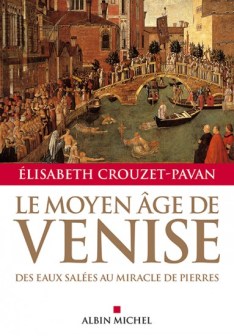
Publication – Elisabeth Crouzet-Pavan, « Le Moyen Age de Venise. Des eaux salées au miracle de pierres »

Elisabeth Crouzet-Pavan, professeur d’histoire médiévale à l’Université Paris-Sorbonne (Paris IV) publie Le Moyen Age de Venise. Des eaux salées au miracles de pierres (Paris, Albin Michel, 2015).

9782226315007g

À Venise, le niveau des eaux s’élève inéluctablement, ronge les pilotis qui soutiennent les palais, érode les rives… De pharaoniques travaux sont entrepris pour empêcher que l’eau s’engouffre dans la lagune et inonde toujours plus les rues et les maisons.

Cette ville à présent fragile fut pourtant triomphante hier, et ce livre raconte l’;histoire de sa construction dans un milieu hostile, sopra le acque salse, sur les eaux salées. Dans les derniers siècles du Moyen Âge, quand Venise comptait bien plus d’habitants qu’aujourd’hui, au gré de chantiers innombrables et d’un effort humain et financier considérable, sans cesse de la terre fut charriée et amassée pour conquérir toujours plus d’espace. Grâce à ce travail de création ininterrompue, accompli malgré la menace permanente de l’écosystème, la ville sur l’eau a été bâtie, ornée, pour devenir ce « miracle de pierres ». Mais Venise n’est pas qu’un décor de marbre et de briques. Retracer l’aventure de l’invention de Venise, c’est aussi faire revivre les acteurs de cette histoire collective, restituer une culture urbaine et un imaginaire civique, ou comment les Vénitiens plaçaient leur histoire sous la protection et la providence divines.

Cet ouvrage capital est la synthèse la plus aboutie et la plus complète qui existe à l’heure actuelle sur la naissance et le développement de Venise au Moyen Âge; une ville qui, à la Renaissance, deviendra la Sérénissime.

Informations pratiques :
Elisabeth Crouzet-Pavan, Le Moyen Âge de Venise. Des eaux salées au miracle de pierres, Paris, Albin Michel, 2015. Format : 170 mm x 243 mm. 1116 pages. EAN13 : 9782226315007.Prix : 32.00 €.

Source : Albin Michel

Publié dans Publications | Laisser un commentaire

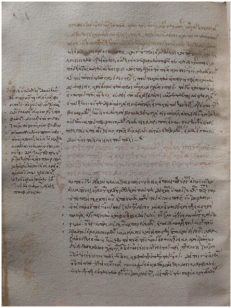
Conférence -Michel Cacouros, « Georges Scholarios (ca 1385/1390 – ca 1470), ses manuscrits autographes et la sauvegarde de son œuvre par lui-même après 1453 »

Scholarios est incontestablement la personnalité la plus importante de la fin de Byzance et du début de l’occupation ottomane, sa renommée ne pouvant être égalée que par celle de son contemporain Bessarion. Toutefois, à cause des interprétations controversées dont il est l’objet jusqu’à nos jours, plusieurs aspects de son activité restent encore dans l’obscurité. L’étude de ses autographes, de même que des manuscrits copiés à sa demande — que nous effectuons depuis plusieurs années — a permis d’éclairer l’activité qu’il déploya peu avant la prise de Constantinople en 1453, notamment son rôle en tête de la Synaxis des Orthodoxes, et les raisons qui ont incité le sultan à le désigner comme (premier) patriarche des Byzantins après 1453. Les Essais (1 008 pages) introduisant les huit tomes de la réédition de ses Œuvres complètes, effectuée par nos soins (2009-14) d’après l’édition de 1928-36, nous ont permis d’élargir cette étude paléographique et d’éclairer davantage son activité.

Le sujet de notre présentation, traité dans le premier Essai, se situe au cœur du pro¬gramme d’étude des auto¬¬graphes de Scholarios et de la tradition de ses œuvres. En effet, notre objectif est d’expliquer un aspect et une étape particulièrement importants dans la sauvegarde et la transmission de ses œuvres : le sort qui fut réservé aux auto¬graphes de celles-ci en 1453 et dans les années qui ont suivi, la plupart de ses œuvres restant encore «inédites» à cette date pour des raisons que nous allons préciser. En somme, cette présentation vise à expliquer la manière dont ses œuvres antérieures à 1453, malgré leur caractère «inédit», ont pour la plupart survécu au pillage de la capitale, lors duquel ses manuscrits furent pourtant dispersés ou détruits. Il sera démontré que, après 1453, Scholarios rechercha systématiquement ses manuscrits éparpillés à travers l’empire désormais ottoman et qu’il put ainsi en récupérer une partie importante. Il sera aussi démontré que, craignant d’autres pertes, il procéda à l’«édition» de ses œuvres, celles qu’il avait composées avant 1453, et qu’il a pu retrouver, et celles qui étaient postérieures à cette date.

Cacouros - CIC

Informations pratiques :

Michel Cacouros (École Pratique des Hautes Études, Sciences Historiques et Philologiques, à la Sorbonne, Paris)

Centre international de Codicologie
Groupe de contact du FNRS « Codicologie »

Lundi 14 décembre 2015
à 13 h 30
Bibliothèque Royale Albert Ier – Koninklijke Bibliotheek
4, Bd de l’Empereur – 1000 Bruxelles
Salle du Conseil (niveau + 2)

Publié dans Colloque | Laisser un commentaire

Conférence – Tim Soens, « La Grande Famine de 1315 – 1317, les agro-systèmes flamands et la vulnérabilité régionale vis-à-vis des crises de l’environnement »

Tim Soens, Professeur à l’Université d’Anvers, viendra ce jeudi 3 décembre à l’IHEB (Institut des Hautes Études de Belgique) à 19h00 pour donner une conférence intitulée de La Grande Famine de 1315 – 1317, les agro-systèmes flamands et la vulnérabilité régionale vis-à-vis des crises de l’environnement.

IHEB

Cela se tiendra avenue Jeanne, au 44, à l’Institut de Sociologie, à 19h00. Fin prévue vers 20h15, max. : http://www.ulb.ac.be/enseignements/iheb/index_5.html

Vous êtes toutes et tous les bienvenus !

Publié dans Colloque | Laisser un commentaire

Offre d’emploi – Past & Present Fellowships

The Past & Present Society and the Institute of Historical Research will offer up to three two-year postdoctoral Fellowships in History for 2016–18, tenable at the Institute. Preference will be given to applicants who demonstrate a broad interest in processes of social, economic, political and cultural change, as manifested in their particular field of study. The Society wishes to promote work of a kind that might be published in the journal Past & Present and its book series, which is published by the Oxford University Press.

logobig IHR.jpg

Area of research:
Social History (broadly defined)
Eligibility requirements:

The Fellowships will be awarded to postdoctoral applicants who have recently completed a doctoral degree in history, or who will have submitted their thesis for examination by 1 October in the academic year in which the Fellowship is to be held. It is a strict condition of the Fellowship that the thesis should have been submitted by that date. Applicants may be of any nationality, and their PhD (or equivalent) may have been awarded in any country. Those who have previously held another postdoctoral research fellowship, or a full-time lectureship, will not be eligible. The Fellowship cannot be held in conjunction with any other substantial maintenance grant, nor can it be used to fund a sabbatical year for the holder of a permanent academic position.

A condition of the award is that Fellows should undertake further historical research and writing. The Fellowships are envisaged as an opportunity for Fellows to develop their doctoral research for publication and to begin work on a postdoctoral project; applicants should clearly indicate their plans in both respects. Fellows will be encouraged to submit their articles or books to the editors of Past & Present for consideration. Fellows will not be required to be resident in London, but should participate in the activities of the Institute, by regular attendance at and presentation of papers to appropriate seminars and by giving information and help to fellow scholars working in the same field. Fellows are expected to develop their own ideas for collaborative activities while at the Institute and some limited funds will be available to help support these activities.

At the discretion of the Director of the Institute, Fellows may engage in teaching or other paid work for up to six hours a week (note however that some categories of non-national may need to obtain a work permit in order to undertake this).

Amount awarded:
£40,000 (approx.)
Application guidelines:
pp_fellowships_guidelines_2016.pdf
Applications open:
1 Dec 2015 to 31 Mar 2016

Source : Institute of Historical Research

Publié dans Bourse, Offre d'emploi | Laisser un commentaire

Offre d’emploi – Un directeur ou une directrice de la Bibliothèque Universitaire Moretus Plantin (Université de Namur)

Faculté : Services interfacultaires
Département : Bibliothèque Universitaire Moretus Plantin (BUMP)
Grade : Directeur
Contrat : durée indéterminée
Catégorie : personnel de direction et attaché
Poste : Allocation (au cadre)
Référence : CA 660

UNamur

Tâches

La personne a pour mission de concevoir et mettre en œuvre un plan stratégique pour une « open » BUMP, bibliothèque universitaire innovante à l’ère numérique, tout en valorisant ses richesses patrimoniales.

Au quotidien, la personne assumera les tâches suivantes :

  • direction de la BUMP;
  • présidence des organes de gouvernance de la BUMP;
  • prévisions/gestion du personnel et du budget en collaboration avec les responsables des services;
  • administration des locaux de la bibliothèque;
  • relation avec les autorités et les organes de gouvernance de l’UNamur;
  • supervision et coordination de la coopération entre la bibliothèque « centrale » et les départements et services de l’université;
  • suivi des dossiers stratégiques en matière de politique documentaire de l’université;
  • représentation externe.

Dans l’exercice de sa mission, cette personne est assistée par un Conseil de gestion formé des responsables des différents services.

Profil

Celles et ceux qui postuleront seront titulaires d’un Master/d’une Licence.

Une expérience de recherche dans une institution universitaire ou scientifique d’au moins 2 ans ou l’obtention d’un doctorat sont des atouts, tout comme des connaissances approfondies et une expérience en matière de documentation scientifique, de bibliothéconomie, des technologies de l’information et des systèmes intégrés de gestion de bibliothèques (SIGB).

Compétences liées à la gestion de bibliothèques universitaires :

  • Expérience significative de plusieurs années dans la gestion de bibliothèques;
  • Vision dynamique et prospective sur le fonctionnement des bibliothèques universitaires;
  • Compétences informationnelles dans le contexte d’une bibliothèque numérique (discovery tools, e-learning, bibliothèque « sans livres »,…);
  • Connaissance des missions de l’université : enseignement, recherche et service;
  • Connaissances verbale et écrite approfondies du français et de l’anglais.

Une bonne connaissance du néerlandais est un atout.

Compétences managériales :

  • Qualités humaines et relationnelles;
  • Leadership naturel;
  • Qualités de management et de gestion des ressources humaines, avec expérience avérée de gestion et animation d’équipes;
  • Expérience éprouvée à la communication.

La commission de recrutement sera attentive tant aux aspects relatifs à la gestion de bibliothèque qu’aux aspects relatifs au management.
Renseignements complémentaires

Madame Martine Raes, Vice-Recteur en charge de la recherche et des bibliothèques : Tél 081 72 52 46 – Email vice-recteur.recherche@unamur.be.

Remarques

La candidature manuscrite, accompagnée d’un curriculum vitae détaillé, d’un formulaire de candidature (disponible via http://www.unamur.be/universite/jobs/formulaires/Formulaire%20PATO.rtf/view), d’une lettre de motivation et d’une ébauche de maximum 5 pages d’un plan stratégique pour la BUMP, doit être adressée à la Direction du Service du Personnel (Rue de Bruxelles, 61 à 5000 NAMUR) pour le 4 janvier 2016 au plus tard.

Entrée en fonction souhaitée le 1er avril 2016.

Source : Université de Namur

Publié dans Offre d'emploi | Laisser un commentaire

Séminaire – Texte et image entre Moyen Âge et Renaissance

Workshop organisé par le Centre belge d’études bourguignonnes 1400-1600 (Université catholique de Louvain & Université Saint-Louis — Bruxelles)

Programme :

Mercredi 9 décembre 2015

13h30-16h30 Collège Mercier Salle Jean Ladrière Place Cardinal Mercier 14 Louvain-la-Neuve

Dr Ingrid Falque (UNamur) – Mise en mot et mise en image de l’ascension spirituelle : Jan Vos et la Vierge d’Exeter de Petrus Christus

Dr Renaud Adam (FNRS / ULg – Transitions) – L’illustration des premiers imprimés des Pays-Bas méridionaux

Dr Anna Dlabacova (UCL – GEMCA) – Text and Image in Vernacular Books for the Pre-Reformational Market produced in Antwerp between c. 1480 and 1500

Entrée libre.
Pour les doctorants, la participation au workshop peut être valorisée dans le cadre des activités de l’Ecole doctorale ED4/EDT56 Histar.

Contact : ralph.dekoninck@uclouvain.be – baudouin.vandenabeel@uclouvain.be – eric.bousmar@usaintlouis.be

Publié dans Séminaire | Laisser un commentaire