
Hybrid International Conference (Nicosie, Université de Chypre/en ligne, 4-6 juin 2027)
Practice both shapes and is shaped by the spaces that encompass it. Although this may appear an obvious statement, it remains no less true, inviting a holistic consideration of architectural spaces, their adornment, and their furnishings in conjunction with the human agents that created and used them and the actions that activated and enlivened them. As a result of this dynamic, reciprocal relationship, no solution to the articulation and elaboration of an architectural space precisely replicates another, despite the presence of shared forms and common patterns of behaviour.
Fully cognisant of the potential for such immense variability in both architectural production and consumption, contemporary research on medieval and early modern church buildings has prioritised the systematic concurrent examination of hitherto underexploited archival and/or assorted documentary evidence, objects in museum and other collections, and the extant edifices in their present state, often with the help of archaeology and modern technologies. Even though much has already been achieved in this field, there is still scope for further research with a view to ultimately graduating from individual case studies to broader and more comprehensive narratives of the uses (and abuses) of Christian sacred space in the medieval and early modern world.
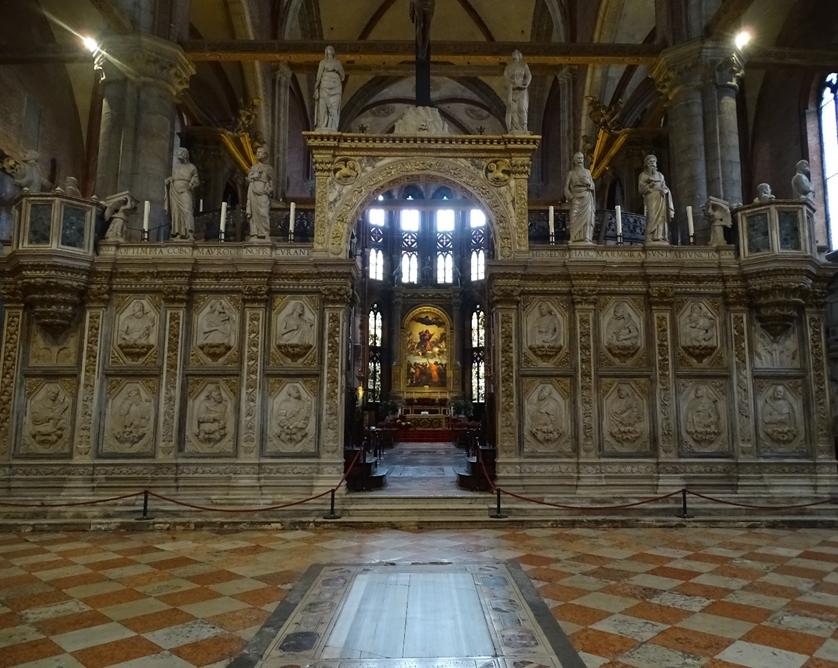
The divergent paths pursued by the Roman- and Eastern-rite churches and their congregations after Late Antiquity led to a multiplicity of approaches to the configuration and function of the most sacred and privileged part of ecclesiastical buildings, usually – though not always – located at their east end. This divergence is reflected, among other areas, in the vocabulary employed by scholars studying different Christian architectural and liturgical traditions to describe such spaces. Here, while acknowledging the arbitrariness of our choice, we employ the term ‘choir’ as a generic yet recognisable term to indicate both the area of the sanctuary (comprising the bema, the prothesis and the sacristy/diakonikon) in Eastern-rite churches and the areas of the sanctuary (with its high altar) and the choir (accommodating the clergy’s stalls), in all their pre- and post-Tridentine variants, in Roman-rite churches.
Scholarship on Western Europe has benefitted from a series of monographs, collective volumes, and conference proceedings that have attempted to reinstate the high medieval (re)configuration of the interior of Roman churches; to better comprehend the placement of the choir within the medieval and early modern sacred space; to trace the transformations of the choral spaces of Renaissance Florence; and to delve deeper into the arrangement and functions of the choir spaces of the mendicant orders throughout Europe. The aforementioned research, coupled with a wide variety of further case studies from all over medieval and early modern Latin Christendom, have demonstrated the fluidity and multiplicity of form, location, access, and function of choir spaces, which were as dependent on changes in liturgical requirements and the ecclesiastical calendar as on fashion and aesthetics. They have also highlighted the ways in which these privileged spaces, which were primarily (though not exclusively) the purview of the clergy, accommodated and amplified the veneration of saints, relics, and images, played a significant role in promoting local cults, and perpetuated the strictly hierarchical stratification of premodern societies, both in life and in death.
Conversely, with respect to Byzantium, the area of the sanctuary is studied primarily as a space where the divine is made manifest at the confluence of art and ritual. The understanding of the area of the sanctuary in medieval / post-Iconoclast (ninth century onwards) Byzantine churches as an area given almost exclusively to liturgical use and accessible only to male clergy has never been critically examined, nuanced, or contested. The focus of studies concerned with the area behind the templon or chancel screen has been on the evolution of its architectural form and on its monumental pictorial decoration in relation to the liturgy and in response to current theological discussions on the Incarnation and the nature of the Eucharist. Potential paraliturgical and other functions, especially those associated with lay piety, have yet to be systematically explored, despite some ground-breaking case-studies.
Regardless of this vivid interest in choral spaces in both Western Europe and the Byzantine East, these two cultural spheres have seldom been examined in tandem from the point of view of choir disposition, embellishment, and use. Following the example of the seminal symposium on religious screens held at Dumbarton Oaks in 2003 (and published as Thresholds of the Sacred: Architectural, Art-Historical, Liturgical, and Theological Perspectives on Religious Screens, East and West, ed. Sharon E. J. Gerstel [Washington, DC, 2006]), this conference aims at bringing together scholars working on the art of choir spaces from the Iberian Peninsula to the Levant during the High/Late Middle Ages and early modernity (c. 1000–1600). It will attempt to venture beyond the relatively well-studied case of Italy to encompass case studies on the display, performance, and experience of art in choir spaces from both ends of the Mediterranean, with a particular interest in instances of 3
transconfessional encounter. Questions such as how the different kinds of source material available for choir spaces West and East condition scholarly approaches to their study; whether it would be possible to identify Byzantine input in the way that choral precincts and furnishings developed in the West and vice versa; or what role, if any, the Latin East could have played in such interactions as an area of intense cultural and religious interchange lie at the heart of the meeting’s agenda.
The stage will be set by our two keynote speakers, Prof. Donal Cooper (University of Cambridge) and Prof. Sharon Gerstel (UCLA), who will broach the theme of the conference from the point of view of Western European and Byzantine art history, respectively. Apart from these broad-brush critical overviews, we invite 20-minute papers in English that consider, but need not be limited to, the above questions. More specifically, we welcome papers on one or more of the following topics:
-Liturgical, paraliturgical, and profane uses of church choirs.
-The morphology of choir furnishings in relation to function and ritual.
-Lay and gendered access beyond the choir/templon/chancel screen, for both the living and the dead, physically or by proxy (i.e., in the form of effigies, inscriptions, graffiti, gifts).
-The ritual movement of people and objects to, from, and through choir spaces.
-Concealing and revealing reliquaries, images, funerary monuments, etc.
-Choir spaces as pilgrimage sites.
-Choir spaces and their art as seen through the lens of the Digital Humanities.
Informations pratiques
Paper titles and abstracts of about 300 words should be forwarded to Michalis Olympios and Maria Parani by 30 September 2026. Submissions should include the prospective speakers’ name and affiliation, email address, and a statement indicating whether they intend to participate in person or remotely. There is no registration fee. While we aim to secure discounted rates for participants at select hotels in Nicosia, please note that we are unable to cover travel or accommodation expenses.
Source : Blog de l’ApAhAu





Vous devez être connecté pour poster un commentaire.