Cycle de conférences – Conférences de la Société d’Art et d’Histoire du Diocèse de Liège

Société d’Art et d’Histoire du Diocèse de Liège
Rue des Prémontrés, 40 – 4000 Liège

Nous avons le plaisir de vous inviter aux prochaines conférences de la Société qui auront lieu comme de coutume le deuxième mercredi du mois à 17 h 15, cette année au Séminaire épiscopal, rue des Prémontrés, 40 à Liège (et pas au local habituel) :

Mercredi 14 janvier 2015, à 17.15
Monsieur Christian Dury, archiviste diocésain
La Société d’art et d’histoire du diocèse de Liège (1880-…)

Mercredi 11 février 2015, à 17.15
Monsieur Olivier Hamal, avocat
Le passage Lemonnier à Liège. Histoire-Evolution-Anecdotes

Mercredi 11 mars 2015, à 17.15
Monsieur Philippe Dieudonné, docteur en Histoire (U.Lg.)
Corneille Van Bommel et Félicité Robert de La Mennais : proximités et divergences au coeur d’un renouveau catholique

Mercredi 8 avril 2015, à 17.15
Monsieur Paul Bertrand, professeur à l’U.C.L.
La révolution de l’écrit à Liège, XIIe-XVe siècles

Mercredi 13 mai 2015, à 17.15
Monsieur Étienne Renard, chargé de cours à l’Université de Namur
Paroisses primitives, grands domaines et dîme ecclésiastique au haut Moyen Âge : où en est-on un siècle après Imbart de la Tour et Brassine ?

Mercredi 10 juin 2015, à 17.15
Monsieur Emmanuel Joly, boursier de doctorat (U.Lg.)
Les chantiers d’églises rurales dans l’ancien diocèse de Liège à la fin du Moyen Âge et au début des Temps modernes
Publié dans Colloque | Laisser un commentaire

École d’été – Luminosus Limes: Geographical, Ethnic, Social and Cultural Frontiers in Late Antiquity

What is a frontier? Does it serve to separate or to link countries, peoples, classes, ideas? Frontiers have become increasingly significant in the study of Late Antiquity, the fastest growing historical discipline, as scholars recognized the fundamental importance of shifting barriers in the process of transformation that led from the classical to the post-classical world. People living in the Roman world between the second and the sixth century tore down many walls demarcating cultures, religions, ethnicities. Frontiers once firmly separating empires, ethnic groups, religions, friends and even the sexes have been intensely crossed in late antiquity – a phenomenon comparable only to the recent transition from modernity to post-modernity — a comparison that we intend to exploit in our methodology.

The “Bright Frontier” summer course explores the dynamic transformation of classical frontiers between the second and the sixth century from a multidisciplinary perspective: archaeology, medieval studies, social and cultural history, art, theology, and literature. Offering a groundbreaking approach to the field of border studies including social, gender, ethnic and religious categories with the participation of outstanding scholars in the field, this course will provide students with a solid knowledge of up-to-date international scholarship on frontiers: a strong theoretical background as well as hands-on acquaintance with physical borders and material artifacts excavated along the Danube River (the ripa Pannonica), around Lake Balaton, as well as in the late antique cemetery of Pécs in Hungary.

Informations pratiques :
Summer University
Central European University, Budapest

Course date : 29 June – 4 July, 2015
Deadline : 14 February, 2015

Course Director(s):
Ralph W. Mathisen, University of Illinois, Urbana, USA
Marianne Saghy, Department of Medieval Studies, Central European University, Budapest, Hungary

Course Faculty:
Sabine Huebner, Department of Ancient History, Basel University, Switzerland
Levente Nagy, Department of Contemporary History, University of Pecs, Hungary
Ekaterina Nechaeva, American Academy of Rome, Italy
Galit Noga-Banai, History of Art, The Hebrew University of Jerusalem, Israel
Danuta Shanzer, Department of Classical Philology, Medieval and Neolatin Studies, Vienna University, Austria
Zsolt Visy, Department of Archaeology, University of Pecs, Hungary

Guest Speaker(s):
Adam Szabo, Archaeology, Hungarian National Museum, Hungary

Source de l’information : CEU Budapest

Publié dans École d'été | Laisser un commentaire

Exposition – Voyager au Moyen Âge

22 octobre 2014 – 23 février 2015
Musée de Cluny – Musée national du Moyen Âge
6 place Paul Painlevé
75005 Paris

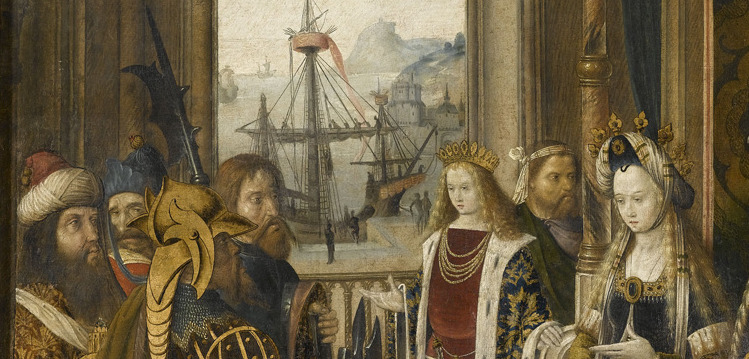
sainte-ursule-voyagerma-bandeauFruit de la première collaboration du réseau des musées d’art médiéval, l’exposition « Voyager au Moyen Âge » propose d’entraîner les visiteurs du musée de Cluny dans un périple à travers le temps et l’espace.

L’exposition évoque les différents types de voyageur, du marchand au pèlerin, du prince à l’artiste. Les objets présentés, témoignages de moments forts ou anecdotiques du voyage permettent de mieux appréhender la manière dont hommes et femmes du Moyen Âge voyageaient, et d’établir des parallèles avec notre histoire contemporaine.

Réservez votre billet pour l’exposition directement en ligne (comprend également l’accès aux collections permanentes).

Téléchargez le communiqué de presse.

Parcours-jeu Enfants à télécharger (en partenariat avec Paris Mômes) . Les réponses aux questions du parcours-jeu sont disponibles ici.

Source de l’information : Musée de Cluny

Publié dans Exposition | Laisser un commentaire

Appel à contribution – Imaging the Public Square

Imaging the Public Square. International conference within the framework of the „Piazza and Monumento“ project at the Kunsthistorisches Institut in Florenz – Max-Planck-Institut
Florence, 22 – 24 October 2015
Deadline: 15 January 2015

Recent broadcasts of scenes playing out in Egypt, Turkey and Ukraine have reinforced our awareness of the significance of the public square as a venue of action and assembly. As a consequence of protest movements, but also independently of them, images circulated in various media have participated in the construction of a visual culture of the public square. Each of these images should be historicised and analysed according to its own logic. The conference, organized by the collaborators of the “Piazza e Monumento” project at the Kunsthistorisches Institut in Florenz – Max Planck Institut, will take the image and imagination of the square as a point of departure for a discussion, ideally through comparative analysis, of the following themes:

I. The public quare in architectural drawings and the planning process : The square is often the result of a pictorial concept in the architectural planning process, whether it results in entirely new venues or the partial alteration of older ones. Carl Linfert has provided a methodological model for this kind of research in his investigation of tactile responses to the architectural drawing. Regarding the depiction of the public square in architectural designs, the question likewise arises: how do approaches to representation shape the image of the square, and how do they relate to structural, formal-aesthetic, legal, and urban-spatial conditions and possibilities? The built city and the designed city are mutually dependent entities. The degree to which architectural designs are capable of intervening in the existing structure of a city is thus worthy of consideration. In other words, to what extent do such plans and drawings develop a dynamic of their own, above and beyond the function assigned them, leading in the long term to changes in the existing built environment?

II. Artistic representations of the city square : The square is often the main feature of a picture, situated in a larger spatial context, and it can be regarded as an embodiment of the city – regardless of whether we are looking at prints of the Early Modern era of the Meidan in Isfahan, built by Shah Abbas I, Menzel’s painting of the Piazza della Erbe in Verona, or photos of Tahir Square in Egypt in the 1950s. Since images of squares vary historically and culturally, but also respond to one another and are subject to processes of change, images of piazzas should also be analysed as pictorial solutions. What perspectives on the public square, and thus on the city and the territory, are developed pictorially? What artistic media are employed in the process, and who are the makers and recipients of these pictures?

III. Scholarly research on the square and the city : Images of squares find their way into many publications, whether as illustrations, elements in a visual argument, or the focal points of research itself. From Renaissance architectural theory and pre-modern engravings to modern architectural and urban anthologies, images of squares are important players on theoretical and methodological levels. What is the significance of these images in architectural and urban studies – including from a history of science perspective – and what social, political and cultural conceptions of society are linked to them?

IV. The mediatisation of the square : The public square is the subject of popular media in various forms, ranging from film, literature and comics to (often anonymous) newspaper, television, and cell phone images. To discuss the square’s mediatisation is thus also to consider the rapid blending of media reality with social and political reality, and to take the pictorial history of the square into account. How much do pictures tell us about the square when protestors climb onto monuments with fluttering flags, as in Kiev? Does this form part of the visual history of liberty, whose canon includes works such as Delacroix’s ‘Liberty Leading the People’, and which can be examined against the background of studies such as Jutta Held’s ‘Monument und Volk’? What impact does the mediatisation of the square have on the ephemerality of certain elements (platforms, public artworks, protest signs, etc.) that temporarily re-design and semanticise the square? And what is the relationship between the visual focus on the square and the construction and transformation of squares? In other words, what effect do experiences of the square from near and far have on not only its perception, but also on its material-physical constitution?

The conference is intended for art historians as well as representatives of neighbouring disciplines. It welcomes case studies and synthetic reflections on the above-suggested themes, which can be treated individually or together, as well as on other topics. Papers should not exceed 25 minutes. Please send your proposal (max. 300 words) and a short CV in German, English or Italian to Dr Brigitte Sölch (soelch@khi.fi.it) and Dr Stephanie Hanke (hanke@khi.fi.it) by 15 January 2015.

Source de l’information : Medieval Art Research

Publié dans Appel à contributions | Laisser un commentaire

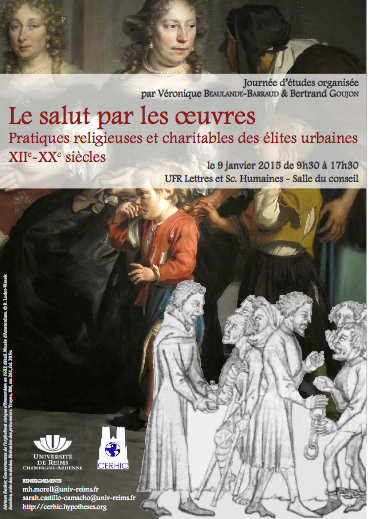
Journée d’étude – Le salut par les œuvres. Pratiques religieuses et charitables des élites urbaines (XIIe-XXe siècle)

À la croisée de l’histoire sociale, religieuse et urbaine, cette journée d’étude propose d’interroger la singularité des élites laïques en milieu urbain en ce qui concerne leurs pratiques religieuses et charitables. Comment se construisent les modèles de comportement en ce domaine ? Quelles formes prennent ces pratiques ? Peut-on en mesurer l’ampleur et en appréhender l’insertion dans les stratégies plus globales des élites, y compris en termes de pouvoir social et politique ? La prise en compte de la longue durée permettra de réfléchir à la périodisation et au rythme des mutations éventuelles. Le prisme confessionnel fera l’objet d’une attention particulière, de même que la spécificité genrée des pratiques élitaires en matière charitable.

Organisateurs :
Véronique Beaulande-Barraud
Bertrand Goujon
(CERHiC, EA-2616)

CERHIC REIMSProgramme :

09h30 : Accueil des participants.
09h45 : V. Beaulande-Barraud et B. Goujon – Introduction

10h15 : Séverine Niveau (Université de Nanterre Paris Ouest La Défense – CHISCO) – Le salut par les œuvres : les bienfaiteurs laïcs de l’Aumône Notre-Dame de Chartres au Moyen Âge
11h00 : Pause-café

11h30 : Bertrand Marceau (École nationale des Chartes – Centre Roland Mousnier) – Le rôle des élites laïques dans le développement des monastères de contemplatifs en ville (XVIe-XVIIIe siècles)
Déjeuner-buffet

13h30 : Nicolas Lyon-Caen (CNRS – CRHQ-UMR6583) – La charité collective contre l’individuation du salut. Les bonnes oeuvres des jansénistes parisiens au XVIIIe siècle
14h15 : David Tournier (Université de Haute-Alsace – CRESAT) – Salut par les œuvres et cohabitation confessionnelle : de l’initiative charitable individuelle à l’organisation ségrégée du contrôle des âmes (Mulhouse, 1798-1870)
15h00 : Pause-café

15h30 : Céline Leglaive (CRH) – Donner à tous les Français sans distinction de religion : La philanthropie des élites juives 1870-1914
16h15 : Yves Tesson (Centre Roland Mousnier) – Entre catholicisme-social et solidarisme : la genèse du modèle social du champagne (1880-1960)

17h00 : Conclusions

Informations pratiques :
9 janvier 2015

Salle des conseils (2e étage) – Université de Reims Champagne-Ardenne – UFR Lettres et Sciences Humaines – Bâtiment 17, 57 rue Pierre Taittinger
Reims, France (51100)

Inscriptions : ici

Source de l’information : CERHIC

Publié dans Colloque | Laisser un commentaire

Appel à contribution – Räume, Orte, Konstruktionen. (Trans)Lokale Wirklichkeiten im Mittelalter und der Frühen Neuzeit

Ort : Eichstätt
Datum : 11.03.2015 – 12.03.2015
Bewerbungsschluss : 06.01.2015

Kontakt :
Daniela Hoffmann
Katholische Universität Eichstätt-Ingolstadt/ Universität Mannheim
daniela.hoffmann@ku.de

Am 11. und 12.03.2015 findet in Eichstätt die interdisziplinäre Nachwuchstagung „Räume, Orte, Konstruktionen. (Trans)Lokale Wirklichkeiten im Mittelalter und der Frühen Neuzeit“ statt, zu der wir Doktorand(inn)en und Habilitand(inn)en aller Disziplinen einladen. Die Veranstaltung ist dem Spatial Turn verpflichtet, der den Raum in den Fokus der Forschung gerückt und Räumlichkeit bzw. Körperlichkeit als anthropologische Grundkonstanten thematisiert hat. Unsere Tagung konzentriert sich bewusst auf den Kernbegriff des Raumes – den dreidimensionalen Raum ‒, um eine thematische Kohärenz und Vergleichbarkeit der Beiträge zu gewährleisten. Es sollen daher ausschließlich dreidimensionale, materiell existierende Räume und deren (mentale, bildliche, sprachliche) Repräsentationen im Mittelalter und der Frühen Neuzeit betrachtet werden ‒ beispielsweise Gebäude, Siedlungen oder Territorien. Wir möchten damit keiner „Re-Essentialisierung“ oder „Re-Territorialisierung“ des Raumbegriffs Vorschub leisten, sondern sehen in der Einschränkung die Chance, enger umgrenzte Fragestellungen vertieft und in vergleichender Perspektive zu behandeln. Ein Vergleich zwischen Räumen in den beiden genannten Epochen bietet sich hierbei an, da man gemeinhin die weitreichende Kontinuität bzw. Evolution der Lebensbedingungen und Herrschaftsstrukturen in Mittelalter und Früher Neuzeit betont.

Im Fokus der Tagung soll insbesondere die Entstehung von Räumen bzw. der Konstruktionsprozess der Räume und ihrer (mentalen, bildlichen, sprachlichen) Repräsentationen stehen. Diese(r) soll in den verschiedenen Beiträgen unter vier Kategorien analysiert werden:

  1. Der Konstruktionsprozess der ausgewählten Räume selbst: Wer schafft wie, warum und wozu Räume?
  2. Das Verhältnis zwischen vorgestelltem und umgesetzten Raum: Inwieweit ließen sich die vorgestellten Räume umsetzen?
  3. Die Probleme bei der Konstruktion von Räumen
  4. Die Wahrnehmung des Raums

Auf der Tagung sollen einige grundlegende Antworten auf diese Fragen gefunden und Kontinuitäten sowie Diskontinuitäten zwischen Mittelalter und Früher Neuzeit aufgezeigt werden. Insbesondere die Probleme, die bei der Konstruktion von Räumen auftreten können (vor allem Raumkonflikte), sind hier von großem Interesse. Ein weiterer Aspekt, der uns interessiert, sind die Gemeinsamkeiten und Unterschiede zwischen städtischen und ländlichen Räumen in der Vormoderne; diese sind in der bisherigen Forschung eher traditionell und deskriptiv, aber nicht nach den Maßstäben des Spatial Turn behandelt worden. Die Eichstätter Tagung möchte damit einen neuen Gesichtspunkt in die Diskussion um die Abgrenzung von „Stadt“ und „Land“ einbringen und Aufmerksamkeit auf die ländlichen und dörflichen Räume sowie kleinere Herrschaftseinheiten lenken, welche die Lebensrealität vieler Menschen im Mittelalter und der Frühen Neuzeit prägten.

Wir möchten Doktorand(inn)en und Habilitand(inn)en aller Disziplinen, die zu dreidimensionalen, materiell existierenden Räumen und deren (mentalen, bildlichen, sprachlichen) Repräsentationen arbeiten, dazu einladen, uns ihre Forschungen vorzustellen. Eingeplant sind Vorträge von 25 Minuten Dauer, welche die oben genannten vier Analysekategorien berücksichtigen und darüber hinaus grundlegende Gedanken zum Thema „Raum“ beinhalten sollten. Die einzelnen Beiträge sollen nach Möglichkeit publiziert werden.

Bitte schicken Sie Ihren Vorschlag für einen Beitrag bis zum 06.01.2015 an folgende E-Mail-Adresse: daniela.hoffmann@ku.de

Die Abstracts sollen enthalten:
– Angaben zur Person: Name, Vorname, Universität, Fachrichtung, E-Mail-Adresse
– Titel des Beitrags
– Inhalt des Beitrags, auf 1-2 Seiten klar und verständlich dargelegt

Für die Referent(inn)en werden die Übernachtungskosten übernommen sowie eine Reisekosten- und Verpflegungspauschale gezahlt.

Die Organisator(inn)en
Daniela Hoffmann
Nicole Koths
Teresa Massinger
Oliver Sowa

Source de l’information : H-Soz-u-Kult

Publié dans Appel à contributions | Laisser un commentaire

Appel à contribution – Colloque Fossier

Valenciennes
26-27 novembre 2015

A l’occasion de l’inauguration du legs de la bibliothèque de Robert Fossier à l’Université de Valenciennes et du Hainaut-Cambrésis, les collègues médiévistes du laboratoire CALHISTE -EA 4343 souhaitent lui rendre hommage en organisant, avec le soutien des collègues et centres de recherches de la région Nord Pas-de-Calais, un colloque les 26 et 27 novembre 2015 à Valenciennes.

L’historiographie médiévale rurale française doit une grande partie de sa notoriété à Robert Fossier. Traduits dans plusieurs langues, nombre de ses ouvrages continuent de faire autorité. Après 20 ans et la publication d’études en son honneur réunies par Elisabeth Mornet ( Campagnes médiévales : l’homme et son espace, Publications de la Sorbonne, 1995), il a paru bon de rassembler à nouveau tous ceux – historiens des textes et archéologues- autour des apports méthodologiques et scientifiques de Robert Fossier à l’histoire des campagnes de l’Occident médiéval.

Cette rencontre doit être l’occasion de revenir sur la fécondité de ses approches, sur les pistes qu’il a ouvertes et la manière dont elles ont été ( ou non) ou sont ( ou non) reprises, explorées, étendues aujourd’hui.

Un deuxième appel, plus détaillé, pourra au besoin être fait dans la lettre de février, mais quatre thématiques ont déjà été retenues :

  • Quelles sources pour l’histoire rurale aujourd’hui ?
  • La naissance du village et l’encellulement aujourd’hui
  • Les paysages médiévaux ( habitats, terroirs et marges)
  • Les gens du Moyen Âge ( société et économie)

D’ores et déjà, les propositions de communications et de poster (de la part de chercheurs confirmés comme de doctorants), accompagnées d’un bref CV, sont à renvoyer au plus tard pour le 15 mars 2015. Le comité d’organisation et le comité scientifique préciseront, au plus tard début avril, la liste des communications et posters retenus.
– emma.santinelli@wanadoo.fr
– cbeck16@wanadoo.fr
– fguizard@gmail.com

Dans l’état actuel des fonds réunis, l’hébergement du 26 novembre et les repas seront pris en charge pour les communicants, mais pas les transports, à moins que nous n’obtenions de nouvelles ressources.

Publié dans Appel à contributions | Laisser un commentaire

Appel à contribution – Domestic Devotions in the Early Modern World

Domestic Devotions in the Early Modern World, 1400-1800. An Interdisciplinary Conference
9-11 July 2015
University of Cambridge

Across faiths and regions and throughout the world, the home was a centre for devotion in the early modern period. Holy books, prayer mats, candlesticks, inscriptions, icons, altars, figurines of saints and deities, paintings, prints and textiles all wove religion into the very fabric of the home. While research into religious practice during this period often focuses on institutions and public ceremonies, it is clear that the home played a profound role in shaping devotional experience, as a place for religious instruction, private prayer and contemplation, communal worship, and the performance of everyday rituals.

The ERC-funded research project Domestic Devotions: The Place of Piety in the Italian Renaissance Home will be hosting this three-day international interdisciplinary conference in July 2015. The project team invites proposals for 20-minute papers that explore domestic devotions in the early modern world. Papers may consider this theme from a variety of perspectives, including material culture studies, art and architectural history, gender studies, theology, religious studies, economic and social history, literary studies, musicology, archaeology and anthropology.

Topics may include, though are not limited to

  • Religion, ritual and belief in the home
  • The use of images, objects or books in private devotion
  • Daily life and life cycles
  • The relationships between collective (e.g. institutional or non-familial) devotion and private devotion
  • The role of the senses in spiritual experience
  • The production and ownership of religious objects found in the home
  • Gender, race or age and devotional life
  • Policing and regulating household religion
  • Encounters between different faiths and traditions in domestic context
  • Domestic devotional spaces
  • Music in domestic devotion
  • Devotional literature

Plenary speakers will be Debra Kaplan (Bar-Ilan University), Andrew Morrall (Bard Graduate Center) and Virginia Reinburg (Boston College).

Please email abstracts of no more than 300 words to Maya Corry at mc878@cam.ac.uk, Marco Faini at mf531@cam.ac.uk, and Alessia Meneghin at am2253@cam.ac.uk by 7th January 2015. Along with your abstract please include your name, institution, paper title and a brief biography. Successful applicants will be notified by 7th February 2015.

For further information on Domestic Devotions see our website http://domesticdevotions.lib.cam.ac.uk/

Registration fees (tbc) will be kept as low as possible and graduate bursaries will be available to help with costs.

Source de l’information : The Renaissance Society of America

Publié dans Appel à contributions | Laisser un commentaire

Appel à contribution – Liturgical and Secular Drama in Medieval Europe: Text, Music, Image (c. 1000-1500)

Green College, University of British Columbia, Vancouver, BC, Canada, 9-11 October 2015
Deadline: 31 December 2014

The Gregorian Institute of Canada and The University of British Columbia’s Medieval Studies Committee invite paper and session proposals for THE 43rd UBC MEDIEVAL WORKSHOP / THE 10th GIC COLLOQUIUM, a joint interdisciplinary research conference:

Liturgical and Secular Drama in Medieval Europe: Text, Music, Image (c. 1000-1500)
Taking place at Green College, University of British Columbia, Vancouver, BC, Canada, on October 9-11, 2015.

This conference will focus on the Medieval segment of the long history of European theatre. One objective will be to analyse aspects of the great repertoire of liturgical drama, from its supposed modest beginnings in the Gregorian liturgy of Easter, through its various developments in Latin and the vernaculars, into liturgical, semi-liturgical and secular plays. Just as importantly we recognize the fact that European drama did not begin in the Medieval church. When one considers the secular themes appearing in semi-religious plays then in comic genres of the late Middle Ages, such as the farce, it often becomes necessary to study the direct or indirect influence of secular sources such as Latin comedies, Medieval French fabliaux, or the troubadours’ satirical dialogues. Beyond this intertextuality, combined in many cases with musical exchanges, Medieval drama gradually acquired visual components including manuscript illuminations, props, theatrical machines, sets, and different approaches to spatial organization in relation to the audience. The transformations in drama over the period 1000-1500 are connected to evolving attitudes toward music in the church, music in theatre, spoken vs. sung plays, the place of the actor in society, religious and secular themes, interactions with other genres, and the manuscript tradition (notations, text transmission, stage directions and commentaries).

Given the diverse aspects of this conference theme, we hope to receive paper and session proposals in: historical musicology, theatre studies, history, performance studies, philosophy, religious studies, translation studies, palaeography and edition. We particularly invite contributions involving two or more of these disciplines.

Proposals for 20-minute papers or 3-paper sessions, in English or in French, should be submitted by December 31, 2014, addressed to James Blasina and Chantal Phan 2015 GIC/UBCMW, and sent by email to: jblasina@fas.harvard.edu and chantal.phan@ubc.ca

or by mail or fax to:
Prof. Chantal Phan (Medieval Studies), FHIS, 797-1873 East Mall, VANCOUVER, BC V6T 1Z1, CANADA. Fax: (1)-604- 822-6675

Source de l’information : blog de l’ApAhAu

Publié dans Appel à contributions | Laisser un commentaire

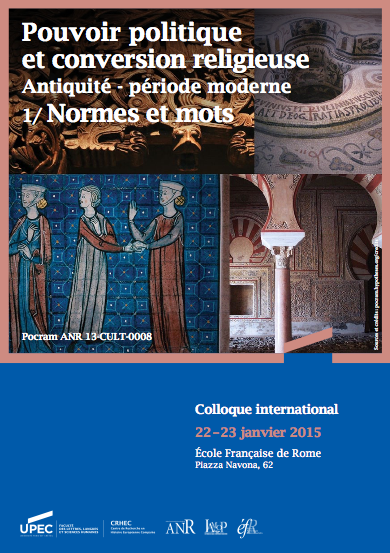
Journée d’étude – Pouvoir politique et conversion religieuse, Antiquité-période moderne. 1/ Normes et mots

Les attitudes du pouvoir politique face au changement religieux que peuvent représenter les conversions sont un angle d’approche privilégié pour mieux comprendre la place de la religion dans les sociétés.

Le programme ANR Pocram analyse ces attitudes dans différentes configurations, depuis la fin de l’Antiquité jusqu’à la fin du XVIIe siècle.

1 / Normes et mots, premier colloque thématique de Pocram, est consacré au vocabulaire de la conversion ainsi qu’à la production des normes concernant la conversion et les convertis.

Programme : ici

POCRAM - 1Informations pratiques :
22–23 janvier 2015
École Française de Rome Piazza Navona, 62

Organisation scientifique :
Thomas Lienhard (LAMOP) et Isabelle Poutrin (CRHEC)

Informations, contact et crédits photographiques :
pocram.anr@gmail.com et pocram.hypotheses.org

Source de l’information : École française de Rome

Publié dans Colloque | Laisser un commentaire