Web – Manuscrits numérisés de la Houghton Library (Harvard University)

Au premier trimestre de 2014, la Houghton Library de Harvard University a mis en ligne une nouvelle série de livres numérisés, dont onze manuscrits médiévaux.

On y compte notamment une série de six rouleaux :

Cambridge (Mass.), Harvard University, Houghton Library, MS Typ 550 : Hymnes de Saint-Bernard de Clairvaux. Manuscrit sur rouleau de la première moitié du 15e siècle (Italie). Provenance : don de Mme. Henry S. Grew, 1968

Cambridge (Mass.), Harvard University, Houghton Library, MS Fr 495
: Fragment d’une chronique (généalogie) du monde. Manuscrit sur rouleau du 15e siècle. Provenance : acquis grâce au legs de Peter P.F. Degrand, 2008.

Cambridge (Mass.), Harvard University, Houghton Library, MS Typ 40 : Chronique d’Angleterre. Manuscrit sur rouleau de 1470 environ. Provenance : Sir Thomas Phillipps (MS 26428); Sir Leicester Harmsworth (sa vente de 1945, 6e portion, no. 1959) ; don de William King Richardson, 1946.

Cambridge (Mass.), Harvard University, Houghton Library, MS Typ 416
: Liturgie de Saint-Basil, en Grecque. Manuscrit sur rouleau de 1300 environ. Provenance : acquis avec le « Fund for Printing and Graphic Arts » donné par Philip Hofer, 1956.

Cambridge (Mass.), Harvard University, Houghton Library, MS Typ 286 : Septem oratiunculae : prières au Christ, à la Vièrge Marie, Sainte-Anne, Sainte-Marie-Madeleine. Manuscrit sur rouleau du 15e siècle, peut-être allemand. Provenance : legs de Philip Hofer, 1984.

Cambridge (Mass.), Harvard University, Houghton Library, MS Lat 198 : Débat entre Hélène et Ganymède : Taurum sol intraverat et ver parens florum. Manuscrit sur rouleau du 12e siècle. Provenance : acquis avec le fonds Frank Brewer Bemis, 1950.

Puis, quatre livres de piété :

Cambridge (Mass.), Harvard University, Houghton Library, MS Richardson 45
: Livre d’heures. Manuscrit de 1405 environ (Paris, Maître de Luçon). Provenance : ex-libris du Comte de Kerchove de la Deuze, Baron d’Exaerde; Longmans; acheté par John Trotter Brockett, vers 1816 (ex-libris); sa vente London, Sotheby’s, 1823, décembre, no. 2307; acheté par Johnstone; ducs de Newcastle; Clumber sale : London, Sotheby’s, 1937, 6 décembre (Clumber sale III), no. 959; acheté par Richardson ; legs de William K. Richardson, 1951.

Cambridge (Mass.), Harvard University, Houghton Library, MS Lat 161 : Livre d’heures à l’usage de Rome. Manuscrit produit entre 1460 et 1480 à Bruges. Provenance : Arthur H. Lea ; don de Caroline T. Lea, 1938.

Cambridge (Mass.), Harvard University, Houghton Library, MS Typ 443.1 : Livre d’heures et missel (« Heures Emerson-White »). Manuscrit produit entre 1485 et 1490 en Flandres (Maître des Heures de Dresde, Simon Marmion, Associés gantois, Maître des miniatures Houghton). Provenance des deux volumes Typ 443 et Typ 443.1 : Bernard Quaritch (encore en 1 seul volume); Sir William Stirling Maxwell (catalogue Quaritch septembre 1886, no. 35696), qui l’a relié en 2 volumes ; Quaritch (les deux volumes). Ensuite le volume 1 (MS Typ 443) passe à William A. White, 1892; sa fille Frances White Emerson ; donné en mémoire de William A. White et de sa fille Frances White Emerson par des membres de leur famille : Harold White, Donald Moffat et Mrs. John Wing, 1958. Le volume 2 (MS Typ 443.1) passe à Alfred T. White, 1892 ; son gendre Adrian Van Sinderen ; depose par Mme. Adrian Van Sinderen, 1966.

Cambridge (Mass.), Harvard University, Houghton Library, MS Widener 2 (HEW 7.11.11)
: Livre d’heures à l’usage de Sarum. Manuscrit de la deuxième moitié du 15e siècle. Provenance : acquis par Harry Elkins Widener de Quaritch, 1902.

Et un manuscrit humaniste :

Cambridge (Mass.), Harvard University, Houghton Library, MS Lat 375 : Dictys de Crète (Dictys Cretensis), De bello troiano ; Francesco Filelfo, De Jesu Christi sacerdotio. Manuscrit écrit à Rome (pour Arrivabene) entre 1465 et 1491. Provenance : don de la collection de Margaret L. Meiss et Millard L. Meiss, 1994.

Source de l’information : Libraria
Publié dans Web | Laisser un commentaire

Appel à contribution – Éditions électroniques, études de corpus et bases textuelles dans les études médiévales

Dans le prolongement du précédent colloque organisé par la Société de Langues et de Littératures Médiévales d’Oc et d’Oïl, qui portait sur l’édition de texte à l’heure du numérique, le colloque organisé à Nancy a pour ambition de présenter et de faire dialoguer des projets qui s’inscrivent dans le vaste champ des recherches qui portent sur la langue et la littérature médiévales en s’appuyant sur les outils et les ressources numériques. Nouveaux moyens d’archivage et d’interrogation, mais aussi nouvelles approches épistémologiques. Il sera intéressant d’interroger les objectifs poursuivis, les méthodes et les résultats, sans occulter d’éventuelles dérives, à partir de cas concrets et d’expériences précises. il pourra également être utile de réfléchir au nouveau type de communication scientifique qui est liée à ces projets, à la mise à disposition des données et à leur fertilisation par et dans de nouveaux projets, comme à la diffusion et à la valorisation de ces données, sur le plan culturel ou didactique.

Les communications pourront porter sur l’édition électronique d’œuvres médiévales, l’édition et l’étude de corpus, la mise en relation de données textuelles, codicologiques ou iconographiques, l’analyse linguistique appuyée sur des bases textuelles (graphies, lexique et sémantique, syntaxe, ponctuation…). Elles pourront également envisager la question des relations entre de tels projets, des liens entre les bases, le partage des connaissances… Les problèmes de construction et de sélection du corpus. Dans un chantier forcément collectif, évolutif, ouvert, comme l’a montré l’expérience du Dictionnaire du Moyen Français et celle de nombreux autres projets…

Proposition de communication :
Envoyer avant le 15 septembre 2014 un titre de communication accompagné d’un résumé (500 mots max.) et d’une bibliographie à pascale.baudinot@atilf.fr

Le programme définitif avec les communications retenues sera envoyé à la fin du mois d’octobre.

Comité scientifique :
Stefano Asperti, la Sapienza Rome
Sylvie Bazin, Université de Lorraine
Venceslav Bubenicek, Université de Lorraine
Bernard Combettes, Université de Lorraine
Michèle Goyens, Leuven
Yan Greub, ATILF/CNRS
Pierre Kunstmann, Ottawa
Christiane Marchello-Nizia, ENS-Lyon

Comité d’organisation :
Julien Abed, Université de Lorraine
Damien de Carné, Université de Lorraine
Pascale Baudinot, ATILF/CNRS
Capucine Herbert, ATILF/CNRS
Sylvain Samyn, ATILF/CNRS
Gilles Souvray, ATILF/CNRS
Béatrice Stumpf, ATILF/CNRS

Soutien des laboratoires : ATILF, ECRITURE, HISCANT-MA, LIS

La publication des Actes est prévue aux PUPS.

Le colloque sera accueilli à Nancy le vendredi 16 janvier à l’ATILF et le samedi 17 janvier 2015 au campus Lettres et Sciences Humaines. Des informations pratiques seront envoyées en même temps que le programme définitif du colloque.

Source de l’information : Fabula

Publié dans Appel à contributions | Laisser un commentaire

Appel à contribution – Building Hagiographies: Saintly Imagery in Monumental Contexts

Event Date: 14-17 May 2015
Event Location: Western Michigan University (Kalamazoo, MI)
Submission Deadline: 15 September 2014

In addition to the EPISCOPUS-sponsored panels at Kalamazoo 2015, EPISCOPUS members planning to travel to Kalamazoo may also be interested in the following additional panel focused on hagiographic narratives.

Building Hagiographies: Saintly Imagery in Monumental Contexts

One of the most innovative developments in the monumental arts of the thirteenth century was the incorporation of saints’ lives into the visual programs of buildings, including the stained glass and sculpture of such well-known structures as the cathedrals of Chartres, Reims, Amiens, and Bourges. Yet even at these well-known monuments, the resident imagery of local saints and the local interpretations of universal saints remain understudied topics. This session will consider the ways in which the imagery of saints was incorporated or reinterpreted in the visual programs of buildings, thereby constructing careful histories within regional and local contexts.

We encourage papers that consider regional and local interpretations of hagiographic imagery in a variety of monumental contexts (cathedrals, parish churches, monasteries) and across geographic regions (Europe, the British Isles, and the Mediterranean). Papers may address but are not limited to such issues as the use of hagiographic narratives to support the power and authority of the local clergy and/or the interaction of local saints’ imagery with liturgical performance, pilgrimage, preaching, and other devotional, didactic, or political concerns.

Proposals for papers should be sent to the organizers and follow guidelines listed here:

Co-Organizers:
Jennifer M. Feltman, jennifer.feltman@gmail.com
Kara Morrow, kmorrow@wooster.edu

Source de l’information : Episcopus

Publié dans Appel à contributions | Laisser un commentaire

Appel à contribution – Concile et conciliarisme. Conceptions, mises en scène, perceptions

Organisateur: Schweizerische Zeitschrift für Religions- und Kulturgeschichte – SZRKG
Date, lieu: 30.04.2015, Fribourg
Deadline: 01.09.2014

«Concile et conciliarisme» sera le thème clé de la Revue suisse d’histoire religieuse et culturelle 2015. D’un point de vue géographique, l’on fera entre autres référence au territoire de la Suisse actuelle. D’un point de vue temporel, des regards approfondis sur certains conciles seront autant souhaités que des comparaisons et des perspectives de longue durée sur la réception des conciles. D’une part, l’on s’intéressera à la réception de conciles médiévaux tels que le IVème concile de Lateran. D’autre part, l’on se concentrera sur les conciles bien connus de Constance et de Bâle, ainsi que sur le concile de Lausanne, moins recherché à ce jour. Trois champs thématiques définiront le cadre.

Le premier champ thématique jettera un regard comparé structurel sur le conciliarisme médiéval tardif, sur des conceptions ecclésiologiques ainsi que leurs inspirateurs, de même que leurs conséquences pour l’Église médiévale tardive. Comment les objectifs conciliaristes ont-­‐ils pu devenir une épée de Damoclès pour une papauté à caractère monarchique? Quelles dynamiques ont pris forme, et comment le conciliarisme a-­‐t-­‐il paralysé l’Église de la Préré-­‐ forme, dont le Vème concile de Lateran ainsi que la convocation et le déroulement «retardés» du concile de Trente sont le reflet à la veille de la Réforme ?

L’aspect de la mise en scène des conciles et de certains acteurs, et donc de la politique des conciles et de la politique avec le(s) concile(s), constituera un deuxième champ thématique. Comment les conciles ont-­‐ils été mis en scène en tant qu’«événements»? Comment les em-­‐ pereurs, rois, princes se sont-­‐ils positionnés vis-­‐à-­‐vis des conciles? Comment les conciles ont-­‐ils rassemblé des représentants du pouvoir local et non-­‐local, la Suisse actuelle étant pré-­‐ cisément un lieu de rencontre? Comment les réformateurs se sont-­‐ils comportés vis-­‐à-­‐vis du conciliarisme ?

La perception et la réception de certains conciles en particulier, leur idearium ainsi que leur mise en scène, également en dehors de l’espace «ecclésiastique» au sens étroit du terme, formeront le troisième champ thématique. Comment les chroniqueurs racontent-­‐ils les conciles – précisément en territoire suisse ? Quel rôle les aspects de la mise en scène des conciles en tant qu’«événements» et le domaine public qui en est issu ont-­‐ils joué dans la perception ?

Pour le thème central «Concile et conciliarisme: Conceptions, mises en scène, perceptions», des contributions en allemand, français, anglais et italien seront considérées. Les articles doivent comporter 25’000 à 40’000 signes (espaces inclus). Les contributions sont évaluées de manière anonyme dans le cadre d’une double procédure d’expertise. La parution est prévue pour la fin de l’automne 2015.

L’annonce d’une contribution avec titre et abstract (max. 1’000 signes) doit être adressée d’ici au début du mois de septembre 2014 à : Dr. Franziska Metzger, rédactrice en chef RSHRC, franziska.metzger@unifr.ch. Les contributions devront êtres envoyées au plus tard fin avril 2015 à la rédactrice en chef.

Contact :
David Neuhold
Universität Freiburg/Schweiz
david.neuhold@unifr.ch

Source de l’information : HSK

Publié dans Appel à contributions | Laisser un commentaire

Appel à contribution – Episcopus sessions at Leeds International Medieval Congress

Event Date: 6-9 July 2015
Event Location: Leeds, England, UK
Submission Deadline: 12 Sept 2014

EPISCOPUS is organizing several sessions for Leeds 2015, some of which are included below.

The Bishop’s Eye and EPISCOPUS are interested in co-organising a panel on reform and renewal in the diocese of Lincoln. In keeping with the Bishop’s Eye rationale we are particularly interested in thinking about how reform and renewal intersected with other aspects of religious men’s identities (social status, gender, membership of particular orders, ethnicity, location etc). We are continuing to think of ‘religious men’ in a broad sense (i.e. monks/clerics and laymen) and would welcome papers from any medieval period and field. Papers could also consider men’s involvement with the reform of women/female orders. But we would encourage you to interpret these fairly general headings as you think best in relation to your own research!We hope to be able to put together sessions made up of papers dealing with comparative contexts and/or methodological approaches. We may decide to have respondents to some of the sessions, and are also planning to propose a round table.

Please submit offers of papers by 12 September 2014. At this stage a title and a few sentences summarising the subject matter of the paper is sufficient. Proposals may be submitted to: Katherine J. Lewis, MA, DPhil, FHEA, FRHistS Senior Lecturer in History, Acting Research Co-ordinator

EPISCOPUS is sponsoring a session on “Methodological Frontiers in Medieval Church Reform and Renewal. Medieval reformers knew no boundaries in their attempts to renew their fellow Christians’ devotions to the Church. Modern researchers similarly push the boundaries of scholarship as they wrestle with questions of reform in their own work. Sometimes, that takes the form of experimentation with digital methodologies. In other cases, it means a revisiting well-known documents with new perspectives and new questions. This panel will feature speakers who have self-consciously applied methodologies and technologies to historical sources and debates concerning reform. From distant reading and data mining, to manuscript studies that question current transmission accounts, to reform accounts that tie several reform periods together, the goal of these papers is to challenge established explanatory paradigms of reform and renewal in the medieval church by stretching the geographic, temporal, and methodological frontiers of medieval reform scholarship.

Please submit offers of papers by 12 September 2014. At this stage, a title and a few sentences summarising the subject matter of the paper is sufficient, although a 250-word abstract is ideal. Proposals should be submitted to: Kalani Craig, PhD (Hutton Honors College, Indiana University, craigkl@indiana.edu)

Finally, EPISCOPUS is sponsoring a session on “Reforming and re-negotiating celibacy, purity and masculinity”
Recent work has questioned how we should imagine ‚reform‘ in the context of medieval religious history. We need to pay closer attention to the interrelation of different processes, actor constellations and portrayals of reform, as both longer reform processes, rewriting of ongoing reforms and recurring re-negotiations of the same themes are visible. One theme which recurs in various waves of religious reform and debate and thus shows many interconnected strands of reform is debate about bodily purity and sexual asceticism of religious elites, realized in forms of priestly celibacy or religious/monastic chastity and virginity. The link between gender and authority not only made it a prime arena of debate in reforms of pastoral care. Re-negotiations of the topic also seem to occur in connection with various situations of competition between different religious elites, and purity and chastity seem to be qualities which were debated hotly (and controversially) among both scholarly elites and the laity. Debates about purity, chastity and celibacy not only intensified with eleventh-century church reform and the fight against ’Nicolaitism’, but also with clashes between heterodox and orthodox religious elites in the eleventh and twelfth centuries, between mendicant and clerical pastors from the thirteenth century onwards, as well as between Christian, Jewish and Islamic elites wherever power shifts unbalanced existing arrangements. While we witness some intense attempts of individuals or groups to enforce celibacy, chastity or purity as a form of gendered religious identity, other debates seem to make polemical use of a growing arsenal of topoi which became embedded in traditions of clerical reform or of clerical, monastic or mendicant education. Yet most of these arenas of the reform of masculine religious identity are studied separately. The session aims to take a closer look at reform debates about celibacy, chastity, and masculine identity, and to study how they connect to reform movements and changing patterns of religious diversity. Scholars working on relevant fields are invited to submit abstracts, which might focus on the use and importance of debates about chastity and celibacy in situations of reform, especially as a topic contested between scholarly and lay opinion the re-use of established ideals of chastity, purity and masculinity the embedding of such ideals in polemical or didactic traditions.

Please submit abstracts to Sita Steckel, sita.steckel@uni-muenster.de, by 12 Sept 2014.

Source de l’information : Episcopus

Publié dans Appel à contributions | Laisser un commentaire

Colloque – Interuniversitaire Masterclass Religie en Cultuur in het Ancien Régime: De Sacrale Ruimte

Programma
Interuniversitaire Masterclass Religie en Cultuur in het Ancien Régime:
De Sacrale Ruimte

Dinsdag 9 september, Leuven, Hollands College, Refter

10u: Registratie en koffie

10u30-11u30: Keynote 1: Dr. Dominique Bauer (KU Leuven) –  De “spatial turn” en de sacrale ruimte

11u30-12u30: Bespreking artikel 1 en 2 uit de reader (cf. p. 4)
S. Hamilton en A. Spicer, ‘Chapter 1: Defining the Holy’ door Sam Janssens
D. Iogna-Prat, ‘Churches in the landscape’ door
12u30-14u: Lunch

14u-16u: Presentatie onderzoek door PhD studenten
Jeroen Reyniers (KU Leuven, KIK) – C’est la plus belle maison et la plus belle église de Huy. Een nieuwe blik op het verdwenen kruisherenklooster
Ruben Suykerbuyck (PhD student UGent) – Eeuwigheid voor de edelman. Motieven voor het religieuze patronage van Jonker Maarten van Wilre in de Zoutleeuwse St.-Leonarduskerk (1548-1558)
Alexander Soetaert (PhD student KU Leuven) – De kerkprovincie Kamerijk als katholiek toevluchtsoord en transregionaal drukkerscentrum (1559-1659)
Tom Bervoets (PhD student KU Leuven, Rijksarchief Anderlecht) – De kerk in het midden? Parochieclerus, lokale elite en de strijd om de controle over de sacrale ruimte op het 18de-eeuwse Brabantse platteland
16u00: Koffiepauze

16u30-17u30: Bespreking artikel 3 en 4 uit reader
T. Coomans, ‘Architectural Competition in a University Town’ door Eva Vandemeulebroucke
A. Walsham, ‘Sacred Topography and Social Memory’ door Louise Vermeersch

Woensdag 10 september, Leuven, Abdij van ’t Park, Alamire Foundation

9u30-10u: Onthaal met koffie

10u-11u: Keynote 2: Prof. dr. Rob Faesen (KU Leuven) – De innerlijke en uiterlijke ruimte in de Middelnederlandse mystiek

11u-12u30: Presentaties onderzoek
Pieter Byttebier (PhD student UGent) – Kerkwijding als bisschoppelijk prerogatief: creatie en organisatie van de sacrale ruimte(s) in elfde-eeuwse kathedralen in Lotharingen.
Ewoud Waerniers (PhD student UGent) – Verhoudingen van stadsbewoners met sacrale ruimtes tijdens de volle middeleeuwen
Kim Overlaet (PhD Student UAntwerpen) – Het succes van de begijnenbeweging in de Nederlanden herbekeken: godsvrucht of pragmatisme? Het Groot Sint-Katharina-begijnhof in Mechelen (ca. 1545-1600)
12u30-13u30: Lunch

13u30-14u: Bespreking artikel 5
P. Raxhon, ‘La démolition de la cathédrale Saint-Lambert de Liège’ door John Arblaster

14u-15u: Presentaties onderzoek
Marina Musurok (PhD student KU Leuven) – Imaginaire steden in de miniatuurkunst van de 15de eeuw: het voorbeeld van Troje.
Tom Callebaut (PhD student KU Leuven) – Wat in hemelsnaam is het dat jou in beweging zet?
15u-15u30: koffiepauze

15u30: Rondleiding in abdij van ’t Park door dhr. Stefan Van Lani, Centrum voor Religieuze Kunst en Cultuur

17u: Afsluitende borrel

Organiserend comité namens KU Leuven
Rob Faesen, Faculteit Theologie en Religiewetenschappen, Onderzoekseenheid Geschiedenis van Kerk en theologie
Wim François, Faculteit Theologie en Religiewetenschappen, Onderzoekseenheid Geschiedenis van Kerk en theologie
Brigitte Meijns (coördinator), Faculteit Letteren, Onderzoeksgroep Middeleeuwen
Violet Soen, Faculteit Letteren, Onderzoeksgroep Nieuwe Tijd

Wetenschappelijk comité
Youri Desplenter, UGent
Steven Vanderputten, UGent
Anne-Laure Van Bruaene, UGent
Veerle Fraeters, UAntwerpen
Guido Marnef, UAntwerpen

Source de l’information : Vlaamse Werkgroep Mediëvistiek

Publié dans Colloque | Laisser un commentaire

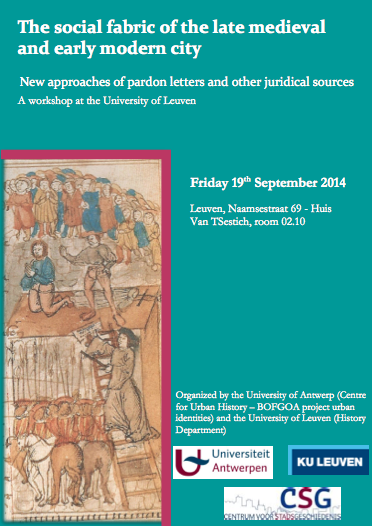
Journée d’étude – The social fabric of the late medieval and early modern city. New approaches of pardon letters and other juridical sources

The social fabric of the late medieval and early modern city. New approaches of pardon letters and other juridical sources
A workshop at the University of Leuven

Friday 19th September 2014
Leuven, Naamsestraat 69 – Huis Van TSestich, room 02.10Organized by the University of Antwerp (Centre for Urban History – BOFGOA project urban identities) and the University of Leuven (History Department)

 
Programme :
Chair : Guido Marnef (University of Antwerp)
14h30 : Peter Arnade (University of Hawai’i at Manoa) – Archives in the Fiction: Pardon Letters in the Burgundian Low Countries.
14h50 : Walter Prevenier (Ghent University) – Notaries and petitioners of Burgundian pardon letters inspired fiction writers.
15h10 : Violet Soen (University of Leuven) – Pardon letters during the Dutch Revolt. Or how the general pardons sparked storytelling.
15h30 : discussion

Chair : Jelle Haemers (University of Leuven)
16h00 : Anke De Meyer (University of Antwerp) – Urban societies in motion: women in late medieval and early modern pardon letters.
16h20 : Andrea Bardyn (University of Leuven) – Women’s fortunes. Female agency, property and investment in the urban space of late medieval Brabant.
16h40 : Peter Stabel (University of Antwerp) – The social fabric of the medieval city: a cross-cultural perspective. Western Europe and the Middle East compared.Participation is free, but all participants should register before 15 September. More information and registration: anke.demeyer@uantwerpen.be

Source de l’information : UGent
Publié dans Colloque | Laisser un commentaire

Web – Digitised Medieval Manuscripts, Trinity College, Cambridge

Trinity College, Cambridge is digitizing its medieval manuscripts, and making them freely available on the Web. A few years ago, M.R.James’s catalogue of the manuscripts was put up on the Library’s website, with some updates. This is now being used as the index tool for searching for digitized volumes. So far, about 150 of the thousand or so manuscripts have been copied, in a programme that is part-funded by the College’s alumni.

For access, go to the Library’s website http://www.trin.cam.ac.uk/index.php?pageid=9

Click on ‘Early manuscripts’, and then ‘The James catalogue’. From there follow the links to the manuscript you wish to see. The descriptions of those manuscripts that have been digitized are headed with access to the relevant images.

Priority is being given to manuscripts that are most in demand. The Librarian (Professor David McKitterick) will be glad to receive suggestions for further manuscripts that might be treated early in the programme.

Source de l’information : FMRSI

Publié dans Web | Laisser un commentaire

Offre d’emploi – Professur (W3) für Mittelalterliche Geschichte

An der Johann Wolfgang Goethe-Universität Frankfurt am Main ist am Fachbereich Philosophie und Geschichtswissenschaften am Histori­schen Seminar zum 01. April 2015 folgende Stelle im Beamten- bzw. äquivalent im Angestelltenverhältnis zu besetzen:

Professur (W3) für Mittelalterliche Geschichte

Die Inhaberin/Der Inhaber der Professur soll das Fach Mittelalterliche Geschichte in Forschung und Lehre in ganzer Breite vertreten. In der Lehre wird die Mitwirkung an allen Studiengängen erwartet, an denen das Historische Seminar beteiligt ist. Da die Professur auch an der Leh­rerbildung beteiligt ist, werden Erfahrungen oder Konzepte zur Vermit­tlung der Fachinhalte an Schulen begrüßt.

Ein Schwerpunkt in der Forschungstätigkeit der Professur liegt auf der Geschichte des Späten Mittelalters. Die verantwortliche Mitwirkung in den bestehenden und künftigen Forschungsverbänden sowie der akade­mischen Selbstverwaltung wird erwartet. Habilitation oder habilita­ti­ons­äquivalente Leistungen sowie Lehrerfahrung werden vorausgesetzt.

Details zu den rechtlichen Rahmenbedingungen der Einstellungs­vor­aus­setzungen finden Sie unter:
http://www.vakante-professuren.uni-frankfurt.de

Wissenschaftlerinnen und Wissenschaftler, die in Forschung und Lehre exzellent ausgewiesen sind und international sichtbare Forschungs­leistungen belegen können, sind eingeladen, ihre Bewerbungen mit Lebenslauf (wissenschaftlichem und beruflichem Werdegang), Foto­kopien der relevanten Zeugnisse und Urkunden, Schriftenverzeichnis, Übersicht der Lehrtätigkeit und ggfs. Lehrevaluationen bis zum 02. Oktober 2014 an folgende Adresse zu richten: Dekan des Fach­bereichs Philosophie und Geschichtswissenschaften der Johann Wolfgang Goethe-Universität, Grüneburgplatz 1, D-60323 Frankfurt am Main, E-Mail: dekanat08@em.uni-frankfurt.de.

Source de l’information : Academics.de

Publié dans Appel à contributions | Laisser un commentaire

Appel à contribution – Human Migration and Displacement in the Medieval Mediterranean at the Time of the Holy Land Crusades (c.1050-c.1300)

International Medieval Congress 2015, Leeds, 6-9 July 2015: Reform and Renewal
Organiser: Jochen Schenk, University of Glasgow

This session aims to look at the challenges posed to societies, governments and secular and religious institutions by the forced or voluntary migration of individuals, groups and populations within and across political and cultural boundaries in areas directly affected by the holy land crusades. Of particular interest in this context are the social and political mechanisms available or invented for dealing with refugees and otherwise displaced persons; the social and cultural costs (and benefits) of human displacement; challenged or shifting concepts of identity; human trafficking: its actors, victims and markets; the challenges posed to government by nomadic societies; migration and the labour market; the legal treatment of migrants and refugees; memories of migration and displacement.

The session is interdisciplinary and international in concept. Publication of a volume of essays is anticipated.

Please send proposals (title & 100 words abstract) to Jochen.schenk@glasgow.ac.uk before 7 September 2014.

Source de l’information : Academia.edu

Publié dans Appel à contributions | Laisser un commentaire


