Appel à contribution – Biennial London Chaucer Conference: Science, Magic and Technology

Biennial London Chaucer Conference: Science, Magic and Technology
London, Senate House, Institute of English Studies, 10-12 July 2015
Deadline: 1 September 2014

Papers are sought on all aspects of ‘Science, Magic and Technology’ in late medieval literature and culture and particularly within Chaucer studies. Approaches might include:

  • The presentation of scientific ideas in myth and poetry
  • Observation and naturalism in literature and art
  • Experiment and experience in science and literature
  • The occult sciences (astrology, magic, alchemy) and their relationship to literature
  • Technology as magic, magic as a technology
  • Scientific literatures and the literariness of science
  • Epistemology and taxonomy in late medieval writing
  • Technologies of writing, parchment making and codicology
  • Concepts of the material and immaterial worlds, the environment, astrology, astronomy and cosmology
  • Cartography; deep-sea and space exploration
  • The science of the senses, optics, sound or scent
  • The representation of medicine in literature or the literary modes of medical writing
  • Trade technologies in literature
  • Science, magic and technology in medievalism

Papers are welcomed on the work of Geoffrey Chaucer or, more broadly, on late medieval writing and culture.

Please send 250 word abstracts to Dr Isabel Davis; Birkbeck, University of London. i.davis@bbk.ac.uk by 1st September 2014.

Source de l’information : Medieval Art Research

Publié dans Appel à contributions | Laisser un commentaire

Appel à contribution – Transmissions et musique. Les journées de musiques anciennes

Les 21, 22 et 23 novembre 2014 à Vanves (92), dans le cadre du festival Les Journées de Musiques Anciennes, se déroulera pour la deuxième année consécutive un colloque de musicologie. Le festival réunit un salon international de 100 luthiers, autour d’une programmation musicale consacrée aux répertoires du Moyen-Âge et de la Renaissance. Ces journées rassemblent professionnels et amateurs, tous les acteurs du monde des musiques anciennes et le grand public. Elles se veulent à la fois festival et journées professionnelles / d’étude.

Pour l’édition 2014, le thème choisi est «Transmission et Musique». Destiné à la communauté scientifique mais également au grand public, les Journées mesurent la pertinence de ce thème présent au cœur même de la démarche du festival. Un thème plus que tout autre propre à conjuguer la démarche du bilan à celle de la prospective.

Le thème «Transmission et Musique » propose un cadre général réunissant musicologues, luthiers, musiciens, historiens de l’art, historiens… afin de discuter les multiples enjeux rassemblant ces deux termes en relation avec les répertoires musicaux anciens en Occident (ca. 800 – 1750).

Axes thématiques

Le colloque cherche à explorer les directions suivantes (sans s’y limiter) :

  • Techniques, outils, répertoires, formes, objets – conditions et contingence de transmission
  • Transmission directe de personne à personne et transmission différée
  • Transmission dans le temps, dans l’espace
  • Mode de transmission

L’inscription de ces thématiques dans un colloque dont le public est notamment constitué de musicologues, enseignants, élèves de conservatoires, pédagogues prend tout son sens : cela permet d’interroger la manière dont les répertoires anciens sont enseignés aujourd’hui, en se confrontant aux modes de transmission ayant cours à l’époque où ces répertoires étaient en usage.

Conditions de soumission

Toutes les propositions de communication, tant de chercheurs confirmés que de jeunes docteurs et doctorants, seront bienvenues. Dans la mesure où les présentations proposées sont issues de leurs spécialités de recherche et/ou de pratique, le colloque est ouvert aux musicologues, historiens de l’art, mais aussi musiciens, luthiers, ou encore restaurateurs ou conservateurs.

N’hésitez pas à nous proposer la communication d’un collègue ou d’une connaissance qui puisse mettre en relief les problématiques que vous aborderez. Les communications peuvent s’effectuer à une ou plusieurs voix. Chaque intervention devra durer entre quinze et vingt minutes (en fonction du nombre de participants) pour être suivie d’une discussion avec les auditeurs et les autres acteurs de la séance. Les intervenants devront tenir compte du public, mêlant étudiants de licence et de master, enseignants-chercheurs et auditeurs libres, et adapter leur discours en conséquence.

Nous remercions toute personne intéressée de bien vouloir envoyer son projet de communication (CV + synopsis d’une page maximum) par voie électronique, aux adresses suivantes : colloque@journees-musiques-anciennes.org

À l’issue du colloque, les articles des intervenants feront l’objets d’une double publication : Ils paraitront dans la lettre d’information mensuelle du festival (et resteront disponible de façon pérenne sur le site internet des Journées) puis seront compilés pour une publication papier dans un numéro spécial du Jardin de Musique, la revue de l’équipe Langages et Patrimoine musicaux de l’Université Paris-Sorbonne.

Date limite : 30 septembre 2014

Comité scientifique

Les propositions seront examinées par l’équipe coordinatrice du projet :

François Picard co-directeur de l’équipe d’accueil Patrimoines et Langages Musicaux EA 4087 université Paris-Sorbonne
Alice Tacaille co-directeur de l’équipe d’accueil Patrimoines et Langages Musicaux EA 4087 université Paris-Sorbonne
Joël Dugot (conservateur – Cité de la Musique de Paris)

La réponse sera communiquée au 15 Octobre 2014.

Source de l’information : Calenda

Publié dans Appel à contributions | Laisser un commentaire

Offre d’emploi – Munby Fellowship in Bibliography 2015-2016

Munby Fellowship in Bibliography 2015-2016
Salary Range: £32,590

The Library Syndicate invite applications for the Munby Fellowship in Bibliography for the tenure of 1 October 2015 to 31 July 2016.

The Munby Fellow will be free to pursue bibliographical research of his/her own choosing. It is, however, expected that the Fellow’s research will be, at least in part, based directly or indirectly on the collections of the University and Colleges of Cambridge and likely to be of benefit, in the broadest sense, to scholars using those collections in the future. The Fellow will have no departmental or other staff duties and responsibilities.

The Fellowship is open to graduates in any discipline of any university and nationality. Preference will be given to scholars at post-doctoral or an equivalent level.

The University of Cambridge is committed to equality of opportunity.

The stipend will be £32,590 (pro-rata).

A non-stipendiary Fellowship at Darwin College will normally be available to the successful candidate, if not already a Fellow of a Cambridge College. Fellows in these categories are members of the Governing Body of the College and may take meals in the College without charge.

Applications (one copy only) should reach the Deputy Librarian’s PA, University Library, West Road, Cambridge, CB3 9DR, UK by 31 October 2014, and should include the following particulars:

  • a completed application cover sheet;
  • a curriculum vitae with a list of principal publications;
  • a statement of the research proposed.

An election will be made in early January 2015. There are no interviews.

Further particulars are available from http://www.lib.cam.ac.uk/Vacancies or by contacting the Deputy Librarian’s PA, tel: 01223 333083, email: Charlotte.Ross@lib.cam.ac.uk.

Closing Date: Friday 31 October 2014

Source de l’information : DigiPal

Publié dans Offre d'emploi | Laisser un commentaire

Colloque – Ideologies of Representation in Medieval and Early Modern Europe

The third workshop of the international project Political representation: communities, ideas and institutions in Europe (c. 1200 – c. 1650) will be convened on 18 and 19 September 2014 in Leuven, Belgium. This time the theme we shall address is Ideas and Languages of Representation. This series of worshops seeks to establish the social and ideological context of representative institutions in order to clarify why and how they functioned as an essential platform for political dialogue. Who exactly took part in this negotiation process, whose interests were at stake and what political ideas motivated the representatives when bargaining with the delegates of the prince? While the first and second workshop (The Hague, 2012; Stirling, 2013) focused on the way representative institutions functioned and the social and political circles from which the representatives were drawn, the final session will concentrate on their ideological and discursive environment.

International research has emphasized that both rulers and delegates of the Estates were favourably disposed towards the existence of such representative institutions. On that platform the parties involved could respectively claim taxes and privileges. However, mostly the outcome of the negotiations was a compromise. The claims of the constituents were tempered by their representatives, as they gathered far away from their home towns, political opinions amongst them diverged and they often received favours from the prince. Although this may be valuable arguments to explain the outcome of specific meetings of the Estates, they fail to take into account why delegates decided to bargain.

Using the sociological framework of Pierre Bourdieu, one could therefore argue that neither the application of ‘social capital’, nor the desire for ‘economic capital’ sufficiently explain the political motives behind the representatives’ choice for negotiations. Therefore ‘symbolical power’ should also be taken into account. Moreover opinions on specific policy matters may have determined the outcome of negotiations, while discursive strategies were an essential tool for deputies to rationalize the decisions they took.

However, we know little on such ideas and discursive strategies of representatives of the Estates, since most scholars in the field have concentrated on the political thought of rulers and speeches they delivered at meetings of the Estates. Therefore, research into the ideological and discursive environment of deputies of the Three Estates is needed in order to more fully understand how representative institutions functioned. In short, by analysing the agency of deputies and their ideas, we hope to overcome the limitations of the existing historical studies on political representation.

Programme :

Thursday 18 September

9h30-10h : Jelle Haemers, University of Leuven – Introduction: The ideology of representation

Session I : City, estates and ideology

10h-13h : Keynote : Jan Dumolyn, Ghent University & Graeme Small, University of Durham – Political representation and political communication in the Burgundian state
Referent: Frederik Buylaert, Free University of Brussels

Valerie Vrancken, University of Leuven – ‘With the consent of the Estates…’ The political rights of the Estates of Brabant in the Inauguration Charters of the Brabantine dukes (1356-1477)
Referent: Eric Bousmar, Université Saint-Louis, Brussels

Marie Van Eeckenrode, Université de Louvain-la-Neuve – Idées et représentation politique en Hainaut au bas Moyen Age
Referent: Jelle Haemers, University of Leuven

13h-14h: Lunch
Naamsestraat 69 – Hogenheuvelcollege, room 00.50

14h-16h : Robert Stein, University of Leiden – The Antwerp clerk Jan van Boendale and the ideology of the Estates of Brabant
Referent: Tim Soens, University of Antwerp

Carlo Taviani, Italienish-Deutsches Historisches Institut, Trento – Duo sunt in ea regna. Representing the Commune and the bank of San Giorgio in renaissance Genoa
Referent: Erik Aerts, University of Leuven

16h-18h: guided tour through Leuven
19h: dinner

Friday 19 September

Session II : Spreading ideas on representation

9h30 – 12h30 : Keynote : Philip Withington, University of Sheffield – Urban citizenship and early modern democracy
Referent: Jan Dumolyn, Ghent University

Pierre Kapitaniak, Université Paris 8, Vincennes-Saint-Denis – Democracy and demonology in sixteenth-century France
Referent: Mario Damen, University of Amsterdam

Ida Nijenhuis, University of Nijmegen – Arguments for Empire: Willem Usselincx versus the States-General
Referent: Robert Stein, University of Leiden

Alastair Mann, University of Stirling – Parliamentary sovereignty and representation through the lens of George Buchanan and his opponents
Referent: Hans Cools, University of Leuven

12h30-13h : Conclusion: Ideology or ideologies of representation?

13h-14h: Lunch

Informations pratiques :
18-19 septembre 2014

Leuven, Naamsestraat 69
Huis Van TSestich, lokaal 02.10

Organizing Committee: Jelle Haemers (KULeuven), Hans Cools (KULeuven), Mario Damen (Universiteit van Amsterdam), Tim Soens (U Antwerpen) en Valerie Vrancken (KULeuven)

Source de l’information : KU Leuven

Publié dans Colloque | Laisser un commentaire

Séminaire – Books Across Cultures in the Late Medieval Low Countries

A half-day workshop will be held in the John Rylands Library, Manchester, on Wednesday 5 November (1.30-4.45 pm). It is aimed primarily at PhD students in relevant disciplines (history, English, modern languages), though master’s students are also welcome subject to approval from their programme director.

Books Across Cultures in the Late Medieval Low Countries aims to introduce students to:

hands-on work with manuscript and early printed books (codicology, material bibliography, transcription, editing), using books from the library holdings;
the importance of translation and rewriting in literary cultures of the late medieval Low Countries.

It accompanies the library exhibition Communities in Communication: Languages and Cultures in the Low Countries, 1450-1530: www.library.manchester.ac.uk/rylands/exhibitions/communitiesincommunication/). The exhibition itself forms part of an ongoing research project supported by the Arts and Humanities Research Council (AHRC), Transcultural Critical Editing: Vernacular Poetry in the Burgundian Netherlands, 1450-1530: www.transculturalediting.eu.

The workshop is free of charge; places are available on a first-come-first-served basis. Prospective participants should send a firm expression of interest to the workshop organizer, Professor Adrian Armstrong (French, Queen Mary University of London: a.armstrong@qmul.ac.uk) by 30 September 2014, indicating their university affiliation, thesis topic or master’s programme, and languages read (French, English, Dutch, Latin – most of the materials studied will be in French). Master’s students should also ask their programme director to confirm approval. Briefing materials will be emailed to students in advance of the workshop.

Source de l’information : Medieval Art Research

Publié dans Colloque, Séminaire | Laisser un commentaire

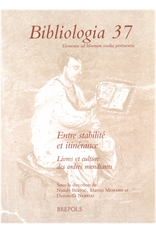
Publication – D. Nebbiai Dalla Guarda, N. Bériou, M. Morard (éd.), « Entre stabilité et itinérance. Livres et culture des ordres mendiants, 13e-15e siècle »

Les travaux de ces dernières années confirment que les livres tiennent une place centrale dans l’organisation des couvents mendiants et dans leurs pratiques économiques. Au quotidien, les livres font partie intégrante de la vie des couvents, comme vecteur de connaissances, support d’édification et outil de communication. Les frères les acquièrent pour étudier, pour transmettre les savoirs et pour discipliner la société. Les sœurs sont aussi, souvent, familières de la culture écrite, qui peut représenter un lieu de rencontre et de complémentarité entre les communautés masculines et féminines. Les contributions réunies dans ce volume s’attachent à considérer les différentes formes sous lesquelles les uns et les autres ont exprimé leur adhésion à la culture livresque, ou leurs éventuelles réserves, et reconnaissent dans la tension entre stabilité et itinérance l’un des points essentiels de l’identité culturelle des ordres mendiants. Parmi les aspects étudiés, figurent, en particulier, les réseaux institutionnels et interpersonnels, où les échanges de livres ont eu une très grande ampleur à l’humanisme, ainsi que les conditions historiques qui marquent le passage du manuscrit à l’imprimé.

Table des matières : ici

dIS-9782503550190-1Nicole Bériou, directrice de l’IRHT, directeur d’études à l’EPHE ; Donatella Nebbiai, directeur de recherche au CNRS, IRHT ; Martin Morard, chargée de recherche LEM, CNRS

Informations pratiques :
Donatella Nebbiai Dalla Guarda, Nicole Bériou, Martin Morard (éd.), Entre stabilité et itinérance. Livres et culture des ordres mendiants, 13e-15e siècle, Turnhout, Brepols, 2014 (Bibliologia, 37). 470 p., 26 b/w ill., 18 b/w tables, 210 x 270 mm. ISBN: 978-2-503-55019-0. Prix : 85,00 euros.

Source de l’information : Brepols

Publié dans Publications | Laisser un commentaire

Appel à contribution – Digital mappings and historical geographies

International Conference of Historical Geographers 2015
London, 5-10 July 2015

Convenors: Keith Lilley (Queen’s University Belfast) and Catherine Porter (Lancaster University)

This session seeks to explore current developments in the use of digital mapping in historical geography. Papers that explore techniques and methods to offer conceptual and critical reflections on digital cartography are particularly welcomed, addressing such questions as:

  • How does digital mapping in historical geography help us to reimagine the past?
  • How is historical cartography being transformed through digital mapping?
  • How can historical geographers use digital maps to explore ‘hidden’ histories and geographies?
  • How useful are current ideas on ‘mutable mappings’ in conceptualising digital cartography?

Individual papers may focus on particular maps, or collections of maps, of all types and scales, and the uses of digital techniques to analyse historic maps and plans to examine questions of past cartographic production and circulation. Alternatively, papers may explore digital mapping methods as approaches used to visualise and understand past geographies of people and places, for example in areas such as landscape and planning histories and in urban and rural settlement morphologies. The aim of the session is to encourage the sharing of experiences and practices of historical geographers engaged with digital mappings, exchanging ideas on methods and techniques, as well as to provide a forum for developing further critical reflection on our uses of digital mapping in historical geography and cartography.

For more information and to submit a paper proposal (200 words by September 5th), please contact Keith Lilley at k.lilley@qub.ac.uk

Further details on the ICHG Conference are available at: 
http://www.ichg2015.org/


Details of conference fees are available at: 
http://www.ichg2015.org/registration/

Publié dans Appel à contributions | Laisser un commentaire

Bourse – Bourse Robert de Sorbon

Public visé

Cette bourse s’adresse aux docteurs en histoire médiévale ayant soutenu leur thèse à l’étranger, depuis trois ans au maximum.

Contenu de la bourse

Cette bourse permettra au lauréat de réaliser un séjour d’un mois, toujours du 1er au 31 mars, au sein du Laboratoire de Médiévistique Occidentale de Paris, lequel prendra en charge son déplacement aller et retour ainsi que son logement à la cité internationale de Paris. En outre, le lauréat obtiendra le statut de membre associé du Laboratoire pendant trois ans.

logo_bourse_lamop

Obligations

Au cours de son séjour, le lauréat présentera ses travaux dans l’un des séminaires du Laboratoire. Un résumé de cette présentation sera publié sur le site du LAMOP.

Calendrier

Publication de l’appel : fin Juin
Clôture de l’appel : 1er Octobre
Réunion du jury : Octobre
Affichage des résultats sur le site du LAMOP : fin octobre

Composition du jury

La composition du jury est revue chaque année par le Conseil de Laboratoire du LAMOP. Ce jury comprend 8 membres :
– un président, choisi parmi le groupe de direction du LAMOP,
– un secrétaire, choisi au sein du conseil de Laboratoire du LAMOP,
– le vice-président des Relations internationales de Paris 1 ou son représentant,
– deux membres du LAMOP, titulaires ou émérites,
– deux extérieurs, chercheurs ou enseignants-chercheurs,
– un acteur de la conservation du patrimoine (Archives nationales de France, Bibliothèque nationale de France…).

– Composition du jury 2014-2015

Pièces à fournir :
– Déclaration de candidature (format docx)
– Curriculum vitae
– Lettre de motivation en français, dans laquelle le candidat présentera les axes de ses recherches, la manière dont ceux-ci peuvent s’articuler aux programmes du Laboratoire et les objectifs de son séjour
– Rapport de soutenance et/ou un résumé de la thèse
– Au moins deux publications jugées représentatives publiées ou à paraître

La procédure de candidature est dématérialisée. Ces pièces seront adressées, avant le 1er Octobre de manière impérative, sous format pdf, dans cet ordre et au sein d’un seul et même fichier, au secrétariat de la bourse : bourselamop@univ-paris1.fr. Sont en charge du secrétariat : François Foronda pour la partie scientifique et Françoise Bornes pour la partie administrative.

Documents pour mémoire : Descriptif de la Bourse ; Appel à candidature

Source de l’information : LAMOP

Publié dans Bourse | Laisser un commentaire

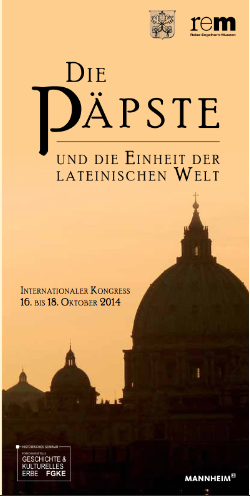
Colloque – Die Päpste und die Einheit der Lateinischen Welt. Internationaler Kongress

Was ist das „Papsttum“? Die Forschung darüber ist in den letzten beiden Jahrzehnten intensiv vorangetrieben worden. Vor allem die jüngere Forschergeneration hat sich intensiv dem Thema gewidmet. Viele Bereiche, wie etwa die papalen Repräsentationsformen, die Entstehung und Funktion des Kardinalkollegiums oder das Legatenwesen, wurden ganz neu aufgearbeitet. Papstwahl und Papstbegräbnis ebenso wie der „Leib des Papstes“ waren Themen großer neuerer Forschungsleistung. Immer stärker rückt die Bedeutung des Papsttums für das gesamte kulturelle, politische und rechtliche Ordnungsgefüge der lateinischen Welt in den Mittelpunkt unseres historischen Interesses.

Dieser neue Forschungsstand soll in einem groß angelegten Ausstellungsprojekt 2017 auch einem breiteren Publikum präsentiert werden: „Die Päpste und die Einheit der Lateinischen Welt. Altertum – Mittelalter – Renaissance“. Die Ausstellung wird in den Reiss-Engelhorn-Museen in Mannheim und in Räumen des Vatikans in Rom gezeigt. Zur Vorbereitung dazu sind zwei Tagungen angesetzt. Die erste wird vom 16.-18. Oktober 2014 in Mannheim stattfinden und sich im Rahmen eines umfassenden Überblicks Grundfragen des Papsttums in Antike und Mittelalter zuwenden: Wie ist es entstanden? Was begründet seine Autorität, seinen Primat, seinen Universalismus? Welches sind die entscheidenden Wendepunkte über die „papstgeschichtliche Wende“ hinaus? Welche Instrumentarien stehen ihm über die Jahrhunderte hinweg zur Verfügung? Welche Kraft entwickelt die transzendentale Verankerung? Was bedeutet „römischer Erdkreis“? Wie stehen Papsttum und „Europa“ zueinander? Inwiefern ist die mehr als tausendjährige Geschichte einer römischen „Papstkirche“ die Grundlage christlicher Konfessionen späterer Epochen?
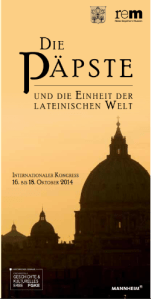
Heidelberg - PapsteProgramme :

Donnerstag, 16.10.2014

14.00 – 14.30
Eröffnung

Alfried Wieczorek/ Stefan Weinfurter – Grußworte;
Msgr. Matthias Türk – Grußwort des Päpstlichen Rates zur Förderung der Einheit der Christen;
Bernd Schneidmüller – Einführung in das Programm

Sektion I. Petrus der Fels: Archäologische Befunde und Zeichen des frühen Kultes
Moderation: Falko Daim (Mainz)

14.30 – 15.00 Hugo Brandenburg (Münster/Rom) – Die literarischen und archäologischen Zeugnisse zur Präsenz Petri in Rom
15.00 – 15.30 Sible de Blaauw (Nijmegen) – Die Gräber der frühen Päpste
15.30 – 16.00 Diskussion
16.00 – 17.00 Pause

Moderation: Wilfried Hartmann (Tübingen)

17.00 – 17.30 Carola Jäggi (Zürich) – Ein Fischer wird Papst. Zur Genese des Petrus-Bildes in der frühchristlichen Kunst
17.30 – 18.00 Sebastian Scholz (Zürich) – Primat und päpstliche Politik in den römischen Inschriften von der Spätantike bis ins hohe Mittelalter
18.00 – 18.30 Diskussion

19.00
Öffentlicher Abendvortrag

Michael Matheus (Mainz) – Einführung
Arnold Nesselrath (Rom) – Der Papst im Bild

Freitag, 17.10.2014

Sektion II Etappen und Strategien der Emanzipation
Moderation: Matthias Becher (Bonn)

9.00 – 9.30 Hartmut Leppin (Frankfurt am Main) – Der Patriarch des Westens und der Kaiser des Ostens
9.30 – 10.00 Florian Hartmann (Bonn) – „Petruspapst“ und „Petruskaiser“. Die Cathedra Petri zwischen östlichem und westlichem Imperium
10.00 – 10.30 Diskussion
10.30 – 11.00 Pause

Moderation: Annette Kehnel (Mannheim)

11.00 – 11.30 Agostino Paravicini Bagliani (Lausanne) – Wie wird man Papst im Mittelalter?
11.30 – 12.00 Gerd Althoff (Münster) – Die Entwicklung der kirchlichen und päpstlichen Verantwortung für die Könige (9.–12. Jh.)
12.00 – 12.30 Diskussion
12.30 – 13.30 Mittagspause

Sektion III Päpstliche Vollgewalt und universaler Anspruch
Moderation: Klaus Herbers (Erlangen)

13.30 – 14.00 Jochen Johrendt (Wuppertal) – Verdichtung und Monetarisierung päpstlicher Herrschaft im 12. und 13. Jh.
14.00 – 14.30 Christian Jaser (Berlin) – Ostensio exclusionis. Die päpstliche Generalexkommunikation zwischen kirchenrechtlicher Innovation und zeremoniellem Handeln
14.30 – 15.00 Lotte Kéry (Bonn) – Das Kirchenrecht als Instrument päpstlichen Führungsanspruchs
15.00 – 15.30 Diskussion
15.30 – 16.30 Pause

Moderation: Gert Melville (Dresden)

16.30 – 17.00 Claudia Zey (Zürich) – Vervielfältigungen päpstlicher Präsenz und Autorität: Boten, Legaten und Symbole
17.00 – 17.30 Stefan Burkhardt (Heidelberg) – Das Papsttum in der mittelalterlichen mediterranen Welt
17.30 – 18.00 Diskussion
18.00 – 19.00 Pause

19.00 – 20.00
Abendveranstaltung, Round Table

Anna-Reiß-Saal, Museum Weltkulturen D5
Christentum, Papsttum und Kirchen
Alfried Wieczorek (Mannheim): Einführung
Diskussionspartner: Bischof Wolfgang Huber (Berlin), Kardinal Karl Lehmann (Mainz), Christoph Markschies (Berlin), Stefan Weinfurter (Heidelberg), Hubert Wolf (Münster)
Moderation: Gerhard Mandel, SWR

Samstag, 18.10.2014

Sektion IV Aufstieg aus dem Niedergang
Moderation: Birgit Studt (Freiburg i. Br.)

9.00 – 10.30 Karl Ubl (Köln) – Der Papst, der keine Simonie begehen kann. Debatten über päpstliche Souveränität im Umkreis Bonifaz‘ VIII.
9.30 – 10.30 Claudia Märtl (München) – Die neue römische Kurie – Organisationsformen im 15. Jh.
10.00 – 10.30 Diskussion
10.30 – 11.00 Pause

Moderation: Ingrid Baumgärtner (Kassel)

11.00 – 11.30 Jürgen Dendorfer (Freiburg i.Br.) – Kardinäle als die wahren Häupter der Kirche?
11.30 – 12.00 Ulrich Pfisterer (München) – Paradiese in Rom. Sakraler Stadtraum um 1500.
12.00 – 12.30 Diskussion

12.30 – 12.45 Michael Matheus (Mainz) – Ausblicke
12.45 – 13.00 Stefan Weinfurter (Heidelberg) – Schlussworte
13.00 Tagungsende

Informations pratiques :
16.10.2014-18.10.2014

Mannheim
Reiss-Engelhorn-Museen Mannheim
Museum Zeughaus C5/ Florian Waldeck-Saal
68159 Mannheim

Veranstalter: Prof. Dr. Bernd Schneidmüller, Historisches Seminar, Universität Heidelberg; Prof. Dr. Stefan Weinfurter, Forschungsstelle Geschichte und kulturelles Erbe, Universität Heidelberg; Prof. Dr. Alfried Wieczorek, Reiss-Engelhorn-Museen, Mannheim

Die Teilnahme an der Tagung ist kostenfrei. Anmeldungen per Post, Fax oder E-Mail werden bis zum 15.09.2014 erbeten an: Reiss-Engelhorn-Museen Mannheim, Buchungsbüro, Museum Weltkulturen D5, 68159 Mannheim, Fax: +49(0)621-293.2138; Mail: buchungen.rem@mannheim.de

Kontakt: Reiss-Engelhorn-Museen Mannheim, Buchungsbüro, Museum Weltkulturen D5, 68159 Mannheim, Fax: +49(0)621-293.2138; Mail: buchungen.rem@mannheim.de

Source de l’information : Universität Heidelberg

Publié dans Colloque | Laisser un commentaire

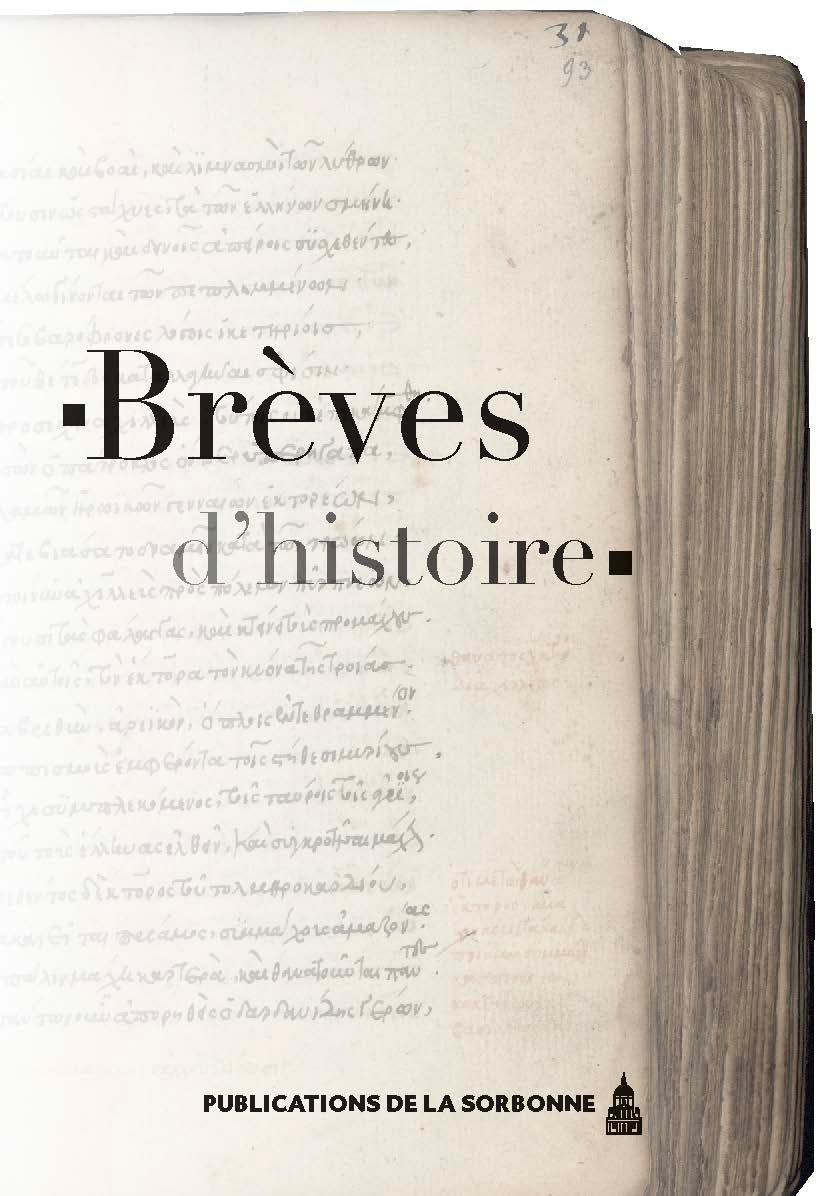
Publication – Patrice Beck et Philippe Bernardi (éd.), « Brèves d’histoire »

La recherche historique en archives impose d’importants dépouillements jetant de manière fugace un éclairage sur des figures, des anecdotes qui n’étant pas centrales pour notre propos ne sont pas intégrées le plus souvent à l’étude. Ces tranches de vie sont tout ce qu’il reste, bien souvent, de la vie d’un homme ou d’une femme, d’êtres sans histoire – dont l’histoire ne peut être reconstituée. Mais ces bribes d’histoires, ces témoignages fugaces restent en mémoire. Les chercheurs les conservent dans leur mémoire, se les racontent. Ces bribes ont le pouvoir évocateur de brèves et résonnent un peu comme les « Je me souviens » de Georges Perec. C’est cette force d’évocation que les auteurs souhaitent proposer à un public plus large, comme témoignage de ces vies ordinaires mais également d’un aspect de la recherche, un arrière-plan fait pour partie d’émotions vis-à-vis de ce que l’on pourrait désigner comme un quotidien sensible. Le parti pris a été de demander à une dizaine de collègues de partager les brèves qu’ils conservaient dans leurs dossiers. Nous avons renoncé à les ordonner thématiquement, ce qui revenait à un début de traitement. Elles sont présentées de manière subjective, comme une série de choix opérés par les divers contributeurs.

28405100016750LWalter Benjamin l’affirmait : « Rien de ce qui s’est passé un jour ne doit être considéré comme perdu pour l’histoire. » Pas même les traces fugaces des anonymes, rebuts de la grande chronique. Elles sont comme des chutes d’archives, tombées au pied de l’établi des historiens. En voici qui, dans leur brièveté, disent quelques petits drames de la vie fragile au Moyen Âge.

Informations pratiques :
Patrice Beck et Philippe Bernardi (éd.), Brèves d’histoire, Paris, Publications de la Sorbonne, 2014. 0,9 x 15 x 0,9 cm, 100 gr. ISBN : 978-2-85944-784-7. Prix : 5 euros.

Source de l’information : Publications de la Sorbonne

Publié dans Publications | Laisser un commentaire