Offre d’emploi – Claudio Leonardi Fellowship of the Schindler Foundation for Medieval Latin Studies

The Claudio Leonardi Fellowship of the Zeno Karl Schindler Foundation for Medieval Latin Studies has been established to support scholarship in Medieval Latin Studies – in particular, research by young scholars – with a grant-in-aid in honor of Claudio Leonardi (1926-2010), founder and first president of the Società Internazionale per lo Studio del Medioevo Latino (S.I.S.M.E.L.).

The grant will allow one scholar (doctoral or postdoctoral candidate) to spend a period of three to six months abroad pursuing research in his/her chosen field with a monthly stipend of 2,500 Swiss francs. In addition, the recipient may make use of an additional subsidy of 3,000 Swiss francs toward the cost of publication of his/her doctoral thesis or posdoctoral research on condition that the print publication indicate foundation support (“published with the support of the Zeno Karl Schindler-Stiftung.“)

Applications should be submitted (with curriculum vitae, description of research project, and reason for research abroad) by September 1, 2014, via email to : Prof. Jean-Yves Tilliette, Langue et littérature latines médiévales, Université de Genève (Jean-Yves.Tilliette@unige.ch). Applications will then be submitted to the Governing Board of the Zeno Karl Schindler Foundation for evaluation during its fall meeting.

The fellowship assignment will be made during the annual S.I.S.M.E.L. General Meeting which will be held on March 28, 2015. The winner will then be given the opportunity to present a fifteen minute lecture on his/her research or on particular aspects of his/her doctoral or postdoctoral research.

Source de l’information : Ménestrel

Publié dans Offre d'emploi | Laisser un commentaire

Colloque – Cathedral Libraries and Archives in the British Isles ‌

The 13th York Manuscripts Conference, 2-4 July 2014

Organised by Brian Cummings, Linne Mooney, Bill Sherman and Hanna Vorholt.

Hosted by the Centre for Medieval Studies and the Centre for Renaissance and Early Modern Studies at the University of York, in association with the Cathedral Libraries and Archives Network.

Venues: The York Minster Library and the King’s Manor, York, UK

York Cathedral LibrThis international conference brings together scholars from a range of Humanities disciplines to consider the under-studied subject of Cathedral Libraries and Archives of the British Isles in the medieval and early modern periods. Papers will range over topics of the formation and housing of cathedral library collections, books and archival materials produced by members of the cathedrals, acquisitions and donations, as well as the dispersal at the reformation. The event will also mark the 600th anniversary of the re-founding of York Minster Library and include a visit to the original library space, built in the wake of the bequest by John Newton in 1414.

Keynote lectures will be given by Nigel Morgan (Cambridge), Christopher Norton (York), Rodney Thomson (Tasmania), and Magnus Williamson (Newcastle)

Programme : here

Source de l’information : University of York

Publié dans Colloque | Laisser un commentaire

Publication – M. Gaillard (éd.), « L’empreinte chrétienne en Gaule du IVe au IXe siècle »

Ce volume contient les textes de la plupart des communications effectuées lors de trois journées d’étude tenues à l’Université de Lille 3, à l’automne 2010. Ces journées avaient pour but de présenter les recherches en cours sur la topographie religieuse des villes épiscopales, de mieux faire connaître les espaces ruraux, objets de nombreux et récents travaux archéologiques et historiques, tout en étudiant les changements intervenus au cours de ces six siècles dans le domaine des normes et comportements sociaux. Les vingt contributions ici offertes entraînent le lecteur de la législation constantinienne à la normalisation carolingienne, des premiers signes archéologiques de la présence du christianisme aux prémices de la paroisse médiévale, des premiers monastères aux communautés cénobitiques strictement encadrées par les réformes carolingiennes, des plus hauts lieux du christianisme gaulois ou gallo-franc à des sites moins illustres mais tout autant chargés d’histoire. Les auteurs ont inscrit leurs réflexions dans les grandes problématiques qui animent aujourd’hui l’archéologie et l’historiographie des débuts du christianisme en Occident, ce qui permet d’apprécier, à chaque étape de ce long itinéraire, l’empreinte du christianisme en Gaule aux premiers siècles de son histoire.

dIS-9782503550442-1

Table des matières :

Avant-Propos
Abréviations

Charles Bonnet et Michèle Gaillard – Introduction

1. Les héritages antiques

L’influence du christianisme dans l’Empire romain tardif

Pierre Jaillette – Une constitution de Constantin sur les pratiques magiques dans les campagnes (code théodosien IX, 16, 3)
Audrey Becker – Les évêques et la diplomatie romano-barbare en Gaule au Ve siècle
Emmanuelle Raga – L’influence chrétienne sur le modèle alimentaire classique : la question de l’alternance entre banquets, nutrition et jeûne

Construction de modèles chrétiens

Bruno Judic – Les modèles martiniens dans le christianisme des Ve-VIIe siècles
Marie-Céline Isaïa – Le saint évêque dans l’hagiographie lyonnaise (IVe-VIIe s.)
Bruno Dumézil – Le modèle royal à l’époque mérovingienne

2. La ville chrétienne

Lieux du culte chrétien

Marc Heijmans – À propos de la mise à jour de la Topographie Chrétienne des Cités de la Gaule : réflexions sur le cas d’Arles
Sylvie Balcon-Berry et Walter Berry – Le groupe épiscopal d’Autun au haut Moyen Âge
Pascale Chevalier – Au coeur du groupe épiscopal du Puy, le baptistère Saint-Jean
Raymond Brulet – La cathédrale Notre-Dame de Tournai : le programme des fouilles archéologiques

Le culte des saints

Jean-François Reynaud – À la recherche des martyrs de Lyon et de Vienne
Ian N. Wood – The cult of saints in the south-east of Gaul in the fifth and sixth centuries
Michèle Gaillard et Christian Sapin – Autour de la tombe de saint Quentin : histoire et archéologie d’un culte (milieu IVe-début VIIIe s.)

3. Les cadres de la vie chrétienne

L’expansion monastique

Yann Codou – Aux origines du monachisme : le dossier de Saint-Honorat de Lérins
Sébastien Bully, Aurélia Bully et Morana Čaušević-Bully avec la collaboration de Laurent Fiocchi – Les origines du monastère de Luxeuil (Haute-Saône) d’après les récentes recherches archéologiques
Étienne Louis – Une église monastique du haut Moyen Âge dans le nord de la France : le cas de Hamage

Le christianisme en milieu rural

Jean Terrier – L’apport des fouilles des églises rurales de la région genevoise à la connaissance de la christianisation des campagnes
Laurent Schneider – Les églises rurales de la Gaule (Ve-VIIIe siècles). Les monuments, le lieu et l’habitat : des questions de topographie et d’espace.
Charles Mériaux – L’« entrée en scène » du clergé rural à l’époque carolingienne
Isabelle Cartron – Quelques réflexions sur les sépultures en milieu rural en Gaule : pratiques funéraires et organisation des nécropoles

Stéphane Lebecq – Conclusion

Résumés
Planches en couleur

Informations pratiques :
M. Gaillard (ed.), L’empreinte chrétienne en Gaule du IVe au IXe siècle, Turnhout, Brepols, 2014 (Culture et société médiévales, 26). 551 p., 136 b/w ill. + 11 colour ill., 3 b/w tables, 156 x 234 mm. ISBN: 978-2-503-55044-2. Prix : 95 euros.

Source de l’information : Brepols

Publié dans Publications | Laisser un commentaire

Colloque – What is a letter? An interdisciplinary approach

The symposium ‘What is a letter? An interdisciplinary approach’ will bring together experts on letter writing from a diverse range of disciplines (including literary and cultural studies in a number of modern languages, linguistics, editorial studies, sociology, and history), countries (including Austria, Britain, and Germany), and institutions (including universities, museums, and libraries).

Against the background of a rapidly and internationally growing number of research and editing projects which centre around letters, the aim of the symposium is threefold: (i) to initiate a much-needed dialogue between disciplines (and scholars from different countries) about the theoretical concepts of ‘the letter’ which form the basis for any engagement with epistolary culture; (ii) to lay the foundations for an inclusive and interdisciplinary methodology for analysing letters, taking into account their subject-specific definitions and uses, and (iii) to make the results of these efforts available to other scholars through publication of the conference proceedings.

Please note: English and German are the working languages of the symposium. An interpreter will be present to summarize papers and assist with the discussion.

Programme :

Wednesday, 2 July

11:30 Registration
12:30 Welcome

Session I: Aspects of epistolarity

12:45 : Michael Sinding – The evolution of epistolarity: conceptual blending in genre transformation
13:30 : Robert Vellusig – Die Poesie des Briefes. Eine literaturanthropologische Skizze
14:15 : Coffee break

14:45 : Nicholas Cronk – Voltaire’s correspondence: When is a letter not a letter?
15:30 : Grace Egan – From ‘post to post’: epistolary valediction and the ‘horror of the last’
16:15 : Coffee break

16:45 : Oliver Herford – Letters, performance and performativity
17:30 : Alan Scott – Letters 2.0? Linguistic insights into the extent to which social media are a substitute for personal letters
19.30 : Pub evening (opt-in)

Thursday, 3 July

08:45 Registration

Session II: Concepts and contexts

09:00: Liz Stanley – ‘Here it ends with my pen, but not my heart’: letterness and the many ends of ‘the letter’
09:45 : Inka Kording – Epistolarisches – Die achtfache Relationalität des Briefes
10:30 : Coffee break

11:00 : Patrick Reinard – ‚…die Hälfte eines Dialoges‘? Briefe auf Papyri und Ostraka. Überlegung zur quellenkritischen Auswertung
11:45 : Zeev Kitsis – Letter writing and knowledge cybernetics in Rabbinic literature of the twentieth century

12:30 Lunch (own arrangements)

13:30 – 14:30 Seminar at the Bodleian Library

Session III: Transmission and postal history

14:45 : Pamela Clemit – Godwin’s letters: transmissions of value
15:30 : Katarzyna Jastal – Der Brief als Sammelobjekt bei Karl August Varnhagen von Ense
16:15 : Coffee break

16:45 : Emma Harper – From cross-written letters to human ones: how postal reforms changed the letter
17:30 : Julia Gillen – The Edwardian postcard revolution – a literacy studies perspective
19:30 : Conference dinner

Friday, 4 July

08:45 Registration

Session IV: Interpretation and materiality

09:00 : Jochen Strobel – Historische Semantik des Briefs und die Chancen digitaler Briefeditionen
09:45 : Caroline Socha – Der Status von Briefbeigaben in der Verlegerkorrespondenz – eine editionsphilologische Perspektive
10:30 : Coffee break

11:00 : Jana Dambrogio/Daniel Starza Smith – Using historic letterlocking to reseal the letters of John Donne: a collaborative approach to letters

12:00 – 13:15 Workshop : Lik Hang Tsui – * Letter writing, calligraphy, and literati taste in medieval China: a reading of a manuscript letter by Mi Fu
Lena Vosding – Gaben aus dem Kloster – die Briefe der Lüner Benediktinerinnen (1460-1550)

13:15 – 14:45 : Lunch (sandwich lunch provided)

14:45 – 15:30 : Discussion and conclusion

15:30 – 16:30 Workshop – postscriptum: An exercise in letter locking (Jana Dambrogio/Daniel Starza Smith)

Publié dans Documentaire | Laisser un commentaire

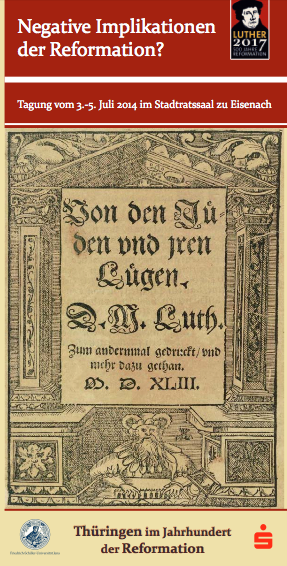
Colloque – Negative Implikationen der Reformation?

Der Ausgangspunkt, eine wissenschaftliche Konferenz mit dem durchaus provozierenden Titel „Negative Implikationen der Reformation?“ durchzuführen, war die 7. Tagung der I. Landessynode der Evangelischen Kirche in Mitteldeutschland im November 2011 in Erfurt. Auf ihrer Zusammenkunft regten die Synodalen an, wissenschaftlich übergreifend der Frage nachzugehen, ob sich aus der Reformation „negative Implikationen“ für Kirchen und Gesellschaft ergeben haben. Dieses Generalthema soll auf unserer Konferenz in Eisenach vom 3. bis 5. Juli 2014 fächerübergreifend diskutiert werden.

Dazu einige Anmerkungen:
Jedem größeren Zeitabschnitt historischer Entwicklung kann man selbstverständlich Singularität und geschichtliche Relevanz zubilligen – so auch dem Zeitalter von Huma-nismus und Renaissance, Reform und Reformation, Staatsbildung und Konfessionalisierung. Unstrittig dürfte sein, dass sich während des 15. und 16. Jahrhunderts gesellschaftliche Prozesse entwickelt, entfaltet und ausgeprägt haben, welche in nachfolgender Zeit eine bemerkenswerte Wirkmacht erlangten und die scheinbar bzw. tatsächlich bis in die Gegenwart hineinreichen. Spätestens seit der Aufklärung entfaltete sich eine lebhafte Diskussion, die nach der Wirkmächtigkeit historischer Prozesse sowie nach deren Voraussetzungen, Ursachen und Folgen fragte – nicht zuletzt nach den Auswirkungen der Reformation, des Augsburger Religionsfriedens oder des Tridentinums. Allerdings scheinen zwischen den Verlautbarungen der 7. Tagung der I. Landessynode der EKM vom November 2011 sowie den „Perspektiven für das Reformationsjubiläum 2017“ (vgl. Anlage) einige nicht geringe Widersprüche zu bestehen. Einerseits die „negativen Implikationen“ mit Andeutungen auf Luthers Judenschriften, den zeitgenössischen Antijudaismus oder den aufkommenden Anstaltsstaat samt Sozialdisziplinierung und individueller Entmündigung – andererseits die Freiheit eines Christenmenschen, Dienst am Nächsten und soziale Verantwortung, ein Verständnis von Kirche als unhierarchische Gemeinschaft ihrer Glieder. Der scheinbare oder tatsächliche Widerspruch zwischen den reformatorischen Errungenschaften und den „negativen Implikationen der Reformation“ sind auf der Konferenz in Eisenach aus historischer Perspektive zu ergründen und zu diskutieren.
Reformation IENAProgramme :

Donnerstag, 3. Juli

13:00 Uhr Grußworte
Katja Wolf, Oberbürgermeisterin der Stadt Eisenach
Dr. Thomas Seidel – Beauftragter der Thüringer Landesregierung zur Vorbereitung des Reformationsjubiläums „Luther 2017“
Dr. Thomas Wurzel – Geschäftsführer der Sparkassen-Kulturstiftung Hessen-Thüringen

13:40 Uhr Tagungseröffnung : Prof. Dr. Uwe Schirmer, Professur für Thüringische Landesgeschichte der Friedrich-Schiller-Universität Jena

14:00 Uhr Sektion I (Minderheiten)
Moderation: Prof. Dr. Armin Kohnle (Leipzig)

Dr. Michael Beyer (Leipzig) – Martin Luther und die Juden
Julia Mandry, M.A. (Jena) – Integration und Ausgrenzung – Versorgung und Ablehnung. Ambivalenzen von Armut und Bettel zwischen Spätmittelalter und Reformation
Kaffeepause (15:30 Uhr)

16:00 Uhr Sektion II (Konfessionelle Gegensätze)
Moderation: Prof. Dr. Armin Kohnle (Leipzig)

Dr. Kai Lehmann (Schmalkalden) – Der Hexenwahn als Folge der Reformation?
PD Dr. Stefan Gerber (Jena) – „Die Mutter aller Revolutionen“. Katholische Reformationsrezeptionen im 19. und 20. Jahrhundert
Pause (17:30 Uhr)

18:30 Uhr Abendvortrag
Einführung: Prof. Dr. Werner Greiling, Vorsitzender der Historischen Kommission für Thüringen
Vortrag: Prof. Dr. Andreas Tacke (Trier): Die Reformation und der Kunstmarkt: (K)ein Grund zu klagen?
19:30 Uhr Empfang

Freitag, 4. Juli

8:15 Uhr Sektion III (Staat und Gesellschaft)
Moderation: Dr. Johannes Mötsch (Meiningen)

Prof. Dr. Enno Bünz (Leipzig) – Die Aufhebung der Klöster in Sachsen und Thüringen. Zukunftsperspektiven von Mönchen und Nonnen in der Reformation
Dr. Christoph Volkmar (Magdeburg) – Verlust, Bedrohung, Chance? Der mitteldeutsche Landadel und die Reformation
Prof. Dr. Uwe Schirmer (Jena) – Entmündigung der bäuerlichen Gemeinden als Folge der Reformation?
Kaffeepause (10:30 Uhr)

11:00 Uhr Sektion IV (Bildung)
Moderation: Dr. Johannes Mötsch (Meiningen)

PD Dr. Andreas Lindner (Erfurt) – Reformation versus Bildung? Die Erfurter Universität in den Wirren der städtischen Reformation
PD Dr. Robert Gramsch (Jena) – Zwischen „Überfüllungskrise“ und neuen Bildungsinhalten: Universitätsbesuch und universitärer Strukturwandel in Deutschland am Ende des Mittelalters (ca. 1470 bis 1530)
Mittagspause (12:30 Uhr)

14:00 Uhr Sektion V (Ordnung und Norm I)
Moderation: Dr. Reinhold Brunner (Eisenach)

Prof. Dr. Heiner Lück (Halle) – Die Reformation als Wirkungsfaktor für einen Paradigmenwechsel in der Sühne- und Strafpraxis Kursachsens?
Prof. Dr. Josef Pilvousek (Erfurt) – Das „Wunder“ von Trient und seine Rezeption. Römische Einheitsliturgie als Folge konfessioneller Abgrenzung?
Kaffeepause (15:30 Uhr)

16:00 Uhr Sektion VI (Ordnung und Norm II)
Moderation: Dr. Reinhold Brunner (Eisenach)

Prof. Dr. Georg Schmidt (Jena) – Luthers verführerisches Angebot: Gehorsam und Kirchenregiment
Prof. Dr. Eike Wolgast (Heidelberg) – Gewissenszwang bei Konfessionswechsel? Staatliches Kirchenregiment und Untertanengehorsam in der Kurpfalz
Pause (17:30 Uhr)

18:30 Uhr Orgelkonzert in der Eisenacher Nikolaikirche
(Kirchenmusikdirektor Christian Stötzner)

Sonnabend, 5. Juli

9:00 Uhr Sektion VII (Gender)
Moderation: Prof. Dr. Werner Greiling (Jena)

PD Dr. Ralf Frassek (Halle) – Modifizierungen im Eherecht infolge der Reformation (1517-1580)
Dr. Julia A. Schmidt-Funke (Jena) – Reformation und Geschlechterordnung. Neue Perspektiven auf eine alte Debatte
Kaffeepause (10:30 Uhr)

11:00 Uhr Sektion VIII (Sprache, Kultur, Zensur)
Moderation: Prof. Dr. Werner Greiling (Jena)

PD Dr. Hans-Peter Hasse (Dresden) – Reformation und Bücherzensur
Dr. Haik Thomas Porada (Leipzig) – Die Folgen der Reformation für die Entwicklung der niederdeutschen Schriftsprache
12:30 Uhr Abschlussdiskussion

14:00 Uhr Historische Stadtführung
(Dr. Reinhold Brunner)

Informations pratiques :
« Thüringen im Jahrhundert der Reformation »; Prof. Dr. Werner Greiling / Prof. Dr. Uwe Schirmer, Friedrich-Schiller-Universität Jena; Prof. Dr. Armin Kohnle, Universität Leipzig

03.07.2014-05.07.2014, Eisenach, Stadtverwaltung Eisenach, Stadtratssaal (Saal 13), Markt 22, 99817 Eisenach
Kontakt:

Dr. Alexander Krünes
Friedrich-Schiller-Universität, Historisches Institut, Fürstengraben 13, 07743 Jena

03641/944441
03641/944412
alexander.kruenes@uni-jena.de

Source de l’information : FSU Jena

Publié dans Colloque | Laisser un commentaire

Offre d’emploi – Job vacancies in Latin and Greek late antique hagiography

Job vacancies: two fully-funded ERC PhD studentships (4 years each) at Ghent University (Belgium)

The Department of Literary Studies at Ghent University (Belgium) is seeking well-qualified applicants for two fully-funded and full-time doctoral research fellowships attached to the European Research Council project Novel Saints. Ancient novelistic heroism in the hagiography of Late Antiquity and the early Middle Ages. The Principal Investigator of this project is Prof Dr Koen De Temmerman, who, as a classicist, specializes in ancient fiction and its persistence in later periods.

The two successful applicants will start employment on 1 October 2014. In order to be eligible, candidates must have obtained their Ma degree at the time of application or demonstrate convincingly that they will have that degree in hand by 1 October 2014.

The ERC project deals with the persistence of ancient novels in (Greek, Latin, Syriac and Arabic) hagiographical narrative traditions in the Mediterranean between the 4th and the 12th centuries. It also investigates the impact of these narrative traditions on medieval fiction in the West, Byzantium and Persia. An abstract of the project can be found at http://erc.europa.eu/cordis_search/project_details/109905.

Within the broad project, subprojects are assigned to individual team members. For the current vacancies, these subprojects are situated in the following areas:

Position 1: Latin late antique hagiography – Position 2: Greek late antique hagiography

Envisaged profiles: the successful candidates will have

  1. an Ma degree in (preferably Latin and/or Greek) Languages and/or Literature (candidates who have an Ma in either Latin or Greek are welcome to apply if they have at least some knowledge of the other language);
  2. excellent knowledge of Latin and/or ancient Greek (see number 1 above);
  3. demonstrable interest in (research into) the literary and/or cultural history of the imperial period, Late Antiquity and/or early Christianity;
  4. good knowledge of the literary and cultural history of this period as evidenced by their study trajectory (optional courses, subject of papers and dissertations, etc.);
  5. very good study results (including Ba and Ma dissertations of high quality).

For each of the two positions, we offer

  1. a contract for four years of full-time employment as a PhD student, continuation being subject to positive evaluation after one year;
  2. a competitive salary that corresponds to the salary scales for PhD students as established by the Flemish government;
  3. a substantial allowance for travel and other research purposes in addition to the salary;
  4. office space at the University and a solid and engaging academic working environment with a strong international profile. The ERC project resonates with the interests of a number of other scholars at Ghent University and the successful candidates will be able to interact with scholars and students affiliated with various departments and research institutes, such as the Department of Literary Studies, the Department of History, the Department of Oriental Studies, the Ghent Institute for Classical Studies, the Henri Pirenne Institute for Medieval Studies and the Ghent Centre for the Study of Christian Traditions;
  5. the possibility to acquire transferable skills as part of a Doctoral School programme.

For each of the two positions, we expect that the successful applicant

  1. will write and successfully defend a PhD dissertation within the four years of the fellowship;
  2. will contribute to the strong research tradition of the Department and the University by pursuing excellence in his/her research and by publishing his/her results in journals and with publishers that are internationally accepted as being of the highest quality;
  3. will come and live in Belgium, work closely together with the other team members and the project’s international advisory board, and contribute to a pleasant and stimulating atmosphere;
  4. will contribute to the scholarly activities of the research group (e.g. by organizing events in collaboration with the Principal Investigator and/or other members of the team, etc.).

How to apply?
(a) Applications should include

  1. a cover letter indicating for which of the two positions the applicant applies (applying for both positions is possible);
  2. a full curriculum vitae (incl. accurate information on grades and study results, e.g. official results lists if available);
  3. a brief autobiographical statement (no more than one page) highlighting why the applicant is interested in this project and what added value (s)he expects to bring;
  4. the applicant’s Ma dissertation (and possibly other relevant writing samples such as papers or a Ba dissertation).

and should be sent by snail mail to
Prof Dr Koen De Temmerman Ghent University
Department of Literary Studies Blandijnberg 2
B-9000 Ghent Belgium

(b) In addition, we kindly ask candidates to arrange for two letters of reference to be sent directly to koen.detemmerman@ugent.be by the referees.

Deadline: applications (both a and b) should arrive no later than 15 July 2014.

Please address any queries to the Principal Investigator (koen.detemmerman@ugent.be).

The University offers professional support for those applying to the many funding schemes at the local, regional and European levels.

Ghent is an attractive medieval town, with a strong economic base and lively cultural scene. Just 30 minutes by train from Brussels, two hours from Paris and Amsterdam and two and a half hours from London, it is ideally situated at the heart of European intellectual life.

Source de l’information : Universiteit Gent

Publié dans Offre d'emploi | Laisser un commentaire

Appel à contribution – Using and Creating Digital Medievalia

Fons Luminis, a peer-reviewed interdisciplinary journal edited and produced annually by graduate students at the Centre for Medieval Studies in the University of Toronto provides a forum in which to address, challenge, and explore the content and methodologies of our various home disciplines. We invite current graduate students to submit papers relating in some way to the 2015 journal theme, “Using and Creating Digital Medievalia.”

Since the mid-twentieth century, computing has been and continues to be a major factor in the medievalist’s research. From Father Busa’s creation of the Index Thomasticus in the 1940’s to current library and archival digitization projects, computational methods are essential aspects of the medievalist’s occupation. Papers are encouraged to address:

  • medievalist use of digitally stored information;
  • social scientists and librarians as creators and/or curators of knowledge about the Middle Ages;
  • future directions of digital humanities; the importance of digital humanities to work in paleography, codicology, diplomatics, and text editing.

Articles may also focus on topics including (but not limited to) mapping and space, the impact of digitization on concepts of the archive, and digital tools in teaching.

Contributions may take the form of a scholarly essay or focus on the study of a particular manuscript. Articles must be written in English, follow the 16th edition (2010) of The Chicago Manual of Style, and be at least 4,000 words in length, including footnotes. Quotations in the main text in languages other than English should appear along with their English translation.

As usual, we continue to accept other submissions on any aspect of medieval studies and welcome longer review articles (approximately 1,500 words) on recent or seminal works in medieval studies.Submissions must be received by July 1, 2014 in order to be considered for publication.Inquiries and submissions (as a Word document attachment) should be sent to edsfl@chass.utoronto.ca.

Source de l’information : Medieval Academy blog

Publié dans Appel à contributions | Laisser un commentaire

Offre d’emploi – Lyell-Bodleian Research Fellow in Manuscript Studies

Weston Library, Bodleian Libraries, Oxford
Grade 7: £29,837 – £36,661 p.a.

The Bodleian Libraries, in association with the board of electors to the James PR Lyell Readership in Bibliography, propose to appoint a postdoctoral research fellow in manuscript studies from 1 October 2014, or as soon as possible thereafter, for a fixed-term of 3 years. The Fellowship is offered concurrently with the non-stipendiary Dilts Fellowship at Lincoln College.

The Fellow will undertake research on any aspect of the Canonici collection of Medieval and Renaissance manuscripts in the Bodleian, which is named after their Venetian collector Matteo Luigi Canonici (1727-1805/6). Research proposals will be invited from any area of manuscript specialism, including the study of texts (Latin, Greek, and vernacular), script, decoration and illustration, codicology (including binding), and provenance (including the history of libraries).

Previous experience of contributing to publications and presentations is essential, as is an interest in the work of the libraries, and desire to contribute to its work.

Only candidates who will have submitted their doctoral theses by the closing date will be considered; proof of submission will be required if a candidate has not been awarded their doctorate by the time of interview.

Applications are to be made online. You will be required to upload a supporting statement as part of your online application. CVs will not form part of the selection process.

Applicants are also asked to arrange for two references to be sent to the Bodleian personnel office using the email address below. Letters must be received by the closing date for your application to be complete. Your referees should not be related to you.

Only applications received online before 12.00 midday on 21 July 2014 can be considered.
Contact Person : Personnel Administrator
Vacancy ID : 113550
Contact Phone : 01865 277171
Closing Date : 21-Jul-2014
Contact Email : personnel@bodleian.ox.ac.uk

Source de l’information : University of Oxford

Publié dans Offre d'emploi | Laisser un commentaire

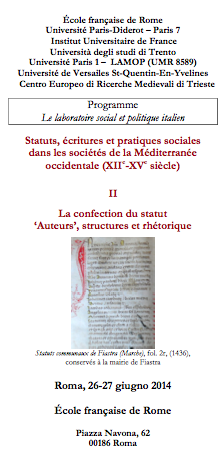
Colloque – Statuts, écritures et pratiques sociales dans les sociétés de la Méditerranée occidentale (XIIe -XVe siècle). II : La confection du statut ‘Auteurs’, structures et rhétorique

Ce second colloque, toujours centré sur l’Italie communale et l’espace du Midi français, voudrait porter une réflexion sur la manière dont un statut est construit en s’intéressant aux « auteurs » de la norme, à la rhétorique et à l’écriture utilisées lors de sa confection et à sa structure.

Pour étudier l’écriture et la rhétorique des statuts, nous nous intéresserons d’abord aux préambules (qui permettent parfois de connaître ou de deviner les motivations qui ont présidé à l’élaboration ou à la révision d’un statut) et aux protocoles finaux (signa, autorités, mode de diffusion, etc). Nous tenterons ensuite de cerner tous les individus ou les groupes qui, à un moment où à un autre, sont intervenus dans le processus d’élaboration des statuts, de celui ou de ceux qui décide(nt) à celui ou ceux qui met(tent) par écrit. Une attention particulière sera portée à ceux qui détiennent le pouvoir de l’écrit (statutarii, juris periti, doctores legum, notaires, notables de la communauté, etc) pour connaître leur formation, leur origine géographique, leur degré de participation à l’élaboration des corpus statutaires, leur rôle dans la validation, l’authentification, la conservation et la diffusion des statuts. On voudrait finalement aboutir à une typologie des acteurs au sein d’un processus d’écriture des textes.

Enfin, il conviendra de mieux comprendre la structure générale du statut : division ou non en livres, nombre et ordre des livres, nombre et ordre des rubriques, outils péritextuels, place qu’occupent les additiones, etc.

Programme : ici

EFR - DIdier LettInformations pratiques :
Roma, 26-27 giugno 2014
École française de Rome
Piazza Navona, 62 00186 Roma

Organisation scientifique
Didier Lett (Université Paris-Diderot, IUF)

Contacts :
École française de Rome
Stéphane Gioanni
Directeur des études médiévales
Grazia Perrino

Secrétariat des études médiévales
Piazza Farnese, 67 – 00186 Roma
Tél. (+39) 06 68 60 12 48 – secrma@efrome.it

Source de l’information : LAMOP

Publié dans Colloque | Laisser un commentaire

Colloque – Seventh International Conference on the Medieval Chronicle

The Liverpool Centre for Medieval and Renaissance Studies at The University of Liverpool is delighted to announce that the Seventh International Conference on the Medieval Chronicle will take place at the University of Liverpool, from Monday, 7 to Thursday, 10 July 2014.

medieval-chronicle-banner-800-650x130The aim of the seventh conference is to follow the broad outline of the previous six conferences, allowing scholars who work on different aspects of the medieval chronicle (historical, literary, art-historical) to meet, announce new findings and projects, present new methodologies, and discuss the prospects for collaborative research.
Keynote speakers include:

  • Professor Anne D Hedeman (University of Kansas)
  • Professor Marcus G Bull (University of North Carolina, Chapel Hill)
  • Professor Christopher Young and Dr Mark Chinca (University of Cambridge)

We are very happy to accommodate any delegates who wish to combine attendance at our conference with a visit to Leeds International Medieval Congress, which also takes place between 7 to 10 July 2014. Please see our Call for Papers page for more details.

Programme : here

Informations pratiques : here

Source de l’information : medievalchronicle.org

Publié dans Colloque | Laisser un commentaire