Conférence – Nelly Labere, "La norme dans les collections littéraires pré-modernes"

Le mercredi 2 avril 2014, Nelly Labere, maître de conférences à l’Université Montaigne Bordeaux 3, présentera une communication intitulée La norme dans les collections littéraires pré-modernes. Cette conférence sera organisée par le Centre belge d’études bourguignonnes et se tiendra à l’Université catholique de Louvain (UCL), Louvain-la-Neuve.

Contact :
Prof. Éric Bousmar (Université Saint-Louis – Bruxelles) : bousmar@fusl.ac.be
Prof. Jean-Marie Yante (Université catholique de Louvain) : jean-marie.yante@uclouvain.be
Présentation générale du Centre : cliquez ici
Site du Centre européen d’études bourguignonnes : cliquez ici

Source de l’information : CRHIDI
Publié dans Colloque | Laisser un commentaire

Offre d’emploi – University Lectureship in Early Ottoman History, c. 1300-c.1800. University of Cambridge, Faculty of History

Salary: £37,756-£47,787
Reference: JJ02030
Closing date: 02 April 2014

Applications are invited for a University Lectureship in Early Ottoman History (c.1300-c.1800). The successful candidate will be part of a lively and intellectually stimulating research community in Early Modern History, which performs to the highest international levels in research and publications, and will have access to the excellent research facilities which Cambridge offers, in particular through the Skilliter Centre for Ottoman Studies. The post is available from 1 October 2014, or as soon as possible thereafter.

The appointee must hold a PhD (or equivalent) and will be an outstanding scholar and teacher in their field. Research of international standing will be expected. The Faculty welcomes both early career scholars and those who already have established careers. The post-holder will be encouraged to build collaborative research programmes as well as to conduct their individual research. He or she will teach at all levels from undergraduate to PhD and will be expected to examine at all levels, and to take a fair share of administration.

The annual pensionable stipend for a Lecturer is on a scale from £37,756 to £47,787 with the possibility of market supplementation where appropriate. Appointments will be for a probationary period of 5 years with appointment to the retiring age thereafter, subject to satisfactory performance. The Lecturer will be based in central Cambridge.

This appointment is subject to a health assessment. Whether an outcome is satisfactory will be determined by the University.

Further particulars and application forms for the post can be downloaded from the Faculty’s website (http://www.hist.cam.ac.uk/jobs) or may be obtained from the Secretary of the Appointments Committee, Faculty of History, West Road, Cambridge CB3 9EF (telephone number 01223 335350, e-mail: jobs@hist.cam.ac.uk), to whom completed applications (comprising a cover letter, CHRIS/6 form, CV and writing sample) should be e-mailed by 5.00pm on Wednesday 2 April, 2014.

Informal enquiries may be made either to the Chair of the Faculty, Professor David Reynolds (histchr@hermes.cam.ac.uk), or to the Faculty’s HR Clerk, Mrs Joanne Pearson (e-mail: jobs@hist.cam.ac.uk, telephone: 01223 335350).

Please quote reference JJ02030 on your application and in any correspondence about this vacancy.
The University values diversity and is committed to equality of opportunity.
The University has a responsibility to ensure that all employees are eligible to live and work in the UK.

Source de l’information : Medieval Art Research
Publié dans Offre d'emploi | Laisser un commentaire

Offres d’emploi – Five positions in the Graduate School within the interdisciplinary Cluster of Excellence “Religion and Politics in Pre-Modern and Modern Cultures” at the Westfälische Wilhelms-Universität Münster – University of Münster, Germany

An exciting opportunity exists for potential PhD students to fill up to five positions by October 1, 2014 in the Graduate School within the interdisciplinary Cluster of Excellence “Religion and Politics in Pre-Modern and Modern Cultures” at the Westfälische Wilhelms-Universität Münster – University of Münster, Germany. The Cluster involves a large number of academics from the areas of History, Catholic and Protestant Theology, Jurisprudence, Islamic Studies, Islamic Theology, Jewish Studies, Philosophy, Philology, Ethnology, Egyptology, Political Science, and the Sociology of Religion. Projects in the Cluster of Excellence are grouped around four themes: Normativity, Mediality, Integration, and Violence. Further information about the research areas of the Cluster of Excellence can be found at: www.religion-und-politik.de/en/forschung/forschungsfelder.

Each of these positions is half an E13 TV-L position (approximately € 1.100 net salary per month, including health insurance). Initially the positions are available for two years, with an extension of up to one year possible. Besides from working on their own projects, PhD students are expected to participate in the planning and organization of at least one conference or workshop. These workshops or conferences are expected to cover such areas as theory, methods, and the interpretation of source material. PhD students will also participate in the Cluster of Excellence’s Doctoral Studies Programme. Information about the Graduate School and its study program can be found at: www.religion-und-politik.de/en/graduiertenschule.

We are seeking students who have demonstrated exceptional ability in the Humanities, Cultural Studies, Social Sciences, Law/Jurisprudence, or Theology/Religious Studies. Furthermore we are particularly interested in attracting students who have demonstrated high competence in interdisciplinary studies, have proven their ability to communicate their research to a variety of forums, and have the potential to establish themselves in international arenas. In order to facilitate communication and collaboration within the Graduate School, applicants who are not proficient in German will be encouraged to attend German language courses. Applicants are kindly requested to provide a five page description of their intended project (including a bibliography). It is expected that the project will complement the research aims and also one or more of the research areas of the Cluster of Excellence. All doctoral projects will be supervised by Cluster professors. 

The University of Münster is an equal opportunity employer and is committed to increasing the proportion of women academics. Consequently, we actively encourage applications by women. Female candidates with equivalent qualifications and academic achievements will be preferentially considered within the framework of the legal possibilities. We also welcome applications from candidates with severe disabilities. Disabled candidates with equivalent qualifications will be preferentially considered.

Please send your application (including cover letter, CV, copies of transcripts, a project description, and two academic references) by April 15, 2014 to the Speaker of the Cluster of Excellence, Prof. Dr. Barbara Stollberg-Rilinger, preferably by email (with an attached PDF file):

Prof. Dr. Barbara Stollberg-Rilinger
Westfälische Wilhelms-Universität Münster
Cluster of Excellence “Religion and Politics in Pre-Modern and Modern Cultures“
D–48143 Münster, Germany

Please direct any further enquiries to the coordinator of the Graduate School, Robert Spät (exc.graduiertenschule@uni-muenster.de).
Publié dans Offre d'emploi | Laisser un commentaire

Appel à contribution – Les couvertures monumentales au Moyen Âge entre Loire et Meuse : images et techniques

C’est en 2008 que les travaux sur les parties romanes, nef et transept, ont débuté à la cathédrale de Tournai. Cette opération a consisté en la restauration des murs extérieurs, suivie par le rétablissement des toitures en plomb comme à l’origine au Moyen Age. Aujourd’hui, l’achèvement des travaux sur la nef offre désormais une image renouvelée de la Cathédrale pour les habitants et ses visiteurs.
Ce changement significatif est l’occasion de se pencher plus attentivement sur les couvertures qui protégeaient les monuments au Moyen Age, et ce d’autant plus que des études récentes renouvellent la connaissance de celles-ci.
Afin de faire le point sur les avancées réalisées dans la connaissance des couvertures médiévales, le Département du Patrimoine organise une rencontre internationale sur la thématique suivante : la toiture, ses contraintes et ses effets
  • Les formes données aux toitures, et leur symbolique
  • La visibilité de ces couvertures dans leur contexte
  • Le décor, son importance passée, ses matériaux et techniques
  • Iconographie, littérature et symbolique
  • Les matériaux de couverture ; mise en forme et mise en œuvre
  • Les contraintes que la couverture pose sur la conception du monument
  • La gestion des eaux pluviales et ses conséquences sur l’humidité interne des édifices, les ventilations et les circulations dans les parties hautes des édifices.
  • L’approche du 19e siècle dans la restauration des couvertures métalliques médiévales
  • Études de cas
Organisation scientifique :
Direction du Patrimoine du Service public de Wallonie, Namur (DGO4)
Centre européen d’Archéométrie, Université de Liège
Organisation pratique :
Agence intercommunale de Développement IDETA, Tournai
Comité scientifique :
Vincent Brunelle (Architecte en chef de Monuments historiques)
Stéphanie Diane Daussy (Archéométrie et Archéologie, Lyon 2)
Laurent Deléhouzée (DGO4)
Françoise Duperroy (DGO4)
Frédéric Epaud (CNRS, Université de Tours)
Patrick Hoffsummer (Centre européen d’Archéométrie, Liège)
Pierre Paquet (DGO4)
Frédérique Pécriaux (Province de Hainaut)
Jacques Pycke (Université catholique de Louvain)
Nicolas Reveyron (Université de Lyon 2)
Comité organisateur :
Françoise Duperroy (DGO4)
Patrick Hoffsummer (Centre européen d’Archéométrie, Liège)
Frédéric Banse (IDETA)
Modalités de soumission :
Propositions de communication, titre et résumé (de 15 à 30 lignes maximum), à renvoyer avec un bref CV (maximum 2 pages, avec les coordonnées complètes de l’auteur), en format Word et en attachement avant le 4 avril 2014 à l’adresse électronique : yves.felix.desmet@spw.wallonie.be
Les communications, d’une durée maximale de 20 à 25 minutes, pourront être présentées en français, néerlandais ou anglais.
Les propositions de communication seront examinées par le comité scientifique dans le mois qui suit. Les propositions qui n’auront pas été retenues par le comité pourront toutefois être présentées par leurs auteurs sous la forme de posters sur les lieux du colloque.
Les frais de transport, de séjour et de logement des intervenants extérieurs au Tournaisis seront pris en charge par les organisateurs.
Source de l’information : Calenda
Publié dans Appel à contributions | Laisser un commentaire

Colloque – Religion et interdits alimentaires : archéozoologie et sources littéraires

La confrontation des sources littéraires et des données archéologiques s’avère importante pour essayer de comprendre tout à la fois la mise en place des interdits alimentaires particuliers à une religion, les limites de la mise en pratique des interdits alimentaires et leur évolution dans le temps. Les interdits alimentaires et les restrictions sur la commensalité permettent à différents groupes religieux d’établir une frontière entre « eux » et « nous ». Il existe donc un corpus de textes normatifs appartenant aux droits religieux et civils interdisant la consommation d’aliments particuliers. Cet aspect a été souvent étudié pour le judaïsme ou l’islam, moins souvent pour les polythéismes, le zoroastrisme ou le christianisme. Nous espérons présenter la littérature normative et faire réfléchir sur les limites de sa mise en application, tout en s’appuyant sur l’archéozoologie qui peut fournir des données sur le décalage entre norme et pratique.
Programme :
Jeudi 3 Avril 2014
09:00-09:30 : Accueil des participants
Ouverture de la conférence : Béatrice Caseau & Hervé Monchot
Directeur du Labex Resmed : Jean-Claude Cheynet
Session 1 : Historiographie et approche chronologique large 
09:30-10:00 :  Bruno LAURIOUX (Université de Versailles Saint-Quentin en Yvelines) – Interdits, interdictions et prescriptions alimentaires dans le Moyen Âge occidental : état de la question
10:00-10:30 : Jean-Baptiste HUMBERT (EBAF, École Biblique et Archéologique Française à Jérusalem) – Des mosquées, des images et du vin.
10:30-11:00 : Pause café
11:00-11:30 : Agnès NAGY (Université de Genève) – Le Cannibale, ce monstre fascinant. Accusations d’anthropophagie de la Grèce antique à l’Europe chrétienne
11:30-12:00 : Sylvain LETEUX (IRIS-Université Lille 3) – État des lieux sur l’hippophagie et les trois grandes religions abrahamiques.
12:00-12:30 : Discussion
12:30-14:00 : Pause déjeuner
Session 2 : Religions aux âges du Bronze et du Fer
14:00-14:30 : Jean-Denis VIGNE (Sorbonne Universités, MNHN, UMR 7209) – Existait-il des interdits alimentaires au Néolithique ?
14:30-15:00 : Emmanuelle VILA (UMR 5133-Archéorient – MOM Lyon) – Rites sacrificiels en Mésopotamie à l’Age du Bronze.
15:00-15h30 : François POPLIN (Sorbonne Universités, MNHN, UMR 7209) – Le vin, le fromage, le chevreau et le lait de sa mère.
15:30-16:00 : Discussion
16:00-16:30 : Pause café
Session 3 : Polythéisme : Égypte et médecine grecque
16:30-17:00 : Louis CHAIX (Université et Muséum d’Histoire naturelle de Genève) – Prêtres et artisans à Karnak (Egypte) : interdits généraux ou temporaires, un cas d’étude.
17:00-17:30 : Youri VOLOKHINE (Université de Genève) – Le mouton en Égypte ancienne. 
17:30-18:00 : John WILKINS (University of Exeter) – Médecine grecque et romaine.
Vendredi 4 Avril 2014
Session 4 : Grèce antique, Judaïsme, & Zoroastrisme
09:00-09:30 : Andréa FESI (Sorbonne Universités, Université Paris-Sorbonne, UMR 8167) – Les interdits alimentaires chez les pythagoriciens : le pythagorisme des « carnivores » et des « végétariens ».
09:30-10:00 : Katerina TRANTALIDOU (Greek Ministry of Culture, Ephorate of Palaeoanthropology-Speleology) – Sacrifice et banquet dans le monde grec. Repères ostéoarchéologiques. 
10:00-10:30 : Misgav HAR-PELED (Bar Ilan university) – Entre le bœuf laboureur et le cochon paresseux : justification du sacrifie animal dans le monde gréco-romain et l’interdit juif du porc.
10:30-11:00 :  Pause café
11:00-11:30 : Emmanuel FRIEDHEIM (Bar Ilan university) – La société juive en Palestine romaine face aux interdits alimentaires.
11:30-12:00 : Touraj DARYAEE (University of California- Irvine) – Eating Meat: The Sin of Zoroastrian Primordial Heroes and Villains.
12:00-12:30 : Samra AZARNOUCHE (Labex HASTEC, UMR 8546) – La table des Mages : prescriptions alimentaires dans le Zoroastrisme de l’Antiquité tardive 
12:30-13:00 : Discussion
13:00-14:30 : Pause déjeuner
Session 5 : Christianisme
14:00-15:00 : Emmanuelle RAGA (Cambridge/Bruxelles) – Interdire la viande à la table monastique. Bricolage normatif et application concrète entre Antiquité tardive et haut Moyen Âge.
15:00-15:30 : Béatrice CASEAU (Sorbonne Universités, Université Paris-Sorbonne, UMR 8167, RESMED) – Les offrandes alimentaires refusées à l’autel dans les églises chrétiennes (antiquité tardive)
15:30-16:00 : Jacopo DE GROSSI MAZZORIN (Université de Salento) – Different diet and consumption by various Monastic Orders in Italy.
16:00-16:30 :  Pause café
16:30-17:00 : Eva WIPSZYCKA (Varsovie) – L’observance des interdits alimentaires dans le milieu monastique d’Égypte, IVe-VIIIe siècle
17:00-17:30 : Benoit CLAVEL & Sébastien LEPETZ (Sorbonne Universités, MNHN, UMR 7209)  – Entre Antiquité et Moyen âge : ce que disent vraiment les os de la consommation du cheval, du chien et du chat en France du nord.
17:30-18:00 : Joanita VROOM (Leiden University) – Food taboo or not food taboo, that is the question: Changing cooking pots in south-eastern Turkey and northern Syria.
Samedi 5 Avril 2014
Session 6 : Islam
09:00-09:30 : Mohammed Hocine BENKHEIRA (HPESS, Paris) – Les interdits alimentaires en islam : un aperçu général.
09:30-10:00 : Tarek OUESLATI (HALMA-IPEL) – Approche comparative de l’alimentation carnée à l’époque Omeyyade entre littoral islamisé et Montagne chrétienne.
10:00-10:30 : Marjan MASHKOUR (Sorbonne Universités, MNHN, UMR 7209) & Hervé MONCHOT (Sorbonne Universités, Labex Resmed) – Le dromadaire de l’âge du feraux périodes islamiques, du rituel à la consommation.
10:30-11:00 : Pause café
11:00-11:30 : Marianne BRISVILLE (UMR 5648-CIHAM, Université-Lyon II) – Préparer et consommer la viande dans l’Occident musulman au Moyen Age (XIIe-XVe siècle).
11:30-12:00 : Phidae SEFROUI (Université Paris-Sorbonne) – Visite de monastères et consommation du vin dans la poésie musulmane du haut Moyen âge
12:30 – 13:00 : Discussion et clôture de la conférence
Informations pratiques :
Organisation :
Béatrice Caseau
Hervé Monchot
Université Paris-Sorbonne – Labex RESMED
UMR 8167 « Orient & Méditerranée » 
52 rue du Cardinal Lemoine 
Paris, France (75005)
3-5 avril 2014
Source de l’information : Calenda
Publié dans Colloque | Laisser un commentaire

Appel à contribution – The Art of Ritual. Object, Image and Space in Medieval and Early Modern Europe

The Art of Ritual: Object, Image and Space in Medieval and Early Modern Europe
Saturday 17 May 2014, Senate House, London, UK

This conference is organized by three Junior Fellows of the Institute of Historical Research from diverse scholarly backgrounds: Dhwani Patel (KCL), Wendy Sepponen (University of Michigan) and Jo Edge (RHUL). It will bring together two fields of research – the material and the ceremonial – that are intimately connected but rarely explored together in a conference setting.

The Art of Ritual aims to bring focus to how material culture and art (broadly defined) fits into and shapes ritual, and will be organized into three principal thematic strands. The first is art that influenced ritual, for example space and site specificity, or the importance and history of a particular place, site or space in connection with ritual. The second is art that reflected ritual, for example representations of processions. The final strand concerns objects and images that functioned as an integral part of ritual, for example relics and magical diagrams.

This conference will have a broad chronological, disciplinary and geographic scope, drawing from art historians, historians, and archaeologists from the late antique to early modern periods. Speakers including Achim Timmermann (University of Michigan), Sophie Page (UCL), Zoe Opacic (Birkbeck), Tom Nickson (The Courtauld Institute) and Natalia Petrovskaia (University of Cambridge) are already confirmed to speak. They will share approaches and experiences that will allow postgraduates in attendance to develop skills in the examination of a wide range of evidence relating to material culture and ritual practice.

There is space for two PhD presenters to give 30 minute papers on any aspect of art, in its broadest definition, and its connection to ritual in the medieval or early modern period. An abstract of no more than 200 words should be sent to artofritualconference@gmail.com by 31 March 2014.

Source de l’information : Medieval Art Research
Publié dans Appel à contributions | Laisser un commentaire

Colloque : Textilien & Inventare (Vienna, 27-28 March 2014)

WORKSHOP 
Inventories of Textiles – Textiles in Inventories (Late Medieval and Early Modern Period)

PROGRAM
March 27 (Late Middle Ages)
CHAIR: Thomas Ertl
14h00 : Opening Remarks

14h15 : Christiane M. Elster – Inventories and Textiles of the Papal Treasury around 1300. Concepts of Papal Representation in written and material media

15h00 : Sarah-Grace Heller – Revisiting the Inventories of Artois: Mahaut and the Line between Treasure and Fashion

15h45 : Break

16h15 : Sharon Farmer – Finding Parisian Silk in Aristocratic and Royal Accounts

17h00 : Lisa Monnas – Reading English Royal Inventories: the Inventory of Henry V (1423)

March 28 Morning (Early Modern Period I)
CHAIR: Barbara Karl

9h30 : Annemarie Stauffer – A List of Garments for Charles the Bolds Entourage Sent to Tommaso Portinari in Bruges in 1473

10h15: Richard Stapleford – The Fabric of Life in the 1492 Inventory of the Estate of Lorenzo de’ Medici

11h00 : Break

11h30 : Jessica Hallett – All His Worldly Possession, Textiles in the Inventory of the Fifth Duke of Braganza, 1563

12h15 : Paula Hohti – European Influences on Scandinavian Noble Dress: Textiles and Clothing in the Surviving Inventories in Finland, 1550-1600

March 28 Afternoon (Early Modern Period II)
CHAIR: Corinne Thepaut- Cabasset

14h00 : Chiara Buss – A “Book of Foreign Samples” Dated 1628 from the State Archives in Milan

14h45 : Burkhard Pöttler – Clothes and Cloths in Styrian Probate Inventories of the Late 17th and 18th Centuries

Break : 15h30

16h15 : Hedda Reindl-Kiel – The Empire of Fabrics – The Range of Fabrics in Internal Ottoman Gift Traffic and Textiles as Ottoman Diplomatic Gifts (16th-18th Centuries)

17h00 : Kim Siebenhüner & Gabi Schopf & John Jordan – Cottons and Indiennes in Early Modern Swiss Inventories

17h45 : Concluding Discussion

The workshop is a joint initiative of MAK (Museum für angewandte Kunst, Wien) and WISO (Department of Economic and Social History, University of Vienna). Guests are most welcome. All presentations will be given in English. For further information please contact:
Prof. Thomas Ertl
Department of Economic and Social History
University of Vienna
Universitätsring 1, 1010 Wien, Austria

Dr. Barbara Karl
Curator of Textiles and Carpets
MAK – Museum für angewandte Kunst
Stubenring 5, 1010 Wien

Source de l’information : Medieval Art Research
Publié dans Colloque | Laisser un commentaire

Appel à contribution – Debating Visual Knowledge

A symposium organized by graduate students in Information Science and History of Art and Architecture
Pittsburgh, PA, University of Pittsburgh, October 3 – 05, 2014

Deadline-CFP: 11 avr. 2014


Call for Participants

Visual knowledge and visual literacy have become pressing concerns across a variety of academic disciplines and areas of creative production. These concerns are shaped by the fluid definitions of “visual knowledge” and the multiple ways in which it manifests. Many forms of visual knowledge have capabilities that are not shared by language. This knowledge is produced, mediated, and distributed by a number of different objects, tools, media, and technologies. This symposium seeks to broaden understandings of intellectual and creative work by interrogating the theorization, production, use, and historicization of visual knowledge. We envision the event as an exploratory lab, comprising scholarly and creative projects that engage with these questions.

Presentations might relate to (but are not limited to) topics such as:
  • Digital humanities
  • Cognition, intellectual history, interpretation
  • Photography, printmaking, engraving
  • “The spatial turn,” GIS, maps, mapping
  • The body, performance
  • Data visualizations, modeling, categories and groups
  • Law and policy
  • Media theory, historiography, ecology
  • Exhibition design, curating
  • Network analysis, grids, graphs, timelines
  • Interfaces, constructed/built environments, design
  • Astronomy, physics, mathematics, botany, medicine

The symposium will include traditional academic papers, posters, and keynote sessions, as well as presentations of creative works, roundtables, praxis sessions, screenings, and performances. Participants may be invited to take part in curated roundtables, seminars or workshops. We also welcome submissions of projects that could be workshopped or collaborated on in the context of the symposium.
Submission Guidelines:
  • For a paper, please submit a 300-word abstract for a 20-minute talk, and a CV.
  • For a poster, please submit a 300-word abstract and a CV. A sketch of your poster is optional. If selected, posters must be printed and provided by the participants, and can be up to 30” x 40”.
  • For a creative work, please submit up to 10 images and/or a 2-minute video or sound clip, a 300-word project description, and a CV.
  • For a pre-constituted panel of up to four papers, please submit a 300-word abstract describing the panel topic, and a 150-word abstract and author’s CV for each proposed paper.
  • To propose to lead a roundtable, seminar, or praxis session, please submit a 300-word description of the topic and CVs for all proposed participants. You may also propose a topic without having chosen participants.

If you have any questions about possible submissions or formats for submissions, please contact us at debatingvisualknowledge@gmail.com.
Send submissions to debatingvisualknowledge@gmail.com by April 11, 2014. Selected participants will be notified by mid-May.
Information Studies : www.ischool.pitt.edu

History of Art and Architecture : www.haa.pitt.edu

Source de l’information : ArtHist
Publié dans Appel à contributions | Laisser un commentaire

Offre d’emploi – The Patricia Fleming Visiting Fellowship in Bibliography and Book History

The Faculty of Information at the University of Toronto is pleased to offer the Patricia Fleming Visiting Fellowship in Bibliography and Book History.

This fellowship was created in 2005 to honour Professor Fleming on the occasion of her retirement from the Faculty of Information. Faculty members, staff, friends, former students, and colleagues raised the necessary funds to establish it.

About the award:
Awarded to a scholar outside the University of Toronto, who works in the field of bibliographical studies or book history, for research to be conducted during 2014–15.

Award amount is $2,000, along with University of Toronto library privileges, and office space at the Faculty of Information, for the duration of the fellowship

Recipient will conduct research for up to one month at Toronto libraries and/or archives

Recipients can do a research project anytime within the calendar year, however, the preferred time to take up the award is during the regular academic terms (September–November or January to March). This would allow the recipient to visit classes offered by the Book History and Print Culture collaborative program, as well as other relevant classes offered by the Faculty of Information.
A brief report must be submitted upon completion of the fellowship

Recipient may also give an informal talk at the Faculty of Information that relates to their research

They may participate in the Collaborative Program in Book History and Print Culture

Value:
$2,000 stipend, effective 2014, derived from annual interest from the previous two (2) years’ income. All access library card from University of Toronto Libraries (UTL)

Timing & Frequency:
Effective 2012, the award will be offered on a bi-annual basis. Next award will be offered in 2014.

Research interests: 
Alternates between Canadiana and non-Canadiana. Research interest for 2014 is open, however, preference may be given to Non-Canadiana research.

Application procedure:
Applicants are asked to submit:
  • a resume,
  • two confidential letters of recommendation, and
  • a 1-2 page research proposal describing the project and the importance of the library or archival collection(s) in Toronto where the research will be conducted.
  • the proposed timing of fellowship.

Awarding body:
Specially selected committee, the “Fleming Bibliography and Book History Fellowship Awards Committee,” to include representative from U of T Libraries, Information Registrar, and Director of Book History and Print Culture Collaborative Program and may include other members designated by the Committee.

Selection of candidates:
In addition, the Committee will consider:
  • The applicant’s ability to complete the project based on the documentation submitted, and the project’s timeline in relation to other proposals received.
  • Stipend is dependent on annual endowment income earned, but should be $2,000, to cover travel, living and research expenses.
  • The recipient’s name will be added to a wall plaque honouring both Prof. Fleming and successful fellows.

Deadline for application:
Required. Deadline for 2014 award will be March 31, 2014

Applications should be sent to:
Bibliography and Book History Fellowship Awards Committee
c/o Adriana Rossini, Registrar
Faculty of Information, University of Toronto
Room 211- 140 St. George Street, Toronto, ON M5S 3G6 Canada

Electronic submissions are encouraged and should be sent to: adriana.rossini@utoronto.ca

Fellowship contributions:

The account is open for additional donations. If you wish to contribute, please visit the University’s Donations website. You will need to specify that you want your donation to go to the Patricia Fleming Fellowship. Tax receipts will be issued to fund contributors. Your support is appreciated.

Source de l’information : University of Toronto
Publié dans Offre d'emploi | Laisser un commentaire

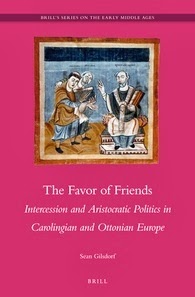
Publication – Sean Gilsdorf,"The Favor of Friends. Intercession and Aristocratic Politics in Carolingian and Ottonian Europe"

The Favor of Friends offers the first book-length exploration of intercession—aid and advocacy by one individual or group in behalf of another—within early medieval aristocratic societies. Drawing upon a variety of disciplines and historiographical traditions, Sean Gilsdorf demonstrates how this process operated, and how it was ideologically elaborated, in Carolingian and Ottonian Europe, allowing individuals and groups to leverage their own, limited interpersonal networks to the fullest, produce new relationships, gain access to previously closed spaces, and generate interest in their agendas from those able to effect change. The Favor of Friends enriches our understanding of early medieval politics and rulership, offering a model of political interaction in which hierarchy and comity do not stand in ideological and pragmatic tension, but instead work in integrated and mutually-reinforcing ways.

Sean Gilsdorf (Ph.D. University of Chicago, 2007) is Lecturer in History and Literature at Harvard University and Visiting Assistant Professor in History at Mt. Holyoke College. He is the author of Queenship and Sanctity (Catholic University Press, 2004).
Table des matières :

Figures and Tables
Acknowledgments
List of Abbreviations

Chapter 1: Understanding Intercession Sources and Approaches
Chapter 2: Courting Intercession Amici, Allies, and Advocacy
Chapter 3: Making Intercession Companions, Kin, and Consorts
Chapter 4: Embodying Intercession The Mediatory Politics of the Episcopacy
Chapter 5: The End(s) of Intercession Consolidations and Conclusions

Appendix 1: Diplomatic intercession, Conrad I to Conrad II (911-1039)
Appendix 2: Excluded diplomata, Conrad I to Conrad II

Bibliography

Index

Informations pratiques :
Sean Gilsdorf, The Favor of Friends. Intercession and Aristocratic Politics in Carolingian and Ottonian Europe, Leyde, Brill, 2014 (Brill’s Series on the Early Middle Ages, 23). 224 p. ISBN : 9789004264588. Prix : 104,00 euros.

Source de l’information : Brill
Publié dans Publications | Laisser un commentaire