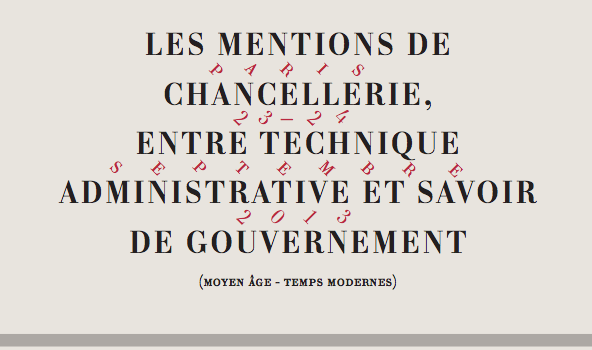
Colloque – Les mentions de chancellerie, entre technique administrative et savoir de gouvernement (Moyen Âge – Temps Modernes)

organisé par l’École nationale des chartes (centre Jean-Mabillon), les Archives nationales et le LAMOP (université Paris 1 Panthéon-Sorbonne).


Paris, 23-24 septembre 2013


Ce colloque est organisé avec le soutien du Labex HASTEC et du GDR Diplomatique du CNRS.
Il se déroulera les 23 et 24 septembre 2013 :
  • 23 septembre, à l’École nationale des chartes, au 19, rue de la Sorbonne, à Paris (Ve)
  • 24 septembre, aux Archives nationales, au 60, rue des Francs Bourgeois, à Paris (IIIe)
Les communications seront réparties en cinq sessions : 
– Pratiques et modèles royaux
– Chancelleries pontificale et cardinalices
– Les processus de diffusion (I) : Les juridictions locales françaises
– Les processus de diffusion (II) : Les principautés face au modèle souverain ?
– Devenirs modernes

Les mentions de chancellerie sont de brèves notes portées au bas des actes de chancellerie médiévaux par les différents services en charge de leur élaboration. Il s’agit là d’une technique de gestion de l’écrit qui recèle des enjeux pratiques et symboliques, que le présent colloque entend explorer dans une perspective comparée, en diachronie et en synchronie. On vise en particulier à définir les conditions dans lesquelles s’est constituée cette technique administrative, en étudiant sa genèse, sa diffusion et son érection en savoir, ainsi que les compétences individuelles mises en jeu par ces phénomènes. Il s’agira également d’explorer la transformation progressive de cette technique en un outil par lequel l’autorité émettrice représente son pouvoir, et de déterminer les modalités d’une transformation qui a conduit les mentions de chancellerie à devenir un enjeu politique.

Programme complet : ici


Contact : Olivier Canteaut (olivier.canteaut (at) enc.sorbonne.fr)
Publié dans Colloque | Laisser un commentaire

Offre d’emploi – 100% praktijkassistent KU Leuven

Voor Middeleeuwen zoeken wij een voltijdse praktijkassistent die inhoudelijke, didactische en organisatorische ondersteuning biedt van het onderwijs verzorgd door deze onderzoeksgroep.

Prakijkassistent Onderzoeksgroep Geschiedenis Middeleeuwen
De Onderzoeksgroep Geschiedenis van de Middeleeuwen is een onderdeel van de onderzoekseenheid Geschiedenis en ze bestudeert de westerse middeleeuwen vanaf de late oudheid tot de overgang naar de Nieuwe Tijd. De klemtonen van onderzoek en onderwijs liggen op de interactie tussen Kerk en samenleving enerzijds, en stadsgeschiedenis anderzijds. Op geografisch vlak ligt de klemtoon op de Zuidelijke Nederlanden en de wisselwerking met de omliggende gebieden. Actuele onderzoekstopics hebben vooral betrekking op de autoriteit van de bisschoppen en de betekenis van hervormingen in de Kerk tijdens de centrale middeleeuwen, op laatmiddeleeuwse religieuze praktijken en volksdevotie, en op de sociale en politieke geschiedenis van de laatmiddeleeuwse stad.

Functie
  • didactische voorbereiding en ondersteuning van de verschillende onderdelen binnen de ‘historische ateliers’ die door de OG Middeleeuwen aangeboden worden, met name ‘Initiatie in de historische praktijk: oefeningen Middeleeuwen’ (F0LC1A), ‘Onderzoeksmethoden Middeleeuwen’ (F0LG7A), ‘Oefening Middeleeuwen’ (F0LH7B), ‘Paleografie’ (F0LD0A), alsook coördinatie van de groepen voor de bachelorpaper en praktische organisatie van het seminarie masterproef, verbetering van tussentijdse taken en examenopdrachten
  • optreden als contactpersoon voor studenten, docenten, administratie en overlegorganen (POC, bibliotheek e.d.)
  • externe communicatie en ondersteuning bij organisatie vergaderingen, onderzoeksseminaries en colloquia van de onderzoeksgroep
  • onderhoud website OG Middeleeuwen

Profiel
  • Je behaalde een diploma Master in de Geschiedenis, afstudeerrichting Middeleeuwen (te behalen ten laatste in september 2013)
  • Je wil zelf bijdragen tot onderzoeksgerelateerd onderwijs en een goede onderwijsorganisatie
  • Je hebt zeer goede redactionele, organisatorische, didactische en communicatieve vaardigheden
  • Je bezit een goede kennis van het Engels en het Frans, zowel mondeling als schriftelijk

Aanbod
Aanstelling aan 100 % voor 1 jaar, verlengbaar tot max. 5 jaar

Interesse?
Meer informatie is te verkrijgen bij prof. dr. Brigitte Meijns, tel.: +3216324998, mail: brigitte.meijns@arts.kuleuven.be.
Solliciteren voor deze vacature kan tot en met 07/07/2013 via onze online sollicitatietoepassing

Source de l’information : Vlaamse Werkgroep Medëvistiek
Publié dans Offre d'emploi | Laisser un commentaire

Offres d’emploi – Offre de deux bourses doctorales et une post-doctorale, "Objets prémodernes. Une archéologie de l’exéprience", Université Ludwig Maximilian de Munich

Le Groupe de recherches international junior part du constat que la notion actuelle d’« objet » en tant que chose matérielle, limitée dans l’espace, et liée à une fonction, n’a été développée qu’avec la « modernité ».
Il se donne pour but de reconstituer des conceptions et des expériences historiquement liées aux objets, et étudie pour cela en particulier les relations entre objets, images et textes.
Outre le travail à un projet de recherche propre, les tâches concernent la participation aux projets scientifiques communs du groupe et à son administration. Il est possible d’enseigner.
Les thèses des doctorant(e)s sont dirigées en principe par le directeur du groupe de recherche (en histoire de l’art). Des champs de recherche possibles sont les images qui apparaissent sur les objets, ou la représentation d’objets dans les images. D’autres projets relevant d’une science historique des objets sont bienvenus.
Pour le poste de post-doctorant/e, un projet de recherche interdisciplinaire est souhaité.
Offre :
Trois postes de Collaborateurs/trices de recherche (2 doctorant/e/s, 1 post-doctorant/e) sont à pourvoir à l’Université-Ludwig-Maximilian de Munich dans le cadre du Groupe de Recherches international junior « OBJETS PRÉMODERNES. UNE ARCHÉOLOGIE DE L’EXPÉRIENCE » (Réseau d’élite de Bavière).
L’Université-Ludwig-Maximilian de Munich (LMU) est l’une des universités les plus renommées et les plus grandes d‘Allemagne.
  • Très bon diplôme de fin d’études ou thèse
  • Les langues de travail possibles sont l’allemand, l’anglais, le français et l’italien. L’anglais devrait être maîtrisé à un niveau académique adéquat ; pour l’allemand, des connaissances de base ainsi que la volonté d’un perfectionnement sont exigés ; une autre langue est souhaitée
  • Intérêt prononcé pour la recherche interdisciplinaire et pour l’enseignement
En outre pour le poste de post-doctorant/e :
  • Publications sur des thèmes pertinents
  • Familiarité avec les collaborations internationales
Les postes de doctorant/e/s sont limités à deux ans pour commencer, avec l’option d’une prolongation pour une année supplémentaire.
Le poste de post-doctorant/e est limité à un an pour commencer, avec l’option d’une prolongation pour une année supplémentaire.
Votre lieu de travail se trouve dans le centre de Munich et peut être rejoint facilement par les transports en commun. Nous vous proposons une activité intéressante et dotée de responsabilités, avec de bonnes possibilités de formation continue et de développement.
La possibilité d’une activité à temps partielle est donnée.
Les candidatures de personnes gravement handicapées seront préférées en présence d’aptitudes par ailleurs similaires pour l’essentiel.
Modalités de candidature :
Merci d’envoyer votre candidature comprenant:
  • Lettre de motivation indiquant deux référents (auprès desquels nous pourrons éventuellement prendre avis)
  • CV (liste de publications le cas échéant)
  • Projet de recherche (environ 5 pages soit 15.000 signes)
  • Résumé du dernier mémoire universitaire
  • Échantillon de texte publié ou tiré d’un mémoire (article ou chapitre)
  • Copies des documents pertinents (diplômes, etc.)
  • sous la forme d’un document PDF (5 MB maximum)
d’ici au 07 juillet 2013
par email avec pour objet « Candidature Groupe de Recherches » à l’adresse suivante : Philippe.Cordez@kunstgeschichte.uni-muenchen.de.
L’évaluation des candidatures sera assuré par le Directeur du groupe de recherche, Philippe Cordez.
3 Collaborateurs/trices de recherche (2 doctorant/e/s, 1 post-doctorant/e)
Conditions de rémunerations
Date d’embauche: 01/10/2013 (ou au plus tard le 01/12/2013)
Fin de la période de candidature: 07/07/2013
Échelon salarial: TV-L E13, 66% (Emploi, paiement et couverture sociale sont déterminés par la convention collective pour le secteur public: Tarifvertrag für den öffentlichen Dienst – TVöD)
Source de l’information : Calenda
Publié dans Offre d'emploi | Laisser un commentaire

Autumn School in Historical Languages 2013 – Old and Middle French and Medieval Latin (Universiteit Gent)

Ghent, 21 – 23 October 2013
This Autumn School is organized for MA and PhD-students in Medieval Studies (art history, history, philosophy, literature, music…) who are required to work with documents in medieval languages. By offering intensive courses in Old and Middle French and in Medieval Latin, the Autumn School wants to remedy the fact that instruction of historical languages is becoming rather marginalized at many universities, while familiarity with this linguistic heritage remains of prime importance to new generations of medieval scholars.
The Autumn School starts with two days of parallel courses in Old and Middle French and in Medieval Latin, taught by a leading expert in the field. These two days consist of both teaching sessions and of workshops in which students are trained to analyze primary texts. On the second afternoon, students are invited to work with primary texts from their own research in specialized workshops. On the third day of the course, a symposium is organized in which, for each language, four case studies will illustrate some recent approaches in research on medieval sources. In the space of three days, students will thus acquire a basic knowledge of either Old and Middle French or Medieval Latin as well the skills to implement this knowledge in their own research projects.
For the course in Old and Middle French, no previous knowledge is required, though a basic familiarity with modern French is deemed necessary. For the course on Medieval Latin, students need to have already a basic knowledge of (classical) Latin grammar and vocabulary. Both courses are delivered in English. Since both courses are taught at the same time, participants can enroll for only one language.
Teaching staff:
For Old and Middle French: Thelma Fenster (Fordham University, NY), with the collaboration of Alexander Roose and Jan Dumolyn (both from Ghent University)
For Medieval Latin: Justin Stover (University of Oxford) and Julian Yolles (Harvard University), with the collaboration of Frédéric Van Vosselen and Els De Paermentier (both from Ghent University)


MONDAY 21 OCTOBER 2013
Ghent, Blandijnberg 2, Faculty Room (110.009) and Meeting Room English (130.037)
PARALLEL SESSIONS FOR OLD AND MIDDLE FRENCH AND FOR MEDIEVAL LATIN
8.30 – 9.00: registration in Faculty Room 
9.00 – 10.45: session 1 
10.45 – 11.00: coffee break 
11.00 – 12.45: workshop 1
lunch
13.45 – 15.30: session 2 
15.30 – 15.45: coffee break 
15.45 – 17.30: workshop 2
TUESDAY 22 OCTOBER 2013
Ghent, Blandijnberg 2, Faculty Room (110.009) and Meeting Room English (130.037)
9.00 – 10.45: session 3 
10.45 – 11.00: coffee break 
11.00 – 12.45: workshop 3
lunch
13.45 – 15.30: session 4 (parallel sessions within each course: one for literary texts, one for administrative documents)
15.30 – 15.45: coffee break 
15.45 – 17.30: workshop 4 (parallel sessions within each course : one for literary texts, one for administrative documents)
WEDNESDAY 23 OCTOBER 2013
Ghent, Blandijnberg 2, Meeting Room English (130.037)
8.50 – 9.00: registration for new participants 
9.00 – 9.10: Welcome
SESSION on Medieval Latin
Chair: Els De Paermentier
9.10 – 9.50: Julian Yolles, Harvard University 
Latin literature in the Crusader States (1099-1187)
9.50 – 10.30: Wim Verbaal, Ghent University 
Latin Fiction
coffee break
10.50 – 11.30: Michele Campopiano, University of York
Cathedral of texts. Dealing with a twelfth century compilation and its textual transmission (Guido da Pisa, 1118-1119)
11.30 – 12.10: Jeroen Deploige, Ghent University and Mike Kestermont, University of Antwerp Stylometry Applied on Medieval Latin. An Analysis of Collaborative Authorship in the Twelfth Century
lunch (not provided by the organizers)
SESSION on Old and Medieval French
Chair: Jan Dumolyn
13.30 – 14.10: Christopher Fletcher, University of Paris I
How to explore the conceptual structures of later medieval Anglo-French texts using PALM and TXM? 
14.10 – 14.50: Jelle Koopmans, University of  Amsterdam 
What can administrative sources tell us, and what do they hide?
coffee break
15.10 – 15.50: Marie-Madeleine Castellani, University of Lille 3 
Rutebeuf’s translation of the life of Saint Elizabeth of Hungary
15.50 – 16.30: Godfried Croenen, University of Liverpool
Froissart, c’est un monde: Jean Froissart and the tradition of late medieval French prose chronicles
Each paper includes a presentation (30 min) and a discussion (10 min)
16.30 – 18.00: informal drinks reception
APPLICATION
The application deadline for the entire course (three days) is August 31, 2013. There will be a maximum of 20 partici- pants per language course. Applications should be sent to Martine.DeReu@UGent.be and must contain the following information: language course applied for, university where your MA or PhD will be obtained, mother tongue, level of English, level of French (for those applying for Old + Middle French), research topic for your master’s or doctoral thesis.
Interested students and scholars not enrolled in the course can attend the sessions on Wednesday for free; they are kindly asked to register before October 1, 2013 with Martine.DeReu@UGent.be.
ACCOMMODATION AND TRANSPORT
Participants need to provide for their own accommodation and transport. Useful information can be found on the following websites:
for accommodation:
for trains:
MEALS
Lunches on Monday and Tuesday will be organized by the H. Pirenne Institute for Medieval Studies. Evening meals and lunch on Wednesday are not provided by the organizers.
REGISTRATION FEE
There is a registration fee of 100 EUR for those who want to attend the entire course (three days). This fee is to be paid – after confirmation has been received of acceptance in the summer school – into the account of Ghent Univer- sity, Sint-Pietersnieuwstraat 25, B-9000 GHENT. Account details: IBAN: BE59-3900-9658-0026 – SWIFT: BBRU BE BB 900. The VAT-number of Ghent University is BE 0248.015.142. The bank transfer should mention “Historical Languages 2013”. Payment of this fee is considered as confirmation of registration.
The registration fee is waived for MA and PhD students from Ghent University, from the Onderzoeksschool Mediëvistiek (Netherlands) and from the University of Oxford. Students and scholars attending only the sessions on Wednesday are not required to pay a registration fee.
This project is organized by the Henri Pirenne Institute for Medieval Studies at Ghent University and funded by the Ghent Doctoral School for Arts, Humanities and Law, by the Dutch Research School for Medieval Studies, by the Society for the Study of Medieval Languages and Literature and by the Ghent educational project Internationalisation@home.
Organizing committee Jeroen Deploige (Ghent University, chair of the Henri Pirenne Institute for Medieval History) Helen Swift (University of Oxford, Faculty of Medieval and Modern Languages) Jan Dumolyn (Ghent University, Department of History) Wim Verbaal (Ghent University, Department of Literature) Maximiliaan Martens (Ghent University, Department of Art History) Martine De Reu (Ghent University, coordinator of the MA in Historical Linguistics and Literature)

All informations here

Publié dans École d'été, Enseignement | Laisser un commentaire

Offre d’emploi – PhD Scholarship in Palaeography and Manuscript Studies (King’s College London)

2013/14 PhD programme
Deadline for applications – 1st July 2013
 
To apply: CV with names of two referees, 600-word research proposal, academic transcript.

Applications are now being accepted for a PhD scholarship (value £24,500 to cover fees with the balance payable as a stipend in 12 equal monthly instalments; tenable for a three-year period) to be awarded competitively to a suitably qualified candidate. The applicant will be completing or have completed a Master’s level qualification, will have knowledge of Latin or at least one medieval language, and must have developed a research proposal relating to some aspect of medieval manuscripts and palaeography. Research students in King’s have access to advanced Latin and palaeography training, although it is expected that the successful candidate will have already gained experience of both disciplines.

London boasts unrivalled collections of Western manuscripts, in private as well as public hands, a large concentration of experts on medieval palaeography, numerous research seminars, including the London Palaeography seminar, and the extensive resources of the Senate House Palaeography Room as well as the British Library Manuscripts Reading Room. Postgraduate students at King’s belong to the Centre for Late Antique and Medieval Studies, one of the best-established interdisciplinary centres of its kind in the country, which brings together international scholars working at the forefront of their disciplines, as well as visiting academics from overseas.

Students within Palaeography and Manuscript Studies have the opportunity of co-supervision in a discipline appropriate to their research interests: Classics and Hellenic Studies, Digital Humanities, History, Literature (English, French, German, Occitan, Spanish), Music, or Theology and Religious Studies. Current major research projects hosted at King’s which involve the study of medieval manuscripts include Digipal, Dynamics of the Medieval Manuscript, Medieval Francophone Literature outside France.


Completed applications should be emailed to Michael Broderick – michael.broderick@kcl.ac.uk. 

Publié dans Offre d'emploi | Laisser un commentaire

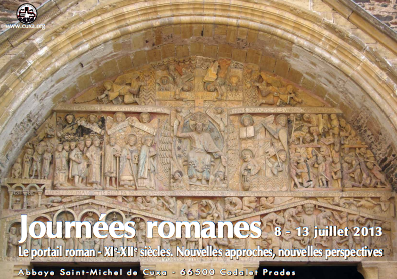
Colloque – Journées romanes 2013 : Le portail roman

Les Journées romanes sont une session d’une semaine, en juillet, généralement autour du milieu du mois. Le programme alterne des journées de conférences, à l’abbaye Saint-Michel de Cuxa, données par des spécialistes, universitaires ou chercheurs, et des visites des principaux monuments romans, en Roussillon et dans les régions voisines : Catalogne, Languedoc. Les Journées sont organisées autour d’un thème particulier, illustrant les rapports entre les arts et la société aux Xème, XIème ou XIIème siècles. Le programme est établi sous la responsabilité d’un Comité scientifique animé par Aymat Catafau, et qui comprend des chercheurs français et espagnols.
Programme :

Lundi 8 juillet 

13h : Accueil 

15h Conférence d’ouverture : Anne-Orange Poilpré, Université de Paris I Panthéon-Sorbonne – Le portail roman : pierre angulaire de l’histoire de l’art médiéval européen
17h : Olivier Poisson, Emmanuel Garland – Visite de l’abbaye
Mardi 9 juillet 

9h : Cécile Treffort, CESCM, Université de Poitiers – Le portail de l’église comme porte du Ciel : autour de quelques tympans inscrits d’époque romane 
10h30 : Milagros Guardia, IRCVM, Universitat de Barcelona Carles Mancho, IRCVM, Universitat de Barcelona – Avant les grands portails : les façades depuis l’Antiquité tardive jusqu’au haut Moyen Âge 
14h : Éliane Vergnolle, Société Française d’Archéologie – Le portail roman : un nouveau cadre architectural pour la sculpture 
15h30 : Marcello Angheben, CESCM, Université de Poitiers – Visions actuelles et eschatologiques : les théophanies des portails romans
17h : Conférences d’étudiants : Marcello Angheben, CESCM, Université de Poitiers – Le portail occidental de la cathédrale de Pampelune : de l’anonymat au mythe Esteban. Histoire d’une attribution controversée 
17h30 : Marcello Angheben, CESCM, Université de Poitiers – L’architecture de Sainte-Foy de Conques : éléments de réflexions 
18h30 : Concert « Trouveurs de mots », textes et musiques des Troubadours (entrée payante)


Mercredi 10 juillet 
Sortie : Ripoll 
10h30 : Conférence à Ripoll : Immaculada Lorés, Universitat de Lleida  – Des arcs romains aux portails romans, un regard critique
14h30 : Présentation du portail in situ : Manuel Castiñeiras, Universitat Autònoma de Barcelona – Le portail de Ripoll. Problèmes de sources et d’interprétation iconographique

Jeudi 11 juillet 

9h : Manuel Castiñeiras, Universitat Autònoma de Barcelona – Le portail roman en Aquitaine et ses implications funéraires 
10h30 : Quitterie Cazes, Université de Toulouse Le Mirail – Les portails des salles capitulaires 
14h : Stéphane Buttner, CEM, Auxerre – La mise en œuvre de la façade et du grand portail de Vézelay : nouvelles données archéologiques 
15h30 : Heike Hansen et Andreas Hartmann-Virnich, Université de Provence  – La façade de Saint-Gilles-du-Gard. Nouvelles recherches sur la construction d’un chef d’œuvre roman 
17h : Conférence d’étudiant : Anna Thirion, CEMM, Université Paul Valéry, Montpellier – Proposition de restitution de l’ancienne tribune abbatiale de Cuxa (v. 1140) 
18h : Assemblée générale de l’Association Culturelle de Cuxa 
Vendredi 12 juillet 
matinée : sortie
– Corneilla-de-Conflent (Olivier Poisson) 
– Villefranche-de-Conflent : grand et petit portail (Géraldine Mallet)
– Santa Maria de Riquer, Catllar (Anne Leturque) 

14h : Giovanna Valenzano, Università di Padova – L’iconographie du portail et de la façade de San Zeno di Verona 
15h30 : Martine Jullian, Université de Grenoble – Le portail roman et le drame sacré
17h : Éliane Vergnolle, Société Française d’Archéologie – Conclusions 

Samedi 13 juillet 
Sortie incluse dans le déroulement des Journées 
(le coût pourra en être déduit des tarifs, si les auditeurs ne peuvent y rester)

Les portails romans du Roussillon

Matinée :
– Saint-André-de-Sorède (Olivier Poisson) 
– Saint-Génis-des-Fontaines (Olivier Poisson) 
– Le Boulou (Manuel Castiñeiras)

Déjeuner au Boulou

Aprés-midi :
– Monestir del Camp, Passa (Jordi Camps) 
– Toulouges (Géraldine Mallet) 
– Perpignan, Saint-Jean-le-Vieux : Le portail de Saint-Jean le Vieux de Perpignan : hypothèses sur un choix très original, ses sources, sa fonction et sa postérité, exposé sur place par Xavier Barral i Altet, Université de Haute-Bretagne, Rennes 

Informations pratiques et programme au format PDF : Journées romanes 2013
Publié dans Colloque | Laisser un commentaire

Colloque – Historiographie moderne (XVIe-XVIIIe siècles) et histoire religieuse du Moyen Age méridional.

Fanjeaux 1er-4 juillet 2013

49e colloque du Centre d’Etudes historique de Fanjeaux

Cette session vise à réunir une synthèse autour de la manière dont les historiens de l’époque moderne ont écrit une part de l’histoire religieuse médiévale méridionale. Il s’agit d’étudier et de mettre en valeur des acteurs, des lieux, des méthodes et des modalités de la transmission d’une écriture de l’histoire de certaines provinces, villes, institutions religieuses du midi de la France. Les communications s’appuient sur des œuvres imprimées, des collections érudites manuscrites, des institutions et des hommes producteurs du savoir aux XVIe, XVIIe et XVIIIe siècles.

PROGRAMMATION
Lundi 1er juillet
  • 9h15 Ouverture de la session.
  • 9h45 Daniel-Odon Hurel (CNRS – UMR 8584, Laboratoire d’études sur les monothéismes), L’historiographie moderne face à l’histoire religieuse du Moyen Âge méridional : acteurs, méthodes et approches.
I. IDENTITE MERIDIONALE ET HISTORIOGRAPHIE
  • 10h30 Noël Coulet (Aix-Marseille Université), Les histoires ecclésiastiques de Provence (XVIIe-XVIIIe siècles).
  • 11h15 Laurent Albaret (CIhAM – Lyon II), La collection Doat : une collection moderne, témoignage de l’histoire religieuse méridionale des XIIIe et XIVe siècles.
  • 14h30 Lucie Laumonier (Université Paul-Valéry – Montpellier III / Université de Sherbrooke), L’histoire religieuse de Montpellier. Charles d’Aigrefeuille et son histoire de la ville, 1737-1739.
  • 15h15 Françoise Durand (Université Paul-Valéry – Montpellier III),Controverses historiographiques autour de l’ordre hospitalier du Saint-Esprit. Dom Vaissète et Gui de Montpellier.
  • 16h00 Nicole Lemaître (Université Paris I), Antoine Bonal (1548-1627) et l’histoire des évêques de Rodez.
Mardi 2 juillet
  • 9h00 Georges Passerat (Institut catholique de Toulouse), Dom Joseph Vaissète (1685-1756), un bénédictin érudit, patriote occitan avant l’heure, et l’histoire religieuse du Languedoc (XIIIe – XIVe siècles).
II. ACTEURS ET METHODES
  • 9h45 François Dolbeau (École pratique des hautes Études, Paris),À la recherche de textes rares : l’enquête de Dom Estiennot sur les manuscrits de Gascogne et du Languedoc.
  • 10h30 Jean-Loup Lemaitre (École pratique des hautes Études, Paris), Un mauriste en campagne : dom Col en Limousin, à travers sa correspondance (1764-1771).
  • 11h15 Nicolas Risso (Objat), Autour du sanctoral de Limoges au XVIIIe siècle.
  • 14h30 Sébastien Fray (Université Paris IV), Entre hagiographie et histoire : L’histoire sainte de Dominique de Jésus.
  • 15h15 Régis Bertrand (Aix-Marseille Université), L’érudit provençal Pierre-Joseph de Haitze (1656-1737) et le Moyen Âge.
  • 16h00 Bernard Joassart, sj (Société des Bollandistes, Bruxelles),Le dossier hagiographique de Marie-Madeleine dans les Acta Sanctorum.

III. HERESIES ET HISTORIOGRAPHIE MODERNE
  • 16h45 Cyrille Dounot (Université Toulouse I), L’albigéisme et les juristes méridionaux au XVIIe siècle.
Mercredi 3 juillet
  • Excursion à Rabastens et Gaillac (Tarn).
Jeudi 4 juillet
  • 9h00 Cyril Daydé (École nationale des chartes et École des hautes Études en Sciences sociales, Paris), La mémoire des hérésies médiévales et de leur répression chez les historiens méridionaux (XVIe-XVIIIe siècles).
  • 9h45 Philippe Martel (Université Paul-Valéry – Montpellier III), La croisade albigeoise, vue par les historiens méridionaux des XVIeet XVIIe siècles.
  • 10h30 Monique Zerner (Université de Nice – Sophia Antipolis), L’hérésie médiévale dans l’oeuvre de Guillaume Besse : entre érudition locale et ambitions parisiennes, un désastre ? (1645 – 1661).

Conclusions

  • 11h15 Conclusions par Daniel-Odon Hurel.

Publié dans Colloque | Laisser un commentaire

Offre d’emploi – Professur Kunstgeschichte der Frühen Neuzeit (Hamburg)

The School of Humanities invites applications for a

W2 Professorship in Art history (Early Modern European Art History)

ref no. 2178/W2


from October 1, 2013 until June 30, 2018
(Research Group « Naturbilder / Images of Nature »; Alexander von Humboldt- Professur Frank Fehrenbach)
Applicants are expected to have international research experience as well as a successful track record in acquiring external funding and carrying out externally-funded projects. The University places particular emphasis on the quality of teaching and therefore requests applicants to provide details of both their teaching experience and objectives.
Universität Hamburg seeks to increase the proportion of women in teaching and research and we therefore explicitly encourage qualified female academics to apply. Qualified female applicants receive
preference in the application process.
Tasks:
The successful candidate will be expected to conduct research and teach (two courses per term) in the field of:  Early Modern European Art History, with a special focus on the history of materials or on the history of architecture. She or he should be willing to collaborate in an interdisciplinary context.
The position will be financed by the Alexander von Humboldt-Foundation.
The planned research group « Naturbilder / Images of Nature » will focus on the concept of nature in both the history of art and that of images, especially in Early Modern Europe. We will study the fundamental characteristics of nature and their imitation, emulation, and transformation in visual culture (e.g., enlivenment, force, form, matter). Images of nature reshaped the very idea of nature at a time when that concept was in transition, and while older ideas of nature as an image-creator persisted. This research group will be a platform for an intensive dialog between the histories of art, science, natural philosophy, and technology.
Requirements:
Academic qualifications and further requirements as specified in §15 of the Hamburg Higher Education Act. Qualified disabled candidates receive preference in the application process.
The deadline for applications is 04 July 2013.
Please submit your application, including the standard documents and reference code 2178/W2 to:
An den
Präsidenten der Universität Hamburg 
Organisationsreferat 
Ausschreibungsstelle
Mittelweg 177
20148 Hamburg
or via email to: UniHHAusschreibungsstelle@verw.uni-hamburg.de
Source de l’information : ArtHist
Publié dans Offre d'emploi | Laisser un commentaire

Appel à contribution – DigiPal Symposium III: 16th September 2013

Date: Monday 16th September 2013
Venue: King’s College London, Strand

Co-sponsor: Centre for Late Antique & Medieval studies, KCL

It is with great delight that the DigiPal team at the Department of Digital Humanities (King’s College London), announce their third Symposium. We’ve built up a scholarly camaraderie over the last two years and much look forward to our annual opportunity to discuss and debate the computer-assisted study of medieval handwriting and manuscripts. Of course, we’ll need some papers. So…

How to propose a paper ?
Papers of 20 minutes in length are invited on any aspect of digital approaches to the study of medieval handwriting and manuscripts.

The topics below might help guide potential submissions:
  • terminology for describing handwriting
  • visualisation of manuscript evidence and data
  • meaning and mining in palaeography
  • automatic letter-form identification
  • methods for dating/localising script
  • crowd-sourcing in palaeography
  • the practical and theoretical consequences of the use of digital images
  • examples of research that would benefit from a Digital Humanities (or DigiPal) approach

The above are only serving suggestions, so please don’t feel limited to these topics.

To propose a paper, please email a brief abstract (250 words max.) to digipal [at] kcl.ac.uk

The deadline for the receipt of submissions is 10.23pm on Wednesday 3rd July 2013

Source de l’information : DigiPal
Publié dans Appel à contributions | Laisser un commentaire

Offre d’emploi – Research Assistant in Art History (The Warburg Institute)

AHRC-funded Project ‘The Production and Reading of Music Sources, 1480–1530 (PRoMS)’

Applications are invited for a research assistantship, as part of a major research project funded by the AHRC. The post is available immediately and tenable for a fixed term of 10 months.
The Project

Funded by the AHRC since December 2010, the project ‘The Production and Reading of Music Sources, 1480–1530 (PRoMS)’ conducts the first systematic study of the mise-en-page of Renaissance sources of polyphonic music (http://www.proms.ac.uk). In this period, polyphonic music had spread across the whole of Europe and had achieved its fullest variety in terms of source and repertoire types. The project examines how the verbal text, musical notation and other visual devices interact on the pages of these manuscripts and printed books, and it explores the ways in which meaning is constructed through such interactions by their makers (music scribes, text scribes, illuminators, printers) and users; it also transfers the results of the investigation to present-day performances. This is achieved by expanding and combining approaches developed for the study of illuminated manuscripts, music manuscripts and printed books, with new directions in digital technology, and by collaborating with performers.

The project employs two Research Assistants, who work on the manuscript sources, as well as a PhD student who works on the printed sources. The material is analysed and presented in two different ways. On the one hand, a database of mise-en-page information is being compiled for all extant sources from this period (c.300 manuscripts and exemplars of c.80 printed editions). On the other, detailed analyses of a select number of sources and overarching thematic questions will be presented both online and in printed form. In the online presentation of the sources, the project also maps correlations between visual and textual elements on selected openings, and establishes cross-references to other sources with similar (or opposing) strategies of visualization. Finally, the project explores with the ensemble Capella Pratensis how an understanding of the mise-en-page informs how the music is sung and heard. The performances and a combined CD/DVD release will include multimedia projections of the sources to convey this to the audience, providing a guide through the various visual layers.

The project is a collaboration between the University of Manchester, the Warburg Institute, Bangor University, the University of York, the Alamire Foundation (Leuven/Belgium), and the Department of Digital Humanities (DDH) at King’s College London; it is led by Professor Thomas Schmidt (Manchester).


The Post

The project employs two Research Assistants, one in musicology based in Manchester, the other in art history based at the Warburg Institute, as well as a funded PhD student based in Manchester. The post advertised here is that of the art historian, and constitutes a replacement for the remaining funded period of the post.

Most of the work is carried out on the basis of digital images within an online database environment, with input shared along disciplinary lines where appropriate. In addition, each of the Research Assistants has main responsibility for a number of individual sources, but also retains responsibility for aspects of his/her discipline.

Duties will include:

1. Providing descriptions of the physical makeup and layout in manuscript sources of polyphonic music between c. 1480 and 1530 within an online database environment, and interacting with the Department of Digital Humanities to assist in further developing this environment

2. Providing comprehensive descriptions of the initials, borders, and other visual devices present in these sources

3. Researching and preparing detailed analytical studies of two individual sources (one book of secular polyphonic song from Italy, one polyphonic chansonnier from France) for print publication; adapting these and existing case studies to the online environment

4. Participating in the editing of project publications

5. Providing support for the project team


Essential appointment criteria:

1. Doctorate or equivalent qualification in art history, with specialist knowledge of art of the 15th and 16th centuries, specifically of manuscript illumination

2. Expertise in codicology and paleography

3. Willingness to engage actively in the development and preparation of the database and online resource.

4. Ability and willingness to work in a team of scholars


Desirable appointment criteria:

1. An interest in music of the period and knowledge of musical notation

2. Experience in developing databases and online resources

3. Experience in editing

4. Ability to engage with theoretical aspects of material culture of the late medieval/early modern period


Conditions of Appointment

The appointment will be to Level 7 (Research), currently £29,541–36,298 p.a. plus London Allowance of £2,134 p.a., making a total of £31,675–38,432 p.a.

The normal work week will be 35 hours.

The appointment is terminable by one month’s notice in writing on either side

The salary will be paid monthly in arrears no later than the last day of each month by bank transfer and will be liable to deductions at source for tax and National Insurance. Deductions for National Insurance contributions will be made at the statutory contracted-out rate.

The person appointed will be deemed automatically to be a member of the Universities’ Superannuation Scheme (USS) and will have contributions deducted accordingly. Once full information on the Scheme has been received, the individual may elect in writing to withdraw from the Scheme.

The annual leave entitlement is six weeks (25 days pro rata) in addition to public holidays and Warburg Institute closures, approximately one week at Easter and at Christmas.

The appointment will be subject to the terms and conditions for administration, management and professional staff of the University of London.

The University is an Equal Opportunities employer.
Method of Application

There is no application form. Candidates should submit with their letter of application a full curriculum vitae giving contact information (including e-mail address), details of qualifications, previous experience, current salary (if any) and the names, addresses and e-mail addresses of two referees (present/previous employers or academic references). Applicants are asked to send with their application the Equal Opportunities form which can be downloaded from the Institute’s website under Vacancies (http://warburg.sas.ac.uk/). Applications must be sent by e-mail to the Institute Manager, Ms Catherine Charlton at catherine.charlton(at)sas.ac.uk .


Applicants are also asked to download an Equal Opportunities form from the link above, which they should complete and send in along with their application.

The Institute will contact, by e-mail, the referees of candidates who are shortlisted for interview. Any candidate who is aware that his/her referees will not be contactable between 28 June and 9 July should arrange for his/her referees to send references direct to the Institute Manager, Ms Catherine Charlton at catherine.charlton(at)sas.ac.uk without waiting for information regarding shortlisting.


Closing date for receipt of applications: 30 June 2013.
Interviews will be held at the Institute on Monday, 15 July 2013.

Source de l’information : The Warburg Institute
Publié dans Offre d'emploi | Laisser un commentaire