Appel à contribution – Resurrecting the book

Call for papers
Llibrary of Birmingham, england
15-17 november 2013
To celebrate the re-opening of the largest public library in Europe and its outstanding special collections The Library of Birmingham, Newman University College Typographic Hub at Birmingham City University and  The Library of Lost Books have united to host a three-day conference on the theme of Resurrecting the book.

The conference will run in conjunction with the Library of lost book project a major exhibition of 50 de-accessioned books which have been given new life as objects redesigned into works of art and which will form part of the opening festival for the new Library of Birmingham in 2013.

The conference will include an opportunity to visit the Library of lost books exhibition and attend artist talks on re-working the books
With e-book downloads outstripping the purchase of hard copies, with libraries closing and discarding books and with the value of the book as physical object being increasingly questioned, this interdisciplinary conference will bring together academics, librarians, artists, creators, designers, and users of books to explore a wide variety of issues pertaining to the creation, design, construction, use, reuse, preservation, loss, and recovery of the material book, electronic and digitized books, and of collections and libraries.
Abstracts on the conference themes and their intersection and covering any historical period are invited.
Conference themes :
Topics may include, but are not limited to:
  • Books as material objects : the materiality of book creation, construction, production, use, reuse and destruction; manuscripts and printed books; book-design, illustration, paratextuality and its manifestations; book covers, bindings, clasps, vellum parchment, paper, manuscript and printing and production processes.
  • Collections and libraries : book collectors, collections and their locations; missing, lost and found books; the creation, recreation, dispersal, sale and destruction of books and libraries; the movement of books and libraries; lost libraries; the impact of libraries on books; lost and revised editions.
  • The artist’s book : altered books; book preservation and conserved books; books and material culture; books as art; books in art; illustration and illumination; woodcuts; engravings; marbled pages; book decoration, printmaking.
  • E-books : the creation use and abuse of ebooks; neglected and lost ebooks; ebook readers; electronic libraries; books and collections and the impact of digital technologies.
  • Publishing : publishers & publishing; the future of publishing; back-catalogues; print-runs; editions; archives; digitization & multimedia books.
Application process : 
Abstracts of no more than 400 words accompanied by a 50-word biographical profile should be sent to both Dr Matthew Day (m.day@newman.ac.uk | 0121 476 1181) and Dr Caroline Archer (caroline.archer@bcu.ac.uk | 0121 331 5871).
Deadline : Friday 1 february 2013
Further details are available at http://www.resurrectingthebook.org
Publié dans Appel à contributions | Laisser un commentaire

Publication – Paléo.fr : Logiciel d’apprentissage de la paléographie médiévale

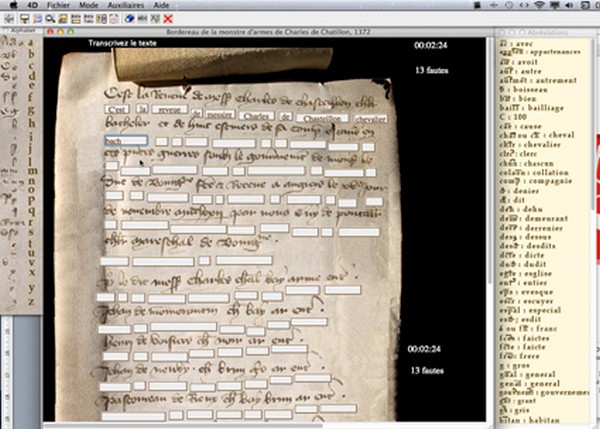
Hervé Mouillebouche, Paléo.fr : Logiciel d’apprentissage de la paléographie médiévale, Chagny, 2012. 15 €, ISBN : 978-2-9532994-9-6. Systèmes : PC : Windows XP, Vista et Windows 7 Mac : Mac Intel Os X 10.5.8 minimum 

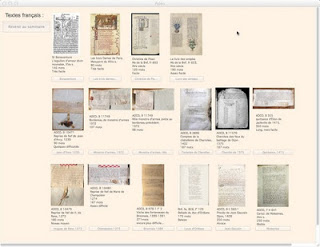
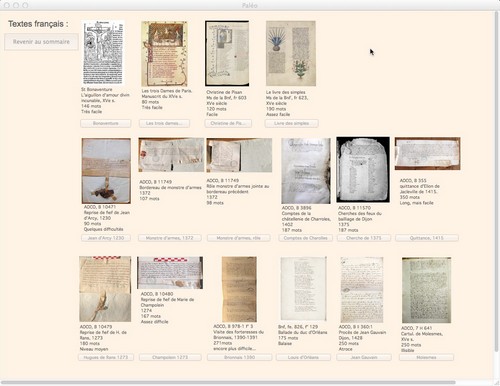
Le logiciel « Paléo.fr » permet d’apprendre la paléographie médiévale française, seul ou en groupe, par des exercices interactifs progressifs. La présente version « Paléo.fr 2012.1 » contient 16 textes français des XIIIe, XIVe et XVe siècles, présentant une grande variété d’écritures et de documents de la France du nord. 

Ce logiciel a été mis au point par Hervé Mouillebouche, maître de conférences en histoire médiévale de l’université de Bourgogne pour un enseignement de paléographie de master d’histoire médiévale. Il donne des consignes de base pour la transcription et le développement des abréviations, puis propose 16 exercices, à réaliser de préférence dans l’ordre présenté par le logiciel, qui permettent de progresser à partir de n’importe quel niveau, jusqu’aux textes français les plus difficiles à lire. 

Le logiciel permet de travailler sur des documents en couleur, en taille réelle, et de le transcrire mot à mot. Il compte les fautes, donne des conseils, chronomètre, et il propose une récréation à la fin de chaque exercice réussi. L’apprenti-paléographe peut également profiter d’une table de transcription alphabétique du texte, et d’une table des abréviations.

Bon de commande : ici


Publié dans Publications | Laisser un commentaire

Séminaire – University of London. Earlier Middle Ages

University of London
Institute of Historical Research
Earlier Middle Ages

Convenors : Stephen Baxter, Julia Crick, David Ganz, Caroline Goodson, Peter Heather, Hugh Kennedy, Alice Rio, Antonio Sennis, Alice Taylor, Jinty Nelson, Dionysios Stathakopoulos, Alan Thacker. 

Venue : The Court Room, unless othrwise noted in the programme, below
Time: Wednesday, 5.30pm

Programme – Spring Term 2013 :
9 January 
Etienne Renard (University of Namur -Belgium)
From Merovech to Clovis: what can we really know? 

16 January 
Robert Houghton (St Andrews)
The vocabulary of groups in eleventh-century Mantua 

23 January 
Els Schröder (York)
Searching for friendship in Anglo-Saxon sources: multilingual insights into tenth-century elite culture

30 January 
Hugh Kennedy (SOAS)
Landholding and law in the early Islamic state 

6 February 
Zubin Mistry (UCL)
Tradition in practice: thinking about abortion under the Carolingians 

13 February 
Not meeting this week 

20 February 
Paul Harvey (Durham)
How to run your landed estate in 11th-century England 

27 February 
Marie Legendre (Oxford)
Not Byzantine nor Islamic? The Duke of the Thebaid and the formation of the Umayyad State 

6 March 
James Lloyd (Cambridge)
Local government in Wessex before the Hundred 

13 March 
George Molyneux (Oxford)
The formation of the English kingdom in the tenth century 

20 March 
Katy Dutton (Manchester)
Negotiating non-royal power in the twelfth century

Informations pratiques :
Institute of Historical Research
University of London
Senate House
Malet Street
London WC1E 7HU

General enquiriesTel: +44 (0)20 7862 8740
Fax: +44 (0)20 7862 8745

Source de l’information : Institute of Historical Research
Publié dans Colloque | Laisser un commentaire

Offre d’emploi – University Lecturer in Medieval French in association with a tutorial fellowship at St Peter’s College

University Lecturer in Medieval French in association with a tutorial fellowship at St Peter’s College
Faculty of Medieval and Modern Languages, in association with St Peter’s College

Salary: £42,883 – £57,581 p.a.

The Faculty, in association with St Peter’s College, is seeking to appoint an individual from 1 October 2013 or as soon as possible thereafter to provide teaching and research in the area of Medieval French.

Oxford University has the largest concentration of scholars working in the Medieval period in the UK, and the appointee will be able to interact with specialists in all other areas and periods of medieval studies.

The appointee will be expected to give no fewer than thirty-six lectures or classes on Medieval French and an average of six hours per week of tutorial teaching in French and Medieval French each year; as well as engaging in independent research and participating in examining, admissions and other administrative duties as required by the Faculty and college.

Applicants should possess: a PhD/DPhil in French (with a significant emphasis on the Medieval period); a successful track record of teaching at undergraduate level, and an understanding of undergraduate and graduate needs and how to address them; and a strong research record in Medieval French, appropriate to the stage of the individual’s career.

Further information, which all applicants should consult, is available in the further particulars available below.

The closing date for applications is noon on Wednesday 13 February 2013.

Contact Person : Vacancy ID : 106191
Contact Phone : Closing Date : 13-Feb-2013

Click on the link(s) below to view documents
Publié dans Offre d'emploi | Laisser un commentaire

Appel à contribution – Performing Medieval Text – a Tautology?

Performing Medieval Text – a Tautology?

Merton College, Oxford

10–11 May 2013


Performing Medieval Text sets a broad framework for philologists, art historians, musicologists, historians, and theologians to discuss the multi-faceted relationships between text and performance in the European Middle Ages between ca. 1150 and 1400. The conference seeks to explore issues including (but not limited to):
  • ontologies of performance;
  • relationships between text and performance;
  • the performers;
  • performance of medieval texts in scholarship.

Graduate students and early career researchers are invited to present 20-minute papers, to which one of the following academics from the University of Oxford will respond:
Dr Jessica Berenbeim (University of Oxford, Art History)
Prof. Elizabeth Eva Leach (University of Oxford, Music)
Dr Sophie Marnette (University of Oxford, French)
Dr Almut Suerbaum (University of Oxford, German)
Dr Helen Swift (University of Oxford, French)
The conference will be framed by keynote papers given by Dr Florence Bourgne (University of Paris-Sorbonne) and Prof. Dr Franz Körndle (University of Augsburg).

Proposals (200 words, English) for papers discussing any of the above topics (or related areas) should be sent to performingmedievaltext@mod-langs.ox.ac.uk by Sunday, 3 February 2013. Please include a short (1 page) academic CV with your proposal. Proposals from institutions outside the UK are warmly encouraged.

You are most welcome to contact either of the conference organisers for further details.

Henry Hope
Faculty of Music
University of Oxford

Pauline Souleau
Faculty of Medieval and Modern Languages
University of Oxford
Website and provisional programme : here
Publié dans Appel à contributions | Laisser un commentaire

Journée d’étude – Signatures, écritures et pouvoirs autour de Gaston III comte de Foix, dit Fébus

Signatures, écritures et pouvoirs autour de Gaston III comte de Foix, dit Fébus 
Coordination : Véronique Lamazou-Duplan

Master Cultures et sociétés : Histoire – Anthropologie – Archéologie
Journée d’étude du 1er février 2013
Université de Pau et des Pays de l’Adour – Institut Claude Laugénie- Salle Chadefaud
Programme de recherche UPPA / ITEM (EA 3002) soutenu par les CG 64 et CG 09

Programme :

9h00 : Ouverture de la journée 

Signatures et marques fébusiennes. Des actes aux manuscrits

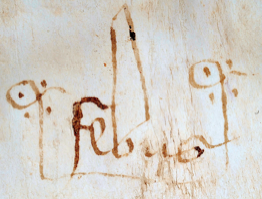
9h15 : Ghislain Brunel, Conservateur en chef des Archives nationales, Véronique Lamazou-Duplan, Maître de conférences à l’UPPA – Les actes signés Febus
9h50 : Paul Mironneau, Directeur du Musée national du Château de Pau – Marques, signatures et autres éléments d’individuation dans les manuscrits ayant appartenu à Gaston Fébus. 
10h25 : Simone Ventura, Universitat de Barcelona – Le statut textuel de l’Elucidari de las proprietatz de totas res naturals : quelques remarques sur la langue et les sources de la version occitane du De proprietatibus rerum. 
Pause 

11h20 : Maria Alessandra Bilotta, chercheur à l’Université de Lille 3 et à l’Université Nouvelle de Lisbonne – Les enluminures de l’Elucidari et celles des manuscrits juridiques enluminés dans le Midi de la France : rapports iconographiques et stylistiques. 
11h55 : Discussion 
12h30 : Déjeuner 

Autour de Fébus : écritures et pouvoirs 
Jean-Pierre Barraqué, Professeur à l’UPPA – Modérateur et discutant

14h30 : Claudine Pailhès, Directrice des Archives départementales de l’Ariège – Fébus, comte de Foix : assises et discours fuxéens. 
15h05 : Benoît Cursente, Directeur de recherche honoraire CNRS – Écriture et servage : le fait du prince et l’appropriation de l’écrit par les maisons paysannes. 
15h40 : Dominique Bidot-Germa, Maître de conférences à l’UPPA – Les sources fiscales et le pouvoir fébusien. 
16h15 : Discussion et conclusions.

Publié dans Colloque | Laisser un commentaire

Journée d’étude – A bunch of books. Book collections in the medieval Low Countries

Due to the überlieferungsgeschichtliche Methode and New Philology, the idea that the meaning of texts is determined by the material context in which they are preserved has become central to the study of historical literature in the Low Countries. However, this approach has mainly inspired researchers to study texts in their manuscript context, especially that of miscellanies. During a symposium on book collections we would like to explore the significance of material context outside the manuscript. Not only individual texts, but also manuscripts as a whole functioned in the context of a larger collection of books and derived meaning from the context of this collection. In Memory’s Library. Medieval Books in Early Modern England (2008) Jennifer Summit stated that ‘libraries were dynamic institutions that actively processed, shaped, and imposed meaning on the very materials they contained’.

The focus of this symposium will be on the ways in which books functioned in the context of a collection, on how individual books related to collections as a whole and to the users and owners of these collections. Book collections constitute a melting point of materials and themes that are often studied separately: Latin and vernacular texts, religious and secular literature, manuscript and print, rhyme and prose, splendour and plainness, old and new. By making use of inventories, library catalogues and preserved manuscripts the speakers at this symposium investigate the characteristics, size and meaning of book collections in the Low Countries. They address questions about the owners and users of these collections, social and cultural exchange, the formation of meaning, the organisation of collections, and the consequences of this approach for our view on literary history. The confrontation of the study of texts in their manuscript context and in book collections will be one of the central discussion points of this day.

Programme :

10h30 : Welcome and Coffee

11h00 :  Suzan Folkerts and Renée Gabriël – Introduction
11h15 :  Prof. Dr Albert Derolez (Ghent University) – Keynote : Texts in medieval libraries: Thoughts for an integrated approach
12h00 : Prof. Dr Herman Brinkman (Huygens ING/University of Amsterdam) – Books that are collections of books 
12h30 : Lunch

14h00 : Dr Sabrina Corbellini (University of Groningen) – Collecting Religious Knowledge: books, libraries and networks
14h30 :  Dr Hanno Wijsman (Institut de recherche et d’histoire des textes Paris) – Book Collections and their Use. Some Examples from Princely and Noble Libraries
15h00 : Coffee and Tea break

15h30 : Ad Poirters MA, in collaboration with Dr Hans Kienhorst (Radboud University Nijmegen) – The Beckers Connection: Some Thoughts on the Latin Books of Hours in the Soeterbeeck Collection
16h00 : Dr Ryan Perry (University of Kent) – Keynote : Devotional anthologies: Collectors of religious texts and their methods
16h45 :  Drinks

You are also invited to the public lecture Medieval Manuscripts as Truly Open Data by Dr. Will Noel, Director of The Special Collections Center and The Schoenberg Institute for Manuscript Studies (University of Pennsylvania) on Wednesday 13 February at 16h30.

Informations pratiques :

A bunch of books. Book collections in the medieval Low Countries

Symposium at the occasion of the twentieth anniversary of Queeste
Organised in cooperation with Radboud University Nijmegen

Date : 14 February 2013
Venue : Gymnasion, room GN 3, Heyendaalseweg 141, 6525 AJ Nijmegen.
Costs : €15,– (students 7,50)
Registration : Please send an e-mail to Renée Gabriël (r.gabriel@let.ru.nl) before 1 February 2013
Program (download pdf)

Source de l’information : Queeste
Publié dans Colloque | Laisser un commentaire

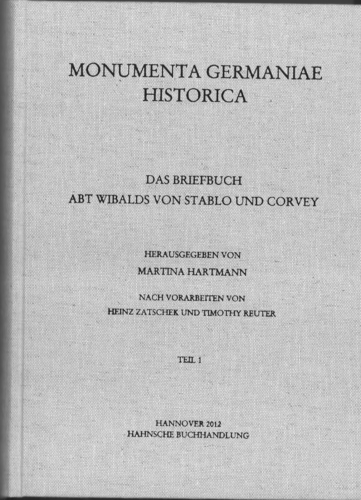
Publication – Martina Hartmann (éd.), Das Briefbuch Abt Wibalds von Stablo und Corvey

Das Briefbuch Wibalds von Stablo und Corvey (1098–1158) ist die wichtigste Briefsammlung zur frühen Stauferzeit und zudem im Autograph überliefert. Wibald, seit 1130 Abt von Stablo, wurde im Herbst 1146 auf Betreiben König Konrads III. auch zum Abt von Corvey an der Weser gewählt. In dieser Situa-tion, die die Verantwortung für zwei bedeutende, sechs Tagesreisen vonein-ander entfernte Klöster mit sich brachte, entschloss sich Wibald, eine Art ‚tragbares Archiv’ anzulegen. Nach Dossiers geordnet wurden die überwie-gend undatierten Schreiben in den verschiedenen Angelegenheiten, mit denen Wibald sich auch im Auftrag des Königs und des Papstes befassen musste, eingetragen. Das Briefbuch umfasst den Zeitraum von Ende 1146 bis Herbst 1157, als Wibald von Friedrich Barbarossa gebeten wurde, zum Kaiser nach Byzanz zu reisen. Von dieser Gesandtschaft kehrte der Abt nicht mehr lebend zurück. Die Edition des Briefbuches, das 450 Stücke von und an Wibald sowie Schreiben dritter enthält, die von ihm verfasst wurden, folgt im Unterschied zu den Editionen des 18. und 19. Jahrhunderts der Reihenfolge im Autograph und versucht auch in der Einleitung, die Entstehung des autographen Codex deutlich zu machen.


Informations pratiques :
Martina Hartmann (éd.), nach Vorarbeiten von Heinz Zatschek und Timothy Reuter, Das Briefbuch Abt Wibalds von Stablo und Corvey, Hanovre, 2012 (Monumenta Germaniae Historica, Die Briefe der deutschen Kaiserzeit, 9). CLXXVI und 1034 S. in drei Bänden. 4º.ISBN 978-3-7752-1812-2 Ln. 150 €.


Source de l’information : Monumenta Germaniae Historica
Publié dans Publications | Laisser un commentaire

Appel à contribution – Mental Health, Spirituality, and Religion in the Middle Ages and Early Modern Age

Ideally, this symposium will bring together medical researchers and scholars in the humanities focusing on the Middle Ages and the early modern period. The research presented will hopefully be of relevance both for scholarshi/research and the general public. The entire symposium will be made available, free of charge, for the general public.

Although the philosopher Immanuel Kant (1724-1804) had formulated that madness is a “disease of ill reason,” in the history of philosophy the debate about the true nature of rationality vs. irrationality has never been completely decided. Does madness not have something of divine prescience and awareness in it? Does not God, do not the gods represent a dimension far beyond human rationality? In other words, does not human existence deeply depend on an awareness or broad notion of the metaphysical realm? Can we easily determine whether a famous artist or composer, a writer or a sculptor was simply ‘mad’ or rather ‘inspired’? Would those who have experienced God, or the divine, if not simply the metaphysical sphere, in a highly personal and intimate manner, have any human means available to come to terms with that ‘maddening’ vision or revelation and express it in comprehensible fashion?

Where would we have to place Vincent van Gogh (1853-1890) with his incredible artistic skill, which yet seem to have been born, at least for some critics, from a deranged mind? How should we interpret the large number of medieval and early modern mystics and visionaries, such as Hildegard of Bingen (1098-1179) and Theresa of Avila (1515-1582)? Arthur Schopenhauer (1788-1860) identified the dram as a short-term experience of madness, while a long-term suffering from madness would be a long dream. Plato (424/23-348/47 B.C.E.), to cite one of the earliest authorities, had explicitly correlated genius with madness, undermining the hope for a clear demarcation of both domains. Michel Foucault (1926-1984) emphasized that those who reject irrational people simply as mad in truth seek to maintain their power over those who do not fit into their episteme and threaten the traditional order as maintained by rationality.

Both literature and music, if not all visual arts, know more about madness and loss of reason in favor of something else than most other human areas. The philosopher Andreas Brenner recently pointed out that the Italian poet Alda Merini (1931-2009), who is now counted among one of the best of her time in that tongue, had spent twenty years in an asylum before she was ‘discovered’ and recognized (Religion und Gesundheit, ed. Albrecht Classen, 2011). In 1996 she was one of the nominees for the Nobel Prize for Literature. Remarkably, she was deeply influenced by the German poet Rainer Maria Rilke (1875-1926), commonly regarded as one of the best poets of his time. But Rilke produced many sonnets and odes that might undermine his claim on a healthy mind, at least in the opinion of the uninformed. There are, in fact, many more examples, both medieval and modern, which all underscore how closely artistic, literary, musical, and other personal skills transgress the traditional binary of rational and irrational, sane and insane. Brenner identified both mystic and madness as some of the most intriguing vehicles for humans to overcome the constraints of material logic and to reach the other world, the ineffable and apophatic. After all, as the Swedish mystic Emanuel Swedenborg (1688-1772) demonstrated, the history of human existence embraces both, the spiritual and the physical, and a truly holistic approach embraces the rational and the irrational as complimentary aspects of life in its totality. In this regard, the European history of spirituality and religion shares much with that of Islam, Judaism, Hinduism, and Buddhism, not to mention a variety of other religions all over the world.

Intriguingly, physical health is intimately connected with spiritual health, as alternative medicine, palliative medicine, but then also psychology, and religious studies have confirmed throughout the ages, and today, perhaps, more than ever before since the late twentieth century. Perhaps not quite surprisingly, medieval and early modern literature knows of many examples that confirm these general observations through unique lenses, especially mysticism. But medieval spiritualism, early modern theology, and late medieval art, for instance, also addressed the same issue, all powerfully framed by a vast corpus of secular and religious literature. One of the essential messages conveyed by the intellectuals and spiritual leaders from the premodern world certainly consists of the firm conviction that the health of the human body depends deeply on a well composed spirituality. For instance, medieval herbal medicine finds much new interest especially today because of it being an integral element of the binary framework of macrocosm and microcosm. In other words, the present and the future have much to learn from the past, especially in the areas of medical research, spirituality, and philosophy.

The examples from modern poetry, music, the visual arts, and literature at large underscore the enigmatic but significant connection with medieval and early modern mysticism and medical research (Paracelsus). However, the gulf between medical research and the humanities is still very wide, especially with regards to historical experiences. In order to address this desideratum, I propose to dedicate the 11th International Symposium on Medieval and Early Modern Studies here at the University of Arizona to the topic of “Mental Health, Spirituality, and Religion in the Middle Ages and Early Modern Time,” in April 2013. An intimate research colloquium, to be open both for scholars/researchers and the general public, promises to be the ideal avenue to achieve the desired goals. These are:
  • Colloquium at which researchers/scholars from the Humanities and from Medicine meet and exchange their experiences, research, and observations
  • The establishment of an open forum for the public to gain insights into the latest findings regarding mental health and spirituality both from a humanistic and a medical perspective
  • Open discussions on the meaning of mental health from a historical and a modern angle
  • Introduction of visual, musical, and literary examples from the Middle Ages and early modern period as mediums for the exploration of mental health and the significance of spirituality for bodily health
  • Initiation of interdisciplinary research bringing together medical researchers and scholars in the humanities and the fine arts
  • Translation of the presentations at that symposium/colloquium into publishable material, to continue with the book series “Fundamentals of Medieval and Early Modern Culture” (De Gruyter, Berlin and New York)

I have organized comparable symposia here since 2003 every year, and I hope to set the stage for the 11th symposium in 2013. This one, however, will be unique because it will be more interdisciplinary than ever before, with very good reasons. As the topic illustrates, only when medical researchers and humanities scholars begin to talk with each other, will we be empowered to learn from each other for the true improvement of human life today. Premodern examples in the disciplines of literature, the arts, philosophy, and religion promise to shed old and new light on universal and perennial problems all humans have to cope with. These, however, can then also be studied more closely by medical researchers.

The conversations between both fields hence promise to yield many far-reaching new insights of deepest value both for members of the academia and the public. While modern medical research has often demonstrated in a variety of methods and approaches that the healing process is improved and accelerated if an artistic background is involved, or if the individual patient can rely on a strong spiritual background. In the premodern world the ideal aimed more for the salvation of the soul in the afterlife, but there are countless examples confirming the superseding relevance of spiritual health for physical health. Despite all differences, modern medical research and investigations in the field of the humanities share fundamental values and ideals. The symposium promises to bring the various voices, ideas, and concepts together, offering new avenues for achieving human health in the widest range of meanings.

Conceptually, we will pursue the ideal of sharing latest insights into alternative medicine combined with a critical examination of literary, artistic, philosophical, and religious documents from the premodern world both with our colleagues and with the public. Each presentation will be followed by an extra long period of discussions allowing good time both for the experts and the public.

Informations pratiques :
Please contact the organizer regarding any further inquiries or information: Prof. Albrecht Classen, aclassen@email.arizona.edu
11th International Symposium on Medieval and Early Modern Studiesat the University of Arizona, Tucson, May 2-5, 2013.
Organizer:
Dr. Albrecht Classen
University Distinguished Professor
Dept. of German Studies, 301 LSB, The University of Arizona
together with Prof. Ronald Grant, Director, Medical Humanities, rgrant@email.arizona.edu
Deadline for submission of abstracts: January 31, 2013, but feel free to send an inquiry even after that date in case there might be a slot still available, to aclassen@u.arizona.edu
Location of Symposium: Conference Room in the Student Union, University of Arizona
This is a self-sustaining academic symposium. Participants are expected to secure travel funds and other resources to cover their costs (housing, registration) from their home institution.
The registration fee of $90 (might have to be increased). will include all meals and refreshments, three receptions in the evenings, and an excursion. Selected papers will be accepted for publication in a planned volume (de Gruyter; see my webpage on Fundamentals. Each contributor to the volume will receive a free copy and can negotiate with the publisher reduced prices for any of the volumes in our series.
Anyone interested in joining the symposium as part of the audience, please contact the organizer. Student participation will be most welcome.
Languages accepted at the symposium: English, French, German, and in exceptional cases Spanish. Non-English papers must be accompanied by a good English summary available as a hand-out. Abstracts of all papers will be posted well ahead of the symposium.
Hotel Accommodations: I have made a special arrangement with Riverpark Inn (formerly Pueblo Inn), $65/night (plus tax [13.05%] plus $2 per night). Within the USA, call: 1-800 551-1466, refer to « Dept. of German Studies/Rural Space, » or to my name. Local number: 520 239-2300. Transportation to and from the symposium (at the University of Arizona Library, Special Collections), will be provided. For international guests, please fax your reservations to: 011- 520-239-2329 (subject to change)
For a downtown map, click on map
For a campus map, click on campus

Source de l’information : University of Arizona
Publié dans Appel à contributions | Laisser un commentaire

Appel à contribution – Spectacle et allégorie du Moyen Âge à nos jours

Spectacle et allégorie du Moyen-âge à nos jours
Revue d’Histoire du Théâtre
Numéro thématique coordonné par Martial Poirson

L’histoire du spectacle n’a pas ménagé la place qui lui revient à l’allégorie dramatique, personnification d’un concept abstrait dont l’invention remonte, au moins, à Aristophane. Ce « théâtre des idées », selon l’expression d’Antoine Vitez, naît pour le domaine français dès le Moyen-âge au sein du théâtre sacré ; puis il apparaît dans le théâtre comique entre le XVIe et le XVIIIe siècles ; enfin, on le retrouve jusque dans le théâtre militant au cours du XXe siècle et il semble prendre un nouvel essor au sein des nouvelles formes scéniques contemporaines depuis le début du XXIe siècle… Pourtant, fort d’une lecture biaisée de théoriciens tels que Walter Benjamin ou Michel Foucault, on croit volontiers l’allégorie oubliée avec l’entrée dans la modernité, liquidée avec l’héritage baroque, qui l’avait placée au coeur de sa poétique, perdue de vue depuis la fin des mystères et du théâtre sacré, à l’aube du classicisme français. N’ayant pas survécu au déclin d’une certaine théologie médiévale, qui était parvenue à instaurer une relation ontologique ou pour le moins, homologique entre l’idée et son incarnation, elle serait entrée dans un long sommeil dogmatique dont l’époque contemporaine tenterait timidement et sans grand succès de la sortir. Seul le XXe siècle aurait su l’en tirer, d’abord avec le théâtre symboliste et expressionniste (Maeterlinck, Claudel, Strindberg), puis, dans un paradoxe qui n’est qu’apparent, avec le théâtre politique, en particulier allemand, soviétique et anglais (Agit Prop ; Bread and Puppet). Or cette idée convenue, encore trop largement partagée, occulte allègrement la survivance de l’allégorie dans le théâtre sacré (en particulier l’auto sacramental espagnol, notamment chez Calderòn, dont l’influence sur la scène française est fondamentale), ainsi que sa profonde fécondité dans le théâtre profane au cours des périodes moderne et contemporaine. C’est cette idée reçue que nous voudrions remettre en cause par ce volume collectif, fruit de travaux récents issus de divers horizons et de diverses disciplines, en exhumant un répertoire assez largement oublié, d’une richesse et d’une variété peu communes, susceptible de nourrir une conception renouvelée des arts de la scène.

« Genre mineur » ou plutôt « mauvais genre » pratiqué aux marges de l’institution, le théâtre d’allégorie, souvent parodique, satirique, parfois même subversif, procède volontiers au détournement du répertoire consacré et des formes canonisées, qu’elles soient lyriques ou dramatiques. Il se saisit de l’actualité sociale et politique prise sur le vif comme des discours de savoir pour les mettre en jugement, voire en procès, au sens le plus littéral du terme, sur une scène théâtrale constituée en espace public délibératif, voire en espace public oppositionnel. Il propose donc moins, selon l’hypothèse défendue dans ce volume, l’évocation d’autres mondes possibles, comme dans les formes allégoriques romanesques, discursives ou picturales qui lui sont contemporaines, que le réexamen critique ou pour le moins distancié du monde réel, de ses conditions sociales, culturelles et politiques d’existence, considérées à travers un dispositif de prisme déformant. Les pièces allégoriques se font donc l’écho, non seulement d’événements précis, historiquement datés et clairement identifiables par le public, mais encore d’un certain état de la conscience collective et de débats idéologiques mis en examen au moyen d’un solide système sémiologique à entrées multiples reposant sur différentes lectures à clefs. Il existerait donc une politique de l’allégorie dramatique, au sens le plus large du terme, dont on peut suivre les redéploiements esthétiques et idéologiques à travers différentes configurations historiques.

Loin de toute forme de théâtre à thèse, le répertoire allégorique repose le plus souvent sur une écriture au second degré propice au métathéâtre à vocation autoréflexive. Il révoque en doute toute illusion consentie de la part du public, renégociant sans cesse le pacte de fiction ou d’illusion consentie avec le spectateur. Parfaitement inscrit dans l’esthétique et dans les grands courants idéologies de son temps, il relève d’une écriture de la discontinuité, de la fragmentation, du mélange des genres et des modes d’expression, producteur d’oeuvres hybrides (échappant, dans une large mesure, aux règles canoniques) caractéristiques des « arts mêlés » (mariant de façon tantôt harmonieuse, tantôt burlesque déclamation, chant, danse, musique, effets spéciaux) et bien souvent, d’un certain type de théâtre musical ou chorégraphique.
Le numéro spécial concentrera notamment, mais pas exclusivement, l’analyse de l’allégorie dramatique sur les questions suivantes :
  • Rapport aux autres formes d’expression allégorique, qu’elles servent de modèle et de source d’inspiration, comme la peinture, la rhétorique, ou plus récemment le cinéma, ou de partenaire de la création, comme la danse, la pantomime, la marionnette ou la musique ;
  • Dispositif esthétique et idéologique de l’allégorie incarnée ;
  • Poétique et enjeux théoriques de ses régimes d’illusion et de créance ;
  • Enjeux des discours de savoir véhiculés, transposés, réappropriés, voire occultés ;
  • Conditions de production, de mise en voix, en corps, en scène, et pratiques de représentation ;
  • Conditions de réception, d’interprétation, modes de lecture, de détournement, de réappropriation par le spectateur ou le lecteur.
  • Question de la mise en scène actuelle du répertoire du théâtre d’allégorie.

Prière de faire parvenir vos propositions de communication, comprenant un titre, une page de présentation et votre affiliation institutionnelle, avant le 30 janvier 2013 à Martial Poirson (martial.poirson@yahoo.fr).

Source de l’information : Fabula.org
Publié dans Appel à contributions | Laisser un commentaire