Appel à contribution – ‘In the hands of God’s servants’. The Power of the Bishop in Western Europe (1000-1300)

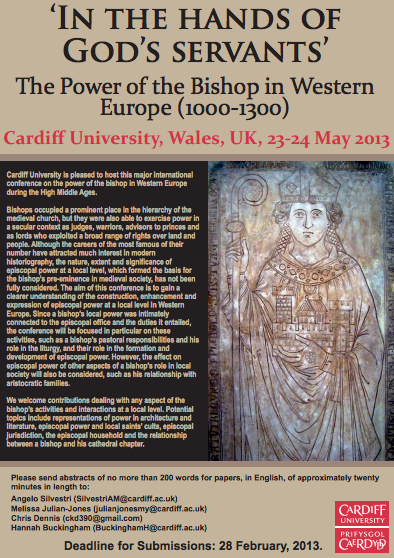
‘In the hands of  God’s servants’. The Power of the Bishop in Western Europe (1000-1300)
Cardiff University, Wales, UK
23-24 May 2013

Cardiff University is pleased to host this major international conference on the power of the bishop in Western Europe during the High Middle Ages. 
Bishops occupied a prominent place in the hierarchy of the medieval church, but they were also able to exercise power in a secular context as judges, warriors, advisors to princes and as lords who exploited a broad range of rights over land and people. Although the careers of the most famous of their number have attracted much interest in modern historiography, the nature, extent and significance of episcopal power at a local level, which formed the basis for the bishop’s pre-eminence in medieval society, has not been fully considered. The aim of this conference is to gain aclearer understanding of the construction, enhancement and expression of episcopal power at a local level in Western Europe. Since a bishop’s local power was intimately connected to the episcopal office and the duties it entailed, the conference will be focused in particular on these activities, such as a bishop’s pastoral responsibilities and his role in the liturgy, and their role in the formation and development of episcopal power. However, the effect on episcopal power of other aspects of a bishop’s role in local society will also be considered, such as his relationship with aristocratic families. 
We welcome contributions dealing with any aspect of the bishop’s activities and interactions at a local level. Potential topics include representations of power in architecture and literature, episcopal power and local saints’ cults, episcopal jurisdiction, the episcopal household and the relationship between a bishop and his cathedral chapter. 
Please send abstracts of no more than 200 words for papers, in English, of approximately twenty minutes in length to: 
Angelo Silvestri (SilvestriAM@cardiff.ac.uk)
Melissa Julian-Jones (julianjonesmy@cardiff.ac.uk)
Chris Dennis (ckd390@gmail.com)
Hannah Buckingham (BuckinghamH@cardiff.ac.uk)
Deadline for Submissions: 28 February, 2013
We anticipate this event will be free. However we can only confirm this in February 2013. To register your interest, sign up here now:
Publié dans Appel à contributions | Laisser un commentaire

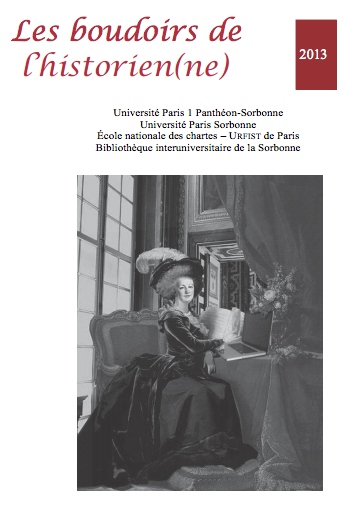
Séminaire – Les boudoirs de l’historien(ne) : formation sur les ressources numériques en histoire

Les boudoirs sont propices aux conversations, et  l’historien(ne), en son boudoir, converse avec des auteurs, des textes, des catalogues que des conservateurs ont organisés, classés, archivés. À l’occasion des rencontres organisées par les écoles doctorales d’histoire des universités Paris 1 Panthéon Sorbonne, Paris Sorbonne et de l’École nationale des chartes, la bibliothèque interuniversitaire de la Sorbonne, le réseau des bibliothèques de Paris 1 et enfin l’URFIST de Paris, ces conversations généralement intimes vont trouver voix et public…

L’objet précis des Boudoirs est de faire connaître les ressources électroniques en histoire (instruments de recherche, dictionnaires, bases de données, périodiques électroniques), de valoriser la méthodologie documentaire et leur appropriation ainsi que d’exposer et critiquer l’utilisation qui peut en être faite. 

De fait, l’offre documentaire, tant dans les lieux de conservation que via internet, est considérable, mais reste mal connue et sous-utilisée. Il s’agit donc ici d’informer, de renseigner et de mettre en commun les connaissances et les pratiques des outils documentaires numériques de la recherche en histoire, en privilégiant les échanges et retours critiques entre spécialistes.

Public privilégié : les doctorants, les chargés de cours et les professionnels de l’information en charge de service public ou/et de formations qui sauront à leur tour « converser » avec les étudiants et leurs collègues.

Séance du lundi 21 janvier 2013 : 
Le médiéviste face à ses sources archives et manuscrits
Olivier Mattéoni (professeur Paris 1-LAMOP)
Ghislain Brunel (conservateur Archives nationales)

Informations pratiques : ici
Publié dans Séminaire | Laisser un commentaire

Appel à contribution – La réception de l’ancien roman de la fin du Moyen Âge au début de la période classique

Colloque à Tours les 10 et 11 octobre 2013
Date limite : le 15 janvier 2013
Le département de Grec de l’Université de Tours et le Centre d’Études Supérieures de la Renaissance organisent à Tours, les 10 et 11 octobre 2013, le VIIe Colloque international sur l’Ancien Roman.
Comme le précédent (Roman VI, octobre 2011), cette manifestation scientifique sera dédiée à la réception de l’Ancien Roman, qu’il soit d’origine païenne (corpus canonique des romans grecs et latins, fragments divers) ou chrétienne (Actes apocryphes ou récits hagiographiques à caractère romanesque), depuis la fin du Moyen-Âge jusqu’au début de l’âge classique.
Le sujet, assez vaste, a été limité à trois axes de recherche :
  • traduction,
  • adaptation,
  • imitation.
Le colloque sera plurilingue (allemand, anglais, français, espagnol, italien), selon les sphères linguistiques et culturelles évoquées et selon le milieu universitaire des collaborateurs.
Le nombre des participants est limité à 22. Les Actes (comme ceux des précédents colloques, Roman I à VI) seront publiés aux Presses de la Maison de l’Orient, Lyon, et diffusés par les éditions de Boccard, Paris.
Une réponse est souhaitée avant le 15 janvier 2013.
Le comité d’organisation :
Cécile Bost-Pouderon, Richard Hillman, Bernard Pouderon
Responsable : Bernard Pouderon
Bulletin d’inscription à renvoyer à :
prof. Bernard Pouderon
6 allée de la Cordaize 37100 Tours
ou, par mail, à bpouderon@free.fr
Source de l’information : Cornucopia
Publié dans Appel à contributions | Laisser un commentaire

Colloque – Kloster und Herrschaft. Interdisziplinäres Kolloquium zum monastischen Leben in Zeiten der Krise

Das interdisziplinäre Kolloquium Kloster und Herrschaft – zum monastischen Leben in Zeiten der Kriseleistet einen Beitrag, Forschende zu Schweizer Klöstern interdisziplinär und Fakultäten sowie Universitäten übergreifend zu vernetzen. Die ab 2013 jährlich stattfindende Kolloquiumsreihe schafft eine Basis für den Austausch zwischen Doktorierenden, Postdocs und ExpertInnen der Sozial- und Geisteswissenschaften, allen voran der Geschichtswissenschaften, Theologie (Kirchengeschichte), Germanistik, Kunstgeschichte, Musikwissenschaften, Hilfswissenschaften sowie Erziehungswissenschaften. 

Das zweitägige Kolloquium Kloster und Herrschaft findet am 25. und 26. Januar 2013 an der Universität Zürich statt und widmet sich der neusten Forschung zu monastischem Leben in Zeiten des Umbruchs anhand der Themenfelder Stiftung und Memoria, Lebensweisen und Neuanfänge, in welchen die interdisziplinäre Annäherung an die Geschichte klösterlicher Gemeinschaften möglich wird. Die gewählten Themenblöcke zeigen die Möglichkeiten verschiedener Zugangsperspektiven, indem jeweils Projekte aus zwei unterschiedlichen Disziplinen vorgestellt und besprochen werden.

In der Vorstellungsrunde Forschungsprojekte I ist es für alle anwesenden NachwuchswissenschaftlerInnen möglich, sich und ihr Forschungsprojekt kurz vorzustellen. Diese Vorstellungsrunde kann, muss aber nicht durch Medien wie Posters oder Slides unterstützt werden und soll zu spontanen Rückmeldungen anderer Kolloqiumsteilnehmern anregen. Die Runde wird von einer Gesprächsleitung strukturiert. In der Vorstellungsrunde Forschungsprojekte II erhalten drei Promovierende die Gelegenheit, ihr Projekt zu umreissen und Inputs von ExpertInnen und KollegInnen entgegenzunehmen. Interessierte sind aufgefordert, sich möglichst bald bei den Organisatorinnen zu melden. Alle NachwuchswissenschaftlerInnen, Vortragende wie Teilnehmende, haben die Möglichkeit, Abstracts ihrer Forschungsprojekte einzuschicken, um sich und ihre Tätigkeit der Forschungsgemeinschaft bereits im Vorfeld der Tagung über die Ausschreibungswebseite http://www.geschichte.klostermuri.ch/veranstaltungen.html bekannt zu machen. 

Für weitere Informationen sowie Anmeldungsmöglichkeiten stehen die Website http://www.geschichte.klostermuri.ch/veranstaltungen.html oder Nina Caprez ninaflurina.caprez@unifr.ch zur Verfügung.

Programme :
Freitag 25.1.2013 
Teil I: Stiftung und Memoria
16:00-16:15 : Prof. Dr. Martina Stercken (Historikerin/Mittelalter, UZH) – Einführung 
16:15-17:00 : Franziska Jahn, B.A. (Historikerin, UZH) – Überlieferung Stiftung Memoria Muri 
17:00-17:45 : Dr. Charlotte Bretscher-Gisiger (Historikerin), Christian Sieber, lic. phil. (Historiker) – Memoria in den Acta Murensia aus klösterlicher und habsburgischer Perspektive 
18:00-19:00 : Vorstellungsrunde Forschungsprojekte I (5 Minuten pro Forschungsprojekt)
19:30 : Gemeinsames Abendessen
Samstag 26.1.2013 
Teil II: Monastische Lebenswelten
09:00-09:15 : Prof. Dr. Markus Ries (Theologe/Kirchenhistoriker, UNILU) – Einführung
09:15-10:00 : Dr. des. Guido Gassmann (Kirchenhistoriker) – Konversen im Mittelalter – Eine Untersuchung anhand der neun Schweizer Zisterzienserabteien 
10:00-10:45 : Dr. des. Ruth Wiederkehr (Germanistin) – Deutschsprachige Gebete des 14. und 15. Jahrhunderts im monastischen Alltag eines Frauenklosters: Eine Analyse des Sarner Gebetbuchbestands 
11:00-12:00 : Vorstellungsrunde Forschungsprojekte II: 3 Beiträge à je 20 Minuten
Teil III: Neuanfänge
13:00-13:15 : Prof. Dr. Carlo Moos (Historiker/Neuzeit, UZH) – Einführung
13:15-14:00 : Pascal Pauli, lic. phil. (Historiker, UZH) – Der Neubau des Klosters Muri im 18. Jahrhundert 
14:00-14:45 : Dr. Anja Buschow Oechslin (Kunsthistorikerin) – Zum Klosterneubau in Einsiedeln 
(25 Minuten Präsentation gefolgt von 20 Minuten Diskussion)
15:00-15:45 : Nina Caprez, lic. phil. (Historikerin, UNIFR) und Annina Sandmeier-Walt, lic. phil. (Historikerin, UZH) – Schlussdiskussion, Leitung
Informations pratiques :
Kloster und Herrschaft. Interdisziplinäres Kolloquium zum monastischen Leben in Zeiten der Krise 
25./26. Januar 2013
Universität Zürich, SOC 101, Rämistrasse 69, 8001 Zürich

Source de l’information : ici
Publié dans Colloque | Laisser un commentaire

Offre d’emploi – Histoire de l’alimentation : recherche appliquée (Université de Namur)

Le Département d’histoire de l’Université de Namur recrute un(e) chercheur(euse) (50%, avec possibilité de passer à 100%). Histoire de l’alimentation – recherche appliquée 

Tâches 
  • réaliser, au sein de la Cellule d’appui aux indications géographiques (CAIG – SPW), des recherches historiques sur les produits du terroir wallon (collecte de données, analyse et communication écrite et orale) ; 
  • travailler en collaboration avec la DGARNE du Service Public de Wallonie, l’Université de Liège – Gembloux Agro Bio-Tech et les producteurs ; 
  • participer aux activités collectives du PolleN (voir www.fundp.ac.be/pollen ). 
Profil 
  • master en histoire, de préférence orientation moderne ou contemporaine, réussi avec Grande Distinction minimum ou expérience de plusieurs années ; 
  • très bonne connaissance du français oral et écrit ; 
  • aptitude et goût pour la recherche scientifique ; 
  • sens de la communication ; 
  • capacité de travailler de façon autonome tout en s’intégrant dans une équipe de recherche. 

Les candidats titulaires d’un excellent CV dans une autre période que l’histoire moderne ou contemporaine ne doivent pas hésiter à poser leur candidature. 

Contacts : 
Professeur Isabelle Parmentier (isabelle.parmentier@fundp.ac.be)
La candidature, accompagnée d’un CV, doit être envoyée au plus tard le 1er février 2013, uniquement par mail, au Professeur Isabelle Parmentier (isabelle.parmentier@fundp.ac.be) pour une entrée en fonction au 1er avril 2013. La candidature fera l’objet d’un accusé de réception.
Publié dans Offre d'emploi | Laisser un commentaire

Summer School – Crossing the Languages of Medieval Europe: Historical, Linguistic and Literary Approaches

Crossing the Languages of Medieval Europe: Historical, Linguistic and Literary Approaches 
3-8 June 2013 Academia Belgica, Rome 
Medieval Europe was marked by far-ranging linguistic diversity. Religion, ethnicity, conquest, gender, profession, socio-economic position, and literary form, among many factors, all shaped and were shaped by language choices and intercultural exchanges. From Iceland to the Eastern Mediterranean, these factors combined in varying ways across the sacred and secular languages of a Europe already engaged beyond its permeable and never clearly defined borders. 
This summer school seeks to open-up and conceptualize this linguistic diversity in order to challenge the established paradigms within which the disciplines of history, linguistics and literature study and teach the medieval past. Students, tutors and lecturers will be drawn from different disciplinary, chronological and geographical specialisms. The aim of the summer school is to go beyond individual specialisms in order to bring different expertises into productive and creative dialogue. Interdisciplinary collaboration will enable new questions of wider significance to be asked and explored. These new questions will, in turn, enrich each student’s own specialist research and help him or her to establish an international network as an early career researcher. 
Possible themes include international languages, relationships of secular and sacred languages, readership and reading, linguistic borders, writing of vernacular languages, what constitutes a vernacular language, language and literary canonization, communication (scholarly, diplomatic, ecclesiastical, merchant and court, for examples), intellectual and literary consequences of multilingualism, impact of modern nationalisms, the EU and globalization on study of medieval languages.
Programme
The summer school will be organized around lectures, discussion groups and time for informal talk. In the mornings, lectures, all of which will be followed by a seminar of the whole group, will address large themes. In the afternoon, smaller seminar groups, each led by a tutor, will work together over the course of the summer school on a series of case studies. There will be substantial reading in advance. Lunches and two dinners will be in common. There will be an excursion on Wednesday (there is no cost for the excursion). 
Tutors are Jeroen Deploige (Ghent University), Christian Høgel (University of Southern Denmark), Lars Boje Mortensen (University of Southern Denmark), Elizabeth Tyler (University of York), and Wim Verbaal (Ghent University). 
The morning lectures will be delivered by Panagiotis Agapitos (University of Cyprus), Robert Bartlett (University of St Andrews), Karla Mallette (University of Michigan, Ann Arbor) and David Wallace (University of Pennsylvania).
Practical information
Application
Applications should be sent before the 15th February 2013 to Martine.DeReu@UGent.be. 
The summer school is open to PhD students of medieval European history, linguistics and literature. In addition to working in their research with texts in at least two medieval languages, students will be expected to read English and either French and/or German. Lectures and seminars will be held in English. Applications should include an abstract of your current research (no more than one side of A4, single spaced) and a statement addressing the contributions you can make to the summer school and what you hope to gain from participating (no more than one side of A4, single spaced). One referee, who will be willing to write in support of the application, has to be named. Referees of short-listed applicants will be contacted directly by the organizers of the summer school. 
There is no cost for attending the summer school. 
Accomodation and transport
Participants need to provide for their own lodging and transport. There is a limited number of free shared rooms available in the Academia Belgica which will be assigned on a first-come first-serve basis. 
Useful information can be found on the following websites: Academia Belgica: http://www.academiabelgica.it/ 
Hotels: 
 Youth Hostels: 
Lunches and two dinners will be provided by the organizers. The participants will take care of the other meals. 
Meals bursaries
Five bursaries (500€) and free shared accommodation in the Academia Belgica are available. Please address your application to Martine.DeReu@UGent.be before the 15th of February 2013, detailing your travel costs and financial need. 
This project is organized by the Centre for Medieval Literature (University of Southern Denmark and University of York) and the Henri Pirenne Institute for Medieval Studies (Ghent University).
Publié dans École d'été, Séminaire, Stage | Laisser un commentaire

Appel à contribution – Medieval Art History after the Interdisciplinary Turn

Medieval Art History after the Interdisciplinary Turn

University of Notre Dame, March 28-29, 2014

This conference brings together a diverse group of scholars representing Byzantine, Islamic, and western European fields to consider the methods and insights of medieval art history in disciplinary terms and in dialogue with the interdisciplinary practice of medieval studies.

In the spring of 2014 it will have been twenty years since Jeffrey Hamburger and Michael Camille confronted the relationship of medieval art history with medieval studies in a volume of conference proceedings, The Past and Future of Medieval Studies (Notre Dame, 1994), and twenty-six years since Herbert Kessler’s authoritative assessment of the state of medieval art history in the Art Bulletin (1988). Since these landmark statements, the interdisciplinary character of medieval art history has become “a given” for new generations of scholars trained in the field. At the same time, a decided “turn” to the visual and material has become increasingly evident throughout medieval studies, as scholars in other disciplines have selectively embraced or appropriated domains of evidence and methods of visual analysis and material interpretation once regarded as the purview of art historians.

In light of these developments, this conference seeks papers that critically examine the convergences and divergences that mark the intersection of medieval art history and a broader tradition of interdisciplinary medieval studies ever more invested in visual and material evidence. What modes of analysis and argument distinguish medieval art history from other art historical fields and from the interpretation of material and visual evidence practiced, variously, by other medievalists? How might older traditions of art historical inquiry reinvigorate an expanding conversation about medieval works of art and material culture? And perhaps above all else: what can an interdisciplinary practice of art history now contribute to medieval studies?

Adhering to the tradition of forward-thinking inquiry promoted by the Medieval Institute at the University of Notre Dame, this prospective – rather than retrospective – conference aims to frame new questions, formulate future research agendas, and identify lacunae in the current state of our knowledge that require new approaches, and new work.

As a forum for rigorous but collaborative dialogue, questioning, and critique among participants, we hope the conference will encourage lively intellectual and collegial exchange, that will ramify in ongoing conversation, future collaborations, and publications.

Submission Guidelines

Submissions are invited for the following conference panels. Proposals of no more than 300 words, along with a two-page CV, should be sent to the organizers of the appropriate panel no later than January 15, 2013. Multiple submissions will not be accepted.

Panels

Objects, Agency, and Efficacy

Panel Organizers:

Beate Fricke, University of California-Berkeley (fricke@berkeley.edu)

Cecily Hilsdale, McGill University (cecily.hilsdale@mcgill.ca)

What work did objects do in medieval culture? What made an object efficacious? Art historians have begun to take seriously objects, including amulets, talismans, ex-votos, funerary effigies, astrolabes, eye glasses, decorative armaments, furniture, textiles, as well as the sacraments of the Christian church and a wide range of medieval counterfeits, that raise important questions of agency, efficacy, and authority. This session seeks papers that engage questions of aura, efficacy, and authority in relation to the production, instrumentality, perceived animation and participation of medieval works and subjects in material and visual culture. While anthropologically informed habits of analysis have proved useful in relation to these issues, the session also welcomes alternative approaches.

Medieval Art History in the Expanded Field

Panel Organizers:

Eric Ramírez-Weaver, University of Virginia (emr6m@eservices.virginia.edu)

Christopher Lakey, Johns Hopkins University (clakey@jhu.edu)

As the field of art history evolved during the twentieth and now twenty-first centuries, the range of objects considered by art historians expanded greatly, transgressing the bounds of a canonical series of acknowledged “masterpieces.” Simultaneously, with the appearance of departments devoted to visual studies and visual culture, together with the new emphasis given to interdisciplinarity, works of art, architecture, and material culture increasingly appear as evidence in the work of other disciplines. Given these developments, can we identify medieval art history’s disciplinarity? Do we want to? How, as medievalists, do we practice art history in this expanded evidentiary and methodological field? Can we envision an “art history” of physical beauty in the Middle Ages? How would an art historical account of the medieval natural landscape or night sky proceed? What might traditional art historical concerns with questions of style or quality contribute to medieval art history in the expanded field? And how do disciplinary modes of analysis succeed or fail when confronted with historical works or phenomena that stretch the boundaries of what has traditionally been recognized as the “stuff” of art historical argument? This session invites papers that take up questions of disciplinarity and evidence by means of specific case studies or focused historical or historiographic cruxes.

Technique, Technology, and Process

Panel Organizers:
Richard Leson, University of Wisconsin-Milwaukee (leson@uwm.edu)

Danielle Joyner, University of Notre Dame (djoyner@nd.edu)

How might renewed consideration of artistic and artisanal techniques and processes affect our vision of the material, visual and intellectual cultures of the Middle Ages? Could art historians better integrate insights from the history of science and archaeology with traditional connoisseurial attention to facture in our interpretations of medieval works of art, architecture and material culture? Can we imagine a new critical formalism in which sustained engagement with artistic and artisanal processes, techniques, and technologies yields a different vision of our objects and monuments? How might such an attention to the making and facture of medieval works transform our understanding of the role of the « hand » in the making of historical cultures? This session welcomes papers that investigate making, artifice, and the specific formal constitution of medieval works of art.

Ornament and the Decorative: When the “minor” is major

Panel Organizers:

Alicia Walker, Bryn Mawr College (awalker01@brynmawr.edu)

Aden Kumler, University of Chicago (akumler@uchicago.edu)

Might the Middle Ages, broadly construed, be best described as an “age of ornament”? While historians of Islamic art have long attended to the function and/or significance of ornament, historians of European medieval art have yet to develop robust accounts of ornament or “the decorative” in medieval material and visual culture. So too, recent work has foregrounded the importance of so-called « minor arts » in the medieval period, challenging the primacy of architecture and book arts in the history of medieval art. This session invites papers that interrogate field-specific habits of thought in relation to the art historiography of ornament and “the minor arts” in the Middle Ages, that consider how “the minor arts” and the « ornamental » were central to medieval aesthetic experiences, or otherwise question how scholarly presumptions concerning media, mimesis, &/or the utility vs autonomy of works may influence our vision of medieval art and material culture.

Publié dans Appel à contributions | Laisser un commentaire

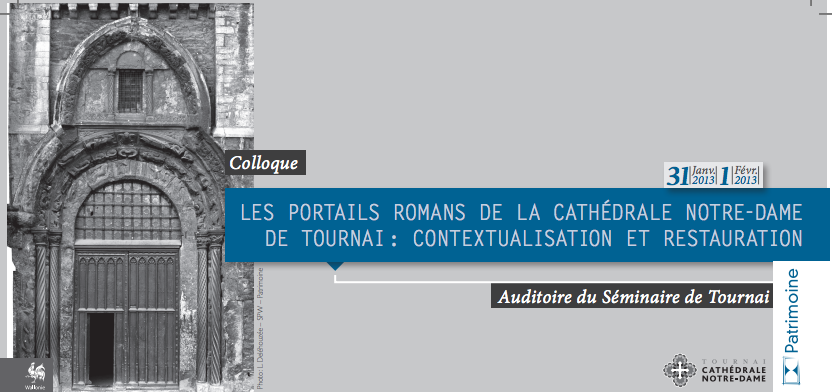
Colloque – Les portails romans de la cathédrale Notre-Dame de Tournai : contextualisation et restauration

Les portails romans de la cathédrale Notre-Dame de Tournai : contextualisation et restauration
Colloque organisé à Tournai les 31 janvier et 1er février 2013.

L’étude des portails médiévaux connait depuis quelques années un regain d’intérêt. Ceux de la cathédrale de Tournai, monument inscrit sur la liste du patrimoine mondial, figurent parmi les plus intéressants de Belgique. La Porte Mantile et la Porte du Capitole, du XIIe siècle, sont sans doute les plus grands portails romans du pays. Leur forme trilobée semble relativement exceptionnelle ; elle leur confère tout leur cachet et conduit à des rapprochements utiles avec l’orfèvrerie de la même époque. La sculpture des portails, comme plaquée, n’a pas dévoilé tous ses mystères, notamment quant à sa place dans le programme iconographique global de la cathédrale. Dans le cadre du vaste plan de restauration de la cathédrale, ces deux portails devront être restaurés en profondeur. Une pré-étude est en cours pour mieux comprendre leur structure. La pierre de Tournai, qui en est constitutive, reste mal connue et il est donc difficile de déterminer quel traitement de conservation doit lui être appliqué.

Dans le prolongement de cette pré-étude et dans la perspective de la restauration, l’IRPA et le département du Patrimoine du Service Public de Wallonie organisent une rencontre internationale. Ce colloque sera l’occasion de mettre à jour les connaissances sur le sujet et envisagera aussi la contextualisation de ces deux portails. Cette réunion visera prioritairement l’approfondissement des connaissances de ceux-ci dans leurs dimensions les plus larges, qu’elles soient techniques, typologiques, stylistiques, iconographiques, etc. L’architecture autant que la sculpture retiendront l’attention. La dimension comparative avec des portails contemporains, en particulier de France, sera également au coeur des préoccupations de la rencontre.

Programme :

Jeudi 31 janvier 2013

10h00 : À l’auditoire du Séminaire de Tournai – Accueil des participants et café

10h30 : Carlo di Antonio, Ministre du Patrimoine, Pierre Paquet, Inspecteur général a.i., SPW / DGO4 / Département du patrimoine, Christina Ceulemans, Directeur général a.i., IRPA – Discours introductifs

Présidence de séance – Dany Sandron, Université de Paris-Sorbonne – Paris IV

11h00 : Laurent Deléhouzée SPW / DGO4 / Département du patrimoine – La place des portails dans la chronologie du chantier roman de la cathédrale de Tournai
11h30 : Benoît Van Den Bossche, Université de Liège – La porte Mantile et la porte du Capitole dans l’histoire de l’art roman: une historiographie par défaut
12h00 : Jean-Claude Ghislain, Docteur en histoire de l’art et archéologie – Université de Liège – Considérations sur les particularités constitutives des portails romans de la cathédrale de Tournai
12h30 : Questions-réponses
13h00 : Lunch

Présidence de séance – Xavier Barral i Altet, Université de Rennes 2 et Venise, Ca’Foscari

14h00 : Jeroen Westerman, Het Gelders Genootschap – Arnhem –  Universiteit Leiden – Typologie architecturale et composition formelle des portails latéraux de la cathédrale de Tournai
14h30 : Marcello Angheben, Université de Poitiers – Les portails du groupe d’Aulnay et leurs rapports avec les portails latéraux de la cathédrale de Tournai
15h00 : Jacqueline Leclercq-Marx et Constantin Pion, Université libre de Bruxelles – La psychomachie de la porte Mantile.  Approche comparée
15h30 : Pause-café

16h00 : Nicolas Reveyron, Université Lumière – Lyon 2 –  Les portails romans de l’ancienne priorale clunisienne Saint-Pierre de Nantua : archéologie du bâti, archéologie de l’image et restitution des programmes effacés
16h30 : Questions-réponses

Conférence publique

18h00 : Xavier Barral i Altet, Université de Rennes 2 et Venise, Ca’Foscari  – Les images des grands portails romans dans la ville médiévale ou l’ordre féodal du monde entre religion et politique 


Vendredi 1er février 2013

Le rendez-vous est fixé à l’Evêché, salle «Bâtir » où se tiendra la première communication


09h00 : Accueil des participants – café
09h30 : Vincent Brunelle, architecte en chef des monuments historiques – auteur de projet de la cathédrale – Introduction aux travaux de restauration, présentation de la philosophie de restauration

10h00 : Vincent Brunelle, architecte en chef des monuments historiques – auteur de projet de la cathédrale et Laurent Deléhouzée, SPW / DGO4 / Département du patrimoine – Visite commentée de la cathédrale

12h30 : Repas libre
Présidence de séance – Francis Tourneur, Université de Liège
14h00 : Laurent Fontaine, Roel Hendrickx, Hilde De Clercq, IRPA, Michiel Dusar, Eric Groessens, Service géologique de Belgique, et Francis Tourneur, Université de Liège – Les portails romans de la cathédrale de Tournai : caractérisation technique et matérielle des mécanismes de dégradation de la pierre de Tournai

14h30 : Fabrice Dagrain, Université de Mons – Etudes préalables dans le cadre de la restauration ou de la réhabilitation d’ouvrages patrimoniaux

15h00 : Pause-café
15h30 : Lieselote Hoornaert, IRPA – Condition assessment and conservation methodology for the Romanesque Portals of the Notre-Dame Cathedral of Tournai

16h00 : Barbara Lubelli, Université de Delft, et Timo G. Nijland, Netherlands, Organisation for Applied Scientific Research TNO – The mausoleum of Maarten Tromp (Old Church, Delft) : investigation of the decay affecting the Tournai stone elements

16h30 : Questions-réponses
17h00 : Françoise Duperroy, SPW / DGO4 / Département du patrimoine, et Pierre-Yves Kairis, IRPA – Conclusions

17h30 : Drink de clôture
Informations pratiques :
31 janvier-1er février 2013
Auditoire du Séminaire de Tournai
Colloque international organisé par la DGO4 / Département du patrimoine / Direction de la protection du patrimoine, avec la collaboration scientifique de l’IRPA

Programme au format PDF et bulletin d’inscription : ici
Publié dans Colloque | Laisser un commentaire

Appel à contribution – Translating Myth

An international conference organized by the Centre for Myth Studies at the University of Essex, supported by the Department of Literature, Film, and Theatre Studies and the Centre for Psychoanalytic Studies.

The Centre for Myth Studies at the University of Essex is pleased to announce an international conference to be held from 5 to 7 September 2013 at firstsite, the home of contemporary visual arts in Colchester. We invite proposals for papers (of 20 minutes duration), or panel sessions (three papers), exploring the theme of ‘Translating Myth’. The organisers would particularly welcome interdisciplinary contributions, especially ones that bridge the domains of literature and psychoanalysis, but we encourage submissions on all aspects of myth that involve the idea of translation. ‘Translating myth’ is to be taken in a broad sense as encompassing any topic that addresses the process of conversion or transfer of cultural sources construed as mythic. The organizers list the following keyword combinations as a stimulus to thought, but, as it always is with myth, your own ideas should allow the imagination free rein in deciding on the possibilities offered by the conference theme:

Accommodation and assimilation; adaptations of the classics; anamnesis and orality; archetypes, prototypes, stereotypes; astrology and astronomy; babel and fable; boundaries and interfaces; chaos and creation; enchantment and ecstasy; gender and hybridity; genre and media; illud tempus and terra incognita; interdisciplinarity and multiculturalism; identity and intertextuality; mask and mandala; migration and transfer; monad, binary, triad, quaternity; mythos and logos; omens and oracles; register and revelation; resistance and change; rites of passage and cultural transfer; roots and rituals; sacred and profane; stage and screen; storyteller, poet, shaman, auteur; theories, poetics, dialectics; transformation and transposition; versions and motifs; zero and hero(ine).

Plenary speakers : David Hawkes (Arizona State University), Miriam Leonard (University College London), Harish Trivedi (University of Delhi).

The deadline for proposals is Friday 25 January, 2013. Proposals should take the form of a title for the paper and a 250-word abstract, accompanied by a brief biographical note, including institutional affiliation where appropriate. To submit a proposal, or for more information, please write to Dr Leon Burnett, Department of Literature, Film, and Theatre Studies, University of Essex, Wivenhoe Park, Colchester, Essex CO4 3SQ or, by e-mail, to mythic@essex.ac.uk.

It is planned to publish a selection of papers on ‘Translating Myth’ after the conference.

Note: Thanks to the generosity of the Bean Trust, a limited number of bursaries are available for speakers contributing to a panel session on the place that William Blake occupies in the field of myth. If you wish to apply for one of these bursaries, please indicate in your proposal.
Publié dans Appel à contributions | Laisser un commentaire

Appel à contribution – Artistic Translations between the 14th &16th Centuries

Medieval and Early Modern One-Day Seminar at the University of Warsaw
Warsaw, April 18, 2013

Deadline for abstracts: January 14, 2013.
Keynote speakers:
Paul Binski (University of Cambridge)
Grayna Jurkowlaniec (University of Warsaw)

Various striking similarities between art from geographically distant locations tempted art historians to analyze and compare specific examples of regional artistic solutions. Until recently most scholars placed their efforts on identifying influences stimulating creation of visually similar art in different locations. Presently the term influence itself was subject to revision, followed by the rejection of its implicit straightforward direction of any artistic connection, and instead arguably more useful term translation had been introduced.

This workshop is aimed at young researchers and is centered around the idea of transregional translation of art in Latin Europe between c.1300 and c.1600. While we will entertain papers on visual connections between any two different regions we particularly seek papers that address the understudied European regions such as British Isles, Norway, Sweden, Poland, Hungary. 

We encourage papers based on specific examples that challenge previous attempts to coordinate stylistically and chronologically similar artistic endeavors from different European regions.

Possible topics include but are not limited to:
  • Direct or mediated access to models from other regions, and issues of the debatable priority of designs. 
  • Local traditions as well as cultural conditions that created context for reception of various foreign designs.
  • Restating of various artistic traditions versus old fashioned idea of foreign imports estranged from singular and homogenous local output. 
  • Arguably unified expectations formulated by patrons of arts, including nuanced differences in taste within Christian Church and at various European courts (different entourages, different family alignments).
  • European codification of certain representational norms and motifs within religious, cultural and political context.
Please send an abstract (less than 250 words) and short biography to zuzanna.ilnicka@cantab.net by January 14, 2013.

Source de l’information : ArtHist.net
Publié dans Appel à contributions | Laisser un commentaire