Web – The Psalter of Henry VI is Now Online

Regular readers of the British Library blog will know that the British Library currently has a number of projects underway to make fully digitised medieval manuscripts available on the Digitised Manuscripts website – including the long-running Greek manuscript project, Harley Science, and our most recent undertaking, which will include a number of manuscripts from the Royal exhibition.
Alongside these projects is an ongoing effort to upload some of the British Library’s manuscript treasures, such as the Lindisfarne Gospels, the Old English Hexateuch, and the Æthelstan Psalter. Today we are pleased to announce the latest addition to this group – the Psalter of Henry VI (Cotton MS Domitian A. XVII), a beautifully illuminated 15th century Parisian manuscript.
Publié dans Web | Laisser un commentaire

Colloque – La pensée sérielle, du Moyen Âge aux Lumières

Pour donner ordre et compréhensibilité à l’univers qui l’entoure, l’homme médiéval développe une nette prédilection pour la pensée sérielle. Les quatre éléments, les cinq sens, les sept vices et vertus … Alors que ces catégories mentales organisées en liste permettent de structurer la pensée, les nombres qui président à ces séries ont valeur symbolique et rendent compte des correspondances entre microcosme et macrocosme. Entre les différentes séries se tissent souvent des réseaux de correspondance, obligeant quelquefois à de sérieux tours de passe-passe. Car comment réduire, par exemple, les cinq sens aux quatre éléments ?
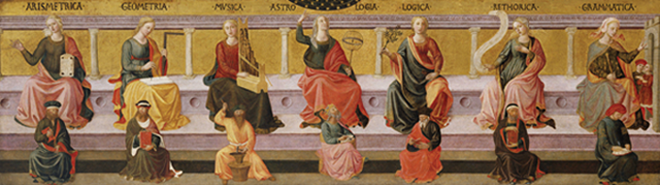
Atelier de Francesco Pesellino, cassone représentant les sept arts libéraux, moitié du XVe siècle
Liée à la pensée métaphorique, c’est souvent par le truchement du symbole et de l’allégorie que la pensée sérielle s’exprime aux niveaux textuel et visuel. Par ailleurs les séries littéraires telles que les Neuf Preux, les Douze Pairs ou encore les dix journées du Décaméron connaissent également un succès considérable, jusque dans la première modernité et au-delà (Les 120 Journées de Sodome…). 
Dans ce colloque, nous examinerons le fonctionnement de la pensée sérielle dans la période médiévale et pendant la première modernité, ainsi que les transformations qu’elle subit au cours des siècles. Comment ce mode de pensée, solidement assis dans la conception médiévale de l’univers, continue-t-il à opérer dans la première modernité ? Est-ce qu’il correspond toujours à un désir fondamental d’organiser la réalité, ou est-il devenu surtout un dispositif rhétorique? Que devient le lien entre la pensée sérielle et le mode d’expression métaphorique ? Le nombre garde-t-il sa charge symbolique? Les réseaux de correspondance entre les séries continuent-ils à exister, et d’ailleurs quels sont les effets qui en ressortent dans les différentes périodes ? Comment passe-t-on de la pensée sérielle à la pensée encyclopédique ? Rencontre-t-on des ruptures par rapport aux modèles sériels (pré)existants, un jeu sur les nombres habituels, d’autres phénomènes de dislocation? Que signifient alors ces écarts ? Comment le recours à l’énumération, la série, la liste, permet-il une meilleure compréhension de l’esthétique de l’époque ?

Programme :

Informations pratiques :

La pensée sérielle, du Moyen Âge aux Lumières. Colloque international et interdisciplinaire, les 7 et 8 juin 2012, Université de Groningen, Pays-Bas

Organisation

Dr. Anne-Marie De Gendt, Dr. Alicia C. Montoya
Renseignements pratiques: Marijke Wubbolts
Publié dans Colloque | Laisser un commentaire

Offre d’emploi – De Tien Geboden en het ideaal van introspectie en individuatie in de Late Middeleeuwen (ca. 1300 – ca. 1550)

Bij de vakgroep Letterkunde van de Faculteit Letteren en Wijsbegeerte (UGent), afdeling Nederlands, is de volgende betrekking vacant:
Voltijds projectmedewerker (m/v) in het kader van het FWO-onderzoeksproject De Tien Geboden en het ideaal van introspectie en individuatie in de Late Middeleeuwen (ca. 1300 – ca. 1550)
Profiel
– master (Historische) Taal- en Letterkunde met zwaartepunt Nederlands, master Nederlandse Letterkunde, of een andere discipline met aantoonbare competentie op het onderzoeksgebied (graden strekken tot aanbeveling)  
– bewezen interesse voor en competentie in de studie van Middelnederlandse geestelijke letterkunde – onderzoeksgerichte attitude  
– in staat zijn academische publicaties te lezen in het Engels, Duits en Frans
Opdracht
– het schrijven van een doctoraatsverhandeling waarin de Middelnederlandse geschriften over de Tien Geboden of Decaloog centraal staan (voor een korte projectomschrijving, zie http://www.nederlandseliteratuur.ugent.be/onderzoek/historischeletterkunde)  
– het publiceren van minstens twee artikelen in internationale wetenschappelijke tijdschriften  
– het leveren van bijdragen op wetenschappelijke congressen en workshops
Begin en duur van de opdracht
– voltijdse functie voor de duur van 4 jaar 
– indiensttreding ten laatste op 1 oktober 2012 (ook studenten die hun masterdiploma in het academiejaar 2011-2012 zullen behalen kunnen zich kandidaat stellen) 
Hoe solliciteren ?
Per e-mail vóór 15 mei 2012, met in bijlage CV en motivatiebrief aan Youri.Desplenter@UGent.be.
Voor meer informatie:
Prof. dr. Youri Desplenter

Universiteit Gent – Faculteit Letteren en Wijsbegeerte

Historische Nederlandse Letterkunde (middeleeuwen)
Blandijnberg 2 
B – 9000 Gent 
+32 (0)9 264 40 71

http://www.nederlandseliteratuur.ugent.be/personeel?departmentnumber=lw10&ugentid=801001367151

Prof. dr. Jürgen Pieters

Universiteit Gent – Faculteit Letteren en Wijsbegeerte

Algemene Literatuurwetenschap / Historische Nederlandse Letterkunde (vroegmoderne periode)
Blandijnberg 2 
B – 9000 Gent 
+32 (0)9 264 40 97

http://www.nederlandseliteratuur.ugent.be/personeel/departmentnumber/lw07/ugentid/801001021082

Publié dans Offre d'emploi | Laisser un commentaire

Offre d’emploi – Casa de Velázquez – Recrutement d’un chercheur contractuel

Madrid
La Casa de Velázquez recrute un docteur dans le cadre du programme ANR-DFG EPISTOLA : « La lettre en péninsule Ibérique et dans l’Occident latin. Héritages et transformations d’un genre littéraire (IVe-XIe siècle) ». Le contrat débutera le 1er septembre 2012 pour une durée de douze mois, renouvelable jusqu’à vingt-sept mois (au total).

Les candidats doivent s’engager à résider à Madrid. Le montant annuel brut de rémunération est fixé à 26 000 €.

Profil :  Les candidats doivent avoir soutenu récemment une thèse d’histoire ou de littérature médiévale. La préférence sera donnée à un spécialiste de la période étudiée et qui aura démontré une bonne maîtrise du latin médiéval. Une bonne connaissance du français et au moins d’une autre langue internationale (allemand, espagnol ou anglais) est requise (oral et écrit). La candidature n’est soumise à aucune condition de nationalité.

Activités :  
Les missions qui seront assignées à la personne recrutée sont les suivantes.
1) Élaborer sur le site internet de la Casa de Velázquez, en liaison avec le service informatique de l’établissement, un espace en ligne assurant la communication du groupe en son sein et vers la communauté scientifique.

2) Piloter l’élaboration par un prestataire de service et la mise en fonctionnement de la base de données collective ; former à son usage les chercheurs rattachés à la Casa de Velázquez et assurer le suivi des saisies.

3) Participer à la préparation des missions des chercheurs rattachés à la Casa de Velázquez et gérer les demandes de numérisation de documents, qui seront adressées à des centres d’archives et à des bibliothèques dans ces deux pays.

4) Participer à la collecte des données, à leur saisie informatique et à leur étude. Un corpus de sources épistolaires lui sera assigné en fonction des compétences qu’il aura acquises à l’occasion de la préparation de sa thèse de doctorat.

5) Participer à la préparation des réunions scientifiques qui se tiendront en Espagne et à l’édition des actes de colloques.

Procédure : 
 Les candidats sont invités à envoyer en version électronique une lettre de motivation, un Curriculum vitae détaillé, un exemplaire de leur thèse et de leurs éventuelles publications à Madame Christelle Pellier, responsable des ressources humaines : christelle.pellier@cvz.es . La date limite de dépôt des dossiers est fixée au 1er juin 2012. 

Contact et informations : 

http:// www. casadevelazquez.org

Publié dans Offre d'emploi | Laisser un commentaire

Nouvelle acquisition de la Bibliothèque royale de Belgique

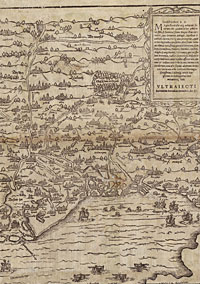
La Bibliothèque royale de Belgique ajoute une nouvelle perle à ses collections. En effet, elle vient d’acquérir la « Corte Cronikel » (Brève chronique) de Cornelis van Hoorn, une chronique du monde en néerlandais contenant un fragment de carte qui se révèle être la plus ancienne carte topographique imprimée de nos régions !
Cette chronique du monde se compose de 18 feuilles imprimées, coloriées à la main, assemblées ici en rouleau, et faisait autrefois partie d’un atlas « Blaeu ». L’exemplaire acquis par la Bibliothèque royale porte la date de 1586. Il constitue une réédition de la chronique de Cornelis van Hoorn de 1537 à laquelle a été ajoutée une feuille complémentaire contenant la suite de la chronique jusqu’en 1557. Cette dernière feuille est imprimée sur un fragment de carte gravée représentant les Pays-Bas méridionaux.
La chronique du monde est unique à plus d’un titre. Premièrement, cette édition complète de 1586 n’a été retrouvée nulle part ailleurs, avec ou sans la feuille ajoutée. De plus, ce fragment de carte constitue une découverte en soi car il permet de compléter la carte de 1526 de l’éditeur anversois Jan Van Hoirne, conservée de manière incomplète. En effet, la feuille représentant les Pays-Bas méridionaux ne figure pas dans l’exemplaire conservé de cette carte de Van Hoirne. Dès lors, la carte gravée au verso de la dernière feuille de la chronique du monde de Van Hoorne est la plus ancienne carte topographique imprimée de nos régions, autrement dit de la Belgique telle que nous la connaissons aujourd’hui.
L’identification de la carte est basée sur l’étude de M. Marco van Egmond, conservateur des cartes et atlas de la Bibliothèque de l’Université d’Utrecht. L’acquisition a été recommandée par M. Wouter Bracke, Chef de la section des Cartes et Plans de la Bibliothèque royale de Belgique.
Grâce à l’intervention d’un mécène, la Bibliothèque royale de Belgique a pu acquérir cette carte pour la somme de 30.000 euros.
Publié dans News | Laisser un commentaire

Conférence – “Beter een simpele wever dan een voorname rechter”. Arbeid, religie en sociale identiteit in de hoogmiddeleeuwse stedelijke gemeenschappen

Woensdag 2 mei, Doelenzaal UB, 15:30-17:00 met aansluitend een borrel

Center of Medieval Studies Amsterdam presenteert :


“Beter een simpele wever dan een voorname rechter”. Arbeid, religie en sociale identiteit in de hoogmiddeleeuwse stedelijke gemeenschappen

Lezing: prof. dr. Jeroen Deploige, Universiteit van Gent

De opkomst van stedelijke gemeenschappen vormde een van de belangrijkste ontwikkelingen tijdens de hoge middeleeuwen. Het ontluiken van de middeleeuwse stad ging hand in hand met nieuwe definities van vrijheid en inspraak, met handel en nijverheid, met de opkomst van corporatieve structuren, met de verdichting van het parochiale netwerk, met het ontstaan van nieuwe dagelijkse praktijken en groepsidentiteiten, met nieuwe opvattingen over tijd, arbeid en lekenspiritualiteit. In deze lezing open ik een cultuurhistorische kijk op de perceptie en performance van sociale identiteit in de vroegste stedelijke samenlevingen van de Zuidelijke Nederlanden en het Rijnland tussen de late elfde en de vroege dertiende eeuw. Ik focus niet zozeer op het eigenlijke ontstaan van die nieuwe groepen, maar vooral op de vraag hoe deze groepen zich bewust werden van hun eigenheid, hoe ze hun samenhorigheid tot uiting brachten en hoe ze door anderen werden gepercipieerd. Mijn bijzondere aandacht gaat uit naar wevers, die zich niet alleen als de vroegste loonarbeiders in het verstedelijkingsproces gingen onderscheiden, maar die vaak ook als verspreiders van heterodoxe religieuze opvattingen werden gezien. Voor deze lezing haal ik voorbeelden uit, in de eerste plaats, Sint-Truiden, maar ook uit St.-Omer, Atrecht, Kamerijk, Brugge, Luik, Keulen… Op die manier hoop ik een facet uit de geschiedenis tot leven te brengen dat vanwege een grote schaarste aan bronnen nog maar heel partieel gekend is.

We hopen u de eerste woensdag van de maand te mogen ontvangen.

Hartelijke groet,
Gaby Zijlstra
_____

Universiteit van Amsterdam
Faculteit der Geesteswetenschappen
Departement Geschiedenis, archeologie en regiostudies

Gaby Zijlstra
secretariaat Geschiedenis

PC Hoofthuis | kamer 5.54
Spuistraat 134 | 1012 VB Amsterdam
T 020 525 4496

Werkdagen: ma/di/do 9.00-17.00 en vr 9-12


Publié dans Colloque | Laisser un commentaire

Offre d’emploi – Poste académique – Histoire – Université de Gand

UNIVERSITEIT GENT
VACATURE – VACANCY
In de Faculteit Letteren en Wijsbegeerte is met ingang van 1 februari 2013 een deeltijds ambt (40%) van docent of hoofddocent te begeven binnen de vakgroep Geschiedenis, voor een opdracht omvattend academisch onderwijs, wetenschappelijk onderzoek en wetenschappelijke dienstverlening in het vakgebied Methodologie en hulpwetenschappen van de middeleeuwse geschiedenis.

Profiel van de kandidaat:
– op het ogenblik van de indiening van de kandidatuurstelling houder zijn van een diploma van doctor op proefschrift in de Geschiedenis, of van een gelijkwaardig erkend diploma;
– over minstens twee jaar postdoctorale ervaring beschikken op 1 februari 2013;
– hoogstaand wetenschappelijk onderzoek verricht hebben in het opgegeven vakgebied,
gestaafd door recente publicaties in nationale en internationale wetenschappelijke
tijdschriften en/of boeken die een ruime verspreiding kennen en die een beroep doen op
deskundigen voor de beoordeling van de ingezonden manuscripten;
– beschikken over aantoonbare paleografische vaardigheden en over kennis van het Latijn en
van West-Europese middeleeuwse volkstalen;
– beschikken over de nodige didactische, communicatieve en organisatorische vaardigheden om academisch onderwijs te verstrekken;
– aantoonbare ervaring met Digital Humanities strekt tot aanbeveling;
– internationale mobiliteit o.m. door onderzoeksverblijven in onderzoeksinstellingen extern aan de instelling waaraan de hoogste academische graad werd behaald, strekt tot aanbeveling.
– bereidheid tonen om Nederlands te leren, indien men deze taal niet beheerst op het ogenblik van de sollicitatie.

Volgend document dient bij de kandidatuur te worden gevoegd:
– een tekst (max. 1500 woorden) waarin de sollicitant zijn/haar visie op onderzoek, onderwijs en wetenschappelijke dienstverlening m.b.t. de te begeven functie uiteenzet.

Niet-Nederlandssprekende kandidaten kunnen eveneens solliciteren. De officiële taal aan de
Universiteit Gent is het Nederlands

De selectie gebeurt in twee fasen:
1. op basis van curriculum vitae, publicatiedossier en ingediende visietekst wordt een short list samengesteld;
2. iedereen op de short list kan uitgenodigd worden voor een interview/proefles op basis waarvan een definitieve rangschikking zal gebeuren van de kandidaten.

Dit deeltijds ambt (40%) geeft in de regel aanleiding tot een aanstelling voor een welomschreven beperkte hernieuwbare tijdsduur.

Afhankelijk van het specifieke profiel van de geselecteerde kandidaat wordt de graad docent dan wel hoofddocent toegekend.

Nadere informatie in verband met dit ambt en de inpassing ervan in de strategische krachtlijnen van de vakgroep kunnen worden verkregen bij prof. Erik Thoen (Erik.Thoen@UGent.be; tel. +32(0)9 331 02 01) of via de website van de vakgroep Geschiedenis: http://www.ugent.be/lw/geschiedenis.

De kandidaturen dienen in tweevoud per aangetekend schrijven gericht aan de rector van de
Universiteit Gent, Rectoraat, Sint-Pietersnieuwstraat 25, 9000 Gent, op de daartoe voorziene sollicitatieformulieren voor ZAP, vergezeld van de bekwaamheidsbewijzen (afschriften van diploma’s), uiterlijk op 25 mei 2012.

De sollicitatieformulieren voor ZAP kunnen worden bekomen op het adres van de Universiteit Gent t.a.v. de directie Personeel en Organisatie, Sint-Pietersnieuwstraat 25, 9000 Gent, of telefonisch aangevraagd op nrs. +32 (0)9 264 31 28 of +32 (0)9 264 95 48. Ze worden eveneens op het internet ter beschikking gesteld, URL:
http://www.ugent.be/nl/werken/aanwerving/formulieren/zap/formulier.doc/view

Ghent University
Vacancy for a professorship

The Faculty of Arts & Philosophy invites applications for the part-time (40%) position of professor in the rank of Lecturer or Senior Lecturer in the Department of History, taking effect on February 1, 2013. Responsibilities will include academic teaching, research and service in the field of methodology and auxiliary sciences of medieval history.

Candidate’s Profile

– on the day of application, candidates are required to hold a doctor’s degree with a doctoral
thesis in History (or equivalent thereof);
– candidates are required to have at least two years of postdoctoral experience on February 1,
2013;
– candidates are required to have research experience in the field of methodology and auxiliary
sciences of medieval history, as is evident from contributions to international conferences and publications in books and/or peer-reviewed journals;
– candidates are required to possess both demonstrable palaeographical skills and knowledge of Latin and Western-European medieval vernaculars;
– candidates are required to possess the necessary didactic, organizational and communicative skills for teaching in an academic context;
– demonstrable experience with Digital Humanities will be considered an asset;
– international experience gained, for instance, through participation in research programmes at institutions other than one’s own, will be considered an asset.

Candidates are required to show their willingness to learn Dutch (insofar as they do not speak this language on the day of application).

The candidates are required to submit an outline (max. 1500 words) explaining their views on research, teaching and administrative duties in relation to this vacancy.

Non-Dutch-speaking candidates can also apply. The official language at Ghent University is Dutch.

Selection procedure:
1. candidates will be short-listed on the basis of their curriculum vitae, bibliography, and the
outline;

2. short-listed applicants will be invited for an interview and required to present a micro-class, on the basis of which the final selection will be made.

This part-time (40%) position is an appointment for a clearly defined, limited and renewable
period of time.

Depending on the specific profile of the selected candidate, s/he will be appointed in the rank of Lecturer or Senior Lecturer.

For further information about this vacancy, applicants are welcome to contact Professor
Erik Thoen (Erik.Thoen@UGent.be or +32 (0)9 331 02 01) or visit the website of the History
Department: http://www.ugent.be/lw/geschiedenis/en.

Applications should be sent in duplicate, and by registered mail to:
the Rector of Ghent University
Rectoraat
Sint-Pietersnieuwstraat 25
B-9000 Ghent
The standard application forms for Autonomous Academic Staff (“ZAP”) should be used, with the required transcripts (copies of degrees) attached. Applications must be sent no later than May 25, 2012.

The application forms for Autonomous Academic Staff (“ZAP”) can be obtained at Ghent
University, Department of Personnel and Organisation, Sint-Pietersnieuwstraat 25, 9000 Gent (tel +32 (0)9 264 31 28 or +32 (0)9 264 95 48), or can be downloaded from the internet:
URL: http://www.ugent.be/nl/werken/aanwerving/formulieren/zap/formulier.doc/view

Publié dans Offre d'emploi | Laisser un commentaire

Journée d’étude – Un « vieux différend » : Le L/logos, le(s) L/livre(s), la Philosophie. Sur l’ouvert et l’origine

Organisé par les Instituts de Philosophie (ISP) & Religions, Spiritualités, Cultures, Sociétés (RSCS) de l’Université de Louvain-la-Neuve

 Un « vieux différend » : Le L/logos,
le(s) L/livre(s), la Philosophie.
Sur l’ouvert et l’origine
Organisateurs
Jean Leclercq, Joaquim Hernandez & Sylvain Camilleri
Avec le Fonds Michel Henry, le Groupe de recherche sur la rationalité théologique & la PFT Fonds-Alpha
Programme
9.00: Jean Leclercq (UCL): Ouvertures. Logos, Mythos & Epos. Avec Heidegger 9.30 : Jérôme de Grammont (Institut Catholique, Paris) : Entre sans-nom et nom propre
10.15: Baudouin Decharneux (ULB): Le Logos dans le récit de la création du monde de Philon d’Alexandrie 
10.45 : Fabien Nobilio (ULB) : La voix peut-elle se faire Verbe ? Le Logos johannique chez Héracléon et Origène
11.15 : Joaquim Hernandez (UCL) : Le Logos, le Moi et l’Incarnation. Sur le christianisme 
11.45 : Marine Manouvrier (ULB) : La vacuité, l’ouvert et l’éveil. Sur le bouddhisme
12.15 : Retour et discussions 
13.00 : Déjeuner
14.30 : Hicham Abdel Gawad (UCL) : Le Logos, le devenir et le vouloir divin. Sur le Coran 
15.00 : Anselme Paluku (UCL) : Un logos interprété : P. Ricœur 
15.30 : Paulo Rodrigues (UCL) : Un logos eschatologique : J. Ladrière 
16.00 : Luca Possati (La Sapienza, Rome) : Un logos « défié » : J. Derrida 
16.30 : Retour et Pause
17.15 : Jérémy Lambert (UCL) : Mythos/logos : écriture et littérature 
17.45 : Olivier Riaudel (UCL) : Logos et formalisation du langage 
18.15 : Retour et discussions 18.45 : Fin des travaux

Informations pratiques
Samedi 28 avril 2012 – 9.00 à 18.30 Salle Jean Ladrière – Collège Mercier, Place cardinal Mercier à 1348 Louvain-la-Neuve – jean.leclercq @ uclouvain.be
Publié dans Colloque | Laisser un commentaire

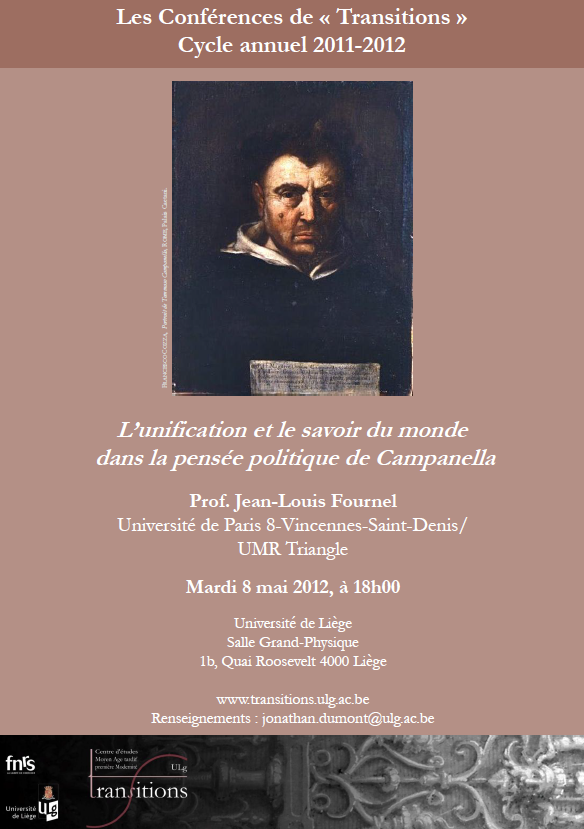
Conférence – L’unification et le savoir du monde dans la pensée politique de Campanella

Le mardi 8 mais 2012 à 18h00, dans le cadre du cycle annuel de conférences organisé par Transitions, le prof. Jean-Louis Fournel (Université de Paris-8-Vincennes-Saint-Denis) tiendra une conférence consacrée à L’unification et le savoir du monde dans la pensée politique de Campanella.

Informations pratiques :
Université de Liège, Salle Grand-Physique
1b, Quai Roosevelt – 4000 Liège.
Renseignements : jonathan.dumont@ulg.ac.be
Publié dans Colloque | Laisser un commentaire

Colloque – 39th International Symposium on Archaeometry : “50 years of ISA”

Location: Leuven, Belgium
28 May – 1 June 2012
Scientific Programme : here
Registration : here

Scope of the conference

The aim of the Symposium is to promote the development and use of scientific techniques in order to extract archaeological and historical information from the cultural heritage and the paleoenvironment. It involves all Natural Sciences and all types of objects and materials related with human activity.
On the town of Leuven…


Leuven is very proud of both its past and its heritage. There is so much to see and to do in and around Leuven that one visit is simply not enough. From the 11th-12th century onwards, Leuven began to develop as an important trading centre. It is now a well-equipped, modern town with a thriving economy and with a good balance of old and new with a rich tradition. Amid all the leisure and student activities, it seems surprising that Leuven finds any time to work. When brewing became a nation-wide industry in the 19th century, Leuven became world famous for its beers, and today it is still proud to be known as the beer capital of Belgium, and possibly even the world…

On the University of Leuven…

Situated at the heart of Western Europe, the KU Leuven has been a centre of learning for almost six centuries. Founded in 1425 by Pope Martin V, KU Leuven bears the honour of being the oldest Catholic university in the world still in existence and the oldest university in the Low Countries.

On archaeometry at the KU Leuven…

In the recent past, at the KU Leuven, there have been many examples of co-operation between archaeological projects and different disciplines from the natural and applied sciences. In 2003 this co-operation was formalized in the Centre for Archaeological Sciences. It acts as a focal point for advanced interdisciplinary research made available to all archaeologists from Leuven, Belgium and the international community in general. The organization of the International Symposium on Archaeometry in 2012 is an extra incentive for the further development of archaeometrical research at the university and in Belgium…

On the symposium…

The symposium will be organised in the (medieval) centre of Leuven, in one of the main auditoria with sufficient capacity and fully equipped with all necessary IT and audio-visual material. Also the necessary room for poster sessions and coffee breaks is nearby. The date of the symposium is 28 May to 1 June 2012. The official language of the symposium will be English.

The fee for the organisation of the symposium in Leuven is 280 Euro (students 125 Euro). This includes the conference fee and book of abstracts, a welcoming reception and a “50 years ISA” reception, all lunches and all coffee breaks.

Travel to Leuven…

Leuven is situated at the very heart of Europe. The town of Leuven is situated at the junction of two major European motorways. Paris, London and Köln are only about two hours away by train. To come to Leuven by air, Brussels airport is situated about 20 km from Leuven and is easily accessible by public transport. Brussels South Charleroi Airport is located at 46 km from Brussels Centre. There are frequent international flights to almost any part of the world.

On the accommodation…

Possibilities for hotel and other accommodation in Leuven (see also http://www.leuven.be) are plenty, ranging in price category from 20 Euro per night (youth hostel) to 180 Euro per night (5-star accommodation).

Liability and Insurance

The organizers of the ISA 2012 meeting do not accept any responsibility for personal injuries, material losses, or damages occurring during or in association with this symposium. It will be the responsibility of the participants to obtain adequate medical, travel or personal insurance for their participation in this event.
Publié dans Colloque | Laisser un commentaire