Appel à contribution – Partikularisierung und Zentralisierung? Wirksamkeit und Wahrnehmungen der Herrschaft Sigismunds von Luxemburg im Reich

Das internationale Forschungsprojekt „Sigismund’s Imperial Rule Reconsidered – Bavaria and the Other Territories of the Empire“ veranstaltet vom 09.-11.02.2026 an der LMU München eine Tagung über die Wirksamkeit und die Wahrnehmungen der Herrschaft König/Kaiser Sigismunds im Heiligen Römischen Reich (1410-1437). Der Call for Papers richtet sich gezielt an jüngere Historiker:innen (Doktorand:innen und Postdoktorand:innen), die sich gerade in einer Qualifizierungsphase befinden und auf diesem Wege ihre zur Tagungsthematik passenden Forschungsergebnisse präsentieren möchten.

Partikularisierung und Zentralisierung? Wirksamkeit und Wahrnehmungen der Herrschaft Sigismunds von Luxemburg im Reich

Zwischen 1387 und 1437 herrschte Sigismund von Luxemburg als ungarischer, römisch-deutscher und böhmischer König sowie Kaiser über weite Regionen Europas. Zahlreiche und vielseitige Quellen künden von den politischen Herausforderungen und Konflikten, mit denen der König konfrontiert war und über die er zu entscheiden hatte. Während die jüngere Forschung zunehmend vergleichende Perspektiven auf die komplexe Realität dieser Personalunion entwickelt hat, erhielten die personellen, wirtschaftlichen und rechtlichen Strukturen seiner Königsherrschaft im Heiligen Römischen Reich zuletzt weniger Aufmerksamkeit. In dem an der LMU München sowie der ÖAW Wien angesiedelten Regesta-Imperii-Projekt „Sigismund’s Imperial Rule Reconsidered – Bavaria and the Other Territories of the Empire“ (Vorgängerprojekt: „Kaiser Sigismund und Bayern“) wird dagegen auf breiter Quellengrundlage die Königsherrschaft Sigismunds in einer wichtigen Region des Reiches erforscht. Dies eröffnet neue Perspektiven auf Sigismunds Königtum im gesamten Reich.

Die internationale Tagung „Partikularisierung und Zentralisierung? Wirksamkeit und Wahrnehmungen der Herrschaft Sigismunds von Luxemburg im Reich“ setzt hier an und untersucht in vergleichender Perspektive, welche Wirksamkeit Sigismunds Königsherrschaft im Reich entfalten konnte und wie sie wahrgenommen wurde. Während sich einerseits Bemühungen des Königs um die Zentralisierung seines Herrschaftsgefüges beobachten lassen, gewannen andererseits zugleich verschiedene Einflussbereiche mit eigenen Partizipationsstrukturen in den Regionen des Reichs an Bedeutung. Vor diesem Hintergrund finden Fragen nach den Möglichkeiten zur Umsetzung von Königsherrschaft im Reich, nach Allianzen, Bündnissen und Konkurrenzen ebenso Beachtung wie nach kommunikativen Strategien und Formen des Konfliktmanagements.

In den einzelnen Sektionen und Beiträgen der Tagung soll vor allem danach gefragt werden, welche Rolle die verschiedenen regionalen Kräfte bei der Umsetzung der Königsherrschaft Sigismunds spielten. Leitende Fragestellungen werden dabei zum Beispiel sein:

– Waren die verschiedenen regionalen Kräfte Gegengewichte und Konkurrenten der Königsherrschaft oder eröffneten sie dem König neue Zugriffsmöglichkeiten?

– Welche Mechanismen und Instrumente der Königsherrschaft kamen in den verschiedenen Regionen zum Einsatz und wie reagierten die jeweiligen regionalen Akteure darauf?

– Wie wurde Sigismund als Herrscher in den verschiedenen Regionen und durch die jeweiligen regionalen Akteure wahrgenommen?

– Welche Rolle spielten Sigismunds zahlreiche und lange Abwesenheiten vom (Binnen-) Reich für seine Wahrnehmung in den einzelnen Regionen und seine Interaktion mit den regionalen Akteuren?

– Wie beeinflussten wichtige Schlüsselereignisse wie z.B. die Konzilien oder Krisen wie z.B. der Hussitenkrieg Sigismunds Beziehungen zu den Regionen im Reich?

– Welche weiteren Akteure waren für die Umsetzung der Königsherrschaft in den verschiedenen Regionen des Reiches von Bedeutung? Was für eine Bedeutung hatte dabei zum Beispiel die Königin, welche Rolle spielten die Fürstinnen?

Der Call for Papers richtet sich gezielt an jüngere Historiker:innen (Doktorand:innen und Postdoktorand:innen), die sich gerade in einer Qualifizierungsphase befinden und auf diesem Wege ihre zur Tagungsthematik passenden Forschungsergebnisse präsentieren möchten. Vortragsvorschläge mit Vortragstitel und Abstract (300-500 Wörter) sowie einen kurzen CV senden Sie bitte bis zum 10.11.2024 an Uwe Tresp (uwe.tresp@lrz.uni-muenchen.de).

Die Konferenzsprachen sind Deutsch und Englisch. Kosten für Reisen und Unterkunft der Referent:innen werden übernommen. Eine Publikation der Beiträge ist geplant.

Kontakt : Uwe.Tresp@lrz.uni-muenchen.de

Source : H-Soz-Kult
Publié dans Appel à contributions | Laisser un commentaire

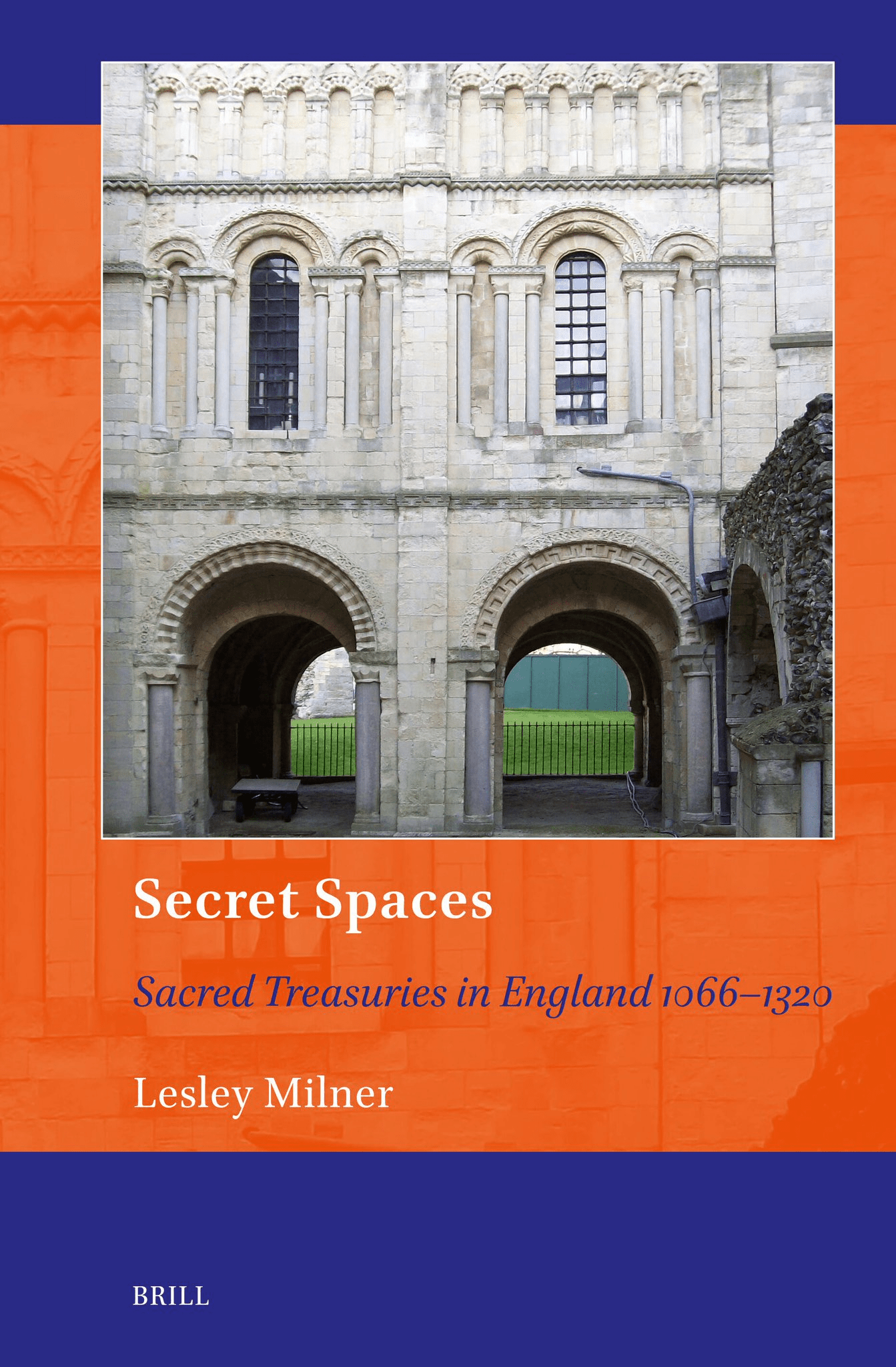
Publication – Lesley Milner, « Secret Spaces: Sacred Treasuries in England 1066–1320 »

The medieval treasure house, consisting of sacristy, vestry and treasure rooms was the depository for the ecclesiastical treasure belonging to a church, holy vessels, vestments, altar hangings, candlesticks and priceless liturgical books and reliquaries. It was carefully designed to convey the message of its status and function.

A book devoted to these medieval museums which housed such precious materials is long overdue. Ironically, the interest in the objects that they conserved has often resulted in ecclesiastical treasure being removed to new museums, leaving their former places of protection in need of protection themselves.

Lesley Milner, M.A. PhD. F.S.A. gained her Ph.D. at the Courtauld Institute, University of London 2015. She is a Fellow of the Society of Antiquaries of London. Since 2016 she has published in the Antiquaries Journal, the Journal of the British Archaeological Association and the Burlington Magazine.

Table des matières : ici

Lesley Milner, Secret Spaces: Sacred Treasuries in England 1066–1320, Boston–Leyde, Brill, 2024 ; 1 vol., XII–254 p. (Art and Material Culture in Medieval and Renaissance Europe, 23). ISBN : 978-90-04-38043-1. Prix : € 140,00.

Source : Brill

Publié dans Publications | Laisser un commentaire

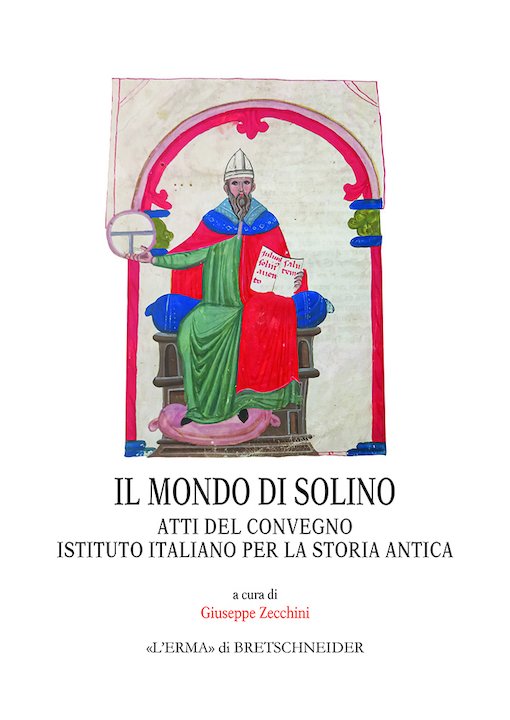
Publication – « Il mondo di Solino. Atti del convegno – Roma, 16/17 febbraio 2023 », éd. Giuseppe Zecchini

All’interno della produzione corografica e taumasiografica del mondo antico il Polyhistor di C. Giulio Solino ha conosciuto negli ultimi vent’anni un’insperata fortuna dopo un oblio più che secolare e si presenta ormai come l’opera di riferimento per la letteratura geografica latina della tarda antichità. Il presente volume raccoglie gli Atti del convegno internazionale su questo autore e il suo contesto culturale tenutosi a Roma il 16 e 17 febbraio 2022 sotto gli auspici dell’Istituto Italiano per la Storia Antica e vuole essere propedeutico all’edizione critica, traduzione e commento storico di Solino, che un’équipe di studiosi italiani sta preparando in funzione di un progetto promosso dall’Istituto stesso.

Table des matières :

Presentazione

Robert Bedon
Titianus comme source très probable de Solin

David Paniagua Aguilar
De los Collectanea rerum memorabilium al Polyhistor. Problemas metodológicos (con una propuesta de edición del capítulo 29)

Alice Borgna
Conchis ipsis inest sensus: animali e emozioni in Solino

Gaetano Arena
Homo minor mundus (Solin.1,93): ‘anatomia’ di un trattato geografico tra pseudoscienza e paradossografia

Edoardo Bianchi
Solinus’ Italy: between Geography and Ethnography

Domenico Giordani
Etnografie salentine: frammenti di dottrina antiquaria tra Solino, Servio e Pseudo-Probo

Salvatore Liccardo
Storie di cannibalismo fra i nomadi eurasiatici. Ricerca di sé e costruzione dell’altro da Erodoto a Gengis Khan, passando per Solino

Giuseppe Zecchini
Solino e la religione

Fabrizio Feraco
La dimensione letteraria dei Collectanea rerum memorabilium: note sullo stile di Solino

Marco Petoletti
‘De Solini scriptis miranda relegi’: episodi della fortuna medievale di Solino

Informations pratiques :

Il mondo di Solino. Atti del convegno – Roma, 16/17 febbraio 2023, éd. Giuseppe Zecchini, Rome L’Erma di Bretschneider, 2024 ; 1 vol., 212 p. (Monografie del Centro Ricerche di Documentazione sull’Antichità Classica, 57). ISBN : 978-8-89133-349-0. Prix : € 80,00.

Source : L’Erma di Bretschneider

Publié dans Publications | Laisser un commentaire

Publication – « Averroes and Averroism in Medieval Jewish Thought », éd. Racheli Haliva , Yoav Meyrav, Daniel Davies

The Andalusian Muslim philosopher Averroes (1126–1198) is known for his authoritative commentaries on Aristotle and for his challenging ideas about the relationship between philosophy and religion, and the place of religion in society. Among Jewish authors, he found many admirers and just as many harsh critics. This volume brings together, for the first time, essays investigating Averroes’s complex reception, in different philosophical topics and among several Jewish authors, with special attention to its relation to the reception of Maimonides.

Racheli Haliva (PhD 2016, McGill) is associate professor of Jewish studies at Shandong University’s Center for Judaic and Inter-Religious Studies and a former co-director of the Maimonides Centre for Advanced Studies at Universität Hamburg. She works on the history of medieval Jewish philosophy and the relationship between Jews and Jewish converts in the Middle Ages.

Yoav Meyrav (PhD 2017, Tel Aviv) is the principal investigator of the ERC-funded HEPMASITE (Hebrew Philosophical Manuscripts as Sites of Engagement) project at Universität Hamburg and a former research associate at the Maimonides Centre for Advanced Studies. He has published on ancient, Arabic, and Jewish philosophy, Hebrew philology, and the history of metaphysics.

Daniel Davies (PhD 2007, Cambridge) has worked for the Taylor-Schechter Genizah Research Unit at the Cambridge University Library and on the “PESHAT in Context” project at Universität Hamburg. He focuses on medieval philosophy and philosophy of religion. His publications include Method and Metaphysics in Maimonides’ Guide for the Perplexed, which received an honourable mention from the Jordan Schnitzer Book Awards. His second book on Maimonides will be published by Polity in 2023.

Table des matières : ici

Informations pratiques :

Averroes and Averroism in Medieval Jewish Thought, éd. Racheli Haliva , Yoav Meyrav, Daniel Davies, Boston–Leyde, Brill, 2024 ; 1 vol., XX–444 p. (Maimonides Library for Philosophy and Religion, 4). ISBN : 978-90-04-67948-1. Prix : € 189,00.

Source : Brill

Publié dans Publications | Laisser un commentaire

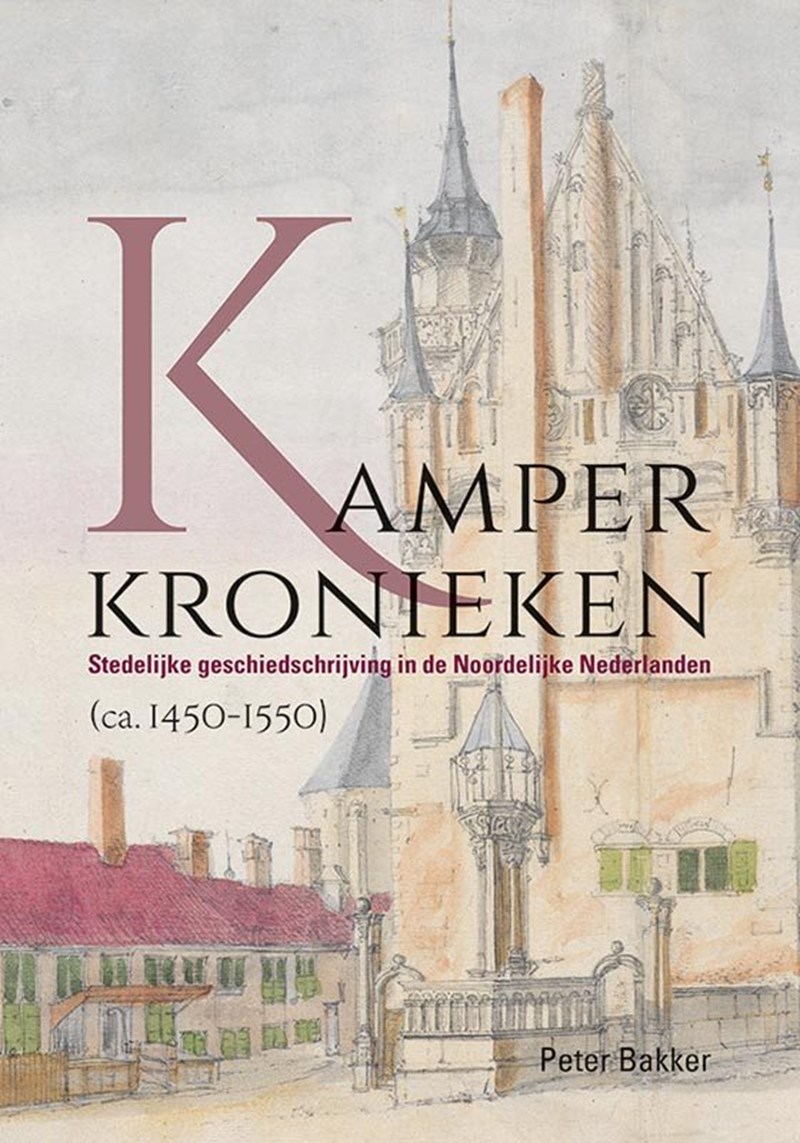
Publication – Peter Bakker, « Kamper kronieken. Stedelijke geschiedschrijving in de Noordelijke Nederlanden (ca. 1450-1550) »

De boeken van de heren zijn duister om te bestuderen, dus houd mond en buidel gesloten.

Op deze wijze waarschuwt de zestiende-eeuwse Kamper stadssecretaris Johan van Breda zijn lezers voor de grilligheid van de landsbestuurders, de heren. Een situatie waar de steden vaak mee te maken kregen, wanneer we de auteurs van de kronieken mogen geloven. De late Middeleeuwen in de Noordelijke Nederlanden waren op veel gebieden een roerige periode. Onder andere de politieke verschuivingen en veranderende economische zwaartepunten hebben hun sporen nagelaten in de stedelijke geschiedschrijving in de Noordelijke Nederlanden. Het is in dit tijdsgewricht dat er niet één, maar twee stedelijke kronieken aan de monding van de IJssel zijn ontstaan.

Daarbij dringt zicht al snel de vraag op: waarom waren er in dezelfde tijd en omgeving twee separate kronieken nodig in Kampen? In dit boek wordt niet alleen de inhoud van de teksten uitvoerig geanalyseerd, maar is er ook volop de ruimte genomen om de achtergrond van de auteurs, de historische context waarin de handschriften zijn gevormd en gebruikt én de fysieke overlevering van de kronieken uiteen te zetten. Het boek eindigt met een comparatief onderzoek waarin is gekeken in hoeverre de Kamper kronieken verschillen of overeenkomen met andere stedelijke kronieken in de Noordelijke Nederlanden, zoals die van Den Bosch, Groningen en Rotterdam.

De twee Kamper kronieken zorgen voor een beter begrip van de functies van stedelijke geschiedschrijving. Bovendien geven ze ons meer inzicht in de staatkundige ontwikkeling van de Nederlanden, in het bijzonder vanuit het perspectief van Kampen. Een stad die er uiteindelijk voor kiest om onderdeel van de Nederlanden van Karel V te worden, maar hetgeen ten tijde van de vervaardiging van de kronieken nog geen uitgemaakte zaak was.

Informations pratiques :

Peter Bakker, Kamper kronieken. Stedelijke geschiedschrijving in de Noordelijke Nederlanden (ca. 1450-1550), Hilversum, Verloren, 2024 ; 1 vol., 426 p. ISBN : 978-9-46455-046-7. Prix : € 39,00.

Source : Verloren

Publié dans Publications | Laisser un commentaire

Base de données – Mise en ligne d’une nouvelle interface pour la base de données Jonas (IRHT-Section romane)

Mise en ligne d’une nouvelle interface pour la base de données Jonas (IRHT-Section romane). 

L’IRHT vient de mettre en ligne une nouvelle interface de la base de données Jonas. La refonte graphique s’accompagne d’une offre accrue quant aux possibilités d’interrogation de la base de données. 

Une présentation complète est publiée sur le carnet de recherche de la Section romane : https://romane.hypotheses.org/7066.

L’adresse de la base de données reste inchangée : https://jonas.irht.cnrs.fr/

Publié dans Banque de données | Laisser un commentaire

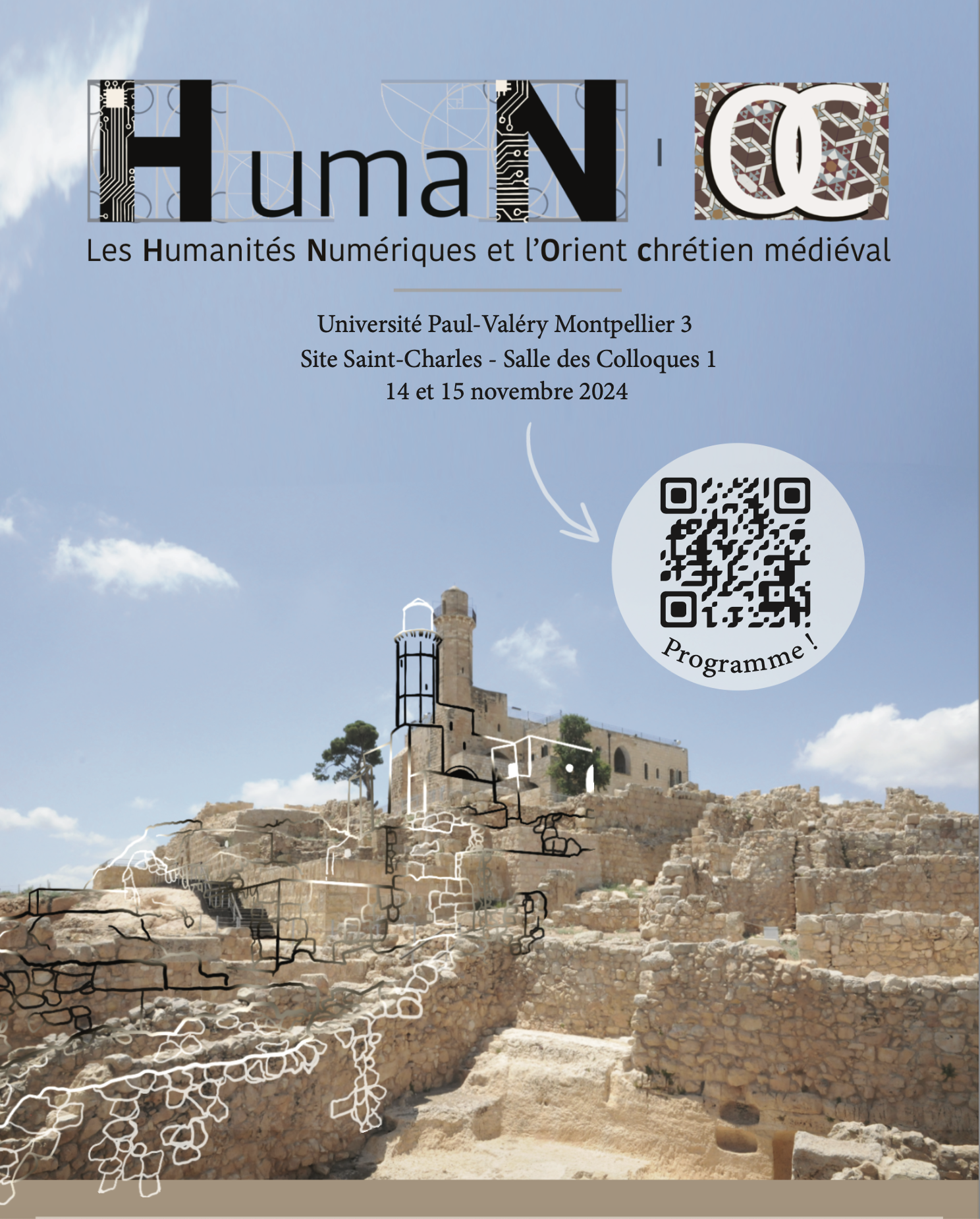
Colloque – Les humanités numériques et l’Orient chrétien médiéval : nouveaux outils, nouvelles approches, nouvelles perspectives

Du Jeudi 14 novembre 2024 au Vendredi 15 novembre

Université Paul-Valéry Montpellier 3, site Saint-Charles 1 – Salle des colloques, 1 rue du Professeur Henri Serre, 34080 Montpellier

JEUDI 14 NOVEMBRE 2024

  • 8H30Accueil des participants

MATINÉE 1

  • 9H-9H30 Florian ARTAUD (Université Paul-Valéry Montpellier 3)
    Introduction
  • 9h30-10hÉlisabeth YOTA (Sorbonne Université / EFA)
    Présentation du projet MistraNum. L’usage et l’apport des nouvelles technologies sur le site archéologique de Mistra (Péloponnèse, Grèce)
  • 10h-10h30 Philippe TRELAT (Université Rouen), Geoffrey MEYER-FERNANDEZ (Aix-Marseille Université / EFA) et Ludivine VOISIN (Université Rouen / EFA)
    Le portail numérique Φραγκικά-Frankika : un nouvel élan pour l’histoire de la Grèce franque et latine
  • 10h30-11h Temps d’échange – Questions
  • 11h-11h15 Pause
  • 11h15-11h45 Estelle INGRAND-VARENNE (Université de Poitiers / CNRS)
    Traiter les inscriptions et graffitis de l’Orient latin : l’environnement numérique de l’ERC GRAPH-EAST
  • 11h45-12h15 Anna GUTGARTS (University of Haïfa) et Myra BOM (Royal Holloway ULondon)
    Revised Regesta Regni Hierosolymitani Database : a Database for the Study of Latin East
  • 12h15-12h45 Temps d’échange – Questions

APRÈS-MIDI 1

  • 14H-14H30 Florian ARTAUD (Université Paul-Valéry Montpellier 3)
    Base de données et cartographie. Pour une nouvelle approche de l’étude des monastères latins dans les États latins du Levant
  • 14h30-15h Simon DORSO (Université Lumière Lyon 2)
    De la charte à la carte et retour : l’apport du SIG à la compréhension de la documentation sur le peuplement rural de la Galilée au XIIe siècle
  • 15h-15h30 Temps d’échange – Questions
  • 15h30-15h45 Pause
  • 15h45-16h15 Clément DUSSART (Université de Poitiers)
    L’apport des humanités numériques à l’étude des graffiti dans les lieux saints : prospecter, enregistrer et analyser
  • 16h15-17h45 Lorenzo MERCURI (Università di Roma La Sapienza)
    La citadelle templière de Tartous à travers les images : outils numériques pour réfléchir sur les origines et en retracer la topographie
  • 17h45-18h15 Temps d’échange – Questions

VENDREDI 15 NOVEMBRE 2024

  • 9h Accueil des participants

MATINÉE 2

  • 9h30-10h Nicolas TATESSIAN (Université de Strasbourg)
    Les humanités numériques au service de l’étude des colophons arméniens
  • 10h-10h30 Chahan VIDAL-GORENE (École nationale des Chartes – PSL)
    Vision par ordinateur et patrimoine arménien écrit
  • 10h30-11h Temps d’échange – Questions
  • 11h-11h15 Pause
  • 11h15-11h45 Isabelle AUGE (Université Paul-Valéry Montpellier 3)
    Sur les pas de Step′annos Orbelean, le temporel de deux monastères de la province de Siwnik′ (Arménie)
  • 11h45-12h15 Sipana TCHAKERIAN (Institut national d’histoire de l’art)
    Édition numérique enrichie et cartographie interactive d’un document inédit : le journal des itinéraires archéologiques des Thierry
  • 12h15-12h45 Temps d’échange – Questions

APRÈS-MIDI 2

  • 14h-14h30 Ludivine VOISIN (Université de Rouen / EFA)
    Outils numériques et nouvelles approches du monde monastique orthodoxe dans les pays grecs dominés par Venise au XVIe siècle
  • 14h30-15h Maureen McGUIRE (University of California Santa Cruz)
    ‟By her righteous toil she built a worthy house”: St. Polyeuktos as a case study of Juliana’s matronage
  • 15h-15h30 Temps d’échange – Questions
  • 15h30-15h45 Pause
  • 15h45-16h15 Isabelle AUGE (Université Paul-Valéry Montpellier 3)
    Conclusion
Publié dans Colloque | Laisser un commentaire

Appel à contribution – Queer Palimpsests: Rewriting Medieval Art History

RAP Graduate Student Symposium
April 11, 2025

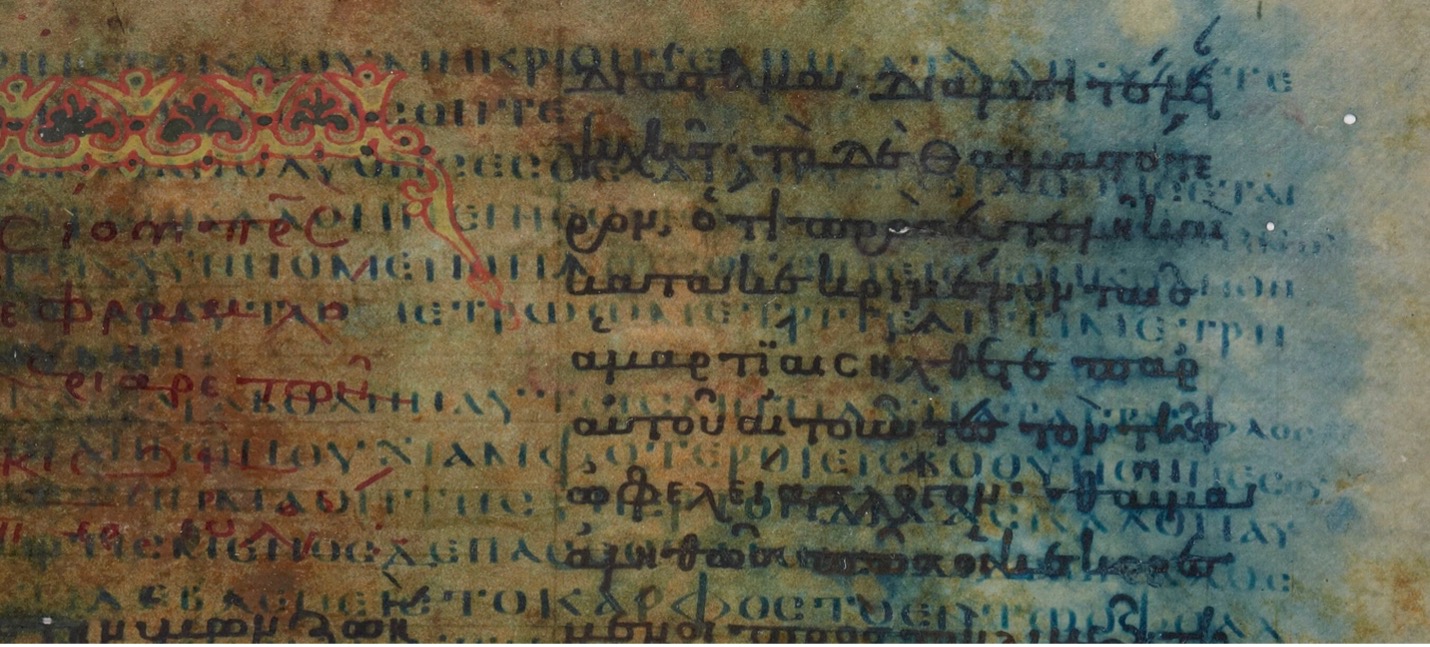
The Research and Academic Program (RAP) at the Clark Art Institute is pleased to invite papers from graduate students for a one-day symposium, “Queer Palimpsests: Rewriting Medieval Art History” on April 11th, to be held in person at the Clark in Williamstown, Massachusetts. In the Middle Ages, palimpsests were parchments whose original text or imagery was effaced in order to reuse their valuable substrate. A transliteration of the Greek word παλίμψηστος (palimpsestos), palimpsest literally means “scraped again,” denoting the process of scraping or rubbing a piece of parchment. Sometimes this repurposing was achieved hastily, leaving behind traces of the original text or image. Beyond its literal meaning, today the term has gained other metaphorical resonances. Collapsing iterations of writing and/or image on the same page, palimpsests evoke questions of temporality, textuality, touch, labor, use, and use value. Queerness has been theorized to—like a palimpsest—decontextualize and reemploy objects. 

The theme Queer Palimpsests evokes this history and is meant to be capacious. Scholars of medievalism might point to the queerness of refashioning the medieval past for the purposes of a given present moment, while medieval manuscript specialists might find queer case studies of palimpsests or imagistic effacement. We also welcome papers that consider historiography and methodology, treating academic discourse over the decades as itself a kind of palimpsestic process. To what extent does the term “palimpsest” comment on the practice of queer medieval art history itself? 

We invite proposals for 20-minute papers from graduate MA, MFA, and ABD students from the fields of art history, architectural studies, queer studies, medieval studies, as well as comparative literature and adjacent disciplines. Interdisciplinary work is welcomed. 

Convened by Luke Williamson (Williams Graduate Program in the History of Art, ’25) and organized by the Research and Academic Program, this semi-private symposium will privilege time for discussion after talks.

The following topics gesture to possible connections with the theme, but are not prescriptive:

  • Medievalism and the afterlives of medieval art
  • Finding affective/symbolic resources for the present from the medieval period
  • Historiographical or methodological investigations, tracing the uses or reuses of queer medieval scholarship 
  • Instances of reuse, including vandalisms, iconoclasms (architectural, illustrated, etc.)
  • Palimpsest theory 
  • Queer temporality
     

The event will conclude with public keynote delivered by Karl Whittington (Professor of Art History at The Ohio State University) on Queer Making: Artists and Desire in Medieval Europe:

What role does desire play in the making of art objects? Art historians typically answer this question with reference to historical evidence about an artist’s sexual identity, personality, and relationships, or with reference to particular kinds of imagery in works of art. But how do we think about desire in the case of anonymous artists or in works whose subject matter is mainstream? We know little about the lives and personalities of the makers of most works of art in Europe in the Middle Ages, but this should not hold us back from thinking about their embodied experience. This talk argues that we can “queer” the works of anonymous historical makers by thinking not about their identities or about the subject matter of their artworks but rather about their embodied experiences working with materials. Through considering issues of touch, pressure and gesture across materials such as wood, stone, ivory, wax, cloth, and metal, Whittington argues for an erotics of artisanal labor, in which the actions of hand, body, and breath interact in intimate ways with materials. Combining historical evidence with more speculative description, this talk broadens our understanding of the motivations and experiences of premodern artists.

Interested participants are invited to submit an abstract of no more than 350 words along with a CV to queerpalimpsests2025@gmail.com by November 12, 2024. Accepted speakers will be notified by late December. The Clark will provide and arrange travel, accommodation (Thursday and Friday nights), and hospitality at the event.

Source : The Clark

Publié dans Appel à contributions | Laisser un commentaire

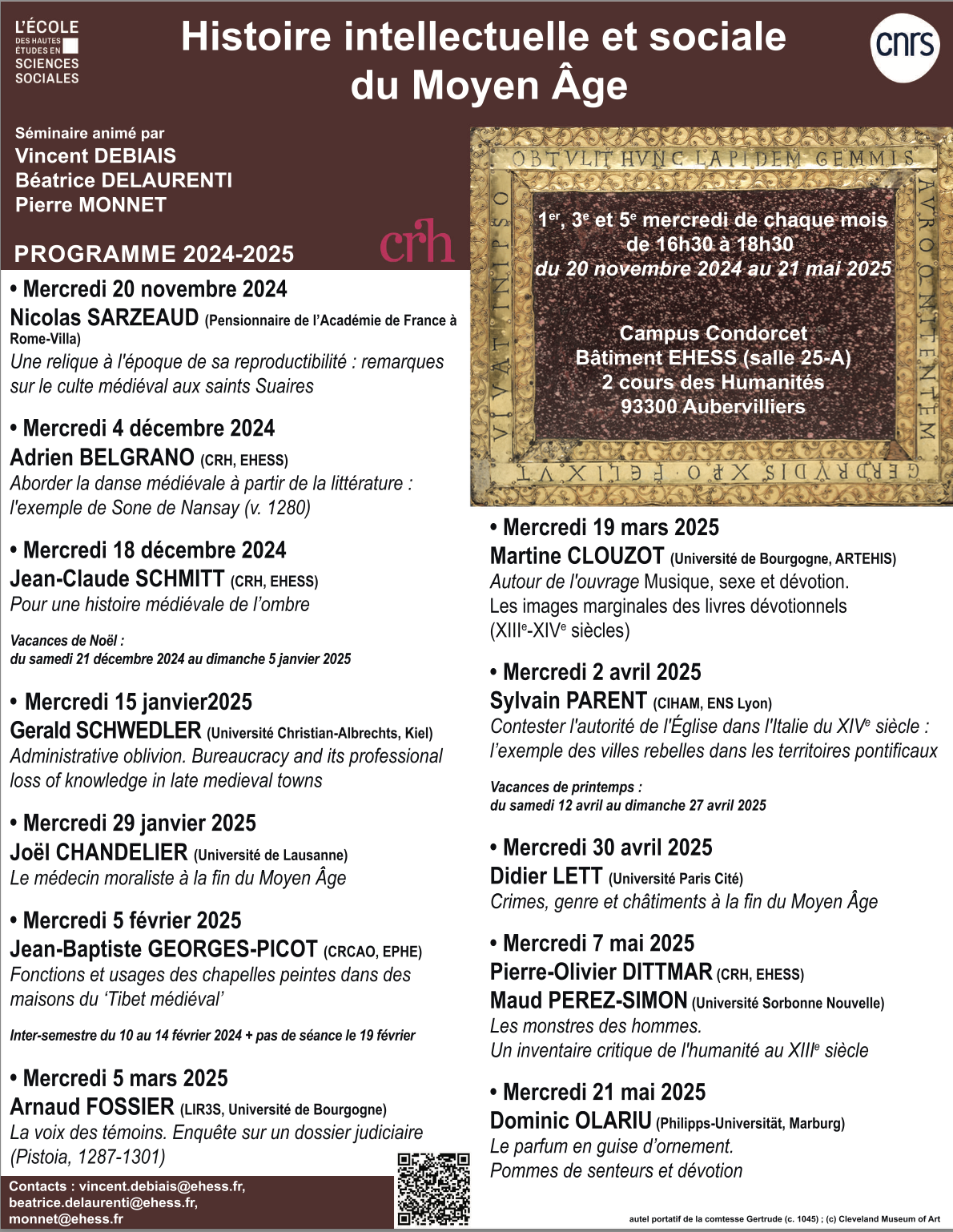
Séminaire – Histoire intellectuelle et sociale du Moyen Âge

Ce séminaire est conçu comme un lieu de formation, de rencontre et de dialogue en histoire anthropologique du Moyen Âge entendu dans sa longue durée. Il se propose, en faisant appel à l’intervention des directeurs du séminaire, des collègues du groupe de recherche réunissant les médiévistes de l’EHESS (AHLoMA), de chercheurs invités et des doctorant·es et postdoctorant·es appelé·es à y présenter leurs travaux en cours, de partir de thématiques renouvelées, d’ouvrages récents, de débats et de questions historiographiques pour présenter et discuter une recherche ouverte, interdisciplinaire et internationale sur la société médiévale. De manière large, le périmètre des objets et des méthodes que ce séminaire entend couvrir s’inscrit dans le champ scientifique revendiqué par le groupe de recherche sur une anthropologie historique du long Moyen Âge (AHLoMA). Il est structuré autour de cinq chantiers de recherche (anthropologie des savoirs ; anthropologie du visuel ; anthropologie du croire ; anthropologie du droit et anthropologie des appartenances), connectés entre eux, supposant chaque fois une forte exigence épistémologique, une réflexion sur la méthodologie, l’historicité et la pratique de l’anthropologie historique dans les limites d’un Occident chrétien plongé cependant dans la comparaison avec d’autres aires culturelles ainsi que d’autres traditions historiographiques européennes et extra-européennes.

Mercredi 20 novembre 2024
Nicolas Sarzeaud (pensionnaire de l’Académie de France à Rome-Villa)
« Une relique à l’époque de sa reproductibilité : remarques sur le culte médiéval aux saints Suaires ».

Mercredi 4 décembre 2024
Adrien Belgrano (CRH, EHESS)
« Aborder la danse médiévale à partir de la littérature : l’exemple de Sone de Nansay (v. 1280) ».

Mercredi 18 décembre 2024
Jean-Claude Schmitt (CRH, EHESS)
« Pour une histoire médiévale de l’ombre »

Vacances de Noël : du samedi 21 décembre 2024 au dimanche 5 janvier 2025

Mercredi 15 janvier 2025
Gerald Schwedler (Université Christian-Albrechts, Kiel)
« Administrative Oblivion. Bureaucracy and its professional loss of knowledge in late medieval towns »

Mercredi 29 janvier 2025
Joël Chandelier (Université de Lausanne)
« Le médecin moraliste à la fin du Moyen Âge »

Mercredi 5 février 2025 : Jean-Baptiste Georges-Picot (CRCAO, EPHE), « Fonctions et usages des chapelles peintes dans des maisons du ‘Tibet médiéval’ »

Inter-semestre du 10 au 14 février 2025 + pas de séance le 19 février

Mercredi 5 mars 2025 : Arnaud Fossier (LIR3S, Université de Bourgogne), « La voix des témoins. Enquête sur un dossier judiciaire (Pistoia, 1287-1301) »

Mercredi 19 mars 2025
Martine Clouzot (Université de Bourgogne)
« Autour de l’ouvrage Musique, sexe et dévotion. Les images marginales des livres dévotionnels (XIIIe-XIVe siècles) »

Mercredi 2 avril 2025
Sylvain Parent (CIHAM, ENS Lyon)
« Contester l’autorité de l’Église dans l’Italie du XIVe siècle : L’exemple des villes rebelles dans les territoires pontificaux »

Vacances de printemps : du samedi 12 avril au dimanche 27 avril 2025

Mercredi 30 avril
Didier Lett (Université Paris Cité)
« Crimes, genre et châtiments à la fin du Moyen Âge »

Mercredi 7 mai
Pierre-Olivier Dittmar (CRH, EHESS) et Maud Perez-Simon (Université Sorbonne Nouvelle)
« Les monstres des hommes. Un inventaire critique de l’humanité au XIIIe siècle »

Mercredi 21 mai
Dominic Olariu (Philipps-Universität, Marburg)
« Le parfum en guise d’ornement. Pommes de senteurs et dévotion »

Informations pratiques :

1er, 3e et 5e mercredi de chaque mois
de 16h30 à 18h30
du 20 novembre 2024 au 21 mai 2025

Campus Condorcet
Ba^timent EHESS (salle 25-A)
2, cours des Humanités
93300 Aubervilliers

Séminaire animé par Pierre Monnet [référent·e] directeur d’études, EHESS / Anthropologie historique du long Moyen Âge (CRH-AHLoMA) Béatrice Delaurenti directrice d’études, EHESS / Anthropologie historique du long Moyen Âge (CRH-AHLoMA) Vincent Debiais directeur de recherche, CNRS / Anthropologie historique du long Moyen Âge (CRH-AHLoMA

Publié dans Séminaire | Laisser un commentaire

Exposition – Dessins anciens. From Bruegel to Rubens

93 dessins anciens, de Bruegel à Rubens, agrémenteront la collection Old Masters dès le 11 octobre.

Deux siècles de l’art du dessin prennent vie dans cette surprenante sélection de près d’une centaine d’œuvres. Du plus méticuleusement fini de Pieter Bruegel au style tourbillonnant de Rubens. Des scènes inventives tirées de la mythologie et de la Bible, des paysages habilement construits et des études spontanées de la vie aux XVIe et XVIIe siècles complètent cet ensemble d’une étonnante variété.

À découvrir avec votre ticket “Old masters”
Catalogue disponible, en vente au shop. Celui-ci se veut être le 5e tome d’une série de 5 : 

  • Tome 1 : Rembrandt et ses élèves (2005)
  • Tome 2 : Dessins du Siècle d’Or hollandais (2007-08)
  • Tome 3 : Disegno & Couleur. Dessins italiens et français du 16e au 18e siècle (2012-2014)
  • Tome 4 : ‘Cabinet des plus merveilleux dessins’. Dessins néerlandais du dix-huitième siècle (2019-2023)

informations pratiques :

Musées royaux des Beaux-Arts de Belgique
Salle 52 – Collection Old Masters

11 octobre 2024 – 16 février 2025

Source : Musées royaux des Beaux-Arts

Publié dans Exposition | Laisser un commentaire