Publication – Elizabeth C. Kelly, « Zoomorphic Incense Burners of Medieval Khurasan. A study of Islamic metalwork »

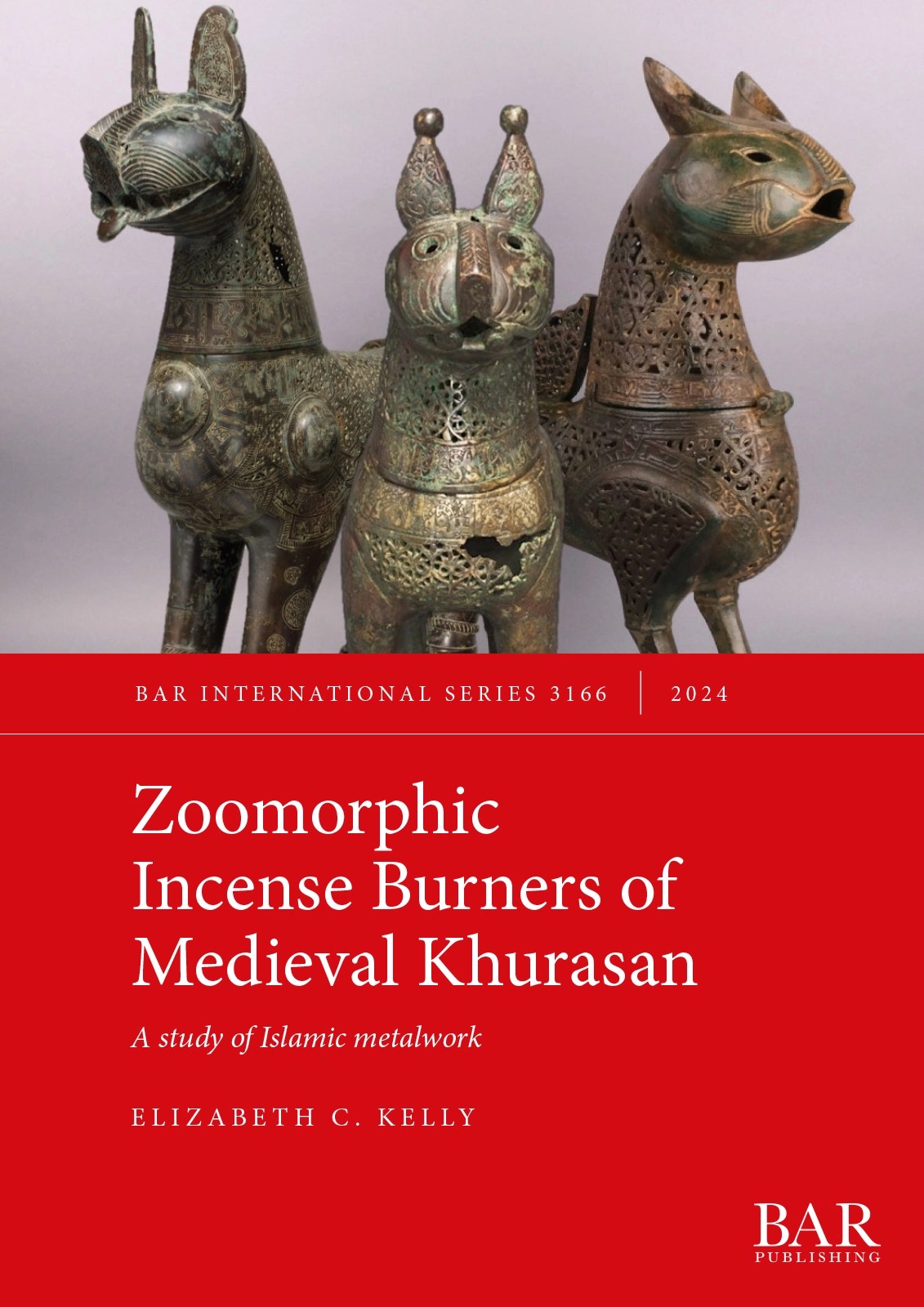
Zoomorphic incense burners were produced in medieval Khurasan between c.441-597/1050-1200. This book examines their role, function and meaning. It includes a database with defined classification criteria that enables them to be contextualised with other contemporaneous metalwork.

Multicultural medieval Khurasan prospered from mercantile activities facilitated by the trade routes. The increased wealth, including middle-class patronage, movement of artisans and goods, along with the resultant transcultural exchanges, all contributed towards a changing aesthetic in artwork that reflect interests and lifestyles. The zoomorphic incense burners that emerged during this time displayed a hybridised iconography of feline and equine characteristics. The analysis indicates they are associated with symbols of power, sovereignty, the military and hunting. Their decorative palmette motifs provide representations of esfand, a plant considered to have talismanic and apotropaic properties known for inducing bravery amongst warriors.

Elizabeth C. Kelly has a PhD in History of Art and Archaeology and a Master’s in History of Art and Architecture of the Islamic Middle East from SOAS University of London.

Table des matières : ici

Elizabeth C. Kelly, Zoomorphic Incense Burners of Medieval Khurasan. A Study of Islamic Metalwork, Oxford, BAR Publishing, 2024 ; 1 vol., 360 p. (International Series). ISBN : 978-1-40735-368-5. Prix : GBP 98,00.

Source : BAR Publishing

Publié dans Publications | Laisser un commentaire

Publication – Jonathan Dumont, « Écrire un avènement. Charles de Habsbourg dans l’œuvre de l’indiciaire Rémi Dupuis »

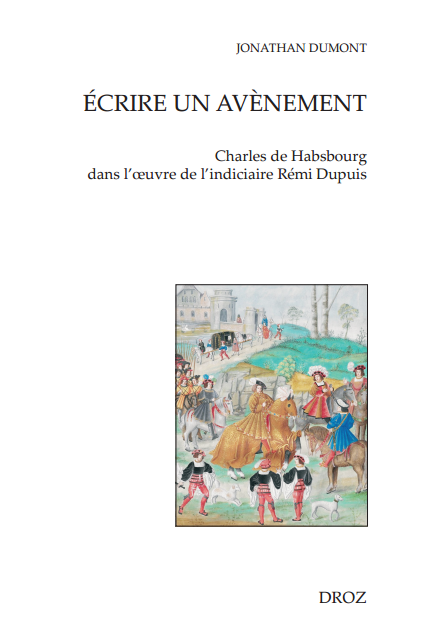
Le 5 janvier 1515, en la grande salle du palais du Coudenberg à Bruxelles, Charles de Habsbourg atteint sa majorité politique, devenant pleinement souverain des Anciens Pays-Bas. Débute ainsi, de 1515 à 1517, une ascension fulgurante qui va lui conférer une envergure continentale. Jonathan Dumont nous éclaire ici sur la manière dont l’avènement de Charles a été mis en récit et commenté dans les Anciens Pays-Bas, durant les années qui précèdent l’élection impériale (1519), en particulier dans l’œuvre de Rémi Dupuis, dernier « indiciaire de Bourgogne ». Son œuvre, tout entière dédiée à la célébration de Charles de Habsbourg, est le témoin privilégié du passage de la dynastie de Bourgogne-Habsbourg à une autre échelle de pouvoir. Tout en proposant une étude historique et littéraire de l’œuvre de Dupuis, cet ouvrage fournit également au lecteur une édition de son œuvre conservée, jusqu’ici inédite.

Docteur en histoire, art et archéologie, Jonathan Dumont est chercheur à l’Académie des Sciences d’Autriche et à l’Université de Liège. Il s’intéresse à l’histoire politique et à l’histoire des idées politiques dans l’Europe de la Renaissance, en particulier au sein de la Monarchie des Habsbourg.

Un prince, son indiciaire, leur récit

Une oeuvre pour ouvrir un règne

Rémi Dupuis, dernier indiciaire de Bourgogne

La tryumphante et solemnelle entree (1515) Une entrée princière sous forme de chronique Justifier la monarchie de Habsbourg Remodeler le portrait du prince Un rapport de force déséquilibré Établissement du texte

Les exeques et pompe funerale (1516) Ferdinand d’Aragon, miroir de vertu Le programme politique d’une monarchie nouvelle Des funérailles antiques et chrétiennes Le rituel de transmission du pourvoir: une innovation symbolique Établissement du texte

S’ensuyt une description poetique (ca 1517) La cour mythifiée Créer la monarchie, créer la nation L’armada, une utopie monarchique Établissement du texte

Principes d’édition

Abréviations et sigles

La tryumphante et solemnelle entree (1515)

Les exeques et pompe funerale (1516)

S’ensuyt une description poetique (1516)

Index personnae et rerum

Glossaire

Figures

Bibliographie

Jonathan Dumont, Écrire un avènement. Charles de Habsbourg dans l’œuvre de l’indiciaire Rémi Dupuis, Genève, Droz, 2024 ; 1 vol., 320 p. (Cahiers d’Humanisme et Renaissance, 201). ISBN : 978-2-600-06555-9.

Source : Droz

Publié dans Publications | Laisser un commentaire

Offre d’emploi – Gutenberg University Mainz Academic staff member in Art History

Johannes Gutenberg University Mainz (JGU) is one of the largest universities in Germany. Thanks to its location in the Rhine-Main science region, the university can unfold to its full potential and showcase its innovative power and dynamism. Its status as a comprehensive university allows for multidisciplinary learning and teaching and has great potential for internationally renowned, interdisciplinary research. Almost all of its institutes are located on a single campus close to the Mainz city center – creating a lively academic culture for researchers, teaching staff, and students from every continent.
Faculty 07: History and Cultural Studies / Institute of Art History and Musicology
Academic staff member in Art History
Full-time (100 %)

The Department of Art History at Johannes Gutenberg University Mainz with currently four professorships represents the discipline in its full width from the Middle Ages to the present in all genres with an interdisciplinary and transregional orientation. The advertised position complements teaching, research and administration. The teaching duties of 8 SWS cover introductory courses as well as in-depth seminars and other teaching formats. In addition, permanent responsibilities include study advice, support for international students and administration.

Your tasks:
■ Collaboration in research according to the orientation of the department
■ Teaching in the area of introductory courses of the Bachelor’s degree programme, seminars of the Master’s degree programme and other course formats in the scope of 8 SWS
■ Advising, especially in the Bachelor’s degree programme and international students
■ Supervision of final examinations and examination coordination
■ Work in the administration, budget management of the Department of Art History
■ Student recruitment
■ Academic organisation and communication
Your profile:
In addition to the general requirements according to public services law, applicants must meet the recruitment requirements stipulated in § 57 of th Hochschulgesetz of Rhineland-Palatinate.
■ Excellent university degree in art history or a related field (Master level)
■ A very good doctorate in a field relevant to the position
■ Post-graduation full-time work experience of at least,2.5 years
■ A strong academic profile related to the Institute’s areas of expertise
■ Several years of teaching experience in B.A. and M.A. seminars in art history with a proven teaching profile

Desirable are:
■ Interest in methodological questions and the history of art historical scholarship
■ Experience in the field of digital humanities
■ Very good knowledge of written and spoken German and English
■ Experience in administration and budgetin

What we have to offer:
■ Stimulating international and interdisciplinary, working environment
■ Collegial cooperation in a committed team
■ Jobticket, optional for the entire Rhine-Main area
■ Extensive human resources development offer

The position is paid according to EG 13 TV-L and to be filled from 01/11/2024 on. The position is permanent.
JGU is diverse and welcomes qualified applications from people with varied backgrounds.
We aim to increase the number of women in the field of research and teaching and therefore encourage female researchers to apply.
Candidates with severe disabilities and appropriate qualifications will be given priority.

Submit your complete application [cover letter, CV, relevant (work) certificates (with German recognition if applicable)] until 22/09/2024, preferably via the „Apply now“ button.
For questions and further information please contact
Univ.-Prof. Dr. Gregor Wedekind:
gregor.wedekind@uni-mainz.de

Data protection information
Apply now

Source : Blog de l’ApAhAu

Publié dans Offre d'emploi | Laisser un commentaire

Appel à contribution – British Archaeological Association sponsored sessions at the International Medieval Congress (Leeds)

The BAA is now welcoming paper proposals for the BAA-sponsored sessions at the International Medieval Congress, which will take place at the University of Leeds (7th-10th July 2025).

The IMC’s research theme for 2025 is ‘Worlds of Learning’ and the IMC’s suggested themes include, but are not limited to:

  • Ideals, practices, and rituals of teaching and learning
  • Gendered ideals of learning and gender in learning
  • Pedagogical techniques for different age groups
  • Technical and artisanal knowledge
  • Oral transmission, practice, and performance in learning processes
  • Medieval epistemologies and systematisations of knowledge
  • Religious conceptualisations and interpretations of learning
  • Forms of learning and/about the self
  • Languages and their role in the acquisition of learning
  • Representations of learning in literature and art
  • Learning materials, including instructional objects, texts, images, and diagrams
  • Schools and universities and their local and regional networks
  • Financial and political networks supporting communities of learning
  • Lieux de savoir and locales of learning, including (permanent or situational) material and spatial arrangements
  • Printing and publishing learned materials
  • Distribution and circulation of knowledge traditions (Digitally) Mapping intellectual networks
  • Cross-cultural and interreligious learning
  • Cultural transfer and cultural appropriation
  • Different national and confessional/religious historiographies of learning, their continuing impact, and their problems

A full list of suggested topics and more details can be found here: https://www.imc.leeds.ac.uk/imc-2025/ 

It is hoped that we can organise several sessions, with similar papers grouped together (either methodologically or by subject). Before submitting a proposal, please ensure you have familiarised yourself with the conference fees and the available bursaries for the IMC, details of which are available here: https://www.imc.leeds.ac.uk/imc-2025/proposals/bursary 

Proposals should consist of a paper title, your affiliation (if any), your contact details, and a short abstract (50-100 words). Please send paper proposals to Harriet Mahood (hpmahood@gmail.com) by Friday 20th September 2024.

Source : Medieval Art Research

Publié dans Appel à contributions | Laisser un commentaire

Cycle de conférences – Enseigner, transmettre, renouveler. Les Jours de l’Art 2024-2025

Après treize années, les Jeudis de l’art font peau neuve et changent de nom. Se tenant désormais le mercredi soir, les Jours de l’art demeurent le même cycle de conférences en histoire de l’art ouvert à tous à l’Institut Catholique de Paris. Il s’étend sur les deux semestres de l’année universitaire 2024-2025 (entre septembre et avril). Dans le cadre des cursus de licence et de master de la Faculté des Lettres, il propose des rencontres régulières qui apportent un complément aux enseignements généraux en abordant des sujets plus spécifiques, et créent un lieu d’échanges interdisciplinaires entre étudiants, enseignants et public extérieur.

Les Jours de l’art prennent prétexte du 150e anniversaire de la fondation de la Faculté de Lettres de l’ICP pour engager une réflexion sur l’enseignement et de ses liens multiples avec l’art : « Enseigner, transmettre, renouveler ». Il s’agit, de prime abord, d’interroger la façon dont l’art représente et interprète l’acte d’enseigner, mais aussi de questionner les modes de transmission et de circulation des savoirs artistiques à travers les périodes, que ce soit dans des formes orales et empiriques compagnonnage, atelier, etc.), sinon écrites et intellectuelles (théories de l’art, travaux universitaires, etc.), ou d’analyser la manière dont ces pratiques se sont renouvelées et sous quelles conditions. Dans ce sens, l’espace de l’enseignement et son architecture sont également un sujet d’étude, que ce soit d’un point de vue fonctionnel et/ou esthétique. La construction des écoles au XIXe siècle, et encore aujourd’hui, mais aussi celle des universités relèvent d’enjeux variés, parfois utopiques. L’avènement récent de l’intelligence artificielle, enfin, a amené à reconsidérer la théorie et la pratique dans ces deux domaines que sont l’art et l’enseignement. La création artistique semble pouvoir se réduire, en quelques clics, à un calcul informatique allant puiser dans l’histoire de l’iconographie, des formes, des couleurs, des compositions, etc. L’enseignement perd-il alors la substance du savoir au profit d’un savoir-faire, sinon d’un savoir-utiliser ?

Programme :

Mercredi 25 septembre – Introduction
Introduction du cycle de conférences par Cécile Coulangeon, Doyenne de la Faculté des Lettres de
l’ICP

Œuvre, curation, augmentation : la rencontre de l’art et l’apport du numérique, par Gian Maria TORE, Professeur-assistant en sémiotique des arts et des médias, Université de Luxembourg


Mercredi 9 octobre 2024 – Premières leçons de conservation
Les collections de moulages au service de l’enseignement de l’archéologie et de l’histoire de l’art
grec et romain en France et en Italie
, par Irène AVOLA, docteure en architecture et patrimoine
(Université Paris Cité) et en sciences historiques et archéologique (Université de Bologne, Italie),
membre associée UMR 8210 ANHIMA

Louis Pasteur ou l’enseignement théorique de la science des matériaux du patrimoine par la
pratique
, par Pauline DESCHAMPS-KAHN, doctorante contractuelle à l’EPHE et au C2RMF,
chercheuse associée à la Bibliothèque nationale de France ; Christopher BAKKE, doctorant à l’EPHE

Mercredi 13 novembre 2024 (Campus de Rouen) – Enseigner, créer, expérimenter
Réception et perception dans l’apprentissage des arts plastiques, par Daphné GUEZ, doctorante en
médiation culturelle au laboratoire d’études supérieures des arts (Université Aix-Marseille), membre
du Centre Internet et Société (CNRS)

Le Pavillon, projet pédagogique au Palais de Tokyo 2002-2015, par Noam ALON, doctorant
contractuel en muséologie (Université Sorbonne Nouvelle)

Éveiller les savoirs, enseigner et transmettre les connaissances historiques de l’Égypte pharaonique
par les expositions immersives : l’exemple de l’Atelier des Lumières
, par Jean-Guillaume OLETTE-
PELLETIER, président du Cercle Pétrarque, docteur en égyptologie, chargé d’enseignement à l’ICP

Mercredi 5 février 2025 – Supports et transmissions

« Le film, une arme de combat » : Hans Richter, transmetteur de savoir au plus grand nombre, par
Léa BICHARD, doctorante contractuelle en histoire de l’art contemporain (Sorbonne Université ED
124, Centre André Chastel UMR 8150), chargée d’enseignement (Sorbonne Université)

L’histoire de l’art au service de l’enseignement artistique : le cas de Vienne entre 1970 et 1998, par
Mélissa RERAT, docteure ès lettres et sciences humaines (Université de Neuchâtel), chercheuse
invitée (Universität für angewandte Kunst à Vienne)

Mercredi 12 mars 2025 – Renouveler les institutions
S’approprier l’institution : une ethnographie des enseignements alternatifs en art – le cas de
l’ENDA
, par Arsène CAENS, doctorant en sociolinguistique (EHESS Paris, pôle « sociologie » du Lier-
Fyt)

Evelyn de Morgan et la Slade Scholl of Art : l’éducation des artistes femmes dans l’Angleterre
victorienne
, par Emilie MARTIN-NEUTE, docteure en histoire de l’art contemporain, directrice de
Master et chargée d’enseignement à l’ICP

Informations pratiques :

Institut Catholique de Paris
Entrée : 74 rue de Vaugirard 75006 Paris
Renseignements : joursdelart@icp.fr

Sur place et/ou en distanciel
18h30 – Gratuit sur inscription

Comité scientifique
Pierre-Emmanuel Perrier de La Bâthie, docteur en histoire de l’art contemporain, chargé
d’enseignement, ICP
Élisabeth Ruchaud, maître de conférences en histoire de l’art médiéval, ICP
Margaux Spruyt, docteure en histoire de l’art antique Proche Orient ancien, ATER Université
Clermont Auvergne
assistés par François Moureaux, étudiant en master d’Histoire de l’art, ICP

Publié dans Séminaire | Laisser un commentaire

Colloque – Experiences of Antiquity in Medieval Art

Programme : ici

The revival of classical antiquity defines the “Middle Ages” and has been studied ever since Ghiberti wrote his Commentarii and before. Ars mediaevalis 2024 will provide a new perspective on the matter by attending to the medieval experiences of ancient artistic traditions, that is, to the ways artisans and other observers perceived the past and incorporated their interpretations into the production of new works. Convened on October 4/5/6, meeting aims to consider, among other questions, how changing scale and media transformed imitations of ancient motives and techniques, how additions to spolia and recontextualizations put allusions to the past to work in new conceits, how political ambitions deployed classical references for contemporary agendas, how artistry itself and writings about the antiquity incorporating fantasies about the past. 

Since 2011, the international colloquium Ars Mediaevalis, hosted by the Fundación Santa María la Real and held annually in Aguilar de Campoo (Palencia), has served as a venue for the most avant-garde, far-reaching research in the field of medieval art history. Each year, some fifteen scholars (seniors and juniors) introduce their most recent research in Aguilar de Campoo, focusing on the analysis of works produced during the Middle Ages, applying such productive, current historiographical approaches as semiotics, cultural anthropology, criticism, and the history of representation. The colloquium has thus raised relevant and timely arguments that advance the analysis and understanding of key aspects of medieval art.

TEMPLA. Equipo internacional de investigación / International Research Team

Informations pratiques :

Aguilar de Campoo
4 – 6 de octubrede 2024

Publié dans Colloque | Laisser un commentaire

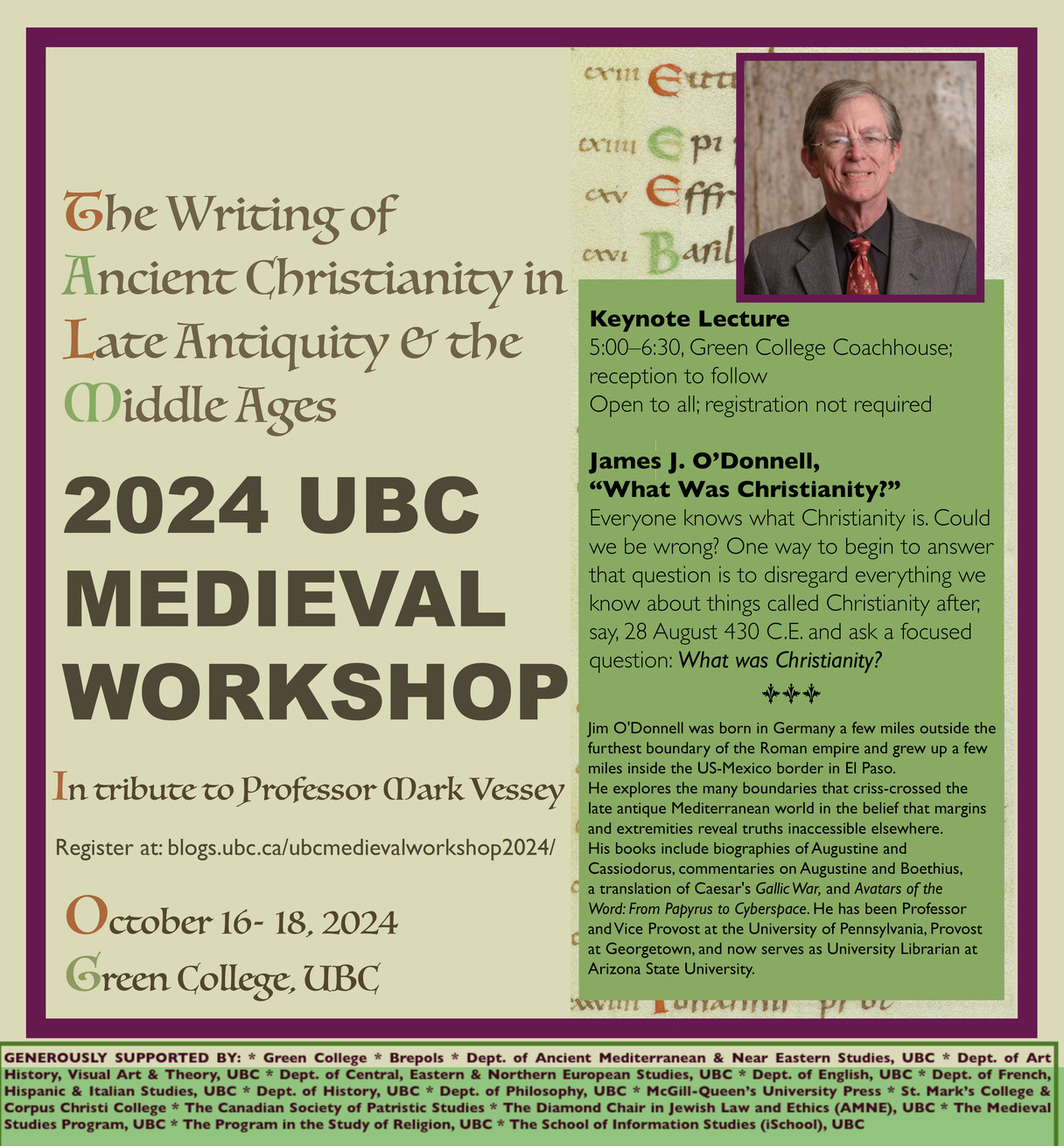
Colloque – The Writing of Ancient Christianity in Late Antiquity and the Middle Ages,

Join us for the 2024 UBC Medieval Workshop, which will be held October 16–18 at the Green College Coachhouse and also live-streamed via Zoom! 

Please register from the link provided on the Workshop website: https://blogs.ubc.ca/ubcmedievalworkshop2024/

Registration – free for students (at any level, any institution) and remote-only registrants – is required to attend the Workshop sessions, though it is optional for the Keynote Lecture, which will be delivered at Green College in the evening on Thursday, October 17 and also livestreamed via Zoom here:

Topic: James J. O’Donnell | « What Was Christianity? » | Keynote Lecture – 2024 UBC Medieval Workshop
Time: Oct 17, 2024 05:00 PM Pacific Time (US and Canada)

Join Zoom Meeting
https://ubc.zoom.us/j/63114014919?pwd=XD29XZ7Pb4cps6A29Uwhga9Pf1g7M1.1

Meeting ID: 631 1401 4919
Passcode: 351074

(There will be a separate Zoom link for all other Workshop sessions, which will be provided to registrants closer to mid October.) 

This, the 46th edition, of the UBC Medieval Workshop will explore the late Roman Church ‘Fathers’ as writers/authors in their own works and cultural settings as well as the complex afterlives of their texts and authorial identities in the centuries after their deaths. The wide-ranging papers that will be presented, by leading authorities in the fields of Late Antique and Medieval Studies together with early-career researchers and graduate students, are intended in tribute to a superlative and prolific scholar of Late Antiquity: UBC Professor Mark Vessey (Dept. of English).

The workshop’s diverse group of presenters will explore some of the fruitful paths broken and avenues of inquiry suggested by Prof. Vessey’s influential scholarship. In so doing, they will illuminate more expansively the distinctive literary landscapes inhabited by late Roman readers and by the medieval (and still later) readers who would construct an idealized world of ‘patristic’ writers at the authoritative core of ‘ancient Christianity’ and an expansive, extra-scriptural literary canon for the post-Roman cultures of medieval Europe and beyond. The presentations at this workshop will serve to illuminate more clearly key connections among ancient, late antique, medieval, and modern cultures of writing, reading, books, and canon-formation together with the historical (and on-going) consequences for such configurations of knowledge and authority.

For their generous contributions, without which the 2024 UBC Medieval Workshop would not have been possible, we extend our sincere thanks to:

•       Brepols 
•       Green College
•       McGill-Queen’s University Press
•       St. Mark’s College & Corpus Christi College 
•       The Canadian Society of Patristic Studies 
•       The Department of Ancient Mediterranean and Near Eastern Studies (AMNE), UBC
•       The Department of Art History, Visual Art and Theory (AHVA), UBC
•       The Department of Central, Eastern and Northern European Studies (CENES), UBC
•       The Department of English, UBC
•       The Department of French, Hispanic and Italian Studies (FHIS), UBC
•       The Department of History, UBC
•       The Department of Philosophy, UBC
•       The Diamond Chair in Jewish Law and Ethics, AMNE, UBC
•       The Medieval Studies Program, UBC
•       The Program in the Study of Religion, UBC 
•       The School of Information Studies (iSchool), UBC

Publié dans Le réseau | Laisser un commentaire

Appel à contribution – Produktion und wirtschaftliche Beziehungen in kleinen und mittleren Städten der Hanse

Pfingsttagung des Hansischen Geschichtsvereins
Unna, 10.-12. Juni 2025

Die Forschungen zur Hanse haben sich mit wenigen Ausnahmen vor allem auf die großen (See- und Fluss-)Städte konzentriert. Umfangreiche Archive, herausragende Kaufmannspersönlichkeiten und die historiographischen Umstände haben diesen Trend begünstigt. Aber: « Man erblickt nur, was man schon weiß und versteht“ (Goethe 1819). Und so stellt sich die Frage, was die vielen mittleren und kleineren Mitglieder in der Gemeinschaft der Städte und Kaufleute beigetragen haben, auch solche, die selbst nicht zu dieser gezählt werden können, aber mit der Wirtschaft im Hanseraum verflochten waren. Bei einigen Regionen, wie zum Beispiel im westfälischen Raum um Unna, lässt sich auf Textil- und Metallverarbeitung hinweisen, andere Standorte sind etwa bekannt für ihr Bier oder lieferten agrarische Erzeugnisse.

Die Pfingsttagung des Hansischen Geschichtsvereins wird solche Plätze in den Blick nehmen. An Einzelbeispielen sollen die Produktion und/oder die Handelsbeziehungen dieser Städte vorgestellt werden, wobei die Definition klein/mittel bewusst offen gehalten werden soll. Durch diese Beispiele soll versucht werden, eine weitere Facette der Hansegeschichte deutlich zu machen, und soll die Verankerung dieser Organisation im gesamten Raum aufgezeigt werden.

Wir erhoffen uns Ihre Beiträge u.a zu den Themen:
– Wirtschaftliche Spezialisierung in einer Stadt oder Region (z.B. Metallverarbeitung, Tuchproduktion, Brauerei, Herstellung landwirtschaftlicher Produkte etc.)
– Rechtlicher Rahmen, Rohstoffversorgung, Techniken, Organisation städtischer Produktion
Verflechtung, Verkehrs- und Handelsbeziehungen einer Stadt oder Region (Stadt-Umlandbeziehungen, Beziehungen zwischen Klein-, Mittel- und Portalstädten, Kaufleutebeziehungen, Transportbedingungen etc.).

Bitte senden Sie Ihre Themenvorschläge mit einem kurzen Abstract bis zum 15. September 2024 an
Prof. Rudolf Holbach, rudolf.holbach@uni-oldenburg.de
oder
Ass. Prof. Carsten Jahnke, jahnke@hum.ku.dk

Source : H-Soz-Kult

Publié dans Appel à contributions | Laisser un commentaire

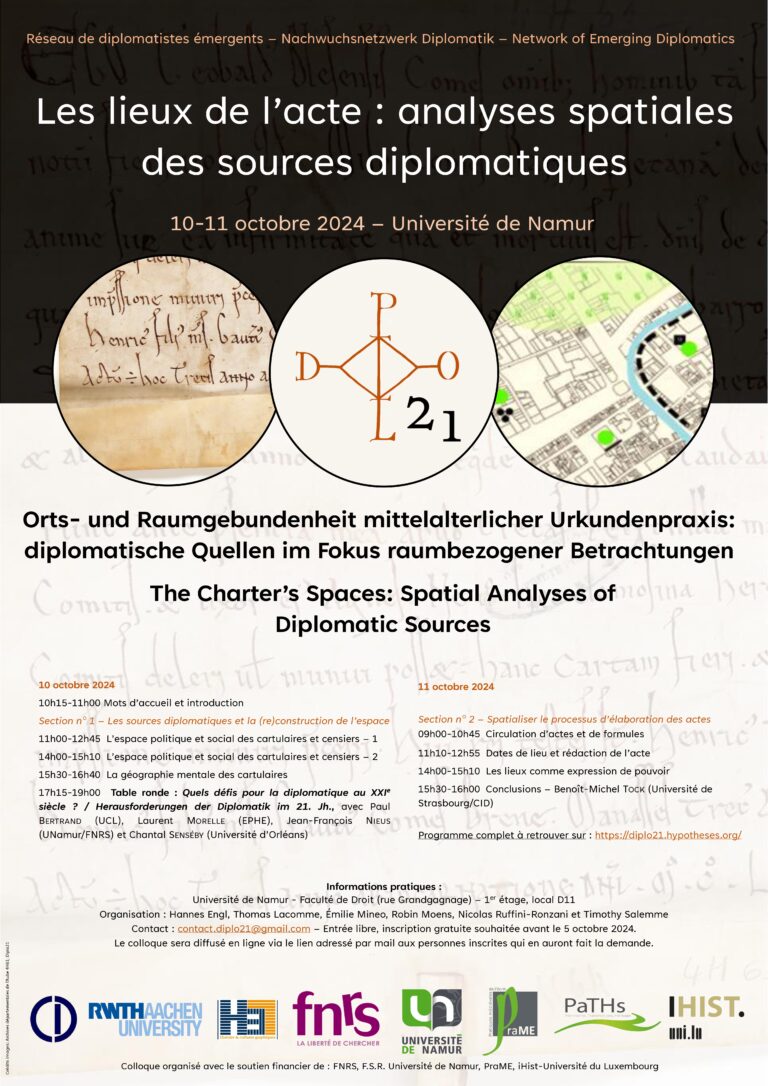
Colloque – Les lieux de l’acte : analyses spatiales des sources diplomatiques

Créé en 2023, le réseau Diplo21 organise des rencontres scientifiques visant à offrir un espace de dialogue et de débat indépendant des traditions historiographiques nationales à de jeunes chercheur·ses consacrant leurs travaux à la diplomatique et aux pratiques de l’écrit de l’Europe médiévale. Le premier thème retenu est celui des « Lieux de l’acte ». Il s’agira notamment de montrer que la diplomatique participe au spatial turn pris par les sciences humaines et sociales depuis les années 1970-1980.

Dans le cadre de ce colloque, on s’intéressera aux logiques spatiales de l’élaboration des actes au Moyen Âge, notamment à la géographie des chancelleries, bureaux d’écriture ou greffe, mais aussi en analysant les dates de lieu des chartes, et ce qu’elles peuvent révéler des négociations entre les autorités et les bénéficiaires des actes, ainsi qu’en interrogeant l’existence d’un « marché de l’acte ». L’attention portera sur la manière dont les sources diplomatiques permettent de révéler les perceptions que leurs rédacteurs ou leurs bénéficiaires se faisaient de l’espace, par l’étude des confronts, par celle du vocabulaire spatial, voire territorial, ou encore par celle des éventuelles logiques topographiques guidant en leur sein l’ordre des biens, droits et revenus (argumentaire complet en annexe).

10 octobre 2024

10h15 Mots d’accueil (15 min)

10h30-11h Introduction – Hannes Engl (RWTH Aachen University), Thomas Lacomme (Université Jean-Moulin Lyon 3), Émilie Mineo (Université du Luxembourg), au nom du réseau Diplo 21

Section n° 1 – Les sources diplomatiques et la (re)construction de l’espace

L’espace politique et social des cartulaires et censiers – 1

11h-11h35 David Bardey (Université de Namur), Cartulaire des Desrée ou cartulaire de la seigneurie de Chassagne ? Les lieux de l’acte dans le cartulaire de Chassagne (1235-1290)

11h35-12h10 Pierre Vey (École nationale des chartes, LAMOP), Les censiers de l’évêque de Marseille : les actualisations des espaces d’une domination entre la fin du XIIIe et le début du XIVe siècle

12h10-12h45 Marie Fontaine Gastan (Université Gustave-Eiffel, Institut historique allemand), De foires en territoires : spatialités des cartulaires provinois (XIIe-XIVe siècle)

12h45-14h Déjeuner

L’espace politique et social des cartulaires et censiers – 2

14h-14h35 Larissa Achermann (Universität Bern), Ein Griff wonach? Von Griffregistern, Ortslisten und Indexierungen als Marker des Raumes

14h35-15h10 Isabelle Bretthauer (Archives nationales), Écrire la terre en période de reconstruction : les actes produits par les tabellions de Dammartin-en-Goële, 1470-1510

15h10-15h30 Pause

La géographie mentale des cartulaires

15h30-16h05 Louis Genton (Université de Lorraine, CRULH), L’itinéraire mental des cartulaires. Analyses spatiales et fabrique de l’espace à Saint-Germain-des-Prés au XIIIe siècle

16h05-16h40 Harold Hans (Sorbonne Université), Organiser un espace multipolaire complexe : le cartulaire et les registres du prieuré de Merton           

16h40-17h15 Pause

17h15-19h Table ronde, animée par Robin Moens (Université de Namur-RWTH Aachen University) et Nicolas Ruffini-Ronzani (Université de Namur-Archives de l’État) pour le réseau Diplo 21 : Quels défis pour la diplomatique au XXIe siècle ? / Herausforderungen der Diplomatik im 21. Jh., avec Paul Bertrand (Université catholique de Louvain), Laurent Morelle (EPHE), Jean-François Nieus (Université de Namur-FNRS) et Chantal Senséby (Université d’Orléans)

11 octobre 2024

Section n° 2 – Spatialiser le processus d’élaboration des actes

Circulation d’actes et de formules

9h-9h35 Franziska Quaas (Philipps-Universität Marburg / Akademie der Wissenschaften und der Literatur Mainz), Das Konzept der „Urkundenlandschaft“ auf dem Prüfstand: Was Texte frühmittelalterlicher Privaturkunden über ihre geographische und institutionelle Verortung wirklich verraten

9h35-10h10 Sebastian Gensicke (RWTH Aachen University), Selbstgemacht ist immer noch am besten. Kontext und Gestaltung von Empfängerausfertigungen bischöflicher Urkunden in der Reimser Kirchenprovinz (11.–12. Jh.)

10h10-10h45 Marie Tranchant (King’s College London), Entre Westminster et Burton : réseaux d’information et circulation des actes en Angleterre au milieu du XIIIe siècle

10h45-11h10 Pause

Dates de lieu et rédaction de l’acte

11h10-11h45 Romain Waroquier (Université de Namur), Témoins de l’auteur ou témoins du bénéficiaire ? Analyse spatio-relationnelle des listes de témoins des chartes (comté de Flandre, fin XIe-fin XIIe siècle)

11h45-12h20 Thomas Lacomme (Université Jean-Moulin Lyon 3), La part des bénéficiaires ecclésiastiques dans la définition de la date de lieu des chartes royales et princières des XIIe-XIIIe siècles : comparaison entre les chartes du roi de France Louis VII (1137-1180) et du comte de Champagne Henri le Libéral (1152-1181)

12h20-12h55 Aaron Schwarz (Universität Wien), Die Raumgebundenheit der Hochmeisterurkunden des Deutschen Ordens im 13. Jahrhundert

12h55-14h Déjeuner

Les lieux comme expression de pouvoir

14h-14h35 Michael Kister (Ludwig-Maximilians-Universität München), Wer datiert wann wo nach wem? Anerkennung von Herrschaft in den „politischen Datierungen“ von Privaturkunden während des sizilischen Thronstreits 1189-1194

14h35-15h10 Alexandra Kaar (Universität Wien), Das „Ausgangtor“ aus dem Binnenreich? Regensburg als Ausstellungsort von Urkunden unter König/Kaiser Sigismund

15h10-15h30 Pause

15h30-16h Conclusions – Benoît-Michel Tock (Université de Strasbourg)

Informations pratiques :

Organisation : Hannes Engl, Thomas Lacomme, Émilie Mineo, Robien Moens, Nicolas Ruffini-Ronzani et Timothy Salemme.

Le colloque aura lieu à l’Université de Namur, Faculté de Droit (rue Grandgagnage), 1er étage, local D11.

Entrée libre, inscription gratuite souhaitée avant le 5 octobre 2024.

Adresse de contact : contact [dot] diplo21 [at] gmail [dot] com

Le colloque sera diffusé en ligne via le lien adressé par mail aux personnes inscrites qui en auront fait la demande.

Source : Diplo 21

Publié dans Colloque | Laisser un commentaire

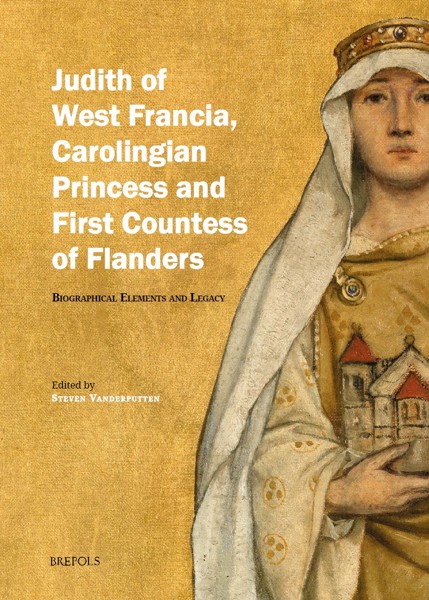
Publication – « Judith of West Francia, Carolingian Princess and First Countess of Flanders. Biographical Elements and Legacy », éd. Steven Vanderputten

Judith of West Francia is one of the most enigmatic of Charlemagne’s early descendants. The daughter of the king of West Francia and future emperor Charles the Bald and his wife Ermentrude, she was one of only a handful of Carolingian princesses who were destined for marriage. Over the course of her teenage years she married two successive kings of Wessex, became the first consecrated queen of England, was widowed twice, returned to Francia with an immense dowry, and sparked a major diplomatic incident when she eloped with a nobleman from Flanders called Baldwin. Eventually she married Baldwin in early 864, and together they established the dynasty of the counts of Flanders. In doing so the couple laid the groundwork for what would become one of the mightiest and most prestigious territorial principalities in north-western Europe in the tenth and eleventh centuries. But even in the tenth century, exceedingly few written memories of Judith’s life survived. This explains why she was never the subject of a biography in the medieval or early modern eras, and why scholarship’s understanding of her life and legacy remains highly fragmented. This volume sets the record straight, offering an accessible and interdisciplinary discussion of all relevant and documented aspects of Judith’s life and legacy.

Steven Vanderputten, Introduction: Judith of Flanders as a Historical Figure, Figurehead of Dynastic Legitimation, and Source of Literary Imagination
Charles West, Judith’s Elopement, set in the Context of Ninth-Century Politics and Ideology
Brigitte Meijns, The Question of The Emergence and Early Development of the County of Flanders
Els De Paermentier, The Early Countesses of Flanders: Profile and Power
Lisa Demets, Judith in the Literary Imagination of the Late Medieval and Early Modern Eras
Georges Declercq, Looking for Judith’s Burial Site
Geert Vermeiren and Marie-Anne Bru, The Discovery of Seven Elite Graves in the Narthex of Saint-Peter’s abbey in Ghent
Jessica Palmer, Isabelle De Groote, et al., Anthropological Analysis of ‘Judith’ and the Six Other Remains.
Annex

Judith of West Francia, Carolingian Princess and First Countess of Flanders. Biographical Elements and Legacy, éd. Steven Vanderputten, Turnhout, Brepols, 2024 ; 1 vol., 254 p. ISBN : 978-2-503-60461-9. Prix : € 70,00.

Source : Brepols

Publié dans Publications | Laisser un commentaire