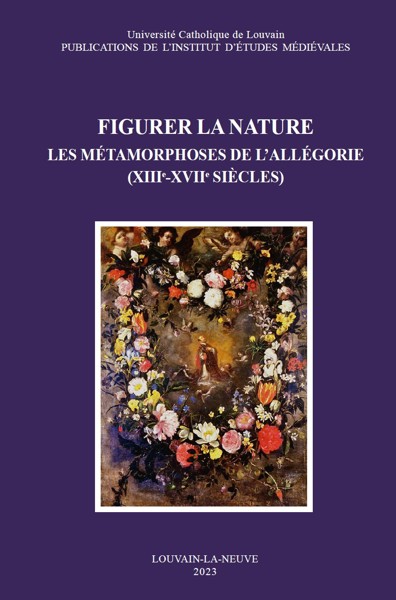
Publication – « Figurer la nature. Les métamorphoses de l’allégorie (XIIIe-XVIIe siècles) », éd. Ralph Dekoninck, Agnès Guiderdoni, Baudouin Van den Abeele

Si l’allégorie – cette opération qui consiste, par une chose, à en signifier une autre – aboutit à un supplément de sens, lorsqu’elle prend pour objet la nature dans son ensemble ou dans ses parties, les enrichissements qu’elle produit se révèlent particulièrement complexes et variables selon les milieux et les époques. Suivant une démarche interdisciplinaire et moyennant des mises en contexte précisément circonstanciées, les études de cas réunies dans ce volume traquent les métamorphoses du symbolisme et des significations prêtés aux fleurs et aux animaux dans les allégories à l’oeuvre dans un vaste corpus iconographique et littéraire européen qui court du Moyen Âge aux temps modernes. Cet ouvrage comprend des analyses de bestiaires et de compilations (tels le Physiologus, le Bestiaire d’amour de Richard de Fournival, le Reductorium morale de Pierre Bersuire), de livres de chasse (de Gace de la Buigne, Henri de Ferrières et Gaston Fébus, notamment), de récits mythologiques (l’Énéide et les Ovides moralisés, entre autres), de commentaires bibliques antiques et modernes (d’Origène à Augustin Calmet), de recueils d’emblèmes (de Mathias Holzwart, Jacob Masen, Filippo Piccinelli), de natures mortes (notamment de Daniel Seghers), et de peintures de dévotion privée (en particulier de Nicolas Poussin et Pierre-Paul Rubens), qui donnent chaque fois à voir la manière spéciale de concevoir allégoriquement la nature qu’ont pu avoir des milieux donnés, aussi bien cléricaux que laïques.

Le volume rassemble les contributions de Rémy Cordonnier (Université de Lille), Ralph Dekoninck (UCLouvain), Jean-Pierre Delville (UCLouvain), Pauline Donceel-Voûte (UCLouvain), Sandra Englebert (UCLouvain), Agnès Guiderdoni (UCLouvain), Nigel Harris (University of Birmingham), Alessandra Mascia (Université de Fribourg), Alison Saunders (University of Aberdeen), Matthieu Somon (UCLouvain), Armand Strubel (Université de Montpellier) et Baudouin Van den Abeele (UCLouvain).
Agnès Guiderdoni, Introduction
Jean-Pierre Delville, Du royaume de Dieu à l’ivresse de Dieu : la figure de la vigne dans la Bible et ses commentaires, de l’Antiquité à l’âge baroque
Rémy Cordonnier, Multiplicité sémantique et synthèse iconographique. Propriétés et figurations des animaux dans les Bestiaires
Sandra Englebert, Une allégorisation devenue systématique au sein des encyclopédies du XIVe siècle : l’exemple du Reductorium morale
Baudouin Van den Abeele, Des miniatures médiévales aux figurations baroques. L’oiseau chaperonné de l’espérance
Armand Strubel, Les livres de chasse français du XIVe siècle : survivance ou liquidation de l’allégorisme ?
Nigel Harris, Man, Monster, Animal ? Virgil’s Cacus in the Middle Ages and Sixteenth Century
Alessandra Mascia, La nature morte chez les jésuites : l’allégorie de la nature et la vie secrète des objets
Ralph Dekoninck, Les sens des fleurs. Daniel Seghers et l’art de la méditation florale et picturale
Matthieu Somon, Botanique et exégèse chez Nicolas Poussin
Alison Saunders, The Early-Modern Language of Flowers : What, Why and How ?
Pauline Donceel-Voûte, Figurer le temps de la nature : codes, personnifications et autres stratégies allégorisantes propres au langage des images

Figurer la nature. Les métamorphoses de l’allégorie (XIIIe-XVIIe siècles), éd. Ralph Dekoninck, Agnès Guiderdoni, Baudouin Van den Abeele, Louvain-la-Neuve, Institut d’études médiévales–Brepols, 2024 ; 1 vol., 275 p. (Textes, études, congrès, 34).ISBN : 978-94-6498-127-8. Prix : € 45,00.

Source : Brepols
Publié dans Le réseau | Laisser un commentaire

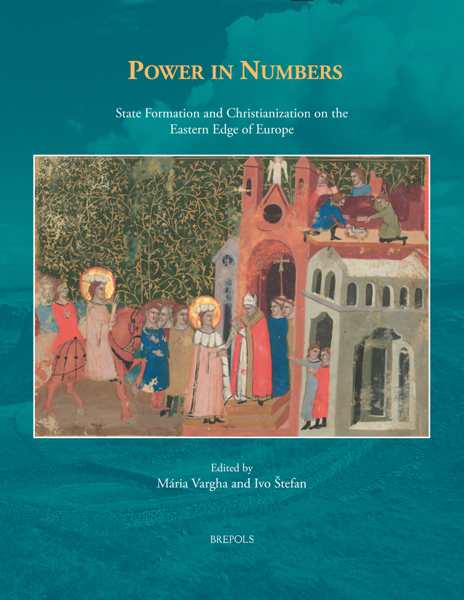
Publication – « Power in Numbers State Formation and Christianization on the Eastern Edge of Europe », éd. Mária Vargha, Ivo Štefan

Around the turn of the first millennium, the political and religious landscape of Central Europe began to change dramatically. As the decentralized pagan societies along its borders became Christian, the polity that later became the Holy Roman Empire began to expand significantly according to the principles of the Imperium Christianum — an idea that first originated with Charlemagne, but that was consciously revived by Emperor Otto I and his predecessors as a way of extending power and authority into the Empire’s newly converted eastern fringes. This acculturation was effective, and societies began to actively adopt the new ideology and social order on their own initiative.

Drawing on material first presented at conferences held in the Department of Archaeology at Charles University, Prague, this volume draws together researchers working on different yet connected events along the Empire’s eastern frontier, and the often-overlooked part of society who nevertheless participated in these events, in particular commoners and the rural population. The papers gathered here cover affairs of the early state and church, networks of archaeological and historical heritage, and archaeological, historical, and digital investigations, to offer a blend of both synthetic archaeological and historical overviews and more focused geographical and thematic case studies that explore the role of Christianization in the centralization processes that occurred at the edge of the Ottonian-Salian world. The result is a forward-looking volume that seeks to explore new approaches to historical narratives, in particular by emphasizing the importance of archaeological material in examining early state formation and religious change. Moreover, it is the first synthetic study to directly compare the north-east and south-east peripheries of the later Holy Roman Empire, making it possible to shed new light on these lands at the periphery of Western Christendom.

Mária Vargha was the PI of the project ‘Empowering the Voiceless. The Role of the Rural Population in State Building and Christianization in East-Central Europe’, conducted within the PRIMUS scheme, and the Lead Agency WEAVE tri-lateral project REPLICO conducted at Charles University Prague and in cooperation with the Naturhistorisches Museum Vienna and the Slovenian Academy of Sciences. She has also obtained an ERC StG grant titled ‘RELIC – Religiopolitics – The Imperium Christianum and its Commoners’, with which she has returned to the University of Vienna. Her research is mainly focused on the material culture, social, and landscape archaeology of the high Middle Ages, as well as on digital humanities, with a particular focus on GIS and network analysis of diverse archaeological and historical data.

Ivo Štefan is an Associate Professor at the Department of Archaeology at Charles University in Prague. He is a Czech archaeologist and historian of the early and high Middle Ages. His main areas of research are the socioeconomic and religious transformations of medieval societies in Central Europe and their reflection in material evidence.

List of Illustrations

Introduction
Mária Vargha and Ivo Štefan

1. Christianisation of East-Central Europe as a Social Process
Ivo Štefan

2. The Establishment of an Ecclesiastical Organisation in the Post–Carolingian Periphery. Czech Lands. Networks – Structures – Sources
David Kalhous and Josef Šrámek

3. The Relationship of Early Medieval Burial Grounds and Churchyards in the Process of Christianisation of Bohemia
Martin Čechura

4. Burial Practice in Transition – Sepulchral Evidence of Christianisation in the Early Piast State
Przemysław Urbańczyk

5. On the Threshold of Christianity. The Church in Kuyavia from the Tenth to the Twelfth Centuries
Marcin Danielewski

6. Fair Relations. Marketplaces and the Formation of Cathedral Cities in East Central Europe
Katalin Szende

7. Pectorals and Amulets. Data on the Spiritual life of the Hungarian Rural Population in the Period of Christianisation
Tibor Ákos Rácz and Ágnes Füredi

8. Wiślica as an Example of a Christian Town in the State of the First Piasts
Nina Glińska

9. Between the Local Power Centre and the Ecclesiastical Network. Living in castrum Orod in the High Middle Ages
Florin Mărginean

10. Chronological Remarks on Early Medieval Jewellery and Evidence for Pilgrimage. The Case Study of the Župna Cerkev Cemetery in Kranj (Slovenia)
Jernej Rihter

11. From Blessing (Hand) Cross to Hanging Cross. An Early Árpádian Cross from Tiszakeszi-Szódadomb
Péter Langó and András Patay-Horváth

12. Turning in Their Graves. Prone Burials in the Early Medieval Northern Balkans
Petar Parvanov

13. ‘Oh, Come Little Children’. Burial Customs on the Eleventh-Century Burial Ground of Oberleiserberg (Austria)
Nina Richards

14. The Formation of the Regnum Marianum. Exploring the Church Network of Early Árpádian Hungary and the Place of Marian Patrocinia
Karen L. Stark

15. Between Palermo and Cefalú. The Role of the First Norman Monastic Foundations in the (Re)Christianisation of the Island’s Rural Population in the Light of Archaeological Research in the Altavilla Milicia Region
Sławomir Moździoch, Ewa Moździoch, and Monica Chiovaro

16. The Pliska-Type Churches, the Great Basilica, and their Relation to the Settlements in the Outer City of Pliska
Andrey Aladzhov and Roland Filzwieser

17. Spatial Patterns as Historical Proxies. A Case Study on the Development of the Early Church Network in Veszprém County (Hungary)
László Ferenczi and Mária Vargha

18. Empowering the Voiceless. The Role of the Rural Population in State Building and Christianisation in East-Central Europe. Preliminary results about Bohemia.
Mária Vargha, Martin Janovský, and Martin Fajta

19. Spatial Analysis of Archaeological and Linguistic Data Reveals the Boundaries of Frankish Power in Northern Bavaria
Viktorie Janovská, Nicolas M. Jansens, Martin Janovský, andTomáš Klír

20. THANADOS – The Anthropological and Archaeological Database of Sepultures
Stefan Eichert

Informations pratiques :

Power in Numbers State Formation and Christianization on the Eastern Edge of Europe, éd. Mária Vargha, Ivo Štefan, Turnhout, Brepols, 2024 ; 1 vol., 308 p. (Borders, Boundaries, Landscapes, 4). ISBN : 978-2-503-60861-7. Prix : € 130,00.

Source : Brepols

Publié dans Publications | Laisser un commentaire

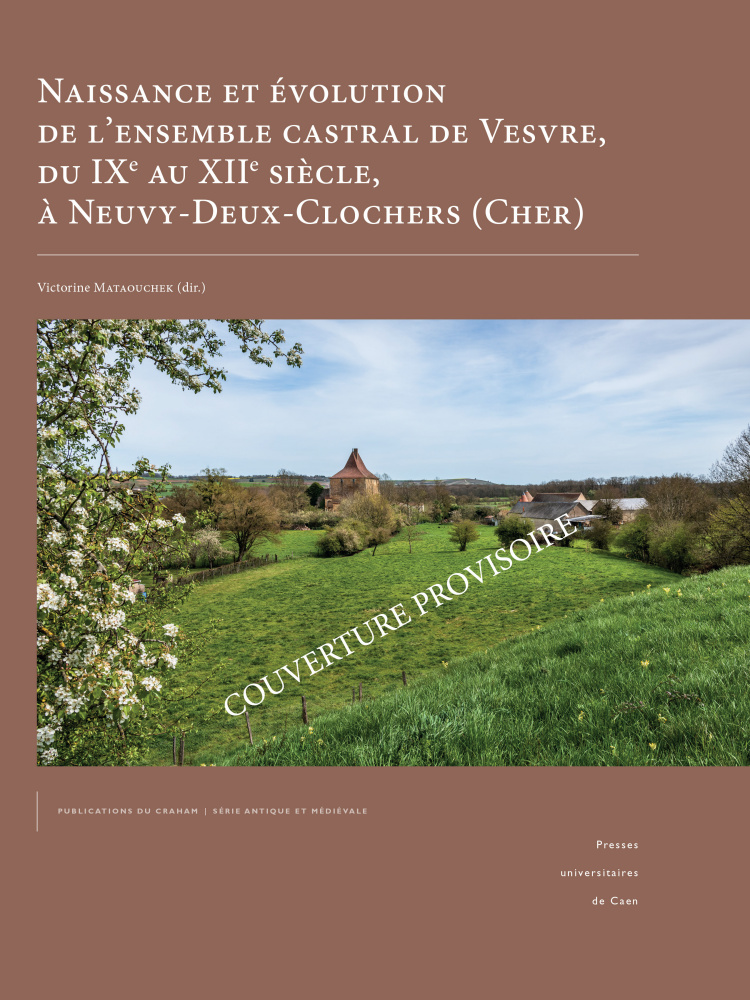
Publication – « Naissance et évolution de l’ensemble castral de Vesvre, du IXe au XIIe siècle, à Neuvy-Deux-Clochers (Cher) », éd. Victorine Mataouchek

Situé à l’écart du village de Neuvy-Deux-Clochers, dans le nord du département du Cher, le site castral de Vesvre a bénéficié de deux campagnes de fouilles préventives, l’une dans les sous-sols de la tour et l’autre sur ses élévations, entre 2003 et 2006. Les fouilles dans le sous-sol, dont il est question ici, ont révélé un pan méconnu de l’histoire du site, depuis sa formation à la fin du IXe jusqu’à la construction de la tour au début du XIIIe siècle. En dépit d’une emprise de fouilles très réduite, menées en milieu humide, la quantité des informations recueillies a largement dépassé toutes les attentes. Rares sont les sites stratifiés de cette période qui permettent d’appréhender le cadre environnemental et la vie quotidienne d’une élite naissante, établie sur une plate-forme occupée pendant trois siècles. De manière tout autant inédite, les fouilles ont particulièrement concerné le secteur des forges qui se succèdent pendant toute la durée de l’occupation alto-médiévale, nous donnant ainsi l’occasion de suivre toutes les évolutions technologiques apportées dans la conception d’un atelier. Cette publication monographique est le fruit des travaux d’une équipe interdisciplinaire composée d’une vingtaine de chercheurs, certains à renommée nationale, réunis pour décrypter le site de Vesvre, reconnu site d’intérêt national.

Table des matières : ici

Naissance et évolution de l’ensemble castral de Vesvre, du IXe au XIIe siècle, à Neuvy-Deux-Clochers (Cher), éd. Victorine Mataouchek, Caen, Presses universitaires de Caen, 2025 ; 1 vol., 416 p. (Publications du Centre de Recherches Archéologiques et Historiques Anciennes et Médiévales). ISBN : 3 978-2-38185-252-2. Prix : € 48,00.

Source : Presses universitaires de Caen

Publié dans Publications | Laisser un commentaire

Séminaire – Le médiévalisme au féminin

Le médiévalisme – Des usages contemporains du Moyen Âge
Séminaire dirigé par Aude Mairey

Le séminaire portera cette année sur le médiévalisme au féminin.

Les séances sont ouvertes à tous et se tiendront si possible le vendredi de 14h à 16h en salle Perroy, à la Sorbonne (et en hybride). Si vous souhaitez y assister, en précisant si vous serez présent ou à distance, inscrivez-vous à l’adresse suivante : aude.mairey@univ-paris1.fr.

31 janvier – Aude Mairey (Université Paris 1), « Introduction ».

7 février – Annick Peters-Custot (Université de Nantes), « Théodora, la femme fatale et les parfums d’Orient (France) » 

14 février – Annliese Nef (Université Paris 1), « De quelques femmes puissantes du monde islamique médiéval entre histoire et fiction » 

7 mars – Justine Breton (Université de Lorraine), « Princesse, guerrière, “femme forte” : que sont nos amies devenues dans les séries médiévalistes ? » 

21 mars – Stéphane Lamassé (Université Paris 1), « Jeanne, un mythe à l’heure du numérique »

11 avril – Fanny Madeline (Université Paris 1), « Emma, Mathilde, Aliénor: la représentation figurée des reines d’Angleterre des XIe-XIIe siècles à l’écran et dans les fictions dessinées »

Source : LAMOP

Publié dans Séminaire | Laisser un commentaire

Colloque – Neue Forschungen zu hagiographischen Fragen

03. April 14:30 Uhr bis 05. April 2025 14:00 Uhr
Stuttgart-Hohenheim

Der Arbeitskreis für hagiographische Fragen widmet sich seit 1994 der interdisziplinären und internationalen Vernetzung von Forschung, die sich unter anderem mit der Hagiographie, den Heiligen, der Materialität des Sakralen, der Liturgie und religiösen Praxen in Zusammenhang mit dem Kult befassen. Die Fragestellungen, mit denen sich der Arbeitskreis beschäftigt, gehören dabei den Geschichts- und Literaturwissenschaften, der Theologie und Kirchengeschichte, der Kunstgeschichte und Archäologie, der Religionswissenschaft und Anthropologie an.

Das diesjährige Arbeitstreffen bietet jüngeren Forscher:innen und etablierten Wissenschaftler:innen eine Plattform zum Austausch und zur Diskussion ihrer wissenschaftlichen Vorhaben. Forschende und Interessierte an hagiographischen Fragen sind eingeladen, an der Tagung teilzunehmen.

Weitere Informationen zum Arbeitskreis:
https://www.akademie-rs.de/themen/hagiographische-fragen

Donnerstag, 3. April 2025

ab 15:00 Uhr
Ankommen bei Tee, Kaffee und Kuchen

15:30 Uhr
Begrüßung und Vorstellungsrunde

Moderation: Andreas Bihrer, Kiel

16:00 Uhr
Interdependenzen von Text und Gebrauchsform in der Hagiographie des frühen und hohen Mittelalters
Moritz Vogelbacher, Freiburg

17:00 Uhr
Religiöse CharismatikerInnen und gesellschaftlicher Wandel (9.–11. Jahrhundert). Ein Werkstattbericht
Gion Wallmeyer, Bielefeld

18:00 Uhr
Abendessen

19:00 Uhr
Eremitismus und die Kultur der Einsamkeit im mittelalterlichen Reich, 900–1300
Gitta Windt & Adrian Kammerer, Göttingen

offener Abend in der Denkbar

08:00 Uhr
Frühstück

Moderation: Elke Koch, Berlin

09:00 Uhr
Hagiographische Sammlung und (heilige) Gemeinschaft. Zur Funktion des Legendars von Cîteaux
Sarah-Christin Schröder, Kiel

10:00 Uhr
Zwischen Vollständigkeitsanspruch und praktikabler Heiligenverehrung. Das Sammlungskonzept des Legendars aus Clairvaux
Annalena Nüsing, Kiel

11:00 Uhr
Kaffee/Tee & Snacks

11:30 Uhr
New Perspectives on the Study of Medieval Latin Hagiography in Catalonia. Reconstructing Hagiographic Collections
Clara Renedo Mirambell, Barcelona

12:30 Uhr
Mittagessen

Moderation: Julia Weitbrecht, Köln

14:00 Uhr
„Hagiographie“ oder „Legende“? Heiligengeschichten und die Genre-Frage am Beispiel des heiligen Ehepaares Heinrich und Kunigunde
Antonia Anstatt, Oxford

15:00 Uhr
Die Beziehung zwischen Prophetie und Heiligkeit bei heiligen Frauen des Spätmittelalters
Frances Courtney Kneupper, Oxford (Mississippi)

16:00 Uhr
Kaffee/Tee & Kuchen

16:30 Uhr
Modellierungen weiblicher Heiligkeit in Regulas ‚buch von den heilgen megden und frowen‘
Maja Schwerinski, Köln

17:30 Uhr
Genese und Transformation der Drucke von ‚Der Heiligen Leben‘. Projektvorstellung
Paul Stein, Berlin

18:30 Uhr
Abendessen
offener Abend in der Denkbar

08:00 Uhr
Frühstück

Moderation: Feliticas Schmieder, Hagen

09:00 Uhr
Die mittelalterlichen ‚miracula‘ polnischer Heiliger. Rahmen des Forschungsprojekts
Tomasz Karol Mantyk, Lublin

10:00 Uhr
Eine Heiltumssammlung in der Höhe: Die Objekte in der Kuppelkugel von St. Lorenz in Kempten (Allgäu). Bemerkungen zu einer besonderen bauarchäologischen Fundgattung
Birgit Kata, Kempten

11:00 Uhr
Kaffee/Tee & Snacks

11:30 Uhr
Heilige Gründungsväter als Teil klösterlicher Politik
Cora Dietl, Gießen

12:30 Uhr
Schlussdiskussion

13:00 Uhr
Mittagessen
Ende der Tagung

Source : Akademie der Diözese Rottenburg-Stuttgart

Publié dans Le réseau | Laisser un commentaire

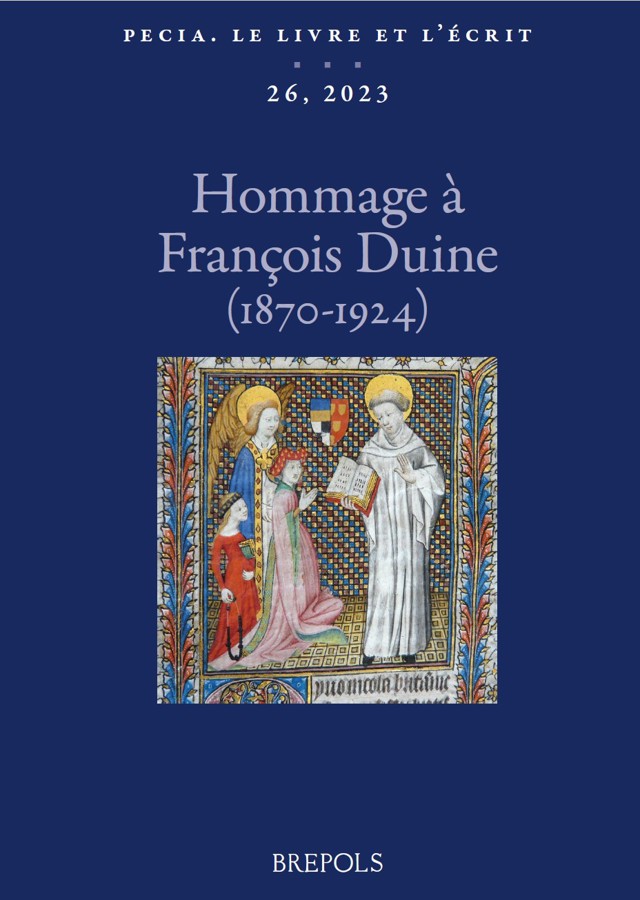
Publication – « Hommage à François Duine (1870-1924) » (Pecia. Le livre et l’écrit, 26)

L’année 2024, marquant le centenaire de la mort de l’érudit breton François Duine (1870-1924), « PECIA. Le livre et l’écrit » ne pouvait manquer l’occasion de dédier ce volume au clericus dolensis. Aussi, plusieurs de ses champs de recherche seront abordés dans ces pages. L’hagiographie et la liturgie bretonne, avec des contributions sur les saints fondateurs Samson et Malo, sur les livres liturgiques en usage dans le diocèse de Dol, auquel François Duine était viscéralement attaché, n’ont eu de cesse de lui fournir matière à exploiter, toujours au plus près des sources manuscrites, ces domaines qu’il affectionnait. Le prêtre dolois, au-delà du personnage complexe et de l’image contrastée qu’il nous laisse, a marqué à tout jamais l’historiographie bretonne. Son style, particulièrement original, sa puissance de travail sur divers sujets dont il reste l’ultime référence, ont contribué à faire de l’œuvre de François Duine, encore aujourd’hui, une documentation incontournable.

Table des matières :

Jean-Luc Deuffic, Autour des reliques de saint Samson. Les livres liturgiques du diocèse de Dol. Approche bibliographique
Mickaël Gendry, Malo, l’évêché d’Alet et les sources hagiographiques
Colleen M. Curran, The Landévennec Group
Anna Mikhalchuk, Dom Guy-Alexis Lobineau, premier historien de la Bretagne et un véritable Breton ?
Andrey Morvan, Diaphaneity and Spirituality: Seeing through Watermarks: Describing and Analyzing Religious Watermarks from the Late Middle Ages
Gerardo Fabián Rodríguez et Lidia Raquel Miranda, From Devotional Sensorium to Hagiosensorium : Los Milagros de Guadalupe as a Sacralizing Text of the Experience of Christian Captives
Jean-Luc Deuffic, Libraires bretons du Moyen Âge (XIIIe-XVe siècles) : une première ‘handlist’
Index des manuscrits cités

Informations pratiques :

Hommage à François Duine (1870-1924), Pecia. Le livre et l’écrit, t. 26, 2024 ; 1 vol., 256 p. ISBN : 978-2-503-60875-4. Prix : € 95,00.

Source : Pecia

Publié dans Publications | Laisser un commentaire

Publication – « Guido delle Colonne et la fortune de Troie dans l’Europe médiévale », éd. Catherine Croizy-Naquet, Aude Mairey, Anne Rochebouet, Florence Tanniou

Ce volume constitue un recueil d’études inédites sur l’historien et juge sicilien Guido delle Colonne (XIIIe siècle), auteur de la plus célèbre des versions médiévales de l’histoire de Troie. Best-seller incontesté, l’Historia a été extrêmement diffusée dans l’Europe médiévale : on en dénombre plusieurs centaines d’exemplaires manuscrits, et elle a également été imprimée à plusieurs reprises, tout en étant traduite dans de nombreuses langues vernaculaires.

Afin d’étudier cette œuvre hors-norme, ce volume résolument inter-disciplinaire et international, croise histoire, littérature, philologie et histoire de l’art pour présenter les dernières recherches sur cet auteur aujourd’hui paradoxalement méconnu, mais aussi les réflexions les plus récentes sur la réception considérable de son œuvre qui a largement façonné la culture européenne à la fin du Moyen Âge.

Introduction

Guido delle Colonne : l’homme et son milieu culturel

Nouvelles découvertes sur Guido delle Colonne : la biographie à la lumière des autographes
Giuseppina Brunetti

From the Roman de Troie to the Historia destructionis Troiae: notes and a proposal on the source of Guido delle Colonne
Jacopo Fois

Les techniques de rédaction de l’Historia destructionis Troiae et l’école campanienne d’ars dictaminis (1220-1290)
Benoît Grévin

Letter Writing without Letters: Guido delle Colonne and the English Artes Dictandi
Alex Mueller

Réceptions : lire, réécrire, inventer Guido en Europe

Guido delle Colonne : la tradition italienne
Arianna Punzi

Traduire, restaurer, compiler : l’incorporation de l’Historia destructionis Troiae à la tradition de matière troyenne en Castille
Clara Pascual-Argente

Guido en Castille : le Libro de la Historia Troyana de Pedro de Chinchilla
María Sanz Julián

Les prémices de la guerre de Troie sur le plafond d’un palais sicilien
Maud Pérez-Simon

Portraits de Guido en Europe
Florence Tanniou

Guido delle Colonne et la fortune de Troie dans l’Europe médiévale, éd. Catherine Croizy-Naquet, Aude Mairey, Anne Rochebouet, Florence Tanniou, paris, Éditions de la Sorbonne, 2024 ; 1 vol., 186 p. (Histoire ancienne et médiévale). ISBN : 979-10-351-0985-1. Prix : € 20,00.

Source : Éditions de la Sorbonne

Publié dans Publications | Laisser un commentaire

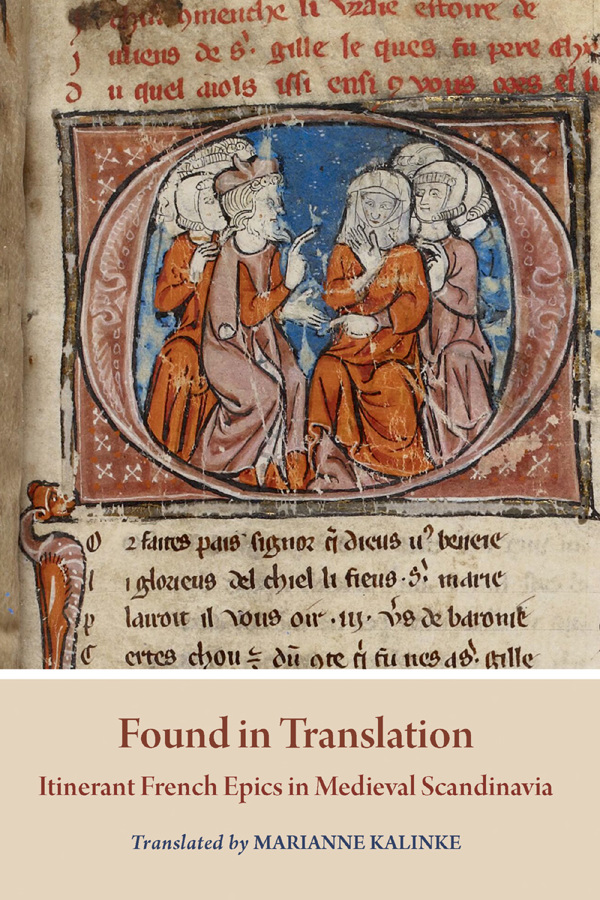
Publication – « Found in Translation. Itinerant French Epics in Medieval Scandinavia », éd. Marianne Kalinke

This volume contains English translations of three Old Norse–Icelandic renderings of French chansons de geste (Elis saga ok Rósamundu, Bevers saga, and Flovents saga), and of one Icelandic chivalric romance (Bærings saga). The French epics translated into Old Norse–Icelandic were composed under the influence of courtly romance and were anonymous narratives subject to revision and recreation. These translations resulted in a new Icelandic genre, the riddarasaga or chivalric saga, of which Bærings saga is the first.

Marianne Kalinke is Center for Advanced Study Professor Emerita of Germanic Languages and Comparative Literature at the University of Illinois Urbana-Champaign. She is the editor of and a contributor to The Arthur of the North: The Arthurian Legend in the Norse and Rus’ Realms (2011) and of Norse Romance II: The Knights of the Round Table (1999), as well as editor and translator of Möttuls saga, Ívens saga, and Erex saga in that volume; and author of Stories Set Forth with Fair Words: The Evolution of Medieval Romance in Iceland (2017). With Kirsten Wolf she is co-author and translator of Pious Fictions and Pseudo-Saints in the Late Middle Ages (2023), also published by the Pontifical Institute of Mediaeval Studies.

Table des matières :

Preface
Abbreviations and Conventions

Introduction
Heroic Epic and Courtly Romance in the Germanic Realm
Translating French Epics and Romances
The Creation of a New Literary Genre in Iceland
Four Old Norse–Icelandic Epics
Rendering Old Norse–Icelandic Sagas into English

The Romance Epic of Elis and Rosamunda
The Romance Epic of Flovent
The Romance Epic of Bevers
The Romance Epic of Baering

Bibliography
Index

Informations pratiques :

Found in Translation. Itinerant French Epics in Medieval Scandinavia, éd. Marianne Kalinke, Turnhout, Brepols, 2024 ; 1 vol., X–256 p. ISBN : 978-0-88844-314-4. Prix : € 30,00.

Source : Brepols

Publié dans Publications | Laisser un commentaire

Web – Le Corpus des inscriptions de la France médiévale désormais sur Biblissima+

Le CESCM et le pôle d’épigraphie participent activement à l’infrastructure numérique multipolaire Biblissima+1, dans le cadre du cluster 5A “Epigraphie et TEI”  Depuis mars 2024, les volumes du Corpus des inscriptions de la France médiévale et les photos de chaque inscription sont traités et en passe d’être accessible sur le portail Biblissima.

Depuis mars 2024, les volumes du Corpus des inscriptions de la France médiévale (CIFM) et les photos de chaque inscription sont en cours de traitement et seront bientôt accessibles sur le portail Biblissima.

Le portail permet d’interroger les inscriptions en fonction de leur lieu d’origine ou de conservation, ou selon la bibliographie qui leur est associée, avec des accès aux références bibliographiques via des liens hypertextes. Un autre grand atout de Biblissima+ est l’utilisation du standard IIIF, avec un visualiseur permettant d’accéder aux textes dans une qualité remarquable.

Seul le volume 1 du CIFM est actuellement disponible sur le portail ( accessible en cliquant sur ce lien). L’ensemble de la collection sera ajouté progressivement d’ici à 2026.

Source : Carnets du CESCM

Publié dans Web | Laisser un commentaire

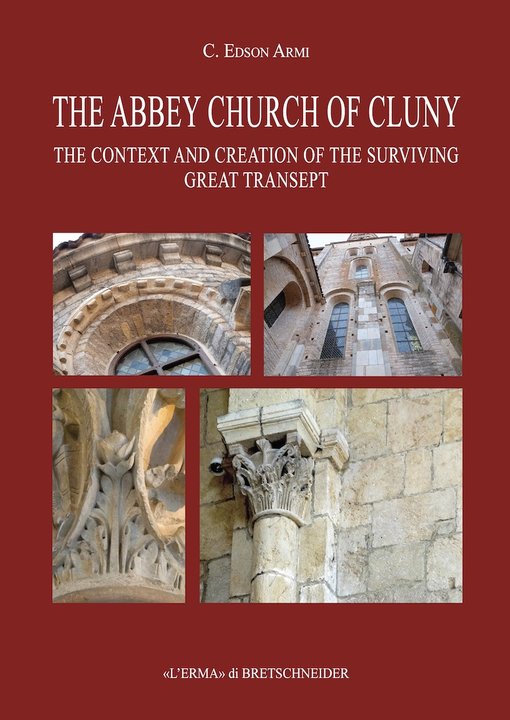
Publication – C. Edson Armi, « The Abbey Church Of Cluny. The Context And Creation Of The Surviving Great Transept »

At the end of the eleventh century, monks at Cluny commissioned the largest basilica in Christendom. Much has been written about the mother church of the Cluniac Order, with a focus on reconstructing missing parts of the church and making connections between Cluniac architecture and medieval culture. My approach is different in a number of ways — concentrating on the innovative and refined features of the surviving transept and placing them in a complex artistic context. It combines examination of archaeology, architecture and sculpture, interweaves analysis of aesthetics — light, space, articulation and decoration — with analysis of practicalities — function, construction and structure, and uncovers numerous sources of the building, piecing together influences from multiple directions. The photography is inclusive as well, documenting from various angles and distances, under different lighting conditions, the power and nuance of the monument.

Table des matières :

INTRODUCTION
PART I
CONTINUITY BETWEEN BAYS

PART II
INDIVIDUAL BAYS

CHAPTER 1
Central Bay
Structure and Construction
Design

CHAPTER 2
Northern Bay
Structure and Construction
Design
Second Story
Third Story

CHAPTER 3
Southern Bay
Structure
Design

CONCLUSION

Informations pratiques :

C. Edson Armi, The Abbey Church Of Cluny. The Context And Creation Of The Surviving Great Transept, Rome, L’Erma di Bretschneider, 2024 ; 1 vol., 194 p. (Bibliotheca Archaeologica, 85). ISBN : 978-8-89133-396-4. Prix : € 150,00.

Source : L’Erma di Bretschneider

Publié dans Publications | Laisser un commentaire