Publication – Na Chang, « The East and West in Late Medieval Travel Writings »

This book traces the history of encounter between Eastern and Western cultures by closely examining a body of medieval travel writings penned or related by Europeans and by inhabitants of East Asia. Whilst these texts are usually considered in the context of kindred European or Chinese literature, this study will make a case for considering them as a common literature of medieval encounters with foreign people. For the modern historian writing in a world that so consciously thinks of itself as ‘global’, these accounts offer a precious lens through which to enter into the world before globalization. In particular, the book shows that these narratives show the similarity in how Eastern and Western travellers thought and behaved in the face of difference, and will show that individuals often held somewhat different views, shaped by their particular experience or agendas, than those of their government or of local cultural convention.

Dr Na Chang was educated at Gonville and Caius College, University of Cambridge, UK. She worked on encounters between the East and the West, relations between the Mongols and Christian Europeans, and maritime history during her PhD studies. She is a research fellow at the School of International Studies and the Collaborative Innovation Center of South China Sea Studies, both at the Nanjing University of China. Na’s current research interests include encounters between the East and the West and maritime relations between great powers.

Na Chang, The East and West in Late Medieval Travel Writings, Cambridge, Cambridge Scholars Publishing, 2024 ; 1 vol., 222 p. ISBN : 978-1-5275-7686-5. Prix : GBP 64,99.

Source : Cambridge Scholars Publishing

Publié dans Publications | Laisser un commentaire

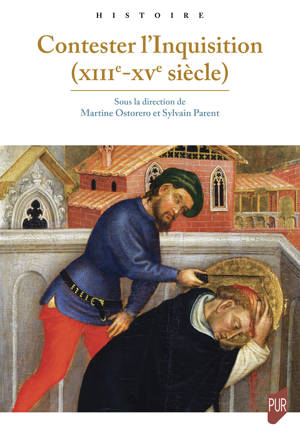
Publication – « Contester l’Inquisition (XIIIe-XVe siècle) », éd. Martine Ostorero, Sylvain Parent

Dès les premiers temps de son existence, dans les années 1230, l’Inquisition suscita des réactions parfois très hostiles et violentes. Les inquisiteurs furent régulièrement les cibles du déchaînement populaire, jusqu’à en perdre la vie. S’il s’agit de l’une des manifestations les plus visibles et spectaculaires de cette hostilité, les formes que prirent les contestations et résistances furent en réalité d’une grande diversité.

Traquer la pluralité de ces modes d’opposition à l’Inquisition nécessite de s’intéresser aux contextes locaux, à l’équilibre des pouvoirs, aux enjeux de la défense des droits et prérogatives, ainsi qu’aux acteurs de cette résistance. Cela conduit à mieux saisir la délicate insertion de ce tribunal au sein de la société, mais aussi à prendre en compte les moyens de défense de l’office par les acteurs eux-mêmes et à mesurer ses capacités de réaction.

L’ambition de ce livre est de poser les bases d’une étude comparative afin d’offrir un premier état des lieux assez large de la diversité des formes que prennent ces contestations dans l’espace de l’Europe. Elle s’inscrit dans le temps long de l’histoire de l’office d’Inquisition, depuis son émergence, jusqu’à la reconfiguration de la sorcellerie comme hérésie à la toute fin du Moyen Âge.

Avec le soutien de l’université de Lausanne, de la Fondation pour la protection du patrimoine culturel, historique et artisanal (Lausanne, Suisse), du CIHAM-UMR 5648 et de l’École normale supérieure de Lyon.

Table des matières : ici

Contester l’Inquisition (XIIIe-XVe siècle), éd. Martine Ostorero, Sylvain Parent, Rennes, Presses universitaires de Rennes, 2024 ; 1 vol., 296 p. (Histoire). ISBN : 978-2-75359-707-5. Prix : € 25,00.

Source : Presses universitaires de Rennes

Publié dans Publications | Laisser un commentaire

Publication – « The Routledge Handbook of Gender and Sexuality in Byzantium », éd. Mati Meyer, Charis Messis

This Handbook is the first to consider the interrelated subjects of gender and sexuality in the Eastern Roman Empire from an interdisciplinary perspective. Drawing on both modern theories and Byzantine perceptions, and considering multiple periods and religions (Eastern Orthodox, Islamic, and Jewish), it provides evidentiary textual and visual material support for an analysis of the two linked themes.

Broadly, the essays demonstrate that gender and sexual constructs in Byzantium were porous. As a result, they expand our knowledge of not only how sex and gender were conceived and performed but also how ideas and practices shaped Byzantine life.

The Routledge Handbook of Gender and Sexuality in Byzantium will be an indispensable guide for students and scholars of late antique and Byzantine religion, history, culture, and art, who will find it a useful critical survey of current scholarship and one that shines new light in their areas of research. The focus on issues of gender and sexuality may also be of interest to individuals concerned with Eastern Mediterranean culture, as well as to the broader public.

Table des matières : ici

Mati Meyer received her PhD from the Hebrew University in Jerusalem and is a faculty member at the Open University of Israel. She has published extensively in articles and a monograph and co‑edited books on women, realia, emotions, corporeality, gender and sexuality, and biblical reception in Byzantine art, including Emotions and Gender in Byzantine Culture, edited by Mati Meyer and Stavroula Constantinou (2018) and Between Judaism and Christianity: Art‑Historical Essays in Honor of Elisheva (Elisabeth) Revel Neher, edited by Katrin Kogman‑Appel and Mati Meyer (2009).

Charis Messis holds a PhD in Byzantine Studies from Écoles des Hautes Études en Sciences Sociales in Paris and a habilitation from the Sorbonne University. He is now teaching Byzantine Literature at the National and Kapodistrian University of Athens, Greece. His research interests concern Byzantine history and literature, especially the history of gender, along with other social and anthropological aspects of the Byzantine world. He is author and co-editor of several books and articles, including Storytelling in Byzantium: Narratological Approaches to Byzantine Texts and Images, edited by C. Messis, M. Mullett, and I. Nilsson (2018).

Informations pratiques :

The Routledge Handbook of Gender and Sexuality in Byzantium, éd. Mati Meyer, Charis Messis, Londres, Routledge, 2024 ; 1 vol., 548 p. (Routledge Handbooks). ISBN : 978-0-36749-093-5. Prix : GBP 205,00.

Source : Routledge

Publié dans Le réseau | Laisser un commentaire

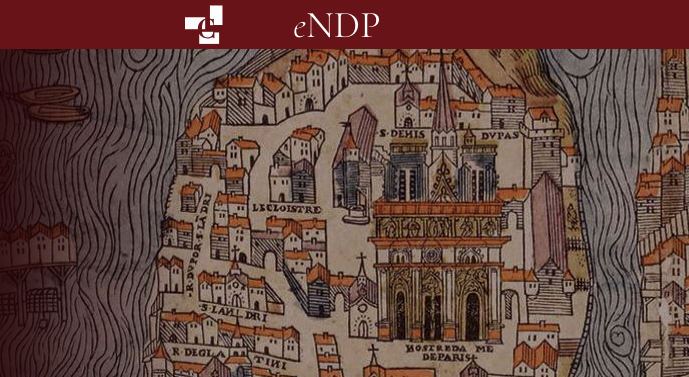
Web – e-NDP. Notre-Dame de Paris et son cloître. Les lieux, les gens, la vie, 1326-1504

Accès : ici

Le projet e-NDP propose de renouveler la connaissance de Notre-Dame de Paris par l’édition collaborative numérique des registres du chapitre cathédral. 26 registres, établis entre 1326 et 1504, donnent accès à toutes les décisions prises par les chanoines sur l’administration de la cathédrale, sur la gestion de leurs droits et de leur patrimoine, et sur la société du cloître.

Ces registres sont désormais accessibles grâce à la numérisation de leurs 14605 pages et à l’utilisation de la reconnaissance automatique de l’écriture manuscrite (HTR), qui permet d’en fournir une transcription. Celle-ci permet d’exhumer une source majeure pour l’histoire et la vie des hommes, des femmes et des enfants qui ont composé la société active à l’ombre de la cathédrale Notre-Dame et ont fait de cette dernière un modèle pour l’architecture, la liturgie, les arts et la vie intellectuelle et scientifique.

Accès aux registres

Les 26 registres médiévaux (1326-1504) du chapitre de Notre-Dame représentent une masse documentaire d’environ 15 000 pages manuscrites. Les variations graphiques et linguistiques, ainsi que la singularité de ces documents de la pratique sont autant de défis pour l’édition d’un corpus largement inédit.

Le projet e-NDP a mobilisé les méthodes et outils de l’apprentissage automatique (machine learning) pour relever ces défis : lecture automatique des écritures manuscrites (HTR) pour la transcription, recours aux modèles de langue pour les annotations linguistiques (lemmatisation et liage des entités nommées).

À chaque étape de la chaîne de traitements (HTR, annotation, indexation), des données sont produites et réutilisées. Nous avons veillé à documenter non seulement chacun de ces jeux de données, mais également les traitements conçus pour leur production. Dans une perspective FAIR, chaque dépôt est fait sur un entrepôt ouvert et pérenne. Ce sont les données ainsi exposées qui sont directement valorisées sur l’application eNDP en s’appuyant sur les API (Application Programming Interface) disponibles.

L’ouverture de ce corpus inédit, disponible pour les analyses computationnelles, participe au renouvellement de la connaissance sur l’administration de la cathédrale par les chanoines.

Accès aux personnes

Source : e-NDP

Publié dans Web | Laisser un commentaire

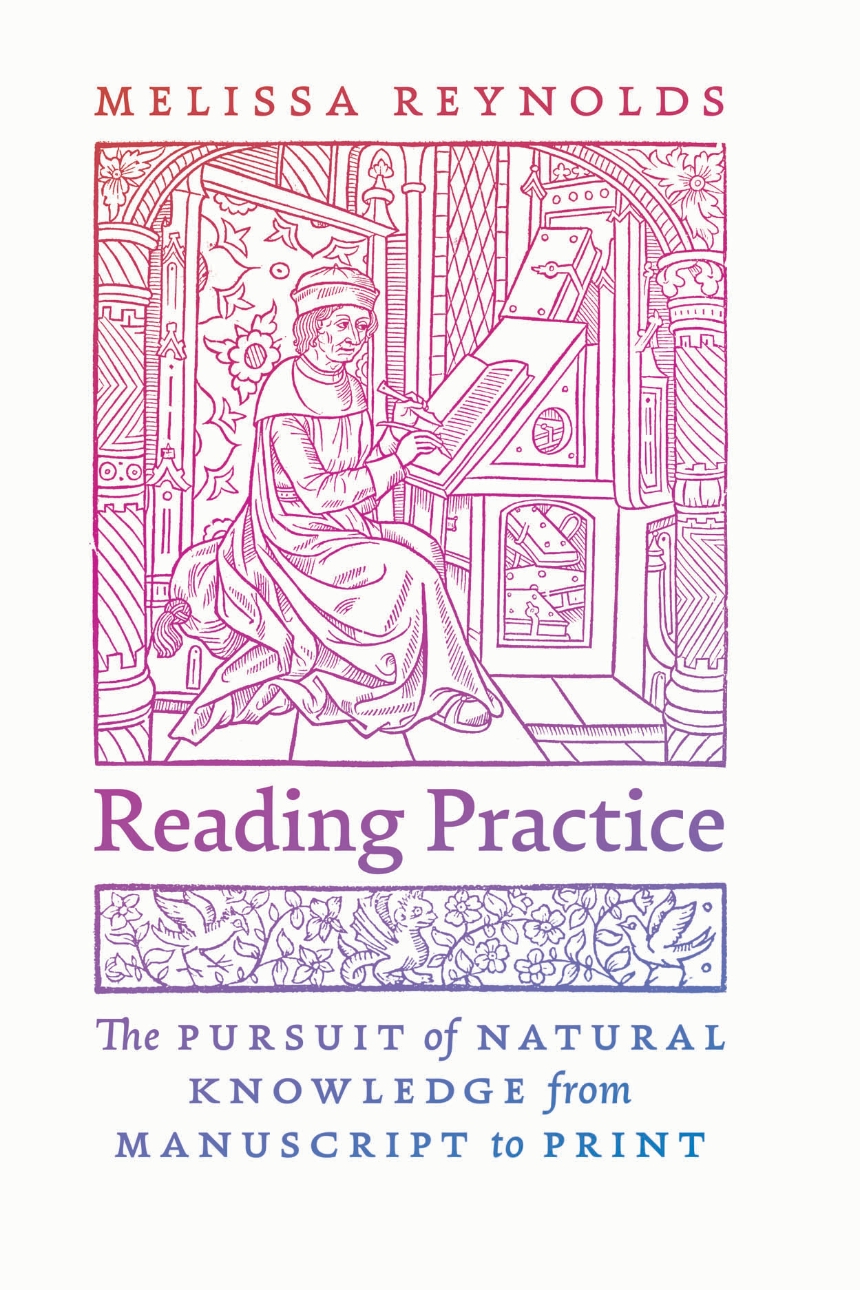
Publication – Melissa Reynolds, « Reading Practice. The Pursuit of Natural Knowledge from Manuscript to Print »

Through portraits of readers and their responses to texts, Reading Practice reconstructs the contours of the knowledge economy that shaped medicine and science in early modern England.
 
Reading Practice tells the story of how ordinary people grew comfortable learning from commonplace manuscripts and printed books, such as almanacs, medical recipe collections, and herbals. From the turn of the fifteenth century to the close of the sixteenth century, these were the books English people read when they wanted to attend to their health or understand their place in the universe. Before then, these works had largely been the purview of those who could read Latin. Around 1400, however, medical and scientific texts became available in Middle English while manuscripts became less expensive. These vernacular manuscripts invited their readers into a very old and learned conversation: Hippocrates and Galen weren’t distant authorities whose word was law, they were trusted guides, whose advice could be excerpted, rearranged, recombined, and even altered to suit a manuscript compiler’s needs. This conversation continued even after the printing press arrived in England in 1476. Printers mined manuscripts for medical and scientific texts that they would publish throughout the sixteenth century, though the pressures of a commercial printing market encouraged printers to package these old texts in new ways. Without the weight of authority conditioning their reactions and responses to very old knowledge, and with so many editions of practical books to choose from, English readers grew into confident critics and purveyors of natural knowledge in their own right.
 
Melissa Reynolds reconstructs shifting attitudes toward medicine and science over two centuries of seismic change within English culture, attending especially to the effects of the Reformation on attitudes toward nature and the human body. Her study shows how readers learned to be discerning and selective consumers of knowledge gradually, through everyday interactions with utilitarian books.

Table des matières :

List of Figures and Tables
Abbreviations
A Note on Transcriptions and Titles

Introduction

  1. The Making of a Practical Manuscript
  2. Picturing the Natural World
  3. Writing Recipes, Wrangling the Power of Nature
  4. Marketing Natural Knowledge
  5. Prognostications Past and Future
  6. Printing Women’s Knowledge, Censoring Secrets
  7. Englishing Medicine and Science
    Conclusion

Acknowledgments
Notes
Bibliography
Index

Informations pratiques :

Melissa Reynolds, Reading Practice. The Pursuit of Natural Knowledge from Manuscript to Print, Chicago, The University of Chicago Press, 2024 ; 1 vol., 318 p. ISBN : 978-0-22683-489-4. Prix : USD 35,00.

Source : The University of Chicago Press

Publié dans Publications | Laisser un commentaire

Appel à contribution – Worlds of Learning

The IMC provides an interdisciplinary forum for the discussion of all aspects of Medieval Studies. Proposals on any topic related to the Middle Ages are welcome, while every year the IMC also chooses a special thematic focus. In 2025 this is ‘Worlds of Learning’.

Histories of learning have transformed fundamentally over the last generation: older research mainly investigated educational institutions or specific intellectual traditions, typically privileging forms of learning which could be connected to modern Western institutions and disciplines. More recent scholarship takes a broader approach, historicising the production and circulation of different forms of knowledge, including many non-Western cultural traditions, as well as practical knowledge, oral traditions, and types of technical or artisanal expertise not represented in the modern canon. As a result, new interdisciplinary research fields have broadened the thematic and geographical scopes of investigation and developed new comparative frameworks.

Perhaps most importantly, different cultural traditions and historiographies of learning across the globe are increasingly discussed in relation to each other or on the basis of interdisciplinary exchange on methodologies. The increasingly global scope of academic exchange enables us to think more productively towards connected histories of learning, whether global or regional in scope, and including non-elite and non-traditional forms of learning.

Processes of learning and resulting written traditions have also been re-situated in their social and material contexts, deepening our understanding of the cultural embeddedness of knowledge. Various recent approaches question the meaning of institutional descriptors like ‘schools’ and challenge the dividing lines between ‘scholarly’/’expert’ or ‘elite’ and ‘popular’ cultures. Frameworks discussing ‘communities of learning’, ‘communities of interpretation’, or ‘communities of practice’ highlight the role of exchange and conflict between different communities and social strata in the production of knowledge. They also allow for a much broader integration of different forms of practice, performance, and oral communication into the study of intellectual production.

On a methodological plane, our understanding of the use, distribution, and long-term differentiation of specific bodies of knowledge profits greatly from a greater appreciation of their mediality and materiality, with new approaches to genre, communicative uses, and the circulation of manuscripts and printed books, but also to a variety of images, objects, and (architectural) landscapes. A growing toolkit of digital approaches has proved to be both a boon and a challenge, as the gathering, analysis, and visualisation of relevant data promises innovative new insights, but also raises questions about standardisation and access to costly infrastructures.

Against this background, IMC 2025 invites a plurality of viewpoints investigating the manifold social, intellectual, and geographical ‘worlds of learning’ shaping pre-modern societies. Seeking to stabilise the trend of the previous years, the strand particularly encourages sessions focusing on non-European worlds of learning. It also invites sessions which address the challenges inherent in the highly diverse disciplinary landscape and the asymmetries shaping extant historiographies of learning, which come from both different global regions and separate disciplines with different emphases.

Themes to be addressed may include, but are not limited to:

  • Ideals, practices, and rituals of teaching and learning
  • Gendered ideals of learning and gender in learning
  • Pedagogical techniques for different age groups
  • Technical and artisanal knowledge
  • Oral transmission, practice, and performance in learning processes
  • Medieval epistemologies and systematisations of knowledge
  • Religious conceptualisations and interpretations of learning
  • Forms of learning and/about the self
  • Languages and their role in the acquisition of learning
  • Representations of learning in literature and art
  • Learning materials, including instructional objects, texts, images, and diagrams
  • Schools and universities and their local and regional networks
  • Financial and political networks supporting communities of learning
  • Lieux de savoir and locales of learning, including (permanent or situational) material and spatial arrangements
  • Printing and publishing learned materials
  • Distribution and circulation of knowledge traditions
  • (Digitally) Mapping intellectual networks
  • Cross-cultural and inter-religious learning
  • Cultural transfer and cultural appropriation
  • Different national and confessional/religious historiographies of learning, their continuing impact, and their problems

The IMC welcomes session and paper proposals submitted in all major languages.

The Special Thematic Strand ‘Worlds of Learning’ will be co-ordinated by Sita Steckel (Historisches Seminar, Goethe-Universität Frankfurt).

Source : IMC Leeds

Publié dans Appel à contributions | Laisser un commentaire

Publication – « Église(s) et grands hommes, entre Renaissance et réformes », dir. Cécile Caby

Loin de se cantonner aux portraits des princes et des rois, des hommes de guerre ou des lettrés et artistes laïcs, la représentation en série des hommes illustres aux XIVe-XVIIe siècles pénètre aussi au cœur de l’institution ecclésiale : d’une part, les catalogues d’hommes illustres englobent des papes, évêques, frères et autres clercs ; d’autre part, l’Église romaine ou certains groupes en son sein – comme les ordres religieux – puis les différentes Églises réformées captent à leur profit les potentialités de cette nouvelle forme d’écriture biographique et historique, déployée dans toutes les déclinaisons de la rhétorique eulogique. En s’interrogeant sur les renouvellements de la biographie religieuse entre Renaissance et réformes, ce livre entend ouvrir deux pistes d’analyse, trop souvent oubliées dans l’historiographie : l’une relative à l’évolution des formes de représentation des mondes ecclésiaux et de leur histoire ; l’autre attentive à la promotion des nouvelles pratiques culturelles humanistes au service de la construction et de la promotion des identités religieuses, notamment sur fond de conflits entre l’Église romaine et les nouvelles Églises issues des réformes protestantes.

Table des matières :

Cécile Caby – Ecclesia Illustrata. Jalons pour une histoire ecclésiale des Grands Hommes

Saints ou Hommes illustres ?

Alessandra Malquori – Un genere figurativo inatteso: i cicli di “Asceti illustri” nella pittura toscana fra Tre e Quattrocento

Daniele Solvi – Senarum civis inclitus. Lo schema dei viri illustres nelle vite di Bernardino da Siena

Papes et prélates en hommes illustres

Concetta Bianca – Iacopo Zeno e le Vitae pontificum

Luca Boschetto – Le biografie dei pontefici nelle Vite di Vespasiano da Bisticci

Amedeo De Vincentiis – Niccolò V nella politica dell’«età» illustre: Tommaso Parentucelli e Vespasiano da Bisticci (1455-1480 ca)

Susanna Allés-Torrent – Tratados aparte, Collective Biographies in Fifteenth-Century Spain. The Case of Prelates in Fernán Pérez de Guzmán and Fernando del Pulgar

Luca Boschetto – Le biografie dei pontefici nelle Vite di Vespasiano da Bisticci

Les hommes illustres à l’épreuve des rivalité entre Églises

Marion Deschamp – Des protestants chez les Illustres : adoption et adaptation d’un genre renaissant

Thierry Amalou – Théologiens, écrivains ou saints ? Histoire et mémoire des illustres maîtres de Sorbonne (XVIe-XVIIe siècles)

Philipp Zitzlsperger – Les bustes des « uomini illustri » au XVIIe siècle et l’iconographie vestimentaire des papes et des cardinaux

Olivier Millet – En guise de conclusion, quelques commentaires

Informations pratiques :

Église(s) et grands hommes, entre Renaissance et réformes, dir. Cécile Caby, Rome, École française de Rome, 2024 ; 1 vol., 337 p. (Collection de l’École française de Rome, 520). ISBN : 978-2-7283-1661-8. Prix : € 32,00.

Source : École française de Rome


Publié dans Publications | Laisser un commentaire

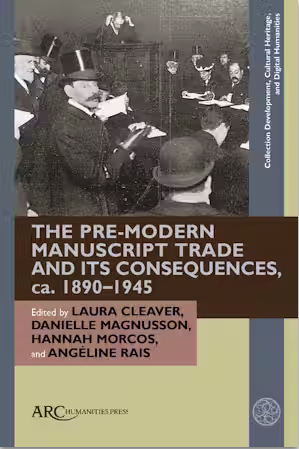
Publication – « The Pre-Modern Manuscript Trade and its Consequences, ca. 1890–1945 », éd. Laura Cleaver, Danielle Magnusson, Hannah Morcos, Angéline Rais

This collection brings together current research into the development of the market for pre-modern manuscripts. Between 1890 and 1945 thousands of manuscripts made in Europe before 1600 appeared on the market. Many entered the collections in which they have remained, shaping where and how we encounter the books today. These collections included libraries that bear their founders’ names, as well as national and regional public libraries. The choices of the super-rich shaped their collections and determined what was available to those with fewer resources. In addition, wealthy collectors sponsored scholarship on their manuscripts and participated in exhibitions, raising the profile of some books. This volume examines the collectors, dealers, and scholars who engaged with pre-modern books, and the cultural context of the manuscript trade in this era.

Laura Cleaver is Senior Lecturer in Manuscript Studies at the University of London and Principal Investigator of the CULTIVATE MSS project.

Danielle Magnusson is a Postdoctoral Research Fellow on the CULTIVATE MSS project. Her research focuses on American collecting and early modern drama.

Hannah Morcos is a Postdoctoral Research Fellow on the CULTIVATE MSS project. Her research focuses on the trade in French manuscripts.

Angéline Rais is a Postdoctoral Research Fellow on the CULTIVATE MSS project. Her research focuses on book dealers in Germany and Switzerland.

Acknowledgements 

Abbreviations

List of Illustrations 

List of Tables

Introduction 

Part 1: Dealers and the Market 

Chapter 1. Pierre-Louis Pinault, Bernard Quaritch Ltd., Bibliophilic Clubs and the Trade in Medieval Manuscripts ca. 1878–1939 

Chapter 2. A. S. G. Edwards, Selling Middle English Manuscripts to North America up to 1945 

Chapter 3. Danielle Magnusson, Dollars and Drama: Early English Plays and the American Book Trade 1906–1926 

Chapter 4. Livia Marcelli, The Fates of the Manuscripts from the Vallicelliana Library of Rome at the end of the Nineteenth Century 

Chapter 5. Katharina Kaska and Christoph Egger, Fuelling the Market—Sales from Austrian Monasteries 1919–1938 

Chapter 6. Angéline Rais, Jacques Rosenthal’s Marketing Strategies: An Analysis of the Bibliotheca medii aevi manuscripta,1925–1928 

Chapter 7. Margaret Connolly, From Drawing Room to Sale-room: Albums of Medieval Manuscript Cuttings in the 1920s 

Chapter 8. Lisa Fagin Davis, Buying and Breaking with Philip and Otto 

Part 2: Buyers 

Chapter 9. Francesca Manzari, Illuminations from Northern and Central Italy in the Collection of the Dealer Vittorio Forti 

Chapter 10. Rhiannon Lawrence-Francis, The One That Got Away: How Lord Brotherton Lost Out on a Book and Founded a Library 

Chapter 11. Karen Winslow, Becoming a Gentleman Collector: Alfred Chester Beatty’s Influence on Calouste Sarkis Gulbenkian’s Manuscript Collection 

Chapter 12. Martina Lanza, A Private Library and the Making of the Middle Ages in Florence: Piero Ginori Conti’s Collection 

Chapter 13. Paola Paesano, The “Calenzio Deal” and the Auction of the Oldest Vallicelliana Codices, 1874–1916

Chapter 14. Federico Botana, The Acquisitions of Florentine Public Libraries 1900–1935 

Chapter 15. Hannah Morcos, Private Purses and “National” Possessions: The French Acquisitions from the Phillipps Library (1908) 

Chapter 16. Jérémy Delmulle and Hanno Wijsman, The Case of Louvain University Library 1919–1940

Chapter 17. James C. P. Ranahan, To Buy, or Not to Buy? Market Forces and the Making of the Shakespeare Birthplace Trust’s Collections 

Chapter 18. Toby Burrows, Women Owners and Collectors in de Ricci’s Census of Medieval and Renaissance Manuscripts in the United States and Canada 

Chapter 19. Natalia Fantetti, “A most fascinating and dangerous pursuit:” The Book Collecting of Isabella Stewart Gardner 

Chapter 20. Jill Unkel, The Collector, Edith Beatty (1886–1952) 

Chapter 21. Nathalie Roman, Paul Durrieu (1855–1925): Art Collecting and Scholarly Expertise 

Part 3: Scholarly and Creative Engagements 

Chapter 22. Nigel Ramsay, Chronicling the Market in Rare Books and Manuscripts: William Roberts and Seymour de Ricci 

Chapter 23. Christine Jakobi-Mirwald, Stories of an Antiquary: The Legacy of M. R. James 

Chapter 24. Kate Falardeau, Phillipps MS 24275 and the Nineteenth- and Early Twentieth-Century Historiography of Bede’s Martyrology

Chapter 25. Alan Mitchell, Manuscripts and Meaning: The Biography and Value of John Ruskin’s Blue Psalter, Brussels,Bibliothèque Royale de Belgique (KBR), MS IV 1013 

Chapter 26. Nora Moroney, Translation, Tradition and Tracing the History of an Irish Manuscript Primer

Chapter 27. Dongwon Esther Kim, The Bedford Psalter and Hours: Making and Un-making National Identity in the Acquisition of an “English” Manuscript 

Chapter 28. Alexandra Plane, The National Collection that Never Was: The “failure” of Henry Yates Thompson’s Experimental National Gallery Exhibition 

Chapter 29. Gaia Grizzi, Exhibiting Italian Books Outside Italy: Tammaro de Marinis and the 1926 Exhibition Le livre italien 

Chapter 30. William P. Stoneman, A Reference Book for Scholars and Collectors: Eric Millar’s English Illuminated Manuscripts, 1926–1928 

Conclusion: Consequences

Select Bibliography

Index of Premodern Manuscripts

Index of Personal Names

Informations pratiques :

The Pre-Modern Manuscript Trade and its Consequences, ca. 1890–1945, éd. Laura Cleaver, Danielle Magnusson, Hannah Morcos, Angéline Rais, Leeds, ARC Humanities Press, 2024 ; 1 vol., 490 p. (Collection Development, Cultural Heritage, and Digital Humanities). ISBN : 978-1-80270-137-1. Prix : GBP 145,00.

Source : ARC Humanities Press

Publié dans Publications | Laisser un commentaire

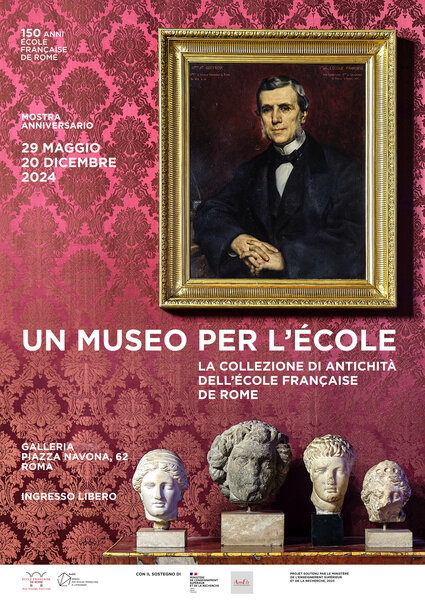
Exposition – Un Musée pour l’École

La collection d’antiques de l’École française de Rome exposée du 29 mai au 20 décembre 2024

29 mai – 20 décembre 2024
École française de Rome (piazza Navona, 62)

Dans le cadre du cent-cinquantième anniversaire de l’École française de Rome.

Sous le commissariat de Christian Mazet (Université libre de Bruxelles) et Paolo Tomassini (Université catholique de Louvain), anciens membres de l’École française de Rome.

De mai à décembre 2024, l’exposition « Un musée pour l’École » présentera au public un ensemble inédit d’objets archéologiques conservés à l’École française de Rome. Principalement réunie par le premier directeur de l’École, Auguste Geffroy, qui avait souhaité doter l’institution d’une collection d’antiques dans une visée scientifique et pédagogique, cette collection a été récemment étudiée par les archéologues Christian Mazet et Paolo Tomassini, anciens membres de l’EFR, qui ont retracé l’histoire mouvementée de sa constitution.

Cette exposition temporaire dans la galerie de l’École, place Navone, en 2024, sera suivie d’une version numérique et d’une exposition permanente au palais Farnèse, à partir de 2025.

Projet soutenu par le ministère de l’Enseignement supérieur et de la Recherche (2023) avec la collaboration de l’association des Amis de l’École française de Rome et du réseau des Écoles françaises à l’étranger.

Les commissaires

Christian Mazet est archéologue, céramologue et historien de l’archéologie, spécialiste de la culture matérielle grecque et préromaine et de l’histoire des collections d’antiques au XIXe siècle. Ancien élève de l’École du Louvre, diplômé de Muséologie, chargé d’études et de recherche à l’Institut national d’histoire de l’art (2014-2018) et docteur de l’École Pratique des Hautes Études – Université PSL (2020), il a été membre scientifique de la section Antiquité de l’EFR (2019-2022), boursier de l’Istituto Nazionale di Studi Etruschi ed Italici et assegnista di ricerca à la Sapienza Università di Roma (2022-2023). Lauréat du Prix Roger Lambrechts décerné par l’Académie royale de Belgique pour ses recherches sur les fouilles Bonaparte à Vulci, il est actuellement chercheur postdoctoral (CIVIS3i Fellow) à l’Université Libre de Bruxelles et codirige une mission archéologique dans les nécropoles orientales de Vulci.

Paolo Tomassini est archéologue, spécialisé dans l’étude du décor et de l’architecture antiques d’époque romaine. Docteur de l’Université catholique de Louvain (2017) et ancien membre de l’École française de Rome (2019-2022), il est actuellement chercheur qualifié à l’université de Namur (Belgique) et invited associate professor à l’Université catholique de Louvain, en Belgique. Ses travaux portent avant tout sur la peinture murale romaine et le travail des peintres de l’antiquité, mais il s’occupe également d’archéologie virtuelle, de restitutions digitales et d’archéologie du bâti. Depuis plusieurs années il travaille sur le site d’Ostia antica, où il co-dirige également des fouilles archéolologiques.

Le parcours de l’exposition

Les visiteurs seront guidés le long d’un parcours organisé en cinq sections :

  1. La première section est consacrée à l’histoire de la collection et du marché des antiquités à la fin du XIXe siècle. L’exposition d’objets représentatifs et de documents d’archives retrace les liens entre les protagonistes de cette histoire singulière, tels qu’Auguste Geffroy, Jules Ferry, Augusto Castellani et Wolfgang Helbig.
  2. La deuxième section est consacrée aux premières fouilles menées par l’École française de Rome à Palestrina en 1878, avec une importante collection de terres cuites votives de production étrusco-latiale.
  3. La troisième section est consacrée à la présentation des sculptures romaines, qui seront exceptionnellement déplacées des salles de réception au deuxième étage du Palais Farnèse.
  4. La quatrième section présente la riche collection de vases offerte par Augusto Castellani. Le commerce des antiquités à Rome dans la seconde moitié du XIXe siècle est également analysé, ainsi que la restauration des vases et l’interaction entre les assemblages et autres pastiches.
  5. La cinquième section présente la collection archéologique, où l’abondance, la variété et la représentativité archéologiques deviennent des outils de formation utiles pour l’étude de la culture matérielle romaine.

Un musée à portée de main

Pour construire un dialogue entre le passé de l’École, le présent de l’exposition et le futur de la recherche et de la valorisation de la collection, l’exposition est également présentée sous une forme virtuelle. Retrouvez au lien ci-dessous la présentation de la collection archéologique de l’École également en ligne, avec une sélection d’objets de la collection modélisée en 3D, le catalogue numérique et les documents d’archives numérisées.

omeka.efrome.it/s/collection-archeologique/page/accueil

À paraître : un ouvrage sur la collection

L’exposition, accompagnés de la publication d’une monographie de référence, première publication scientifique entièrement dédiée à la collection archéologique de l’École française de Rome, a été conçue par Christian Mazet e Paolo Tomassini, anciens membres de l’École française de Rome de la section Antiquité.

Informations pratiques

Exposition ouverte au public du 29 mai au 20 décembre 2024 dans la galerie de l’École française de Rome (piazza Navona, 62).

Jours et horaires d’ouverture, à partir du 29 mai 2024 :

  • du lundi au vendredi de 10 h à 19 h, le samedi de 10 h à 13 h
  • fermetures exceptionnelles :
    • le samedi 29 juin
    • du jeudi 8 août au dimanche 25 août inclus
    • le vendredi 1er novembre
    • le lundi 11 novembre.

Entrée libre
 

Source : École française de Rome

Publié dans Exposition | Laisser un commentaire

Publication – Marc Bloch, « La Vie d’outre-tombe du roi Salomon »

En marge des recherches préparatoires à son célèbre ouvrage Les Rois thaumaturges, Marc Bloch découvre une intrigante légende dont il fait la matière d’un court article publié en 1925. Demeurée méconnue, cette brève étude de l’imaginaire médiéval sur la pénitence subie dans l’au-delà par le roi Salomon constitue une magistrale leçon d’histoire des mentalités.

Florence Hulak, dans sa présentation, souligne la force et le caractère novateur de la méthode de Bloch, fondée sur l’observation, l’engagement du présent dans l’étude du passé, l’usage systématique et réfléchi de la comparaison. L’historien élabore une approche originale des mythes, qui rend compte de leur historicité et de leur forme propre de rationalité. Il peut ainsi raviver la puissance interprétative du mythe biblique de Salomon, à la fois roi, sage et juif.

Julien Théry, dans sa postface, montre comment ce texte précurseur a ouvert un vaste champ qui allait s’avérer particulièrement fertile : l’anthropologie historique des représentations religieuses.

Marc Bloch est né le 6 juillet 1886 à Lyon. Agrégé d’histoire, il participe à la Première Guerre mondiale. Reçu docteur en histoire en 1920, il publie en 1924 un ouvrage majeur, Les Rois thaumaturges. Nommé professeur d’histoire du Moyen Âge à la faculté de Strasbourg à partir de 1927, il participe, avec Lucien Febvre, à la fondation de la revue Annales d’histoire économique et sociale en 1929. L’école historiographique des Annales, en rupture avec l’école méthodique, s’émancipait des aspects événementiels et institutionnels pour ouvrir à une histoire totale des sociétés, soucieuse des structures de longue durée. En 1939, Marc Bloch publie une synthèse magistrale, La Société féodale.
Alors qu’il est professeur à la Sorbonne, les lois sur le statut des juifs édictées par le gouvernement de Vichy en 1940 le privent de sa chaire. Il rédige alors
L’Étrange défaite, méditation sur les causes de l’effondrement face à l’Allemagne, avant d’entrer dans la Résistance. Arrêté à Lyon par la Gestapo, il est exécuté le 16 juin 1944.

Florence Hulak est docteure en philosophie et professeure de science politique à l’université Paris 8 Vincennes–Saint-Denis. Ses recherches portent sur la philosophie de l’histoire et des sciences humaines, notamment sur Marc Bloch et Émile Durkheim. Elle est l’autrice de Sociétés et mentalités : la science historique de Marc Bloch (Hermann, 2012).

Julien Théry est archiviste-paléographe, professeur d’histoire médiévale à l’université Lumière Lyon 2 et directeur scientifique des Presses universitaires de Lyon. Ses recherches portent sur les liens entre religion et gouvernement, particulièrement en France et en Italie aux derniers siècles du Moyen Âge. Il anime par ailleurs l’émission « La grande H. » sur Le Média TV.

Informations pratiques :

Marc Bloch, La Vie d’outre-tombe du roi Salomon, préface Florence Hulak, postface Julien Théry, Lyon, Presses universitaires de Lyon, 2024 ; 1 vol., 128 p. (Essentiels,). ISBN : 978-2-72971-441-3. Prix : € 10,00.

Source : Presses universitaires de Lyon

Publié dans Publications | Laisser un commentaire