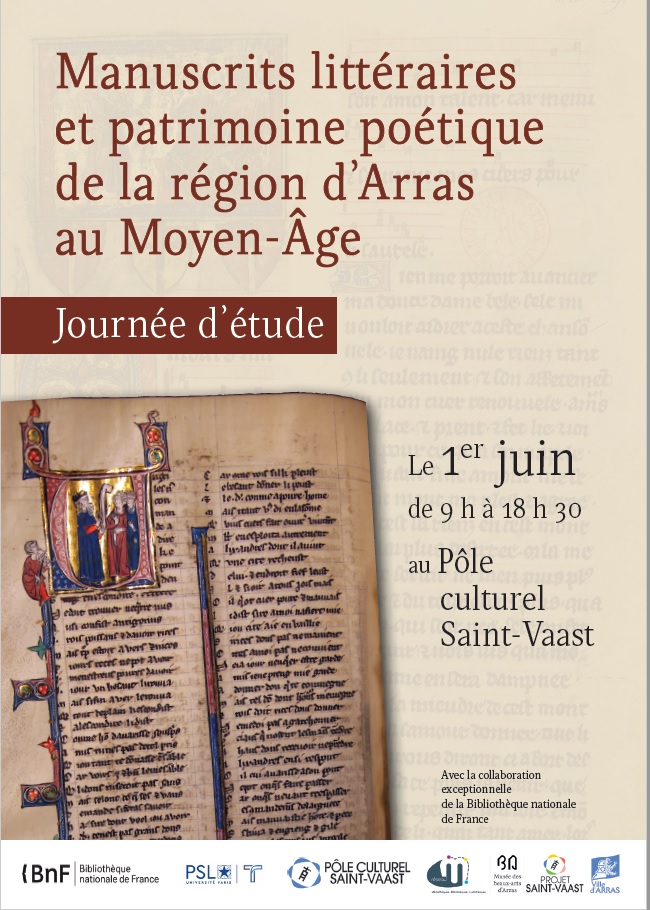
Journée d’étude – Manuscrits littéraires et patrimoine poétique de la région d’Arras au Moyen-Âge

  • 9 h – 9 h 30 : Accueil des participants
  • 9 h 30 : Allocutions de bienvenue : M. Frédéric LETURQUE, Maire de la ville d’Arras, et Mme Laurence ENGEL, Présidente de la Bibliothèque nationale de France

Présidente de session : Marie-Geneviève GROSSEL

  • 9 h 45 – 10 h 20 : Françoise VIELLIARD (École nationale des chartes) :
    La transmission de la poésie lyrique médiévale par les « chansonniers ». Le cas de la poésie d’oïl
  • 10 h 20 – 10 h 40 : Graziella PASTORE (Bibliothèque nationale de France) :
    Présentation du ms. BnF fr.24406
  • 10 h 40 – 10 h 50 : Discussions
  • 10 h 50 – 11 h : Pause

Présidente de session : Charlotte DENOËL

  • 11 h – 11 h 20 : Myriam WHITE-LE GOFF (Université d’Artois) :
    La légende du purgatoire de saint Patrick dans deux manuscrits enluminés : Vers l’expressivité
  • 11 h 20 – 11 h 40 : Pascal RIDEAU (Bibliothèque municipale d’Arras) :
    Les productions du Scriptorium de l’abbaye Saint-Vaast d’Arras au XIe siècle
  • 11 h 40 – 12 h : Discussions
  • 12 h – 14 h : Pause méridienne

Présidente de session : Françoise VIELLIARD

  • 14 h – 14 h 20 : Nadège LE LAN (Université du Littoral Côte d’Opale) :
    Chercher l’image : ouvrir les manuscrits de La Mort du roi Arthur
  • 14 h 20 – 14 h 40 : Marie-Geneviève GROSSEL (Université de Valenciennes) :
    « Un bon faiseur de chansons » entre les cours et le puy, le trouvère Gillelbert de Berneville
  • 14 h 40 – 15 h : Discussions
  • 15 h – 15 h 15 : Pause

Présidente de session : Nadège LE LAN

  • 15 h 15 – 15 h 35 : Justine DOCKX (Université polytechnique Hauts-de-France) :
    Comtés du Nord-Ouest : mises en valeur d’un paysage dans la Prose d’Anseÿs de Gascogne
  • 15 h 35 – 15 h 55 : Anna ARATO (École normale supérieure) :
    Réseaux poétiques médiévaux dans le Nord de la France: perspectives de recherche
  • 15 h 55 – 16 h 15 : Discussions
  • 16 h 15 – 17 h 30 : Visite libre des collections permanentes et des expositions temporaires
  • 17 h 30 – 18 h 30 : Concert de musique médiévale de l’Ensemble Alla francesca
Programme du concert

« Juifs et trouvères : Chansons des communautés juives dans la France du Nord au tournant des XIIIe et XIVe siècles ». Ensemble Alla francesca.

Distribution

  • Vivabiancaluna BIFFI : vièle à archet
  • Christel BOIRON : chant
  • Michaël GRÉBIL : luth, cistres, chant, percussions
  • Lior LEIBOVICI : chant
  • Brigitte LESNE : harpe-psaltérion, chant, percussions, direction, conception du programme et transcriptions musicales

Programme

  • Baruch hagever : chant de prière, Ovadia Hager
  • Danse real : danse instrumentale
  • Shalfu tzarim : poème liturgique (piyyut), anonyme, mélodie de Moniot de Paris
  • Les anfanz des avot : poème pour le Nouvel An, mélodie de Richard Coeur de Lion
  • Flos in monte cernitur : conduit [instrumental]
  • Chanter et renvoisier sueil : chanson d’amour, Thibaut de Blazon
  • Por mon chief reconforter : chanson mariale, Gautier de Coincy
  • Sol sub nube latuit : conduit [vocal puis instrumental]
  • Par grant franchise : chanson d’amour, Mahieu le Juif
  • Quinte estampie : danse instrumentale
  • Onques n’amai tant que jou fui amee : chanson d’amour et motet, Richard de Fournival
  • Septime estampie : danse instrumentale
  • En Egypte / Ne puis ma grant joie celer : chanson de Jacob, Estoire de Joseph, texte et mélodie anonymes
  • Por autrui movrai mon chant : chanson d’amour, Mahieu le Juif
  • Deror yiqra : chanson de chabbat, texte et mélodie anonymes
  • Mout sont il a mechief mis : Elégie de Troyes, anonyme, mélodie du Châtelain de Coucy
  • Redit etas aurea : conduit [instrumental]
  • Amour voules vous acorder : chanson d’amour, Jehan de Lescurel
  • La nuit de Pesah : chant pour la fête de Pessah, texte et mélodie anonymes

Biographie Alla francesca

Depuis sa création au tout début des années 90, Alla francesca se consacre aux chansons et musiques instrumentales depuis la fin du XIe siècle jusqu’au début du XVIe siècle.

Ensemble à géométrie variable, son répertoire couvre la diversité des musiques les plus anciennes : troubadours et trouvères, période de l’ars nova (Guillaume de Machaut), musiques de diverses cultures puisant leurs sources dans les traditions les plus anciennes (en Espagne, en Italie…), chansons et polyphonies tardives en allant jusqu’à la Renaissance.

Alla francesca approfondit particulièrement aujourd’hui sa recherche selon deux axes principaux :

  • L’interprétation de l’art poétique en langue d’oïl, l’ancien français (mais également dans d’autres langues romanes anciennes), en affinant toujours plus son travail sur l’éloquence du chant et la subtilité de l’accompagnement instrumental ;
  • La mise en valeur de l’apport spécifique des musiques médiévales dans l’interprétation de celles qui leur succèdent immédiatement, à la Renaissance, en France et en Italie.

Alla francesca est invité par les plus grands festivals internationaux de musique ancienne et se produit dans le monde entier. Il est à la tête de dix-neuf enregistrements, parmi lesquels les derniers, Variations amoureuses (2020) et Le Chansonnier de Bayeux (2021), sont parus sous le label Paraty.

CD « Juifs et trouvères »

  • Paru chez IEMJ / Buda musique : coproduction Centre de musique médiévale de Paris, avec le soutien du FCM
  • Alla francesca
  • Direction : Brigitte LESNE
  • Production Centre de musique médiévale de Paris
  • Avec le soutien de la Direction régionale des affaires culturelles d’Île-de-France
  • http://www.allafrancesca.fr – contact@allafrancesca.fr

Source : BnF – Hypothèses

Publié dans Colloque | Laisser un commentaire

Publication – Ninon Dubourg, « Disabled Clerics in the Late Middle Ages. Un/suitable for Divine Service? »

he petitions received and the letters sent by the Papal Chancery during the Late Middle Ages attest to the recognition of disability at the highest levels of the medieval Church. These documents acknowledge the existence of physical and/or mental impairments, with the papacy issuing dispensations allowing some supplicants to adapt their clerical missions according to their abilities. A disease, impairment, or old age could prevent both secular and regular clerics from fulfilling the duties of their divine office. Such conditions can, thus, be understood as forms of disability. In these cases, the Papal Chancery bore the responsibility for determining if disabled people were suitable to serve as clerics, with all the rights and duties of divine services. Whilst some petitioners were allowed to enter the clergy, or – in the case of currently serving churchmen – to stay more or less active in their work, others were compelled to resign their position and leave the clergy entirely. Petitions and papal letters lie at intersection of authorized, institutional policy and practical sources chronicling the lived experiences of disabled people in the Middle Ages. As such, they constitute an excellent analytical laboratory in which to study medieval disability in its relation to the papacy as an institution, alongside the impact of official ecclesiastical judgments on disabled lives.

Ninon Dubourg is a doctor in Medieval History of the University of Paris Diderot, now a post-doctoral researcher at the Transitions Unit of the University of Liège (Belgium). She is in charge of the research blog History of Disease, Disability and Medicine in Medieval Europe and the co-organiser of the EHESS’ monthly seminar “Construire une histoire du handicap et de la surdité au travers des siècles” (Building a history of disability and deafness through the centuries) with Fab-rice Bertin (EHESS) and Gildas Brégain (Rennes, CNRS) (2021-2022). She is a foreign associate member of the research network Homo Debilis at the Bremen University and a member of the Re-search Group Handicap et sociétés of the Réseau Jeunes chercheurs Santé et Sociétés at the EHESS.

Table des matières :

Preface
Introduction: A Formal Dialogue
Chapter 1: Legal Origins of the Prohibition on Clerical Disability
Chapter 2: Aetiologies of Impairment: Congenital, Geriatric, and Acquired Conditions
Chapter 3: Joining the Clergy
Chapter 4: Staying in the Clergy
Chapter 5: Leaving the Clergy
Conclusion
List of works cited for each chapter

Informations pratiques :

Ninon Dubourg, Disabled Clerics in the Late Middle Ages. Un/suitable for Divine Service?, Amsterdam University Press, 2023 ; 1 vol., 294 p. (Premodern Health, Disease, and Disability). ISBN : 978-9-46372-156-1. Prix : € 133,00.

Source : Amsterdam University Press

Publié dans Publications | Laisser un commentaire

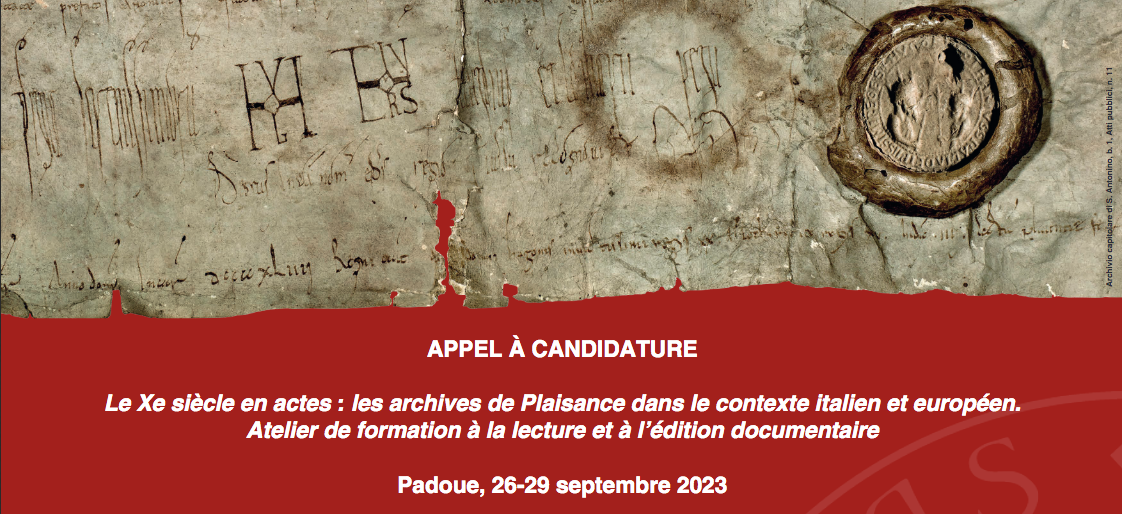
Appel à candidature – Le Xe siècle en actes : les archives de Plaisance dans le contexte italien et européen

Inscriptions ouvertes] Un atelier de formation à la lecture et à l’édition documentaire est proposé aux doctorants dans les disciplines médiévales du mardi 26 au dimanche 29 septembre 2023 à Padoue.

L’histoire urbaine du Xe siècle italien est écrasée entre la longue phase historique précédente et (surtout) la suivante. Considéré comme le terminus ad quem de la périodisation conventionnelle d’un haut Moyen Âge oscillant constamment entre continuité et fractures par rapport au patrimoine antique, il a traditionnellement assumé, en même temps, la valeur d’une époque incubatrice de développements démographiques, de vitalité économique, de dynamiques politiques et sociales qui trouveraient une sanction définitive dans l’affirmation triomphante des autonomies communales. L’objectif de l’atelier doctoral est au contraire d’attirer l’attention sur les particularités et les expérimentations d’une longue période – qui s’étend de la fin de l’empire carolingien à la mort d’Otton III – qui, même dans les contextes urbains, a été caractérisée par l’interaction originale entre les règles supérieures du jeu politique et les protagonismes émergeant d’une société progressivement plus articulée et conflictuelle.

Avant toute reconstruction (et comme antidote à une éventuelle surinterprétation des nouveautés actuelles), une évaluation du panorama et de la structure des sources – en particulier documentaires – qui, au Xe siècle, ont enregistré une augmentation quantitative généralisée, est une condition préalable à toute reconstruction. D’où le choix d’organiser le programme de travail en fonction d’études de cas – locales ou régionales – présentant des sources à la structure comparable. La ville de Plaisance, au coeur de la vallée du Pô, sert ici de « laboratoire ». Il s’agit du deuxième gisement documentaire de l’Italie du haut Moyen Âge et la publication des actes qui s’y rapportent (environ 430 pièces), encore largement inédits, est l’un des objectifs du projet « Repenser le 10e siècle au prisme des territoires : régulations et résistances dans une Europe en reformation (870-1000) », Programme structurant 2022-2026 de l’École française de Rome.

Les participants à l’atelier doctoral, par le biais de formations qualifiantes et d’activités en ateliers, auront l’occasion de participer à cette entreprise éditoriale. En effet, outre des conférences sur de vastes questions historiographiques et des études de cas concernant le regnum (Milan, Émilie, Toscane), les territoires de tradition byzantine (Venise, Ravenne, Rome) et le Sud lombard (Bénévent et Salerne), des séminaires sont consacrés aux sources documentaires de Plaisance, aux habitudes graphiques du notariat local, aux dynamiques de peuplement et à l’organisation du territoire. L’atelier comprend la lecture, l’analyse, la transcription, l’édition (traditionnelle et numérique) d’une sélection d’actes disponibles dans des reproductions à très haute résolution grâce à une campagne de reproduction numérique pilotée par l’Institut de recherche et d’histoire des textes (CNRS, Paris).

La participation est ouverte aux doctorants dans les disciplines médiévales de toute institution italienne ou étrangère.

Quinze bourses destinées aux étudiant(e)s sont à attribuer. L’atelier est de nature résidentielle et les participants doivent faire une brève présentation de leurs recherches en cours lors d’un séminaire. Ces présentations peuvent être faites en italien, en français ou en anglais.

Grâce à ces bourses, le projet prendra en charge les coûts de l’hébergement et des dîners à Padoue pour les doctorant(e)s sélectionnés. Une aide au financement concernant le voyage vers et depuis Padoue pourra aussi être attribuée, sous conditions.

Modalités de candidature

Les candidats doivent envoyer leur dossier au Prof. Gianmarco De Angelis (gianmarco.deangelis@unipd.it) avant le 30 juin 2023, en indiquant dans l’objet « Application for Atelier doctoral EFR ».

Chaque dossier devra être constitué de :

  • Un curriculum vitae du candidat.
  • Une brève présentation (5 pages maximum) du projet de thèse de doctoratet et un résumé de l’article que le candidat a l’intention de discuter lors des sessions de l’atelier.

INFORMATIONS PRATIQUES

Type d’événement: Ecole d’été

Conditions d’accès : Inscription

Date des séances : 30/06/2023 – 19:00

Lieu : Padoue

Source : IRHT

Publié dans Appel à contributions, École d'été, Enseignement | Laisser un commentaire

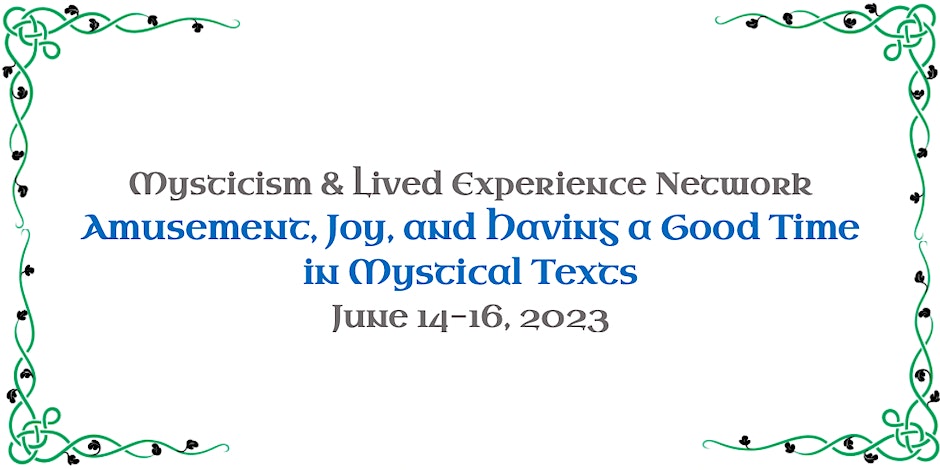
Colloque – Amusement, Joy, and Having a Good Time in Mystical Texts

Mystics who suffered, through illness, asceticism, the withdrawal of divine grace, the ruthlessness of their critics, or just from the harshness of life, often dominate our readings of the texts of and about mystics. While these are crucial aspects of their experience, what is often overlooked are the moments of happiness and contentment that also exist in these works. The M&LEN 2023 Annual Conference will answer Amy Hollywood’s call to not only speak of suffering and pain in relation to female mystical lives, but also of joy. We will be exploring the “lighter” moments, looking at how mystical texts discuss happiness, joy, amusement, playfulness, and the enjoyment of life, as well as how pain and suffering are transformed into joy in some works.

Inscription : ici

Programme :

Wednesday, June 14th , 16:00-17:15 BST

Einat Klafter & AJ Langley – Welcome and Opening Remarks

Keynote Speaker: Peter Jones (Complutense University of Madrid): « When and When Not to Laugh: A Cistercian Guide « 

Thursday, June 15th, 14:00-15:30 BST

Lauren Cole (Northwestern University): The Acoustics of Joy: Hildegard of Bingen’s Chants for St Rupert

Tatiana Barkovskiy (University of Warsaw): « Marguerite Porete’s Metaphysics of Love and Epistemology of Joy »

Hannah Victoria (Sorbonne Université): Be Gay: Theorising the Joyous Queer in Mystical Texts

Friday, June 16th, 14:00-15:00 BST

Lieke Smits (University of Antwerp): Who wants to play? The infant Jesus having a good time in mystical and devotional Practice

Philip Liston-Kraft (Harvard University): Hide and Seek: Christina von Hane and the Infant Jesus at Play

Friday, June 16th, 16:30-17:30 BST

Ngo Hin Cheng (KU Leuven): The Joy of the Bride and the Maidens in Bernard of Clairvaux’s Sermones super Cantica canticorum

Erin Risch Zoutendam (Duke University): Readers and Lovers: The Song of Songs as Hermeneutic in Hugh of Balma’s The Roads to Zion Mourn

Publié dans Colloque | Laisser un commentaire

Colloque – Online Conference on Histories of Disability and Emotions

The history of disability and the history of emotions are now two well established fields. Historians of disabilities have often referred to and included emotions in their historical narratives. Examples of these are the existing histories related to the instrumental place occupied by pity in telethons, the tangible presence of rage and anger in histories of disability activism or the reference to (un)happiness in histories dealing with the emergence of special education. Despite the seemingly overall presence of emotions in disabilities histories, however, a more detailed examination of the role played by emotions in the history of disability is lacking. On the basis of a wide range of historical case studies the organizers of the conference Histories of Disability and Emotions aim at moving forward our knowledge and insights with regard to the methodological and theoretical approaches towards emotional histories of disabilities. 

Programme :

Tuesday, 13 June 2023

All time indications are CET. Paper presentations are limited to 15 minutes.

9.30 AM: Welcoming remarks and introduction by Sara Scalenghe (Loyola University Maryland), Ninon Dubourg (University of Liège) & Pieter Verstraete (KU Leuven)

10 AM: PANEL 1 – Emotional normativities through time (Chair: Pieter Verstraete)

  • Corinne Doria (Chinese University of Hong Kong): From Pride to Embarrassment: Perception of Myopia in the 19th Century and Early 20th Century
  • Beck Chamberlain Heslop (University of Manchester): Feeling the Way: Emotional entanglements of white canes in Britain, c. 1960-1980
  • Simonetta Polenghi & Anna Debè (Catholic University of the Sacred Heart): From Christian commiseration to patriotic pride. Eliciting emotions in readers of Italian children’s literature, magazines and school textbooks (1870-1930)

11.15 AM: Coffee break

11.30 AM: PANEL 2 – Biographical and archeological approaches to emotions (Chair: TBD)

  • Gregory Carrier (University of Toronto): Sorrowful Parents and Joyful Brothers: Emotions in Two Biographies of Hermannus Contractus
  • Mari Eyice (Stockholm University): Feeling dis/ability in 17th century Sweden
  • June-Ann Greeley (Sacred Heart University): Reading “The Lament of the Old Woman of Beare”: Gendered Old Age as Disability

12.45 PM: Lunch break 

2 PM: PANEL 3 – Disability, emotions and experience (Chair: Ninon Dubourg)

  • Michael Rembis (University at Buffalo): Madness, Affect, and Asylums in the 19th-century United States
  • Wendy Turner (Augusta University): Emotion, Mental Health, and Intellectual Disabilities in the Legal and Administrative Records of Medieval England
  • Silvia Carraro (University of Padua): Odi et amo? Daily Emotions towards Disabled People in Medieval Venice (14th-15th century)
  • Maja Bondestam (Uppsala University): Disability and hot nature: How emotional, not physical, traits disqualified people from work and good manners according to late 18th century Swedish medicine

3.30 PM: Coffee break

4 PM: Keynote 1 by David Turner

Wednesday, 14 June 2023

10 AM: PANEL 4 – Emotional approaches to illness and disability (Chair: TBD)

  • Saghar Bozorgi (University of Texas at Austin): Be Fearful and/but Heal Yourself : Analyzing Emotions about Disability and Healing in mid-20th Century Iran
  • Emanuele Piazza (Università degli Studi di Catania): Healing Disabilities in the Diaologi of Gregory the Great
  • Mia Edwards (University of Warwick): Physical Disability, Physicality, and Masculinity within the Plantation Labour System, 1800-1861
  • Nicole Reibe (Loyola University Maryland): Silent Solidarity: Deafness, Anger, and Action in the Work of Teresa de Cartagena

11.30 AM: Coffee break

11.45 AM: PANEL 5 – The body and emotional politics (Chair: TBD)

  • Bianca Frohne (Kiel University): Disability, Emotions, and Pain in Medieval and Early Modern Miracle Accounts
  • Jack Litchfield (Independent scholar): Maimed, Wounded, Febled, and Debrused: Feeling Hurts in Late Medieval English Martial Culture
  • Wei Yu Wayne Tan (Hope College): Disability and Illness in Quarantine: Hōjō Tamio and the Experience of Leprosy (Hansen’s Disease) in Modern Japan 

1 PM: Lunch break

2 PM: PANEL 6 – Disability, narrativity and emotional prosthesis (Chair: TBD)

  • Marla Carlson (University of Georgia): Blindness and Disgust in Medieval French Farce
  • Magdalena Matczak (Nicolaus Copernicus University): Osteobiographies of Disability and Emotions in Medieval Culmen, Poland
  • Marit Ronen (Independent scholar): Disgust and Disability, Gatekeeping in Early Medieval England
  • Abigail Greaves (University of Nottingham): Impairment, Sadness, and Hagiography in Early Medieval England 

3.30 PM: Coffee break

3.45 PM: Panel 7 – Agency, the disabled self and emotions (Chair: TBD)

  • Chayyim Holtkamp (The Citadel): Resistance in a Mental Institution: The South Carolina Lunatic Asylum as a Site of Patient Agency
  • Paul Van Trigt (Leiden University): Disabling suffering. Dutch self-advocates and pain (relief) during the 1990s
  • Timo Houtekamer (European University Institute): Symptoms or Self-Expressions? The Role of Emotions in Patient Files of People Diagnosed with Schizophrenia in Zurich, 1908-1950

5 PM: Coffee break

5.15 PM: Keynote 2 by Barbara Rosenwein

Thursday, 15 June 2023

10 AM: PANEL 8 – Performing emotions and disability (Chair: TBD)

  • Kalina Hadzhikova (Johns Hopkins University): Folly, Performance, and Emotional Regulation in Medieval England. »
  • Kirstie Stage (Christ’s College, University of Cambridge): ‘Piss on Pity’: Disabled Activists Challenging Narratives
  • Flora Amann (University of Jean Monnet): A Language of Emotions in the Age of Reason. Sign Language, Rationalism and Sensualism in Eighteenth-Century France
  • Esme Cleall (University of Sheffield): Dancing for Joy’: Disability and the Affective Connection in British Missionary Writing

11.30 AM: Coffee break

11.45 AM: PANEL 9 – Educational regimes of emotions and disability (Chair: TBD)

  • Shilpaa Anand (BITS Pilani, Hyderabad Campus): Being Sentimental, Being Enraged: Historicizing the Symbolism of Ekalavya’s Amputation
  • Gábor Bradács (Independent scholar): Claudi quoque et muti, surdique et paralitici a suis sunt infirmitatibus liberati. The perception of the disability in the medieval Hungarian hagiography between abhorrence and compassion
  • Léo Delaune (University of Strasbourg): Fear of humiliation, desire for humility: shame and physical disability in medieval exempla

1 PM: Lunch break

2 PM: PANEL 10 – Emotional knowledge and disablement (Chair: Sara Scalenghe)

  • Hilary Buxton (Kenyon College): Pride and Pity: Performing Emotion in Interwar South Asian Disability Petitions
  • Marco Di Giulio (Franklin & Marshall College): Contesting the Politics of British Prosthetic Care: Pain, Nativeness, and the Plight of Palestinian Jewish Amputees in WWII
  • Nathanje Dijkstra (Utrecht University): Navigating pain, fatique and misery. A practice-focused analysis of emotional expressions in workers’ disability benefit claims in the Netherlands (1901-1967)
  • Elif Küskü (Istanbul Technical University): Feelings of the Orthopedically Disabled: Arm and Leg Prosthesis Petitions in the Ottoman Empire 

3.30 PM: Concluding remarks 

Informations pratiques :

13 Jun 2023 09:30 AM to 15 Jun 2023 04:00 PM
Online via Zoom (Register below to get the Zoom-link)

Source : KU Leuven

Publié dans Colloque | Laisser un commentaire

Publication – Claire Tignolet, « Théodulf d’Orléans (vers 760-821). Histoire et mémoire d’un évêque carolingien »

Parmi les lettrés entrés au service de Charlemagne à la fin du VIIIe siècle, Théodulf est une figure à la fois représentative et singulière. Par ses productions et ses fonctions de missus, d’évêque, d’abbé, il contribue à l’élaboration et à la mise en œuvre des réformes et fait partie des proches du souverain. Sa déposition en 818 jette cependant une ombre sur sa carrière et sur ce qu’il est possible d’en reconstituer. À partir de l’étude de son œuvre et des variations de son image dans les sources du premier Moyen Âge, y compris manuscrites, cet ouvrage examine les différentes facettes de son action et de son parcours, comme lettré et comme prélat, et met en lumière le jeu d’échelles qui caractérise les réformes carolingiennes. Grâce à l’analyse de son environnement relationnel, la participation de Théodulf à la révolte de Bernard d’Italie et sa disgrâce font l’objet de nouvelles hypothèses.

Agrégée d’histoire, docteur en histoire médiévale de l’université Paris I Panthéon-Sorbonne (2013), Claire Tignolet est chercheuse associée au Laboratoire de médiévistique occidentale de Paris (LaMOP – UMR 8589).

Table des matières :

Liste des illustrations
Remerciements
Avertissement

Introduction
Théodulf : un bilan historiographique
Pour une approche biographique

Prologue. La déposition de Théodulf
La courte épitaphe d’un prélat mort en exil
Un fait marquant pour les contemporains
Théodulf et la révolte de Bernard d’Italie dans l’historiographie
Un corpus affecté par sa déposition ?

Chapitre 1. Le souvenir et la mémoire du prélat
Théodulf dans l’historiographie carolingienne
Théodulf dans la mémoire locale
Des strates mémprielles entremêlées
Conclusion

Chapitre 2. Mobilité et déplacements au service du souverain
De l’Espagne à la cour
L’installation de Théodulf à Orléans
Les déplacements d’un agent du roi
Sous Louis le Pieux, la mise à l’écart de Théodulf
Conclusion

Chapitre 3. Un évêque réformateur entre la cour et Orléans
Un Savant engagé dans les travaux intellectuels de la cour
Un agent de la mise en ordre carolingienne
Un bâtisseur dans l’Orléanais
Un artisan de la Renaissance carolingienne
Conclusion

Chapitre 4. Théodulf, un homme de réseaux
Un proche de Charlemagne
Rivalités et amitiés autour de Théodulf
Des liens en recomposition sous Louis le Pieux
Conclusion

Épilogue. Le retour en grâce
Le poème Hesperia genitus
Un contexte favorable
La diffusion du corpus d’exil
Jeux d’échelles

Bibliographie
Index des noms de personnes
Index des noms de lieux

Informations pratiques :

Claire Tignolet, Théodulf d’Orléans (vers 760-821). Histoire et mémoire d’un évêque carolingien, Turnhout, Brepols, 2023 ; 1 vol., 291 p. (Haut Moyen Âge, 46). ISBN : 978-2-503-60158-8. Prix : € 80,00.

Source : Brepols

Publié dans Publications | Laisser un commentaire

Offre d’emploi – Assistant Professor in Medieval Literary Studies (Durham University)

Durham University
Closes: 31st May 2023

The Department of English Studies seeks to appoint an Assistant Professor in Medieval Literary Studies with effect from September 2023.

Applicants should have appropriate teaching experience and research interests within the broad area of medieval literary studies. The post-holder will be expected to contribute to teaching across the medieval period, including Old English and/or Old Norse, and will have the ability to contribute to teaching beyond the medieval period. Applicants should demonstrate experience or interest in any aspect of digital literary studies.

Source : Jobs.ac.uk

Publié dans Offre d'emploi | Laisser un commentaire

Publication – « Literary Theory and Criticism in the Later Middle Ages Interpretation, Invention, Imagination », éd. Ardis Butterfield, Ian Johnson, Andrew Kraebel

This collection makes a new, profound and far-reaching intervention into the rich yet little-explored terrain between Latin scholastic theory and vernacular literature. Written by a multidisciplinary team of leading international authors, the chapters honour and advance Alastair Minnis’s field-defining scholarship. A wealth of expert essays refract the nuances of theory through the medium of authoritative Latin and vernacular medieval texts, providing fresh interpretative treatment to known canonical works while also bringing unknown materials to light.

Ardis Butterfield, Yale University
Ardis Butterfield is Marie Borroff Professor of English and Professor of French and Music at Yale University. Her books include Poetry and Music in Medieval France (Cambridge University Press, 2002) and The Familiar Enemy: Chaucer, Language and Nation in the Hundred Years War (2009), which won the R. H. Gapper prize for French Studies.

Ian Johnson, St Andrews University
Ian Johnson is Professor of Medieval Literature and Head of the School of English at the University of St Andrews. The author of The Middle English Life of Christ: Academic Discourse, Translation and Vernacular Theology (2013), he edited Geoffrey Chaucer in Context, (Cambridge University Press, 2019), recognised as a 2020 Choice Outstanding Academic Title, and, with Alastair Minnis, The Cambridge History of Literary Criticism, ii, The Middle Ages (Cambridge University Press, 2005).

Andrew Kraebel, Trinity University
Andrew Kraebel is Associate Professor of English at Trinity University, Texas. He is the author of Biblical Commentary and Translation in Later Medieval England: Experiments in Interpretation (Cambridge University Press, 2020), which was awarded the Ecclesiastical History Society’s book prize.

Table des matières :

The career and contribution of Alastair Minnis Vincent Gillespie
Introduction: criticism, theory and the medieval text Andrew Kraebel
1. Access through accessus: gateways to learning in a manuscript of school texts Marjorie Curry Woods
2. Scholastic theory and vernacular knowledge Jocelyn Wogan-Browne
3. Poetics and biblical hermeneutics in the thirteenth century Gilbert Dahan
4. Robert holcot and De vetula: beyond Smalley’s assessment Ralph Hanna
5. The inspired commentator: theories of interpretive authority in the writings of Richard rolle Andrew Kraebel
6. Guitar lessons at blackfriars: Vernacular Medicine and Preachers’ Style in Henry Daniel’s Liber uricrisiarum Joe Stadolnik
7. The re-cognition of doctrinal discourse and scholastic literary theory: affordances of ordinatio in Reginald Pecock’s Donet and reule of Crysten religioun Ian Johnson
8. Arts of love and justice: property, women and golden age politics in Le Roman de la Rose Jessica Rosenfeld
9. The many sides of personification: Rhetorical Theory and Piers Plowman Nicolette Zeeman
10. Encountering vision: dislocation, disquiet, perplexity in bonaventure, The Squire’s Tale and Pearl Mary Carruthers
11. George Colvile’s translation of the consolation of philosophy Ian Cornelius
12. When did the emotions become political? Medieval Origins and Enlightenment Outcomes Rita Copeland
Bibliography of the Works of Alastair Minnis Gina Marie Hurley and Clara Wild
Bibliography
Index.

Informations pratiques :

Literary Theory and Criticism in the Later Middle Ages Interpretation, Invention, Imagination, éd. Ardis Butterfield, Ian Johnson, Andrew Kraebel, Cambridge, Cambridge University Press, 2023 ; 1 vol., 300 p. ISBN : 978-1-10849-239-3. Prix : GBP 100,00.

Source : Cambridge University Press

Publié dans Publications | Laisser un commentaire

Séminaire – Actualité de la recherche médiévaliste (Modernités Médiévales)

Pour l’année 2023, le séminaire de Modernités médiévales se tourne spécifiquement vers le dynamisme du médiévalisme, en proposant des séances sur le sujet “Actualité de la recherche médiévaliste”.

Les séances auront lieu en visio (Zoom), via le lien suivant : https://univ-artois-fr.zoom.us/j/97142575651?pwd=ZUREUmV1dUE0NE5XQnpzL3N0cnpuUT09

ID de réunion : 971 4257 5651
Code secret : 400687

Programme

  • Lundi 15 mai, 17h30-18h30 : Justine Breton présentera son ouvrage Un Moyen Âge en clair-obscur (2023) consacré aux séries télévisées médiévalistes
  • Lundi 12 juin, 17h30-18h30 : Aude Bonord présentera son inédit d’HDR consacré aux variations littéraires XX-XXIe siècle sur François d’Assise
  • Jeudi 14 septebre, 17h30-18h30 : Marine Roussillon
  • Lundi 16 octobre, 17h30-18h30 : Pauline Pilote
  • Mercredi 15 novembre : Michèle Gally
  • (à venir)

Source : Modernités Médiévales

Publié dans Séminaire | Laisser un commentaire

Publication – « The Rise of an Academic Elite : Deans, Masters, and Scribes at the University of Vienna before 1400 », éd. Monica Brînzei

Henry of Rheinfelden, a Dominican from Basel, spent the last decade of the fourteenth century at the University of Vienna studying theology. During this time he took notes on the academic activities of the first rectors of the university and deans of the Faculties of Arts and Theology. This volume explores Rheinfelden’s contribution to our understanding of the doctrinal, curricular, administrative, and prosopographical history of the early University of Vienna. Deciphering Rheinfelden’s surviving notebooks in the Universitätsbibliothek Basel sheds new light on the rise of an academic elite in Vienna. His manuscripts reveal a network of scholars sharing a passion for knowledge and supply a gallery of intellectual profiles, starting with the mentors of the group, Henry of Langenstein and Henry Totting of Oyta, and continuing with the lesser-known figures Stephen of Enzersdorf, Gerhard Vischpekch of Osnabrück, Paul (Fabri) of Geldern, Andreas of Langenstein, Rutger Dole of Roermond, Nicholas of Hönhartzkirchen, Nicholas of Dinkelsbühl, John Berwart of Villingen, John Stadel of Russbach, Peter de Treysa, Michael Suchenschatz of Hausleiten, Peter Schad of Walse, Thomas of Cleves, and Leonhard of Dorffen. The papers gathered in this volume highlight the intricate relationship between a commitment to administrative duty and an appetite for the creation of a doctrinal tradition via debating, forging arguments, defending and attacking positions, commenting on authorities, and adopting and adapting academic practices imported from Paris, since the majority of the authors in our gallery were educated in Paris and built their careers in Vienna. Through Rheinfelden’s notebooks, this volume provides access to unique and previously unknown texts that together offer a new image of the medieval University of Vienna.

Table des matières :

Introduction – Monica BRÎNZEI

Acknowledgements

Adinel C. DINCĂ – Henry of Rheinfelden (†1433) The Identity of a Scribe
Nadège CORBIÈRE – Henry of Rheinfelden’s Collection of Quaestiones on Peter of Lombard Sentences in Basel, Univesitätsbibliothek, A IX 92
Aurora PANZICA – Une tentative de réductionnisme au Moyen Âge: la philosophie naturelle d’Henri de Langenstein, de Paris à Vienne
Luciana CIOCA – The Parisian Background of Henry of Langenstein Through the Case of John of Calore’s Vesperies
Harald BERGER – Henry Totting of Oyta and hisQuaestiones Sententiarum
Andrei MARINCA – Stretching the Great Chain of Being: Stephen of Enzersdorf on the Latitude of Creatures
Mihai MAGA – A Law Professor Discussing a Theological Question in Vienna: Gerhard Vischpekch of Osnabrück on Peter Lombard’s Sentences, Book 4, Dist. 18
Alexandra BANEU – Paul of Geldern – A Portrait of the Parisian artista as a Viennese Theologian
Chris SCHABEL – Andrew of Langenstein (ca 1362–1399†) and His Question on Human Freedom from a Disputatio Aularis
Monica BRÎNZEI – Discovering Rutger Dole of Roermond (†1409) via Henry of Rheinfelden’s Collection of NotesMonica BRÎNZEI – Notes on Magister John of Russbach (†1417)With an Update of Paul Uiblein’s Survey and Some Discoveries
Matteo ESU – Pedagogical Practices at the University in Vienna: New Textual Evidence on Nicholas de Dinkelsbühl’s Theological Training
Edit Anna LUKÁCS and Daniel COMAN – Thomas of Cleves on the Universal Force of CharityLavinia GRIJAC and Alexander BAUMGARTEN – Quelibet creatura est creativa. Traces of Peter Schad de Walse’s Theological Debates in Vienna at the End of the 14th Century Alexandra BANEU – Leonard of Dorffen’s Question about Lucifer’s Sin
Monica BRÎNZEI – Nicholas of Anaskilch or Nicholas of Hönhartzkirchen (†1400) on Angelic Cognition
Ioana CURUŢ – John Berwart of Villingen: Witness of Henry of Langenstein and the Viennese Opinio Communis on Predestination
Daniel COMAN – Grace Meets Free Will Ruling in a Regal Government: Magister Michael Suchenschatz on Grace and Free Will
Monica BRÎNZEI – Rectors and Deans as Scribes at the Medieval University from Vienna

Indices

Informations pratiques :

The Rise of an Academic Elite : Deans, Masters, and Scribes at the University of Vienna before 1400, éd. Monica Brînzei, Turnhout, Brepols, 2023 ; 1 vol., XI–697 p. (Studia Sententiarum, 6). ISBN: 978-2-503-60102-1. Prix : € 95,00.

Source : Brepols

Publié dans Publications | Laisser un commentaire