
CEMR, UCLouvain
15 mars 2023
18h30, SOCR 23
Cycle « Biographies médiévales »
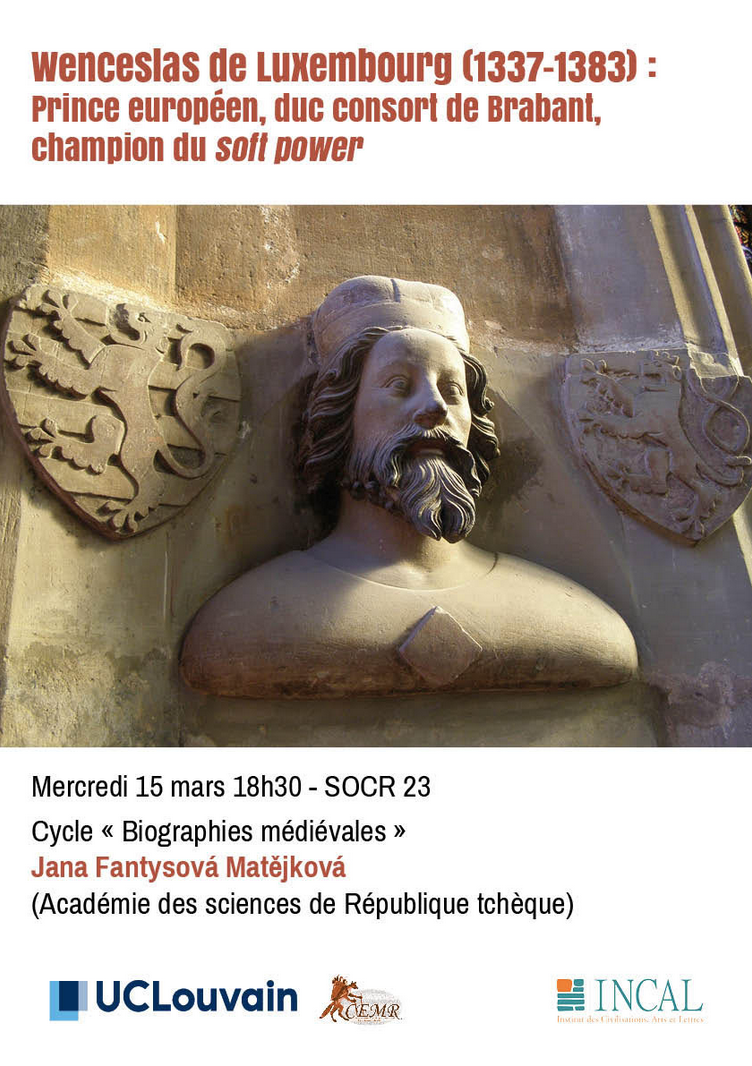
Jana Fantysová Matějková (Académie des sciences de République tchèque)
Wenceslas de Luxembourg (1337-1383): Prince européen, duc consort de Brabant, champion du soft power
CEMR, UCLouvain
15 mars 2023
18h30, SOCR 23
Cycle « Biographies médiévales »
Jana Fantysová Matějková (Académie des sciences de République tchèque)
Wenceslas de Luxembourg (1337-1383): Prince européen, duc consort de Brabant, champion du soft power
Medieval Scandinavia went through momentous changes. Regional power centres merged and gave birth to the three strong kingdoms of Denmark, Norway, and Sweden. At the end of the Middle Ages, they together formed the enormous Kalmar Union comprising almost all lands around the North Atlantic and the Baltic Sea. In the Middle Ages, Scandinavia became part of a common Europe, yet preserved its own distinct cultural markers.
Scandinavia in the Middle Ages 900–1550 covers the entire Middle Ages into an engaging narrative. The book gives a chronological overview of political, ecclesiastical, cultural, and economic developments. It integrates to this narrative climatic changes, energy crises, devastating epidemies, family life and livelihood, arts, education, technology and literature, and much else. The book shows how different groups had an important role in shaping society: kings and peasants, pious priests, nuns and crusaders, merchants, and students, without forgetting minorities such as Sámi and Jews. The book is divided into three chronological parts 900–1200, 1200–1400, and 1400–1550, where analyses of general trends are illustrated by the acts of individual men and women.
This book is essential reading for students of, as well as all those interested in, medieval Scandinavia and Europe more broadly.
Kirsi Salonen is Professor of Medieval History at the University of Bergen, Norway. Her previous publications include Papal Justice in the Late Middle Ages. The Sacra Romana Rota (2016); and she is the co-editor of Scandinavia and the Vatican Archives (2022).
Kurt Villads Jensen is Professor of Medieval History and Director of the Centre for Medieval Studies at Stockholm University, Sweden. His previous publications include Crusading at the Edges of Europe. Denmark and Portugal c.1000–c.1250 (2017); and he is the co-author of The Rise and Fall of the Danish Empire (2022).
Table des matières :
Introduction
Part I: 900–1200: Formation
1. Coming of the Kingdoms
2. Coming of Christ
3. Tilling the Land – The Local Economy
4. Cultural Tradition and Transition
Part II: 1200–1400: Consolidation and Restructuring
5. Dominion over the Seas
6. Consolidation of the Church
7. Economic Growth and Fall – Urbanisation and Agrarian Crisis
8. Cultural Universalism
Part III: 1400–c. 1550: Power in Crises
9. Rise and Fall of the Kalmar Union
10. Fall of the Church
11. Economic Expansion – The International Market Economy
12. A Revolution in Communication
Informations pratiques :
Kirsi Salonen, Kurt Villads Jensen, Scandinavia in the Middle Ages 900-1550. Between Two Oceans, Londres, Routledge, 2023 ; 1 vol., 340 p. ISBN : 978-0-36755-869-7. Prix : GBP 32,99.
Source : Routledge
Disparue des publicités commerciales qui vantent la saveur du chocolat, sainte Geneviève impose encore sa haute silhouette protectrice sur le pont de la Tournelle à Paris, à deux pas de Notre-Dame. Les flâneurs qui arpentent le Quartier latin gravissent sa Montagne, les visiteurs du Panthéon renouent avec son histoire esquissée par le pinceau de Puvis de Chavannes, et les étudiants se pressent dans la bibliothèque qui porte son nom.
Qui était donc cette femme contemporaine de Clovis et d’Attila? Comment s’est déployé le culte à son endroit, qui demeure, aujourd’hui encore, entretenu par la confrérie des porteurs de la châsse de ses reliques? Une vingtaine de chercheurs ont uni leurs savoirs et croisé leurs enquêtes afin de restituer sainte Geneviève à la mémoire de notre temps. Ils décryptent ici les textes, les partitions et les images qui, au fil des époques, ont donné consistance à la figure polysémique d’une sainte éminente, imaginée sous les traits d’une bergère qu’elle ne fut pas. Elle inspira Péguy, Apollinaire et Claudel. De Nanterre à Paris, elle demeure, selon la formule de Michel Zink, Secrétaire perpétuel honoraire de l’Académie des Inscriptions et Belles-Lettres, «le bien commun de tous les habitants du grand Paris».
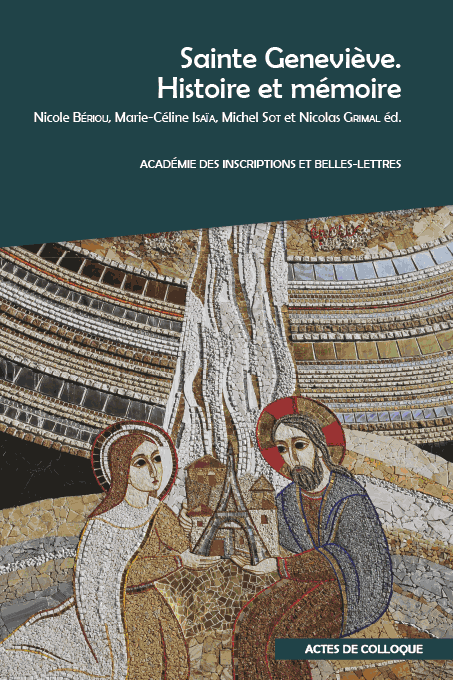
Table des matières : ici
Informations pratiques :
Sainte Geneviève. Histoire et mémoire. Actes du colloque organisé par l’Académie des Inscriptions et Belles-Lettres, le Collège des Bernardins, Sorbonne-Université, la Bibliothèque Sainte-Geneviève et le Comité d’histoire de la ville de Paris dans la salle Louis Liard en Sorbonne, au Collège des Bernardins et à l’Académie des Inscriptions et Belles-Lettres, du 3 au 5 novembre 2021, éd. Nicole Bériou, Marie-Cléine Isaïa, Nicolas Grimal, Louvain, Peeters, 2023 ; 1 vol., 524 p. (Actes de colloque) ISBN : 978-2-87754-695-9. Prix : € 50,00.
Source : Peeters
October 27-29th 2023
At the bi-millennium of the birth of the Latin author–administrator–statesman–soldier Pliny the Elder, we are reminded that the elder Pliny and his Natural History represent an important opportunity for the study of not only the man and his work, but also the craft and intellectual milieu with which he was engaged. Pliny’s work is of great importance both in the arc of writing “natural histories” and in encyclopedism. Its import is observable in the reception and transmission of the Natural History in the later Roman and post-Roman worlds. In the spirit of Pliny’s endeavor, this conference aims to explore the traditions that guided the study of the natural world across the first millennium CE and beyond, along with the ways in which “natural historians” carried out their work, and how contemporary scholars approach and utilize the bounty of information his text contains. The conference seeks to bring together researchers interested not only in the Roman author himself, but also in the legacy of the Natural History or the contours of natural philosophical inquiry in premodern societies. Given the persistence of “Dark-Age” stereotypes with regard to scientific inquiry, we hope to focus on connections between Antiquity and the earlier Middle Ages in Byzantine, Islamic, and European cultures, as well as on global approaches that highlight comparisons between the Natural History and texts with similar objectives produced in East or South Asia.
We invite papers and panels from a variety of disciplinary and methodological perspectives on any topic related to the traditions of natural history, including:
Keynote speakers: Cynthia Damon, Professor of Classical Studies, University of Pennsylvania
Sarah Blake McHam, Distinguished Professor of Art History, Rutgers University
Abstract Submission deadline: March 31, 2023. Abstracts for individual in-person papers and for in-person sessions are invited. Papers should be 20 minutes in length. Send abstracts to cemers@binghamton.edu.
For Information visit: www.binghamton.edu/cemers/conference
For questions contact Hilary Becker at hbecker@binghamton.edu.
Source : The Medieval Academy Blog
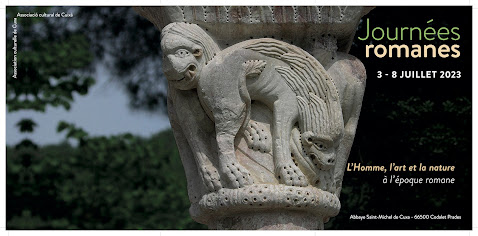
Quels sont, au moyen âge roman, les rapports entre l’Homme et la nature ? L’art les traduit-il ou, au moins, permet-il de les approcher ? La nature se reflète-t-elle, ou non, dans le legs somptueux de cette époque parvenu jusqu’à nous, les sculptures des portails ou des cloîtres, le bestiaire si présent dans le décor des églises, les manuscrits, les mosaïques ?
Ces questions seront l’argument des 54èmes Journées de Cuxa, ouvertes par Jean-Claude Bonne et où interviendront 13 conférenciers, venus de nombreuses universités ou institutions de recherche de toute l’Europe. Ils évoqueront les penseurs ou théologiens dont les textes éclairent la pensée des XIème ou XIIème siècles en rapport avec la nature, saint Bernard, Hildegarde de Bingen, mais questionneront aussi des œuvres qui comptent parmi nos plus précieux patrimoines : la sculpture de Saint-Guilhem-le-Désert ou de Saint-Jacques de Compostelle, les mosaïques de Saint-Marc de Venise, des manuscrits, etc.
Le paysage sera aussi évoqué : quel est ce « désert » où s’installent les monastères, quels sont ces lieux sauvages ? Quel rôle jouent les ressources de la nature dans l’art roman, par exemple les pierres, avec lesquelles on bâtit ?
Ces conférences alterneront avec des visites : outre la découverte de Cuxa, les Journées se rendront à Vic, en Catalogne, pour visiter l’exposition sur les animaux au Moyen ge présentée par le musée d’art médiéval et visiteront le monastère de l’Estany et son cloître (Catalogne), Saint-Genis-des-Fontaines (Roussillon), Caunes-Minervois et Rieux-Minervois (Languedoc).
Programme :
Lundi 3 juillet
13 h : Accueil des participants
15 h : Conférence d’ouverture : Sanctifier le monde, Jean-Claude Bonne, École des Hautes Études en Sciences sociales
16 h 30 : Visite de l’abbaye : Quitterie Cazes, Emmanuel Garland, Olivier Poisson
Marianne Besseyre : « Les pierres sauvages, lectures accompagnées »
18 h : Apéritif amical dans le cloître
Mardi 4 juillet
9 h : Autour de l’articulation entre nature et spiritualité chez Bernard de Clairvaux et Guillaume de Saint-Thierry, Alexis Grélois, Université de Rouen
10 h 30 : La nature dans l’esthétique de l’école de Chartres, Oleg Voskoboynikov, École des hautes études économiques (Moscou), Centre de recherches historiques, EHESS (Paris)
14 h : «Sa forme et sa couleur signalaient chaque chose »: la perception médiévale de la nature représentée dans l’art roman, Xavier Barral i Altet (Université de Haute-Bretagne, Rennes, Bibliotheca Hertziana-Max Planck Institut für Kunstgeschichte, Rome)
15 h 30 : Saint-Guilhem, la maîtrise du lieu sauvage, Julia Perratore (The Met Cloisters, USA), Autour de quelques chapiteaux issus de l’ »atelier » de la Daurade de Toulouse, Max Hello (doctorant, École des Chartes)
Mercredi 5 juillet
Excursion et visites : Museu episcopal de Vic (Catalogne) : visite de l’exposition Bèsties. Els animals en l’art medieval del MEV (les animaux dans l’art médiéval du musée), Marc Sureda.
Monastère et cloître de Santa Maria de L’Estany (Jordi Camps).
Jeudi 6 juillet
9 h : Quelques remarques sur le refus de la réplication de la nature à l’époque romane, Neil Stratford, Membre de l’Institut
10 h 30 : L’homme et le bestiaire dans le monde terrestre de la crypte de la cathédrale de Saint-Jacques-de-Compostelle, Victoriano Nodar, Université de Vigo (Espagne)
14 h : Du désert au Paradis : Conques et son environnement prémoderne, Ivan Foletti, Université Masaryk, Brno (République Tchèque)
15 h 15 : Animer la pierre au Moyen Âge. Sources et usages des matériaux lithiques dans le bâti roman des Pyrénées catalanes aux XIe et XIIe siècles, Michel Martzluff, Université de Perpignan
16 h 30 : Le Crucifix roman de Saint-Sernin de Toulouse, Gabriel Imbert, étudiant, Université de Toulouse Jean-Jaurès
17 h : Présentation du relevé de l’abbatiale de Cuxa et de sa crypte, Heike Hansen, architecte, archéologue du bâti
18 h : Assemblée générale de l’Association culturelle de Cuxa
Soirée : concert (participation aux frais)
Vendredi 7 juillet
Matinée, excursion et visites : Visite du cloître de Saint-Genis-des-Fontaines et de l’église Sainte-Colombe de Cabanes (Roger Gardez, Olivier Poisson)
14 h : Les plantes dans quelques herbiers de l’époque romane, Dominic Olariu, Université Henrich-Heine de Düsseldorf (Allemagne)
15 h 30 : Nascita dalle acque: riflessi ecologici nei mosaici dell’atrio di San Marco a Venezia (La naissance des eaux : échos écologiques dans les mosaïques du vestibule de Saint-Marc de Venise), David Ganz, Université de Zürich (Suisse)
17 h : Conclusions des Journées : Jean-Claude Bonne
Samedi 8 juillet :
Excursion, visites : En Languedoc : Caunes-Minervois : ancienne abbaye Saint-Pierre-Saint-Paul, Carrière du roi (sous réserve), Rieux-Minervois : église Sainte-Marie
Informations pratiques et inscriptions : ici
Source : Association culturelle de Cuxa
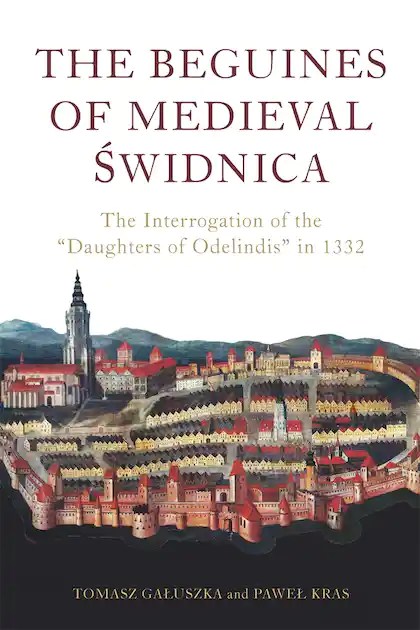
Documents recording the interrogation of sixteen women and the nature of their unusual spiritual practices, now available in a full edition and, for the first time, a full English translation.
In September 1332, in the town of Świdnica, an important economic and communication centre of what was then Silesia, a group of sixteen women stood before the Dominican inquisitor, John of Schwenkenfeld, to testify about the local community of beguines, who called themselves the Hooded Sisters or the Daughters of Odelindis. We are fortunate that the original records of this heresy interrogation have survived, preserved as a notarial instrument drawn up shortly afterwards, eventually transferred to the Papal Curia, and now kept in the Vatican Library. The documents provide unique insights into the everyday life and spirituality of this group of lay women, as they attempted to adopt the ideals of vita apostolica. They lived in the strict poverty they thought necessary for spiritual perfection, and took part in austere ascetic practices, including regular flagellation and a strict diet regime, aiming to mortify sinful flesh and help them achieve mystical union with God.
Using this evidence, the authors of this book piece together a sense of who these interrogated beguines were and the nature of their spiritual practices. Were they pious illiterates, or self-trained theologians, keenly interested in debates around the doctrine of such intellectuals as Master Eckhart, John Duns Scotus and Thomas Aquinas? The book also addresses the nature of their interrogation and the conduct of Friar John of Schwenkenfeld. And it contains a full edition and, for the first time, a full English translation of the documents themselves.
Paweł Kras is Associate Professor at the John Paul II Catholic University of Lublin and Director of the Centre for Medieval Studies in Lublin; his main area of study is the systems of the Inquisition in Medieval Europe.
Tomasz Gałuszka OP is Associate Professor at the Papal University of John Paul II in Krakow and Director of the Dominican Historical Institute; his research focuses on Henry Harrer`s Tractatus contra beghardos, the Dominicansand early fourteenth-century heresy in Lesser Poland.
Table des matières :
Foreword by Robert E. Lerner
Part One: Historical Studies
Preface
1. The Rise of the Beguines
2. The Council of Vienne and the Persecution of Beguines
3. John of Schwenkenfeld O.P. and the Interrogations of Świdnica Beguines
4. The Daughters of Odelindis: Identity and Religious Practice
5. A Dominican Inquisitor and Theological Controversies of His Times
6. Conclusions
Part Two: Latin Edition and English Translation of the 1332 Protocol
Description of the Manuscripts
Criticial Study
Editorial Principles
Examinatio testium in causa Capuciatarum monialium in Swydnicz
Examination of Witnesses in the Case of the Hooded Sisters at Świdnica
The Swesteren of Odelind of Piritz and Cologne and their European Context
Letha Böhringer
Bibliography
Index
Informations pratiques :
The Beguines of Medieval Świdnica. The Interrogation of the « Daughters of Odelindis » in 1332, éd. Paweł Kras, Tomasz Gałuszka, Woodbridge, Boydell and Brewer, 2023 ; 1 vol., 316 p. (Heresy and Inquisition in the Middle Ages). ISBN : 978-1-80010-914-8. Prix : GBP 75,00.
Source : Boydell and Brewer
Les ports, les cours, les foires, les universités ou encore les champs de bataille furent au Moyen Âge autant d’endroits où femmes et hommes d’origine différente eurent à communiquer et pour ce faire à surmonter les difficultés posées par la maîtrise de langues différentes. En effet, loin d’apparaître comme une accumulation de sphères hermétiques, la société médiévale fut un laboratoire d’expérimentations linguistiques rendues nécessaires par les innombrables connections des acteurs de l’époque. Si la lingua franca unit les marins de la Méditerranée et que le latin put être le véhicule des échanges entre théologiens des quatre coins du continent, bien plus nombreuses furent les occasions où il fallut aux gens du Moyen Âge apprendre la langue de l’autre, pour commercer, débattre ou lui faire la guerre.
L’étude de ces processus, particulièrement vivace ces dernières années, permet de dégager plusieurs dynamiques dont il est désormais bienvenu d’étudier les ressemblances et différences. En quoi, en effet, une reconfiguration de la langue peut-elle s’observer tant dans la traduction érudite que dans des contextes de coexistence de plusieurs langues ? La maîtrise de plusieurs langues par des ambassadeurs, des « fixeurs » ou des marchands trouve-t-elle des échos dans les personnages des textes littéraires ? Les échanges intellectuels comme l’écriture de l’histoire peuvent-ils s’accommoder de l’usage simultané de plusieurs vernaculaires ou nécessitent-ils le recours à une seule langue ?
C’est ainsi dans une perspective d’histoire culturelle connectée que le Réseau des Médiévistes belges de Langue française – Groupe de contact F.R.S.-FNRS vous invite à assister à sa 47e Journée d’étude. Celle-ci se tiendra le 7 avril 2023 à l’Université de Liège.
Programme :
9h : Accueil
Présidence du matin : Nathan Carlig (ULiège)
9h30 : Baudouin Van den Abeele (FNRS/UCLouvain) – Introduction
10h : Marion Dapsens (UCLouvain) – Les traductions scientifiques arabo-latines médiévales : le cas du Morienus
10h30 : Pause
10h50 : Lisa Demets (UGent) – Bruges comme « zone de contact multilingue ». Production de livres et réseaux littéraires polyglottes à Bruges au quinzième siècle
11h20 : Maria Rupprecht (University of Bristol / Cardiff University), Le Brut de Laӡamon – Un témoin textuel du changement linguistique dans l’Angleterre multilingue du XIIIe siècle
11h50 : Dîner
Présidence de l’après-midi : Élise Franssen (ULiège)
13h30 : Sandra Otte (ULiège) – Langues des personnages et folie dans la littérature française médiévale : le plurilinguisme, un signe de démence ou d’emprise diabolique ?
14h00 : Nissaf Sghaier (USL-B) – Truchements, guides, marchands, espions, captifs, convertis : les fixeurs entre espaces chrétiens et musulmans. Esquisse d’analyse à partir de sources narratives du XVe siècle
14h30 : Pause
14h50 : Ide François (KU Leuven) – La polyglossie dans l’Italie du 15e siècle : La coexistence du latin, du grec et de la langue vernaculaire dans les cercles intellectuels du Quattrocento italien
15h20 : Manhal Makhoul (UCLouvain) – Relations et migrations des textes entre les communautés, copte, syriaque et arabe
16h : Fin des travaux
Informations pratiques :
Vendredi 7 avril 2023
Université de Liège
Place du XX Août
Salle des Professeurs
Inscription libre et gratuite, mais souhaitée pour des raisons d’organisation : info.rmblf@gmail.com
Programme au format PDF : ici
La crise est omniprésente, au moins dans les discours. Sans tomber dans le catastrophisme, il faut bien constater que la pandémie a mis à l’épreuve nos contemporains et nombre d’institutions (Bergeron et al. 2020). Sans doute les défis à venir, ou en tout cas annoncés, les éprouveront-ils davantage. Cela ne peut manquer d’interpeller l’historien·ne. Quelles relations entretiennent les institutions et les crises ? La question doit être posée au regard des expériences des sociétés du passé. Surtout, elle ne peut faire l’économie d’un travail de définition de ces concepts pour le moins vagues. Voici un enjeu essentiel de ce colloque adressé aux jeunes chercheur·e·s, qui n’entend pas proposer un prêt-à-penser, mais suggérer des pistes de réflexion, afin de conférer une vertu heuristique à ces concepts. Nous insistons ici sur l’importance des études empiriques pour fonder le comparatisme : c’est la condition pour atteindre un degré de généralité satisfaisant dans une telle perspective.
Programme : ici
Org. : Anthony Hamon ; Pierre Karila-Cohen ; Alexandre Lepesteur ; Pierre Meignan ; Jean-François Morvan

Informations pratiques :
À l’épreuve des tempêtes. Institutions et crises : approches historiques
Rennes, 16-17 mars 2023
Maison des Sciences de l’Homme en Bretagne
2 avenue Gaston Berger, 35000 Rennes
Source : Tempora
This definitive environmental history of medieval fish and fisheries provides a comprehensive examination of European engagement with aquatic systems between c. 500 and 1500 CE. Using textual, zooarchaeological, and natural records, Richard C. Hoffmann’s unique study spans marine and freshwater fisheries across western Christendom, discusses effects of human-nature relations and presents a deeper understanding of evolving European aquatic ecosystems. Changing climates, landscapes, and fishing pressures affected local stocks enough to shift values of fish, fishing rights, and dietary expectations. Readers learn what the abbess Waldetrudis in seventh-century Hainault, King Ramiro II (d.1157) of Aragon, and thirteenth-century physician Aldebrandin of Siena shared with English antiquarian William Worcester (d. 1482), and the young Martin Luther growing up in Germany soon thereafter. Sturgeon and herring, carp, cod, and tuna played distinctive roles. Hoffmann highlights how encounters between medieval Europeans and fish had consequences for society and the environment – then and now.
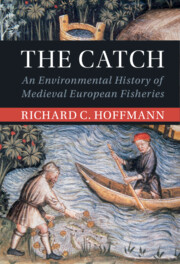
Richard Hoffmann is Professor Emeritus in History at York University, Toronto, and author of the acclaimed An Environmental History of Medieval Europe (Cambridge, 2014).
Table des matières :
Introduction
Considering fisheries: medieval Europe and its legacies
1. ‘Natural’ aquatic ecosystems around Late Holocene Europe
2. Protein, penance, and prestige: medieval demand for fish
3. Take and eat: subsistence fishing in and beyond the Early Middle Ages
4. Master artisans and local markets
5. Aquatic systems under stress, ca. 1000–1350
6. Cultural responses to scarcities of fish
7. Going beyond natural local ecosystems I: carp aquaculture as ecological revolution
8. Going beyond natural local ecosystems II: over the horizon toward abundance and ‘tragedy’
9. Last casts: two perspectives on past environmental relations.
Informations pratiques :
Richard C. Hoffmann, The Catch. An Environmental History of Medieval European Fisheries, Cambridge, Cambridge University Press, 2023 ; 1 vol., 350 p. (Studies in Environment and History). ISBN : 978-1-10895-820-2. Prix : GBP 34,99.
Source : Cambridge University Press
Invitation masterclass and conferral of honorary degree
to Prof. Daniel Lord Smail
The Faculty of Arts of the University of Antwerp would like to welcome you to the masterclass and official conferral of the honorary degree to Prof. Daniel Lord Smail, on Thursday 30 March at 3 p.m.
The award ceremony follows the faculty’s Research Day.
3 p.m. – Masterclass
➡ Welcome by Prof. Luc Herman, Dean of the Faculty of Arts, University of Antwerp
➡ Introduction by Prof. Jeroen Puttevils, nominator
➡ Masterclass ’The Imagined Space of the Late Medieval Urban Household‘ by Prof. Daniel Lord Smail
➡ Q&A
4.15 p.m. – Conferral of the honorary degree to Prof. Daniel Lord Smail
4.30 p.m. – Reception
You can attend the masterclass and conferral of honorary degree to Prof. Daniel Lord Smail follow in-person or online.




Vous devez être connecté pour poster un commentaire.