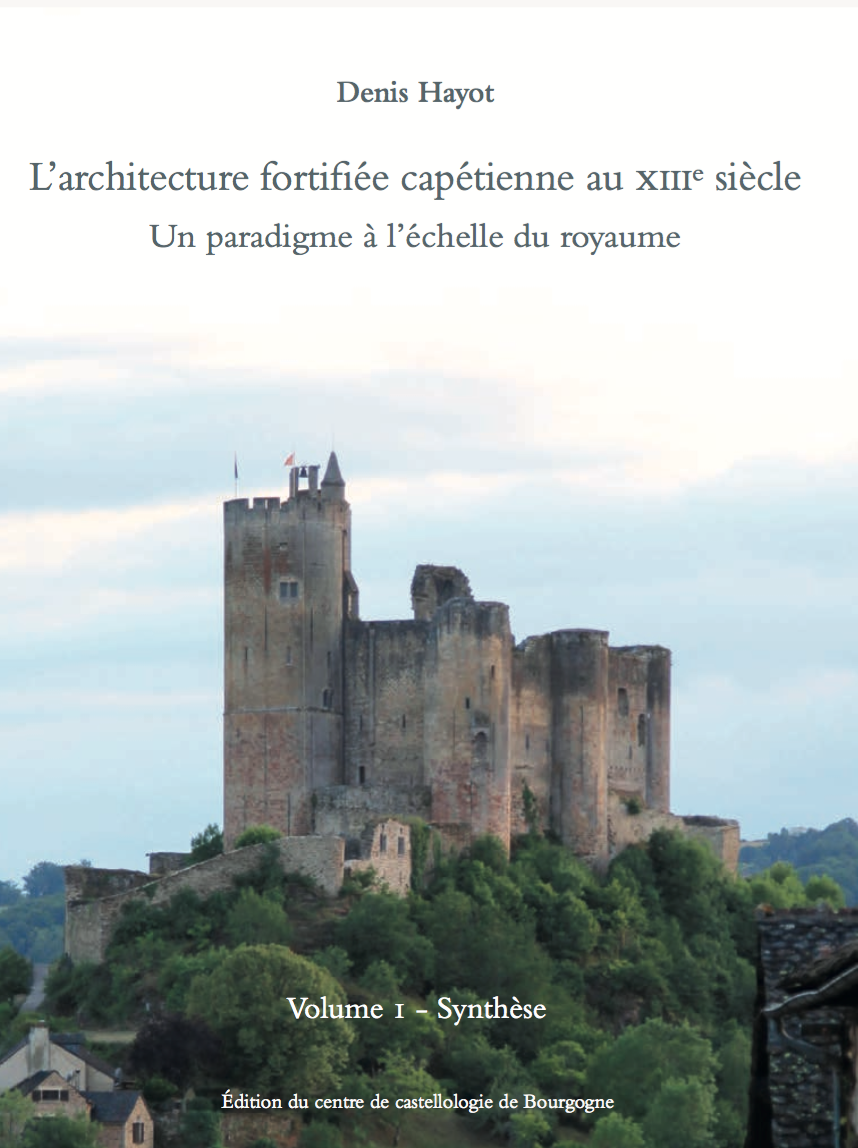
Publication – Denis Hayot, « L’architecture fortifiée capétienne au XIIIe siècle Un paradigme à l’échelle du royaume », vol. 1 : « Synthèse »

Fondée sur l’usage des tours cylindriques à archères, la forteresse idéale du XIIIe siècle ressemble à un « château-fort » de dessin d’enfant : un château carré, crénelé et cantonné de tours rondes. Mais derrière cette apparence si familière se cache un phénomène architectural majeur : apparue à la charnière de l’an 1200, et pratiquée aussi bien par le roi que par les grands princes ou les seigneurs plus modestes, l’architecture fortifiée « capétienne » remporte un immense succès dans l’ensemble du royaume tout au long du XIIIe siècle, au point d’avoir façonné le territoire et notre propre vision du Moyen Âge.

Pour comprendre cette oraison architecturale et dépasser les longs débats de l’historiographie, Denis Hayot a pris le parti d’une recherche globale, embrassant dans une même étude les forteresses royales, princières et seigneuriales à l’échelle du royaume. Cette réflexion le conduit à interroger l’idée reçue d’un hypothétique « modèle royal », à laquelle il faut préférer le constat de l’émergence d’un modèle commun, dans un royaume alors en phase d’uni cation culturelle.
Ce travail universitaire monumental n’était jusqu’alors accessible qu’à quelques chercheurs. Le Centre de castellologie de Bourgogne s’est fait un devoir de l’éditer, en un volume de synthèse et cinq volumes régionaux de monographies, afin de le mettre à disposition de tous les amoureux des châteaux-forts.

Informations pratiques :

Denis Hayot, L’architecture fortifiée capétienne au XIIIe siècle. Un paradigme à l’échelle du royaume, vol. 1 : Synthèse, Dijon, CECAB, 2022.
Publié dans Publications | Laisser un commentaire

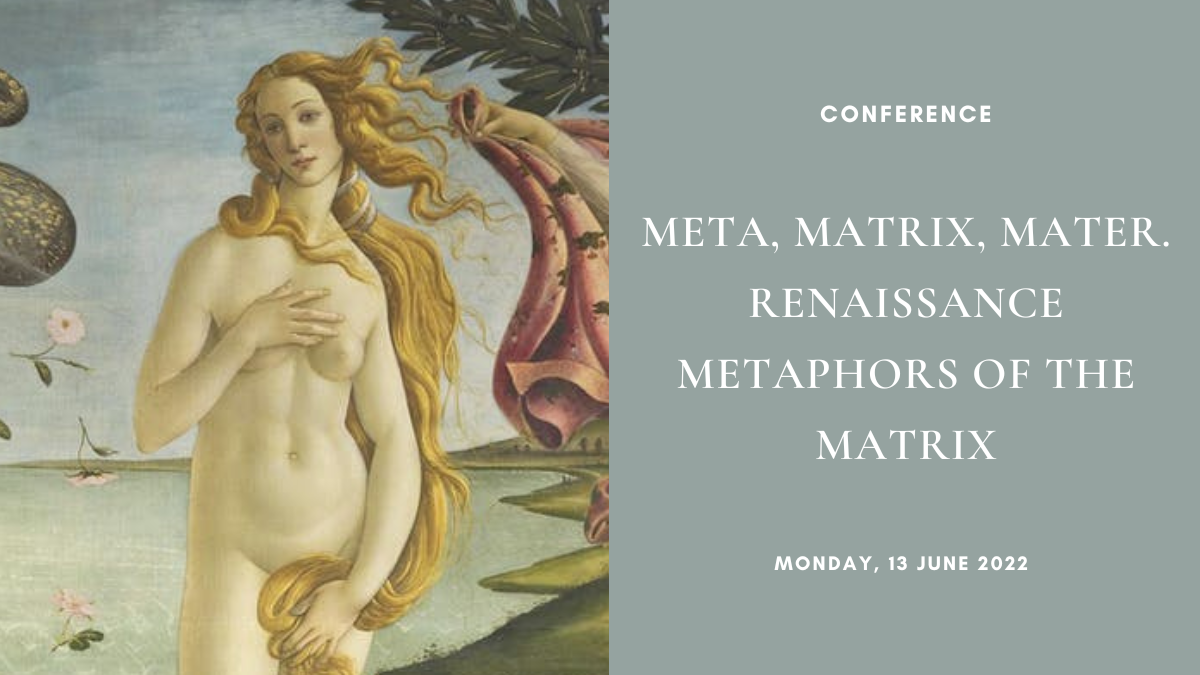
Colloque – Meta, Matrix, Mater. Renaissance Metaphors of the Matrix

The female sex has become the core of an increasing number of early modern studies since the rise of a gender-sensitive feminist viewpoint in art history. Many have dealt with images of a hairless and polished vulva, sometimes ostensibly eroticized. Pending this approach, the 2022 CHAR Workshop, Meta, Matrix, Mater. Renaissance Metaphors of the Matrix, wishes to re-explore the imaginary of the female sex from within and focus on the metaphors of the matrix in images and material culture in the Renaissance.

Free entrance within the limit of the number of places available. Please note there will be a live stream to allow those outside Paris access to the event. Communications in French and in English.

Programme :

09h45 Présentation de la journée
Fiammetta Campagnoli, Université Paris 1 Panthéon-Sorbonne
Florence Larcher, Université Paris 1 Panthéon-Sorbonne

10h00 Conférence inaugurale
Concetta Pennuto, Université François Rabelais – Tours

10h45 Discussion

SESSION 1
THE POWER OF THE MATRIX IN (PRO)CREATION
Chair: Baptiste Tochon-Danguy, École Pratique des Hautes Études

11h00 Womb, Print, Imprint: Early Modern Birth Figures and their Uses
Rebecca Whiteley, University of Manchester

11h30 Michelangelo’s Matrix: The Childbirth Metaphor in Italian Renaissance Art Theory
Jordan Troeller, Freie Universität Berlin

12h00 Discussion

SESSION 2
FROM MATERIAL TO MATERIALITY, FROM MINERAL TO VEGETAL
Chair: Florence Larcher, Université Paris 1 Panthéon-Sorbonne

14h30 Madder, Matter and Matrix: Stained Ivory Virgins from the Fourteenth Century
Marian Bleeke, Cleveland State University

15h00 Au-delà de l’humain. La matrice et ses images végétales (XVIe-XVIIIe s.)
Sara Petrella, Université de Neuchâtel

15h30 Le monde de Cérès : allégorie de la matrice végétale et humaine aux XVIe et XVIIe siècles
Cassandre Herbert, Université Paris 1 Panthéon-Sorbonne

16h Discussion and break

SESSION 3
BETWEEN THE FATHER AND THE MOTHER
Chair: Fiammetta Campagnoli, Université Paris 1 Panthéon-Sorbonne

17h00 La matrice de Dieu le Père : la mandorle comme lieu de filiation
Clémence Légoux, Université Paris 1 Panthéon-Sorbonne

17h30 Begotten, not Made: Authenticity inside the Body of the Virgin Mary
Melissa Katz, Independent Scholar

18h00 Discussion and conclusion

Free Registration at https://vu.fr/atelierduchar2022

Source : Medieval Art Research

Publié dans Colloque | Laisser un commentaire

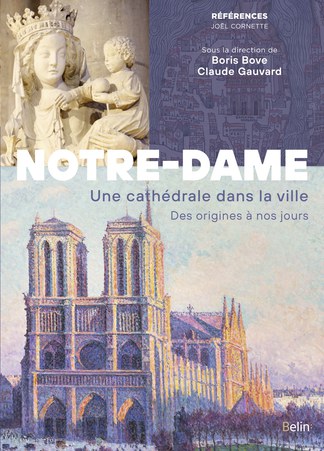
Publication – « Notre-Dame de Paris Une cathédrale dans la ville. Des origines à nos jours », dir. Claude Gauvard et Boris Bove

Dressée au cœur de Paris depuis le XIIe siècle, la cathédrale Notre-Dame a été bâtie par et pour la ville, dont elle a modifié le visage. Loin de n’être qu’une construction de pierre, dont les prouesses architecturales et esthétiques ne cessent de fasciner, Notre-Dame constitue avant tout un phénomène historique urbain et global inscrit dans la longue durée, dès avant la cathédrale gothique. C’est de ce constat que sont partis Boris Bove et Claude Gauvard, accompagnés d’une quinzaine de spécialistes parmi les meilleurs, pour retracer l’histoire de cette cathédrale, laquelle, longtemps restée le symbole d’une ville, appartient désormais au patrimoine mondial, au point que la destruction de sa flèche lors du grand incendie de 2019 ait ému la communauté internationale.

Plus d’une centaine de documents iconographiques et une dizaine de cartes originales éclairent cet objet d’étude, au croisement de l’histoire religieuse, sociale, politique, culturelle et urbaine.

Informations pratiques :

Notre-Dame de Paris Une cathédrale dans la ville. Des origines à nos jours, dir. Claude Gauvard et Boris Bove, Paris, Belin, 2022 (Références). 488 Pages. ISBN : 978-2-410-02455-5. Prix : 39 euros.

Source : Belin

Publié dans Publications | Laisser un commentaire

Appel à contribution – Early Global Insularities

Call for Proposals: Early Global Insularities
Viator Special Cluster
Editors: Sara Torres and Nahir I. Otaño Gracia

Early Modern literatures are suffused with references to fantastical, miraculous, and topographical islands, from the isle of Avalon in Arthurian legend, to Dante’s Purgatorio, to the pilgrimage site of St. Patrick’s Purgatory in Lough Derg, Ireland. Some texts imagine islands as archipelagos and networks—linked coastal zones where merchants, missionaries, and migrants mingle in local ports. Islands can be replicable, itinerant, or phantasmagorical (St. Brendan’s Isle), tied to the temporalities of liturgy or climate. They can, like the Fortunate Isles, float tantalizingly at the edges of cartographic knowledge and cultural epistemes, beckoning us beyond the thresholds of human knowledge. Other texts, such as Thomas More’s Utopia, focus on the spatial autonomy of islands, emphasizing their disjunctive status as unique in culture or in social organization, exceptionalist in outlook or in ideology. Such sites, conspicuously separate from surrounding polities and politics, draw attention to cultural difference or utopian possibility, and can facilitate the nostalgic affect that transforms a kingdom such as England into a “sceptered isle”—fantasies that can be used to exclude other communities or reinforce endogenous practices. At the heart of the idea of islands is an exploration of the nature and extent of our relationship as individuals to society at large, and of cultures to one another.

Islands occupy a sometimes ambiguous place in center-periphery models, and it’s our hope that by “centering” insularity as a topography, a literary conceit, and a disciplinary trope, we can explore both the range of “islands” in medieval and medievalist texts as well as the possibilities of working in an archipelagic scholarly community. In a time of climate crisis, the precarity of islands and archipelagoes (so often the sites of colonial violence) brings a sense of urgency to our reappraisal of the historical ideation of insularity and the relationship of the local to the global.

We invite proposals on topics broadly related to our theme of “Insularity and Early Globalities” and especially encourage contributions from early career scholars and scholars whose work spans multiple geographical regions and linguistic traditions.

Possible topics include:

  • Mythical islands in medieval, medievalist, or early modern literature
  • Iberian insolarios, coastal contact zones, and archipelagic regions
  • Mediterranean studies, Blue studies, and ecological commentaries on coasts or islands
  • Reflections on how geographical thought shapes premodern and early modern theories of race
  • Islands, periodization, and disruptive temporalities
  • Decolonizing approaches to early global insularities
  • Disciplinary insularity and its discontents
  • Reflections on teaching premodern or early modern literature from scholars working within “insular” institutional or geographical spaces

Proposals should be no more than 500 words in length and should be submitted by email to sara.torres@converse.edu and nahir@unm.edu with “Viator Proposal” in the subject line by 15 July 2022. The authors of selected proposals will be notified by 31 August 2022. Contributors will have the opportunity to workshop essays-in-progress in November 2022. Completed essays will be expected by 20 January 2023. Tentative publication date 2024.

Source : The Medieval Academy of America

Publié dans Appel à contributions | Laisser un commentaire

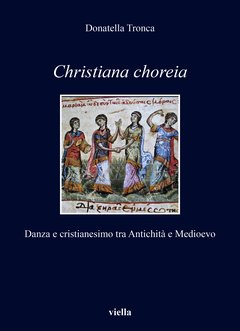
Publication – Donatella Tronca,  » Christiana choreia. Danza e cristianesimo tra Antichità e Medioevo »

Christiana choreia è una chiave interpretativa delle forme e dei modi con cui gli intellettuali cristiani, dall’Antichità alle soglie del Medioevo, hanno percepito e tentato di regolamentare la danza.

Guidato da un’analisi di tipo storico-semantico e storico-culturale, questo libro offre, nelle prime pagine, una ricostruzione delle concezioni che i cristiani avevano ereditato dal mondo antico: in particolare le teorie platoniche relative alla choreia della Città ideale, il concetto di schema e il pregiudizio romano sul mestiere del danzatore, sempre marchiato dallo stigma di infamia.

L’ipotesi di fondo è che si sia giunti alla formulazione di un’antropologia cristiana della gestualità coreutica che invitava gli uomini a diventare i perfetti imitatori di una choreia angelica come anticipazione della Città celeste: i corpi degli uomini erano strumenti musicali che, correttamente istruiti all’imitazione del moto degli angeli, avrebbero dovuto produrre all’unisono quella melodia armonica capace di arrivare direttamente a Dio. Christiana choreia era dunque uno strumento cognitivo che consentiva di disciplinare le forme, i tempi e i modi di appartenenza alla comunità cristiana.

Donatella Tronca svolge attività di docenza e ricerca presso le Università di Bologna e Verona. Le discipline di riferimento del suo lavoro sono la storia del cristianesimo e la paleografia latina. Si occupa principalmente dello studio di testi cristiani tardoantichi e medievali, che analizza da un punto di vista storico-antropologico e materiale anche attraverso la storia della trasmissione manoscritta e delle biblioteche.

Table des matières :

  • Introduzione. Christiana choreia: cristianesimo danzato
  • 1. La choreia consacrata. Il fondamento paideutico greco
    • 1. La paideia musicale e gestuale
    • 2. I buoni schemata della vita
    • 3. Le dottrine dell’ethos e dell’harmonia
    • 4. La mania
    • 5. La sobrietà del symposion
    • 6. Theios choros: la danza divina
  • 2. Qui in scaenam prodierit, infamis est. L’eredità romana
    • 1. Veniamus ad ludos: gli spettacoli romani
    • 2. I pantomimi artifices saltationis
    • 3. Lo stigma dell’infamia
  • 3. Angelon choreia. Un’antropologia cristiana della danza nella Tarda Antichità
    • 1. Theoretikos bios: la vita contemplativa
    • 2. La sobria ebrietas
    • 3. La danza della charis
    • 4. Dove c’è l’orchesis, là c’è il diavolo
    • 5. Danzare al ritmo del Nuovo Canto
  • 4. Ballationes e schemata medievali
    • 1. Le mortiferae ballematiae degli insipienti
    • 2. La consuetudo ballandi dei pagani
    • 3. Schemata e habitus: gli ornamenti dell’eloquenza
    • 4. Cosmos, harmonia e controllo del corpo
  • Bibliografia
  • Indice dei nomi

Informations pratiques :

Donatella Tronca, Christiana choreia. Danza e cristianesimo tra Antichità e Medioevo, Rome, Viella, 2022 (I libri di Viella, 415). pp. 180, 15×21 cm, bross. ISBN: 9788833138947. Prix : 27 euros.

Source : Viella

Publié dans Publications | Laisser un commentaire

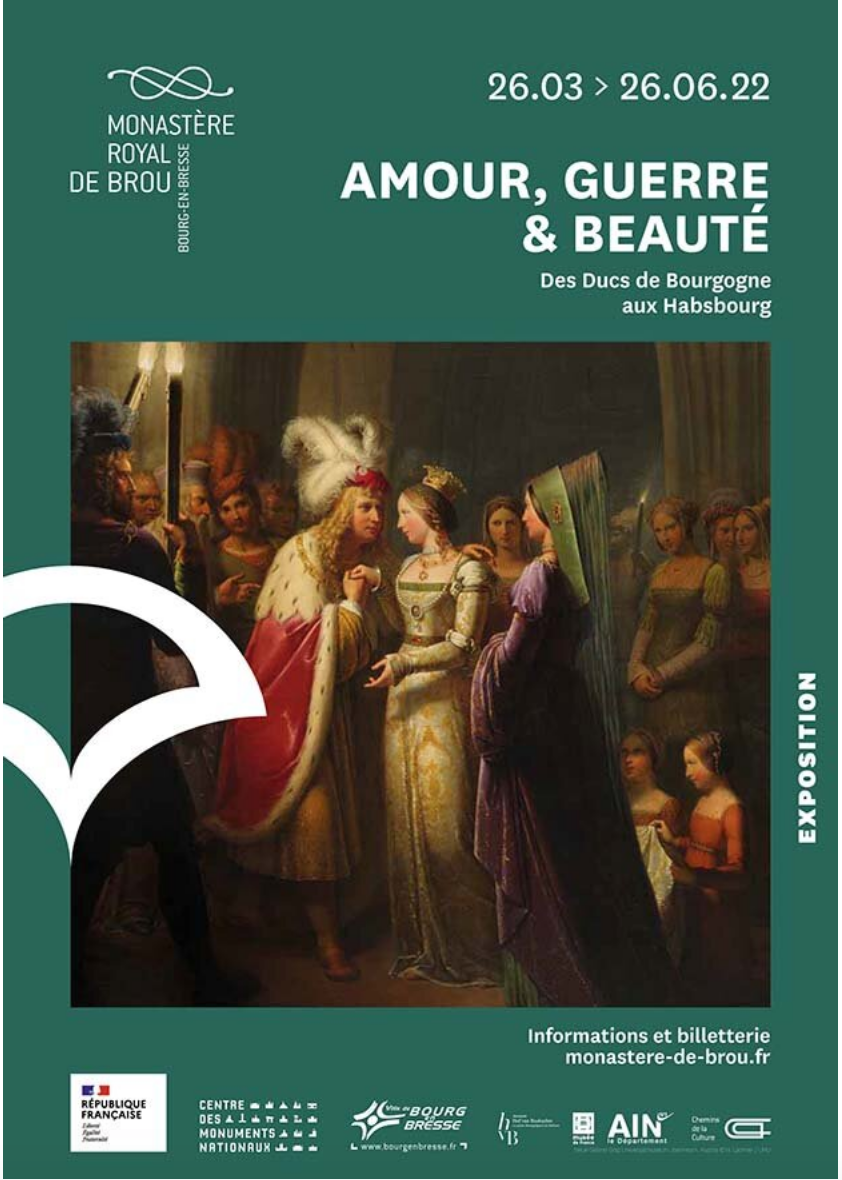
Exposition – Amour, Guerre & Beauté – Des Ducs de Bourgogne aux Habsbourg

26 mars 2022  > 26 juin 2022 Événement , Exposition

Découvrez les histoires à rebondissements des souverains bourguignons aux 15e et 16e siècles !

Entre rivalités familiales, histoires sentimentales, luttes de pouvoir, mariages voire assassinats, leurs vies ont tout d’un feuilleton télévisé.

Autour d’une quarantaine d’œuvres, découvrez les moments marquants de cette époque, faite de conflits sans fin entre les Français, les Bourguignons, puis les Habsbourg. Parmi les personnages principaux de ces lignées : Philippe le Hardi, Charles le Téméraire, Charles Quint, François 1er mais aussi Marguerite d’Autriche.

Découvrez la manière dont leurs histoires ont été représentées au 19e siècle par des artistes de toute l’Europe, inspirés par l’époque : Eugène Delacroix, Paul Delaroche, Edouard Hamman, Fleury Richard ou encore Sophie Rude.

Plus de 300 ans après, les faits ont souvent été idéalisés. Cette exposition propose une lecture artistique d’un temps méconnu de notre histoire européenne, et explore la manière dont les artistes du 19e siècle ont participé à la construction des jeunes nations

Cette exposition a été coproduite par le monastère royal de Brou et le musée Hof van Busleyden de Malines, la Ville de Bourg-en-Bresse et le Centre des monuments nationaux.

Informations pratiques :

Exposition comprise dans le droit d’entrée du monument.

9,5€ / Gratuit -26 ans

Réservez votre billet sur notre billetterie en ligne.

Source : Monastère royal de Brou

Publié dans Exposition | Laisser un commentaire

Offres d’emploi – Three postdoctoral positions: ERC Starting grant « Polyphonic Philosophy. Logic in the Long Twelfth Century for a New Horizon in the History of Philosophy »

Three postdoctoral positions of 2 years, renewable for up to another two years, are announced in the ERC Starting grant « Polyphonic Philosophy. Logic in the Long Twelfth Century for a New Horizon in the History of Philosophy » (PI Caterina Tarlazzi), starting on 1 September 2022 at Ca’ Foscari (Venice) – Department of Philosophy and Cultural Heritage.  The project focuses on 12th-century logical commentaries in Latin.

Deadline for application: 10th June 2022. 

They are in the fields of: 

(Postdoc 1) 12th-century Latin codicology

(Postdoc 2) Textual criticism and digital humanities (especially with expertise in logico-philosophical texts and commentaries); 

(Postdoc 3) History of medieval philosophy/logic (with special reference to 12th-century philosophy).

Candidates who are completing their PhD, but have not received the title yet can also be considered for position (3). 

More information and the official announcements here:  (english) https://www.unive.it/data/28825/ or (in Italian) https://www.unive.it/data/12137/

Info: ricerca.fbc@unive.it or caterina.tarlazzi@unive.it

Source : Università Ca’Foscari

Publié dans Offre d'emploi | Laisser un commentaire

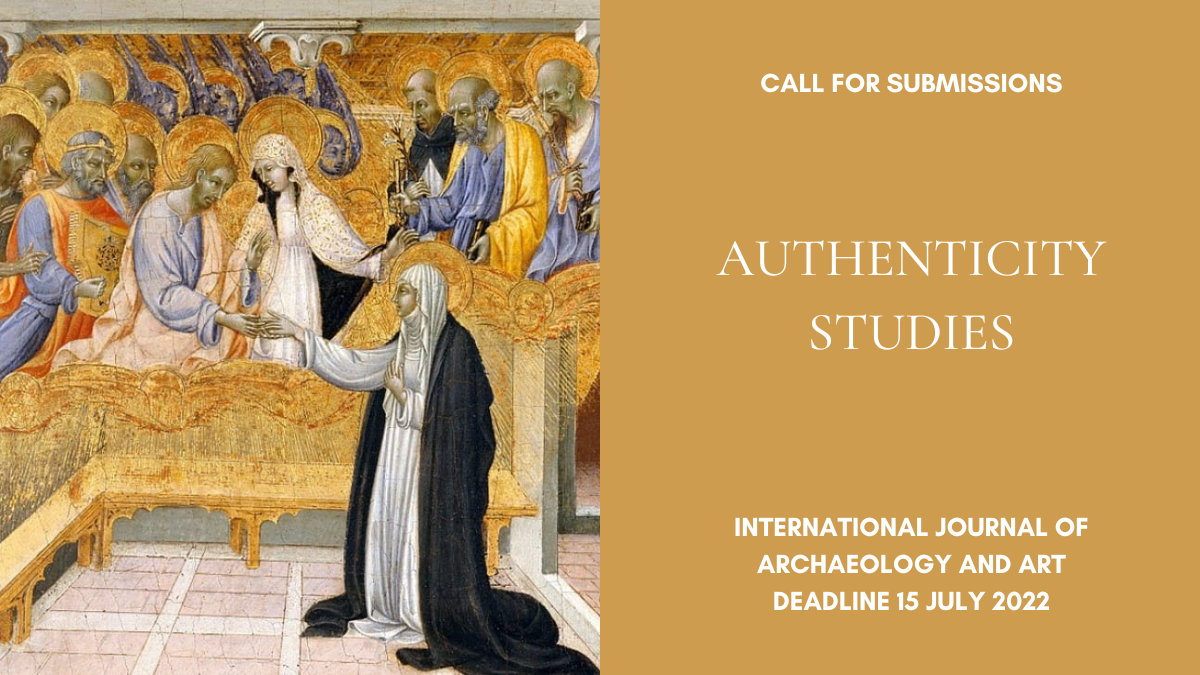
Appel à contribution – Authenticity Studies, International Journal of Archaeology and Art

Authenticity Studies-International Journal of Archaeology and Art is an international and independent journal, based on a peer review system and dedicated to the study of the methods of attribution and authentication of archaeological and art-historical artifacts.


Founded by Monica Salvadori (Editor in Chief), Federica Toniolo, Andrea Tomezzoli, Marta Nezzo, Monica Baggio and Luca Zamparo, Authenticity Studies is a journal of the Department of Cultural Heritage of the University of Padua and is published by Padova University Press. Authenticity Studies is an open access electronic journal (with ISSN). It is based on an anonymous and international double peer review system.

Authenticity Studies accepts original and unpublished contributions focused on three main research lines:

1 – Theory and method of art-historical and archaeological attribution
2 – Investigations on the phenomenon of falsification: history, philosophy, methods and society
3 – Provenance Studies

In this way, Authenticity Studies intends to analyze the methods of study and analysis, as well as the philology, for the attribution and authentication of archaeological and artistic manufacts, to propose new attributions or verify the authenticity of the same, as well as to study the revival of taste and tradition in modern and contemporary society.

Furthermore, Authenticity Studies intends to propose a complete analysis of the phenomenon of falsification, verifying the material results and the economic, social, legal, philosophical and ethical implications. Authenticity Studies analyzes the authentication techniques and methods (humanistic and technological-scientific), the connections with the art market, and the history of collecting, thus also investigating historical fakes and those inserted, over time, in the field museum public and private.

Finally, Authenticity Studies wants to be the forum for discussion and reflection around studies on the provenance and on the reconstruction of the original context of archaeological and art-historical heritage, and the place for discussion on protection practices and on the actions to be taken for the conservation and the safeguarding of authentic Cultural Heritage.

Authors submitting a contribution to Authenticity Studies guarantee the originality of their works, the intellectual property of the contribution and the absence of conflicts of interest or economic interests arising from the publication of the attribution/authentication.

Authenticity Studies does not accept: attribution or authentication researches of objects of uncertain or incorrectly reconstructed provenance (and/or ownership); attributions or authentication of items offered for sale.

Authenticity Studies. International Journal of Archaeology and Art is published annualy.
The publication of the next volume is scheduled for March 2023.

The deadline for articles submissions is July 15th, 2022.

Publication is free of charge.

Submissions should be sent to: authenticity.studies.dbc@unipd.it

Info: luca.zamparo@unipd.it (Managing Editor)

Source : Medieval Art Research

Publié dans Appel à contributions | Laisser un commentaire

Colloque – Documents anciens et reconnaissance automatique des écritures manuscrites

Cette manifestation scientifique se tiendra les 23 et 24 juin 2022 à l’École nationale des chartes (65, rue de Richelieu, 75002 Paris), en salle Delisle (rez-de-chaussée haut). Elle se déroulera selon des modalités mixtes avec une diffusion sur Youtube : https://www.youtube.com/c/ÉcolenationaledeschartesPSL

Nombre de projets incluent aujourd’hui une étape d’acquisition automatique du texte dans leur chaîne de production ou d’exploitation des données. Plusieurs plateformes de transcription et différents moteurs HTR sont maintenant disponibles. L’intégration de cette technologie dans des chaînes de traitement de plus en plus efficaces a entraîné une automatisation des tâches qui remet en question la place du chercheur dans le processus d’établissement du texte. Cette nouvelle pratique, gourmande en données, rend pressant le besoin de rassembler, et donc d’harmoniser les corpus nécessaires à la constitution de corpus d’entraînement, mais aussi leur mise à disposition pour améliorer la qualité des résultats de l’HTR. 

Dans le cadre du projet CREMMALab soutenu par le DIM MAP, l’École nationale des chartes (centre Jean Mabillon) en partenariat avec le LAMOP et le LabEX Hastec organise les 23 et 24 juin 2022 un colloque mêlant questions philologiques et techniques pour faire un état des lieux scientifique de l’HTR pour les documents anciens. Nous ferons le point à cette occasion sur l’HTR et ses outils, ses résultats, ses apports et les nouvelles pratiques qu’induit son utilisation dans les projets d’édition et d’exploitation des documents. Cet événement permettra de rassembler une communauté internationale de chercheurs, aujourd’hui grandissante, pour échanger autour de l’usage de l’HTR dans leurs projets scientifiques. Enfin, ce colloque repose sur la volonté de traiter la thématique de l’HTR tout en l’articulant à des problématiques scientifiques de constitution et/ou d’exploitation des corpus. Nous souhaitons également questionner les aspects pratiques de l’utilisation de cette technologie (développement de moteur HTR, d’interface de transcription, d’interface utilisateurs pour utiliser et entrainer des modèles, etc.), tout en soulevant ses enjeux méthodologiques et son impact sur les données de la Recherche.

Si vous souhaitez participer à ces journées en présence, pensez à vous inscrire au lien suivant : https://dahtr.sciencesconf.org/registration

Programme : ici

Informations pratiques :

23-24 juin 2022 Paris (France)

Inscriptions : ici

Source : SciencesConf

Publié dans Colloque | Laisser un commentaire

Offre d’emploi – Assistant Professor in Medieval History (1.0 FTE) (Utrecht University)

Job description

The Department of History and Art History seeks to appoint a full-time Assistant Professor in Medieval History. Members of the Section Medieval History tend to specialise in early medieval history, in later medieval urban history, or in the history of (written) culture in the Middle Ages generally. We are looking for an Assistant Professor who is willing and able to collaborate in developing at least one of these specialisations.

Requirements

The successful candidate will have:

  • a PhD degree in medieval history;
  • the ability to play a role in departmental management and to contribute fully to the academic life of the department;
  • a supportive attitude towards colleagues, with an open mind towards creative forms of exchange and cooperation, contributing to the academic life of the department;
  • a clear teaching philosophy (to be included in your letter of motivation, briefly outlining in a teaching philosophy statement your teaching beliefs and practices, and the skills and knowledge you bring to an education team; 
  • an innovative research theme and strategy (outlined in a research statement included in your letter of motivation);
  • experience in teaching Medieval Palaeography is a bonus.

Utrecht University has a teaching qualification system for university lecturers, and candidates are required to obtain the Basic Teaching Qualification (BKO) within two years if they are not already in possession of one. Candidates are expected to be proficient in both Dutch and English. Non-Dutch candidates will need to master the Dutch language on an academic level within two years.


The department is committed to diversity and inclusion in the workplace. We welcome all employees who contribute to the diversity of our faculty through their unique background and perspective.

Conditions of employment

We offer a position (1.0 FTE), as from 1 August 2022, for a period of one year and after a positive evaluation, the appointment will become permanent. The gross salary – depending on previous qualifications and experience  – ranges between €3,821 and €5,230 (scale 11 according to the Collective Labour Agreement Dutch Universities) per month for a full-time employment. Salaries are supplemented with a holiday bonus of 8% and a year-end bonus of 8.3% per year. In addition, Utrecht University offers excellent secondary conditions, including an attractive retirement scheme, (partly paid) parental leave and flexible employment conditions (multiple choice model). For more information: working at Utrecht University.

Employer

A better future for everyone. This ambition motivates our scientists in executing their leading research and inspiring teaching. At Utrecht University, the various disciplines collaborate intensively towards major societal themes. Our focus is on Dynamics of Youth, Institutions for Open Societies, Life Sciences and Sustainability.

The Faculty of Humanities has around 6,000 students and 900 staff members. It comprises four knowledge domains: Philosophy and Religious Studies, History and Art History, Media and Culture Studies, and Languages, Literature and Communication. With its research and education in these fields, the faculty aims to contribute to a better understanding of the Netherlands and Europe in a rapidly changing social and cultural context. The enthusiastic and committed colleagues and the excellent amenities in the historical city center of Utrecht, where the faculty is housed, contribute to an inspiring working environment.

Additional information

For more information about this position, please contact:
Marco Mostert (Professor of Medieval History), via m.mostert@uu.nl.

Source : Academic Transfer

Publié dans Offre d'emploi | Laisser un commentaire