Publication – Hartmann Von Aue, « Erec », trad. Danielle Buschinger

Tout comme Heinrich von Veldeke, adaptateur du Roman d’Enéas français, Hartmann von Aue fait partie de la première génération des auteurs allemands qui adoptent la nouvelle conception de l’amour par le biais du roman courtois importé de France. Mais alors que le Roman d’Enéas relève du « roman d’antiquité », Érec et Énide est le premier roman arthurien, composé par Chrétien de Troyes entre 1165 et 1170, vraisemblablement à la cour de Marie de Champagne, l’une des filles d’Aliénor d’Aquitaine et de son premier mari, le roi de France Louis VII. Entre 1180 et 1185, Hartmann von Aue « translate » le roman de Chrétien en allemand, rédigeant ainsi le premier roman arthurien de langue allemande, qui introduit la « matière de Bretagne », et avec elle le concept de chevalerie et les idéaux chevaleresques dans les pays de langue allemande.
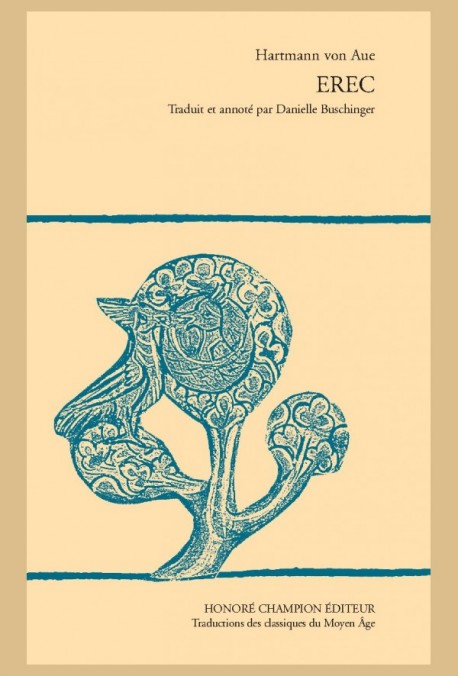
Danielle Buschinger, professeur émérite à l’Université de Picardie-Jules Verne, est l’auteur de nombreuses études sur la littérature allemande du Moyen Âge et de la première modernité : Tristan, romans du Graal, romans arthuriens, contes et nouvelles, romans animaliers, épopées en pays de langue allemande, romans en prose, lyrique d’amour (Minnesang) et poésie du discours chanté (Sangspruchdichtung). Elle a également travaillé sur Richard Wagner et a traduit un grand nombre d’œuvres médiévales allemandes.

Table des matières : ici

Informations pratiques :

Hartmann Von Aue, Erec, trad. Danielle Buschinger, Paris, Honoré Champion, 2022 ; 1 vol., 232 p. (Classiques français du Moyen Âge. Traductions, 108). ISBN : 978-2-74535-752-6. Prix : € 38,00.

Source : Honoré Champion
Publié dans Publications | Laisser un commentaire

Publication – Richard Kieckhefer, « The Mystical Presence of Christ. The Exceptional and the Ordinary in Late Medieval Religion »

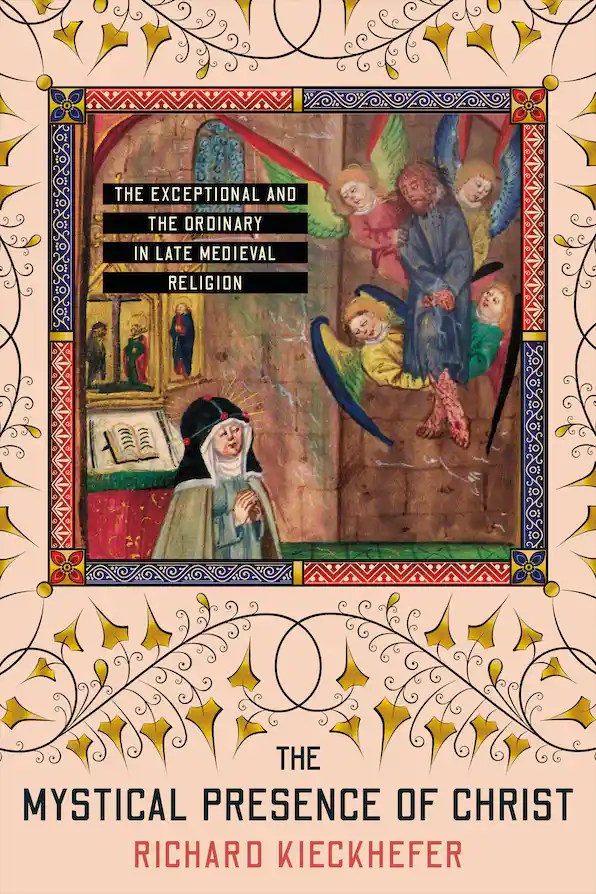
The Mystical Presence of Christ investigates the connections between exceptional experiences of Christ’s presence and ordinary devotion to Christ in the late medieval West. Unsettling the notion that experiences of seeing Christ’s figure or hearing Christ speak are simply exceptional events that happen at singular moments, Richard Kieckhefer reveals the entanglements between these experiences and those that occur through the imagery, language, and rituals of ordinary, everyday devotional culture.

Kieckhefer begins his book by reconsidering the « who » and the « how » of Christ’s mystical presence. He argues that Christ’s humanity and divinity were equally important preconditions for encounters, both exceptional and ordinary, which Kieckhefer proposes as existing on a spectrum of experience that moves from presupposition to intuition and finally to perception. Kieckhefer then examines various contexts of Christ manifestations—during prayer, meditation, and liturgy, for example—with attention to gender dynamics and the relationship between saintly individuals and their hagiographers. Through penetrating discussions of a diverse set of texts and figures across the long fourteenth century (Angela of Foligno, the nuns of Helfta, Margery Kempe, Dorothea of Montau, Meister Eckhart, Henry Suso, and Walter Hilton, among others), Kieckhefer shows that seemingly exceptional manifestations of Christ were also embedded in ordinary religious experience.

Wide-ranging in scope and groundbreaking in methodology, The Mystical Presence of Christ is a magisterial work that rethinks the interplay between the exceptional and the ordinary in the workings of late medieval religion.

Richard Kieckhefer is Professor Emeritus of Religious Studies with a joint appointment in the Department of History at Northwestern University. Among his ten books are Unquiet Souls, Magic in the Middle Ages, Theology in Stone, and European Witch Trials.

Informations pratiques :

Richard Kieckhefer, The Mystical Presence of Christ. The Exceptional and the Ordinary in Late Medieval Religion, Ithaca (NY), Cornell University Press, 2022 ; 1 vol., 382 p. ISBN : 978-1-50176-511-7. Prix : USD 54,95.

Source : Cornell University Press

Publié dans Publications | Laisser un commentaire

Colloque – Entre création et destruction : les représentations de la femme dans l’Espagne médiévale

Organisé par Soizic ESCURIGNAN

Lieu : CESCM, salle Crozet, Bât E13, 24 rue de la Chaîne – POITIERS

Dates : vendredi 7 et samedi 8 octobre.

Programme :

Vendredi 7 octobre

13h30 > Accueil des participants

14h00 > Ouverture de la journée

14h15 > Antoine PARIS (AUSONIUS, Univ. Bordeaux Montaigne) : Ambivalence du vocabulaire du féminin et des liens entre personnages féminins dans la Bible. Quelques perspectives

Session 1 – La femme personnage biblique

15h05 > Sophie COUSSEMACKER (AUSONIUS, Univ. Bordeaux Montaigne) : La Grande prostituée de Babylone chevauchant la bête dans les Beatus ibériques

15h30 > Sarah SALAMANCA (CEIIBA, Univ. Toulouse) : La représentation d’Esther dans la General Estoria d’Alphonse X le Sage, la construction d’une figure régente

15h55 > Débat et pause

Session 2 – La femme personnage historiographique

16h20 > Soizic ESCURIGNAN (CESCM, Univ. Poitiers) : Les femmes fondatrices dans la Estoria de España d’Alphonse X le Sage, pouvoir ou impuissance ?

16h45 > Marta LACOMBA (AMERIBER, Univ. Bordeaux Montaigne) : Urraca la despechada

17h10 > Charles GARCIA (CESCM, Univ. Poitiers) : Et Dieu foudroya la femme. La punition divine de la reine Urraque de León (XIIe siècle)

17h35 > Débat

Samedi 8 octobre

9h00 > Début de la journée

Session 3 – Femme dans le siècle, femme dans la règle

9h10 > Cécile CODET (CIHAM, Univ. Lumière Lyon II) : Entre construction de sa propre image et destruction de l’œuvre du Créateur : la coquetterie féminine

9h35 > Corinne MENCE-CASTER (CLEA, Sorbonne Univ.) : Les modalités langagières de recréation des représentations de la femme dans El triunfo de las donas de Juan Rodríguez del Padrón

10h00 > Sergi Sancho FIBLA (Univ. Padova) : La maestra y la ilestrada. La représentation de la femme religieuse et le savoir en Castille à la fin du Moyen Âge

10h25 > Débat et pause

Session 4 – La femme et Alphonse X

10h45 > Giovanni BORRIERO (Univ. Padova) : La figure féminine dans les Cantigas de Santa María

11h10 > Johan PUIGDENGOLAS (CEIIBA, Toulouse-Jean Jaurès) : La Vierge destructrice dans le Setenario d’Alphonse X le Sage

11h35 > Belén ALMEIDA (GITHE, Univ. Alcalá) : Mujeres sabias en la General Estoria de Alfonso X el Sabio

12h > Débat et clôture

Source : CESCM

Publié dans Colloque | Laisser un commentaire

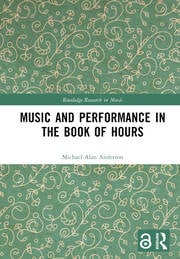
Publication – Michael Alan Anderson, « Music and Performance in the Book of Hours »

This study uncovers the musical foundations and performance suggestions of books of hours, guides to prayer that were the most popular and widespread books of the late Middle Ages.

Exploring a variety of musical genres and sections of books of hours with musical implications, this book presents a richly textured sound world gleaned from dozens of extant manuscript sources from fifteenth-century France. It offers the first overview of the musical content of these handbooks to liturgy and devotional prayer, together with cues that show scribal awareness for the articulation of sacred plainchants. Although books of hours lack musical notation, this survey elucidates the full range of musical genres and styles suggested both within and beyond the liturgical offices prescribed in books of hours. Privileging sound and ritual enactment in the experience of the hours, the survey complements studies of visual imagery that have dominated the category.

The book’s interdisciplinary approach within a musical context, and beautiful full-color illustrations, will attract not onlyspecialists in musicology, liturgy, and late medieval studies, but also those more broadly interested in the history of the book, memory, performance studies, and art history.

Michael Alan Anderson is Associate Professor of Musicology at the Eastman School of Music, University of Rochester. He specializes in European sacred music from the fourteenth to the sixteenth century, with emphasis on lay devotion and saints.

Table des matières : Introduction, Part 1: Music of the Offices, 1. Psalms, 2. Antiphons, 3. Hymns, 4. Responsories, 5. Dialogues, Part 2: Music beyond the Offices, 6. The Seven Penitential Psalms, 7. The Litany, 8. Suffrages, 9. Mass for the Virgin

Informations pratiques :

Michael Alan Anderson, Music and Performance in the Book of Hours, Londres, Routledge, 2022 ; 1 vol., 246 p. (Routledge Research in Music). ISBN : 978-0-36769-132-5. Prix : GBP 120,00.

Source : Routledge

Publié dans Publications | Laisser un commentaire

Bourse – Bourse Robert de Sorbon (2022-2023)

L’appel à candidature à la Bourse Robert de Sorbon 2022-2023 est ouvert.

Elle s’adresse aux docteurs en histoire médiévale ayant soutenu leur thèse à l’étranger. Dépôt des candidatures du 5 septembre au 15 octobre 2022 inclus.

Cette bourse permettra au lauréat de réaliser un séjour d’un mois, du 1er au 31 mars 2023, au sein du Laboratoire de Médiévistique Occidentale de Paris, lequel prendra en charge son déplacement aller et retour, son logement à la cité internationale de Paris et lui versera une somme de 1000 euros destinée à couvrir les frais courants du séjour. En outre, le lauréat obtiendra le statut de membre associé du Laboratoire pendant trois ans. À son arrivée, le lauréat donnera une conférence publique destinée à faire connaître ses travaux.

Pour plus d’information : https://lamop.pantheonsorbonne.fr/lamop/bourse-robert-sorbon

Source : LAMOP

Publié dans Bourse | Laisser un commentaire

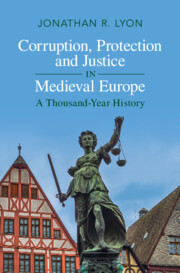
Publication – Jonathan R. Lyon, « Corruption, Protection and Justice in Medieval Europe. A Thousand-Year History »

What was an “advocate” (Latin: advocatus; German: Vogt) in the Middle Ages? What responsibilities came with the position and how did they change over time? With this groundbreaking study, Jonathan R. Lyon challenges the standard narrative of a “medieval” Europe of feudalism and lordship being replaced by a “modern” Europe of government, bureaucracy and the state. By focusing on the position of advocate, he argues for continuity in corrupt practices of justice and protection between 750 and 1800. This book traces the development of the role of church advocate from the Carolingian period onward and explains why this position became associated with the violent abuse of power on churches’ estates. When other types of advocates became common in and around Germany after 1250, including territorial and urban advocates, they were not officeholders in developing bureaucracies. Instead, they used similar practices to church advocates to profit illicitly from their positions, which calls into question scholarly arguments about the decline of violent lordship and the rise of governmental accountability in European history.

Jonathan R. Lyon is Professor of History at the University of Chicago, where he specializes in the history of the Holy Roman Empire. He has previously held fellowships from the Humboldt Foundation and the Austrian Science Fund. He is the author of Princely Brothers and Sisters: The Sibling Bond in German Politics, 1100–1250 (2013), which won the 2017 John Nicholas Brown Prize from the Medieval Academy of America, and Noble Society: Five Lives from Twelfth-Century Germany (2017).

Table des matières :

Introduction

  1. The First “Medieval” Advocates
  2. Putting Down Roots in Ninth-Century Francia
  3. The « Aristocratization » of Post-Carolingian Advocacy
  4. Elite Competition at the Turn of the First Millennium
  5. The Limits of Church Reform
  6. Pigs and Sheep, Beer and Wine, Pennies and Pounds
  7. A History of Violence
  8. Weapons of the Not-so-Weak
  9. The Murder of Archbishop Engelbert
  10. Widening the Lens
  11. The Emperor as Vogt, ca. 1000–1500
  12. From Lordship to Government?
  13. Reframing the History of Violence
  14. Crossing the False Divide: Advocates after 1500
  15. A Cultural History of the Rapacious Advocate, or: William Tell’s Revenge
    Conclusion.

Informations pratiques :

Jonathan R. Lyon, Corruption, Protection and Justice in Medieval Europe. A Thousand-Year History, Cambridge, Cambridge University Press, 2022 ; 1 vol., 375 p. ISBN : 978-1-31651-374-3. Prix : GBP 29,99.

Source : Cambridge University Press

Publié dans Publications | Laisser un commentaire

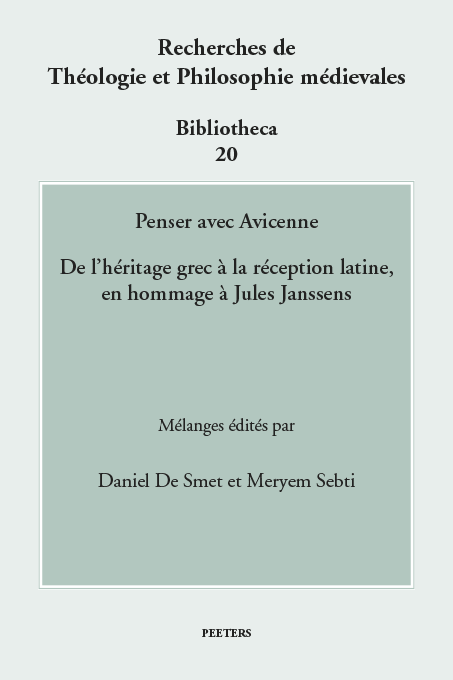
Publication – « Penser avec Avicenne. De l’héritage grec à la réception latine, en hommage à Jules Janssens », dir. Daniel De Smet et Meryem Sebti

Jules Janssens a construit une œuvre importante, qui, pour de nombreux chercheurs, a ouvert des perspectives de recherches nouvelles et fécondes. Ses travaux ont fait date. Ils portent principalement sur la philosophie d’Avicenne, ses sources, ses rapports avec la pensée musulmane, son influence sur la théologie ash’arite (al-Ghazali, Fakhr al-Din al-Razi) et sa réception dans le monde latin. Pour lui rendre hommage, quatorze collègues et amis de renommée internationale se sont réunis pour poursuivre ses réflexions sur ces thèmes. L’ouvrage qui en est issu offre un état des lieux de la recherche contemporaine sur Avicenne et sa postérité arabo-latine.

Table des matières : ici

Informations pratiques :

Penser avec Avicenne. De l’héritage grec à la réception latine, en hommage à Jules Janssens, dir. Daniel De Smet et Meryem Sebti, Louvain, Peeters, 2022 ; 1 vol., IV-405 p. (Recherches de Théologie et Philosophie Médiévale. Bibliotheca, 20). ISBN : 978-9-04294-919-5. Prix : € 92,00.

Source : Peeters

Publié dans Publications | Laisser un commentaire

Conférence – Anne Rauner, « Le système documentaire de la memoria de la paroisse Sainte-Aurélie de Strasbourg au bas Moyen Âge »

Le séminaire d’histoire médiévale organisé par l’École pratique des hautes études et l’Institut historique allemand se poursuit avec, le mercredi 19 octobre 2022, de 10h00 à 12h00,

Anne Rauner (université de Strasbourg), « Le système documentaire de la memoria de la paroisse Sainte-Aurélie de Strasbourg au bas Moyen Âge ».

La discussion qui suivra sera animée par Jean-Loup Lemaitre (École pratique des hautes études).


Le séminaire aura lieu en mode hybride, avec un système de visioconférence pour ceux qui ne pourront pas se déplacer à l’IHA.

Les personnes désireuses d’assister au séminaire sur place se feront connaître auprès de Rolf Große : rgrosse@dhi-paris.fr (message adressé en copie à Laurent Morelle : Laurent.Morelle@ephe.psl.eu).

Pour les personnes souhaitant participer à distance, merci de vous inscrire ici : https://us06web.zoom.us/meeting/register/tZEpdOqsrzsrGtXsP9oXxxpAhG_2xBxb6u-O

Après votre inscription, vous recevrez un mail de confirmation.

Vous trouverez le programme complet du séminaire sous cette adresse : https://calenda.org/1017513?lang=fr

Source : Institut historique allemand

Publié dans Colloque | Laisser un commentaire

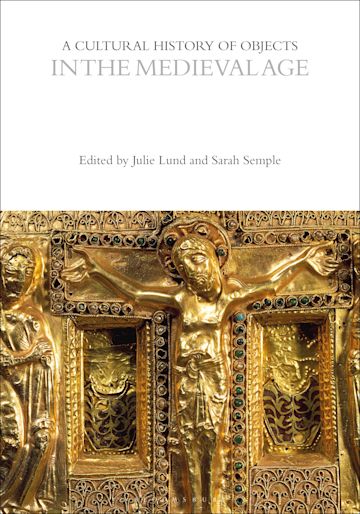
Publication – « A Cultural History of Objects in the Medieval Age », vol. 32, éd. Julie Lund et Sarah Semple

A Cultural History of Objects in the Medieval Age covers the period 500 to 1400, examining the creation, use and understanding of human-made objects and their consequences and impacts. The power and agency of objects significantly evolved over this time. Exploring objects and artefacts within art, technology, and everyday life, the volume challenges our understanding of both life worlds and object worlds in medieval society.

The 6 volume set of the Cultural History of Objects examines how objects have been created, used, interpreted and set loose in the world over the last 2500 years. Over this time, the West has developed particular attitudes to the material world, at the centre of which is the idea of the object. The themes covered in each volume are objecthood; technology; economic objects; everyday objects; art; architecture; bodily objects; object worlds.

Julie Lund is Associate Professor at the University of Oslo, Norway. Sarah Semple is Professor at Durham University, UK.

Table des matières :

1. Objecthood, Robin Fleming and Katherine L. French
2. Technology, Steve Ashby
3. Economic Objects, Dries Tys and Pieterjan Deckers
4. Everyday Objects: Making and Shaping Medieval Worlds, Toby F. Martin
5. Art, Hans Henrik Lohfert Jørgensen
6. Architecture, Sam Turner
7. Bodily Objects, Bonnie Effros
8. Object Worlds, Ben Jervis and Sarah Semple

Informations pratiques :

A Cultural History of Objects in the Medieval Age, éd. Julie Lund et Sarah Semple, Londres, Bloomsbury, 2022 ; 1 vol., 296 p. (The Cultural Histories Series). ISBN : 978-1-47429-868-1. Prix : USD 99,00.

Source : Bloomsbury

Publié dans Le réseau | Laisser un commentaire

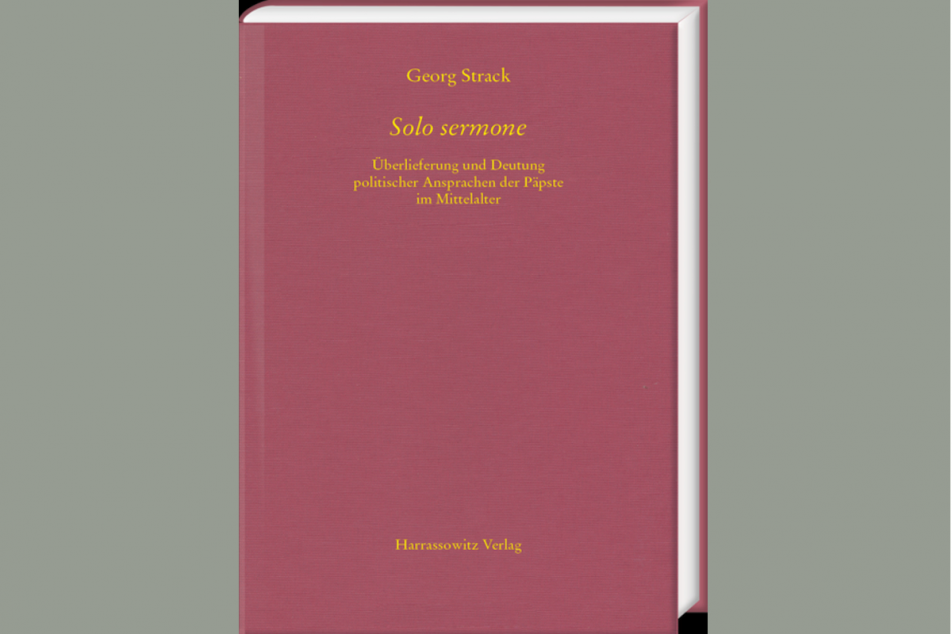
Publication – Georg Strack, « Solo sermone. Überlieferung und Deutung politischer Ansprachen der Päpste im Mittelalter »

Die vorliegende Monographie untersucht erstmals systematisch politische Ansprachen von Päpsten des Hoch- und Spätmittelalters. Als wichtigstes Redeforum nimmt sie Konzilien in den Blick und zeigt, wie päpstliche Oratorik dazu beiträgt, den Konsens über allgemein verbindliche Beschlüsse rituell zu verdeutlichen. Dieser Funktion entspricht die feierliche, aber eher schlichte Gestaltung der Vorträge, wie sie in Konzilsakten – etwa dem Papstwahldekret von 1059 – überliefert sind. Die Studie macht deutlich, dass es vor allem das literarische Verfahren der réécriture ist, das Päpste in Heiligenviten, Chroniken und Versepen zu großen Rednern werden lässt. Vor diesem Hintergrund erscheinen Ansprachen von Leo IX. bis Bonifaz VIII. in einem neuen Licht – und auch der angeblich so dramatische, in Deus vult-Rufen gipfelnde Kreuzzugsaufruf Urbans II. in Clermont. Besser bezeugt ist persuasive Oratorik für Calixt II., der als Prediger primär auf die Imitatio Christi rekurriert. Das Thema der Leidensnachfolge dominiert in politischen Ansprachen der Päpste seit Innozenz III. Seine Konzilspredigt Desiderio desideravi (Luc. 22,15) von 1215, die Jacques-Paul Migne nur unvollständig druckte, wird im Anhang erstmals kritisch ediert. Innozenz III. steht auch am Beginn der Überlieferungstradition päpstlicher Konsistorialreden, die in einem Ausblick bis hin zu Clemens VI. exemplarisch diskutiert werden. Das Buch wird erschlossen durch Register der Handschriften, Namen und Bibelzitate.

Table des matières : ici

Informations pratiques :

Georg Strack, Solo sermone. Überlieferung und Deutung politischer Ansprachen der Päpste im Mittelalter, Wiesbaden, Harrassowitz Verlag, 2022 ; 1 vol., XLIV–328 p. (Schriften, 79). ISBN : 978-3-447-11388-5. Prix : € 70,00.

Source : Monumenta Germaniae Historica

Publié dans Publications | Laisser un commentaire