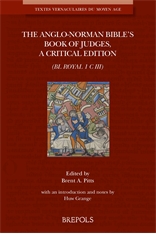
Publication – The Anglo-Norman Bible’s Book of Judges. A Critical Edition (BL Royal 1 C III)

The critical text of the Anglo-Norman Bible’s Book of  Judges is here based on the fourteenth-century manuscript British Library Royal I C III. An introduction and notes elucidate the text for the modern reader.

A silver-tongued assassin, a motherly prophetess, a consecrated strongman unable to resist the charms of foreign women: the Anglo-Norman Bible’s Book of Judges features a roll-call of unlikely heroes. At the book’s core is a cycle of saviour stories. Twelve times the Israelites embrace foreign gods, succumb to neighbouring enemies, repent and are delivered by a ‘judge’. As Israel itself descends into ever-greater religious, moral and political decay, the narrative pattern also unravels. The book ends bleakly, with stories of rape, murder and civil war. The stage is set for a king.

Gideon—a doubting Thomas who repeatedly ‘tests’ God—and Samson—lion-killer and lover of Delilah—were firm medieval favourites. Their tales and those of other flawed judges inspired heroic deeds on the battlefield and provided lessons on how to behave (and indeed how not to behave). With its remarkable heroines, moreover—from cut-throat Jael, who wields a tent-peg to devastating effect, to Jephthah’s dignified daughter, sacrificed because of her father’s rash vow—this is a book that prompted much reflection in the Middle Ages on the place of women in society.The Anglo-Norman Bible’s Book of Judges survives in two fourteenth-century manuscripts: British Library Royal MS 1 C III (L), noted for its multilingual glosses, and the richly illustrated Paris, Bibliothèque nationale de France, fonds français 1 (P). The critical text, based on L, has been prepared by Pitts. An introduction and notes by Grange aim to elucidate and interpret the Anglo-Norman Bible’s Book of Judges for the modern reader.
Brent A. Pitts is the editor of numerous geographical and biblical works in Anglo-Norman, including the Anglo-Norman Bible’s books of Joshua, Ruth and Tobit. He is professor emeritus of French at Meredith College, Raleigh, North Carolina.

Huw Grange is the author of Saints and Monsters in Medieval French and Occitan Literature (2017).He is currently a researcher at UiT The Arctic University of Norway.

Table des matières :

Acknowledgements
Abbreviations
Introduction
The Old Testament book of Judges
Manuscripts of the Anglo-Norman Bible’s book of Judges
Sources and influence of the Anglo-Norman Bible’s book of Judges
Comparison of manuscripts L and P
Language
Orthography
Nouns, articles, adjectives and pronouns
Verbs
Syntax
Lexis
The book of Judges in medieval culture
Editorial considerations
Bibliography
The Anglo-Norman Bible’s book of Judges
Text edition
Rejected readings
Critical notes
Appendices
A. Comparison of the Anglo-Norman Bible to the twelfth-century Anglo-Norman Judges
B. Comparison of L and P
C. Divergent word-choice in L and P
D. Personal names in the Anglo-Norman Bible’s book of Judges
E. Geographical names in the Anglo-Norman Bible’s book of Judges
Glossary

Informations pratiques :

The Anglo-Norman Bible’s Book of Judges. A Critical Edition (BL Royal 1 C III), Turnhout, Brepols, 2022 (Textes vernaculaires du Moyen Âge). 169 p., 1 b/w ill., 156 x 234 mm, 2022 ISBN: 978-2-503-60011-6. Prix : 70 euros.

Source : Brepols
Publié dans Publications | Laisser un commentaire

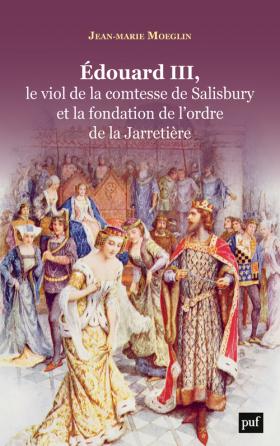
Publication – Jean-Marie Moeglin, « Edouard III, le viol de la comtesse de Salisbury et la fondation de l’ordre de la Jarretière »

Qui pourrait croire que le roi Édouard III d’Angleterre a violé l’épouse de son proche ami William Montagu, comte de Salisbury ? C’est pourtant ce qu’affirme vers 1350 un récit stupéfiant du chroniqueur Jean Le Bel.

Tel est le point de départ de ce livre. L’auteur montre comment Jean Le Bel, admirateur déçu d’Édouard III, invente ce forfait après que son héros, qui se rêvait en nouveau roi Arthur, a renoncé à conquérir la couronne de France. Sa chronique tombe vite dans l’oubli mais le chroniqueur Jean Froissart a eu le temps de transformer cette sombre histoire en un grand récit d’amour courtois. La fiction inventée par Jean Le Bel connaît ainsi une étonnante carrière, qui la conduira notamment à donner forme, vers 1580, à la légende fondatrice de l’ordre de la Jarretière et à être reprise par de nombreux écrivains, de Bandello et Shakespeare à Alexandre Dumas.

Après la redécouverte de la chronique de Jean Le Bel, l’amour d’Édouard III pour la comtesse de Salisbury ne peut plus rester un thème littéraire. Mais cette histoire et la série de détournements et d’interprétations dont elle a été l’objet sont une éclatante démonstration de la puissante intrication entre l’Histoire, la Fiction et le Roman.

Jean-Marie Moeglin, ancien élève de l’École normale supérieure et ancien membre de l’Institut universitaire de France, est professeur d’histoire culturelle du Moyen Âge à Sorbonne-Université et directeur d’études à l’École pratique des Hautes Études. Il est l’auteur de nombreux travaux, notamment sur les rituels politiques et l’historiographie.

Informations pratiques :

Jean-Marie Moeglin, Edouard III, le viol de la comtesse de Salisbury et la fondation de l’ordre de la Jarretière, Paris, PUF, 2022. 256 p. ISBN : 978-2-13-083346-8. Prix : 22 euros.

Source : PUF

Publié dans Publications | Laisser un commentaire

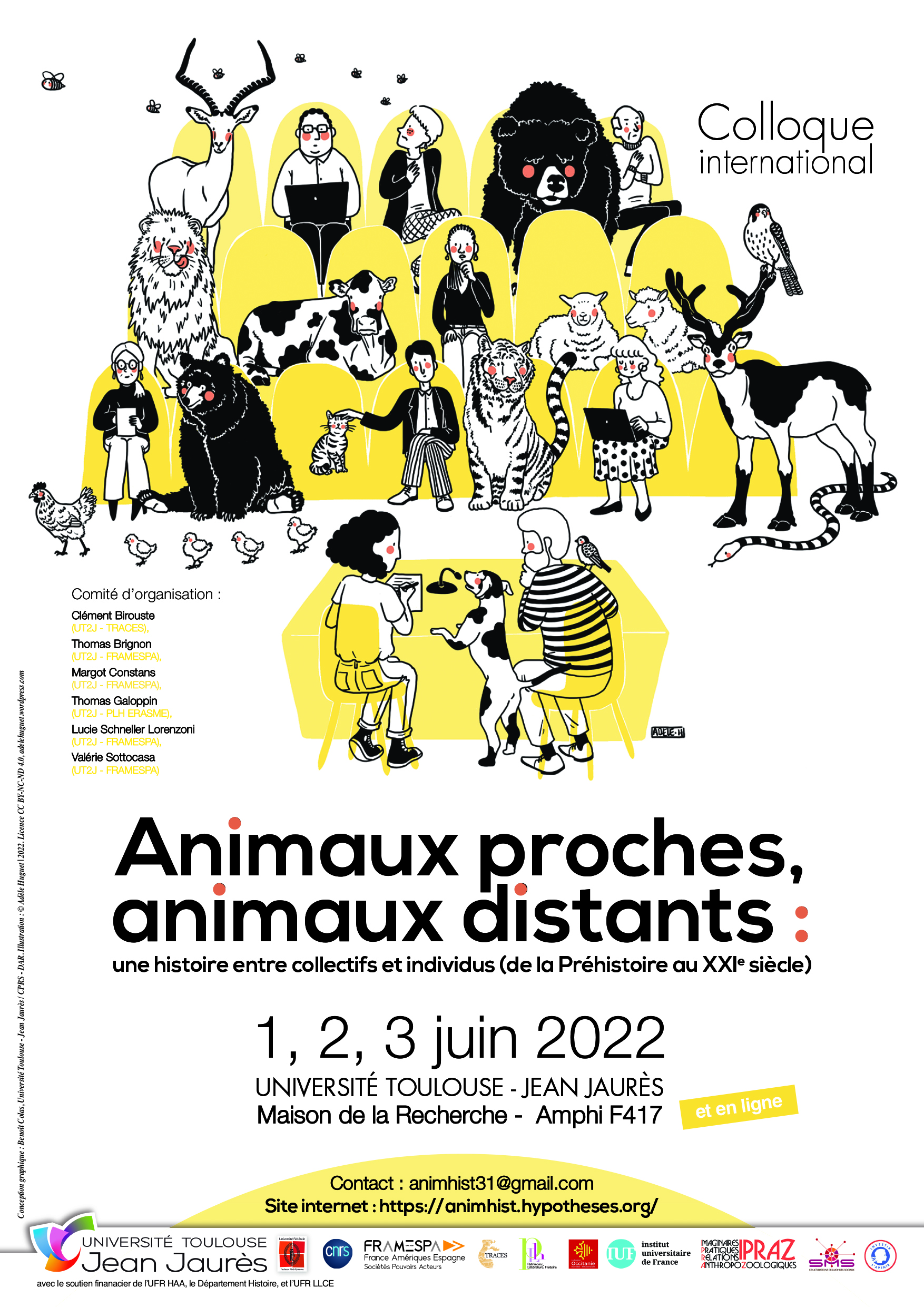
Colloque – Animaux proches, animaux distants : une histoire entre collectifs et individus (de la Préhistoire au XXIe siècle)

Depuis le début des années 2000, l’histoire des animaux a été enrichie par deux grandes approches méthodologiques : d’une part, une démarche centrée sur l’identification et la définition de communautés constituées d’humains et d’autres animaux. De l’autre, une recherche visant à faire émerger des expériences individuelles animales ou des échanges inter-individuels entre humains et non-humains. Cherchant à faire converger ces deux perspectives, notre colloque international et interdisciplinaire propose de privilégier l’étude des relations de proximité et de distance entre humains et autres animaux, de la Préhistoire au XXIe siècle.

Programme : ici

Informations pratiques :

1, 2, 3 juin 2022

UNIVERSITÉ TOULOUSE – JEAN JAURÈS

et en ligne

Animaux proches, animaux distants : une histoire entre collectifs et individus (de la Préhistoire au XXIe siècle), avec le soutien finanacier de l’UFR HAA, le Département Histoire, et l’UFR LLCE

Maison de la Recherche – Amphi F417

Contact : animhist31@gmail.com

Site internet : https://animhist.hypotheses.org/

Colloque en modalités hybrides, lien pour la visioconférence bientôt disponible sur le carnet de recherche https://animhist.hypotheses.org/

Publié dans Colloque | Laisser un commentaire

Publication – « Rewriting History in the Central Middle Ages, 900–1300 », éd. Emily A. Winkler et C. P. Lewis

How historians in the central Middle Ages rewrote the past to meet the needs of a changing present.

In the Middle Ages, rewriting history was a distinct activity within the larger sphere of historical writing. Rewriting started with existing historical accounts, recasting them into new forms as new stories about the past. Changes in circumstances drove rewriting, encouraging historically literate writers and their patrons to examine their histories anew, to jettison what no longer made sense or was useful, and to supply new material to fill gaps or expand ideas. Writers rewrote not only for the present and future, but also for the past. They curated the past and reorganized its intellectual artifacts, thereby revealing new facets of old history to future eyes.

Rewriting was a defining characteristic of the central Middle Ages (900–1300), distinct both from earlier traditions of universal history and from later traditions of making continuations which left the narrative core intact. Reimagining the past by rewriting happened across genres, in the vernaculars as well as the universal languages of Latin and Greek, and across Europe, west and east. The chapters in this book explore the reasons and methods for rewriting, ranging across the Anglo-Norman realm, France and Flanders, Christian Iberia, Norman Italy and the Mediterranean, Byzantium, and Georgia and Armenia. Together, they show a set of rewriters who made themselves the authorities for their own age.

Emily A. Winkler is Principal Investigator of a research project on medieval historical writing in England and Wales, funded by the Arts and Humanities Research Council. She is a Research Fellow at St Edmund Hall and the Faculty of History at the University of Oxford. An historian of medieval thought and writing, she has research interests in responsibility and leadership, conquest and diplomacy, material culture, and emotion and experience.

C. P. Lewis is Research Fellow in the Department of History at King’s College London, and Senior Fellow at the Institute of Historical Research. He has published on English and Welsh history in the central Middle Ages and has edited both Anglo-Norman Studies and Haskins Society Journal. Besides his published articles on the twelfth-century Life of Gruffudd ap Cynan, he has work in hand on the Anglo-Norman historians Orderic Vitalis and William of Malmesbury.

Table des matières :

Rewriting History in the Central Middle Ages, 900–1300, éd. Emily A. Winkler et C. P. Lewis, Turnhout, Brepols, 2022 (International Medieval Research, 26). 342 p., 8 maps, 156 x 234 mm.
ISBN: 978-2-503-59686-0. Prix : 95 euros.

Source : Brepols

Publié dans Publications | Laisser un commentaire

Offre d’emploi – Bourse de doctorat de la Fondation Périer-D’Ieteren

La Fondation attribue une bourse de doctorat pour des recherches menées dans les domaines de l’Histoire de l’Art des XIVe-XVIIIe siècles. Cette bourse d’une durée de un an sera renouvelable éventuellement trois fois. Un appel à candidature sera effectué chaque année au mois d’avril.

Appel en cours : du 1er avril au 30 juin 2022Formulaire de candidature

Source : Fondation Périer-D’Ieteren

Publié dans Offre d'emploi | Laisser un commentaire

Offre d’emploi – Temporary Lecturer in Medieval History (0.7 FTE) (Utrecht University)

Job description

The Department of History and Art History seeks to appoint a temporary Lecturer in Medieval History. Members of the Medieval History Section are required to teach Medieval History, both at BA level (in Dutch and English) and at RMA level (in English). They make contributions to the (interdisciplinary) courses of the minor Medieval Studies, and they are also requested to make a contribution to the department’s general BA courses (both in Dutch and in English). Finally, on occasion they may be asked to contribute to teaching in the Dutch Research School in Medieval Studies.

Requirements

The successful candidate will have:

  • experience teaching undergraduate students and a commitment to thesis supervision and internships;
  • a PhD degree or far advanced PhD trajectory in medieval history or a closely related discipline;
  • a clear teaching philosophy (to be included in your letter of motivation, briefly outlining in a teaching philosophy statement your teaching beliefs and practices, and the skills and knowledge you bring to an education team;
  • the ambition and the ability to contribute fully to the academic life of the group and the department.

Utrecht University has a teaching qualification system for university lecturers, and candidates are required to obtain the Basic Teaching Qualification (BKO) within two years if they are not already in possession of one. Candidates are expected to be proficient in both Dutch and English. Candidates must fulfill the conditions set by the IND to work in the Netherlands. 

Conditions of employment

We offer a position (0.7 FTE), as from 1 August 2022 for a period of one year and after a positive evaluation, the appointment will become permanent. The gross salary – depending on previous qualifications and experience  – ranges between €3,821 and €5,230 (scale 11 according to the Collective Labour Agreement Dutch Universities) per month for a full-time employment. Salaries are supplemented with a holiday bonus of 8% and a year-end bonus of 8.3% per year. In addition, Utrecht University offers excellent secondary conditions, including an attractive retirement scheme, (partly paid) parental leave and flexible employment conditions (multiple choice model). For more information: working at Utrecht University.

Employer

A better future for everyone. This ambition motivates our scientists in executing their leading research and inspiring teaching. At Utrecht University, the various disciplines collaborate intensively towards major societal themes. Our focus is on Dynamics of Youth, Institutions for Open Societies, Life Sciences and Sustainability.

The Faculty of Humanities has around 6,000 students and 900 staff members. It comprises four knowledge domains: Philosophy and Religious Studies, History and Art History, Media and Culture Studies, and Languages, Literature and Communication. With its research and education in these fields, the faculty aims to contribute to a better understanding of the Netherlands and Europe in a rapidly changing social and cultural context. The enthusiastic and committed colleagues and the excellent amenities in the historical city center of Utrecht, where the faculty is housed, contribute to an inspiring working environment.

Additional information

For more information about this position, please contact:  Marco Mostert (Professor of Medieval History), via m.mostert@uu.nl.

Source : Academic Transfer

Publié dans Offre d'emploi | Laisser un commentaire

Publication – Symphorien Champier, « La Nef des dames vertueuses », éd. Judy Kem

La Nef des dames vertueuses (1503) de Symphorien Champier, humaniste et médecin lyonnais, est une « apologie féministe », qui consiste en quatre livres : un recueil de biographies de femmes célèbres, un traité sur le mariage, une étude sur les prophéties des sibylles et un essai sur l’amour platonique.

Table des matières : ici

Informations pratiques :

Symphorien Champier, La Nef des dames vertueuses, éd. Judy Kem, nouv. éd., Paris, Classiques Garnier, 2022 (Textes de la Renaissance, n° 114). 307 p. ISBN : 978-2-406-12827-4. Prix : 35 euros.

Source : Classiques Garnier

Publié dans Publications | Laisser un commentaire

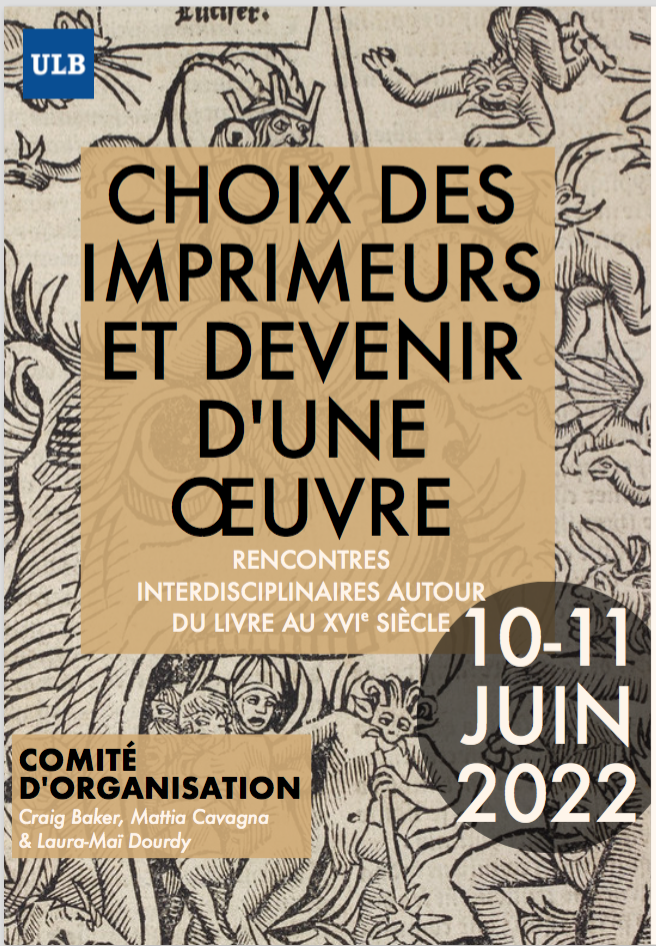
Colloque – Choix des imprimeurs et devenir d’une œuvre. Rencontres interdisciplinaires autour du livre au XVIe siècle

Le colloque « Choix des imprimeurs et devenir d’une œuvre » se veut l’occasion d’étudier la réception des récits médiévaux et le renouveau générique au XVIe siècle. Il réunira des experts de différents champs, qui focaliseront leur réflexion sur le genre littéraire, en empruntant les méthodes de l’histoire du livre et de la bibliographie matérielle, et en les faisant dialoguer avec celles d’autres disciplines, telles que la littérature, la philologie et la linguistique. Les participants analyseront la fortune des œuvres dans l’Europe du XVIe siècle en essayant de déterminer le rôle des passeurs de textes impliqués dans la production et dans le commerce du livre. Les analyses de plusieurs traditions imprimées permettront de révéler différentes habitudes et stratégies éditoriales. Les catalogues, inventaires d’ateliers et autres documents d’archives liés aux libraires et imprimeurs seront explorés afin d’identifier les genres les plus répandus, les succès de librairie et leur devenir tout au long du XVIe siècle. Les choix concernant les pages de titre, les tables des matières, la mise en page, l’emploi de bois, de certains signes typographiques ou encore de formes linguistiques plus ou moins archaïsantes seront également interrogés car ils constituent autant de phénomènes qui permettent de cerner les conventions, les innovations et les évolutions génériques à la fin du Moyen Âge. 

Programme :

Vendredi 10 juin

Salle H2111
(Bâtiment H – Solbosch) 9h45 Accueil des participants

10h15 Introduction par Laura-Maï Dourdy (Université Libre de Bruxelles)

SÉANCE 1 : LE REMANIEMENT DES ŒUVRES AU XVIe SIÈCLE

MARIA COLOMBO TIMELLI (Università degli Studi di Milano) Titre et genre : quel sort pour le Dialogus creaturarum / Dialogue des creatures ?

FANNY MAILLET (Universität Zürich)
Du livre de choses au propriétaire revisité : observations sur le passage à l’imprimé du De proprietatibus rerum en français

MARCO VENEZIALE (Universität Zürich)
Poèmes de cour en variation controlée : la poésie marotique imprimée par Pierre Attaingnant

Lunch

SÉANCE 2 : IMPRIMER LES ROMANS DE CHEVALERIE

FRANCESCO MONTORSI (Université Lumière-Lyon 2) Editio princeps chez le Prince ? Le cas du Giglan

LAURA-MAÏ DOURDY (Université Libre de Bruxelles) Réception des romans de chevalerie au XVIe siècle : matérialité et langue d’un genre littéraire

Pause

SÉANCE 3 : L’ÉVOLUTION MATÉRIELLE AU XVIe SIÈCLE

15h30 JORAN PROOT (Cultura Fonds Library)
A Theory about Typographical Evolution in the Early Modern Period

16h00 SUSAN BADDELEY (Université Paris-Saclay)
The First Printed Works for Teaching French in England

16h30 URSULA RAUTENBERG (Friedrich-Alexander-Universität) Some Basic Features Concerning the Transition of Vernacular Narrative Texts from Manuscript to Printed Book

DOUBLE-TEST

SAMEDI 11 JUIN

Bibliothèque du CIERL

9h30 Accueil des participants

SÉANCE 4 : LA LANGUE DES IMPRIMÉS

ANJA VOESTE (Justus-Liebig-Universität Gießen) Linguistic Features as part of the Dispositif?

MARKO NEUMANN (Justus-Liebig-Universität Gießen)
Tables of Contents in the Spotlight. Linguistic Interventions in Early Book Printing

Pause

SÉANCE 5 : DANS L’ATELIER D’UN IMPRIMEUR

11h30 GABRIELLA PARUSSA (Sorbonne Université) Le rôle des libraires et imprimeurs dans la diffusion et réception des mystères médiévaux au XVIe siècle : l’exemple de Jean Saint Denis et de Julien Hubert

12h00 Conclusions

Publié dans Colloque | Laisser un commentaire

Appel à contribution – The Other who listens: Holiness and Preaching to Minorities and Excluded in the Late Middle Ages and Early Modernity

November 3-4, 2022
IV o COLLOQUIUM ON HAGIOGRAPHY

It is the purpose of this IVth Colloquium on Hagiography, convened by the Augustinian Library in Buenos Aires, to be able to reflect on the research in the hagiographic field referring to Saints, Blesseds and venerable ones who have given their testimony of holiness in the midst of the Blessed of the Gospel (Cf. Mt V, 3-12).

Discourses on poverty, minorities and the exclusion of these for various reasons related to religion, gender, ethnic origin, health and life decisions, are highly cultivated nowadays. Following a path of scientific production that began a couple of decades ago, studies related to the social field, cultures, practices of writing and reading, ways of preaching, the practice of power and the hagiographic models, continue to enjoy a vitality from different disciplines, which contribute to the debate and generate the challenge of also providing a living contribution and an analysis of what is happening to us in the present as a society from the academic field.

For this, we invite researchers with work in progress who want to share their contributions from their disciplinary or confessional approaches, within the time frame of the call (From Early Christianity to the 18th century), with special emphasis on those witnesses of the Christian faith. who have been in contact with Judaizing minorities, Moors, excluded for reasons of origin, ethnicity or race, slaves, poor, migrants, etc. Likewise, the modern period includes the possibility of also analyzing the relationship between preaching and holiness with the original cultures of the New World as it was called at that time. In turn, the approach used may include any of the three main aspects of the act of preaching: the preacher as the transmitter of the message, the sermon as an instrumental, documentary and textual reflection of that act, and the audience as the objective, receiver and interpreter of the message. speech. The event will be in Hybrid and/or Virtual format according to the development of the health situation that affects us all.

The rules for presenting papers are similar to those of the publication Bibliotheca Augustiniana ISSN 2469 – 0341, where those that pass peer review will be edited once presented at the Colloquium.

The Abstract submission date is open until Friday, June 24, and the delivery of the final paper on Friday, October 7, 2022.

This allows us to have Abstracts and Final Papers peer reviewed prior to the event. It is suggested to send the abstract in the following way: Title of the work, Author and Academic membership, a text of no more than 250 words and at least four keywords.

The date of the event, as is tradition, will be in the Spring of the Southern Cone, at the beginning of November 2022, on November 3 and 4.

We would like to count on your collaboration, participation and assistance. The dynamics of the Colloquium is following the Liturgical Hours of the day, with a Conference of Terce, one of Median Hour and one of Vespers. The Discussion Tables of the Presentations have 20 minutes of oral presentation per work and about ten minutes of general consultations at the end of each Table, composed of no more than three exhibitors.

We believe that revitalizing hagiographic studies is a good way to generate memory and values in the society that contains us and is a contribution to all of the Humanities.

Our contact email for the Colloquium is:
bibcisao@gmail.com bibliothecaugustiniana@gmail.com & biblioteca@sanagustin.org

Publié dans Appel à contributions | Laisser un commentaire

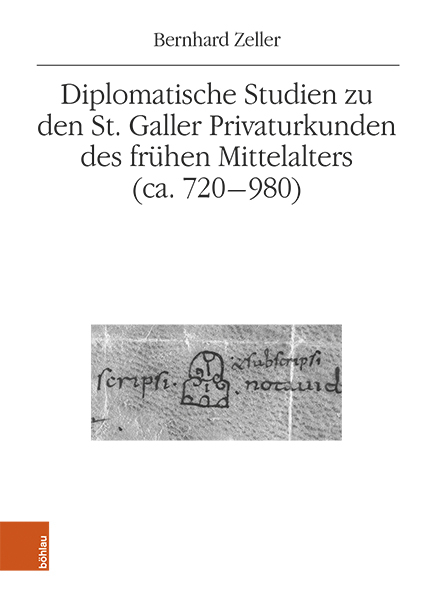
Publication – Bernhard Zeller, « Diplomatische Studien zu den St. Galler Privaturkunden des frühen Mittelalters (ca. 720-980) »

Bis zum heutigen Tag werden im Stiftsarchiv St. Gallen weit über 800 Urkunden aus der Zeit vor dem Jahr 1000 aufbewahrt. Es ist ein außergewöhnlicher Bestand von Originaldokumenten, der im vorliegenden Buch erstmals einer systematischen diplomatischen Untersuchung unterzogen wird. In den ersten drei Abschnitten des Buches werden grundlegende Aspekte des Urkundenwesens im frühmittelalterlichen Alemannien behandelt sowie ausführlich die äußeren und inneren Merkmale der St. Galler Dokumente (also Schreib- und Beschreibstoffe, Schriftformen, graphische Symbole, Urkundenformen und -formeln) untersucht. Auf dieser formal-diplomatischen Grundanalyse beruhen die folgenden Abschnitte, in denen zuerst die Entwicklung des klösterlichen (St. Galler) Urkundenwesens verfolgt und dann den Spuren von nichtklösterlicher-lokaler Schreibtätigkeit nachgegangen wird. Auf diese Weise werden schrittweise die Koordinaten einer historischen „Urkundenlandschaft“ Alemannien abgesteckt.

Bernhard Zeller hat an der Universität Wien Geschichte und Germanistik studiert, ist Mitglied des Instituts für Österreichische Geschichtsforschung und hat sich 2018 für Mittelalterliche Geschichte und Historische Hilfswissenschaften habilitiert.

Informations pratiques :

Bernhard Zeller, Diplomatische Studien zu den St. Galler Privaturkunden des frühen Mittelalters (ca. 720-980), Göttingen, Vandehoeck und Ruprecht, 2022 (Mitteilungen des Instituts für Österreichische Geschichtsforschung. Ergänzungsbände, 66). 632 Seiten, gebunden ISBN: 978-3-205-21487-8 Böhlau Verlag Wien, 1. Auflage, 2022. Prix : 95 euros.

Source : Vandehoeck und Ruprecht

Publié dans Publications | Laisser un commentaire