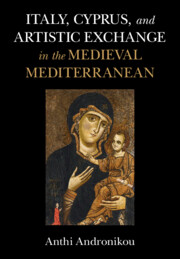
Publication – Anthi Andronikou, »Italy, Cyprus, and Artistic Exchange in the Medieval Mediterranean »

In this volume Anthi Andronikou explores the social, cultural, religious and trade encounters between Italy and Cyprus during the late Middle Ages, from ca. 1200 -1400, and situates them within several Mediterranean contexts. Revealing the complex artistic exchange between the two regions for the first time, she probes the rich but neglected cultural interaction through comparison of the intriguing thirteenth-century wall paintings in rock-cut churches of Apulia and Basilicata, the puzzling panels of the Madonna della Madia and the Madonna di Andria, and painted chapels in Cyprus, Lebanon, and Syria. Andronikou also investigates fourteenth-century cross-currents that have not been adequately studied, notably the cult of Saint Aquinas in Cyprus, Crusader propaganda in Santa Maria Novella in Florence, and a unique series of icons crafted by Venetian painters working in Cyprus. Offering new insights into Italian and Byzantine visual cultures, her book contributes to a broader understanding of cultural production and worldviews of the medieval Mediterranean.

Table des matières :

  1. A prosopography of encounters
  2. Southern Italy, Cyprus and the Holy Land: a tale of parallel aesthetics?
  3. Deconstructing myths: transmutations of Madonna and Panagia between Italy and Cyprus
  4. Thomas Aquinas, the Dominicans and artistic patronage in trecento Cyprus
  5. The peregrinations of a Cypriot king in Italian material culture, 1362-1368
  6. Art in the interstices: hybrid Italian panels and Cypriot nobility.

Informations pratiques :

Anthi Andronikou, Italy, Cyprus, and Artistic Exchange in the Medieval Mediterranean, Cambridge, Cambridge University Press, 2022 ; 1 vol., 350 p. ISBN : 978-1-31651-092-6. Prix : GBP 75,00.

Source : Cambridge University Press

Publié dans Publications | Laisser un commentaire

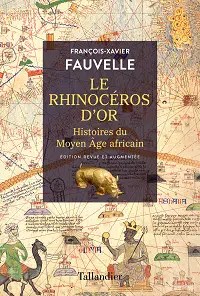
Publication – François-Xavier Fauvelle, « Le Rhinocéros d’or. Histoire du Moyen Âge africain » (nouv. éd. augmentée)

Le Rhinocéros d’or peint le tableau d’une Afrique méconnue, celle des « siècles d’or » du Moyen Âge (VIIIe-XVe siècle).

Le témoignage d’un négociant, d’un aventurier, d’un géographe arabe, une carte, une fresque, une inscription gravée, les ruines d’une ville de sel ou de terre, un site récemment fouillé, sont autant de traces qui permettent à François-Xavier Fauvelle de reconstituer ces pans d’histoire. Il nous mène de l’Afrique du Nord aux royaumes du Ghâna et du Zâfûn, de l’empire du Mâli à l’Égypte, du Kânem près du lac Tchad aux royaumes chrétiens de Nubie et d’Éthiopie, des principautés de la côte d’Afrique de l’Est aux énigmatiques ruines de Grand Zimbabwe. On découvre les cours de souverains opulents ; les villes bruissantes d’activité où les commerçants du monde islamique rencontraient les négociants africains ; les marchés où s’échangeaient ambre de cachalot, esclaves et or contre perles indopacifiques et vaisselle de Chine. Les sociétés africaines étaient alors parties prenantes d’un vaste monde interconnecté. Devenu un classique, Le Rhinocéros d’or a été traduit en une dizaine de langues. Paru dans sa première version en 2013 (Alma), le livre a reçu le Grand Prix du livre d’histoire (Rendez-vous du livre d’histoire de Blois), l’édition anglaise (Princeton University Press, 2018) celui du « Medieval book of the year » (Medievalists.net).

Cette nouvelle édition est augmentée de plusieurs chapitres et enrichie des fruits d’une dizaine d’années de recherches.

François-Xavier Fauvelle est professeur au Collège de France. Auteur d’une vingtaine d’ouvrages, il est l’un des spécialistes mondiaux de l’histoire des sociétés africaines anciennes.

Informations pratiques :

François-Xavier Fauvelle, Le Rhinocéros d’or. Histoire du Moyen Âge africain, nouv. éd., Paris, Tallandier, 2022 ; 1 vol. 400 p.. ISBN : 979-1-02105-220-8. Prix : € 21,90.

Source : Tallandier

Publié dans Publications | Laisser un commentaire

Appel à contribution – Questioning “Gregorian Reform Art” (11th-12th c.): Challenges, Strategies, and New Approaches

International Congress on Medieval Studies,
May 11-13, 2023
University of Western Michigan, Kalamazoo, MI (USA)
Sponsored by the Italian Art Society, http://www.italianartsociety.org Submission
Deadline: September 15, 2022

Organizers:

Barbara Franzé, Lecturer, Universities of Neuchâtel and Lausanne Gillian B. Elliott, Adjunct Professor, George Washington University

Call for Papers:

Since the early studies by Ernst Kitzinger and Hélène Toubert, art historians have interpreted
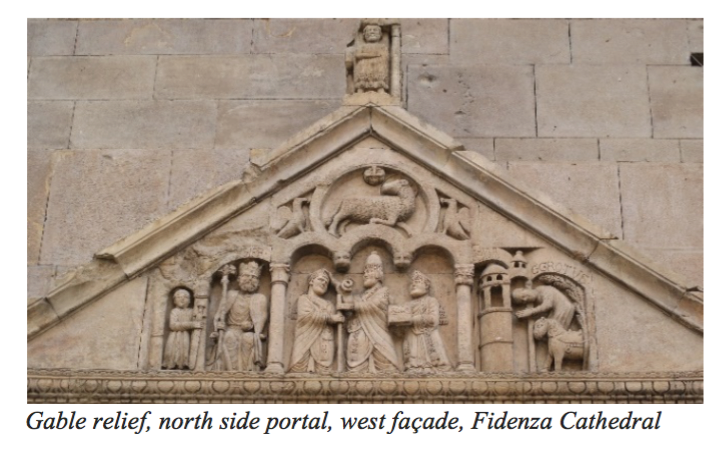
the monumental decorative programs of Rome by placing formal inventiveness, new narrative strategies, and the intensification of figurative production of the reforming century in a causal relationship with the social issues of the Gregorian Reform movement. Even as research initiatives now consider a vast territory, from Northern Italy to France, the Iberian Peninsula, and the regions of Eastern Europe, the subject of “Gregorian Reform Art” remains controversial because skeptics continue to cast doubt on a systematic artistic reform agenda. The purpose of the two sessions is to free our discipline from the epistemological rut of the “all-encompassing reform agenda” or the “non-existent reform agenda” in which it is stuck, by proceeding on a case-by-case basis, through the examination of singular monuments. By analyzing iconography and its language, the art historian discovers the intentions expressed “hic et nunc” and reveals the issues presiding over the materialization of the decorations. By accumulating specific knowledge of individual monuments, the sessions aim to draw a more complete picture of a complex and changing phenomenon.

Session I. Rome and Northern Italy

For the first session we welcome papers about artistic programs in Rome, its surrounding area and northern Italy.

Session II. To the Boundaries

For the second session we wish to widen the debate to the “off-center” territories of the reform (Portugal, Croatia, Hungary, Poland, etc.) and the question of a universalist (i.e., Western European), character of the pontifical project.

Please submit proposals that consider, but are not limited to, the following possible topics:

  • Individual monumental artistic programs in Italy
  • Comparisons of a range of monuments
  • Shifting definitions of “Gregorian Reform Art”
  • Methodological approaches to political interpretation and artistic programs
  • Hybrid spaces and meanings
  • The artistic language of the reform
  • Universal vs. local political agendas

Please submit abstracts of 200 words no later than September 15, 2022, to Barbara Franzé at barbara.franze@unil.ch and Gillian Elliott at gillianelliott@gwu.edu

Publié dans Appel à contributions | Laisser un commentaire

Publication (en ligne) – « Mélanges de l’École française de Rome. Moyen Âge »

Accès : ici

Table des matières :

Source : Open Edition

Publié dans Publications | Laisser un commentaire

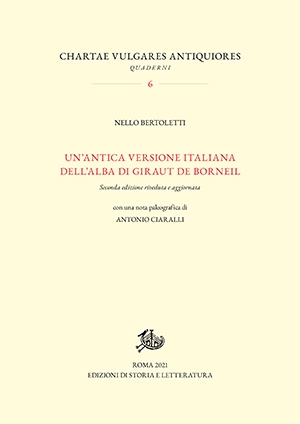
Publication – « Un’antica versione italiana dell’alba di Giraut de Borneil. Seconda edizione riveduta e aggiornata », éd. Nello Bertoletti

L’alba Reis glorios di Giraut de Borneil è uno dei componimenti più intensi ed enigmatici della letteratura trobadorica. Questo volume ne rende nota una versione in volgare italoromanzo, trascritta nei primi decenni del Duecento (non oltre il 1239-40) in un codice ora conservato presso la Biblioteca Ambrosiana di Milano. Dopo la scoperta della canzone ravennate, del frammento zurighese di Giacomino Pugliese e del frammento piacentino, la poesia italiana delle origini si arricchisce dunque di un nuovo reperto, che è prezioso testimone di un’antica ricezione italiana dell’alba provenzale, cioè di un genere destinato a non avere in séguito alcun successo nella penisola.

La nuova edizione, riveduta e aggiornata, tiene conto di importanti novità non solo sulla collocazione geografica del codice e della copia avventizia, ma anche sul rapporto cronologico tra l’alba e le figure geomantiche.

Informations pratiques :

Un’antica versione italiana dell’alba di Giraut de Borneil. Seconda edizione riveduta e aggiornata, éd. Nello Bertoletti, Rome, Edizioni di Storia e Letteratura, 2022 ; 1 vol., 128 p. (Chartae vulgares antiquiores. Quaderni, 6). ISBN : 978-8-89359-527-8. Prix : € 24,00.

Source : Edizioni di Storia e Letteratura

Publié dans Publications | Laisser un commentaire

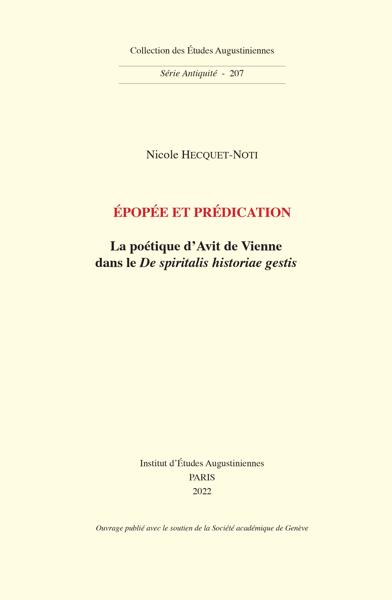
Publication – Nicole Hecquet-Noti, « Épopée et prédication. La poétique d’Avit de Vienne dans le De spiritalis historiae gestis »

Avit de Vienne est l’auteur des cinq chants de l’Histoire spirituelle, qui célèbre l’importance du Christ dans la catéchèse baptismale, par la glorification des patriarches Adam, Noé et Moïse. Évêque catholique appartenant à l’aristocratie gallo-romaine, Avit est un lettré d’une grande culture latine. La présente étude examine son écriture poétique au moyen d’une approche narratologique croisée avec les méthodes de la philologie traditionnelle. Il en ressort l’importance des deux voix auctoriales construisant le poème : la voix de l’évêque, formé par la pratique de la liturgie de la Parole, et celle du poète, pétri de rhétorique et rendant hommage à la poétique classique. Ce mélange des voix auctoriales produit un poème accessible à un large public, contemporain mais aussi postérieur au VIe s. – le poème connaîtra une grande diffusion au Moyen Âge. L’analyse proposée permet de saisir la construction du récit poétique, de montrer l’adaptation des codes épiques à la transmission de la foi chrétienne et de souligner la dette d’Avit envers les poètes épiques latins. Enfin, l’étude stylistique et métrique prouve la parfaite maîtrise de l’hexamètre de la part du poète chrétien.

Table des matières :

Avant-propos
Introduction : L’homme et l’œuvre

Première partie : Les instances énonciatives
Chapitre premier. Dualité du narrateur premier
Chapitre II. Réception du poème : destinataires et lecteurs
Conclusion : L’utilitas poétique

Deuxième partie : Structure et récit épiques
Chapitre premier. Unité globale et composition épisodique
Chapitre II. Principaux constituants : les discours
Chapitre III. Les excursus descriptifs
Chapitre IV. La narration principale

Troisième partie : Intertextualité et style
Chapitre premier. Avit lecteur des poètes classiques
Chapitre II. Austérité stylistique et licentia poetarum
Chapitre III. Un maniérisme formel ? Rythme et prosodie

Conclusion générale

Annexes
Indices

Informations pratiques :

Nicole Hecquet-Noti, Épopée et prédication. La poétique d’Avit de Vienne dans le De spiritalis historiae gestis, Paris, Institut des études augustiniennes, 2022 ; 1 vol., 334 p. (Collection des Études Augustiniennes. Série Antiquité, 207). ISBN : 978-2-85121-318-1. Prix : € 46,00.

Source : Brepols

Publié dans Publications | Laisser un commentaire

Appel à contribution – Medieval and Early Modern Equids: Classifying by Breeds, Types and Functions

Medieval and Early Modern Equids:

Classifying by Breeds, Types and Functions

Call for papers for a special thematic volume

to be published in the Rewriting Equestrian History series by Trivent Medieval

Nature has not given [all horses] the same capabilities. Some shine more at war work; others are inclined to win Olympic crowns; others are adaptable for domestic use, civilian duties and farm work.

Leon Battista Alberti, De equo animante (c. 1445)

Equine breeds as we think of them today are an early modern invention. Instead, medieval people distinguished between horses based on their origin and the type of work for which they were used. In the volume, we propose exploring medieval horse types, their treatment, training, use, artistic and literary representation as well as equipment employed for different tasks. Possible topics include, but are not limited to, the following issues:

  • Types of horses used in warfare (warhorses, coursers, packhorses, and others)
  • Civilian horses (palfreys, amblers, etc.)
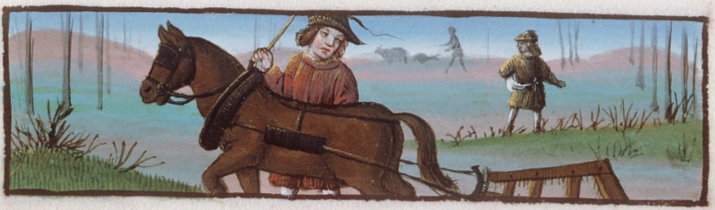
  • Working horses (plough horses, cart horses, etc.)
  • Horse types used for ceremonial purposes and special equestrian equipment
  • Representation of horses in marginalia, including imaginary equids and hybrids
  • Differential treatment of horse types in sources, including legal documents, hippiatric treatises and literature

The volume will be co-edited by John Clark, Gail Brownrigg, Kelly-Anne Gilbertson and Andrew Ó Donghaile. If you would like to contribute as co-editor or reviewer, please contact us.

We hope to include papers delivered at IMC as well as new papers. The preferred length of article is 9-12,000 words, but shorter and longer submissions can be considered on a case-by-case basis. There is no limit on the maximum number of illustrations, as long as they are relevant to the argument made in the chapter. The expected final date for the delivery of first drafts is 15 June 2023.

To propose an article, please send a short biography of 2-3 sentences and an abstract of 250-300 words to the Rewriting Equestrian History series co-editor Anastasija Ropa (anastasija.ropa@trivent-publishing.eu) by 10 September 2022.

Publié dans Appel à contributions | Laisser un commentaire

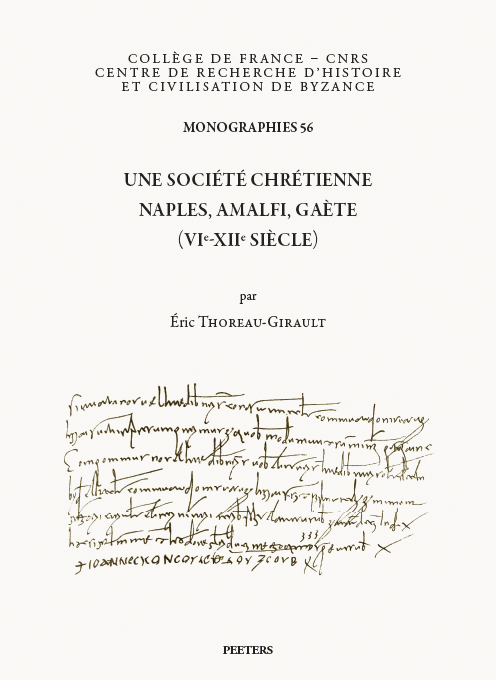
Publication – Éric Thoreau-Girault, « Une société chrétienne. Naples, Amalfi, Gaète (VIe-XIIe siècle) »

Dans la seconde moitié du VIe siècle, les Lombards conquièrent la majeure partie de l’Italie. Trois cités du littoral tyrrhénien, Naples, Gaète et Amalfi, résistent avec succès à l’invasion et se constituent peu à peu en duchés indépendants. Cette spécificité fait de ces trois cités un cadre privilégié pour observer la vie et les mentalités religieuses dans une perspective sociale, culturelle et institutionnelle entre Antiquité tardive et haut Moyen Âge. Isolées politiquement dans un environnement dominé par les Lombards, les trois duchés conservent jusqu’à la conquête normande, au XIIe siècle, des structures ecclésiastiques ailleurs disparues. L’isolement n’est toutefois pas absolu et des influences extérieures, lombardes, byzantines et surtout romaines, sont perceptibles. En effet, malgré la perte progressive de leurs possessions, les papes conservent un lien hiérarchique et religieux privilégié avec la région. L’importance, l’ancienneté et la permanence de ses institutions ecclésiastiques encouragent même l’Église de Naples, au IXe siècle, à se comparer avec celle de Rome. L’originalité de cette région latinophone, dotée d’un patrimoine littéraire et surtout documentaire exceptionnel, réside dans la coexistence de traditions culturelles latines et grecques. La vie religieuse des clercs, des moines et des fidèles se distingue enfin par son caractère très urbain qui encourage un développement précoce de formes de piété collective. Ces territoires d’Italie méridionale constituent ainsi de remarquables observatoires pour suivre en détail les évolutions religieuses qui ont marqué le haut Moyen Âge en Europe et dans le monde méditerranéen.

Informations pratiques :

Éric Thoreau-Girault, Une société chrétienne. Naples, Amalfi, Gaète (VIe-XIIe siècle), Louvain, Peeters, 2022 ; 1 vol., VI–588 p. (Monographies du Centre de Recherche d’Histoire et Civilisation de Byzance – Collège de France, 56). ISBN : 978-9-04294-810-5. Prix : € 72,00.

Source : Peeters

Publié dans Publications | Laisser un commentaire

Colloque – The Queen’s Resources: Examining the Lands, Revenues, Networks, and Economic Power of Premodern Royal Women

University of Winchester
04.09.2022 – 06.09.2022

The conference ‘The Queen’s Resources: Examining the lands, revenues, networks, and economic power of premodern royal women’, to be held at the University of Winchester on 4-6 September 2022 in hybrid form (in person or remote participation), seeks to examine the economic agency and activity of royal women across premodern Europe.

The conference brings together the themes of previous workshops on lands, resources, affinities, and administration, and covers other areas related to the financial practices of royal women. The conference will also include a workshop where participants will work together to map the next phase of the project and develop an application for funding for future plans for collaborative research.
Registration for the conference is now open: https://store.winchester.ac.uk/conferences-and-events/external-conferences-events/conferences/the-queens-resources-conference

There are a range of options including residential packages to stay onsite at the university, day attendance options if you live locally or want to source your own accommodation, or virtual options to attend online only (rates are calculated at cost, with different rates for staff/faculty and student/early career/independent). Both the full packages, residential and day, include the conference dinner but if you book individual days only, you need to add the conference dinner if you want to join in for that evening event. The virtual attendance charge is a flat fee which covers ALL days of the conference.

Programme :

Sunday, 4 September 2022
1:30-2:00 WELCOME/COFFEE

2:00-2:30 INTRODUCTION
Ellie Woodacre

2:30–4:00 SESSION 1: Account Books as Sources
Chair: TBA
Elysia Cains: A Psychological Reading of the Financial Activities of Eleanor of Castile
Chris Woolgar: Treasure, Wealth, and Two Fourteenth-Century English Queens
Isabel Escalera Fernández: The Account Books as Testimonies of the Promotion of Jewellery by Queen Isabel la Catolica

4:00–4:30 COFFEE

4:30–5:30 LIGHTNING ROUND 1: Tudor Queens
Chair: TBA
Valerie Schutte: Anne of Cleves and the Brockehouse Affair
Elizabeth Norton: Jane Seymour as Lady of the Manor
Nicola Clark: Tudor Queens Consort and ‘Household Economy’: a Two-Way Street?
Andrea Silen-McMillin: The Lands of the Tudor Queens

5:45–6:45 KEYNOTE
Katrin Keller: Of Donations, Debts and Domains. Economy and Finance as Spaces of Agency for Princely Women in the Holy Roman Empire

6:45–7:30 WINE RECEPTION

Monday, 5 September 2022
8:30–9:00 WELCOME/COFFEE

9:00-10:30 SESSION 2: Queens’ Lands and Administration
Chair: TBA
Anaïs Waag: A Year in the Life: Petronila of Aragon in the Comital Accounts of Provisioning at Vilamajor (June 1156–April 1157)
Katia Wright: The Queen’s Administration: The Case of Philippa of Hainault’s Estates
Inês Olaia: Tax Collecting in the Portuguese Queens’ Lands: Double the Trouble?

10:30–11:00 COFFEE

11:00–12:30 SESSION 3: Administration and Finances
Chair: TBA
Manuela Santos Silva: The Administration of the Queens’ Town of Óbidos (Portugal, 1387–1437)
Jan Vojtíšek: Administration of the Queen’s Domain in Fourteenth-Century Bohemia
Lledó Ruiz Domingo: The Queen’s Treasury: Queenship, Resources, and Administration in the Crown of Aragon during the Fourteenth and Fifteenth Century

12:30-1:30 LIGHTNING ROUND 2: Provisions for Death and Widowhood
Chair: TBA
Ana Maria Rodrigues: “With All My Wisdom and Health”: Queens’ Wealth and its Distribution at the Time of Death
Zsolt Simon: The Hungarian Queen’s Lands and Revenues in the Middle Ages
Charlotte Backerra: Dowagers’ Challenge: Hessian Landgravines and their Dowers
Laura Rehrmann: “She shouldn’t have more than other noble widows”: Dower in the Context of Security, Appreciation, and Male Power

1:30–2:30 LUNCH

2:30-4:00 SESSION 4: Dowers and Dowries
Chair: TBA
Paula Del Val Vales: Mapping Thirteenth-Century Queens’ Dower Lands in Castile, Aragon, and England
Zita Rohr: Unrealized Assets and Blue-Sky Opportunities: Dowers and Dowries in Late Medieval Aragon and France
Silvia Z. Mitchell: Leaning-In Habsburg Style: Mariana of Austria’s Pension and Economic Resources in Widowhood, 1676–1696

4:00–4:30 COFFEE

4:30–6:00 SESSION 5: Credit
Chair: TBA
Emily Rose: The Queen and her Moneyman: Eleanor of Castile and Hagin fil. Cress in the Thirteenth-Century Real Estate Market
Cristina Garcia Garcia: Gifts and Credit: An Economic Perspective for Studying Royal Affinities from Observations of the Royal Household of Juan I
Ruben Gonzalez Cuerva: Bankrupting your Banker: Empress Maria of Austria, Constantino Magno, and the Limits of Moneylending

6:00–7:00 LIGHTNING ROUND 3: Power, Councils, and Households
Chair: TBA
Isabela Alberquerue: Anglo-Saxon Queens and the Exercise of Political Power: Possibilities of Analysis
Clara Kaleogérakis: “para sustentación de su Casa”: When the Economy of a Household Sealed the Fate of Joanna of Castile (1496)
Alexander Isaacson: To Be and Remain Her Majesty’s Faithful, Obedient, and Loyal Subjects: Multiple Sources of Authority of Queen Dowager Kristina in Early Seventeenth-Century Sweden
Maria Hayward: Serving the Queen: The Role of Catherine of Braganza’s Council

7:00 DINNER

Tuesday, 6 September 2022
8:30–9:00 WELCOME/COFFEE

9:00–10:30 SESSION 6: Economic Resources
Chair: TBA
Fabian Persson: The Island and the Spider: Networks of Early Modern Queens
Ben James: Dona Maria (1644–1693): Economic Resources and Power of an Illegitimate Royal
Patrik Paštrnák: Reconstructing the Financial Background of the Bridal Journeys: Festival and Agency

10:30–11:00 COFFEE

11:00–12:30 ROUNDTABLE: Database Projects
Chair: Cathleen Sarti
Anna Jagos: Regesta reginarum: House Luxembourg
Jason Sadler: GeoData, University of Southampton
Stefan Dumont: Telota, BBAW (to be confirmed)
Tracy Chapman Hamilton: Mapping the Premodern Women, Sweet Briar (US)
Anna Foka & Dann Wu: Centre for Digital Humanities, Uppsala

12:30–1:00 CLOSING REMARKS
TBA

1:00 LUNCH

END OF CONFERENCE

Source : H-Soz-Kult

Publié dans Colloque | Laisser un commentaire

Appel à contribution – Masculin et féminin en poésie latine : voix, stratégies et mises en scène

Lyon / Saint-Étienne, 19-20 octobre 2023

Appel à contributions
Date limite : 01/10/2022


L’objectif de cette rencontre sera d’analyser la dialectique entre les polarités masculine et féminine chez les poètes latins et de mieux cerner comment ces derniers les exploitent pour, par exemple :
• donner voix aux personnages
• construire un personnage et sa psychologie
• structurer un intrigue, une œuvre
• tisser des liens intertextuels
• manipuler des images et des représentations


Dans une optique strictement littéraire, on proposera de nouvelles analyses sur la circulation des symboliques entre le masculin et le féminin, sur les constructions et mises en scène et sur les espaces spécifiques ou communs à ces deux pôles. On s’attachera également à décrypter les intentions poétiques, les stratégies et les enjeux de cette thématique dans les différents genres poétiques latins, de Catulle à l’Antiquité tardive.
Informations pratiques :
-Les propositions de communication (titre et 15 lignes maximum de présentation, dans une des principales langues européennes) sont à adresser avant le 01/10/2022 à F. Garambois-Vasquez et D. Vallat (florence.garambois.vasquez[at]univ-st-etienne.fr; Daniel.Vallat[at]univ-lyon2.fr).
-La durée de chaque intervention est fixée à 30 minutes maximum (25 + 5 min de discussion).
-L’organisation du colloque ne pourra prendre en charge que les frais de séjour ; les frais de transport seront à la charge des participants.
-La publication des Actes du colloque est prévue après expertise des contributions, qui devront être impérativement remises avant le 01/02/2024.

Lieu de la manifestation : St-Étienne ; Lyon
Organisation : Florence Garambois et Daniel Vallat

Source : Compitum

Publié dans Appel à contributions | Laisser un commentaire