Colloque – Vous avez dit « authentiques » ?

6es Journées doctorales internationales de Transitions
(Université de Liège, salle Wittert)

Programme :

Jeudi 5 mai 2022 : L’objet à l’épreuve du temps

9h00 : Accueil des participants

9h30 : Introduction

Session 1 (modérateur : Christophe Masson)

10h00 : BORRELLI Carolina (Università degli Studi di Siena / EPHE, Paris)

L’authenticité des « stations-relais » : la philologie des codices et le cas du chansonnier occitan T (Paris, Bibliothèque nationale de France, fr. 15211).

10h20 : OTTE Sandra (Université de Liège)

Le Tablante de Ricamonte : une traduction « originale » et authentique du Jaufré occitan ?

10h40 : Discussion

11h00 : Pause

Session 2 (modérateur : Aleuna Macarenko)

11h20 : MOORS Sophie (Universiteit Antwerpen)

Constrained. A Comparative Study of the Influence of Formal Aspects of a Text on the Material Transmission of Middle Dutch Literature.

11h40 : DONNINI Piero (Università Ca’ Foscari, Venezia)

Khayyāmi as a philological product: The Ṭarabkhānẹ and the Timurid roots of an authentic resemblance.

12h00 : Discussion

12h20 : Pause déjeuner

Session 3 (modératrice : Eva Trizzullo)

13h30 : BRAY Maxime (Sorbonne Université, Paris)

Expertises en authenticité et en attribution de tableaux devant les juridictions d’Ancien Régime. Réflexions autour d’un procès-verbal de 1700.

13h50 : GARCÍA-MARTÍNEZ Saray (Universitat Autónoma de Barcelona / Università degli Studi di Roma Tor Vergata)

The object to the test of time. Two Bacchic medallions on the National Museum of Art of Catalonia (MNAC), ancient or modern?

14h10 : Discussion

14h30 : Pause

Session 4 (modérateur : Gaylen Vankan)

14h50 : KHAIR Khadija (Université de Poitiers)

L’intelligibilité d’une authenticité à travers la technicité : Le cas des soieries ottomanes (XVe – XVIe siècle).

15h10 : GAUBERT Aymeric (Centre d’Études Supérieurs de la Renaissance, Tours)

La « graffitologie » ou l’authentification des graffitis anciens (XIIIe-XVIe siècles).

15h30 : CAZALS Mahaut (Université de Versailles Saint-Quentin-en-Yvelines)

Une authenticité trompeuse : les paysages de Grands Causses et la séquence médiévale (XIe-XIIIe s.).

15h50 : Discussion

18h00 : Conférence de Philippe SÉNÉCHAL, Professeur à l’Université de Picardie Jules Verne (Modératrice : Stefania Tullio Cataldo)

Plâtre et vérité.

Vendredi 06 mai 2022 : L’authenticité, gage de vérité ?

Session 5 (modérateur : Aurélien Bourgaux)

9h30 : CRESCI Francesca (Università degli Studi di Siena / Université de Liège)

La représentation littéraire de Dauphin d’Auvergne et de sa cour (XIIe-XIIIe siècles) : quel degré d’« authenticité » ?

9h50 : BUSZKA Magdalena (Université Adam Mickiewicz, Poznań, Pologne)

L’authenticité dans les mystères médiévaux de sainte Barbe.

10h10 : HORVÁTHY Sára (Université Eötvös Loránd, Budapest, Hongrie)

Je vous dis bien que… les interventions narratoriales, garanties de véracité du discours romanesque.

10h30 : Discussion

10h50 : Pause

Session 6 (modérateur : Lorenzo Battistini)

11h15 : FILIPPOZZI Margherita (Sapienza Università di Roma)

«Aliud latina sapit oratio». Thucydide en grec et dans la traduction de Lorenzo Valla : une réflexion stylistique.

11h35 : KAISIN Mathilde (FNRS / Université de Liège)

Girolamo Mei, un humaniste en quête de vérités.

11h55 : Discussion

12h15 : Pause déjeuner

Session 7 (modératrice : Émilie Margaix)

14h00 : VALK Karl Peeter (Sorbonne Université, Paris / Université de Tallinn)

Authenticité et Vérité dans l’œuvre de Philippe de Mézières.

14h20 MOENS Robin (RWTH Aachen University / Université de Namur)

Une falsification « grégorienne » ? Un dossier de pseudo-chartes papales à Metz au début du XIIe siècle

14h40 : GUILLEMOT Lise et LAGRANGE Blanche (Université de Poitiers)

Les chroniques « authentiques » de Morée et de Simon de Gand : entre réalité et subjectivité.

15h10 : Discussion

Publié dans Colloque | Laisser un commentaire

Colloque – Attraverso le stampe: scambi artistici tra Fiamminghi e Italiani nel XVI secolo / Prints as Agents of Artistic Exchanges between Fiamminghi and Italiani in the 16th Century

Attraverso le stampe: scambi artistici tra Fiamminghi e Italiani nel XVI secolo/ Prints as Agents of Artistic Exchanges between Fiamminghi and Italiani in the 16th Century

Rome, Academia Belgica
Apr 7–08, 2022

Conception and Organization :

Prof. Dominique Allart (Université de Liège)
Dr. Antonio Geremicca (Université de Liège)
Dr. Sabine van Sprang (Academia Belgi

Programme :

Thursday, April 7 2022

14.00 Sabine van Sprang (Academia Belgica): Welcome
Dominique Allart & Antonio Geremicca (Université de Liège): Introduction

Moderator: Sabine van Sprang

14.20 Joris Van Grieken (KBR, Royal Library of Belgium): Between Rome and Antwerp. Rome and the Rise of Professional Printmaking in the Low Countries, 1530-1550

14.50 Dominique Allart (Université de Liège): Once Again on the Triumph of Bacchus Engraved by Cornelis Bos, Its Sources and Reception

15.20 Discussion
15.40 Coffee Break

Moderator: Anna Cerboni Baiardi

16.10 Alessia Alberti (Milano, Castello Sforzesco, Raccolta delle stampe ‘A. Bertarelli’): Il Sogno di Raffaello di Giorgio Ghisi tra Italia e Fiandre

16.40 Antonio Geremicca (Université de Liège): Tra Giorgio Ghisi e Hieronymus Cock. Sul fortuito successo anversese di Bronzino nell’incisione

17.10 Anne-Sophie Laruelle (Université de Liège): L’utilisation de modèles gravés dans les
tapisseries réalisées dans les anciens Pays-Bas au XVIe siècle. Etudes de cas

17.40 Discussion

Friday, April 8 2022

Moderator: Elena Rossoni
09.30 Laura Aldovini (Pavia, Musei Civici del Castello Visconteo): Tiziano, la xilografia e il Trionfo nei Paesi Bassi
10.00 Giorgio Marini (Ministero per i Beni e le Attività Culturali): Cornelis Cort, Titian, the Carraccis: Reproductive Printmaking as ‘Critical Interpretation’ of Venetian 16th Century Painting

10.30 Discussion
10.50 Coffee Break

Moderator: Giorgio Marini
11.20 Elena Rossoni (Pinacoteca Nazionale di Bologna): Due Crocifissioni a confronto: Jacob Bos, il milieu internazionale romano, e le reciproche influenze tra cultura italiana e fiamminga

11.50 Anna Cerboni Baiardi (Università degli Studi di Urbino ‘Carlo Bo’): Francesco Barocci e Cornelis Cort: un incontro decisivo

12.20 Discussion

12.40 Dominique Allart, Antonio Geremicca & Sabine van Sprang: Conclusion

Source : Centre d’Histoire de l’Art de la Renaissance

Publié dans Colloque | Laisser un commentaire

Publication – Renata Segre, « Preludio al Ghetto di Venezia. Gli ebrei sotto i dogi (1250-1516) »

Accès ouvert ici

Una storia della presenza ebraica a Venezia e nella Serenissima Repubblica prima dell’istituzione del Ghetto di Venezia non era ancora mai stata scritta, in assenza di un’indagine nelle fonti documentarie degli archivi e delle biblioteche. Questo libro, frutto di una ventennale ricerca sistematica, intende smentire il mito di uno stanziamento degli ebrei a Venezia solo dal 1516. L’ambito documentario copre quasi trecento anni (tra metà del Duecento e secondo decennio del Cinquecento), ossia dalle prime sicure presenze di ebrei al loro definitivo insediamento nell’area urbana denominata Ghetto (nuovo), in un periodo particolarmente travagliato della storia veneziana. In questo quadro storico, un rilievo speciale va riconosciuto a Mestre, che, a ridosso del XV secolo, assurse a capitale dell’ebraismo veneto: non solo vi operavano i banchi di prestito feneratizio, ma vi trovarono sede l’unica sinagoga ufficiale, l’ostello e il cimitero. Purtroppo nessuna di queste testimonianze si è preservata, e la stessa memoria di quella comunità si è presto cancellata. Una vicenda molto simile si è prodotta a Treviso, primario centro ashkenazita, scomparso a fine Quattrocento, a differenza di Padova, sola tra le maggiori e più antiche comunità ebraiche a superare i secoli, senza mai poter contendere la primazia al Ghetto di Venezia.

Informations pratiques :

Renata Segre, Preludio al Ghetto di Venezia. Gli ebrei sotto i dogi (1250-1516), Venise, Edizioni Ca’ Foscari, 2021 (Studi di storia, 15). 620 p. ISBN : 978-88-6969-553-7. Prix (imprimé) : 40 euros.

Source : Edizioni Ca’ Foscari

Publié dans Publications | Laisser un commentaire

École d’été – Semaines d’études médiévales de Poitiers 2022

Le CESCM organise depuis 1954 une session annuelle internationale francophone de formation, qui regroupe une cinquantaine d’étudiants, doctorants et jeunes chercheurs, français et étrangers. Les conférences, les séances de travail autour des ressources documentaires, les excursions et visites au programme des stagiaires sont proposées par des spécialistes du Moyen Âge venus du monde entier.

Cette manifestation interdisciplinaire, unique en son genre, a contribué à construire et à renforcer, depuis une soixantaine d’années, un solide réseau national et international dans le domaine de l’étude du Moyen Âge.

Date : 20 au 30 juin 2022

Lieu : CESCM – Hôtel Berthelot – 24 rue de la Chaine – Poitiers

Admission sur dossier, date limite de candidature : 29 avril 2022

Les candidatures des stagiaires peuvent être renvoyées dès à présent* au moyen du Formulaire de candidature

*Merci d’imprimer le document et de le remplir puis de nous le transmettre par courriel ou par voie postale.


Renseignement : sem.cescm@univ-poitiers.fr

Tél.  33(0)5 49 45 45 57

Programme :

Lundi 20 juin

9h30 – Accueil des stagiaires, présentation du CESCM et de ses  ressources documentaires

14h – Visite de l’église Notre-Dame-la-Grande

16h30 – Conférence inaugurale de  Laura Weigert (Rutgers University–New Brunswick USA) : Hors cadre : expérience immersive et nouveaux media au XVe siècle

18h : Allocutions et pot d’accueil

Mardi 21 juin

9h – Marcella Lopes Guimarães (Université fédérale de Paraná, Brésil) : Que veut-on dire quand on parle de biographie médiévale ?

14h – Annette Kehnel (Université de Mannheim, Allemagne) : ‘Scientists for Future’ et les études médiévales.  Étude de cas sur les Frères du Pont d’Avignon

16h30 – Présentation des manuscrits enluminés de la Médiathèque François-Mitterrand

Mercredi 22 juin

9h – Sini Kangas (Université de Tampere, Finlande / Université de Poitiers – CESCM) : La guerre, la violence et le concept d’inimitié dans les sources des croisades du XIIe siècle

14h – Jean-François Nieus (Université de Namur–FNRS, Belgique) :  Le sceau médiéval, des pratiques de l’écrit à l’histoire sociale (séance aux Archives départementales)

16h30 – Visite des Archives départementales de la Vienne

Jeudi 23 juin

9h – Corinne Beck (Université de Valenciennes) : Géohistoire forestière : entre territorialités et temporalités

14h – Jean-Marie Fritz (Université de Bourgogne) : Moraliser le crime et le délit : approche comparée des Ovide moralisés latins et français

16h30 – Visite de l’église Saint-Hilaire-le-Grand

Vendredi 24 juin

9h – Martin Aurell (Université de Poitiers – CESCM) : Autour de la déchirure intra-familiale : grande révolte de 1173 contre Henri II, roi d’Angleterre

14h – Café-débat animé par l’Association Janua

16h – Visite de la cathédrale Saint-Pierre et du baptistère Saint-Jean

Samedi 25 juin – journée libre

Dimanche 26 juin

Excursion en Touraine (Tavant, Tours, Cormery)

Lundi 27 juin

14h – Conférence : Éric Palazzo (Université de Poitiers – CESCM) : Godescalc : Diacre et liturgiste carolingien oublié

16h30 – Visite de l’église Saint-Jean de Montierneuf

Mardi 28 juin

9h – Javier Martínez de Aguirre (Université Complutense de Madrid, Espagne) : La voix et le regard: images et propagande spirituelle dans quelques églises romanes du Chemin de Saint-Jacques

13h30 – Excursion à Saint-Savin et Chauvigny

Mercredi 29 juin

9h – Bernard Outtier (CNRS-LEM, Paris) : Du rouge dans des manuscrits géorgiens du Xe siècle

14h – Visite des collections médiévales du Musée Sainte-Croix

19h – Soirée internationale

Jeudi 30 juin

9h00 : Jean-René Valette (Sorbonne Université) : Les mystiques courtoises (XIIe-XIIIe siècles)

11h00 : Conclusions et clôture des Semaines.

Publié dans École d'été | Laisser un commentaire

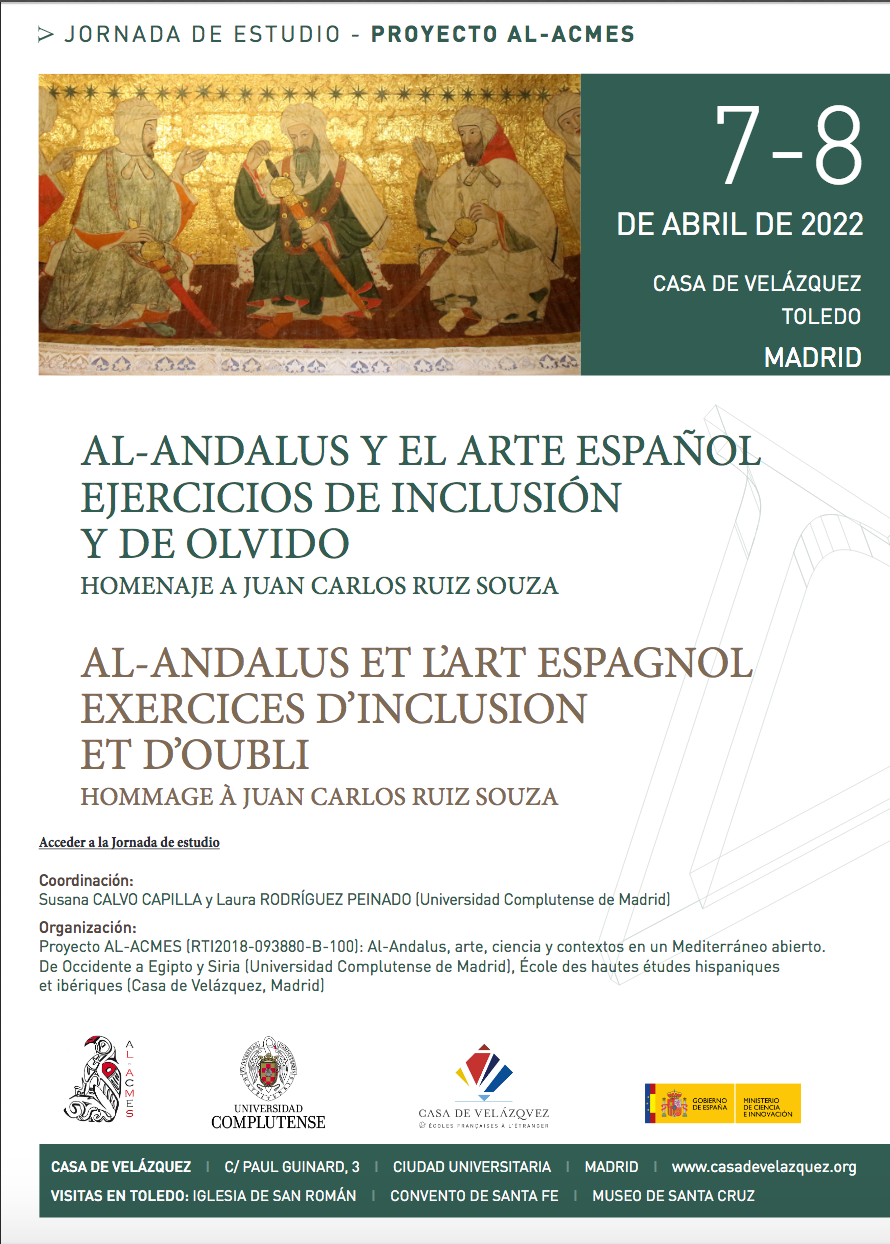
Colloque – Al-Andalus et l’art espagnol. Exercices d’inclusion et d’oubli

Les recherches du Dr. Juan Carlos Ruiz Souza se sont distinguées par son importante contribution au renouveau des études sur l’art médiéval espagnol. A travers de ses nombreuses publications, il a offert une vision complète et panoramique de l’art des royaumes chrétiens et d’al-Andalus, sans toutefois oublier le vaste et riche contexte méditerranéen dans lequel ils s’inscrivaient, un contexte sans lequel les nombreuses manifestations artistiques et culturelles hispaniques étaient difficilement compréhensibles.

Dans les thèmes qui ont attiré son attention, il a toujours apporté une vision nouvelle et « inclusive », en rupture avec les paradigmes d’« exclusion » ou d’oubli fréquents dans l’historiographie de l’art espagnol et andalusi. Cette journée d’études vise d’une part, à réfléchir, sur les particularismes de l’art hispanique et la présence des discours d’inclusion, d’exclusion et d’omission dans son analyse, deux notions sous-jacentes dans tous ses ouvrages. D’autre part, seront étudiées certaines œuvres
d’art qui sont le résultat des liens avec les zones européenne, méditerranéenne et islamique, et ainsi retrouver ces vastes paysages culturels des œuvres andalusies et hispaniques, l’objectif central de ce projet de recherche.

Programme : ici


Informations pratiques :

7-8 avril 2022

Coord. : Susana CALVO CAPILLA y Laura RODRÍGUEZ PEINADO (Universidad Complutense de Madrid)

Org. : Proyecto AL-ACMES (RTI2018-093880-B-100): Al-Andalus, arte, ciencia y contextos en un Mediterráneo abierto. De Occidente a Egipto y Siria (Universidad Complutense de Madrid), École des hautes études hispaniques et ibériques (Casa de Velázquez, Madrid)

CASA DE VELÁZQUEZ
C/ Paul Guinard, 3
28040 MADRID – Ciudad Universitaria

Source : Casa de Velázquez

Publié dans Colloque | Laisser un commentaire

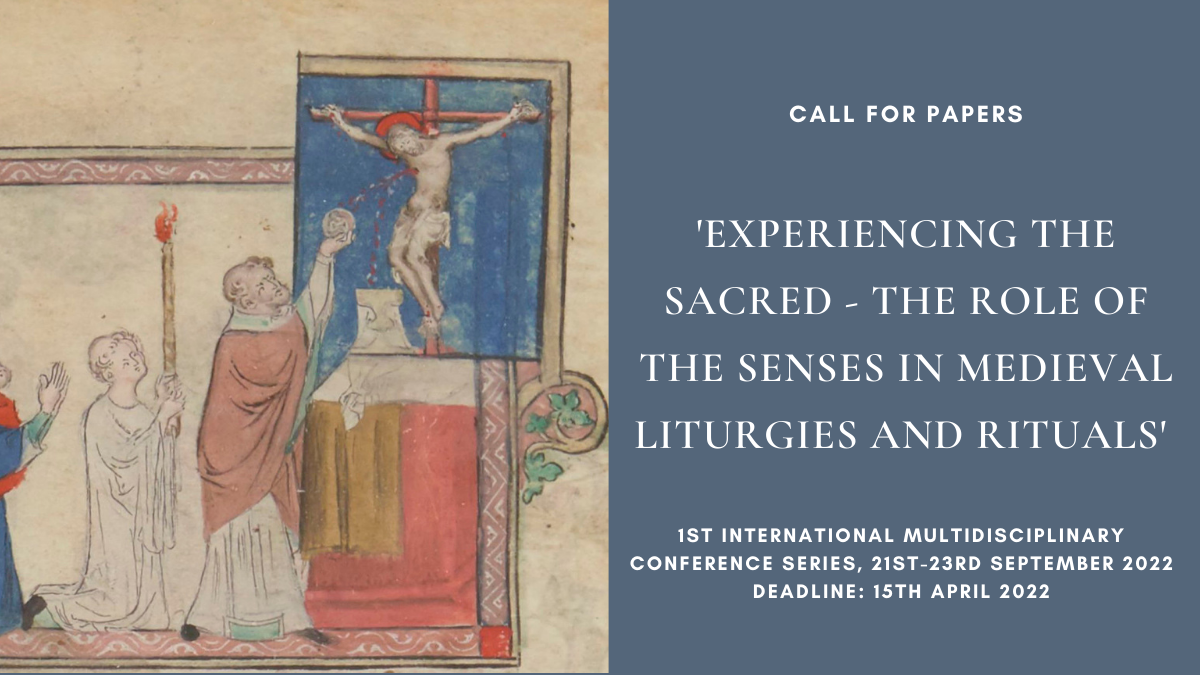
Appel à contribution – Experiencing the Sacred – The Role of the Senses in Medieval Liturgies and Rituals

1st International Multidisciplinary Conference Series
21st-23rd September 2022
Deadline: 15th April 2022

 By the Late Middle Ages, the liturgy has become the most important and elaborate ceremonial of Christianity in an already highly ritualised society. Indeed, rituals dominated the everyday life of the faithful, from the Divine Office and the Mass to the individual reading of the Hours; and they accompanied the life of people from their birth to their last breath. Besides, liturgy called for collective involvement and aimed at engaging the faithful by stimulating their senses, in order to trigger emotional and spiritual responses.

Over the past century, much has been said about the liturgy in the Middle Ages. Starting from the historical contribution of Mario Righetti (1946), in the last decades scholars have explored fresh research paths, incorporating notions and tools established by diverse disciplines. Philippe Buc (1997) and Eric Palazzo (2000) have opened up new research opportunities by assimilating sociological concepts, exploring the role of rituals as agents in shaping society and fostering social cohesion. More recently, this field has been fuelled with contributions from numerous disciplines that have started to engage in the study of the past, including neurosciences, performance studies, anthropology (Bull & Mitchell, 2016) and sensory studies (Palazzo, 2014; Neri & Caseau, 2021).

The scientific relevance of these contributions in generating adventurous approaches and opening up new panoramas is unquestionable. Following these fresh pathways, the first conference of the series “Experiencing the Sacred”, established by the SenSArt ERC project, aims to develop the topic further by triangulating the liturgy (broadly intended), the experience of the faithful (understood both as an individual and as social groups) and the sensoria (i.e. the diverse sensory systems that existed in the Middle Ages). In so doing, it aims at showing that the experience of the sacred was not homogeneus and static. On the contrary, it was a multimodal and multisensorial activity, one that bore complex and overlapping layers of meaning, and which was perceived in different ways by the diverse groups and individuals involved.

In order to reach this objective, the conference will consider both the material and the immaterial aspects of the liturgy, and will emphasise the wide range of its sensorial appeal. Images, objects, odours, words, flavours, movement, and sounds all formed part of the liturgical performance that permeated the life of medieval people. And yet, they were exploited and perceived in different terms by the diverse groups involved, such as the religious and lay community, men and women, members of the aristocracy and of the lower social groups.

The meeting will bring together a multi- and interdisciplinary community of scholars with a broad interest in the religious rituals of the late Middle Ages (ca. 1200 to ca. 1500), with particular respect to Art History, History, Musicology and Liturgy, in order to cross-fertilise these perspectives.

Scholars may address the topic with a broad approach but always considering the role of the sensorium in the performance and reception of the rites. This conference will focus specifically on Christian liturgies without geographical restrictions. Paper topics may include, but are by no means limited to: 

Rituals beyond the Mass such as vestments, consecrations, or monastic professions.
Civic rituals mediated by the Church, such as coronations.
Individual liturgical practices: how the rituals enter the everyday.
The materiality of liturgy: the role of objects within different liturgical ceremonies (books, altarpieces, sculptures, paintings, metalworks, vestments, relics). 
Regulations and norms: how was the liturgy orchestrated? How did the church regulate the rituals?
‘Unofficial’ liturgy and subversive rituals: irregularities, contaminations and hybridisations between popular traditions and the Church regulations.
Collective practices: how did different social groups interact with the sacred during the rituals? How were the rituals received and perceived by the faithful, from the clergy to the peasants?

Please send a title and abstract of no longer than 300 words, together with a short CV and personal data (max. 300 words), to the following emails: zuleika.murat@unipd.it; valentina.baradel@unipd.it; sara.carreno@unipd.it
The language of the conference is English. 
Deadline: April 15th, 2022

This conference is organised by the ERC research project SenSArt – The Sensous Appeal of the Holy. Sensory Agency of Sacred Art and Somatised Spiritual Experiences in Medieval Europe (12th-15th century), Grant Agreement ID: 950248, ERC H-2020, PI Zuleika Murat, Università degli Studi di Padova. https://cordis.europa.eu/project/id/950248

Organising Committee: 
Zuleika Murat (Associate Professor, Università degli Studi di Padova)
Valentina Baradel (Post-Doctoral Research Fellow, Università degli Studi di Padova)
Sara Carreño (Post-Doctoral Research Fellow, Università degli Studi di Padova)

Scientific Committee:

Valentina Baradel (Dipartimento dei Beni Culturali – Università degli Studi di Padova)

Sara Carreño (Dipartimento dei Beni Culturali – Università degli Studi di Padova)

Matteo Cesarotto (Centre d’études supérieures de la Renaissance – Université de Tours)

João Luís Inglês Fontes (Instituto de Estudos Medievais – Universidade NOVA de Lisboa)

Zuleika Murat (Dipartimento dei Beni Culturali – Università degli Studi di Padova)

Salvador Ryan (St Patrick’s Pontifical University, Maynooth)

More information can be found here.

Source : Medieval Art Research

Publié dans Appel à contributions | Laisser un commentaire

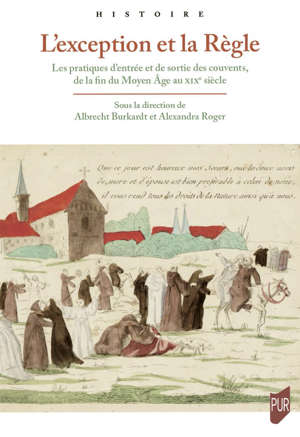
Publication – « L’exception et la Règle. Les pratiques d’entrée et de sortie des couvents, de la fin du Moyen Âge au XIXe siècle », dir. Albrecht Burkardt et Alexandra Roger

La question des conditions d’entrée et de sortie a sans doute marqué l’histoire des ordres religieux depuis qu’ils existent, et elle est liée à bien des innovations que la vie régulière a connues à travers les siècles. À l’époque moderne, ces mêmes conditions acquièrent toutefois une importance particulière. La période est caractérisée, dès ses débuts, par une crise profonde des réguliers, la Réforme protestante niant résolument leur raison d’être. Les ordres religieux ont pourtant connu, à l’époque de la Contre-Réforme et de la Réforme catholique, une formidable renaissance. Aussi ne cessaient-ils d’affronter des défis nouveaux qui, dans bien des cas, impliquaient une reconsidération des rapports avec « le monde ».

Tout au long de la période, l’entrée dans les ordres, de même que les possibilités d’en sortir, avaient des enjeux sociétaux importants suscitant régulièrement débats et conflits entre les différents acteurs : les ordres religieux, les familles « alimentant » le recrutement du clergé, les institutions romaines, les autorités étatiques, l’opinion publique naissante.

Le présent livre cherche à dresser un tableau des problèmes que pose ce sujet à facettes multiples, en prenant en compte la production des normes autant que les pratiques, les entrées et les sorties définitives ou temporaires, bien réelles ou relevant du domaine des (auto)représentations.

Albrecht Burkardt est professeur des universités en histoire moderne à l’université de Limoges. Ses recherches portent en particulier sur l’histoire religieuse et l’histoire du voyage de l’Europe moderne.

Alexandra Roger est enseignante dans le secondaire. Elle prépare une étude approfondie sur les vocations forcées dans la France de l’Ancien Régime.

Table des matières : ici

Informations pratiques :

L’exception et la Règle. Les pratiques d’entrée et de sortie des couvents, de la fin du Moyen Âge au XIXe siècle, dir. Albrecht Burkardt et Alexandra Roger, Rennes, PU Rennes, 2022. 346 p. ISBN : 9782753586529. Prix : 30 euros.

Source : PU Rennes

Publié dans Publications | Laisser un commentaire

École d’été – Central European Interdisciplinary Summer School, c. 1200–1700

University of Pécs
22–24 July 2022

We are pleased to announce a new initiative that aims to create a network of young and established researchers interested in the medieval and early modern period in Central Europe. Discussions may deal with, but are not limited to, the following suggested questions: To what extent can we determine a Central European region in the pre-modern era? What historiographical significance does this area bear for us scholars today? How can the methodology of connected history be used in the study of Central European history?

The Central European Interdisciplinary Summer School will take place at the University of Pécs with the goal of connecting early career researchers (PhD students and postdoctoral fellows) of medieval and early modern European history, and of stimulating international and interdisciplinary investigation among them. The event will present a wide range of academic lectures from distinguished scholars as well as provide participants with the opportunity to consider historiographical issues and methodological approaches in the form of workshops and seminars. By offering roundtable discussions, book launch events and museum visits; this summer school will enhance our understanding of the political, diplomatic, economic, religious, and social history of the Central European region. We hope to establish a research community from which future conferences and publications could arise.

Confirmed speakers: Jeroen Duindam (Leiden University), Márta Font (University of Pécs), Attila Bárány (University of Debrecen).

Motivation letters of 200-250 words along with a short biography up to 100 words should be sent to the summer school organisers at ceissorg@gmail.com by 31 March 2022. We plan to hold the summer school in person in Pécs but this may change due to developments relating to Covid-19. Tuition fee: 150 EUR (please indicate in your application your request for accommodation).

Publié dans Le réseau | Laisser un commentaire

Offre d’emploi – Contrat doctoral établissement 2022 (Université d’Avignon)

L’Université d’Avignon (École doctorale 537) propose, au sein du Laboratoire CIHAM -UMR 5648, un contrat doctoral (PhD Grant) en histoire du Moyen Âge sur l’un des trois thèmes de recherche suivants : « La cour et la ville : cités, élites et pouvoirs (XIIe-XVe s.) » (Guido Castelnuovo: guido.castelnuovo@univ-avignon.fr) « La lèpre et les établissements d’assistance dans le Comtat Venaissin au Moyen Âge. Approches historiques et archéologiques » (Marilyn Nicoud : marilyn.nicoud@univ-avignon.fr) « Médecine, santé, société (Occident médiéval, XIIe-XVe siècles) » (Marilyn Nicoud : marilyn.nicoud@univ-avignon.fr)


Tous les détails se trouvent aussi sur sur le site : https://univ-avignon.fr/recherche/le-doctorat/je-souhaite-preparer-un-doctorat-27687.kjsp?RH=1453988705690

La date limite du dépôt des candidatures est fixée au 18 mai prochain.

La/le candidat.e qui aura, au préalable, pris contact avec l’un des deux directeurs de thèse pour définir son sujet, doit envoyer à l’adresse suivante (guido.castelnuovo@uni-avignon.fr ; marilyn.nicoud@univ-avignon.fr) au plus tard le 18 mai avant 17h, un dossier constitué de :.
– CV détaillé explicitant les expériences de recherche
– Lettre de motivation explicitant l’intérêt du candidat pour une thèse et pour le sujet proposé
– Relevé des notes de M1 et de M2 ou tout autre document équivalent
– 1-2 Lettre(s) de recommandation de responsables pédagogiques et/ou responsables de stages
– Lettre de recommandation du directeur de thèse

Source : Université d’Avignon

Publié dans Le réseau | Laisser un commentaire

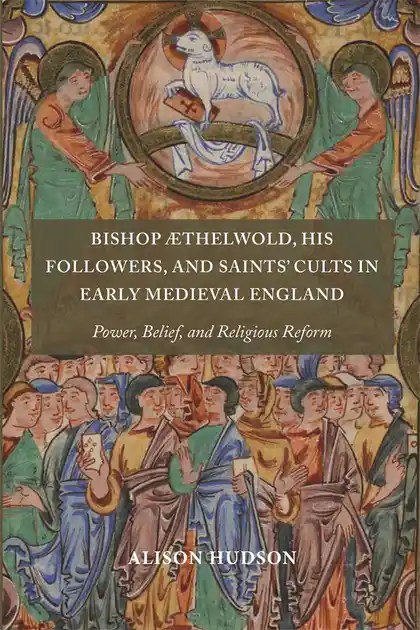
Publication – Alison Hudson, « Bishop Æthelwold, his Followers, and Saints’ Cults in Early Medieval England. Power, Belief, and Religious Reform »

Bishop Æthelwold of Winchester and his associates were some of the most radical monastic reformers in tenth-century Europe. In two generations, they took over most of the powerful churches in the kingdom of England and implemented a number of the policies found in their ambitious monastic manifestos. They also had a major impact on the early development of the kingdom itself, taking a role in the establishment of a shire system that lasted a thousand years, negotiations with invaders, and attempts to create a standardized English language.

Æthelwold and his circle were also enthusiastic venerators of saints. This book examines a range of sources, from hagiographies to charters, from liturgy to archaeological remains, to argue that saints’ cults helped these men and women secure their power, wealth, and relationships with groups outside their monasteries. The saints that Æthelwold’s circle promoted most lavishly were not necessarily the ones that they studied or the ones that matched their ideological agenda. Rather, Æthelwold’s monks and nuns connected themselves to a wide range of saints, including the Virgin Mary, St Swithun, Æthelthryth of Ely, Iudoc, Grimbald, Botulf, Cuthbert, and many others. Venerating these saints helped Æthelwold and his followers appeal to other groups in society, including unreformed ecclesiastics, lay nobles, and the workers on their estates. This book therefore not only has implications for the study of early English history and literature, but also for the history of western European monasticism and saints’ cults more generally.

Alison Hudson is an historian who works on tenth- and eleventh-century monks and manuscripts. She received her doctorate from Oxford University in 2014, and has since worked in Brussels, London, and Orlando.

Table des matières :

Introduction

  1. Intellectual Priorities, Individuals, and Intra-Communal Veneration
  2. Saints and Property
  3. Saints and Unreformed Clerics
  4. Saints and Nobles
  5. Saints, the Laity, and Sacred Spaces
  6. Saints and the Second Generation
    Conclusion
    Appendix 1: Saints and Property in Royal Grants, 900-1000
    Appendix 2: Members of the Circle Appointed to High Ecclesiastical Offices, 956-1016
    Bibliography
    Index

Informations pratiques :

Alison Hudson, Bishop Æthelwold, his Followers, and Saints’ Cults in Early Medieval England. Power, Belief, and Religious Reform, Woodbridge, Boydell & Brewer, 2022 (Anglo-Saxon Studies). 312 Pages 23.4 x 15.6 cm 9 b/w, 1 colour illus. ISBN : 9781783276851. prix : GBP 65.

Source : Boydell & Brewer

Publié dans Publications | Laisser un commentaire