
Levi Roach: « Forging Exemption: Fleury from Abbo to William (c. 997-1072) », intervention au webinaire H 37 Histoire et Cultures Graphiques le 23 novembre 2020
Source : YouTube – H37
Levi Roach: « Forging Exemption: Fleury from Abbo to William (c. 997-1072) », intervention au webinaire H 37 Histoire et Cultures Graphiques le 23 novembre 2020
Source : YouTube – H37
Warren Pezé: « Le dossier des ‘dona annua’ carolingiens », communication au webinaire H37 – Histoire et Cultures graphiques, le 11 janvier 2021.
Source : H37 – YouTube
Accès en ligne : ici
This book examines a cultural revolution that took place in the Scandinavian artistic landscape during the medieval period. Within just one generation (c. 1340–1400), the Augustinian monastery of Helgafell became the most important centre of illuminated manuscript production in western Iceland. By conducting interdisciplinary research that combines methodologies and sources from the fields of Art History, Old Norse-Icelandic manuscript studies, codicology, and Scandinavian history, this book explores both the illuminated manuscripts produced at Helgafell and the cultural and historical setting of the manuscript production.
Equally, the book explores the broader European contexts of manuscript production at Helgafell, comparing the similar domestic artistic monuments and relevant historical evidence of Norwich and surrounding East Anglia in England, northern France, and the region between Bergen and Trondheim in western Norway. The book proposes that most of these workshops are related to ecclesiastical networks, as well as secular trade in the North Sea, which became an important economic factor to western Icelandic society in the fourteenth century. The book thereby contributes to a new and multidisciplinary area of research that studies not only one but several European cultures in relation to similar domestic artistic monuments and relevant historical evidence. It offers a detailed account of this cultural site in relation to its scribal and artistic connections with other ecclesiastical and secular scriptoria in the broader North Atlantic region.
Stefan Drechsler is a Postdoctoral fellow at the Department of Linguistic, Literary and Aesthetic Studies, University of Bergen. He received his PhD in Scandinavian Studies from the University of Aberdeen in April 2018. His principal research interests lie in the fields of Old Norse Philology and Art History, and he has published numerous articles and book chapters on interdisciplinary and societal aspects of Scandinavian and English manuscript cultures.
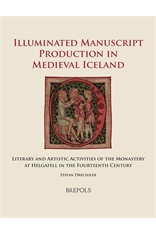
Table des matières :
List of Illustrations, Notes on Terminology, Abbreviations, and Images, Acknowledgements
Introduction: The Helgafell Manuscripts
Chapter 1: An Anaysis of Medieval Icelandic Manuscript Cultures
Chapter 2: Helgafell: An Augustinian House of Canons Regular in Western Iceland
Chapter 3: The Scriptorium
Chapter 4: European Artworks
Chapter 5: Back at Western Icelandic Scribal Desks
Conclusion: Helgafell and the Wider North-Atlantic World
Bibliography
Index
Informations pratiques :
Stefan Drechsler, Illuminated Manuscript Production in Medieval Iceland. Literary and Artistic Activities of the Monastery at Helgafell in the Fourteenth Century, Turnhout, Brepols, 2021 (Manuscripta Publications in Manuscript Research). 275 p., 192 b/w ill. + 22 colour ill., 47 b/w tables, 7 b/w line art, 216 x 280 mm. ISBN: 978-2-503-58902-2. Prix : 120 euros.
Source : Brepols
Ce volume contient les actes des deux dernières conférences romaines organisées dans le cadre de SAS en 2013 et 2014. Après avoir examiné des concepts clés (la légitimité, la vérité, la valeur) et des composantes du système de communication (les rituels, le marquage de la ville et du statut social, le système de représentation, le langage politique), il s’est agi de tester la possibilité de construire un modèle général du lien entre la transformation des sociétés politiques dans le cadre de la genèse de l’État moderne et la mutation culturelle de l’Occident latin médiéval, tout en mettant l’accent sur l’un de ses déclencheurs majeurs, la Réforme grégorienne.
Ce volume clôt ainsi provisoirement cette recherche sur le fonctionnement et la puissance des mécanismes qui fondent la légitimité du pouvoir et le rendent acceptable dans le cadre d’une sémiotique de l’État moderne telle que les vecteurs du système de communication permettent de l’explorer.
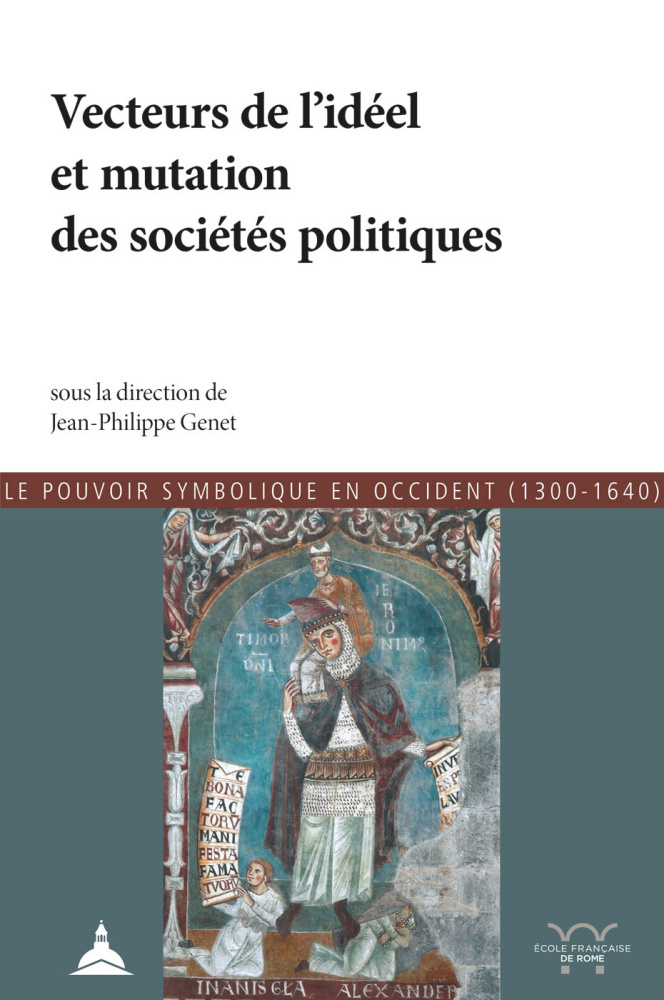
Table des matières :
Avant-propos
Jean-Philippe Genet
Introduction
Un modèle en question ?
Jean-Philippe Genet
Vecteurs de l’idéel et mutations des sociétés politiques
Jean-Philippe Genet
Quelques remarques sur « Vecteurs de l’idéel et mutations des sociétés politiques »
Jean-Claude Schmitt
Partie I. L’IMPACT DE L’ÉVOLUTION CULTURELLE
Révolution intellectuelle ou révolution des « intellectuels » ? Intellectuels organiques et société politique aux derniers siècles du Moyen Âge
Antoine Destemberg
Academics as Councellors of German Kings and Rulers (ca. 1350-1550)
Rainer Christoph Schwinges
Littérature, esthétisation et politique en Angleterre à la fin du Moyen Âge
Aude Mairey
Quelques réflexions pour une histoire matérielle de la culture écrite dans le monde occidental
Ezio Ornato
La révolution du droit est-elle une révolution de la justice ? Le cas français aux XIVe et XVe siècles
Claude Gauvard
Partie II. PRATIQUE DE L’ÉTAT ET LANGAGE POLITIQUE
Le style de l’État. Réflexions sur la naissance et le développement de la phraséologie étatique occidentale (XIIe-XVIIe s.)
Benoît Grévin
L’usage politique des citations bibliques et des apologues classiques : une petite contribution au problème des relations entre culture ecclésiastique et culture laïque entre le XIIe et le XIVe siècle
Paolo Cammarosano
Dominer, administrer, gouverner. L’écrit administratif et la question de l’État
Pierre Chastang
Vérité ou coutume ? Une dialectique triangulaire entre les pouvoirs symboliques de l’Église, des villes et de l’État dans le comté de Flandre au XIIIe siècle
Jan Dumolyn
Partie III. LANGUES ET POUVOIRS : POUR UNE APPROCHE COMPARATIVE
Langues des rois et communication civile en France et en Angleterre (XIIIe-XVe siècle) : l’origine lointaine des langues nationales
Serge Lusignan
Langues du pouvoir et sociétés traditionnelles. Jalons pour un comparatisme eurasiatique (Moyen Âge-époque moderne)
Benoît Grévin
Zoé et Théodora (1042). Opinion populaire, sexes et genres, société politique, communication : les balbutiements d’un « État moderne » byzantin ?
Georges Sidéris
Partie IV. IMAGE ET SOCIÉTÉ POLITIQUE
Un esempio di comunicazione visuale della regina ungarese con i suoi sudditi in Dalmazia tardomedievale : l’arca di San Simeone Profeta a Zara
Nikola Jakšić
Usages et mésusages des images selon les prédicateurs du Moyen Âge (XIIIe-XVe s.)
Marie Anne Polo de Beaulieu
Fête, pouvoir et images dans la Rome pontificale
Martine Boiteux
La gloire des humbles : peuple en armes et monument aux morts au début du XVIe siècle
Joana Barreto
Partie V. AUTOUR ET AU-DELÀ DU MODÈLE
La nouvelle emprise empirique sur le monde en Europe occidentale, Xe-XIIIe siècle
Wim Blockmans
Entre tribus et État, entre Maghreb et Mashrek : le califat-imâmat almohade (XIe-XIIIe siècle)
Pascal Buresi
Le modèle vu depuis la péninsule Ibérique : le pouvoir royal comme opérateur
François Foronda
Dénationaliser le passé, désétatiser le politique : les apports d’un dialogue nouveau entre historiographies française et italienne des formations politiques de la fin du Moyen Âge
Solal Abélès
Les réformes protestantes, une rupture à ne pas oublier
Jean-Marie Le Gall
Conclusion
Genetique de l’État médiéval. Pour ne surtout pas conclure
Patrick Boucheron
Informations pratiques :
Vecteurs de l’idéel et mutation des sociétés politiques. Le pouvoir symbolique en Occident (1300-1640), éd. Jean-Philippe Genet, Paris, Éditions de la Sorbonne, 2021 (Histoire ancienne et médiévale). 542 p., 24 x 16 cm. ISBN :979-10-351-0635-5. Prix : 24 euros.
Source : Éditions de la Sorbonne
Créé en 1958, le Bulletin de l’IRPA compte aujourd’hui parmi les revues les plus anciennes et les plus prestigieuses au niveau international dans les domaines de l’histoire de l’art et des sciences appliquées au patrimoine.

Dans le domaine de l’histoire de l’art, la revue publie des contributions originales consacrées à l’art flamand et belge – du Bas Moyen Âge au XIXe siècle – et à son rayonnement européen et international. La revue privilégie une approche monographique classique, « object-oriented » et des contributions présentant des problématiques innovantes dans le domaine du connoisseurship, pour autant qu’il fasse l’objet d’une mise en contexte sociologique, politique et/ou culturelle.
Dans le domaine du patrimoine, la revue publie des contributions originales sur la conservation-restauration et les sciences appliquées au patrimoine, en privilégiant les textes capables d’offrir de nouvelles perspectives à la recherche et aux techniques de restauration, notamment par des approches méthodologiques innovantes. Une approche interdisciplinaire est particulièrement appréciée.
Les articles sont soumis au système d’évaluation par peer-review. La revue accepte les articles en français, néerlandais ou anglais. Une attention particulière est apportée à la qualité des illustrations.
Les articles pour le Bulletin 37 doivent être remis pour le 10/01/2022.
Le comité scientifique évaluera la recevabilité de votre article puis, s’il est accepté, le soumettra au peer review. Vous serez ensuite averti des commentaires des referees et pourrez, le cas échéant, retravailler votre article.
Le Bulletin 37 paraîtra début 2023.
Plus d’infos ? Contactez Elisabeth Van Eyck (bulletin@kikirpa.be)
Modalités de soumission et normes pour la bibliographie
Source : Bulletin de l’IRPA
Chartres (Eure-et-Loir)
29 septembre–2 octobre 2021
Programme : ici
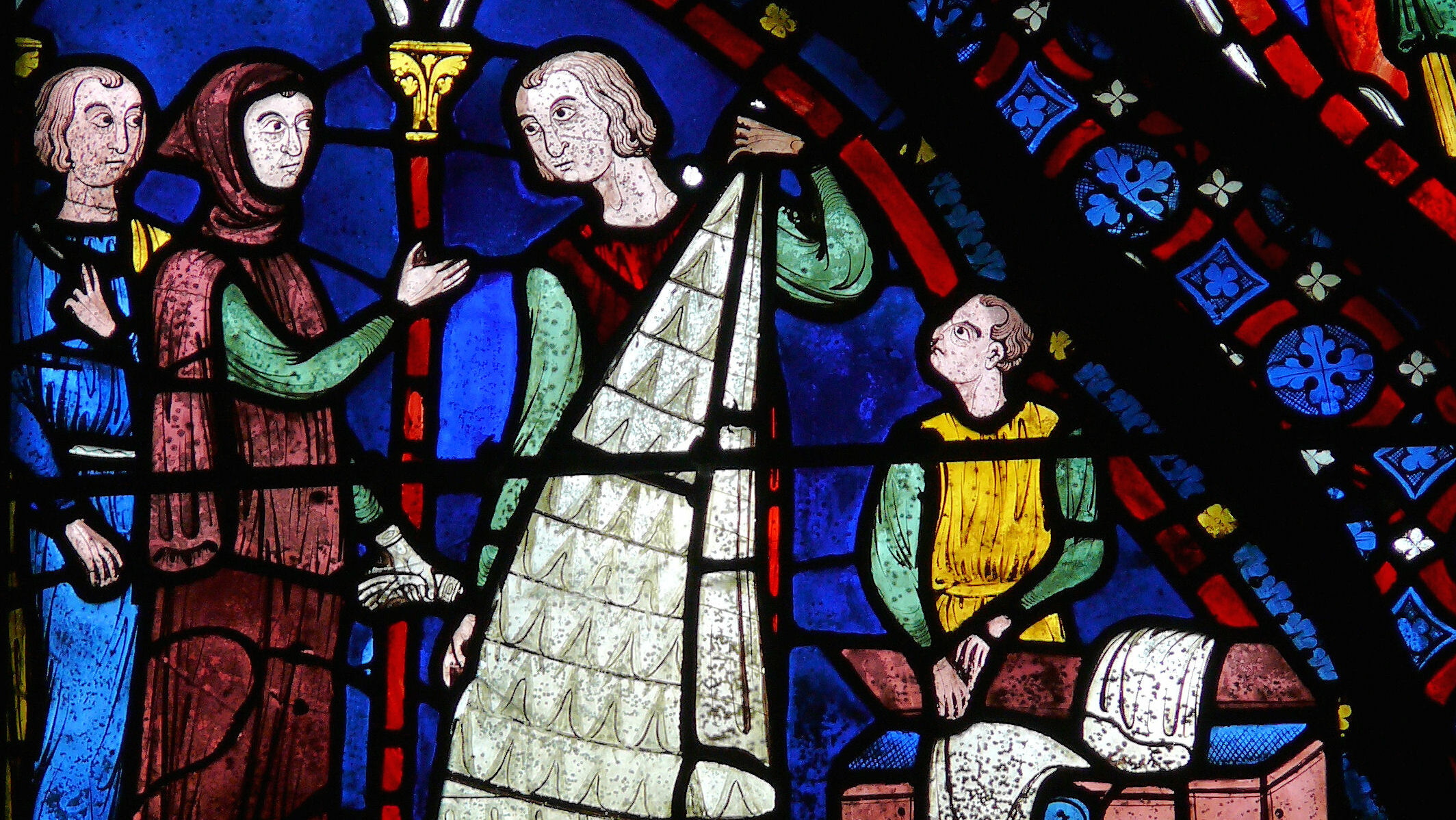
Après le report de l’année dernière, le comité d’organisation, au nom de l’AFAM, Chartres métropole et l’ensemble des partenaires de ces journées, est heureux de vous accueillir à l’occasion des 41e Journées internationales de l’AFAM.
Ces journées se tiendront à Chartres du 29 septembre au 02 octobre 2021.
Les deux thèmes principaux sont :
– “Se vêtir au premier Moyen Âge”
– “L’archéologie du premier Moyen Âge (Ve-XIIe s.) en région Centre-Val-de-Loire”.
La dernière matinée sera consacrée aux actualités archéologiques.
Pendant deux jours et demi, une trentaine de communications et autant de posters seront présentés. Une conférence inaugurale aura lieu le mercredi soir (29/09) avant le début du colloque, le jeudi matin (30/09). Le colloque s’achèvera le samedi midi (02/10). Voici le programme complet.
À cause du contexte sanitaire encore incertain, le colloque se déroulera en semi-présentiel (avec uniquement un orateur par communication, le bureau de l’AFAM, les membres du comité scientifique et les organisateurs) à l’Hôtellerie Saint-Yves de Chartres.
Mais soyez rassurés : pour les auditeurs et le reste des participants, une retransmission par visio-conférence des communications sera disponible sur une plateforme, de même qu’un espace pour visualiser les posters.
L’inscription en ligne est gratuite mais nécessaire pour assister aux Journées : https://afam2021.sciencesconf.org/
Un lien de visio-conférence vous sera envoyé seulement après inscription. Les pré-actes du colloque vous seront également transmis en version numérique (pdf).
En fonction de l’évolution de la situation sanitaire, une décision sera prise en septembre quant à l’accueil éventuel de public en présentiel, mais en jauge restreinte (merci de nous signaler si vous êtes intéressés).
La présence à Chartres sera soumise au respect des règles sanitaires du moment. Elles seront diffusées en septembre. Le pass sanitaire sera demandé, en plus du respect des gestes barrières et du port du masque.
Source : AFAM
Tagungsleitung: Prof. Dr. Wolfgang Huschner
Koordination: Dr. des. Sven Jaros / Dr. des. Marie-Ulrike Jaros / Dr. Eric Böhme / Dr. Stefan Magnussen
Datum: 13. bis 15. September 2021
Ort: Sächsische Akademie der Wissenschaften zu Leipzig (Hybrid)
Interessierte sind herzlich zur digitalen Teilnahme über ZOOM eingeladen. Um vorherige Anmeldung wird gebeten (siehe Flyer).
Programme : here
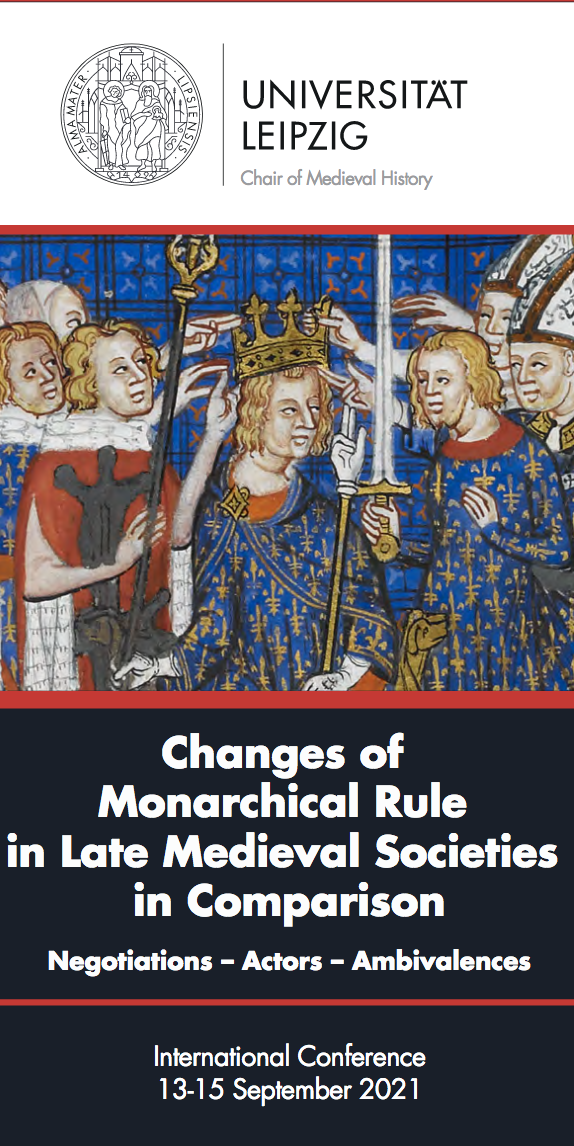
For the study of ruling systems in the pre-modern period, changes of rulership have proven to be a fertile environment, as they shook existing arrangements and triggered new negotiations. These transitive phases opened up extensive leeway, which both the monarchs and the elites could use to pursue their own as well as joint interests. Not infrequently, this led to a lasting reorganisation of the configurations of rulership.
Changes of rulership at the margins of Latin Europe have been the focus of the DFG funded research project “Mediation of Rule at the Borders of Latin Europe in the Late Middle Ages“. Within the conference, its main results shall be discussed and integrated in the European debate. By focussing on the border regions of Latin Europe, areas under Muslim, Christian-Orthodox or gentile-religious rule will be considered more broadly than before. At the same time, the comparative view will be directed back to Central Europe in order to discern possible similarities or specifics. The comparability of the case studies is ensured by a common analytical grid.
The conference will take place in hybrid form, with the digital part running via ZOOM. We kindly ask those, who wish to take part digitally to register via E-Mail until August 20th.
Source : Universität Leipzig
Through a generous donation, King’s College Cambridge is able to invite applications for a four-year Research Fellowship from those who are completing or have recently completed a doctorate and who intend to pursue a research project on some aspect of the Silk Road countries, societies, and cultures of Asia from the Western borders of China to the Mediterranean Sea, as well as their relationships with China in the East and Europe in the West. The research project’s discipline may address, amongst other issues, Environmental History, Religion, Art, Maritime History, China before 1911, Ottoman Empire, and Russian Central Asia, but applicants should not feel constrained by this list.

This Research Fellowship is part of a broader programme of studies of the countries of the Silk Roads, which includes lectures, seminars and conferences, as well as graduate scholarships and further Research Fellowships. As well as pursuing their own research project, the successful candidate will be expected to play an active role in developing the programme and in organizing academic activity concerned with the countries of the Silk Road.
This post-doctoral Fellowship is intended to encourage research into the Silk Roads and the countries of the Silk Roads by enabling the successful candidate to complete a substantial research project on their own choosing. Projects may concern any aspect of the countries, societies, and cultures of the Silk Roads, from the Western borders of China to the Mediterranean Sea, and of the Silk Roads themselves, that is to studies of relationships and the movement of materials, knowledge, and technologies between China and the Mediterranean, at any period to the present day.
The ideal candidate for this Research Fellowship will have a strong background in a relevant discipline and be completing or have completed an outstanding doctoral thesis. It is not a requirement that the candidate’s doctoral studies or the work that they submit in support of their application should have concerned questions of the Silk Roads specifically, but candidates will be expected to show in their applications both how their future work relates to the work that they have already done. The successful candidate will be expected to engage broadly with the whole college community.
Graduates of any university are eligible. Candidates will usually have completed their PhD but must not have undertaken more than 3 years of postdoctoral work by 1 October 2022 (i.e. your PhD cannot have been granted before 30 September 2019).
For complete information and instructions on how to apply, visit https://www.kings.cam.ac.uk/research/research-fellowships
Source : Medieval Art Research
Call for papers for special sessions at the International Medieval Congress, Leeds, 4-7 July 2022
Nature has not given [all horses] the same capabilities. Some shine more at war work; others are inclined to win Olympic crowns; others are adaptable for domestic use, civilian duties and farm work.
Leon Battista Alberti, De equo animante (c. 1445)
Equine breeds as we think of them today are an early modern invention. Instead, medieval people distinguished between horses based on their origin and the type of work for which they were used. At our thematic sessions, we propose exploring medieval horse types, their treatment, training, use, artistic and literary representation as well as equipment employed for different tasks. Possible topics include, but are not limited to, the following issues:
Additionally, we propose a round table on mounted games, such as Iberian cane games, and medieval antecedents of modern mounted sport games (polo, polocrosse and others).
The sessions and the round table are sponsored by Trivent Medieval. Selected contributions will be published in the Rewriting Equestrian History series or in Cheiron: The International Journal of Equine and Equestrian History.
Please send proposals and expressions of interest to Dr Anastasija Ropa (anastasija.ropa@trivent-publishing.eu) by 10 September 2021. To propose a session paper, please send a short biography of approximately 50 words and an abstract of 250-300 words. To participate in the round table, send your topic and one or two sentences explaining what you want to talk about.
Please note that IMC 2022 is planned as a hybrid event. In the event your paper is accepted, you can participate either virtually or in person. The authors are responsible for securing funding for the Congress attendance.
Der vierte Katalogband setzt die Erschließung der in der Wissenschaftlichen Stadtbibliothek Mainz befindlichen Handschriften fort. Die 144 Handschriften schließen inhaltlich die Theologica der Signaturengruppe I ab und eröffnen die Gruppe der Libri juridici. Es überwiegen weiterhin Kartause-Handschriften, jedoch kommen vermehrt auch andere Provenienzen hinzu (u.a. die Mainzer Jesuiten und Karmeliten, die Alte Universitätsbibliothek Mainz). Neben den überwiegend lateinischen Codices finden sich auch zehn deutschsprachige Handschriften, darunter ein Psalmenkommentar des Nicolaus de Lyra aus der Laienbibliothek der Kartause und ein Band bisher unbekannter Provenienz mit Predigten Martin Luthers. Die frühesten Bände – ein Evangeliar und das Martyrologium des Hrabanus Maurus – stammen aus dem 11. Jahrhundert; die spätesten Zeugnisse sind Vorlesungsmitschriften aus dem letzten Drittel des 16. Jahrhunderts.

Die Beschreibung durch Gerhard List in den Jahren 2005-2007 folgte, anders als bei den Vorbänden, dem verkürzten Modell der ‚Bestandsliste‘ gemäß den neuen Konzepten der DFG zur Handschriftenerschließung. Seit 2016 sind die Erschließungsdaten in Manuscripta Mediaevalia übertragen. Für die Drucklegung wurden die Beschreibungen überarbeitet; neue Forschungsliteratur wurde ergänzt, punktuell wurden neue Erkenntnisse nachgetragen und es wurde ein umfangreiches Register erstellt. 16 Seiten mit Farbabbildungen zu Provenienzhinweisen, Subskriptionen, Buchschmuck und Textauszügen runden den Band ab.
Informations pratiques :
Die Handschriften der Stadtbibliothek Mainz / Hs I 351– Hs I 490, par Gerhard List, Annelen Ottermann et Christoph Winterer, Wiesbaden, Harrassowitz Verlag, 2021 (Mainz: die Handschriften der Stadtbibliothek Mainz, 4). 248 Seiten, 49 Abb., 20 x 28,5 cm. ISBN : 978-3-447-11102-7. Prix : 84 euros.
Source : Harrassowitz Verlag




 L'Agenda des Médiévistes
Vous devez être connecté pour poster un commentaire.