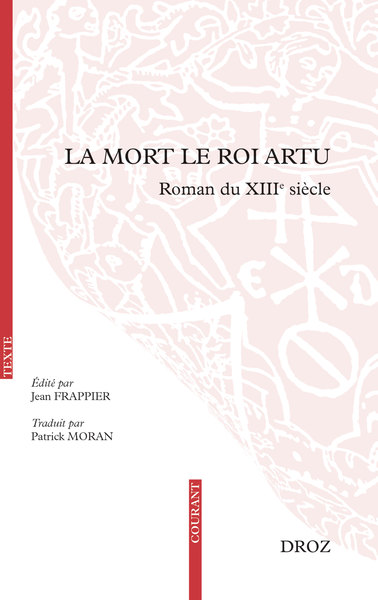
Publication — « La Mort le roi Artu. Roman du XIIIe siècle », trad. Patrick Moran

Rédigée dans le premier tiers du XIIIe siècle, La Mort le roi Artu dépeint un monde arthurien au bord du précipice, où l’envie et le ressentiment mettent en péril les valeurs chevaleresques traditionnelles, où l’amour interdit de la reine Guenièvre et de Lancelot du Lac risque à tout moment d’être révélé au grand jour et de détruire le fragile équilibre de la cour. Dernier volet du cycle du Lancelot-Graal, recopié sans cesse jusqu’au xve siècle avant d’être imprimé de nombreuses fois à la Renaissance, ce roman anonyme constitue la version la plus riche et la plus complexe de la chute du royaume d’Arthur, par le biais d’un récit choral où les héros d’antan sont la proie de leurs propres désirs et des caprices de Fortune. On trouve ici l’édition critique lachmannienne de Jean Frappier, avec une nouvelle traduction très réussie de Patrick Moran.

Informations pratiques :

La Mort le roi Artu. Roman du XIIIe siècle, trad. Patrick Moran, Genève, Droz, 2021 (Texte Courant, 14). 712 pages. ISBN : 978-2-600-06293-0. Prix : 16 euros.

Source : Droz

Publié dans Publications | Laisser un commentaire

Offre d’emploi – Lecturer in European History 1300-1500 CE (Durham University)

Recruiter : DURHAM UNIVERSITY
Location : Durham
Salary : £33797 – £40322 per annum
Posted : 10 Aug 2021
End of advertisement period : 24 Aug 2021
Ref : 21000979

The Department of History at Durham University seeks to appoint a talented individual to the fixed term role of Lecturer in European History (including Britain/Ireland) 1300-1500 CE.

The Department of History is widely recognized as a leading centre of historical research and teaching, consistently ranking amongst the top UK History departments in league tables.

The role of a fixed term Lecturer at Durham provides the opportunity to deliver outstanding education and research within an inclusive and supportive environment that is staffed by world class colleagues. Lecturers will be supported to develop their academic careers by training and financial support in research and education, guided by a designated mentor.

The primary focus of this role is on research and teaching but there will also be the opportunity to engage in wider citizenship within the University and beyond.

This role of Lecturer is for a fixed term of 23 months. It is not anticipated that this post would be extended beyond the initial fixed term. Applicants must demonstrate research excellence in European History 1300-1500 CE, with the ability to teach our students to an exceptional standard and to fully engage in the services, citizenship and values of the University. The University provides a working and teaching environment which is inclusive and welcoming and where everyone is treated fairly and with dignity and respect. Candidates will be expected to demonstrate commitment to these key principles as part of the assessment process.

In the first year, the post-holder will be expected to contribute to the team-taught level 1 module ‘Decline and Crisis? Europe, 1300-1500’, and to offer a strand for the core Level 1 module ‘Making History’. They may also be expected to offer an optional module for the MA. They will undertake some undergraduate and MA dissertation supervision and, where appropriate, carry out other teaching duties specified by the Head of Department. In the second year, they will be expected to offer additional teaching on new or existing level 2/3 modules.

Candidates will be expected to demonstrate these key principles as part of the assessment process.

Source : Times Higher Education

Publié dans Offre d'emploi | Laisser un commentaire

Offre d’emploi – Dessinateur topographe en archéologie (m/f/x), Musées royaux d’Art et d’Histoire, Bruxelles

  • Vous assistez l’archéologue responsable de la recherche archéologique et de l’enregistrement digital du patrimoine archéologique relatif à la recherche archéologique préventive en région bruxelloise.
  • Vous travaillez sur chantier pour la réalisation de relevés précis des éléments archéologiques en plan et en élévation, vous faites des levés topographiques.
  • Vous travaillerez aussi en bureau, sur ordinateur pour la vectorisation des plans et cartes, les calculs de photogrammétries, la réalisation de documents nécessaires aux différentes publications et présentations dont le dessin des objets.
  • Vous travaillez en équipe et accepter d’être flexible dans les horaires (soirée/weekend).

Cette liste de tâches n’est pas exhaustive et vous pourrez être amené à en effectuer d’autres à la demande de votre responsable hiérarchique.

Une bonne partie des tâches s’exercent en extérieur par des conditions climatiques difficiles (froid, intempéries, …), il faut pouvoir travailler en hauteur (sur échelle, échafaudage, …) et pouvoir porter des charges lourdes (transport de matériel, …).

Plus d’info sur la fonction ?
Ann Degraeve – Responsable du département patrimoine archéologique
Correspondant pour le Urban.Brussels
Tél. : 02 243 83 11
Courriel : adegraeve@urban.brussels

Vous pouvez poser votre candidature jusqu’au 23 août 2021 inclus.

Source et informations complémentaires : Selor

Publié dans Le réseau | Laisser un commentaire

Colloque – Communities and Networks in Late Medieval Europe (c. 1300–1500)

International Virtual Conference
9–10 September 2021

Historical research has witnessed a rapidly growing interest in „networks“ since the turn of the twenty-first century. This is due not only to the utility of networks in describing interrelations between historical actors, but also to the adoption of the concepts and methodologies associated with social network analysis (SNA).

Communities and Networks in Late Medieval Europe aims to build on and contribute to this expanding field of research by exploring how the descriptive, conceptual, and methodological tools provided by the study of networks can deepen our understanding of the complex sets of relationships between and within different types of communities in the specific context of the last two centuries of the European Middle Ages. The fourteenth and fifteenth centuries were a time of great political, socio-economic, and cultural change in Europe: the period in question, therefore, offers numerous exciting opportunities (and challenges) for the application of network-based approaches to the study of community dynamics.

To register for this event, please go to https://communitiesandnetworks21.eventbrite.co.uk.

Programme :

9 SEPTEMBER 2021

09:00–09:15 Welcome (Teresa Barucci and Matthew Coulter, University of Cambridge)

09:15–10:45 Session 1: Communities in the Making (Chair: Matthew Coulter)

Invited Speaker: Prof. Christina Lutter (University of Vienna), How Do Groups Become Communities? Urban Spaces of Belonging in Late Medieval Central Europe

Dr Joana Balsa de Pinho (University of Lisbon), A Community and Networking Experience in Late Medieval Portugal: Art and Material Culture of the Confraternities of Mercy

Dr Julien Le Mauff (Paris-Sorbonne University), Communitas perfecta and Regimes of Exclusion in Aristotelian Literature (13th–14th Centuries): The Growing Wariness towards Peregrins and Gens de mer

10:45–11:00 Break

11:00–12:30 Session 2: Networks of Strangers? (Chair: Dr Rodrigo García-Velasco, University of Cambridge)

Dr Monica White (University of Nottingham), Lands of Opportunity in the Medieval Orthodox World

Filip Vukuša (Bielefeld University), Networks of Newcomers from the Apennine Peninsula in 14th-Century Zadar

Guillermo López Juan (University of Valencia/University of Picardie – Jules Verne), A Close-Knitted Community: Interrelation, Integration and Assimilation of the Conversos of Valencia (1391–1440)

12:30–13:30 Lunch Break

13:30–15:00 Session 3: Travel and Trade Networks (Chair: Jessica Tearney-Pearce, University of Cambridge)

Invited Speaker: Dr Flávio Miranda (University of Porto), Caught in a Web: Merchant Communities and Commercial Networks between Portugal and Flanders, 1300–1500

Dr Prajakti Kalra (University of Cambridge), The Mongol Empire and the Making of European Communities in Eurasia

Annabel Hancock (University of Oxford), Networks of Trade: The Benefits and Challenges of Using Network Analysis to Explore Connections in Literature, Archaeology, and Commercial Contracts, c. 1150–1400

15:00–15:15 Break

15:15–17:15 Session 4: Economics, Finance, and Networks (Chair: Annabel Hancock)

Nicolò Zennaro (University of Antwerp; presenting author), Dr Jeroen Puttevils (University of Antwerp), and Prof. Francesco Guidi Bruscoli (University of Florence), Per chagione della Moria: A Social Network Analysis of an Epidemic Shock in the Datini Correspondence

Dr Julia Exarchos (RWTH Aachen University), The Networks of the Labouring Poor in the Late Medieval Rhineland

Aviya Doron (Hebrew University of Jerusalem), Communities of Credit or Communities of Debt? Jewish-Christian Financial Networks in 14th-Century Frankfurt-am-Main

Angus Russell (University of Cambridge), Unjust Collection: Institutional and Monastic (Un-)Networks in Northern Rus

17:15–17:30 Break

17:30–19:00 Keynote Session (Introduction: Prof. Nora Berend, University of Cambridge)

Prof. Felicitas Schmieder (FernUniversität in Hagen), Did „Magdeburg Law“ Create a Network of Culturally-Mixed Urban Communities across Central Europe?

10 SEPTEMBER 2021

09:00–09:15 Welcome

09:15–10:45 Session 5: Urban Networks (Chair: Teresa Barucci)

Invited Speaker: Prof. Jan Dumolyn (Ghent University), Guild Politics in the Medieval Low Countries: Class, Communities and Networks

Dr Marios Dimitriadis (National and Kapodistrian University of Athens), Drama as a Means of Networking for the World of Labour and a Field for the Debate on Social Hierarchy in Late Medieval English Towns

Ward Leloup (Free University of Brussels/Ghent University), „All Good Friends“? Economic and Social Relations of Leatherworkers in Late Medieval Bruges

10:45–11:00 Break

11:00–12:30 Session 6: Material Culture and Social Networks (Chair: Rebecca Field, University of Cambridge)

Dr Natalie Calder (Queen’s University Belfast) and Dr Hannah Schühle-Lewis (University of Kent), Theorising the Early Guildhall Library’s Social and Codicological Networks

Johanna-Pauline Thöne (University of Oslo), Late Medieval Music Manuscripts: Diachronic Testimonies to Musical and Cultural Networks, c. 1400

Róisín Donohoe (University of Cambridge), „To my Daughter“: Childbirth Networks in Late Medieval English Parish Communities

12:30–13:30 Lunch Break

13:30–15:30 Session 7: Mobility and Communication (Chair: Dr Luca Zenobi, University of Cambridge)

Invited Speaker: Dr Justyna Wubs-Mrozewicz (University of Amsterdam), „Merchants“ Marks in Premodern Northern Europe: Communicating Networks

Chiara Melchionno (Scuola Superiore Meridionale of Naples), Qui nescit fingere nescit regnare: The Use of Paroemie in Italian Diplomatic Letters of the 15th Century and the Building of a Linguistic and Political Network

Dr Marco Ciocchetti (University of Rome Tor Vergata), Networks and Exchanges in the Cardinals’ College in the First Half of the Fourteenth Century

Dr Tamás Kiss (Eötvös Loránd University) and Dr Stephen Pow (St Petersburg State University), The Expansion of Social Networks in the Late Middle Ages from Samarkand to Castile: The Case Study of Two Medieval Women

15:30–15:45 Break

15:45–17:15 Session 8: Political and Dynastic Networks (Chair: Dr Vedran Sulovsky, University of Cambridge)

Dr Christa Birkel (Heinrich Heine University Düsseldorf), The Foreign Prince and the Realm: On the Difficulty of Developing a Community in Late Medieval Luxembourg (c. 1380–1440)

Simon Bürcky (University of Giessen), Dynastic Networks of the Non-Princely High Nobility in the Holy Roman Empire during the 15th Century

Giovanni Contel (Sapienza University of Rome), The Italian Contribution to the „Imperial Community“ of Maximilian I during the First Italian Wars (c. 1490–1520)

17:15–17:30 Break

17:30–18:30 Concluding Session (Introduction: Prof. Jan Dumolyn)

Prof. Wim Blockmans (Leiden University), Concluding Remarks

All times in British Summer Time (BST)

Publié dans Colloque | Laisser un commentaire

Publication – « Queering the Medieval Mediterranean: Transcultural Sea of Sex, Gender, Identity, and Culture », ed. Felipe Rojas and Peter E. Thompson

In ten essays authored by an international team of scholars, this volume explores queer readings of Western and Eastern Mediterranean Europe, Northern Africa, Islam and Arabic traditions. The contributors enter into a dialogue, comparing cases from opposite sides of the Mediterranean, in order to analyze the forgotten exchange of sexualities that was brought forth through the Mediterranean and its bordering landmasses during the Middle Ages.

This collection questions the hypothesis that distinct cultures treated sexuality and the “other” differently. The volume initiates the conversation around queerness and sexuality on these trade routes, and problematizes the differences between various Mediterranean cultures in order to argue that through both queerness and sexuality, neighboring civilizations had access to, and knowledge of, common shared experiences.

Table des matières : ici

Informations pratiques :

Queering the Medieval Mediterranean: Transcultural Sea of Sex, Gender, Identity, and Culture, ed. Felipe Rojas and Peter E. Thompson, Leiden–Boston, 2021 (The Medieval Mediterranean, 121). ISBN : 978-90-04-31515-0. Prix : 94 €, 113 USD.

Source : Brill

Publié dans Publications | Laisser un commentaire

Podcast – Jay Diehl, « Priestly Education as Monastic Reform: The Culture of Writing at Saint-Laurent de Liège, c.1090-1110 »

Jay Diehl (Long Island University): « Priestly Education as Monastic Reform: The Culture of Writing at Saint-Laurent de Liège, c.1090-1110 », communication au webinaire H37 – Histoire et Cultures graphiques, le 10 février 2021.

Publié dans Podcast | Laisser un commentaire

Podcast – Hanno Wijsman, « Présentation de la base de données Bibale »

A l’occasion de l’adhésion au CERL (Consortium of European Research Libraries) d’un groupe de bibliothèques municipales françaises à l’initiative du Ministère de la Culture, un séminaire est organisé à l’attention des bibliothèques afin de mieux les informer des activités et actualités du CERL, mais également de resserrer les liens entre elles.

Hanno Wijsman (Ingénieur à la section de codicologie, histoire des bibliothèques et héraldique) présente la base de données Bibale : un outil collaboratif pour recenser et rechercher les provenances des manuscrits et livres imprimés : http://bibale.irht.cnrs.fr

Source : YouTube – IRHT

Publié dans Podcast | Laisser un commentaire

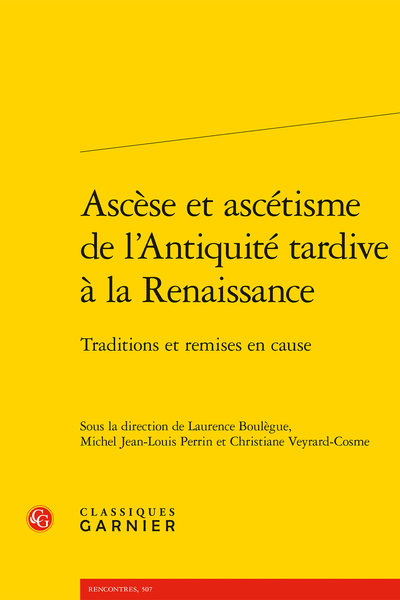
Publication – « Ascèse et ascétisme de l’Antiquité tardive à la Renaissance. Traditions et remises en cause », dir. Laurence Boulègue, Michel Jean-Louis Perrin et Christiane Veyrad-Cosme

Cet ouvrage propose d’étudier les multiples visages de l’ascèse au croisement des domaines littéraire, philosophique, religieux, artistique, de l’Antiquité tardive à la Renaissance, en trois volets consacrés aux théories et pratiques de l’ascèse, aux modalités de son écriture et à ses différentes figures.

Table des matières : ici

Informations pratiques :

Ascèse et ascétisme de l’Antiquité tardive à la Renaissance. Traditions et remises en cause, dir. Laurence Boulègue, Michel Jean-Louis Perrin et Christiane Veyrad-Cosme, Paris, Classiques Garnier, 2021 (Rencontres, 507 ; Lectures de la Renaissance latine, 14). 412 p. ISBN : 978-2-406-11152-8. Prix : 46 euros.

Source : Classiques Garnier

Publié dans Publications | Laisser un commentaire

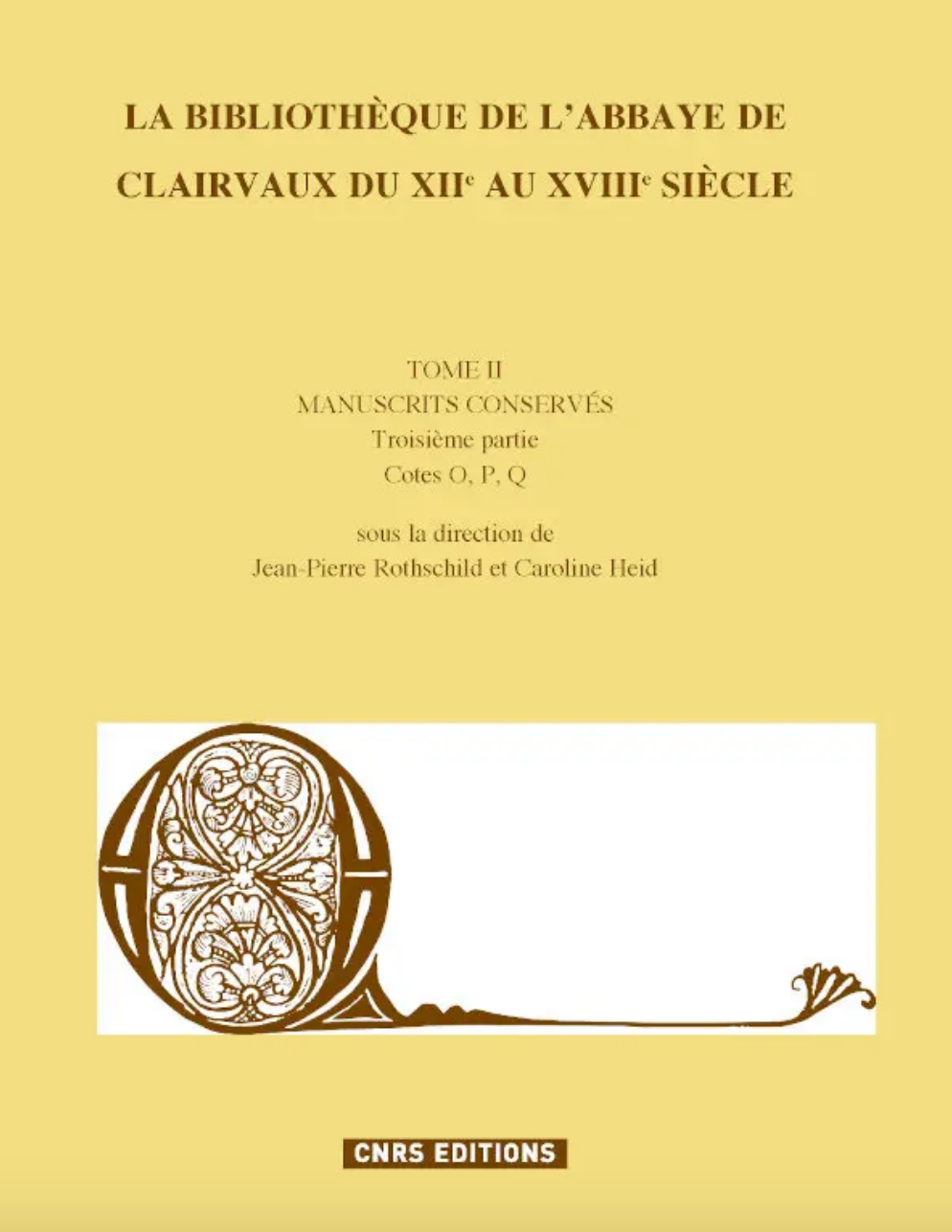
Publication – « La Bibliothèque de l’abbaye de Clairvaux du XIIe au XVIIIe siècle. T. II, 3e partie », dir. Jean-Pierre Rothschild et Caroline Heid

La bibliothèque de l’abbaye de Clairvaux fut un centre de première importance de la vie spirituelle et intellectuelle en France et en Europe au Moyen Âge.  André Vernet en a édité les anciens catalogues en 1979, dans cette même collection « DER », et ses collaborateurs de la section de codicologie de l’IRHT, Jean-Paul Bouhot et le regretté Jean-François Genest, y ont publié en 1997 les notices descriptives de plus de la moitié (manuscrits bibliques, patristiques et théologiques) des mille et quelque manuscrits subsistants du catalogue de 1472. Le travail a été repris dans la section latine de l’IRHT il y a quelques années, la nature des manuscrits restant à décrire (où les recueils de pièces multiples sont nombreux : florilèges, sermonnaires, collections hagiographiques, livres liturgiques) et les moyens nouveaux d’identification détaillée imposant un autre format de notices. Le présent volume est ainsi le premier publié de quatre qui couvriront, selon l’ordre des cotes du catalogue de 1472, des manuscrits de sermons (volume en préparation), d’autres recueils de sermons, des instruments pour la pastorale et des textes de théologie scolaire, de dévotion, d’histoire sainte, d’histoire profane et d’hagiographie (ce volume), le droit, les sciences et les lettres (en préparation), la liturgie (en préparation). Ce volume qui décrit 142 manuscrits de contenu très varié a été l’occasion d’un nombre élevé de découvertes de copies inconnues de divers textes. Mais le projet vise aussi à décrire et à comprendre le fonds en tant qu’ensemble, partiellement comme le produit du travail d’un scriptorium ou d’un petit nombre d’ateliers, et dans sa totalité comme bibliothèque organisée et vivante du XIIe au XVIIIe siècle.

Informations pratiques :

La Bibliothèque de l’abbaye de Clairvaux du XIIe au XVIIIe siècle. T. II, 3e partie, dir. Jean-Pierre Rothschild et Caroline Heid, Paris, CNRS Éditions, 2021 (Documents, études et répertoires). 504 p., 21 x 27 cm. ISBN : 9782271137876. Prix : 120 euros.

Source : CNRS Éditions

Publié dans Publications | Laisser un commentaire

Appel à contribution – New academic journal – Call for articles : TranScript – « Traduzione e scrittura nel Medioevo europeo »

TranScript – « Traduzione e scrittura nel Medioevo europeo »-is a new international high-quality peer reviewed academic journal edited by Edizioni Ca’ Foscari (ECF) Digital Publishing – Venice. It will provide a forum for discussion on the translation of cultures from orality to script, and across differing traditions, with particular reference to the centuries spanning the 11th to the 15th. For more information, see https://edizionicafoscari.unive.it/en/edizioni4/riviste/transcript/info.

If you wish to submit a paper for publication, please send your abstract (max. 1500 incl. spaces) with a summary bibliography by September 15th 2021. Accepted contributions (no word limit) should be sent to transcript_editor@unive.it, or submitted online by October 15th 2021. Please refer to ECF style guidelines: https://edizionicafoscari.unive.it/it/edizioni4/pubblicare-con-noi/. TranScript publishes contributions in all Romance languages, English and German.

Publié dans Appel à contributions | Laisser un commentaire