Publication — « The Roles of Medieval Chanceries. Negotiating Rules of Political Communication », dir. Christina Antenhofer et Mark Mersiowsky

Medieval (political) communication followed rules that were defined, negotiated, and altered in processes of exchange. Conflicts resulting from different communication practices, as well as forms of innovation, revolve around rules that are not self-evident. Political actors such as princes and cities, chanceries, secretaries, ambassadors, and councillors formed rules of political participation, which became visible in written documentation. These rules were both formed and negotiated via processes of communication (a practice-oriented understanding of political participation). Medieval chanceries can thus be understood as a vast field of experimentation where different solutions were tested, passed on, or discarded.

This book explores communication practices in German, French, Italian, Tyrolian, and Gorizian chanceries, as well as at diets from the tenth to the sixteenth century. Its chapters examine royal, monastic, princely, and communal chanceries. For the early and high Middle Ages, a close analysis of documents will reconstruct negotiation and communication from within the documents themselves. For the later Middle Ages, focus will turn to the chancery, with the appearance of chancery orders and chancery annotations that provide explicit insight in communication between the chancellors, secretaries, and political authorities (princes or cities). The growing amount and variety of documents issued in the late Middle Ages allows us to retrace conflicts resulting from differing chancery practices as well as attempts to reorganise the chancery into a political instrument for the prince.

The processes of political communication will be followed in three parts. Part I focuses on the rules within documents. Part II looks at administrative processes within specific chanceries, while Part III explores forms of exchange between the chancery and other political actors.

Table des matières :

Introduction — CHRISTINA ANTENHOFER

I. Rules Within the Documents: Chanceries and Charters

The Sanctiones of the Cluniac Charters of the 10th-11th Centuries
— SÉBASTIEN BARRET
 
Nulli… Si Quis and Their Copycats: Penal Forms in Later Medieval Charters
— ARNOLD OTTO 


II. Chancery Rules and Organisation: The Chancery as Platform of Administration

Internal Rules of Late Medieval German Chanceries and Their Heuristic Value — ELLEN WIDDER

Chancery Notations and Their Role as Means of Communication in Medieval Chanceries: The Case of the Bavarian and Tyrolean Chanceries — JULIA HÖRMANN-THURN UND TAXIS

Late Medieval Urban Chanceries: Town Clerks and Town Books — KLAUS BRANDSTÄTTER †


III. Platforms and Exchanges: The Chanceries as Platforms of Political Communication

Power Beyond the Rules: Formalism and Experimentation in the Italian Chancelleries, c. 1380–1500 — ISABELLA LAZZARINI

Antiquated Meets Modern: Conflicting Rules in Late Medieval Chancellery Practices: The Example of the Gorizian Chancellery  — CHRISTINA ANTENHOFER 

‘Vermerkt die gewalt so in die cantzley geantwortet sind auf dem lanndtag… ‘: The Chancery and the Negotiations at the Tyrolean Diet, 15th Century — MICHAELA FAHLENBOCK

Index of Names
List of Contirbutors 

Informations pratiques :

The Roles of Medieval Chanceries. Negotiating Rules of Political Communication, dir. Christina Antenhofer et Mark Mersiowsky, Turnhout, Brepols, 2021 (Utrecht Studies in Medieval Literacy, 51). IX+198 p., 22 b/w ill., 156 x 234 mm. ISBN: 978-2-503-58964-0. Prix : 70 euros.

Source : Brepols

Publié dans Publications | Laisser un commentaire

Offre d’emploi – PostDoc (m/w/d) in DFG-funded Research Training Group “The Literary and Epistemic History of Small Forms” / im DFG-Graduiertenkolleg „Literatur- und Wissensgeschichte kleiner Formen“ an der HU Berlin

Application deadline: August 26, 2021 / Bewerbungsfrist: 26.08.2021

Within the framework of the DFG-supported Research Training Group 2190

»Literatur- und Wissensgeschichte kleiner Formen«
(»The Literary and Epistemic History of Small Forms«)

we are inviting applications for

1 PostDoc Position (TV-L 13, 100%, duration of 4.5 years until March 2026)

to commence October 1, 2021. The Research Training Group analyzes small forms from a literary perspective and with regard to the history of knowledge, from antiquity to the present, and investigates their functions in different fields of praxis: literature, science, and popular culture. The main focus is on the interrelations between aesthetic, epistemic, and praxeological aspects of small forms. Further information about the group’s research program and a job description for the PostDoc position are available at: http://www.kleine-formen.de/.

Application Requirements

The position will be awarded to an early career researcher from the fields of literature, history, cultural and media studies who completed his/her PhD with outstanding accomplishment (»magna cum laude« and higher or equivalent). Applications from abroad are particularly encouraged. We welcome German and English speaking candidates whose research projects address the key topics of our research program in the second funding period (i.e. co-evolutions between small forms and media formats, transitions between small forms in prose and verse, small forms as actors within collectives, small forms as global/postcolonial travellers).

Applications should include the following materials:

  • Cover letter/statement of motivation (1-2 pages)
  • Outline of the research project (maximum 10 pages, timeline included)
  • Writing sample (excerpt from the PhD thesis, 15-20 pages)
  • Tabular curriculum vitae and list of publications
  • Copies of degrees and/or transcripts providing reference of your academic qualification (undergraduate, graduate and postgraduate certificates and, if applicable, further postdoctoral qualifications)
  • Two letters of recommendation
  • Applicants who are not native speakers of German or English will need to provide language certificates for German (C1 / DSH 2 / ZOP / TestDaF 4 / DSD II) or English (B2 / IELTS 5.0 / TOEFL 500-170-80 / Cambridge Examination CEA / 7 years English instruction on a German school)

The Humboldt University of Berlin is an equal opportunity employer. The call for applications is explicitly aimed at people of all genders (m/f/d). In case of equally qualified candidates, women are given preference. We also welcome applications from people with migration background and people with severe disabilities.

Please submit your application – key word DR/085/21 –by August 26, 2021 to the Speaker of the Research Training Group:

Prof. Dr. Ethel Matala de MazzaHumboldt-Universität zu BerlinInstitut für deutsche LiteraturUnter den Linden 610099 Berlin

or preferably in electronic form as a single PDF (max 3 MB) by email to gk-kleineformen@hu-berlin.de.

The PostDoc’s responsibilities within the Research Training Group

The PostDoc will serve as the major contact person for the Research Training Group’s PhD students and will offer guidance and advice on matters both academic and practical. The PostDoc will host the group’s research colloquium, (co-)organize and carry out project events and actively contribute to the group’s networking and outreach activities. He/she will be involved in the editing process for the Research Training Group’s publications and have the opportunity to gain teaching experience. In addition, he/she will serve as a member on all administrative committees related to the Research Training Group. The PostDoc will receive career mentoring by an advisor to be chosen from the group’s associated senior faculty. His/her mentor will offer support with regard to grant applications as well as administrative matters concerning a potential postdoctoral qualification (Habilitation) at Humboldt University.

Promising young researchers will thus find within the Research Training Group the opportunity to

  • acquire international visibility through an innovative project carried out within a stimulating research environment
  • build up a network with PhD candidates, Principle Investigators, collaborators, and academic guests
  • gain experience in public talks, organization, and teaching
  • develop and realize collaborative publication projects with the group’s PhD students
  • expand key competences
  • receive guidance on personal career development
Publié dans Offre d'emploi | Laisser un commentaire

Publication (en ligne) – « Le Meditationes Vitae Christi in volgare secondo il codice Paris, BnF, it. 115. Edizione, commentario e riproduzione del corredo iconografico », éd. Diego Dotto, Dávid Falvay et Antonio Montefusco

Accès : ici

Le Meditationes vitae Christi costituiscono uno dei testi di più grande successo del tardo Medioevo e occupano una posizione di assoluto rilievo nella ridefinizione della religiosità e della sfera devozionale della loro epoca. Scritte in Toscana all’inizio del XIV secolo, le Meditationes sono tramandate da una ricca tradizione manoscritta plurilingue, precisamente latina e volgare, alla quale va sommata la presenza di stampe antiche. Paragonabile per intensità al successo dell’opera è il dibattito che permane circa la veste linguistica originale del testo. Nonostante si possa ormai indicare in quella latina la versione primigenia, il manoscritto segnato Paris, BNF, it. 115 tramanda un testo in volgare che riveste notevolissima importanza sia sul piano filologico che su quello figurativo. Il codice parigino, infatti, oltre a essere uno dei testimoni più antichi dell’opera, tramanda la prima traduzione italiana, ascrivibile all’area pisana, ed è impreziosito da uno splendido apparato iconografico. Il presente volume fornisce, in una prospettiva internazionale e multidisciplinare, la prima edizione critica del testo, la riproduzione di tutte le miniature, nonché l’edizione delle istruzioni date al miniatore e lo studio testuale e materiale del codice. Il volume è accompagnato da puntuali commenti filologici e storico-artistici, da glossari e da sette contributi introduttivi di carattere interdisciplinare.

Informations pratiques :

Le Meditationes Vitae Christi in volgare secondo il codice Paris, BnF, it. 115. Edizione, commentario e riproduzione del corredo iconografico, éd. Diego Dotto, Dávid Falvay et Antonio Montefusco, Venise, Edizioni Ca’ Foscari, 2021 (Filologie medievali e moderne, 24). ISBN : 978-88-6969-510-0. Prix (copie physique) : 98 euros.

Source : Edizioni Ca’ Foscari

Publié dans Publications, Web | Laisser un commentaire

Cycle de conférences – 2021 : les 500 ans du siège du château fort de Logne

Dans le cadre de son année 1521-2021, le domaine de Palogne organise à la fin de l’été une série de conférence portant sur le contexte du siège de 1521 au terme duquel les troupes de Charles Quint, soutenue par celles du prince-évêque de Liège Érard de la Marck rasèrent la forteresse.

Ce cycle invite à la découverte de nombreuses thématiques liées au contexte historique, politique, militaire et artistique du siège et de 1521, en compagnie de spécialistes passionnés.

Programme :

• Jeudi 26 août – Alain Marchandisse (Maître de recherches du Fonds National de la Recherche Scientifique/Maître de conférences / Université de Liège/Département des sciences historiques) et Christophe Masson (Chercheur qualifié F.R.S.-FNRS/Université de Liège Service d’Histoire du Moyen Âge tardif et de la Renaissance) : Logne entre France et Empire, le contexte européen du siège de 1521 »

• Vendredi 3 septembre – Michaël Depreter (Université d’Oxford, Chercheur postdoctorant / docteur en Histoire de l’Université libre de Bruxelles) :« Logne 1521 ou la fin des places fortes seigneuriales ? La fortification seigneuriale face à la révolution de l’artillerie (14e-16e siècles) »

• Vendredi 10 septembre – Michaël Depreter (Université d’Oxford, Chercheur postdoctorant / docteur en Histoire de l’Université libre de Bruxelles) : « Artillerie, Argent, et Pouvoir: Logne 1521 ou l’État dynastique à l’assaut des derniers féodaux ? « 

• Vendredi 1er octobre – Sophie Denoël (Docteure en Histoire de l’art, Directrice à l’Agence Wallonne du Patrimoine – Direction opérationnelle de la zone est) : « Entre tradition et modernité, l’art au Pays de Liège sous le règne d’Érard de la Marck »

• Vendredi 8 octobre – Pierre Leclercq (Historien de l’alimentation, collaborateur scientifique de l’Université de Liège) : « Festin au Château de Logne, Manières de table et bien manger en 1521 » (conférence suivie d’une dégustation)

• Vendredi 29 octobre – Christophe Masson (Chercheur qualifié F.R.S.-FNRS/Université de Liège Service d’Histoire du Moyen Âge tardif et de la Renaissance) : « La chevalerie ne meurt jamais. Guerre, éthique et technique au premier XVIe siècle »

• Vendredi 5 novembre – Jean-Luc Charlier (Docteur en Histoire de l’Art et Archéologie – Licencié en Histoire des Religions – Attaché à l’Agence wallonne du Patrimoine) : « Chevaliers et lansquenets – Armes et armées entre Moyen Âge et Renaissance »

• Vendredi 12 novembre – Philippe Mignot (Archéologue, attaché à l’Agence Wallonne du Patrimoine) : « La vérité au fond du puits versus les châteaux sans puits »

Informations pratiques :

Château de Harzé
1, route de Bastogne
4920 Harzé
Réservation : 086/21.20.33
Tarif : 8 € / conférence
5 € / conférence à partir de 2 conférences réservées (hors conférence du 8/10)
5 € / conférence pour les étudiants

Source : Domaine de Palogne

Publié dans Colloque | Laisser un commentaire

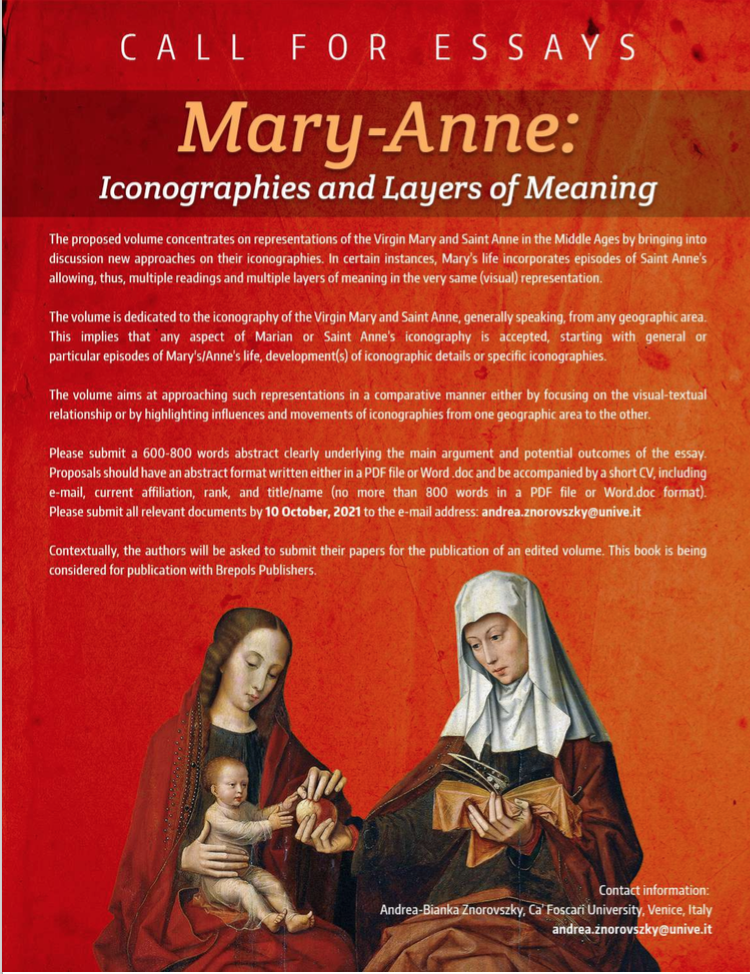
Appel à contribution – Mary-Anne: Iconographies and Layers of Meaning

The proposed volume concentrates on representations of the Virgin Mary and Saint Anne in the Middle Ages by bringing into discussion new approaches on their iconographies. In certain instances, Mary’s life incorporates episodes of Saint Anne’s allowing, thus, multiple readings and multiple layers of meaning in the very same (visual) representation.

The volume is dedicated to the iconography of the Virgin Mary and Saint Anne, generally speaking, from any geographic area. This implies that any aspect of Marian or Saint Anne’s iconography is accepted, into the session, starting with general or particular episodes of Mary’s/Anne’s life, development(s) of iconographic details or specific iconographies.

The volume aims at approaching such representations in a comparative manner either by focusing on the visual-textual relationship or by highlighting influences and movements of iconographies from one geographic area to the other.

Please submit a 600-800 words abstract underlying the main argument and potential outcomes of the essay. Proposals should have an abstract format written either in a PDF file or Word.doc and be accompanied by a short CV, including e-mail, current affiliation, and title/name (no more than 800 words in a PDF file or Word.doc format). Please submit all relevant documents by 10 October, 2021 to the e-mail address: andrea.znorovszky@unive.it

Contact information:
Andrea-Bianka Znorovszky, Ca’ Foscari University, Venice, Italy (andrea.znorovszky@unive.it)

Publié dans Appel à contributions | Laisser un commentaire

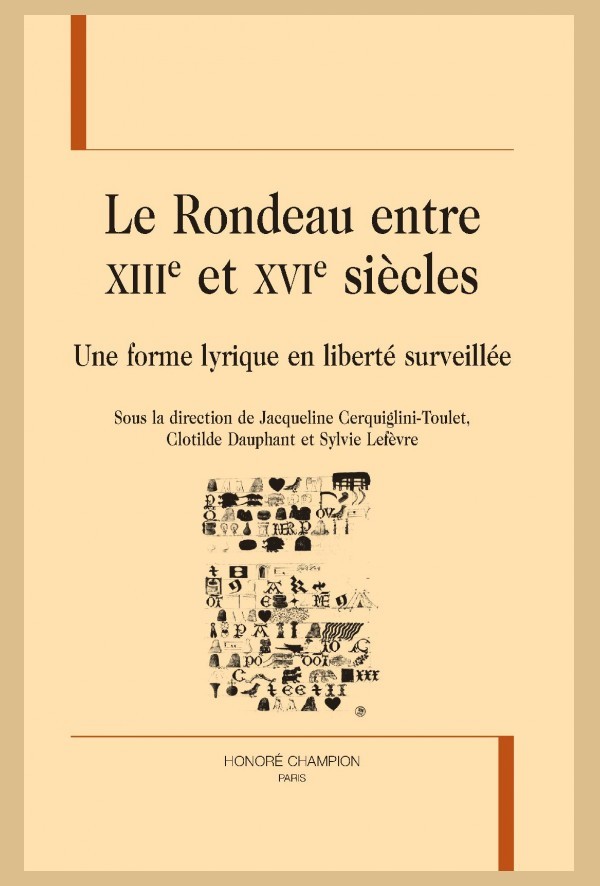
Publication – « Le Rondeau entre XIIIe et XVIe siècle. Une forme lyrique en liberté surveillée », dir. Jacqueline Cerquiglini-Toulet, Clotilde Dauphant et Sylvie Lefèvre

Labyrinthe de mots ou figure du cercle, le rondeau continue de poser des questions sur sa forme, simple ou complexe, sur ses origines et sur son évolution dans le temps long. Chanson, rondel de carole, rondel, caractérisé par un refrain de plusieurs vers au Moyen Âge, le rondeau devient texte à refrain de quelques mots ou rentrement au XVe siècle. C’est cette dernière forme que le XVIIe siècle, amateur d’archaïsme, reprendra, souvent comme pièce de circonstances. Au XIXe siècle, historiens, théoriciens et poètes décident de distinguer nettement rondeau et rondel tandis que les éditeurs de poésie médiévale se divisent sur la longueur de reprise d’un refrain abrégé en etc. Ce débat n’a pas été tranché jusqu’à présent, et s’il ne l’est pas de façon définitive et de manière uniforme dans ce volume, c’est qu’entre texte et musique le rondeau a longtemps été, plutôt qu’une forme fixe, une forme en liberté surveillée.

Jacqueline Cerquiglini-Toulet est professeur émérite de littérature française du Moyen Âge à Sorbonne Université, spécialiste de poésie lyrique, de Guillaume de Machaut à François Villon.

Clotilde Dauphant est maître de conférences de littérature française du Moyen Âge à Sorbonne Université, spécialiste de poésie lyrique, en particulier des formes fixes et d’Eustache Deschamps.

Sylvie Lefèvre est professeur de littérature française du Moyen Âge à Sorbonne Université, spécialiste des XIVe-XVe siècles (histoire et poétique des textes). Elle a travaillé sur Nicole Oresme, Antoine de La Sale, sur les questions de l’épistolaire, du recueil et de l’autographie.

Table des matières : ici

Informations pratiques :

Le Rondeau entre XIIIe et XVIe siècle. Une forme lyrique en liberté surveillée, dir. Jacqueline Cerquiglini-Toulet, Clotilde Dauphant et Sylvie Lefèvre, Paris, Honoré Champion, 2021. 224 p., 15,5 x 23,5 cm. ISBN : 9782745355355. Prix : 35 euros.

Source : Honoré Champion

Publié dans Publications | Laisser un commentaire

Offre d’emploi – Lecturer in History 300-700 CE, Durham University

The Department of History at Durham University seeks to appoint a talented individual to the fixed term role of Lecturer in History CE 300-700.  They are particularly eager to hear from applicants with a focus on the history of the Mediterranean world.  

The primary focus of this role is on research and teaching but there will also be the opportunity to engage in wider citizenship within the University and beyond.

This role of Lecturer is for a fixed term of 12 months and to provide cover for Eleanor Barraclough, who has been awarded an AHRC Leadership Fellowship. It is not anticipated that this period would be extended beyond the initial fixed term.

Applicants must demonstrate research excellence in the field of History CE 300-700, with the ability to teach our students to an exceptional standard and to fully engage in the services, citizenship and values of the University.

The post-holder will be expected to contribute to a new team-taught level 1 module on the late-antique Mediterranean world, to contribute a strand to the core level 1 module ‘Making History’, and to teach a new or existing level 2 module in an aspect of early medieval history. They will undertake some undergraduate and MA dissertation supervision and, where appropriate, carry out other teaching duties specified by the Head of Department.

All applicants are asked to submit:

  • A CV and covering letter which details your experience, strengths and potential in the requirements set out above;
  • PDFs of up to two pieces of research focused work;
  • A personal research plan [of 500-1,000 words, setting out your intended research programme for the coming three to five years, with some indication of possible publications and sources of funding]

You should provide details of 3 academic referees and the details of your current line manager so that we may seek an employment reference (if they are not listed as an academic referee).  Please note:

  • We shall seek the academic references during the application process.  We would ask that you alert your academic referees to this application as soon as possible so that we can quickly obtain references should you be progressed to the long list stage.  If you do not wish (some or all) of your referees to be approached during the recruitment process; you must clearly indicate this to us at the time of your application.
  • Academic references sought for long-listed candidates may be made available to the panel during the shortlisting process.
  • We will seek a reference from your current line-manager if we make you an offer of employment (albeit you may have also nominated your line manager as an academic referee).  Please clearly indicate which referee is your current line-manager and please let us know if we should only approach them once an offer has been made.

Applications are particularly welcome from women and black and minority ethnic candidates, who are under-represented in academic posts in the University. The deadline to apply is 17th August 2021. Please apply via the Durham jobs page: https://www.dur.ac.uk/jobs/

Source : Medieval Art Research

Publié dans Offre d'emploi | Laisser un commentaire

Publication (souscription) – Splendeur et dispersion des manuscrits et des chartes d’une prestigieuse abbaye bénédictine normande (Xe -XXe s.). Volume 1 : La bibliothèque et les archives de la Sainte-Trinité de Fécamp pendant la période ducale (911-1204)

Centre politique et religieux majeur de la Normandie ducale (911-1204), la place-forte de Fécamp s’affirme au cours du Moyen Âge comme l’un des hauts lieux intellectuel spirituel et culturel de la chrétienté.

La collégiale fondée en ses murs par les ducs de Normandie en 990, puis transformée en abbaye bénédictine dès 1001, a joué un rôle essentiel dans cet essor et dans ce succès. Richement doté dès l’origine par les ducs, le monastère devient rapidement l’une des abbayes les plus puissantes de Normandie et d’Occident. C’est aussi un centre de pèlerinage réputé, dédié à la relique du Précieux Sang. La population cosmopolite qui y gravite, l’origine italienne de ses premiers abbés et ses liens étroits avec Saint-Bénigne de Dijon, Cluny ainsi que la papauté ont contribué à façonner sur place une pensée originale, aux influences multiples. Nous l’observons aussi bien dans les textes que dans le décor des manuscrits ou la pierre des monuments. Pionnier dans le domaine de l’écrit, son scriptorium a produit parmi les plus anciennes annales et les plus anciens nécrologes, livres du chapitre, actes diplomatiques et cartulaires connus en Normandie. Les livres et les chartes conservés témoignent encore, malgré leurs dispersions et les injures du temps, de l’importance et du rayonnement exceptionnel de cette abbaye depuis l’an Mil jusqu’à la Révolution française. C’est pourquoi ce monastère a attiré l’attention de nombreux historiens et érudits depuis le XVIIe siècle.

Ce constat et ce contexte particulier de conservation des sources écrites anciennes incitent aujourd’hui les chercheurs à tenter de reconstituer virtuellement la bibliothèque et le chartrier de ce prestigieux monastère. Les communications prononcées lors des deux journées d’études organisées à Fécamp les 25 et 26 octobre 2017 par les associations des Amis du Vieux Fécamp et du Pays de Caux et des Amis de l’abbatiale de la Sainte-Trinité de Fécamp constituent en quelque sorte le fondement de cet utile et ambitieux projet. Ces journées d’études ont en effet permis de réunir quelques uns des spécialistes de l’histoire de l’abbaye, de sa bibliothèque, de ses archives et de son scriptorium. Les actes qui en sont issus ont pour objectif de présenter un état des recherches menées à ce sujet de 2010 à 2020. Le lien vers le sommaire des deux volumes de ces actes, qui paraîtront en 2021 et 2022.

L’association des Amis du Vieux Fécamp et du Pays de Caux, qui assure la publication de ces actes, vous propose de participer à la souscription du premier volume, qui paraîtra d’ici la fin de l’année 2021 et sera vendu au prix unitaire de 30 €.

En souscrivant dès maintenant, et avant le 1er septembre 2021, vous bénéficierez d’un prix préférentiel d’achat à 25 € (soit une remise de 5 € par volume acheté).

Pour cela, veuillez remplir le formulaire de souscription et suivre les instructions qu’il contient.

Vous pouvez faire le choix soit de recevoir vos exemplaires par envoi postal (moyennant des frais de port), soit de retirer gratuitement vos exemplaires auprès de l’association, à Fécamp, ou à l’Université de Caen en contactant l’un des directeurs de publication de ces actes à l’adresse mail suivante : stephane.lecouteux@unicaen.fr

Source : CRAHAM

Publié dans Publications | Laisser un commentaire

Offre d’emploi – Belspo BRAIN 2.0 project LORD (Lordship and State Formation in the County of Flanders, 15th – 18th C.) has a vacancy for 1 PhD student (at Ghent University)

The principal investigators of the Belgian Belspo BRAIN 2.0 project LORD (Lordship and State Formation in the County of Flanders, 15th – 18th C.) are looking for a PhD student for a 4-year project at Ghent University’s Department of History. LORD is a partnership project of the Department of History at Ghent University (Prof. dr. Frederik Buylaert & Prof. dr. Thijs Lambrecht) and The State Archives of Belgium (Dr. Joke Verfaillie). The project focuses on premodern processes of centralisation and state formation in the Southern Low Countries. Specific attention is given to the relation between (feudal) lordship (« Heerlijkheid ») and the central authority.

The PhD student will operate in a dynamic team that consists of the principal investigators at both insitutions, a postdoctoral researcher and one other PhD student.

In fact, LORD has two PhD sub-projects:

  1. A reconstruction of the number of lordships in Flanders (late 15th century – c. 1750), based on existing data sets and new research on original source material. Focus on social background and the political-administrational activities of lords.
  2. A study of the financial structures of lordships in Flanders (c. 1400 – 1800), based on accounts and juridical source material. Focus on the (fiscal / financial) relation between lordships and the fiscal policy and demands of the central government.

One PhD student has already been hired, but the projects have not yet been attributed. Candidates are invited to indicate which topic they would prefer to work on.

You can find all details of the PhD position and the LORD project in the (Dutch) job text attached. The deadline for application is 20 August 2020!

Source : UGent – Henri Pirenne Institute for Medieval Studies

Publié dans Offre d'emploi | Laisser un commentaire

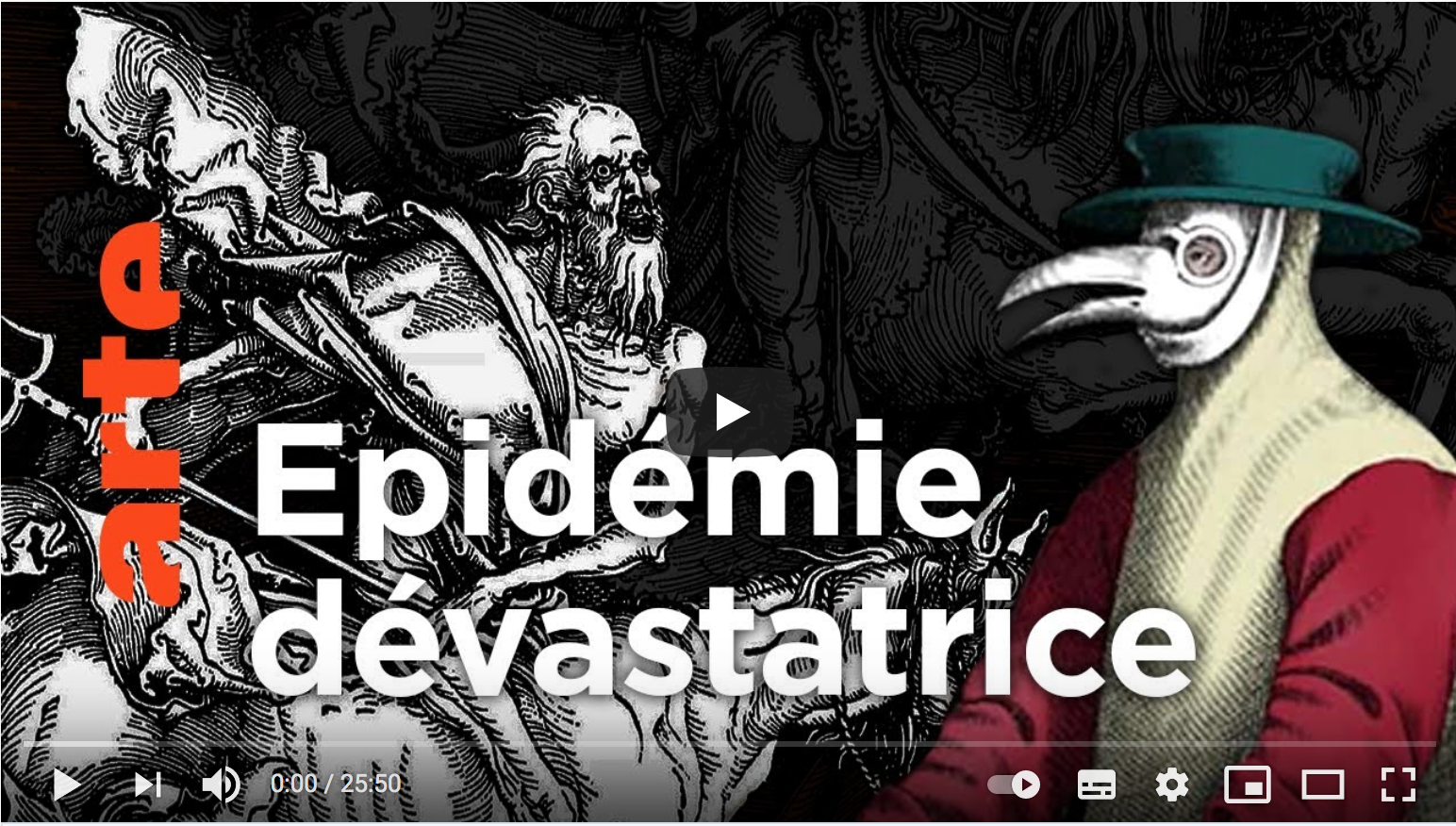
Podcast – « Peste : La grande épidémie » (1974, avec not. Jacques Le Goff) & « 1347 : La peste noire | Quand l’histoire fait dates »

Peste : La grande épidémie
Histoire des gens | ORTF | 26/10/1974


L’émission est consacrée à la peste, terreur du moyen âge. A Florence, Pierre DUMAYET converse avec l’historien Jacques LE GOFF sur la Grande peste qui a ravagé la ville italienne en 1348. La maladie entraine des bouleversements sociaux et religieux fondamentaux dans la civilisation occidentale. Puis à Gordes, Pierre DUMAYET écoute le docteur Jean Noël BIRABEN raconter les épidémies dont celle de Marseille en 1720. En conclusion, Jacques LE GOFF rencontre le professeur MOLLARET de l’institut Pasteur, qui prévient sur les risques toujours possibles d’une épidémie. L’émission est constituée de promenades-discussions de Pierre DUMAYET et ses invités, ponctués d’extraits de films, de dessins et gravures, de nombreuses images de Florence et de ses principaux monuments, des statues de cire du musée de la Specola, du vieux port avec le quartier de l’Estaque à Marseille.

1347 : La peste noire | Quand l’histoire fait dates

Accès : ici


Alors qu’en l’espace de cinq ans la grande peste a décimé un tiers de la population européenne, il reste finalement peu de traces de la pire catastrophe que le Moyen Âge ait connue. Que s’est-il réellement passé entre 1347 et 1352 sur notre continent ? Il apparaît que cette épidémie a été le marqueur d’une première mise en relation massive de l’Eurasie et du monde méditerranéen. L’histoire en mouvement Portée par le récit face caméra, aussi savant que vivant, de Patrick Boucheron, professeur au Collège de France, cette collection documentaire met l’histoire en mouvement. Des frises chronologiques animées accueillent images, documents et archives, illustrant les dix grandes dates évoquées. En reconstituant, au fil d’une enquête captivante, ces événements inscrits dans les manuels scolaires, et en les replaçant dans plusieurs temporalités (au travers des différents calendriers), la série rend ainsi sensible la manière dont l’histoire s’écrit, se date et se commémore. Une approche nouvelle du sujet, où se croisent art de la narration, techniques ludiques d’animation et rigueur scientifique.

Série documentaire de Patrick Boucheron et Denis van Waerebeke (France, 2017, 26mn)

Publié dans Podcast | Laisser un commentaire