Conférence – « Le temps de la synthèse. Autour de l’ouvrage Florian Mazel (dir.), Nouvelle histoire du Moyen Âge »

Le temps de la synthèse une discussion proposée par François Foronda (Université Paris 1 Panthéon-Sorbonne, Lamop)

à propos de l’ouvrage

Florian Mazel (dir.), Nouvelle histoire du Moyen Âge, Paris, Éditions du Seuil, 2021

avec les interventions de

Adrien Bayard (historien médiéviste), Guillaume Calafat (historien moderniste)

Isabelle Heullant-Donat et Régine Le Jan (historiennes médiévistes)

En présence du directeur de l’ouvrage et de contributeurs

Informations pratiques :

Le jeudi 13 janvier 2022

Sorbonne, Amphithéâtre Bachelard

De 18h à 20h

Publié dans Colloque | Laisser un commentaire

Offre d’emploi – Associate Professor, Classical Chinese and Medieval China (University of Oxford)

University of Oxford – China Centre
Closes: 10th February 2022

Location: China Centre, Canterbury Road, Oxford

The Faculty of Oriental Studies and St. Anne’s College are recruiting an Associate Professor of Classical Chinese and Medieval China with outstanding research on China between the Han and Ming periods and a strong commitment to and experience in the teaching of Classical Chinese.

You will have a doctorate in the study of medieval China, a strong publication record appropriate to your career stage and an ongoing research agenda in the study of medieval China. We welcome applicants working on all aspects of medieval China including its literature, history, culture, religion, philosophy, art etc. The number of academics, postdocs and doctoral students working on premodern China makes this a stimulating and supportive environment for research.

You will have the ability to teach and advise students in the history and culture of medieval China. Much of this teaching is at the graduate level including options in the area of the post-holder’s research interests, research methods for premodern Sinology, and graduate courses on the wider East Asian world. You will also have the ability to train, guide and motivate research students.

The holder of the post will also be responsible for the Faculty’s Classical Chinese teaching and text reading classes at both undergraduate and graduate levels. Classical Chinese is a core element of our undergraduate degree in Chinese and our Master’s degrees in Traditional China and Traditional East Asia. In addition, an important feature of the BA Chinese at Oxford is that undergraduates, who may not have studied any Chinese before they begin the program, must take Classical Chinese alongside Modern Chinese from the first year and continue the subject throughout their degree. The post-holder will be responsible for the first-year course which introduces them to Classical Chinese and should be able to inspire beginners with enthusiasm for the subject as well as teaching text reading to more advanced students.

You will also have evidence of a commitment to equality, diversity and inclusion in research, teaching and/or your broader community, excellent communication, interpersonal and organisational skills, and evidence of good citizenship and a willingness to undertake administrative duties (within reason) to support the smooth running of the College and the Faculty.

This position is based in central Oxford. This is a full-time position from 1 October 2022, permanent upon completion of a successful review which is conducted during the first 5 years.

The closing date for applications is 12 noon on 10 February 2022.

Source : Jobs.ac.uk

Publié dans Offre d'emploi | Laisser un commentaire

Offre d’emploi —Wissenschaftliche/n ProjektmitarbeiterIn mit Doktorat (m/w/d)

An der Universität Graz arbeiten ForscherInnen und Studierende in einem breiten fachlichen Spektrum an Lösungen für die Welt von morgen. Unsere WissenschafterInnen entwickeln Strategien, um den aktuellen Herausforderungen der Gesellschaft zu begegnen. Die Universität Graz bekennt sich zur Leistungsorientierung, fördert Karrierewege und bietet mehrfach ausgezeichnete Rahmenbedingungen für gesellschaftliche Diversität in einer zeitgemäßen Arbeitswelt – unter dem Motto: We work for tomorrow. Werden Sie Teil davon!


Das Zentrum für Informationsmodellierung- Austrian Centre for Digital Humanities sucht eine/n

Wissenschaftliche/n ProjektmitarbeiterIn mit Doktorat (m/w/d)

40 Stunden/Woche befristet bis 31.12.2026 zu besetzen ab: 01.01.2022  

Ihre Aufgaben

  • Entwicklung und Anwendung computerlinguistischer Verfahren (Natural language processing) auf historische Textcorpora im Rahmen des ERC Forschungsprojekts « From Digital to Distant Diplomatics ».
  • Mitarbeit an der Weiterentwicklung und des institutionellen Forschungsdatenrepositoriums „GAMS“
  • Betreuung und Beratung von Masterstudierenden und Dissertierenden im Fachbereich Computerlinguistik und Natural Language Processing
  • Beratung von KollegInnen am Zentrum und Mitwirkung in internationalen und nationalen Arbeitsgruppen im Fachbereich Computerlinguistik und Natural Language Processing
  • selbstständige Forschung und Publikationstätigkeit im Bereich computerlinguistischer Verfahren im Rahmen des ERC Forschungsprojekts « From Digital to Distant Diplomatics »

Ihr Profil

  • Doktorat in historischer Linguistik (mit Anwendung digitaler Methoden) oder in Computerlinguistik (mit Schwerpunkt auf historischen Texten)
  • Erfahrungen in der Informationsextraktion
  • Erfahrungen in der Verarbeitung von lateinischen Texten (wünschenswert)
  • Erfahrungen in der Verarbeitung von historischen deutschen Varietäten, historischem Französisch, Spanisch oder Tschechisch (wünschenswert)
  • Sprachkenntnisse: Deutsch (gut), Englisch (sehr gut), Latein (gut)
  • Erfahrungen mit Projektarbeit in einem interdisziplinären Team (wünschenswert)
  • Team- und Kommunikationsfähigkeit
  • Bereitschaft zur selbstständigen Weiterbildung im Bereich Systementwicklung

Unser Angebot

Einstufung

Gehaltsschema des Universitäten-KV: B1

Mindestgehalt

Das kollektivvertragliche Mindestentgelt gemäß der angegebenen Einstufung beträgt € 3.945,90 brutto/Monat (bei Vollzeitbeschäftigung). Durch anrechenbare Vordienstzeiten und sonstige Bezugs- und Entlohnungsbestandteile kann sich dieses Mindestentgelt erhöhen.

Wir bieten Ihnen eine abwechslungsreiche und eigenverantwortliche Tätigkeit. Es erwarten Sie flexible Arbeitszeiten sowie zahlreiche Weiterbildungs- und Entwicklungsmöglichkeiten. Nutzen Sie die Chance für den Einstieg in ein herausforderndes Arbeitsumfeld, geprägt von Teamgeist und Freude am Job. Ende der Bewerbungsfrist: 05.01.2022

Die Universität Graz strebt eine Erhöhung des Frauenanteils an, insbesondere in Leitungsfunktionen und beim wissenschaftlichen Personal und lädt deshalb qualifizierte Frauen ausdrücklich zur Bewerbung ein.

Insbesondere im wissenschaftlichen Bereich freuen wir uns über Bewerbungen von Menschen mit Behinderung, die über eine ausschreibungsadäquate Qualifikation verfügen.

Bewerberinnen und Bewerbern mit Nachweis einer COVID-19 Schutzimpfung wird bei gleicher fachlicher Eignung der Vorzug gegeben. Weitere Informationen entnehmen Sie bitte unseren allgemeinen Bewerbungsbestimmungen.

Bitte fügen Sie Ihrer Bewerbung ein Motivationsschreiben hinzu.

Bei weiteren Informationen oder Fragen wenden Sie sich gerne an:
Mag. Walter Scholger (zim@uni-graz.at | +43 316 380 2292)

Anika Maier
anika.maier@uni-graz.at
03163801117

Source : Uni-Graz

Publié dans Offre d'emploi | Laisser un commentaire

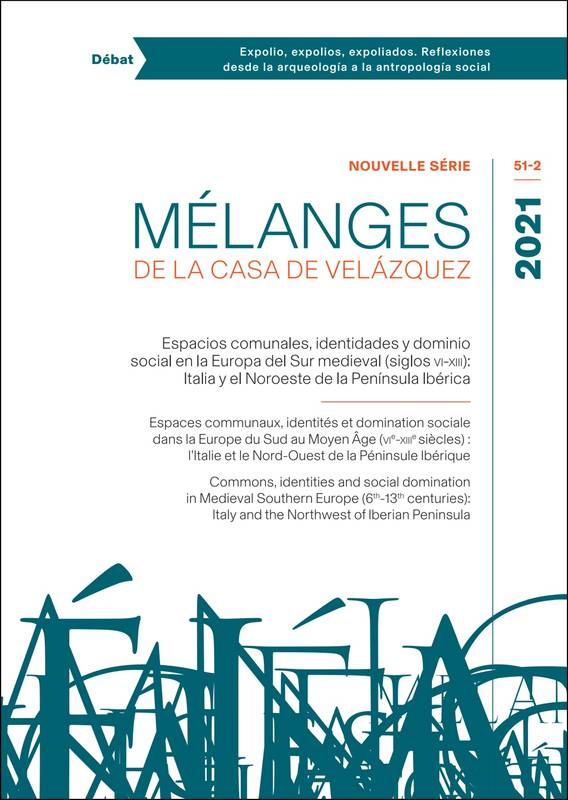
Publication — « Espacios comunales, identidades y dominio social en la Europa del Sur medieval (siglos VI-XIII). Italia y el Noroeste de la Península Ibérica »

Ce dossier est consacré à l’analyse, par le biais de la documentation écrite, des espaces d’exploitation communale au Moyen Âge dans la Méditerranée Occidentale, en proposant des différents cas d’étude provenant de la Péninsule Ibérique et la Péninsule Italique. Le but est d’identifier les formes prises par ces usages communaux et leur évolution dans le temps. Tout en cernant la recherche sur trois axes fondamentaux, il s’agit de connaître les dynamiques de gestion de ces espaces, leur rôle dans la création des identités au niveau local et les formes d’articulation des modalités de domination sociale qui préservaient ces usages communautaires. Ces objectives ont été associés à une vision comparative entre régions très différentes les unes des autres et à une perspective qui primait la « longue durée » et qui couvrait la période entre les temps post-romaines et le début de l’époque moderne. Le dossier proposé s’inscrit dans le cadre des recherches réalisées par des chercheurs provenant du Nord de l’Europe (De Moor, Kuyzer), mais on revendique en même temps le rôle de la Méditerranée Occidentale comme lieu pour l’étude des usages communaux médiévaux.

Table des matières :

Iñaki Martín Viso
Presentación

Pablo C. Díaz
Cerdos y otras bestias. Pastos comunales/pastos públicos en la Lex Visigothorum

Esther Pascua Echegaray
Usos colectivos, mancomunales y ganadería a través del Becerro Galicano de San Millán de la Cogolla

Iñaki Martín Viso
Mancomunales, identidad comunitaria y economía moral en el norte de la Península Ibérica (siglos X-XII)

Vito Loré
Sull’origine dei demania meridionali: un’ipotesi

Francesco Violante
Spazi a gestione comune nella Puglia centrale tra xi e xiii secolo: il caso della controversia tra Bitetto e Grumo

Riccardo Rao
Svolta ambientale, istituzionalizzazione e valorizzazione nella gestione dei beni comuni nei contesti fluviali e alpini dell’Italia settentrionale (XII-XIII secolo)

Anna María Stagno, Carlos Tejerizo García
La materialidad de lo común: apuntes para una aproximación arqueológica a los comunales en el sur de Europa

MISCELLANÉES

Davide Maffi
El nadir de un modelo. La crisis del sistema de reclutamiento en Italia por asiento en la segunda mitad del siglo XVIII

Vanina Marchi van Cauwelaert
Giudice di Cinarca et Mariano II d’Arborea. À l’origine du parti aragonais en Corse et en Sardaigne (1245-1297)

Marcela Ternavasio
Crisis de los imperios ibéricos y conexiones transatlánticas. Las disputas por la Banda Oriental del Río de la Plata en el concierto europeo de la Restauración

Javier Jiménez Ávila, Alfredo Mederos Martín
Acebuchal «Lapidados-5» y los broches de cinturón de pivotes en el Bajo Guadalquivir orientalizante

ACTUALITÉ DE LA RECHERCHE

Débats
Expolio, expolios, expoliados. Reflexiones desde la arqueología a la antropología social

Informations pratiques :

Espacios comunales, identidades y dominio social en la Europa del Sur medieval (siglos VI-XIII). Italia y el Noroeste de la Península Ibérica, Madrid, Casa de Velázquez, 2021 (Mélanges de la Casa de Velázquez no 51-2). 329 p., 17 x 24 cm. 32 € ISBN 9788490963579.

Source : Casa de Velázquez

Publié dans Publications | Laisser un commentaire

Prix – The Marjorie Chibnall Essay Prize

Submissions are now being sought for the 2022 Marjorie Chibnall Essay Prize, offered in memory of the former director of the Battle Conference on Anglo-Norman Studies and co-founder of the Allen Brown Memorial Trust. It is awarded for an unpublished scholarly paper based upon original research and relating to the study of the Anglo-Norman world, broadly defined, between c. 850 and c. 1250.

Candidates for the Prize are normally expected to be doctoral students in a recognised institution of Higher Learning, or within two years of having completed a doctorate (from the date the degree was awarded).

The winning paper will be awarded a place at the 2022 Battle Conference on Anglo-Norman Studies, to take place in Bonn between 21 and 26 July; the conference registration fee and expenses to a certain level will be covered. It is a condition of the Prize that the paper should be delivered at the conference following its award, and be submitted for exclusive publication in Anglo-Norman Studies.

The paper should be written in English, up to 8000 words in length (including footnotes), and be prepared to a consistent form of citation.

Candidates should send a covering letter, an abstract (between 200 and 250 words) of their paper, and their entry itself, to The Hon. Secretary of the Allen Brown Memorial Trust, Ms Caroline Palmer, via an email attachment to Cpalmer@boydell.co.uk with the three documents combined into one file. The letter should make a statement as to the originality of the work; an indication of how the candidate qualifies for entry to the competition; agreement to the terms of the Prize competition; and name, postal address, email address, and institutional details.

Entries must be submitted by 1 March 2022. Previously unsuccessful candidates may reapply, but must address a new topic.

The winner will be announced in early April, the work having been judged by a selection committee made up of representatives of the Trust; their decision will be final and no correspondence will be entered into. The Trustees reserve the right not to make an award should no essay of sufficient quality be entered.

It is planned to include a poster session for ECRs during the conference. For further details please contact Dr Leonie Hicks: leonie.hicks@canterbury.ac.uk,

Publié dans Prix | Laisser un commentaire

Publication – Mary B. Cunningham, « The Virgin Mary in Byzantium, c.400-1000 »

Mary B. Cunningham, University of Nottingham

Informations pratiques :

Mary B. Cunningham, The Virgin Mary in Byzantium, c.400-1000, Cambridge, Cambridge University Press, 2021. 23 ,( x 16 cm. ISBN : 9781108845694. PRix GBP : 75,00.

Source : Cambridge University Press

Publié dans Publications | Laisser un commentaire

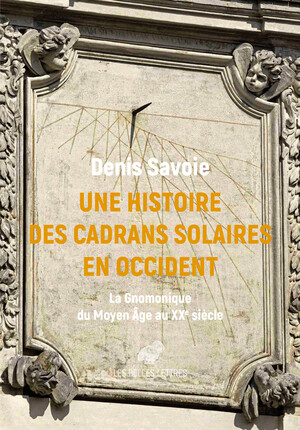
Publication — Denis Savoie, « Une Histoire des cadrans solaires en Occident. La Gnomonique du Moyen Âge au XXe siècle »

800 cadrans solaires de l’Antiquité sont connus et conservés dans les musées. Il en existe des dizaines de milliers en Europe construits entre le Moyen Âge et aujourd’hui. La France en compte à elle seule plus de 32 000. La grande majorité fonctionne encore sur les églises, dans les jardins, sur les bâtiments publics ou sur les maisons privées.

Dans Une histoire des cadrans solaires en Occident, Denis Savoie rappelle l’héritage de la gnomonique gréco-romaine puis examine les réalisations médiévales qui traduisent le net recul de l’astronomie en Occident. Un profond changement s’amorce dans la mesure du temps à la fin du Moyen Âge et au début de la Renaissance, avec l’apparition des horloges mécaniques et l’abandon des heures antiques. Le développement des mathématiques, la diffusion des premiers ouvrages imprimés au XVIe siècle, l’augmentation de la précision des cadrans sur lesquels se règlent désormais les horloges, tous ces facteurs contribuent à massivement diffuser ces instruments qui vont pour longtemps rester la seule façon de connaître l’heure dans les villes et les campagnes.

Les cadrans solaires deviennent un domaine de recherche inépuisable et il s’en construit de nombreux types, des portables luxueux de poche jusqu’aux méridiennes dans les cathédrales en passant par les simples cadrans qui ornent les façades. Même si le XIXe siècle les relègue au second plan, les cadrans solaires n’ont jamais cessé d’être à la fois des objets d’art souvent ornés de devises et des instruments scientifiques et pédagogiques indispensables à la compréhension des mouvements du Soleil.

Synthèse unique de la gnomonique, cette Histoire des cadrans solaires, richement illustrée, nous fait découvrir toutes les facettes d’un instrument qui remonte aux débuts de l’astronomie.

Denis Savoie, historien des sciences, est conseiller scientifique à Universcience (Palais de la Découverte & Cité des Sciences et de l’Industrie) et chercheur associé à l’Observatoire de Paris (Syrte). Il a présidé pendant vingt ans la Commission des cadrans solaires.

Table des matières :

Préface, par Anthony Turner

Introduction

Chapitre 1. Les différents types d’heures : antiques, équinoxiales, italiques, babyloniques

Chapitre 2. Rappels sur les cadrans solaires antiques

Chapitre 3. La gnomonique du VIIe au XIIIe siècle
Les tables d’ombre
Les cadrans médiévaux
Le cylindre portatif et les quadrants anciens

Chapitre 4. La gnomonique du XIVe au XVIe siècle
L’apparition du style polaire en Occident
Les cadrans de hauteur
Les cadrans portables avec boussole
Le nocturlabe
Les premiers ouvrages de gnomonique
Les instruments pour tracer les cadrans solaires

Chapitre 5. La gnomonique au XVIIe siècle
Les cadrans d’azimut
Cadran en projection stéréographique
Les cadrans analemmatiques

Les tables gnomoniques et le calcul trigonométrique
Les méridiennes astronomiques
Trois grands noms de la gnomonique
Ozanam : la gnomonique récréative
Kircher : la gnomonique baroque
La Hire : la gnomonique universelle

Chapitre 6. La gnomonique au XVIIIe siècle
Histoire de l’équation du temps
Les méridiennes horaires
Les méridiennes de temps moyen
Les ouvrages de référence

Chapitre 7. La gnomonique au XIXe siècle
Gnomonique et géométrie descriptive
L’adaptation des cadrans solaires face aux modifications de l’heure
Les cadraniers
Les premiers travaux en histoire de la gnomonique

Chapitre 8. La gnomonique au XXe siècle
Les cadrans comme objets sociaux et patrimoniaux
Trois inventions gnomoniques

Annexes
Jean Fusoris
Henri Arnault

Notes de fin
Glossaire
Bibliographie gnomonique
Table des figures
Index

Informations pratiques :

Denis Savoie, Une Histoire des cadrans solaires en Occident. La Gnomonique du Moyen Âge au XXe siècle, Paris, Les Belles Lettres, 2021. 312 p., 21,5 x 15 cm. ISBN : 9782251452319. Prix : 26,50 euros.

Source : Les Belles Lettres

Publié dans Publications | Laisser un commentaire

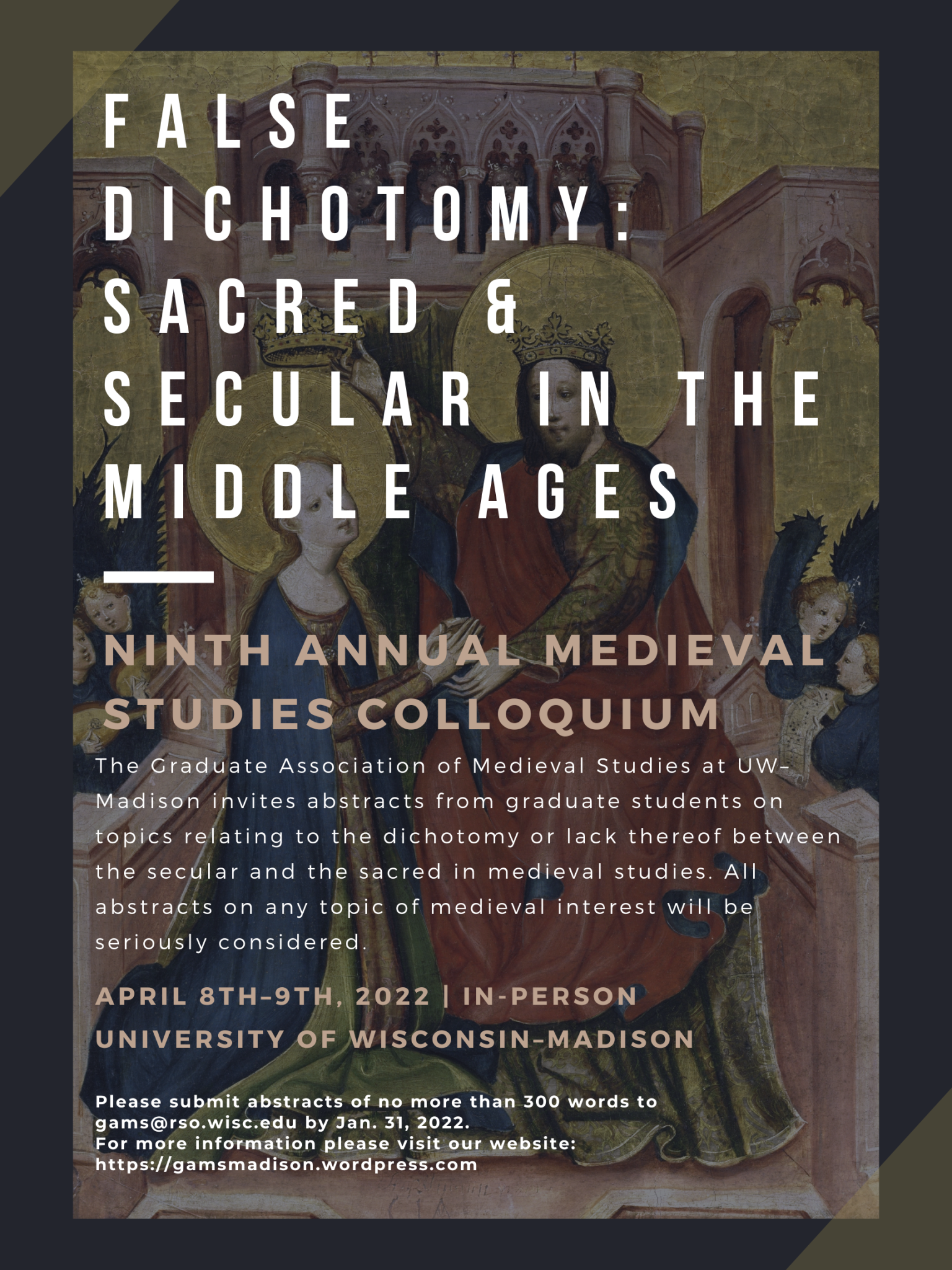
Appel à contribution – False Dichotomy: Sacred & Secular in the Middle Ages

9th Annual Medieval Studies Colloquium
UW–Madison
Deadline: 31 December, 2021

The Medieval Studies Colloquium is an annual event which takes place on UW–Madison’s campus each spring. The Colloquium offers an opportunity for graduate students in multiple disciplines to present their research in the various fields of medieval studies, share and receive feedback, and participate in discussion on topics of interest with peers from a wider, interdisciplinary community of Medieval Studies scholars, without the restrictions of membership or registration fees.

Ninth Annual Medieval Studies Colloquium: The call for papers for the Ninth Annual Medieval Studies Colloquium “False Dichotomy: Sacred & Secular in the Middle Ages” is now open. The colloquium will take place Friday, April 8th and Saturday, April 9th, 2022, in-person at the University of Wisconsin–Madison. Information about our keynote lectures and workshops will be posted soon.

The Graduate Associations of Medieval Studies (GAMS) at UW–Madison invites abstracts from graduate students on topics relating to the dichotomy or lack thereof between the secular and the sacred in medieval studies. All abstracts on any topic of medieval interest will be seriously considered.

Please submit abstracts of no more than 300 words to gams@rso.wisc.edu by January 31st, 2022.

Source : Medieval Art Research

Publié dans Appel à contributions | Laisser un commentaire

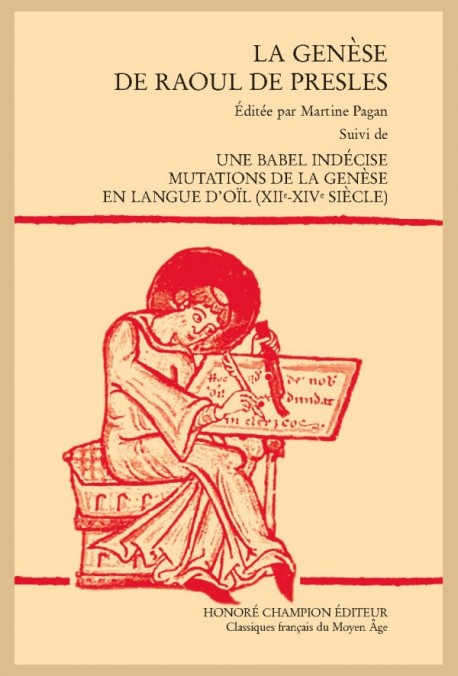
Publication – « La genèse de Raoul de Presles ». Éditée par Martine Pagan. Suivi de « Une Babel indécise. Mutation de la Genèse en langue d’oïl (XIIe-XIVe siècle) »

Raoul de Presles est le dernier traducteur en français de la Bible avant l’apparition de l’imprimerie. Il a été injustement traité par l’historiographie qui a voulu voir en lui un simple plagiaire, au point que son oeuvre biblique était restée inédite. Cette édition de la Genèse le réhabilite dans sa dimension de traducteur original et d’exégète. L’ascèse philologique autorise l’audace herméneutique. Aussi, à l’horizontalité de l’édition convenait-il d’adjoindre la verticalité d’un sondage sur les diverses versions françaises de l’épisode de Babel entre le XIIe et le XIVe siècle. Il en ressort que la célèbre péricope n’est pas perçue dans ce corpus selon les schémas aujourd’hui dominants, hérités de la Renaissance. Le traitement du motif, particulièrement indécis et sujet à de multiples ambiguïtés, invite à revisiter une interprétation de Babel que la tradition a figée.

Martine Pagan, après avoir enseigné l’ancien français et l’histoire de la langue française comme MCF HDR à l’Université Paris IV (Sorbonne Université), dont elle est aujourd’hui émérite, est professeure de Langue et Culture françaises à l’Alma Mater de Bologne. Ses recherches conjuguent l’histoire des textes et une approche psychanalytique de leur contenu.

Informations pratiques :

La genèse de Raoul de Presles. Éditée par Martine Pagan. Suivi de Une Babel indécise. Mutation de la Genèse en langue d’oïl (XIIe-XIVe siècle), Paris, Honoré Champion, 2021 (Classiques français du Moyen Âge, 196). 544 p., 11 x 17,5 cm. ISBN : 9782745356055. Prix : 35 euros.

Source : Honoré Champion

Publié dans Le réseau | Laisser un commentaire

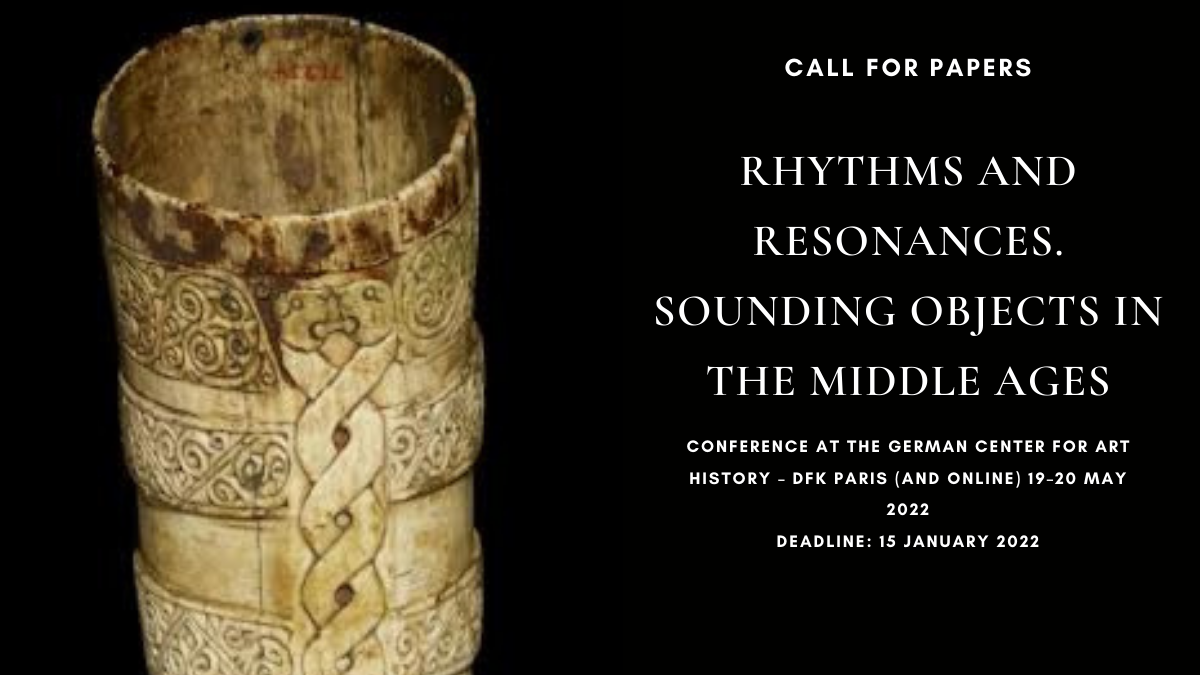
Appel à contribution – Rhythms and Resonances. Sounding Objects in the Middle Ages

Conference at the German Center for Art History – DFK Paris (and online)
May 19–20, 2022

Organization:
Philippe Cordez (Centre allemand d’histoire de l’art – DFK Paris)
Rebecca Müller (Ruprecht-Karls-Universität Heidelberg)
Joanna Olchawa (Goethe-Universität Frankfurt am Main)

According to ancient legend, one day Pythagoras was walking past a forge and heard four hammers pounding irons on an anvil. The sound of the instruments of varying weights and the resulting divergent rhythms and intervals are said to have led him to a theory of harmony and, in turn, to the foundation of music theory. The story circulated widely in the Middle Ages in writings on music theory, as well as in songs and pictorial representations.

Medieval objects that either sound or symbolize sound find their place within historically and culturally inflected notions of the interconnectivity of earthly life and cosmic harmony. The medievalist Jean-Claude Schmitt (Les rythmes au Moyen Âge, Paris 2016) and the sociologist Hartmut Rosa (Resonance: A Sociology of Our Relationship to the World, Cambridge 2019) have recently shown, in different ways, how concepts of rhythm and resonance are applicable to comprehensive considerations of human society. In this sense, rhythmically moving and vibrating objects that, in their reception, generate physical and cognitive resonance can claim a vital role in and make a decisive contribution to shaping, experiencing, and negotiating social and world orders.

This interdisciplinary conference is dedicated to objects from the medieval period that produce music, repetitive sounds, or tones – from bells and organs, musical instruments, and sounding automata to the coins in one’s wallet. Also crucial is the question of how such sounds are “echoed” in ornament, images, and texts. In what terms might we describe and understand the relationship of object-generated sound to sight, touch, and other senses, as well as to voice and narration? In objects and architectures, how are sounds designed, staged, and received through movements and rituals? What intentions and meanings are conveyed in this way?

Submissions are welcome from history and art history, literary studies, musicology, cultural anthropology, and the fields of Sound History and Sensory Studies. Please send an abstract, not exceeding one page in length, to pcordez@dfk-paris.org, r.mueller@zegk.uni-heidelberg.de, and olchawa@kunst.uni-frankfurt.de by January 15, 2022.

Source : Medieval Art Research

Publié dans Appel à contributions | Laisser un commentaire