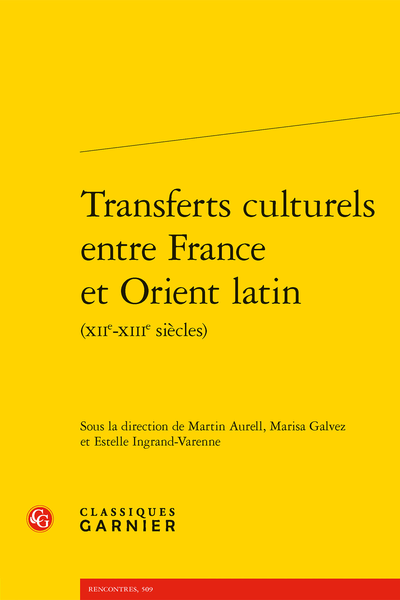
Publication — « Transferts culturels entre France et Orient latin (XIIe-XIIIe siècles) », dir. Martin Aurell, Marisa Galvez, Estelle Ingrand-Varenne

Comment comprendre les relations entre France et Orient au Moyen Âge ? La méthode des transferts culturels permet de réfléchir aux circulations et interactions des langages, idées, biens et modes de vie, dans le va-et-vient incessant entre mondes latin, byzantin et arabo-musulman aux XIIe-XIIIe siècles.

Table des matières : ici

Informations pratiques :

Transferts culturels entre France et Orient latin (XIIe-XIIIe siècles), dir. Martin Aurell, Marisa Galvez, Estelle Ingrand-Varenne, Paris, Classiques Garnier, 2021 (Rencontres, n° 509 ; Histoire, n° 10). 461 pages. ISBN : 978-2-406-11405-5. Prix : 36 euros.

Source : Classiques Garnier

Publié dans Publications | Laisser un commentaire

Offre d’emploi – Assistant Professor in Medieval History (1.0 FTE)

The Department of History and Art History seeks to appoint an Assistant Professor in Medieval History. The position involves 0.7 FTE teaching and 0.3 FTE research activities. 

Profiel

The successful candidate will have:

  • a PhD degree in Medieval History;
  • a proven track record of research in late Medieval History relative to the Low Countries, with attention to urban history, as shown in the candidate’s publication record;
  • substantial experience in teaching European Medieval History and global Medieval History, as shown by a list of courses taught, supervised, and organized, at BA, MA, and PhD level;
  • organizational experience and willingness, in time, to act as Secretary for a section of Medieval History.

Utrecht University has a teaching qualification system for University Lecturers, and candidates are required to obtain the Basic Teaching Qualification (BKO) within two years if they are not already in possession of one. Candidates are expected to be proficient in both Dutch and English; non-Dutch candidates will need to master the Dutch language on an academic level within two years.

Aanbod

We offer a temporary position (1.0 FTE) as of 1 February 2022 at the latest, for a period of one year. In case of good performance, the employment will become permanent. The gross salary – depending on previous qualifications and experience  – ranges between €3,746 and €5,862 (scale 11-12 according to the Collective Labour Agreement Dutch Universities) per month for a full-time employment. Salaries are supplemented with a holiday bonus of 8% and a year-end bonus of 8.3% per year. In addition, Utrecht University offers excellent secondary conditions, including an attractive retirement scheme, (partly paid) parental leave and flexible employment conditions externe link (multiple choice model). More information about working at Utrecht University externe link can be found here.

Over de organisatie

A better future for everyone. This ambition motivates our scientists in executing their leading research and inspiring teaching. At Utrecht University externe link, the various disciplines collaborate intensively towards major societal themes. Our focus is on Dynamics of Youth, Institutions for Open Societies, Life Sciences and Sustainability.

The Faculty of Humanities  externe linkhas around 6,000 students and 900 staff members. It comprises four knowledge domains: Philosophy and Religious Studies, History and Art History, Media and Culture Studies, and Languages, Literature and Communication. With its research and education in these fields, the faculty aims to contribute to a better understanding of the Netherlands and Europe in a rapidly changing social and cultural context. The enthusiastic and committed colleagues and the excellent amenities in the historical city center of Utrecht, where the faculty is housed, contribute to an inspiring working environment.

Aanvullende informatie

For more information about this position, please contact: Prof. Marco Mostert externe link (Head of the section of Medieval History), via m.mostert@uu.nl externe link.

Solliciteren

Everyone deserves to feel at home at our university. We welcome employees with a wide variety of backgrounds and perspectives. To apply, please send your curriculum vitae, including a letter of motivation via the ‘apply’ button below. The letter of motivation (max. 2 A4) should at least contain a concise reflection on the candidate’s general teaching objectives and methods, as well as a short outline of the candidate’s research plans for the coming years.

Candidates who will be selected for an interview will be requested to provide two letters of recommendation and evaluations of their teaching.

Initial interviews may be conducted via Teams. Interviews are scheduled to take place on 3 November (first round) and 8 November (second round).

Acquisition in response to this vacancy is not appreciated.

Uiterlijk reageren op 11 oktober 2021.

Source : Universiteit Utrecht

Publié dans Offre d'emploi | Laisser un commentaire

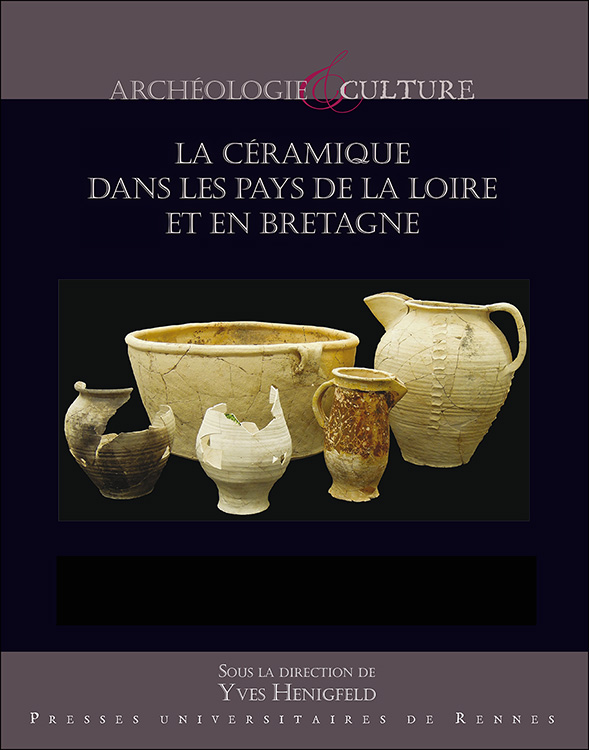
Publication – « La céramique dans les Pays de la Loire et en Bretagne », dir. Yves Henigfeld

Cet ouvrage présente les résultats d’un projet collectif de recherche ayant mobilisé, de 2012 à 2017, une trentaine de chercheurs de l’université, du CNRS, de l’Inrap, des collectivités territoriales et du secteur associatif ou privé. Le corpus est constitué de plusieurs centaines de milliers de tessons correspondant à environ 55 000 objets provenant de 51 sites de production et de consommation, répartis sur 32 communes.

En deux volumes, sous coffret.

Avec le soutien du ministère de la Culture, de l’Inrap et de l’université de Nantes.

Table des matières : ici

Informations pratiques :

La céramique dans les Pays de la Loire et en Bretagne. La céramique dans les Pays de la Loire et en Bretagne, dir. Yves Henigfeld, Rennes, Presses universitaires de Rennes, 2021 (Archéologie et Culture). 864 pages, 21,8 x 28 cm. ISBN : 978-2-7535-8172-2. Prix : 69 euros.

Source : Presses universitaires de Rennes

Publié dans Publications | Laisser un commentaire

Publication – Mathias Kluge, « Verschuldete Könige. Geld, Politik und die Kammer des Reichesim 15. Jahrhundert »

Die vorliegende Studie analysiert die Funktionalität und Wirkung des Agierens mit Krediten im Kontext der politischen Ordnung des 15. Jh. Ausgangspunkt ist die Entstehung neuer Mechanismen der Politik, die den Finanzbedarf weit über die verfügbare Geldmenge wachsen ließen. Sie machten das 15. Jh. zum Jahrhundert der verschuldeten Könige. Europas Kronen wurden mit Krediten erworben und zur Sicherung von Krediten verpfändet. Die Stadt mit ihren Kaufleuten und Juden wurde zum Schauplatz und Überlieferungsträger einer Reichspolitik, deren Funktionalität nun wesentlich auf Kreditverhältnissen gründete. Gegenüber der älteren Forschung, in der die Geschichte der Kammer und des königlichen Agierens mit Schuld und Kredit erfolgsorientiert aus ökonomischer und verwaltungshistorischer Perspektive betrachtet wurde, bietet die Studie eine funktions- und wirkungsorientierte Analyse. Sie erhellt eine dunkle Seite finanzhungriger Reichspolitik, indem der königliche Umgang mit Geld nicht nach wirtschaftsökonomischen Prinzipien, sondern im Kontext politischer und repräsentativer Zwecksetzung untersucht wird. Dabei tritt die Geschichte derjenigen in den Vordergrund, die Geld brauchten oder es unter politischem Druck verloren. Der wachsende Finanzierungsdruck führte zur Entstehung neuer Formen der Reichspolitik, die der Kredit überhaupt erst ermöglichte. Sie prägten die folgenden Jahrhunderte.

Table des matières : ici

Informations pratiques :

Mathias Kluge, Verschuldete Könige. Geld, Politik und die Kammer des Reichesim 15. Jahrhundert, Wiesbaden, Harrassowitz Verlag, 2021 (Monumenta Germaniae Historica, Schriften 77). LIV, und 562 S. 8°. 2021. ISBN 978-3-447-11569-8 Ln. EUR 90, —

Source : Monumenta Germaniae Historica

Publié dans Publications | Laisser un commentaire

Publication — « Historiography and Identity VI: Competing Narratives of the Past in Central and Eastern Europe, c. 1200 —c. 1600 », dir. Pavlina Rychterová

The volume discusses narratives of identification in late Medieval eastern central Europe written in Latin as well as in various vernaculars emerging as the new political languages in the time.

The volume discusses Central European and Eastern Central European historiographies of the High and Late Middle Ages. It deals with histories written in a time which brought about a profound differentiation of medieval societies in these regions. As new social classes achieved economic and political power, the demand for reassuring identifications grew more pressing. Narratives of the past were tailored specifically for distinct social groups, often using vernacular languages instead of the universal language of elite education, Latin.

The volume pays attention to the interplay between languages and focuses on the strategies that individual works developed in order to balance the many alternative modes of identification. Filling a significant scholarly gap, the volume offers important insights into narratives of identification written in Latin and in the various vernaculars emerging as the new political languages of the period.

Table des matières :

Introduction — PAVLINA RYCHTEROVÁ AND DAVID KALHOUS

A Past that never was: Creating collective identities

The Terms ‘Polans’, ‘Poles’, ‘Poland’, and their Historiographical Context in Medieval Poland and Rus’ — PAWEŁ ŻMUDZKI

People, Realm, and Dynasty in the Fourteenth Century – Chronica de gestis Hungarorum — JÁNOS M. BAK

Master Vincent and his Making of the Oldest History of the Lechites-Poles  — JACEK BANASZKIEWICZ

Narrating for Specific Communities? The Case of the Österreichische Chronik von den 95 Herrschaften  — MATTHIAS MEYER

How to Create a Hussite Identity? The Hussite Chronicle by Lawrence of Březová  — PAVLÍNA CERMANOVÁ

The Realm and its People: Re-writing Political Identities

The Hungarian-Polish Chronicle as the Polish-Hungarian Perspective on the Earliest Hungarian and Polish History — RYSZARD GRZESIK

The Chronicle of the so-called Dalimil and its Concept of Czech Identity — PAVLÍNA RYCHTEROVÁ

Literary Reminiscences in the Characterization of the Bohemian King Wenceslas II (1283–1305) and his Contemporaries in Ottokar from the Geul’s Styrian Rhymed Chronicle — VÁCLAV BOK

Slavonic and Czech Identity in the Chronicon Bohemiae by Přibík Pulkava of Radenín — VÁCLAV ŽŮREK AND PAVLÍNA RYCHTEROVÁ

The Rhymed German Translation of the Chronicle of the So-Called Dalimil and its Strategies of Identification — VLASTIMIL BROM

From Dynasty to Noble Identity: The Development of the Historical Tradition in the Chronicles of the Grand Duchy of Lithuania in the Fifteenth and Sixteenth Centuries  — RIMVYDAS PETRAUSKAS


Local and Regional Identities in a Dialogue

Versus Lubenses: Ethnic Differences, Political Identification, and the Cohesion of Social Groups in Thirteenth- and Fourteenth-Century Silesia  — PRZEMYSŁAW WISZEWSKI

Affective Strategies for Narrating Community: Jans (the) ‘Enikel’’s Fürstenbuch — CHRISTINA LUTTER

Historical Memory and Local Identity: Jan Długosz and the Church in Cracow  — PIOTR WĘCOWSKI

The Chronicles of the Teutonic Order in Prussia in the Fourteenth and Fifteenth Centuries — MARCUS WÜST

Annals, Chronicles, and Saints: Monastic Narratives in Early Austrian Historiography and their Perception by Local Elites — MARTIN HALTRICH

Adam a German? The Ethnic Element in Swabian Chronicles of the Fifteenth Century  — JÖRG SONNTAG

Index

Informations pratiques :

Historiography and Identity VI: Competing Narratives of the Past in Central and Eastern Europe, c. 1200 —c. 1600, dir. Pavlina Rychterová, Turnhout, Brepols, 2021 (Cultural Encounters in Late Antiquity and the Middle Ages, 32). XII+468 p., 156 x 234 mm, 2021 ISBN: 978-2-503-58545-1. Prix : 120 euros.

Source : Brepols

Publié dans Publications | Laisser un commentaire

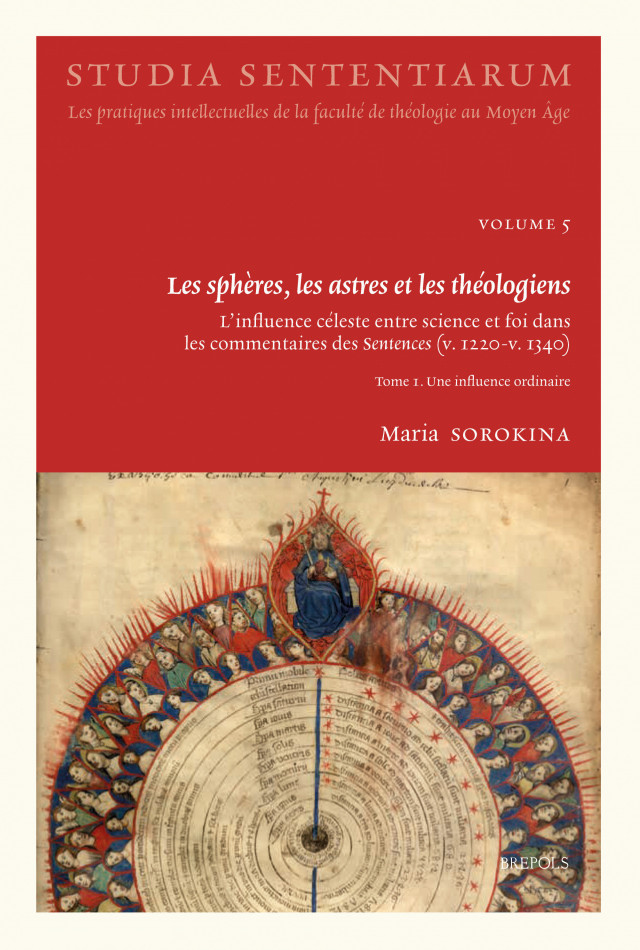
Publication — Maria Sorokina, « Les sphères, les astres et les théologiens. L’influence céleste entre science et foi dans les commentaires des Sentences (v. 1220 – v. 1340) »

Pour la totalité des savants médiévaux, les sphères et astres causent de multiples phénomènes terrestres, des événements météorologiques jusqu’aux changements dans le corps humain. Mais qu’en disent les théologiens ? Ce livre propose la première reconstitution de la théorie de l’influence céleste à partir d’une analyse exhaustive du corpus des commentaires des Sentences (v. 1220-v. 1340). Non seulement ces auteurs adhèrent à la doctrine de la causalité céleste, mais aussi ils prônent une approche originale. D’une part, ils traitent de l’influence « ordinaire », celle des corps supérieurs connus des astronomes : son étendue, ses mécanismes, ses limites. D’autre part, ils dépeignent une influence « hors normes », celle des sphères, des planètes et des étoiles dont l’existence est postulée par la foi chrétienne : le ciel empyrée, demeure des bienheureux, ou les corps célestes métamorphosés par l’Apocalypse. Dotés, à première vue, de propriétés contraires à l’ordre naturel, ces cieux sont néanmoins décrits avec la philosophie naturelle aristotélicienne. La théologie s’adapte donc à la science, mais en renouvelant cette dernière : en englobant le cas des cieux « atypiques », la théorie de l’influence céleste en ressort profondément modifiée. Il s’agit d’une clé pour comprendre l’innovation du savoir scientifique médiéval et, peut-être, pour penser les évolutions scientifiques ultérieures.

Ce livre est la version retravaillée d’une thèse de doctorat distinguée par deux prix : le prix Daniel et Michel Dezès (décerné par le Comité français des sciences historiques sous l’égide de la Fondation de France) et le prix de la Société française d’histoire des sciences et des techniques (SFHST).

Maria Sorokina (docteur, Université Paris-Est, 2017 ; chercheuse postdoctorale, De Wulf-Mansion Centre, KU Leuven) est une historienne des sciences médiévales ; ses recherches portent, en particulier, sur le problème des rapports entre science et foi.

Table des matières :

Introduction

Partie I : Une influence ordinaire. Les corps célestes comme causes

Chapitre 1 :  An sit ? L’existence de l’influence céleste : les arguments d’usage et leur remise en cause

Chapitre 2 : Qualis sit ? Les effets et les typologies des influences célestes

Chapitre 3 : Quomodo sit ? Les modalités de l’influence céleste

Section : L’influence céleste et ses limites

Chapitre 4 : L’influence céleste dans le monde supralunaire

Chapitre 5 : Les effets contingents des causes nécessaires : les corps célestes face aux causes secondes

Chapitre 6 : Les corps célestes et les êtres vivants : l’origine des âmes corruptibles

Chapitre 7 : Le libre arbitre face à l’influence céleste : la théorie de l’inclinatio

Partie II : Une influence ordinaire. Les corps célestes comme signes

Chapitre 8 : Ut sint in signa et tempora. Les signes peuvent-ils être des causes ?

Chapitre 9 : « Les signes dont l’observation est une vanité ». L’astrologie dans les commentaires des Sentences

Partie III : Une influence céleste « hors normes » : le cas du ciel empyrée

Chapitre 10 : Le ciel empyrée : l’existence et la causalité en question

Chapitre 11 : Un ciel pour la vie future ? Un argument « théologique » contre l’influence de l’empyrée

Chapitre 12 : L’immobilité, l’obstacle principal à l’influence de l’empyrée ?

Chapitre 13 : Une lumière sans rayons : une autre menace pour la théorie de l’influence de l’empyrée ?

Section : Les effets de l’empyrée

Chapitre 14 : Pour l’influence de l’empyrée : cadre général de l’argumentation

Chapitre 15 : L’empyrée comme lieu de l’univers. Une preuve incertaine de l’influence de l’ultime sphère

Chapitre 16 : Le ciel empyrée et les autres sphères

Chapitre 17 : L’empyrée et et la vie humaine : la lumière de l’ultime sphère dans l’union de l’âme et du corps

Chapitre 18 : Le sel à Poitiers, les lions en Afrique et d’autres effets d’un ciel immobile

Partie IV : Une influence céleste « hors normes » : les corps célestes à la fin des temps

Chapitre 19 : Le monde supralunaire à la veille de l’Apocalypse : les signes célestes et le feu purgatoire

Chapitre 20 : Lux solis erit septempliciter. La lumière accrue des derniers temps et l’influence céleste

Chapitre 21 : Les corps célestes doivent-ils s’arrêter ? Le repos du ciel comme nécessité 

Chapitre 22 : Les corps célestes peuvent-ils s’arrêter ? Le repos du ciel comme possibilité 

Chapitre 23 : Immobilité céleste, immobilité terrestre ? Le repos des corps supérieurs et l’existences des corps inférieurs

Chapitre 24 : La fin des temps comme fin d’un cycle cosmique. La position des corps célestes après le Jugement dernier

Chapitre 25 : Le meilleur des mondes. L’ici-bas après l’arrêt des corps célestes

Conclusion générale

Annexe : Notices bio-bibliographiques sur les commentaires des Sentences

Sources et bibliographie
Indices

Informations pratiques :

Maria Sorokina, Les sphères, les astres et les théologiens. L’influence céleste entre science et foi dans les commentaires des Sentences (v. 1220 – v. 1340), Turnhout, Brepols, 2021 (Studia Sententiarum, 5). 2 vol., XXVI+1306 p., 156 x 234 mm. ISBN: 978-2-503-59086-8. prix : 120 euros.

Source : Brepols

Publié dans Publications | Laisser un commentaire

Appel à contribution — Identity Abroad in Central and Late Medieval Europe and the Mediterranean

(A Two-Day Interdisciplinary Conference for Postgraduates and Early Career Researchers)

7-8 January 2022, Cambridge

Keynote Speakers: Prof. Miri Rubin (Queen Mary University, London),

Roser Salicrú i Lluch (Institució Milà i Fontanals), Teresa Shawcross (Princeton University)

Life in the central and late Middle Ages was characterised by high levels of mobility and migration. Developments in manufacturing, trade, education, and diplomacy, as well as political and religious conflict and persecution encouraged and at times forced various individuals and groups to move ‘abroad’, permanently or temporarily, to places nearby or further afield. Each had their own different socio-economic background, political allegiance, language, cultural heritage, and faith.

The position and impact of these ‘foreigners’ in societies across Europe and the Mediterranean has been widely discussed. However, what is less discussed is how these individuals and groups understood and (re)presented themselves. Our conference seeks to explore the construction, expression, and practical significance of different forms of ‘social identity’ among individuals and groups living ‘abroad’ in Europe and the Mediterranean in the period between the eleventh and the fifteenth century.

We invite abstracts for papers of up to 20 minutes from graduate and early career researchers working across all relevant disciplines. By bringing together a variety of different perspectives, the conference aims to consider not only how ‘identity abroad’ functioned in specific contexts, but also to identify and emphasise developments, patterns, and divergences. This will allow us to reflect more broadly on how the topic can be approached in the pre-modern period and beyond, speaking to current social challenges in a world which is more mobile than ever.

Topics of interest include, but are not limited to:

  • Individuals and groups living ‘abroad’, such as merchants, labourers and artisans, pilgrims, students, intellectuals, diplomats, courtiers, soldiers and crusaders, exiles, ethnic and religious minorities, and captives and enslaved people
  • Voluntary and forced migration
  • Temporary and permanent migration
  • Relations between different ‘foreign’ individuals and groups
  • Interaction and assimilation/resistance to assimilation with ‘local’ populations, institutions, and rulers
  • Impact of gender, socio-economic background, and other types of differences
  • Expressions of identity, such as textual production and visual and material culture
  • Theoretical explorations of the concepts of ‘identity’, ‘foreignness’, and ‘abroad’ in the Middle Ages

To submit a proposal, please send an abstract of up to 250 words and a short biographical note to identityabroad22@gmail.com no later than 12th September 2021.

Source : Identity Abroad

Publié dans Appel à contributions | Laisser un commentaire

Cycle de conférences – Conférences de la Société d’Art et d’Histoire du Diocèse de Liège 2021-2022

Nous avons le plaisir de vous inviter aux prochaines conférences de la Société qui auront lieu comme de coutume le deuxième mercredi du mois à 17 h 15, au Séminaire épiscopal, rue des Prémontrés, 40 à Liège.

Mercredi 8 septembre 2021.
Elisabeth Terlinden, doctorante à l’Université de Namur
Production et usage du livre dans une abbaye qui se réforme : le cas de Saint-Jacques à Liège au début du XVe siècle

Mercredi 13 octobre 202
Gérard van Haeperen, o.s.b.
Le corps des martyrs des catacombes romaines conservés dans le diocèse de Liège

Mercredi 10 novembre 2020
Yves Charlier, directeur de la Bibliothèque du Séminaire épiscopal de Liège
La traversée d’une œuvre exceptionnelle : La Bible de Léau

Mercredi 8 décembre 2020.
Claudine Schloss, conservateur honoraire à la Ville de Liège
Antoine Dejardin, capitaine du Génie et collectionneur invétéré (1818-1892)

Publié dans Colloque | Laisser un commentaire

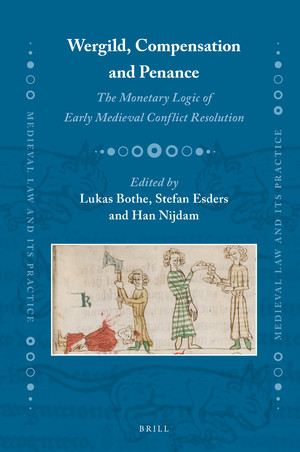
Publication — « Wergild, Compensation and Penance. The Monetary Logic of Early Medieval Conflict Resolution », ed. Lukas Bothe, Stefan Esders, and Han Nijdam

This volume offers the first comprehensive account of the monetary logic that guided the payment of wergild and blood money in early medieval conflict resolution. In the early middle ages, wergild played multiple roles: it was used to measure a person’s status, to prevent and end conflicts, and to negotiate between an individual and the agents of statehood. This collection of interlocking essays by historians, philologists and jurists represents a major contribution to the study of law and society in Western Europe during the early Middle Ages.

Contributors are Lukas Bothe, Warren Brown, Stefan Esders, Wolfgang Haubrichs, Paul Hyams, Tom Lambert, Ralph W. Mathisen, Rob Meens, Han Nijdam, Lisi Oliver, Harald Siems, Karl Ubl, and Helle Vogt.

Table des matières : ici

Informations pratiques :

Wergild, Compensation and Penance. The Monetary Logic of Early Medieval Conflict Resolution, ed. Lukas Bothe, Stefan Esders, and Han Nijdam, Leiden–Boston, Brill, 2021 (Medieval Law and Its Practice, 31). XII–328 p. ISBN : 978-90-04-31510-5. Prix : 143 euros.

Source : Brill

Publié dans Publications | Laisser un commentaire

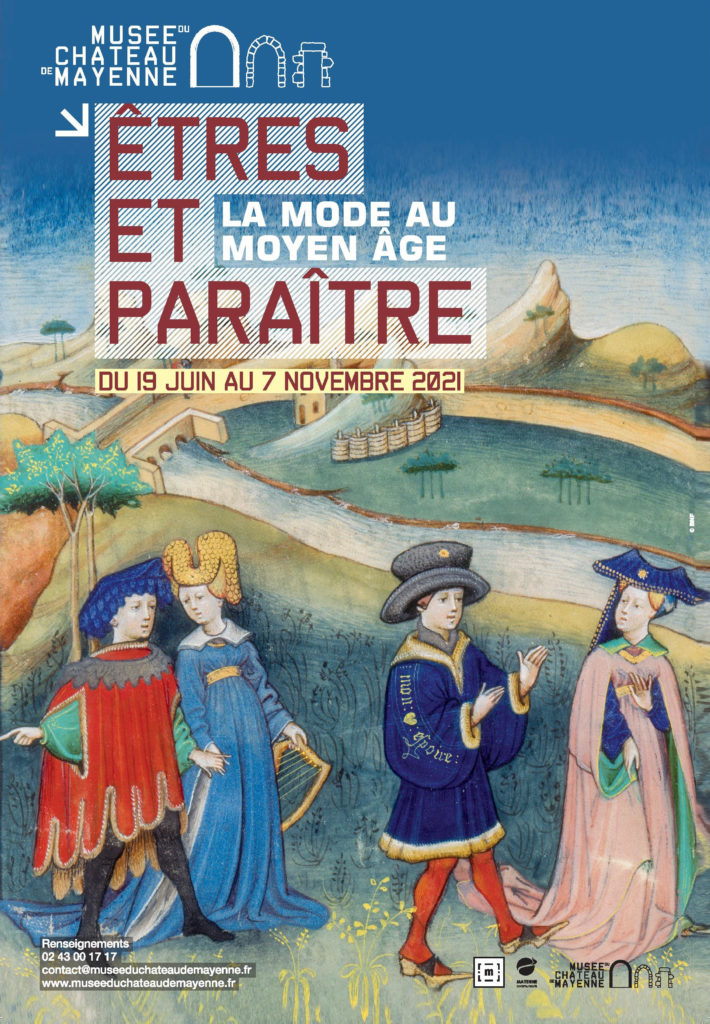
Exposition — Êtres et paraître, la mode au Moyen Âge !

Musée du Château de Mayenne
Du 19 juin au 7 novembre 2021

Une partie de cette exposition a été créée et présentée en 2016 par la Tour Jean Sans Peur (Paris). Elle est agrémentée d’objets archéologiques issus de nos collections et de collections d’autres musées. Certains sont exceptionnellement sortis des réserves du château de Mayenne ! Si les panneaux de la Tour Jean Sans Peur évoquent les vêtements comme élément majeur de la représentation médiévale, les objets archéologiques exposés permettent d’étoffer le propos avec des accessoires liés à la mode (couture, bijoux, objets de toilette…).

Au fil du parcours, de nombreux dispositifs de médiation sont à disposition des familles pour découvrir l’exposition de manière interactive et participative

Source : Musée du Château de Mayenne

Publié dans Exposition | Laisser un commentaire