10h20-10h45 : Marlène Hélias-Baron (IRHT), Les mots de l’eau chez les quatre premières filles de Cîteaux Discutante : Danielle Arribet-Deroin
11h-11h25 : Clémentine Villien (doctorante Université Paris 1), Les abbatiales Franche-Comté, la ressource en pierre (en visio depuis l’Autriche) Discutant : Philippe Bernardi
11h40-12h05 : Merlin Muzellec (doctorant Université de Rennes 2), Les aménagements hydrauliques des abbayes bretonnes Discutant : Benoit Rouzeau
12h20-14h30 : pause méridienne
Session 2 : Varier les approches
14h30-14h55 : Lucile Chamignon (Inventaire Haut-de-France), Les ressources de l’abbaye de Noirlac Discutant : Didier Panfili
15h10-15h35 : François Blary (professeur, Université Libre de Bruxelles), Le moulin à roue verticale de l’abbaye de Preuilly Discutante : Danielle Arribet-Deroin
15h50-16h15 : Marc Viré (INRAP) Le grand logis des Bernardins à Paris : construire en milieu humide Discutante : Danielle Arribet-Deroin
Pause 16h30
16h45-17h : Pierre Brochard et Benoit Rouzeau, Créer et développer une base de données liée aux cisterciens et à leurs ressources Discutante Eliana Magnani (LAMOP-CNRS)
Lancement du numéro spécial de la revue Cîteaux
17h30 : Lancement du numéro de la revue Cîteaux Commentarii cistercienses « Les cisterciens et l’eau » en hommage à Paul Benoit, par Benoit Rouzeau et Alexis Grélois
Welcome to the Medieval French Roads Project. Here you will find a digital map of roads and bridges in France between the 11th and 16th centuries. The map has been created using a variety of primary sources, from well-known itineraries such as the Itinerarium de Brugis and Charles Estienne’s La Guide des Chemins de France, to unpublished manuscript sources
A database has been created which provides essential details about each individual stretch of road and bridge including its century of attestation, source, any notes in the source text, and, where necessary, our own notes.
Using the Map
The map view is customisable by date, source, and by level of detail which allows users to create their own bespoke maps, isolating a particular source or sources, specific centuries, and decide whether to view a simple itinerary of places linked with a straight line or our own recreation of the approximate actual route. These approximate routes have been created by reference to the medieval sources themselves, topographical features, historical maps, and the modern road network. The medieval walls, gates and major internal roads of important towns and cities have also been digitised to provide users with a better impression of the size of medieval settlements and their place in the road network. The database entry for each feature (whether route, bridge, city gate or wall) will pop up when that feature is clicked on. The result is a powerful tool for the dynamic visualisation of a variety of textual sources which have been brought together here for the first time. The concerns of the pre-modern traveller, whether commerce, pilgrimage, military, or even simple curiosity, are well represented in these sources, and we hope that researchers, students, and others with an interest in these areas will find the map a useful resource.
A Note of Caution
No map can be exhaustive, and ours is no exception, so the absence of a route on this map should not be taken as conclusive evidence of the real-world absence of that route. Those familiar with using pre-modern sources need no further warning about the potential pitfalls that entails. Moreover, particularly at the local level, road networks in France between the fall of Rome and modernity tended to be characterised by what Jean Mesqui called a « hairy » (chevelu) mass of interconnecting routes both old and new. In these circumstances, a high-level approach such as ours cannot hope to reveal the full extent of the byways, highways, paths, and tracks that crisscrossed France then as now.
Im Mittelalter rechtfertigten die Benediktinerabteien ihre Existenz durch ihre Isolation von der Welt. Um zu überleben, mussten die Abteien der umgebenden Bevölkerung Waren oder Dienstleistungen abgewinnen (Oblaten, Nahrung, Schutz…) und dafür andere zur Verfügung stellen (politische Unterstützung, Gastfreundschaft…). Mittelalterliche Klöster waren daher tief in die Gesellschaft integriert, auch wenn sie vorgaben, von der Gesellschaft isoliert zu sein. Dieses Paradoxon des klösterlichen Lebens wird in den Ordensforschungen häufig erwähnt, viel seltener jedoch in den Arbeiten zu einzelnen Ordenseinrichtungen. Ziel dieses Buches ist es, diesen theoretischen Rahmen mit der Realität zu konfrontieren, in der die Mönche der Abtei Saint-Pierre in Lobbes (Hennegau, Belgien) seit der Gründung dieses Klosters (7. Jh.) bis zum Ende des 14. Jahrhunderts gelebt haben. Konkret werden die Wechselwirkungen zwischen der Abtei und ihrem politischen und wirtschaftlichen Umfeld analysiert.
Jérôme Verdoot promovierte in mittelalterlicher Geschichte an der Université libre de Bruxelles, an der er 2016 promoviert wurde. Anschließend wechselte er an die Universität Oxford (Corpus Christi College), wo er sich mit der politischen Rolle der Benediktinerabteien Englands und den Niederlanden im späteren Mittelalter befasste.
Jérôme Verdoot, Une clôture hermétique? Isolement régulier et intérêts séculiers au monastère Saint-Pierre de Lobbes, VIIe–XIVe siècle, Heidelberg, Heidelberg University Publishing, 2021 (Pariser Historische Studien, 119). 328 p., ISBN : 978-3-96822-004-8. Prix : 47,20 euros.
At the Faculty of Historical and Cultural Studies of the University of Vienna the position of a University Professor of Economic and Social History of the Late Medieval and Early Modern Ages (full time, permanent position) is to be filled.
The professorship focuses on the field of Economic and Social History of the Late Medieval and Early Modern Ages (13th–17th centuries). Research and teaching experiences should cover both periods, and successful candidates are expected to offer classes crossing topics and periods at the Bachelor, Master, and PhD level and for the Teacher training programme: History, Social Studies and Political Education (Teaching Subject). With respect to research and research-based teaching, the professorship will contribute to the established main research area “Economy and Society – A view from history and cultural studies” of the Faculty for Historical and Cultural Studies. Successful candidates are expected to have a strong interest in theories and methods of social sciences and economics.
The University of Vienna expects the successful candidate to acquire, within three years, proficiency in German sufficient for teaching in bachelor’s programmes and for participation in university committees. In addition, the University of Vienna expects the successful candidate to be prepared to take over responsibility on the organisational level of the Faculty and the University, if necessary.
This book examines the place of physical bodies, a major topic of natural philosophy that has occupied philosophers since antiquity. Aristotle’s conceptions of place (topos) and the void (kenon), as expounded in the Physics, were systematically repudiated by John Philoponus (ca. 485-570) in his philosophical commentary on that work. The primary philosophical concern of the present study is the in-depth investigation of the concept of place established by Philoponus, putting forward the claim that the latter offers satisfactory solutions to problems raised by Aristotle and the Aristotelian tradition regarding the nature of place. Philoponus’ account proposes a specific physical model of how physical bodies exist and move in place, and regards place as an intrinsic reality of the physical cosmos. Due to exactly this model, his account may be considered as strictly pertaining to the study of physics, thereby constituting a remarkable episode in the history of philosophy and science.
This publication is GPRC-labeled (Guaranteed Peer-Reviewed Content).
Ioannis Papachristou holds a PhD in Philosophy from Humboldt-Universität zu Berlin. He is a post-doctorate researcher in the Project ‘Sourcebook of Byzantine Philosophy’ at the National and Kapodistrian University of Athens.
Table des matières :
Acknowledgments Preface
Chapter1. Form, Method and Structure of the Physics Commentary
1.1 The form of the Physics commentary 1.2 A note on Vitelli’s edition 1.3 The form of the commentary and Philoponus’ philosophical contributions 1.4 Levels of interpretation 1.5 Dividing Aristotle’s Physics into lectures 1.6 Introduction to the digressions 1.7 The argument of the digressions 1.8 A note on Philoponus’ sources and targets in the digressions
Chapter 2. Place as Extension: Problems and Solutions
2.1 Aristotle’s rejection of place as extension 2.2 Themistius’ exegesis of Aristotle’s argument 2.3 Philoponus’ exegesis of Aristotle’s argument 2.4 Philoponus refuting the infinity of places 2.5 Philoponus refuting changing and coinciding places
Chapter 3. The Ontology of Place According to Philoponus
3.1 Three-dimensionality of place 3.2 Place as measure 3.3 Place and the ‘violation’ of nature 3.4 The empty universe 3.5 Place, substance, qualities and quantity
Chapter 4. Philoponus on Void as Place
4.1 The concept of plērōsis 4.2 The void is place 4.3 Motion through void and motion through a corporeal medium 4.4 Motion of bodies in Philoponus’ cosmological system 4.5 Philoponus on physical place
Chapter 5. Philoponus against Aristotle and the Peripatetic Tradition
5.1 Aristotle’s definition of place 5.2 The equality between place and the bodies in it 5.3 The immobility of place 5.4 Motion through surfaces 5.5 The place of the heavens
Epilogue Bibliography Texts Translations Secondary literature
Index Locorum Index Nominum
Informations pratiques :
Ioannis Papachristou, John Philoponus on Physical Place, Louvain, Leuven University Press, 2021 (Ancient and Medieval Philosophy – Series 1, 60). 193 p., 234 × 156 × 14 mm. ISBN : 9789462702745. Prix : 69,50 euros.
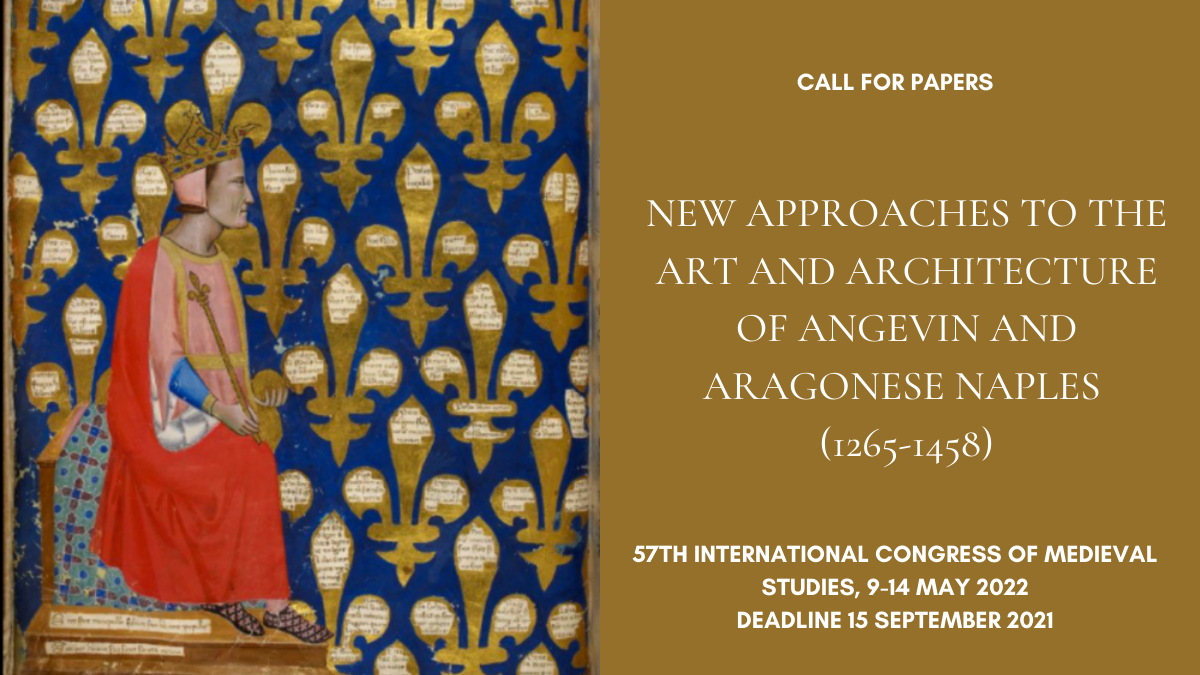
57th ICMS, 9-14 May 2022 Deadline 15 September 2021
The city and kingdom of Naples occupied a central place in late-medieval Mediterranean life: it was a powerful kingdom with deep connections to the French throne; it controlled vast territories throughout Italy in service to the papacy; and its many ports welcomed goods arriving from the Levant, north Africa, and western Europe. Despite this importance during the medieval period the city has been, generally, overshadowed by other cities such as Rome, Florence, and Venice in academic discourse. Nevertheless, the city has been interrogated in recent decades by many prominent European and American art historians who have expanded our understanding of Neapolitan art patronage and devotional images during the trecento and quattrocento, including Francesco Aceto, Nicolas Bock, Caroline Bruzelius, Bianca de Divitiis, Stefano D’Ovidio, Janis Elliott, Cathleen Fleck, Adrian Hoch, Pierluigi Leone de Castris, Vinni Lucherini, Tanja Michalsky, Alessandra Perriccioli Saggese, Elisabetta Scirocco, Paola Vitolo, Cordelia Warr, and Sarah Wilkins, to name a few.
This panel invites submissions from students that will build on recent scholarship and examine the relationship between the art, artists, and architecture of late-medieval Naples and the wider connected world. Topics of interest include but are not limited to: the movement of material and visual culture between Naples, the wider Mediterranean, and beyond; the movement of people, including patrons, artists, and craftsmen, between Naples and the wider connected world; the impact of trade to or from Naples; diplomatic, political, commercial, artistic, and cultural exchanges and interactions and their effects within and beyond Naples; the role of women as patrons, rulers, nuns, and powerbrokers in Naples; dress and comportment; the textile arts; portolan atlases; trade between Naples and other cities, including, but not limited to, Florence, London, Paris, Rome, Tunis, or Jerusalem.
A good abstract will state the topic and argument and will inform specialists in the field of what is new about the research. Generalities known to everyone, or research that a scholar intends to do but has not yet begun, are not appropriate. Please keep in mind that, if selected, your abstract will be used, as is, for the online program and conference app.
Since the International Congress on Medieval Studies will be run virtually in 2022, the ICMA (via a Samuel H. Kress Foundation grant) will cover the conference fees of those participating in the ICMA-sponsored session(s). Participants will be required to be members of the ICMA at the time of the conference (May 2022).
Janis Elliott and Denva Gallant are organizing two sessions on Naples sponsored by the ICMA, Naples and Beyond: World-Wide Cultural Networks. To promote stronger networks between ICMA student and senior scholars, they will also moderate the Student Committee session.
Alors que l’État national souverain a longtemps été considéré comme l’acteur exclusif des relations internationales, ce projet a l’ambition de nouer un dialogue entre historiens et historiens du droit pour s’interroger sur le droit international conçu comme le cadre multi-normatif qui régit les relations entre une grande variété d’acteurs. Cette notion nous paraît mieux s’adapter aux traits spécifiques de la constellation politique médiévale et pré-moderne, qui était caractérisée par l’entrelacement de différentes juridictions, fondées sur des liens de dépendance personnelle et sur des relations de sujétion territoriale, par la coexistence d’une pluralité de centres de pouvoir au statut variable et par la répartition de l’autorité politique à différents niveaux.
Les thèmes abordés dans les deux rencontres (la première à Rome le 20 septembre 2021 et la deuxième à Lille et Courtrai les 18-19 mai 2022) incluent la guerre, les représailles, la diplomatie, les relations féodales, le droit de la mer, le commerce ou encore les relations avec les juifs et les « infidèles », notre ambition générale étant de faire porter la réflexion sur trois questions transversales : celle des acteurs du droit international ; celle des sources du droit international, qui ne constituait pas à l’époque prémoderne une branche autonome de la science juridique ; celle enfin de la résolution des conflits, en particulier à travers la médiation et l’arbitrage.
En raison des consignes sanitaires, le nombre de place est limité et sous inscription à : forms.gle/J5BfmkRt8KzcSSC29
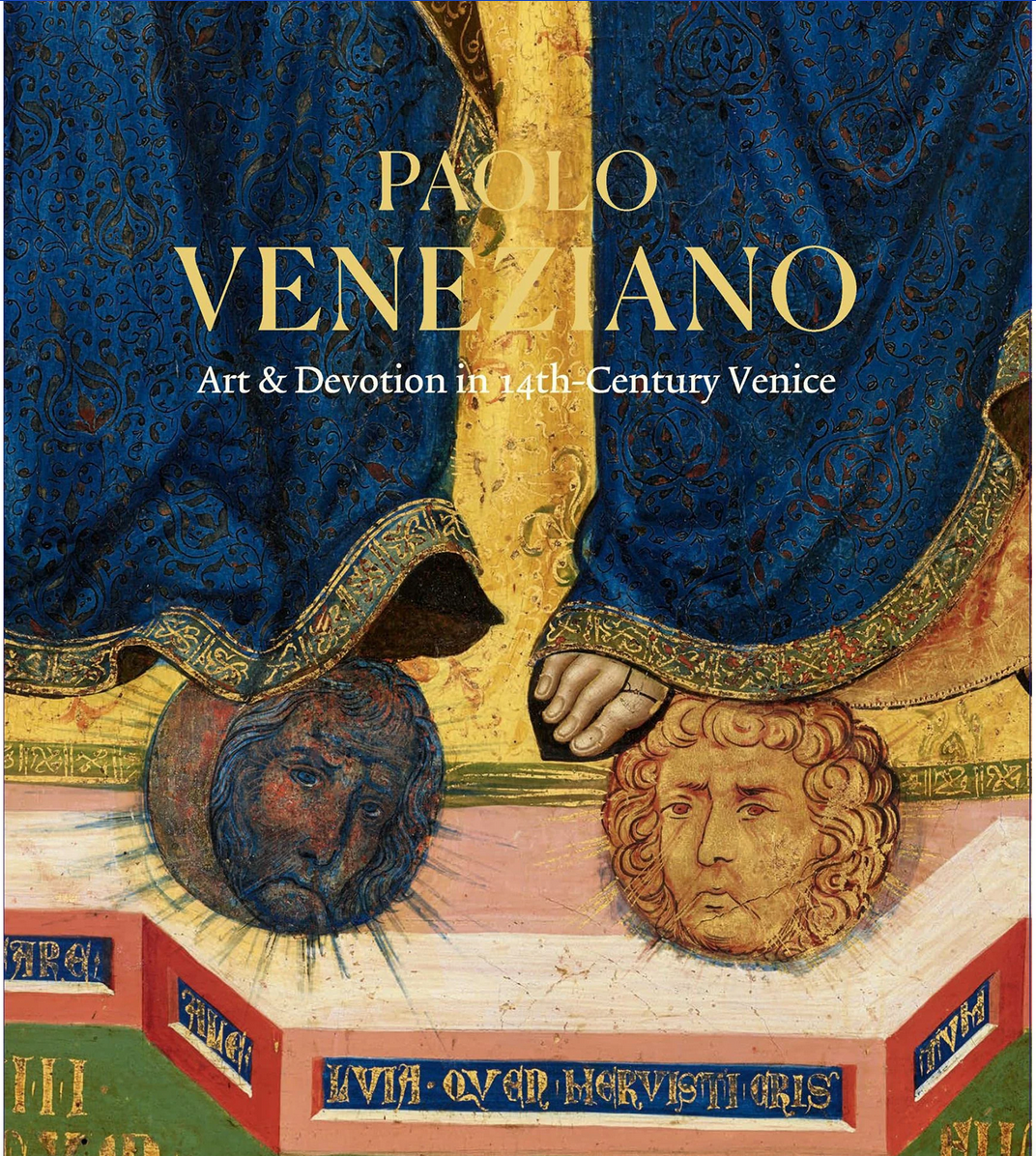
Paolo Veneziano led the premier painter’s workshop in late medieval Venice, producing work ranging from large complex altarpieces to small paintings intended for personal devotion. This focused exhibition reunites panels that originally formed a larger ensemble but are today scattered across different collections. This reconstruction, together with his other paintings, is set against the backdrop of the city’s uniquely cosmopolitan visual culture.
Avec le soutien du FNRS, du CRHiDI (UCLouvain – Saint-Louis, Bruxelles), d'INCAL (UCLouvain), de PraME (UNamur), de sociAMM (ULB) et de Transitions (ULiège)








Vous devez être connecté pour poster un commentaire.