Colloque – Se vêtir au premier Moyen Âge. 41e Journées internationales de l’AFAM

Chartres (Eure-et-Loir)
29 septembre–2 octobre 2021

Programme : ici

Après le report de l’année dernière, le comité d’organisation, au nom de l’AFAM, Chartres métropole et l’ensemble des partenaires de ces journées, est heureux de vous accueillir à l’occasion des 41e Journées internationales de l’AFAM. 

Ces journées se tiendront à Chartres du 29 septembre au 02 octobre 2021.

Les deux thèmes principaux sont :

– “Se vêtir au premier Moyen Âge” 

– “L’archéologie du premier Moyen Âge (Ve-XIIe s.) en région Centre-Val-de-Loire”.

La dernière matinée sera consacrée aux actualités archéologiques.

Pendant deux jours et demi, une trentaine de communications et autant de posters seront présentés. Une conférence inaugurale aura lieu le mercredi soir (29/09) avant le début du colloque, le jeudi matin (30/09). Le colloque s’achèvera le samedi midi (02/10). Voici le programme complet.

À cause du contexte sanitaire encore incertain, le colloque se déroulera en semi-présentiel (avec uniquement un orateur par communication, le bureau de l’AFAM, les membres du comité scientifique et les organisateurs) à l’Hôtellerie Saint-Yves de Chartres.

Mais soyez rassurés : pour les auditeurs et le reste des participants, une retransmission par visio-conférence des communications sera disponible sur une plateforme, de même qu’un espace pour visualiser les posters.

L’inscription en ligne est gratuite mais nécessaire pour assister aux Journées : https://afam2021.sciencesconf.org/

Un lien de visio-conférence vous sera envoyé seulement après inscription. Les pré-actes du colloque vous seront également transmis en version numérique (pdf).

En fonction de l’évolution de la situation sanitaire, une décision sera prise en septembre quant à l’accueil éventuel de public en présentiel, mais en jauge restreinte (merci de nous signaler si vous êtes intéressés).

La présence à Chartres sera soumise au respect des règles sanitaires du moment. Elles seront diffusées en septembre. Le pass sanitaire sera demandé, en plus du respect des gestes barrières et du port du masque.

Source : AFAM

Publié dans Colloque | Laisser un commentaire

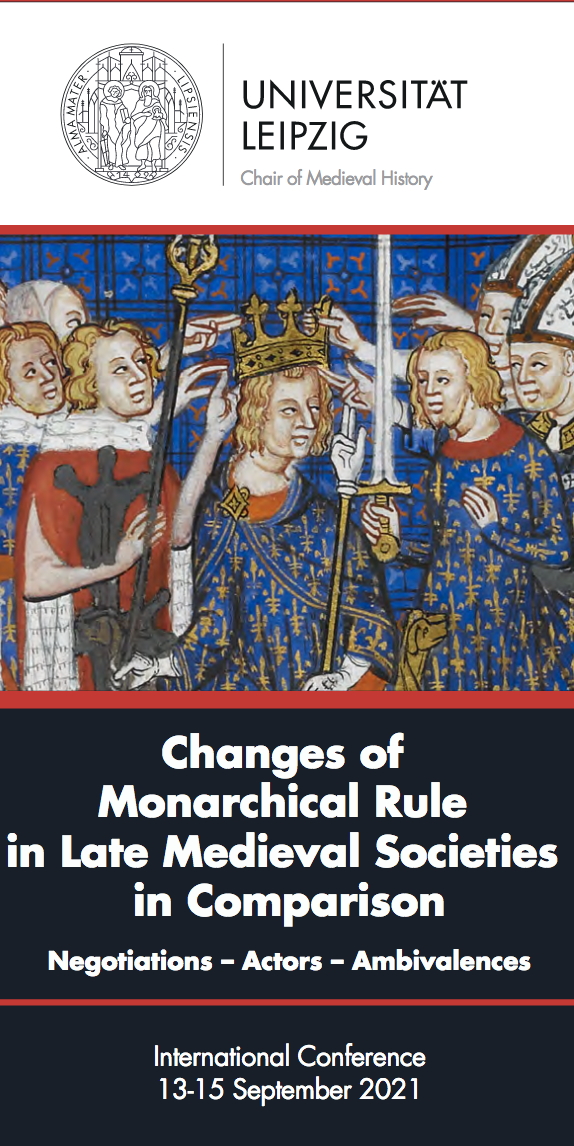
Colloque – Changes of Monarchical Rule in Late Medieval Societies in Comparison

Tagungsleitung: Prof. Dr. Wolfgang Huschner

Koordination: Dr. des. Sven Jaros / Dr. des. Marie-Ulrike Jaros / Dr. Eric Böhme / Dr. Stefan Magnussen

Datum: 13. bis 15. September 2021

Ort: Sächsische Akademie der Wissenschaften zu Leipzig (Hybrid)

Interessierte sind herzlich zur digitalen Teilnahme über ZOOM eingeladen. Um vorherige Anmeldung wird gebeten (siehe Flyer).

Programme : here

For the study of ruling systems in the pre-modern period, changes of rulership have proven to be a fertile environment, as they shook existing arrangements and triggered new negotiations. These transitive phases opened up extensive leeway, which both the monarchs and the elites could use to pursue their own as well as joint interests. Not infrequently, this led to a lasting reorganisation of the configurations of rulership.

Changes of rulership at the margins of Latin Europe have been the focus of the DFG funded research project “Mediation of Rule at the Borders of Latin Europe in the Late Middle Ages“. Within the conference, its main results shall be discussed and integrated in the European debate. By focussing on the border regions of Latin Europe, areas under Muslim, Christian-Orthodox or gentile-religious rule will be considered more broadly than before. At the same time, the comparative view will be directed back to Central Europe in order to discern possible similarities or specifics. The comparability of the case studies is ensured by a common analytical grid.

The conference will take place in hybrid form, with the digital part running via ZOOM. We kindly ask those, who wish to take part digitally to register via E-Mail until August 20th.

Source : Universität Leipzig

Publié dans Publications | Laisser un commentaire

Offre d’emploi – Post-Doctoral Fellowship: Research Fellowship in the History and Culture of the Countries of the Silk Roads, 2022-2026, King’s College, Cambridge

Through a generous donation, King’s College Cambridge is able to invite applications for a four-year Research Fellowship from those who are completing or have recently completed a doctorate and who intend to pursue a research project on some aspect of the Silk Road countries, societies, and cultures of Asia from the Western borders of China to the Mediterranean Sea, as well as their relationships with China in the East and Europe in the West. The research project’s discipline may address, amongst other issues, Environmental History, Religion, Art, Maritime History, China before 1911, Ottoman Empire, and Russian Central Asia, but applicants should not feel constrained by this list.

This Research Fellowship is part of a broader programme of studies of the countries of the Silk Roads, which includes lectures, seminars and conferences, as well as graduate scholarships and further Research Fellowships. As well as pursuing their own research project, the successful candidate will be expected to play an active role in developing the programme and in organizing academic activity concerned with the countries of the Silk Road.

This post-doctoral Fellowship is intended to encourage research into the Silk Roads and the countries of the Silk Roads by enabling the successful candidate to complete a substantial research project on their own choosing. Projects may concern any aspect of the countries, societies, and cultures of the Silk Roads, from the Western borders of China to the Mediterranean Sea, and of the Silk Roads themselves, that is to studies of relationships and the movement of materials, knowledge, and technologies between China and the Mediterranean, at any period to the present day.

The ideal candidate for this Research Fellowship will have a strong background in a relevant discipline and be completing or have completed an outstanding doctoral thesis. It is not a requirement that the candidate’s doctoral studies or the work that they submit in support of their application should have concerned questions of the Silk Roads specifically, but candidates will be expected to show in their applications both how their future work relates to the work that they have already done. The successful candidate will be expected to engage broadly with the whole college community.

Graduates of any university are eligible. Candidates will usually have completed their PhD but must not have undertaken more than 3 years of postdoctoral work by 1 October 2022 (i.e. your PhD cannot have been granted before 30 September 2019).

For complete information and instructions on how to apply, visit https://www.kings.cam.ac.uk/research/research-fellowships

Source : Medieval Art Research

Publié dans Le réseau | Laisser un commentaire

Appel à contribution – Medieval Horse Types and How to Use Them

Call for papers for special sessions at the International Medieval Congress, Leeds, 4-7 July 2022

Nature has not given [all horses] the same capabilities. Some shine more at war work; others are inclined to win Olympic crowns; others are adaptable for domestic use, civilian duties and farm work.

Leon Battista Alberti, De equo animante (c. 1445)

Equine breeds as we think of them today are an early modern invention. Instead, medieval people distinguished between horses based on their origin and the type of work for which they were used. At our thematic sessions, we propose exploring medieval horse types, their treatment, training, use, artistic and literary representation as well as equipment employed for different tasks. Possible topics include, but are not limited to, the following issues:

  • Types of horses used in warfare (warhorses, coursers, rounceys, packhorses)
  • Civilian horses (palfreys, amblers, etc.)
  • Working horses (plough horses, cart horses, etc.)
  • Horse types used for ceremonial purposes and special tack
  • Representation of horses in marginalia, including imaginary equids and hybrids
  • Differential treatment of horse types in sources, including legal documents, hippiatric treatises and literature

Additionally, we propose a round table on mounted games, such as Iberian cane games, and medieval antecedents of modern mounted sport games (polo, polocrosse and others).

The sessions and the round table are sponsored by Trivent Medieval. Selected contributions will be published in the Rewriting Equestrian History series or in Cheiron: The International Journal of Equine and Equestrian History.

Please send proposals and expressions of interest to Dr Anastasija Ropa (anastasija.ropa@trivent-publishing.eu) by 10 September 2021. To propose a session paper, please send a short biography of approximately 50 words and an abstract of 250-300 words. To participate in the round table, send your topic and one or two sentences explaining what you want to talk about.

Please note that IMC 2022 is planned as a hybrid event. In the event your paper is accepted, you can participate either virtually or in person. The authors are responsible for securing funding for the Congress attendance.

Publié dans Appel à contributions | Laisser un commentaire

Publication – « Die Handschriften der Stadtbibliothek Mainz / Hs I 351– Hs I 490 », par Gerhard List, Annelen Ottermann et Christoph Winterer

Der vierte Katalogband setzt die Erschließung der in der Wissenschaftlichen Stadtbibliothek Mainz befindlichen Handschriften fort. Die 144 Handschriften schließen inhaltlich die Theologica der Signaturengruppe I ab und eröffnen die Gruppe der Libri juridici. Es überwiegen weiterhin Kartause-Handschriften, jedoch kommen vermehrt auch andere Provenienzen hinzu (u.a. die Mainzer Jesuiten und Karmeliten, die Alte Universitätsbibliothek Mainz). Neben den überwiegend lateinischen Codices finden sich auch zehn deutschsprachige Handschriften, darunter ein Psalmenkommentar des Nicolaus de Lyra aus der Laienbibliothek der Kartause und ein Band bisher unbekannter Provenienz mit Predigten Martin Luthers. Die frühesten Bände – ein Evangeliar und das Martyrologium des Hrabanus Maurus – stammen aus dem 11. Jahrhundert; die spätesten Zeugnisse sind Vorlesungsmitschriften aus dem letzten Drittel des 16. Jahrhunderts.


Die Beschreibung durch Gerhard List in den Jahren 2005-2007 folgte, anders als bei den Vorbänden, dem verkürzten Modell der ‚Bestandsliste‘ gemäß den neuen Konzepten der DFG zur Handschriftenerschließung. Seit 2016 sind die Erschließungsdaten in Manuscripta Mediaevalia übertragen. Für die Drucklegung wurden die Beschreibungen überarbeitet; neue Forschungsliteratur wurde ergänzt, punktuell wurden neue Erkenntnisse nachgetragen und es wurde ein umfangreiches Register erstellt. 16 Seiten mit Farbabbildungen zu Provenienzhinweisen, Subskriptionen, Buchschmuck und Textauszügen runden den Band ab.

Informations pratiques :

Die Handschriften der Stadtbibliothek Mainz / Hs I 351– Hs I 490, par Gerhard List, Annelen Ottermann et Christoph Winterer, Wiesbaden, Harrassowitz Verlag, 2021 (Mainz: die Handschriften der Stadtbibliothek Mainz, 4). 248 Seiten, 49 Abb., 20 x 28,5 cm. ISBN : 978-3-447-11102-7. Prix : 84 euros.

Source : Harrassowitz Verlag

Publié dans Publications | Laisser un commentaire

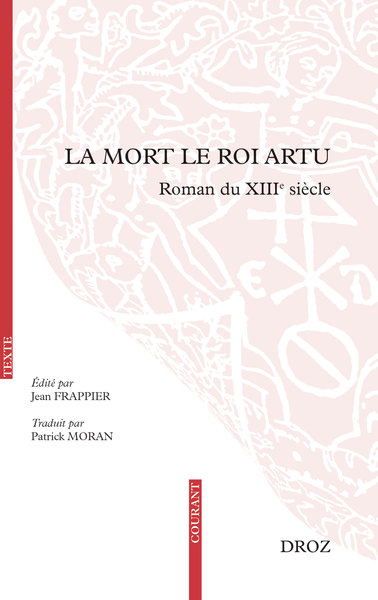
Publication — « La Mort le roi Artu. Roman du XIIIe siècle », trad. Patrick Moran

Rédigée dans le premier tiers du XIIIe siècle, La Mort le roi Artu dépeint un monde arthurien au bord du précipice, où l’envie et le ressentiment mettent en péril les valeurs chevaleresques traditionnelles, où l’amour interdit de la reine Guenièvre et de Lancelot du Lac risque à tout moment d’être révélé au grand jour et de détruire le fragile équilibre de la cour. Dernier volet du cycle du Lancelot-Graal, recopié sans cesse jusqu’au xve siècle avant d’être imprimé de nombreuses fois à la Renaissance, ce roman anonyme constitue la version la plus riche et la plus complexe de la chute du royaume d’Arthur, par le biais d’un récit choral où les héros d’antan sont la proie de leurs propres désirs et des caprices de Fortune. On trouve ici l’édition critique lachmannienne de Jean Frappier, avec une nouvelle traduction très réussie de Patrick Moran.

Informations pratiques :

La Mort le roi Artu. Roman du XIIIe siècle, trad. Patrick Moran, Genève, Droz, 2021 (Texte Courant, 14). 712 pages. ISBN : 978-2-600-06293-0. Prix : 16 euros.

Source : Droz

Publié dans Publications | Laisser un commentaire

Offre d’emploi – Lecturer in European History 1300-1500 CE (Durham University)

Recruiter : DURHAM UNIVERSITY
Location : Durham
Salary : £33797 – £40322 per annum
Posted : 10 Aug 2021
End of advertisement period : 24 Aug 2021
Ref : 21000979

The Department of History at Durham University seeks to appoint a talented individual to the fixed term role of Lecturer in European History (including Britain/Ireland) 1300-1500 CE.

The Department of History is widely recognized as a leading centre of historical research and teaching, consistently ranking amongst the top UK History departments in league tables.

The role of a fixed term Lecturer at Durham provides the opportunity to deliver outstanding education and research within an inclusive and supportive environment that is staffed by world class colleagues. Lecturers will be supported to develop their academic careers by training and financial support in research and education, guided by a designated mentor.

The primary focus of this role is on research and teaching but there will also be the opportunity to engage in wider citizenship within the University and beyond.

This role of Lecturer is for a fixed term of 23 months. It is not anticipated that this post would be extended beyond the initial fixed term. Applicants must demonstrate research excellence in European History 1300-1500 CE, with the ability to teach our students to an exceptional standard and to fully engage in the services, citizenship and values of the University. The University provides a working and teaching environment which is inclusive and welcoming and where everyone is treated fairly and with dignity and respect. Candidates will be expected to demonstrate commitment to these key principles as part of the assessment process.

In the first year, the post-holder will be expected to contribute to the team-taught level 1 module ‘Decline and Crisis? Europe, 1300-1500’, and to offer a strand for the core Level 1 module ‘Making History’. They may also be expected to offer an optional module for the MA. They will undertake some undergraduate and MA dissertation supervision and, where appropriate, carry out other teaching duties specified by the Head of Department. In the second year, they will be expected to offer additional teaching on new or existing level 2/3 modules.

Candidates will be expected to demonstrate these key principles as part of the assessment process.

Source : Times Higher Education

Publié dans Offre d'emploi | Laisser un commentaire

Offre d’emploi – Dessinateur topographe en archéologie (m/f/x), Musées royaux d’Art et d’Histoire, Bruxelles

  • Vous assistez l’archéologue responsable de la recherche archéologique et de l’enregistrement digital du patrimoine archéologique relatif à la recherche archéologique préventive en région bruxelloise.
  • Vous travaillez sur chantier pour la réalisation de relevés précis des éléments archéologiques en plan et en élévation, vous faites des levés topographiques.
  • Vous travaillerez aussi en bureau, sur ordinateur pour la vectorisation des plans et cartes, les calculs de photogrammétries, la réalisation de documents nécessaires aux différentes publications et présentations dont le dessin des objets.
  • Vous travaillez en équipe et accepter d’être flexible dans les horaires (soirée/weekend).

Cette liste de tâches n’est pas exhaustive et vous pourrez être amené à en effectuer d’autres à la demande de votre responsable hiérarchique.

Une bonne partie des tâches s’exercent en extérieur par des conditions climatiques difficiles (froid, intempéries, …), il faut pouvoir travailler en hauteur (sur échelle, échafaudage, …) et pouvoir porter des charges lourdes (transport de matériel, …).

Plus d’info sur la fonction ?
Ann Degraeve – Responsable du département patrimoine archéologique
Correspondant pour le Urban.Brussels
Tél. : 02 243 83 11
Courriel : adegraeve@urban.brussels

Vous pouvez poser votre candidature jusqu’au 23 août 2021 inclus.

Source et informations complémentaires : Selor

Publié dans Le réseau | Laisser un commentaire

Colloque – Communities and Networks in Late Medieval Europe (c. 1300–1500)

International Virtual Conference
9–10 September 2021

Historical research has witnessed a rapidly growing interest in „networks“ since the turn of the twenty-first century. This is due not only to the utility of networks in describing interrelations between historical actors, but also to the adoption of the concepts and methodologies associated with social network analysis (SNA).

Communities and Networks in Late Medieval Europe aims to build on and contribute to this expanding field of research by exploring how the descriptive, conceptual, and methodological tools provided by the study of networks can deepen our understanding of the complex sets of relationships between and within different types of communities in the specific context of the last two centuries of the European Middle Ages. The fourteenth and fifteenth centuries were a time of great political, socio-economic, and cultural change in Europe: the period in question, therefore, offers numerous exciting opportunities (and challenges) for the application of network-based approaches to the study of community dynamics.

To register for this event, please go to https://communitiesandnetworks21.eventbrite.co.uk.

Programme :

9 SEPTEMBER 2021

09:00–09:15 Welcome (Teresa Barucci and Matthew Coulter, University of Cambridge)

09:15–10:45 Session 1: Communities in the Making (Chair: Matthew Coulter)

Invited Speaker: Prof. Christina Lutter (University of Vienna), How Do Groups Become Communities? Urban Spaces of Belonging in Late Medieval Central Europe

Dr Joana Balsa de Pinho (University of Lisbon), A Community and Networking Experience in Late Medieval Portugal: Art and Material Culture of the Confraternities of Mercy

Dr Julien Le Mauff (Paris-Sorbonne University), Communitas perfecta and Regimes of Exclusion in Aristotelian Literature (13th–14th Centuries): The Growing Wariness towards Peregrins and Gens de mer

10:45–11:00 Break

11:00–12:30 Session 2: Networks of Strangers? (Chair: Dr Rodrigo García-Velasco, University of Cambridge)

Dr Monica White (University of Nottingham), Lands of Opportunity in the Medieval Orthodox World

Filip Vukuša (Bielefeld University), Networks of Newcomers from the Apennine Peninsula in 14th-Century Zadar

Guillermo López Juan (University of Valencia/University of Picardie – Jules Verne), A Close-Knitted Community: Interrelation, Integration and Assimilation of the Conversos of Valencia (1391–1440)

12:30–13:30 Lunch Break

13:30–15:00 Session 3: Travel and Trade Networks (Chair: Jessica Tearney-Pearce, University of Cambridge)

Invited Speaker: Dr Flávio Miranda (University of Porto), Caught in a Web: Merchant Communities and Commercial Networks between Portugal and Flanders, 1300–1500

Dr Prajakti Kalra (University of Cambridge), The Mongol Empire and the Making of European Communities in Eurasia

Annabel Hancock (University of Oxford), Networks of Trade: The Benefits and Challenges of Using Network Analysis to Explore Connections in Literature, Archaeology, and Commercial Contracts, c. 1150–1400

15:00–15:15 Break

15:15–17:15 Session 4: Economics, Finance, and Networks (Chair: Annabel Hancock)

Nicolò Zennaro (University of Antwerp; presenting author), Dr Jeroen Puttevils (University of Antwerp), and Prof. Francesco Guidi Bruscoli (University of Florence), Per chagione della Moria: A Social Network Analysis of an Epidemic Shock in the Datini Correspondence

Dr Julia Exarchos (RWTH Aachen University), The Networks of the Labouring Poor in the Late Medieval Rhineland

Aviya Doron (Hebrew University of Jerusalem), Communities of Credit or Communities of Debt? Jewish-Christian Financial Networks in 14th-Century Frankfurt-am-Main

Angus Russell (University of Cambridge), Unjust Collection: Institutional and Monastic (Un-)Networks in Northern Rus

17:15–17:30 Break

17:30–19:00 Keynote Session (Introduction: Prof. Nora Berend, University of Cambridge)

Prof. Felicitas Schmieder (FernUniversität in Hagen), Did „Magdeburg Law“ Create a Network of Culturally-Mixed Urban Communities across Central Europe?

10 SEPTEMBER 2021

09:00–09:15 Welcome

09:15–10:45 Session 5: Urban Networks (Chair: Teresa Barucci)

Invited Speaker: Prof. Jan Dumolyn (Ghent University), Guild Politics in the Medieval Low Countries: Class, Communities and Networks

Dr Marios Dimitriadis (National and Kapodistrian University of Athens), Drama as a Means of Networking for the World of Labour and a Field for the Debate on Social Hierarchy in Late Medieval English Towns

Ward Leloup (Free University of Brussels/Ghent University), „All Good Friends“? Economic and Social Relations of Leatherworkers in Late Medieval Bruges

10:45–11:00 Break

11:00–12:30 Session 6: Material Culture and Social Networks (Chair: Rebecca Field, University of Cambridge)

Dr Natalie Calder (Queen’s University Belfast) and Dr Hannah Schühle-Lewis (University of Kent), Theorising the Early Guildhall Library’s Social and Codicological Networks

Johanna-Pauline Thöne (University of Oslo), Late Medieval Music Manuscripts: Diachronic Testimonies to Musical and Cultural Networks, c. 1400

Róisín Donohoe (University of Cambridge), „To my Daughter“: Childbirth Networks in Late Medieval English Parish Communities

12:30–13:30 Lunch Break

13:30–15:30 Session 7: Mobility and Communication (Chair: Dr Luca Zenobi, University of Cambridge)

Invited Speaker: Dr Justyna Wubs-Mrozewicz (University of Amsterdam), „Merchants“ Marks in Premodern Northern Europe: Communicating Networks

Chiara Melchionno (Scuola Superiore Meridionale of Naples), Qui nescit fingere nescit regnare: The Use of Paroemie in Italian Diplomatic Letters of the 15th Century and the Building of a Linguistic and Political Network

Dr Marco Ciocchetti (University of Rome Tor Vergata), Networks and Exchanges in the Cardinals’ College in the First Half of the Fourteenth Century

Dr Tamás Kiss (Eötvös Loránd University) and Dr Stephen Pow (St Petersburg State University), The Expansion of Social Networks in the Late Middle Ages from Samarkand to Castile: The Case Study of Two Medieval Women

15:30–15:45 Break

15:45–17:15 Session 8: Political and Dynastic Networks (Chair: Dr Vedran Sulovsky, University of Cambridge)

Dr Christa Birkel (Heinrich Heine University Düsseldorf), The Foreign Prince and the Realm: On the Difficulty of Developing a Community in Late Medieval Luxembourg (c. 1380–1440)

Simon Bürcky (University of Giessen), Dynastic Networks of the Non-Princely High Nobility in the Holy Roman Empire during the 15th Century

Giovanni Contel (Sapienza University of Rome), The Italian Contribution to the „Imperial Community“ of Maximilian I during the First Italian Wars (c. 1490–1520)

17:15–17:30 Break

17:30–18:30 Concluding Session (Introduction: Prof. Jan Dumolyn)

Prof. Wim Blockmans (Leiden University), Concluding Remarks

All times in British Summer Time (BST)

Publié dans Colloque | Laisser un commentaire

Publication – « Queering the Medieval Mediterranean: Transcultural Sea of Sex, Gender, Identity, and Culture », ed. Felipe Rojas and Peter E. Thompson

In ten essays authored by an international team of scholars, this volume explores queer readings of Western and Eastern Mediterranean Europe, Northern Africa, Islam and Arabic traditions. The contributors enter into a dialogue, comparing cases from opposite sides of the Mediterranean, in order to analyze the forgotten exchange of sexualities that was brought forth through the Mediterranean and its bordering landmasses during the Middle Ages.

This collection questions the hypothesis that distinct cultures treated sexuality and the “other” differently. The volume initiates the conversation around queerness and sexuality on these trade routes, and problematizes the differences between various Mediterranean cultures in order to argue that through both queerness and sexuality, neighboring civilizations had access to, and knowledge of, common shared experiences.

Table des matières : ici

Informations pratiques :

Queering the Medieval Mediterranean: Transcultural Sea of Sex, Gender, Identity, and Culture, ed. Felipe Rojas and Peter E. Thompson, Leiden–Boston, 2021 (The Medieval Mediterranean, 121). ISBN : 978-90-04-31515-0. Prix : 94 €, 113 USD.

Source : Brill

Publié dans Publications | Laisser un commentaire