Podcast – Jay Diehl, « Priestly Education as Monastic Reform: The Culture of Writing at Saint-Laurent de Liège, c.1090-1110 »

Jay Diehl (Long Island University): « Priestly Education as Monastic Reform: The Culture of Writing at Saint-Laurent de Liège, c.1090-1110 », communication au webinaire H37 – Histoire et Cultures graphiques, le 10 février 2021.

Publié dans Podcast | Laisser un commentaire

Podcast – Hanno Wijsman, « Présentation de la base de données Bibale »

A l’occasion de l’adhésion au CERL (Consortium of European Research Libraries) d’un groupe de bibliothèques municipales françaises à l’initiative du Ministère de la Culture, un séminaire est organisé à l’attention des bibliothèques afin de mieux les informer des activités et actualités du CERL, mais également de resserrer les liens entre elles.

Hanno Wijsman (Ingénieur à la section de codicologie, histoire des bibliothèques et héraldique) présente la base de données Bibale : un outil collaboratif pour recenser et rechercher les provenances des manuscrits et livres imprimés : http://bibale.irht.cnrs.fr

Source : YouTube – IRHT

Publié dans Podcast | Laisser un commentaire

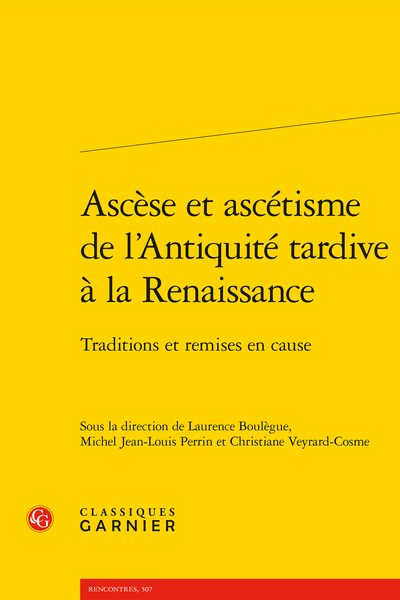
Publication – « Ascèse et ascétisme de l’Antiquité tardive à la Renaissance. Traditions et remises en cause », dir. Laurence Boulègue, Michel Jean-Louis Perrin et Christiane Veyrad-Cosme

Cet ouvrage propose d’étudier les multiples visages de l’ascèse au croisement des domaines littéraire, philosophique, religieux, artistique, de l’Antiquité tardive à la Renaissance, en trois volets consacrés aux théories et pratiques de l’ascèse, aux modalités de son écriture et à ses différentes figures.

Table des matières : ici

Informations pratiques :

Ascèse et ascétisme de l’Antiquité tardive à la Renaissance. Traditions et remises en cause, dir. Laurence Boulègue, Michel Jean-Louis Perrin et Christiane Veyrad-Cosme, Paris, Classiques Garnier, 2021 (Rencontres, 507 ; Lectures de la Renaissance latine, 14). 412 p. ISBN : 978-2-406-11152-8. Prix : 46 euros.

Source : Classiques Garnier

Publié dans Publications | Laisser un commentaire

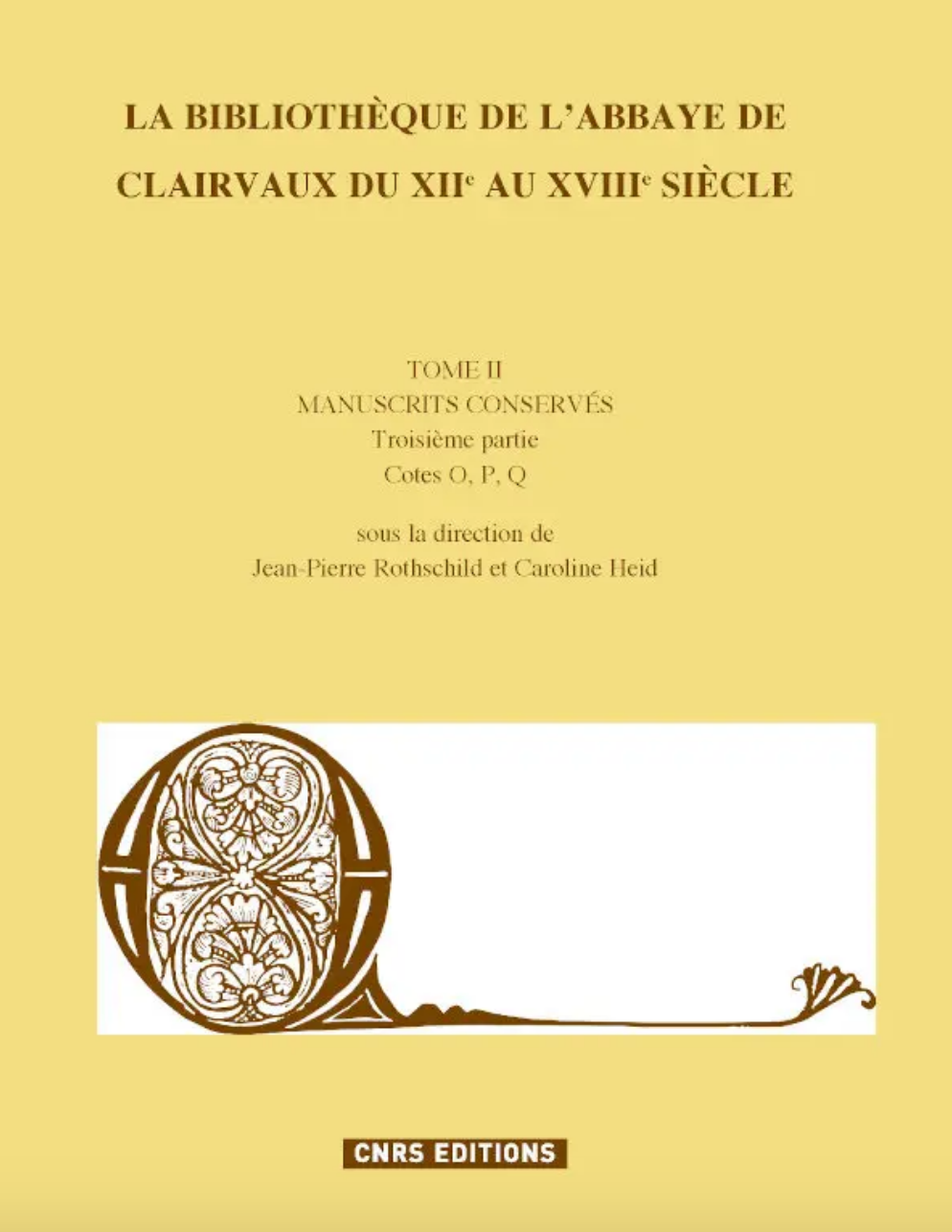
Publication – « La Bibliothèque de l’abbaye de Clairvaux du XIIe au XVIIIe siècle. T. II, 3e partie », dir. Jean-Pierre Rothschild et Caroline Heid

La bibliothèque de l’abbaye de Clairvaux fut un centre de première importance de la vie spirituelle et intellectuelle en France et en Europe au Moyen Âge.  André Vernet en a édité les anciens catalogues en 1979, dans cette même collection « DER », et ses collaborateurs de la section de codicologie de l’IRHT, Jean-Paul Bouhot et le regretté Jean-François Genest, y ont publié en 1997 les notices descriptives de plus de la moitié (manuscrits bibliques, patristiques et théologiques) des mille et quelque manuscrits subsistants du catalogue de 1472. Le travail a été repris dans la section latine de l’IRHT il y a quelques années, la nature des manuscrits restant à décrire (où les recueils de pièces multiples sont nombreux : florilèges, sermonnaires, collections hagiographiques, livres liturgiques) et les moyens nouveaux d’identification détaillée imposant un autre format de notices. Le présent volume est ainsi le premier publié de quatre qui couvriront, selon l’ordre des cotes du catalogue de 1472, des manuscrits de sermons (volume en préparation), d’autres recueils de sermons, des instruments pour la pastorale et des textes de théologie scolaire, de dévotion, d’histoire sainte, d’histoire profane et d’hagiographie (ce volume), le droit, les sciences et les lettres (en préparation), la liturgie (en préparation). Ce volume qui décrit 142 manuscrits de contenu très varié a été l’occasion d’un nombre élevé de découvertes de copies inconnues de divers textes. Mais le projet vise aussi à décrire et à comprendre le fonds en tant qu’ensemble, partiellement comme le produit du travail d’un scriptorium ou d’un petit nombre d’ateliers, et dans sa totalité comme bibliothèque organisée et vivante du XIIe au XVIIIe siècle.

Informations pratiques :

La Bibliothèque de l’abbaye de Clairvaux du XIIe au XVIIIe siècle. T. II, 3e partie, dir. Jean-Pierre Rothschild et Caroline Heid, Paris, CNRS Éditions, 2021 (Documents, études et répertoires). 504 p., 21 x 27 cm. ISBN : 9782271137876. Prix : 120 euros.

Source : CNRS Éditions

Publié dans Publications | Laisser un commentaire

Appel à contribution – New academic journal – Call for articles : TranScript – « Traduzione e scrittura nel Medioevo europeo »

TranScript – « Traduzione e scrittura nel Medioevo europeo »-is a new international high-quality peer reviewed academic journal edited by Edizioni Ca’ Foscari (ECF) Digital Publishing – Venice. It will provide a forum for discussion on the translation of cultures from orality to script, and across differing traditions, with particular reference to the centuries spanning the 11th to the 15th. For more information, see https://edizionicafoscari.unive.it/en/edizioni4/riviste/transcript/info.

If you wish to submit a paper for publication, please send your abstract (max. 1500 incl. spaces) with a summary bibliography by September 15th 2021. Accepted contributions (no word limit) should be sent to transcript_editor@unive.it, or submitted online by October 15th 2021. Please refer to ECF style guidelines: https://edizionicafoscari.unive.it/it/edizioni4/pubblicare-con-noi/. TranScript publishes contributions in all Romance languages, English and German.

Publié dans Appel à contributions | Laisser un commentaire

Publication — « The Roles of Medieval Chanceries. Negotiating Rules of Political Communication », dir. Christina Antenhofer et Mark Mersiowsky

Medieval (political) communication followed rules that were defined, negotiated, and altered in processes of exchange. Conflicts resulting from different communication practices, as well as forms of innovation, revolve around rules that are not self-evident. Political actors such as princes and cities, chanceries, secretaries, ambassadors, and councillors formed rules of political participation, which became visible in written documentation. These rules were both formed and negotiated via processes of communication (a practice-oriented understanding of political participation). Medieval chanceries can thus be understood as a vast field of experimentation where different solutions were tested, passed on, or discarded.

This book explores communication practices in German, French, Italian, Tyrolian, and Gorizian chanceries, as well as at diets from the tenth to the sixteenth century. Its chapters examine royal, monastic, princely, and communal chanceries. For the early and high Middle Ages, a close analysis of documents will reconstruct negotiation and communication from within the documents themselves. For the later Middle Ages, focus will turn to the chancery, with the appearance of chancery orders and chancery annotations that provide explicit insight in communication between the chancellors, secretaries, and political authorities (princes or cities). The growing amount and variety of documents issued in the late Middle Ages allows us to retrace conflicts resulting from differing chancery practices as well as attempts to reorganise the chancery into a political instrument for the prince.

The processes of political communication will be followed in three parts. Part I focuses on the rules within documents. Part II looks at administrative processes within specific chanceries, while Part III explores forms of exchange between the chancery and other political actors.

Table des matières :

Introduction — CHRISTINA ANTENHOFER

I. Rules Within the Documents: Chanceries and Charters

The Sanctiones of the Cluniac Charters of the 10th-11th Centuries
— SÉBASTIEN BARRET
 
Nulli… Si Quis and Their Copycats: Penal Forms in Later Medieval Charters
— ARNOLD OTTO 


II. Chancery Rules and Organisation: The Chancery as Platform of Administration

Internal Rules of Late Medieval German Chanceries and Their Heuristic Value — ELLEN WIDDER

Chancery Notations and Their Role as Means of Communication in Medieval Chanceries: The Case of the Bavarian and Tyrolean Chanceries — JULIA HÖRMANN-THURN UND TAXIS

Late Medieval Urban Chanceries: Town Clerks and Town Books — KLAUS BRANDSTÄTTER †


III. Platforms and Exchanges: The Chanceries as Platforms of Political Communication

Power Beyond the Rules: Formalism and Experimentation in the Italian Chancelleries, c. 1380–1500 — ISABELLA LAZZARINI

Antiquated Meets Modern: Conflicting Rules in Late Medieval Chancellery Practices: The Example of the Gorizian Chancellery  — CHRISTINA ANTENHOFER 

‘Vermerkt die gewalt so in die cantzley geantwortet sind auf dem lanndtag… ‘: The Chancery and the Negotiations at the Tyrolean Diet, 15th Century — MICHAELA FAHLENBOCK

Index of Names
List of Contirbutors 

Informations pratiques :

The Roles of Medieval Chanceries. Negotiating Rules of Political Communication, dir. Christina Antenhofer et Mark Mersiowsky, Turnhout, Brepols, 2021 (Utrecht Studies in Medieval Literacy, 51). IX+198 p., 22 b/w ill., 156 x 234 mm. ISBN: 978-2-503-58964-0. Prix : 70 euros.

Source : Brepols

Publié dans Publications | Laisser un commentaire

Offre d’emploi – PostDoc (m/w/d) in DFG-funded Research Training Group “The Literary and Epistemic History of Small Forms” / im DFG-Graduiertenkolleg „Literatur- und Wissensgeschichte kleiner Formen“ an der HU Berlin

Application deadline: August 26, 2021 / Bewerbungsfrist: 26.08.2021

Within the framework of the DFG-supported Research Training Group 2190

»Literatur- und Wissensgeschichte kleiner Formen«
(»The Literary and Epistemic History of Small Forms«)

we are inviting applications for

1 PostDoc Position (TV-L 13, 100%, duration of 4.5 years until March 2026)

to commence October 1, 2021. The Research Training Group analyzes small forms from a literary perspective and with regard to the history of knowledge, from antiquity to the present, and investigates their functions in different fields of praxis: literature, science, and popular culture. The main focus is on the interrelations between aesthetic, epistemic, and praxeological aspects of small forms. Further information about the group’s research program and a job description for the PostDoc position are available at: http://www.kleine-formen.de/.

Application Requirements

The position will be awarded to an early career researcher from the fields of literature, history, cultural and media studies who completed his/her PhD with outstanding accomplishment (»magna cum laude« and higher or equivalent). Applications from abroad are particularly encouraged. We welcome German and English speaking candidates whose research projects address the key topics of our research program in the second funding period (i.e. co-evolutions between small forms and media formats, transitions between small forms in prose and verse, small forms as actors within collectives, small forms as global/postcolonial travellers).

Applications should include the following materials:

  • Cover letter/statement of motivation (1-2 pages)
  • Outline of the research project (maximum 10 pages, timeline included)
  • Writing sample (excerpt from the PhD thesis, 15-20 pages)
  • Tabular curriculum vitae and list of publications
  • Copies of degrees and/or transcripts providing reference of your academic qualification (undergraduate, graduate and postgraduate certificates and, if applicable, further postdoctoral qualifications)
  • Two letters of recommendation
  • Applicants who are not native speakers of German or English will need to provide language certificates for German (C1 / DSH 2 / ZOP / TestDaF 4 / DSD II) or English (B2 / IELTS 5.0 / TOEFL 500-170-80 / Cambridge Examination CEA / 7 years English instruction on a German school)

The Humboldt University of Berlin is an equal opportunity employer. The call for applications is explicitly aimed at people of all genders (m/f/d). In case of equally qualified candidates, women are given preference. We also welcome applications from people with migration background and people with severe disabilities.

Please submit your application – key word DR/085/21 –by August 26, 2021 to the Speaker of the Research Training Group:

Prof. Dr. Ethel Matala de MazzaHumboldt-Universität zu BerlinInstitut für deutsche LiteraturUnter den Linden 610099 Berlin

or preferably in electronic form as a single PDF (max 3 MB) by email to gk-kleineformen@hu-berlin.de.

The PostDoc’s responsibilities within the Research Training Group

The PostDoc will serve as the major contact person for the Research Training Group’s PhD students and will offer guidance and advice on matters both academic and practical. The PostDoc will host the group’s research colloquium, (co-)organize and carry out project events and actively contribute to the group’s networking and outreach activities. He/she will be involved in the editing process for the Research Training Group’s publications and have the opportunity to gain teaching experience. In addition, he/she will serve as a member on all administrative committees related to the Research Training Group. The PostDoc will receive career mentoring by an advisor to be chosen from the group’s associated senior faculty. His/her mentor will offer support with regard to grant applications as well as administrative matters concerning a potential postdoctoral qualification (Habilitation) at Humboldt University.

Promising young researchers will thus find within the Research Training Group the opportunity to

  • acquire international visibility through an innovative project carried out within a stimulating research environment
  • build up a network with PhD candidates, Principle Investigators, collaborators, and academic guests
  • gain experience in public talks, organization, and teaching
  • develop and realize collaborative publication projects with the group’s PhD students
  • expand key competences
  • receive guidance on personal career development
Publié dans Offre d'emploi | Laisser un commentaire

Publication (en ligne) – « Le Meditationes Vitae Christi in volgare secondo il codice Paris, BnF, it. 115. Edizione, commentario e riproduzione del corredo iconografico », éd. Diego Dotto, Dávid Falvay et Antonio Montefusco

Accès : ici

Le Meditationes vitae Christi costituiscono uno dei testi di più grande successo del tardo Medioevo e occupano una posizione di assoluto rilievo nella ridefinizione della religiosità e della sfera devozionale della loro epoca. Scritte in Toscana all’inizio del XIV secolo, le Meditationes sono tramandate da una ricca tradizione manoscritta plurilingue, precisamente latina e volgare, alla quale va sommata la presenza di stampe antiche. Paragonabile per intensità al successo dell’opera è il dibattito che permane circa la veste linguistica originale del testo. Nonostante si possa ormai indicare in quella latina la versione primigenia, il manoscritto segnato Paris, BNF, it. 115 tramanda un testo in volgare che riveste notevolissima importanza sia sul piano filologico che su quello figurativo. Il codice parigino, infatti, oltre a essere uno dei testimoni più antichi dell’opera, tramanda la prima traduzione italiana, ascrivibile all’area pisana, ed è impreziosito da uno splendido apparato iconografico. Il presente volume fornisce, in una prospettiva internazionale e multidisciplinare, la prima edizione critica del testo, la riproduzione di tutte le miniature, nonché l’edizione delle istruzioni date al miniatore e lo studio testuale e materiale del codice. Il volume è accompagnato da puntuali commenti filologici e storico-artistici, da glossari e da sette contributi introduttivi di carattere interdisciplinare.

Informations pratiques :

Le Meditationes Vitae Christi in volgare secondo il codice Paris, BnF, it. 115. Edizione, commentario e riproduzione del corredo iconografico, éd. Diego Dotto, Dávid Falvay et Antonio Montefusco, Venise, Edizioni Ca’ Foscari, 2021 (Filologie medievali e moderne, 24). ISBN : 978-88-6969-510-0. Prix (copie physique) : 98 euros.

Source : Edizioni Ca’ Foscari

Publié dans Publications, Web | Laisser un commentaire

Cycle de conférences – 2021 : les 500 ans du siège du château fort de Logne

Dans le cadre de son année 1521-2021, le domaine de Palogne organise à la fin de l’été une série de conférence portant sur le contexte du siège de 1521 au terme duquel les troupes de Charles Quint, soutenue par celles du prince-évêque de Liège Érard de la Marck rasèrent la forteresse.

Ce cycle invite à la découverte de nombreuses thématiques liées au contexte historique, politique, militaire et artistique du siège et de 1521, en compagnie de spécialistes passionnés.

Programme :

• Jeudi 26 août – Alain Marchandisse (Maître de recherches du Fonds National de la Recherche Scientifique/Maître de conférences / Université de Liège/Département des sciences historiques) et Christophe Masson (Chercheur qualifié F.R.S.-FNRS/Université de Liège Service d’Histoire du Moyen Âge tardif et de la Renaissance) : Logne entre France et Empire, le contexte européen du siège de 1521 »

• Vendredi 3 septembre – Michaël Depreter (Université d’Oxford, Chercheur postdoctorant / docteur en Histoire de l’Université libre de Bruxelles) :« Logne 1521 ou la fin des places fortes seigneuriales ? La fortification seigneuriale face à la révolution de l’artillerie (14e-16e siècles) »

• Vendredi 10 septembre – Michaël Depreter (Université d’Oxford, Chercheur postdoctorant / docteur en Histoire de l’Université libre de Bruxelles) : « Artillerie, Argent, et Pouvoir: Logne 1521 ou l’État dynastique à l’assaut des derniers féodaux ? « 

• Vendredi 1er octobre – Sophie Denoël (Docteure en Histoire de l’art, Directrice à l’Agence Wallonne du Patrimoine – Direction opérationnelle de la zone est) : « Entre tradition et modernité, l’art au Pays de Liège sous le règne d’Érard de la Marck »

• Vendredi 8 octobre – Pierre Leclercq (Historien de l’alimentation, collaborateur scientifique de l’Université de Liège) : « Festin au Château de Logne, Manières de table et bien manger en 1521 » (conférence suivie d’une dégustation)

• Vendredi 29 octobre – Christophe Masson (Chercheur qualifié F.R.S.-FNRS/Université de Liège Service d’Histoire du Moyen Âge tardif et de la Renaissance) : « La chevalerie ne meurt jamais. Guerre, éthique et technique au premier XVIe siècle »

• Vendredi 5 novembre – Jean-Luc Charlier (Docteur en Histoire de l’Art et Archéologie – Licencié en Histoire des Religions – Attaché à l’Agence wallonne du Patrimoine) : « Chevaliers et lansquenets – Armes et armées entre Moyen Âge et Renaissance »

• Vendredi 12 novembre – Philippe Mignot (Archéologue, attaché à l’Agence Wallonne du Patrimoine) : « La vérité au fond du puits versus les châteaux sans puits »

Informations pratiques :

Château de Harzé
1, route de Bastogne
4920 Harzé
Réservation : 086/21.20.33
Tarif : 8 € / conférence
5 € / conférence à partir de 2 conférences réservées (hors conférence du 8/10)
5 € / conférence pour les étudiants

Source : Domaine de Palogne

Publié dans Colloque | Laisser un commentaire

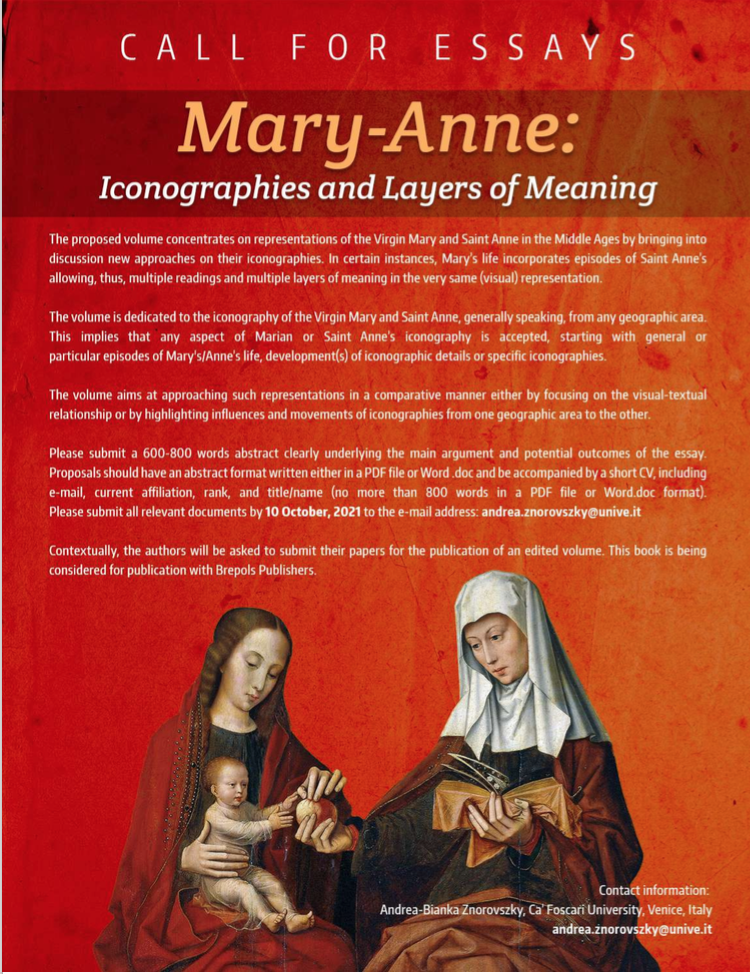
Appel à contribution – Mary-Anne: Iconographies and Layers of Meaning

The proposed volume concentrates on representations of the Virgin Mary and Saint Anne in the Middle Ages by bringing into discussion new approaches on their iconographies. In certain instances, Mary’s life incorporates episodes of Saint Anne’s allowing, thus, multiple readings and multiple layers of meaning in the very same (visual) representation.

The volume is dedicated to the iconography of the Virgin Mary and Saint Anne, generally speaking, from any geographic area. This implies that any aspect of Marian or Saint Anne’s iconography is accepted, into the session, starting with general or particular episodes of Mary’s/Anne’s life, development(s) of iconographic details or specific iconographies.

The volume aims at approaching such representations in a comparative manner either by focusing on the visual-textual relationship or by highlighting influences and movements of iconographies from one geographic area to the other.

Please submit a 600-800 words abstract underlying the main argument and potential outcomes of the essay. Proposals should have an abstract format written either in a PDF file or Word.doc and be accompanied by a short CV, including e-mail, current affiliation, and title/name (no more than 800 words in a PDF file or Word.doc format). Please submit all relevant documents by 10 October, 2021 to the e-mail address: andrea.znorovszky@unive.it

Contact information:
Andrea-Bianka Znorovszky, Ca’ Foscari University, Venice, Italy (andrea.znorovszky@unive.it)

Publié dans Appel à contributions | Laisser un commentaire