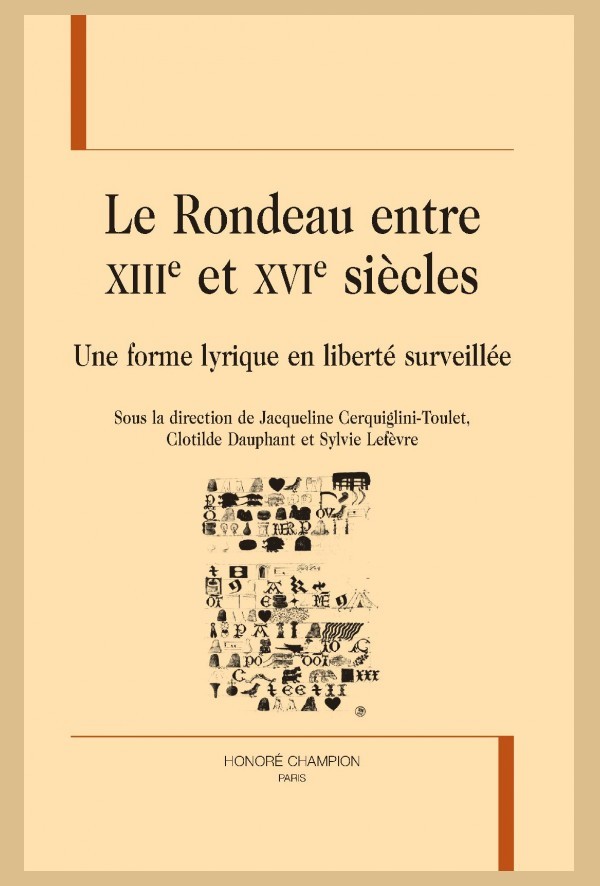
Publication – « Le Rondeau entre XIIIe et XVIe siècle. Une forme lyrique en liberté surveillée », dir. Jacqueline Cerquiglini-Toulet, Clotilde Dauphant et Sylvie Lefèvre

Labyrinthe de mots ou figure du cercle, le rondeau continue de poser des questions sur sa forme, simple ou complexe, sur ses origines et sur son évolution dans le temps long. Chanson, rondel de carole, rondel, caractérisé par un refrain de plusieurs vers au Moyen Âge, le rondeau devient texte à refrain de quelques mots ou rentrement au XVe siècle. C’est cette dernière forme que le XVIIe siècle, amateur d’archaïsme, reprendra, souvent comme pièce de circonstances. Au XIXe siècle, historiens, théoriciens et poètes décident de distinguer nettement rondeau et rondel tandis que les éditeurs de poésie médiévale se divisent sur la longueur de reprise d’un refrain abrégé en etc. Ce débat n’a pas été tranché jusqu’à présent, et s’il ne l’est pas de façon définitive et de manière uniforme dans ce volume, c’est qu’entre texte et musique le rondeau a longtemps été, plutôt qu’une forme fixe, une forme en liberté surveillée.
Jacqueline Cerquiglini-Toulet est professeur émérite de littérature française du Moyen Âge à Sorbonne Université, spécialiste de poésie lyrique, de Guillaume de Machaut à François Villon.

Clotilde Dauphant est maître de conférences de littérature française du Moyen Âge à Sorbonne Université, spécialiste de poésie lyrique, en particulier des formes fixes et d’Eustache Deschamps.

Sylvie Lefèvre est professeur de littérature française du Moyen Âge à Sorbonne Université, spécialiste des XIVe-XVe siècles (histoire et poétique des textes). Elle a travaillé sur Nicole Oresme, Antoine de La Sale, sur les questions de l’épistolaire, du recueil et de l’autographie.

Table des matières : ici

Informations pratiques :

Le Rondeau entre XIIIe et XVIe siècle. Une forme lyrique en liberté surveillée, dir. Jacqueline Cerquiglini-Toulet, Clotilde Dauphant et Sylvie Lefèvre, Paris, Honoré Champion, 2021. 224 p., 15,5 x 23,5 cm. ISBN : 9782745355355. Prix : 35 euros.

Source : Honoré Champion
Publié dans Publications | Laisser un commentaire

Offre d’emploi – Lecturer in History 300-700 CE, Durham University

The Department of History at Durham University seeks to appoint a talented individual to the fixed term role of Lecturer in History CE 300-700.  They are particularly eager to hear from applicants with a focus on the history of the Mediterranean world.  

The primary focus of this role is on research and teaching but there will also be the opportunity to engage in wider citizenship within the University and beyond.

This role of Lecturer is for a fixed term of 12 months and to provide cover for Eleanor Barraclough, who has been awarded an AHRC Leadership Fellowship. It is not anticipated that this period would be extended beyond the initial fixed term.

Applicants must demonstrate research excellence in the field of History CE 300-700, with the ability to teach our students to an exceptional standard and to fully engage in the services, citizenship and values of the University.

The post-holder will be expected to contribute to a new team-taught level 1 module on the late-antique Mediterranean world, to contribute a strand to the core level 1 module ‘Making History’, and to teach a new or existing level 2 module in an aspect of early medieval history. They will undertake some undergraduate and MA dissertation supervision and, where appropriate, carry out other teaching duties specified by the Head of Department.

All applicants are asked to submit:

  • A CV and covering letter which details your experience, strengths and potential in the requirements set out above;
  • PDFs of up to two pieces of research focused work;
  • A personal research plan [of 500-1,000 words, setting out your intended research programme for the coming three to five years, with some indication of possible publications and sources of funding]

You should provide details of 3 academic referees and the details of your current line manager so that we may seek an employment reference (if they are not listed as an academic referee).  Please note:

  • We shall seek the academic references during the application process.  We would ask that you alert your academic referees to this application as soon as possible so that we can quickly obtain references should you be progressed to the long list stage.  If you do not wish (some or all) of your referees to be approached during the recruitment process; you must clearly indicate this to us at the time of your application.
  • Academic references sought for long-listed candidates may be made available to the panel during the shortlisting process.
  • We will seek a reference from your current line-manager if we make you an offer of employment (albeit you may have also nominated your line manager as an academic referee).  Please clearly indicate which referee is your current line-manager and please let us know if we should only approach them once an offer has been made.

Applications are particularly welcome from women and black and minority ethnic candidates, who are under-represented in academic posts in the University. The deadline to apply is 17th August 2021. Please apply via the Durham jobs page: https://www.dur.ac.uk/jobs/

Source : Medieval Art Research

Publié dans Offre d'emploi | Laisser un commentaire

Publication (souscription) – Splendeur et dispersion des manuscrits et des chartes d’une prestigieuse abbaye bénédictine normande (Xe -XXe s.). Volume 1 : La bibliothèque et les archives de la Sainte-Trinité de Fécamp pendant la période ducale (911-1204)

Centre politique et religieux majeur de la Normandie ducale (911-1204), la place-forte de Fécamp s’affirme au cours du Moyen Âge comme l’un des hauts lieux intellectuel spirituel et culturel de la chrétienté.

La collégiale fondée en ses murs par les ducs de Normandie en 990, puis transformée en abbaye bénédictine dès 1001, a joué un rôle essentiel dans cet essor et dans ce succès. Richement doté dès l’origine par les ducs, le monastère devient rapidement l’une des abbayes les plus puissantes de Normandie et d’Occident. C’est aussi un centre de pèlerinage réputé, dédié à la relique du Précieux Sang. La population cosmopolite qui y gravite, l’origine italienne de ses premiers abbés et ses liens étroits avec Saint-Bénigne de Dijon, Cluny ainsi que la papauté ont contribué à façonner sur place une pensée originale, aux influences multiples. Nous l’observons aussi bien dans les textes que dans le décor des manuscrits ou la pierre des monuments. Pionnier dans le domaine de l’écrit, son scriptorium a produit parmi les plus anciennes annales et les plus anciens nécrologes, livres du chapitre, actes diplomatiques et cartulaires connus en Normandie. Les livres et les chartes conservés témoignent encore, malgré leurs dispersions et les injures du temps, de l’importance et du rayonnement exceptionnel de cette abbaye depuis l’an Mil jusqu’à la Révolution française. C’est pourquoi ce monastère a attiré l’attention de nombreux historiens et érudits depuis le XVIIe siècle.

Ce constat et ce contexte particulier de conservation des sources écrites anciennes incitent aujourd’hui les chercheurs à tenter de reconstituer virtuellement la bibliothèque et le chartrier de ce prestigieux monastère. Les communications prononcées lors des deux journées d’études organisées à Fécamp les 25 et 26 octobre 2017 par les associations des Amis du Vieux Fécamp et du Pays de Caux et des Amis de l’abbatiale de la Sainte-Trinité de Fécamp constituent en quelque sorte le fondement de cet utile et ambitieux projet. Ces journées d’études ont en effet permis de réunir quelques uns des spécialistes de l’histoire de l’abbaye, de sa bibliothèque, de ses archives et de son scriptorium. Les actes qui en sont issus ont pour objectif de présenter un état des recherches menées à ce sujet de 2010 à 2020. Le lien vers le sommaire des deux volumes de ces actes, qui paraîtront en 2021 et 2022.

L’association des Amis du Vieux Fécamp et du Pays de Caux, qui assure la publication de ces actes, vous propose de participer à la souscription du premier volume, qui paraîtra d’ici la fin de l’année 2021 et sera vendu au prix unitaire de 30 €.

En souscrivant dès maintenant, et avant le 1er septembre 2021, vous bénéficierez d’un prix préférentiel d’achat à 25 € (soit une remise de 5 € par volume acheté).

Pour cela, veuillez remplir le formulaire de souscription et suivre les instructions qu’il contient.

Vous pouvez faire le choix soit de recevoir vos exemplaires par envoi postal (moyennant des frais de port), soit de retirer gratuitement vos exemplaires auprès de l’association, à Fécamp, ou à l’Université de Caen en contactant l’un des directeurs de publication de ces actes à l’adresse mail suivante : stephane.lecouteux@unicaen.fr

Source : CRAHAM

Publié dans Publications | Laisser un commentaire

Offre d’emploi – Belspo BRAIN 2.0 project LORD (Lordship and State Formation in the County of Flanders, 15th – 18th C.) has a vacancy for 1 PhD student (at Ghent University)

The principal investigators of the Belgian Belspo BRAIN 2.0 project LORD (Lordship and State Formation in the County of Flanders, 15th – 18th C.) are looking for a PhD student for a 4-year project at Ghent University’s Department of History. LORD is a partnership project of the Department of History at Ghent University (Prof. dr. Frederik Buylaert & Prof. dr. Thijs Lambrecht) and The State Archives of Belgium (Dr. Joke Verfaillie). The project focuses on premodern processes of centralisation and state formation in the Southern Low Countries. Specific attention is given to the relation between (feudal) lordship (« Heerlijkheid ») and the central authority.

The PhD student will operate in a dynamic team that consists of the principal investigators at both insitutions, a postdoctoral researcher and one other PhD student.

In fact, LORD has two PhD sub-projects:

  1. A reconstruction of the number of lordships in Flanders (late 15th century – c. 1750), based on existing data sets and new research on original source material. Focus on social background and the political-administrational activities of lords.
  2. A study of the financial structures of lordships in Flanders (c. 1400 – 1800), based on accounts and juridical source material. Focus on the (fiscal / financial) relation between lordships and the fiscal policy and demands of the central government.

One PhD student has already been hired, but the projects have not yet been attributed. Candidates are invited to indicate which topic they would prefer to work on.

You can find all details of the PhD position and the LORD project in the (Dutch) job text attached. The deadline for application is 20 August 2020!

Source : UGent – Henri Pirenne Institute for Medieval Studies

Publié dans Offre d'emploi | Laisser un commentaire

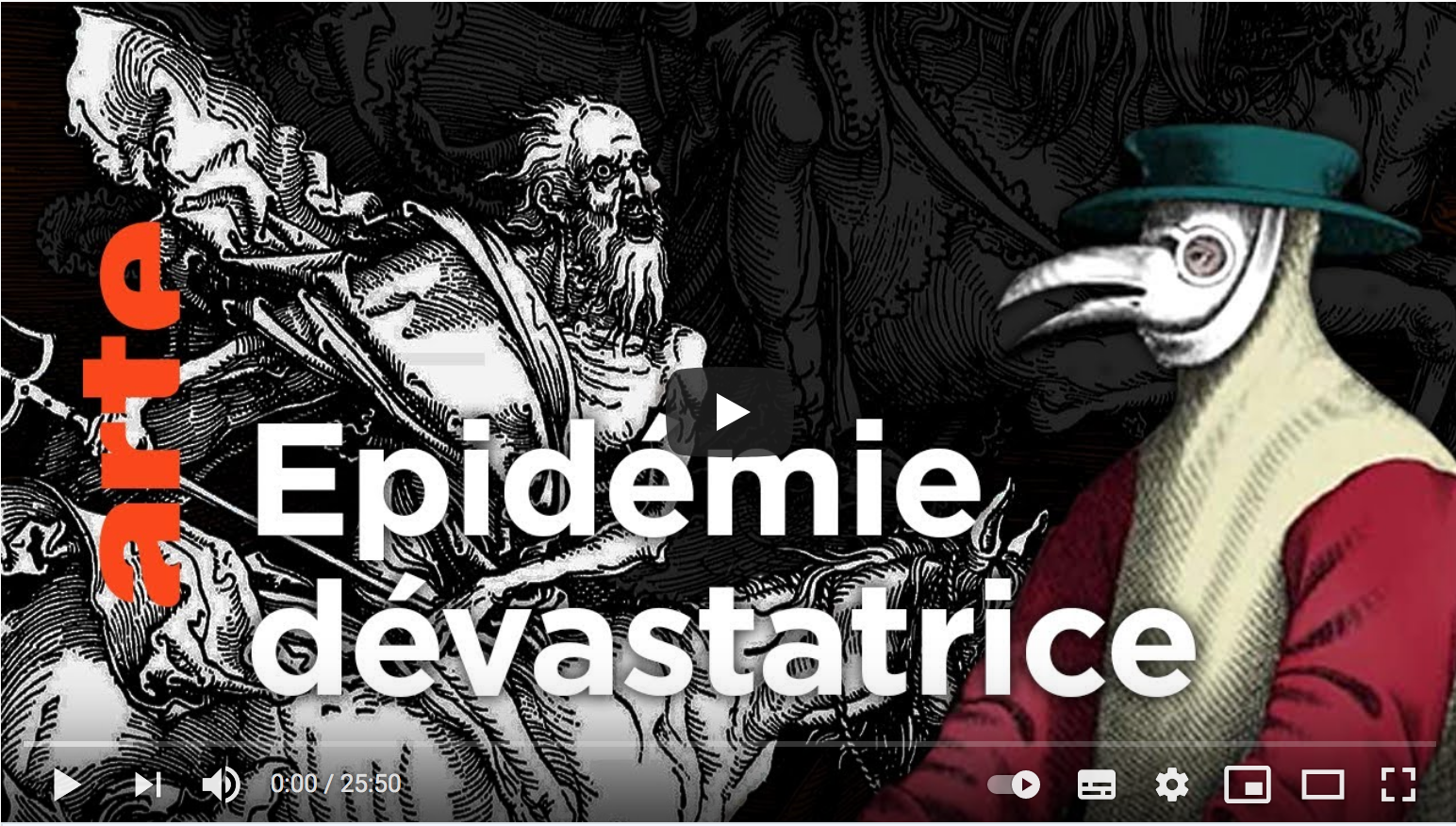
Podcast – « Peste : La grande épidémie » (1974, avec not. Jacques Le Goff) & « 1347 : La peste noire | Quand l’histoire fait dates »

Peste : La grande épidémie
Histoire des gens | ORTF | 26/10/1974


L’émission est consacrée à la peste, terreur du moyen âge. A Florence, Pierre DUMAYET converse avec l’historien Jacques LE GOFF sur la Grande peste qui a ravagé la ville italienne en 1348. La maladie entraine des bouleversements sociaux et religieux fondamentaux dans la civilisation occidentale. Puis à Gordes, Pierre DUMAYET écoute le docteur Jean Noël BIRABEN raconter les épidémies dont celle de Marseille en 1720. En conclusion, Jacques LE GOFF rencontre le professeur MOLLARET de l’institut Pasteur, qui prévient sur les risques toujours possibles d’une épidémie. L’émission est constituée de promenades-discussions de Pierre DUMAYET et ses invités, ponctués d’extraits de films, de dessins et gravures, de nombreuses images de Florence et de ses principaux monuments, des statues de cire du musée de la Specola, du vieux port avec le quartier de l’Estaque à Marseille.

1347 : La peste noire | Quand l’histoire fait dates

Accès : ici


Alors qu’en l’espace de cinq ans la grande peste a décimé un tiers de la population européenne, il reste finalement peu de traces de la pire catastrophe que le Moyen Âge ait connue. Que s’est-il réellement passé entre 1347 et 1352 sur notre continent ? Il apparaît que cette épidémie a été le marqueur d’une première mise en relation massive de l’Eurasie et du monde méditerranéen. L’histoire en mouvement Portée par le récit face caméra, aussi savant que vivant, de Patrick Boucheron, professeur au Collège de France, cette collection documentaire met l’histoire en mouvement. Des frises chronologiques animées accueillent images, documents et archives, illustrant les dix grandes dates évoquées. En reconstituant, au fil d’une enquête captivante, ces événements inscrits dans les manuels scolaires, et en les replaçant dans plusieurs temporalités (au travers des différents calendriers), la série rend ainsi sensible la manière dont l’histoire s’écrit, se date et se commémore. Une approche nouvelle du sujet, où se croisent art de la narration, techniques ludiques d’animation et rigueur scientifique.

Série documentaire de Patrick Boucheron et Denis van Waerebeke (France, 2017, 26mn)

Publié dans Podcast | Laisser un commentaire

Publication – Bernard Gueugnon, « Le château d’Alone-Toulongeon en Autunois »

Du château d’Alone-Toulongeon, à 15 km au sud d’Autun, il ne restait guère qu’une partie des douves en eau et quelques moignons de murs émergeant des broussailles, quand son propriétaire, auteur de ce livre, entreprit de l’aménager. Le curage des fossés et l’aménagement d’un chemin contournant la butte ont fait apparaître le plan du château des XIIe-XVIIe siècles réaménagé au XVIIIe siècle et entouré d’un jardin à la française. À la fin de l’Ancien régime, celui-ci passait pour être le plus beau de la région.


Ce château a hébergé des personnages illustres : Antoine-II de Toulonjon époux de Françoise de Rabutin-Chantal, fille de sainte Jeanne de Chantal et tante de la marquise de Sévigné ; Gabrielle de Toulonjon épouse de Roger de Bussy-Rabutin et Charles Gravier de Vergennes, ministre de Louis XVI.

Informations pratiques :

Bernard Gueugnon, Le château d’Alone-Toulongeon en Autunois, Dijon, CECAB, 2021. 66 p. – 46 illustrations – 10 €. ISBN : 979-10-95034-18-6.

Source : CECAB

Publié dans Publications | Laisser un commentaire

Appel à contribution — L’Architettura normanna e il Mediterraneo. Dinamiche di interazione culturale

CfP – Deadline: 31.07.2021
L’Architettura normanna e il Mediterraneo. Dinamiche dell’interazione culturale

The expansion of the Normans in medieval Europe and beyond is proving to be a wide and very rewarding field for research into the complex phenomenon of transcultural exchange processes (after the conceptual narrowing as « popolo d’Europa » in 1994, most recently Burkhardt/Foerster 2016; Scirocco/Wolf 2018; Stringer/Jotischky 2019 and Tabanelli/Tranchina 2020 as well as the exhibition in the Mannheim Reiss-Engelhorn Museum 2022/23). On the one hand, studies deal with the great mobility of people, ideas and goods within the territories under Norman rule; on the other hand, the powerful dynamics of the exchange between the new Norman upper class and the population already living in these areas are increasingly coming into view. Here it should be noted that the Norman territories in the 11th and 12th centuries – in particular Normandy, England, southern Italy and the Principality of Antioch – were discontinuous and generally only connected by sea. There has been much less investigation into the Norman presence, albeit organised differently and of lower intensity, in the Dalmatian coastal region, on the east coast of the Ionian Sea, on the Iberian Peninsula (the Dukedom of Tarragona), in Ifriqiya (North Africa) and in the Holy Land.

The special issue of this journal focuses on the contribution of the Normans to the architectural culture of the southern and eastern Mediterranean region. Contributions are particularly sought which treat of the associated mutual cultural exchange processes in the sense of a Histoire croisée. Works are particularly welcome which combine theoretical reflections with the concrete treatment of architectural contexts. Here the narrow focus of the research on the Palermo royal court should be widened with a significantly broader geographical and social approach. Along with contributions to the cultural relations of the various ethnic groups in southern Italy and eastern Sicily, investigations are of interest into the visible signs of cultural interaction between the various Norman territories with other cultures in the Mediterranean area. Here the interest is directed at questions of town planning as well as individual buildings (sacred and secular). In terms of the thematic focus, particularly noteworthy are the transfer of construction know-how and of spatial and vault solutions, architecture as promoter of social participation, the importance of port cities and other „contact zones“, strategies of spoliation and possible semantics, aspects of residential comfort, the relationship between space and liturgy, and building sculpture with its ruling-related and socio-politically interpretable image programs.

Proposals are welcome for two types of contributions in English and Italian: – Articles with a length of 20,000–40,000 characters (including spaces and notes) and up to 12 illustrations; short articles or miscellanea of 5,000–10,000 characters (including spaces and notes) and up to 3 illustrations.

Prospective contributors are asked to send an abstract (up to 400 words) and a short CV to redazione.aistarch@gmail.com by July 31, 2021. Editorial rules and other guidelines will be announced after receipt of the suggestions. The contributions must be unpublished; the deadline for contributions is the 20th of December 2021. Contributions received will be discussed by the editorial committee and undergo a peer-review (double-blind) procedure.

Timetable
– Submission deadline for proposals to redazione.aistarch@gmail.com: 31st of July 2021
– Feedback from the editors: 3rd of September 2021
– Submission deadline for contributions: 20th of December 2021
– Publication of the special issue: June 2022

redazione.aistarch@gmail.com

Source : H-Soz-Kult

Publié dans Appel à contributions | Laisser un commentaire

Podcast — Bastien Dubuisson, « L’hagiographie latine dans le diocèse de Trèves à la veille de la Réforme »

Atelier de la recherche virtuel PraME

Mardi 26 janvier 2021 Bastien Dubuisson (Université du Luxembourg – Université de Namur) « L’hagiographie latine dans le diocèse de Trèves à la veille de la Réforme. L’exemple de l’abbaye bénédictine de Saint-Maximin »

Publié dans Podcast | Laisser un commentaire

Publication — « Philosophie et fiction de l’Antiquité tardive à la Renaissance », dir. Fabienne Pomel et Sophie Van der Meeren

Quels étaient les représentations et enjeux de la philosophie et de la fiction, leurs échanges, interactions et zones frontières de l’Antiquité tardive jusqu’à la Renaissance? La fiction peut apparaître comme l’envers de la vérité. Elle n’en est pas moins une forme de recherche de vérité, savoir ou sagesse: Augustin, Macrobe, Martianus Capella ou Boèce, puis les poèmes allégoriques latins du XIIe siècle, les encyclopédies du XIIIe siècle, suivies par des œuvres allégoriques écrites dans le milieu de la cour de Charles V et Charles VI ou encore par Ficin problématisent le statut de la fiction: quelle est sa légitimation philosophique? Quels sont les rapports entre philosophie et arts libéraux, philosophie et poétique, philosophie et théologie? Les contributions interrogent le lexique et l’arrière-plan philosophique. Elles examinent aussi les moyens de la fiction pour mettre en œuvre un projet herméneutique et heuristique fécond: la personnification, la prosopopée, les modèles narratifs (banquet ou voie) ou le cadre dialogique.

Table des matières : ici

Informations pratiques :

Philosophie et fiction de l’Antiquité tardive à la Renaissance, dir. Fabienne Pomel et Sophie Van der Meeren, Louvain, Peeters, 2021 (Synthema, 12). XII–358 p. ISBN : 9789042943308. Prix : 86 euros.

Source : Peeters

Publié dans Publications | Laisser un commentaire

Publication – Zachary Guiliano, « The Homiliary of Paul the Deacon. Religious and Cultural Reform in Carolingian Europe »

An ambitious examination of one of the most important theological and liturgical texts of the Middle Ages — the homiliary of Paul the Deacon commissioned by Charlemagne — and the first comprehensive study of its earliest witnesses, a resource for all those interested in Charlemagne, medieval liturgy, theology, and preaching.

As one of the most widely used products of Charlemagne’s religious and cultural reforms, the homiliary of Paul the Deacon is a unique monument in the history of Western Europe. Completed around AD 797, this collection of patristic homilies and sermons shaped the religious faith and liturgical practices of the churches in Carolingian Europe and those of countless other churches over the course of a millennium of use.

Until now, scholarly study of the homiliary has rested on seven partial witnesses to the collection. This study, however, draws on over 80 newly identified witnesses from the Carolingian period, while providing a brief guide and handlist to hundreds of later manuscripts. It replaces the current scholarly reconstruction of the homiliary, discusses the significance of the collection’s liturgical structure and provisions, and considers the composition of the homiliary in the context of Charlemagne’s reforms and Paul’s patron-client relationships. The study also brings together evidence for the production and use of this text in thirty-three Carolingian monasteries, cathedrals, and churches.

The book then addresses the homiliary’s theological character: the contents of the homiliary reflected a concern for expressing and defending orthodox doctrine at Charlemagne’s court against Trinitarian and Christological heresies, as well as an urgent attention to moral reform in the light of a belief in the imminence of divine judgement. Finally, the study demonstrates the varied uses of Paul’s collection and its historical legacy.

The Revd Dr Zachary Guiliano is chaplain and career development research fellow at St Edmund Hall, Oxford. He is the author of various articles, essays, and reviews in theology and church history.

Informations pratiques :

Zachary Guiliano, The Homiliary of Paul the Deacon. Religious and Cultural Reform in Carolingian Europe, Turnhout, Brepols, 2021 (Sermo, 16). 339 p., 1 b/w ill. + 3 colour ill., 13 b/w tables, 2 b/w line art, 156 x 234 mm. ISBN : 978-2-503-57791-3. Prix : 90 euros.

Source : Brepols

Publié dans Publications | Laisser un commentaire