Colloque – Maître Eckhart, lecteur d’Augustin

Metz, Institut européen d’écologie 2, rue des Récollets
15-16 mai 2019

Responsables scientifiques : Marie-Anne VANNIER, Professeur Université delorraine Markus VINZENT, Professeur
King’s College, Londres

Augustin et Eckhart

Programme :

15 Mai

9h 30 : Marie-Anne VANNIER (UL, IUF, ERMR), Eckhart, l’un des meilleurs lecteurs d’Augustin
10h : Harald SCHWAETZER (Kueser Akademie, Bernkastel-Kues), L’argument du Cogito chez Augustin, Eckhart et Nicolas de Cues
Pause

11h : Markus ENDERS (Université de Freiburg im Breisgau), Les fondements augustiniens de la compréhension eckhartienne de la vérité
11h 30 : Jean DEVRIENDT (ERMR), La place d’Augustin dans les Sermons latins d’Eckhart

Après-Midi

14h 30 : Gérard NAUROY (Université de Lorraine), Eckhart, lecteur d’Ambroise de Milan à travers Augustin
15h : Dietmar MIETH (Université de Tübingen, Max-Weber-Kolleg, Erfurt), Le De disciplina christiana d’Augustin dans les Sermons d’Augustin Deus caritas est
15h 30 : Jean-Claude LAGARRIGUE (ERMR), La place d’Augustin dans le Livre des Paraboles de la Genèse d’Eckhart
Pause

16h 30 : Johann KREUZER (Université de Oldenburg), La beauté chez Augustin et chez Eckhart. Convergences et divergences
17h : Matthias VOLLET (Kueser Akademie, Bernkastel-Kues), La quête de Dieu, sans cesse reprise chez Augustin, Eckhart et Nicolas de Cues

16 Mai

Matin

9h : Markus VINZENT (King’s College, Londres), Differentia duorum testamentorum, timor et amor. (Augustinus, Contra Adamantium). Eckhart e Augustin sur le rapport entre l’Ancien et le Nouveau Testament
9h 30 : Maxime MAURIEGE (Thomas Institut, Cologne, ERMR), L’enjeu des deux sermons d’Eckhart sur Augustin Pause
10h 30 : Julie CASTEIGT (IUF, Max-Weber-Kolleg, Erfurt), L’influence d’Augustin dans le Commentaire eckhartien de Jean
11h : Silvia BARA BANCEL (Université Comillas, Madrid, UL, ERMR), La sagesse chez Augustin et chez Eckhart Discussion

Après-Midi

14h 30 : Jana ILNICKA (Max-Weber-Kolleg, Erfurt), La place d’Augustin dans les Questions parisiennes d’Eckhart 15h : Henri PERRIN (Grenoble), La regio dissimilitudinis chez Augustin et Eckhart
Pause

15h 30 : Marco VANNINI (Université de Florence), La place d’Augustin dans les Sermons et Leçons d’Eckhart sur l’Ecclésiastique
16h 30 : Jean-Louis SOHET (Collège San Lorenzo, Rome), La réception d’Eckhart au prisme de la conversion d’Augustin par Benoît de Canfield

Conclusions

Source : MSH Lorraine
Publié dans Colloque | Laisser un commentaire

Offre d’emploi – Lecturer/Lecturer below the bar in English (Medieval and Early Modern Studies)

University of Limerick
Faculty of Arts, Humanities & Social Sciences

The University of Limerick (UL) with over 15,000 students and 1,400 staff is an energetic and enterprising institution with a proud record of innovation and excellence in education, research and scholarship. The dynamic, entrepreneurial and pioneering values which drive UL’s mission and strategy ensures that we capitalise on local, national and international engagement and connectivity. We are renowned for providing an outstanding student experience and employability and conducting leading edge research. Our commitment is to make a difference by shaping the future through educating and empowering our undergraduate and postgraduate students. UL is situated on a superb riverside campus of over 130 hectares with the River Shannon as a unifying focal point. Outstanding recreational, cultural and sporting facilities further enhance this exceptional learning and research environment.

default-logo

Applications are invited for the following position:

Faculty of Arts, Humanities & Social Sciences
School of English, Irish, and Communication
Lecturer/Lecturer below the bar in English (Medieval and Early Modern Studies) – Multiannual

Contract Type: Lecturer below the bar – Tenure Track (five year fixed term). During the term of the contract the successful applicant will have the opportunity to apply for tenure in accordance with the University’s Policy and Procedures for Granting Multi-annual Status to Tenure Track Academic Staff

Salary Scale: Lecturer €52,187 – €83,038 p.a.

Salary Scale: Lecturer below the bar €39,118 – €53,782 p.a.

Further information for applicants and application material is available online from:

http://www.ul.ie/hrvacancies

The closing date for receipt of applications is Thursday 2nd May 2019.

Applications must be completed online before 12 noon, Irish Standard Time on the closing date.

Please email erecruitment@ul.ie if you experience any difficulties

Applications are welcome from suitably qualified candidates.

The University of Limerick holds a Bronze Athena SWAN award in recognition of our commitment to advancing equality in higher education. The University is an equal opportunities employer and is committed to selection on merit welcoming applicants from all sections of the community. The University has a range of initiatives to support a family friendly working environment, including flexible working.

“The University of Limerick has implemented a “Smoke and Vape Free Campus Policy”. Smoking and vaping in all forms is prohibited.”

Source : Jobs.ac.uk

Publié dans Offre d'emploi | Laisser un commentaire

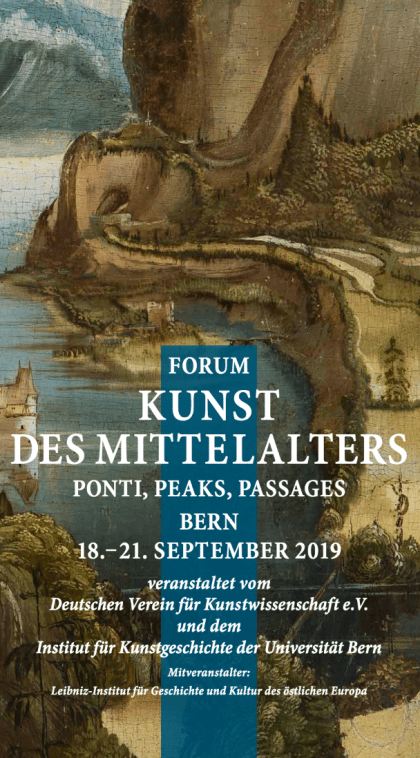
Colloque – Forum Kunst des Mittelalters. Ponti, Peaks, Passages

Berne
18-21 septembre 2019

Capture d’écran 2019-04-12 à 09.08.18

Der Deutsche Verein für Kunstwissenscha e. V. lädt zum fünf- ten Mal zu einem internationalen Kongress „Forum Kunst des Mittelalters“ ein, der vom 18. bis 21. September 2019 in Bern statt ndet und in Zusammenarbeit mit dem Institut für Kunst- geschichte der Universität Bern sowie den Kulturinstitutionen aus Bern und Umgebung veranstaltet wird. Der Deutsche Verein für Kunstwissenscha ist seit seiner Gründung bemüht, For- schungen zu allen Epochen der deutschen Kunst zu fördern, doch spiegeln zahlreiche vom Verein herausgegebene Corpus- werke und Monographien das besondere Interesse an der mittel- alterlichen Kunst.

Seit den vorausgegangenen Tagungen in Halberstadt (2011), Frei- burg (2013), Hildesheim (2015) und Berlin-Brandenburg (2017) richtet der Verein, neben der Herausgabe wissenschaftlicher Publikationen und der Zeitschri , auch große internationale Konferenzen aus. Die fün e Tagung, die wieder ein Forum für freien und o enen Gedankenaustausch über Kunstwerke des Mittelalters sein soll, ist dieses Mal dem ema „Ponti, Peaks, Passages“ gewidmet und ndet an der Universität sowie an ver- schiedenen bernischen Institutionen statt, die dem Tagungs- thema und übergeordneten Fragen Leben verleihen.

Programme : ici

Source : Forum Kunst des Mittelalters

Publié dans Colloque | Laisser un commentaire

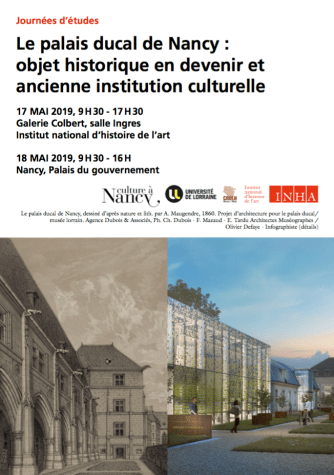
Colloque – Le palais ducal de Nancy : objet historique en devenir et ancienne institution culturelle

Cette journée, consacrée à l’un des ensembles patrimoniaux majeurs de Nancy et plus largement de la Lorraine, offre l’occasion de rassembler historiens, archéologues, historiens de l’art et architectes autour des questions que pose son nouveau chantier.

Il s’agira d’engager un dialogue autour de la double valorisation qui est projetée, celle de ses collections ainsi que celle de son bâti historique, et des choix qui y sont liés. Résidence ducale entre le XVIe et le XVIIIe siècle, le Musée lorrain, aujourd’hui riche de sa double dialectique muséale et palatiale, invite à envisager la restauration et l’aménagement de son site en rapport à ces deux aspects, entre valeur patrimoniale, au cœur d’une logique guidée par des problématiques de conservation du bâti, et valeur d’usage, centrée sur un exercice de valorisation. Interroger cet équilibre à l’aune de son histoire et des multiples modifications anciennes ou récentes du bâti (qu’il s’agisse des destructions anciennes ou des interventions constructives du XIXe siècle) ainsi que des enjeux modernes permettra d’envisager ce nouveau projet architectural dans un cadre théorique et historique élargi.

Capture d’écran 2019-04-19 à 15.07.04

Programme :

17 MAI 2019
Institut national d’histoire de l’art, galerie Colbert, salle Ingres, Paris

09h30 Mot d’accueil : Pauline Chevalier (INHA) et Abel Debize (INHA)
10h00 La demeure princière à cheval entre XVe et XVIe siècle : architecture et représentation – Flaminia Bardati
10h30 Révolutions au palais. Art de bâtir, arts du décor et art de vivre à la cour de Nancy au début du XVIIe siècle – Paulette Choné
11h00 Le palais ducal, un modèle pour les hôtels particuliers nancéiens? – Yann Vaxelaire
11h30 Le palais ducal, espace de pouvoir de l’Etat lorrain – Laurent Jalabert
12h00 Pause déjeuner

14h00 Les objets du palais – Richard Dagorne
14h30 Raconter et partager l’histoire du palais ducal. La conception d’un système de médiation spécifique – Sophie Mouton
15h00 Genèse du projet architectural et muséographique – Fabrice Mazaud
15h30 Pause

15h45 Les apports de l’archéologie à la connaissance de l’histoire du palais ducal au XVIIIe siècle – Lonny Bourada
16h15 Le palais ducal de Nancy, une restauration emblématique du XIXe siècle – Pierre-Yves Caillault
16h45 L’hôtel ducal de Dijon : un iceberg documentaire – Hervé Mouillebouche
17h15 Discussion

18 MAI 2019
Palais du gouvernement, Nancy

09h30 : Mot d’accueil, introduction : Laurent Hénart (maire de la ville de Nancy, ancien ministre)
10h00 : L’hôtel de Mayenne, une résidence entre Paris et la Lorraine – Alexandre Gady
10h30 : À la mode de Bourgogne. Le palais ducal de Nancy vis-à-vis les palais urbains bourguignons et Habsbourg des anciens Pays-Bas – Krista de Jonge
11h00 : Habiter le palais mais vivre au chantier: regard porté sur les persistantes activités artisanales au palais ducal de Nancy entre les XVIe et XVIIe siècles – Abel Debize
11h30 : Le palais ducal de Nancy sous Léopold et François III (1698-1737) : entre visions idéales et pragmatisme du quotidien – Thierry Franz
12h00 : Discussion
12h30 : Pause déjeuner

14h00 – 16h00 : Visite du site du palais ducal

Informations pratiques :

Organisateur : Abel Debize (INHA), Richard Dagorne (Musée lorrain)

17 MAI 2019 Institut national d’histoire de l’art Galerie Colbert, salle Ingres
2 rue Vivienne ou 6 rue des Petits- Champs,
75002 Paris

Métro
Ligne 3 : Bourse Lignes 1 et 7 : Palais Royal – Musée du Louvre
Lignes 7 et 14 : Pyramides

Horaires
9H30-17H30

18 MAI 2019 Nancy, Palais du Gouvernement Place de la Carriere 54000 Nancy

Horaires
9H30-16H

Pour plus d’information Accueil INHA: 01 47 03 89 00 http://www.inha.fr

Publié dans Colloque | Laisser un commentaire

Offre d’emploi – LabEx haStec : Appel à candidature pour les contrats post-doctoraux 2020

Le LabEx HaStec étudie, de façon pluridisciplinaire, l’entrelacs historique des Savoirs, des Techniques et des Croyances – élément structurant des cultures et des sociétés humaines – selon un arc chronologique qui s’étend de l’Antiquité au XXIe siècle. Chacun de ces trois termes est entendu selon une polysémie réglée, qui dépasse les limites de l’histoire des sciences et des techniques, ou de l’histoire des religions, et intègre la pluralité des savoirs, les divers modes de croyance (y compris dans le domaine économique), et déploie les sens du mot « technique » selon un spectre vaste qui comprend aussi bien la rhétorique que les techniques intellectuelles (argumentatives, exégétiques) et spirituelles. Une attention particulière est portée aux Humanités numériques.

haStec

Le labEx Hastec est évidemment soucieux de l’aide à apporter aux jeunes chercheurs dans la mise en œuvre de son programme. Notre Laboratoire d’Excellence en histoire et anthropologie des savoirs, des techniques et des croyances (HASTEC) propose pour l’année civile 2020, cinq contrats post-doctoraux (1 an) à de jeunes chercheurs inscrivant leur enquête dans les champs thématiques du LabEx.

> Appel d’offre et constitution du dossier de candidature (à compléter)

> Contrat post-doctoral – fiche de renseignements (à compléter)

> Obligation des chercheurs Post-doc du labEx Hastec

> Liste des laboratoires partenaires du LabEx Hastec (les correspondants scientifiques doivent être membres du Labex Hastec)

Ensuite une fois sur cette page, cliquez sur « Liste des membres et associés HASTEC » pour chaque laboratoire

Dépôt du dossier de candidature

Pour les candidatures aux contrats post-doctoraux, le dossier de candidature doit être envoyé sous forme électronique au format .pdf (un seul fichier portant le nom du candidat) et la publication significative (aussi au format .pdf), avant le lundi 1er juillet 2019 (à 9h du matin), au Service de la Recherche de l’EPHE, à l’attention de M. Sylvain Pilon, Chargé d’appui à la coordination du LabEx Hastec : coordinateur.hastec@ephe.sorbonne.fr

M. Jérôme Billaud (responsable administratif, Service de la Recherche de l’EPHE) : recherche@ephe.sorbonne.fr

Les correspondants scientifiques doivent être membres du Labex Hastec  > Liste des partenaires

Composition du Jury

> en cours

 Examen des dossiers et pré-sélections

Mardi 22 octobre 2019  

> Procédures de sélection pour les post-doctoraux Hastec 

Résultats Audition et sélection des candidats

Mardi 12 novembre 2019

Source : LabEx haStec

Publié dans Offre d'emploi | Laisser un commentaire

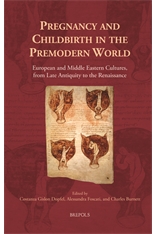
Publication – « Pregnancy and Childbirth in the Premodern World European and Middle Eastern Cultures, from Late Antiquity to the Renaissance », éd. C. Gislon Dopfel, A. Foscati, C. Burnett

This volume of contributions from international scholars offers a cross-cultural and multi-period analysis of pregnancy and childbirth traditions in Western and Middle Eastern cultures. The studies focus on the ideas, practices, and visual representations surrounding pregnancy and birth-giving from Late Antiquity to the Renaissance and offer the reader the possibility of observing the perception, representation, and theoretic paradigm of these events in a wide range of cultural contexts. The collection fits within multiple traditions of specialized scholarship, yet its scope suggests a geographically global approach and a new, multicultural methodology that encompasses a wide range of practices, historical periods, and topics. On one hand, it participates in the well-established medical, historical, and iconographic discourse on childbirth and family that has enticed much interest over the last two decades; on the other, its unique thematic structure includes cultures and periods previously ignored in similar collections of essays. The articles span from Northern Europe to the Mediterranean, the Middle East, and India, and connect the experience of childbirth to the exchanges of knowledge, religious beliefs, and social practices. With its variety of topics and specializations, the volume encourages a global comparative approach to the cultural narrative surrounding the activities and attitudes connected to conception and birth, paying particular attention to material culture, religion, history, and iconography, as well as to the exchange and dispersion of medical knowledge.

Costanza Gislon Dopfel, PhD, is Professor of Italian Culture and Chair of the Department of Art and Art History at Saint Mary’s College of California.

Alessandra Foscati, PhD in Medieval History is research fellow at the Beni Culturali department of Bologna University and at SISMEL (Società Internazionale per lo Studio del Medioevo Latino), Florence.

Charles Burnett, PhD, LGSM is Professor of the History of Arabic/Islamic Influences in Europe at the Warburg Institute, University of London, and Co-Director of the Centre for the History of Arabic Studies in Europe.

dIS-9782503580555-1

Table des matières :

Preface — CHARLES BURNETT

Introduction — COSTANZA GISLON DOPFEL

Part 1: Cultural Exchanges and Transmission of Knowledge

Educating the Midwife. The Role of Illustration in Late Antique and Medieval Obstetrical Texts — FRANCESCA MARCHETTI
Pregnancy and Birth in Middle-Persian Zoroastrian Literature: The Exchange of Knowledge between India, Iran, and Greece in Late Antiquity — PAOLO DELAINI
Tracing the Maternal Body in Medieval Muslim Gynaecological Texts — KATHRYN KUENY
Calculating Birth: Abraham Ibn Ezra’s Role in the Creation and Diffusion of the Trutina Hermetis — SHLOMO SELA

Part 2: Birth, Death, and Magic

Mother and Child: Archaeological Evidence of Childbirth Complications in Medieval Normandy — ARMELLE ALDUC-LE BAGOUSSE, CÉCILE CHAPELAIN DE SERÉVILLE-NIEL, and RAPHAËLLE LEFEBVRE
‘Girde hyr wythe thys mesure’: Birth Girdles, the Church, and Lollards — MARY MORSE
Prayer as Obstetric Practice at Thirteenth-Century La Cambre — SARA RITCHEY
Retracing Childbirth Through Hagiographical Texts and Canonization Processes in Italy and France between the Thirteenth and Sixteenth Centuries — ALESSANDRA FOSCATI

Part 3: Lying-in and Holy Birth: Tradition, Iconography, and Political Statement

‘Lying-in’ in High Medieval England — FIONA HARRIS-STOERTZ
Mary and Eve: The Permanence of the First Mother in Armenian Apocryphal Infancy Gospels — VALENTINA CALZOLARI
Mystras’ Byzantine Frescoes: The Political Message in the Iconography of the Birth of Mary — ANTONELLA PARMEGGIANI
Holy Mothers and Vanished Nativities: Maternal Art as Female Visual Epic in Quattrocento Florence — COSTANZA GISLON DOPFEL

Index

Informations pratiques :

Pregnancy and Childbirth in the Premodern World European and Middle Eastern Cultures, from Late Antiquity to the Renaissance, éd. C. Gislon Dopfel, A. Foscati, C. Burnett, Turnhout, Brepols, 2019 (Cursor Mundi, 36). XXIV+357 p., 38 b/w ill., 2019. ISBN: 978-2-503-58055-5. prix : 100 euros.

Source : Brepols

Publié dans Publications | Laisser un commentaire

Colloque – Peindre à Avignon aux XVe-XVIe siècles

Fondé sur le connoisseurship et amorcé à l’Université de Genève dès 2010 (soutenu par le FNS depuis 2015), le programme Peindre en France à la Renaissance cherche à reconstruire la dynamique de la peinture produite dans le royaume de France aux XVe et XVIe siècles, en tenant compte de toutes les techniques impliquées par le métier du peintre. Il a déjà généré sept volumes publiés aux éditions Silvana et qui forment collection. Les deux premiers (2011-2012) ont fixé le cadre méthodologique. Les suivants se focalisent, chacun, sur un foyer artistique : Lyon (2014), Troyes (2015), Dijon (2016), Rouen (2017), Bourges (2018). Le présent colloque, huitième de la série, vise à reconstituer la peinture produite dans une ville qui sert de relais entre la vallée du Rhône et le monde méditerranéen. Il abordera des peintres tels que Jacques Iverny, Barthélemy d’Eyck, Enguerrand Quarton, Jean Changenet, Hans Clemer, Simon de Châlons et Giovanni Capassini.

photo-dillustration-768x1024

Programme :

Vendredi 26 avril 2019

14h00 Accueil et introduction. Frédéric Elsig (Université de Genève)

I. Le XVe siècle
Président de séance : Till-Holger Borchert (Bruges, Groeningemuseum)

14h30 L’Arbre des batailles de la Biblioteca Nacional de España (Vitr/23/12) : le manuscrit autographe d’Honoré Bovet – Samuel Gras (Madrid, Centro de Estudios Europa Hispánica)
15h00 Deux peintres avignonnais à Saint-Antoine l’Abbaye : Robin Favier et Jacques Iverny – Mireia Castaño (Université de Genève)
15h30 L’irruption de l’ars nova en Provence dans les années 1440 : Barthélemy d’Eyck et quelques autres – Philippe Lorentz (Paris IV Sorbonne)
16h00 Discussions et pause

16h30 Le Couronnement de la Vierge d’Enguerrand Quarton : nouvelle interprétation – Emma Capron (Londres, Courtauld Institute of Art)
17h00 Enguerrand Quarton et Pierre Villate – Constantin Favre (Université de Genève)
17h30 L’Adoration des Mages de Carpentras et l’atelier Changenet – Carmen Decu Teodorescu (Université de Genève)
18h Discussions

Samedi 27 avril 2019

II. Le XVIe siècle
Président de séance : Mauro Natale (Université de Genève)

9h L’apport de l’érudition locale à l’étude de la peinture du XVIe siècle en Provence – Marie-Claude Léonelli (CIDRPP Avignon)
9h30 Enquête sur la genèse d’une œuvre oubliée de l’Ecole d’Avignon : le triptyque de Venasque du musée du Petit Palais – Dominique Vingtain (Avignon, musée du Petit Palais et Palais des Papes)
10h Quelques remarques sur le portrait et sur le courant septentrional à Avignon dans la première moitié du XVIe siècle – Cécile Scailliérez (musée du Louvre)
10h30 Discussions et pause

11h Une proposition pour Simon de Châlons – Camille Larraz (Université de Genève)
11h30 Giovanni Capassini : nouvelles propositions – Rafaël Villa (Université de Genève)
12h Discussions et conclusions

Informations pratiques :

Uni Bastions, Salle B111, 5 rue De-Candolle, 1205 Genève
L’accès au colloque est libre et ouvert à toute personne intéressée

CONTACT : Carmen.DecuTeodorescu@unige.ch
T +41(0)22 379 76 19

Source : Blog de l’ApAhAu

Publié dans Colloque | Laisser un commentaire

Offre d’emploi – Postdoc-Position in Pre-modern Islamic thought | Institut supérieur de philosophie – UCLouvain

ORGANISATION/COMPANY :
Université Catholique de Louvain (UCL)

RESEARCH FIELD :
History › Other
Philosophy › Other

RESEARCHER PROFILE :
First Stage Researcher (R1)
Recognised Researcher (R2)

APPLICATION DEADLINE
30/04/2019 00:00 – Europe/Brussels

LOCATION
Belgium › Louvain-la-Neuve

TYPE OF CONTRACT
Temporary

JOB STATUS
Full-time

HOURS PER WEEK
40

OFFER STARTING DATE
01/03/2019

logo-telechargerlelogo

Postdoc position (24 months) for the project: “Avicenna East & West I: Commentaries on the Qaṣīdat al-nafs” (FRS-FNRS; UCLouvain, Louvain-la-Neuve, Belgium)

Project Description

The aim of this project on the commentaries on the Qasidat al-nafs attributed to Avicenna is twofold: (1) to provide a better understanding of how Avicenna’s theory on the soul was received, interpreted and transformed in this tradition of commentaries; and (2) to document the attitude towards Avicenna’s legacy, and falsafa in general, in Islamic society

Sub-projects:
(1) Edition and analysis of the commentaries by Baḥrānī (d. 672/1274); ‘Afīf al-Dīn Tilimsanī (d. 690/1291); Qayṣarī (d. 751/1350)
(2) Comparative analysis of the commentaries by Dāʼūd al-Anṭākī (d. 1599) and ʻAbd al-Raʼūf al-Munāwī (d. 1621)
(3) General analysis of the commentary tradition on the Qaṣīdat al-nafs

The postdoc researcher will be responsible for sub-project 2 (commentaries by Anṭākī and Munāwī) and participate in the other sub-projects. The successful applicant is also expected to participate in the intellectual life of the Institut supérieur de philosophie and to spend part of her/his time to pursue her/his own intellectual interests and to work creatively to produce new exciting research.

Source : Euraxess

Publié dans Offre d'emploi | Laisser un commentaire

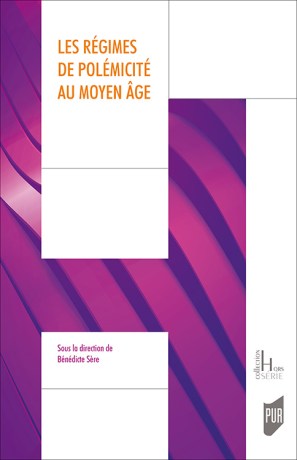
Publication – « Les régimes de polémicité au Moyen Âge », dir. Bénédicte Sère

Cet ouvrage se propose, pour la période médiévale, de dresser un état de l’art des études récentes sur la polémicité. Des IIe et IIIe siècles jusqu’au cœur du XVe siècle, avec des incursions dans l’époque moderne, l’étude se distingue par la volonté d’examiner la dimension ecclésiale du problème, restée peu défrichée jusqu’à présent et propose, ce faisant, une autre lecture du dialogue possible entre histoire et sciences sociales.

1553013184

Avec le soutien du laboratoire CHiSCO de l’université Paris Nanterre.

Table des matières : ici

Informations pratiques :

Les régimes de polémicité au Moyen Âge, dir. Bénédicte Sère, Rennes, Presses universitaires de Rennes, 2019. 15,5 x 24 cm, 216 p. ISBN : 978-2-7535-7562-2. Prix : 35,00 €.

Source : Presses universitaires de Rennes

Publié dans Publications | Laisser un commentaire

Appel à contribution – 16th International Congress of Medieval Canon Law

16th International Congress of Medieval Canon Law
Saint Louis University
19 – 25 July 2020

The 16th International Congress of Medieval Canon Law, co-sponsored by ICMAC (Iuris Canonici Medii Aevi Consociatio/International Society of Medieval Canon Law) and Saint Louis University, will take place on the university’s campus in St. Louis, Missouri, USA, from Sunday, July 19, through Saturday, July 25, 2020. These quadrennial Congresses, alternating sides of the Atlantic, constitute the premier academic conference in the field of medieval canon law. Traditionally they have drawn scholars from many countries, including not only medievalists and canonists, but also those who study related fields, such as Western jurisprudence and legal norms, Roman law, ecclesiastical and papal history, theology and biblical exegesis, manuscript studies, and the history of culture, society, and ideas.

ST Louius

ICMAC and the Congress organizers, Steven A. Schoenig, S.J., and Atria A. Larson, are pleased to announce the following plenary speakers for the Congress:

Professor Bruce Brasington (West Texas A&M University, USA)
Prof. Dr. Gisela Drossbach (University of Augsburg, Germany)
Professor Mia Korpiola (University of Turku, Finland)
Dr. Titus Lenherr (Diocese of Sankt Gallen, Switzerland)
Professor Rob Meens (Utrecht University, The Netherlands)
Professor Kenneth Pennington (The Catholic University of America, USA)
Professor Robert Somerville (Columbia University, USA)

The Academic Committee welcomes proposals on any topic touching upon medieval canon law, including, but not limited to, the following themes:

  • Texts and Jurisprudence
  • The Influence of the ius commune on the Western Legal Tradition and International Law
  • Canon Law and Local Ecclesiastical History
  • Canon Law, Theology, and Pastoral Care
  • Medieval Law in Comparative Perspective

The chronological focus of the Congress is typically on c. 500 – c. 1500, but select papers or sessions may also be accepted on Early Christian Canon Law and, in light of the 500th anniversary of Martin Luther’s burning of the Corpus iuris canonici, Canon Law and the Reformation.

The Academic Committee invites proposals for individual 20-minute papers or complete sessions of four 20-minute papers. Papers may be delivered in the following languages: English, French, German, Italian, or Spanish. Scholars not presenting in English are encouraged to utilize PowerPoint presentations and/or to provide written English summaries of their papers.

Regular sessions will not feature papers on text-editing projects. Updates on critical editions or other text-editing projects will be showcased in a poster session during the Congress. Scholars who wish to present on such projects may submit two proposals if they desire, one for the text-editing poster session and another for a regular session.

All proposals must include, for each participant, the following information: name (with title); position and institutional affiliation; email address; postal address; language of presentation; working title of paper (or poster presentation); and a 200-250 word abstract of the paper (or poster project). Proposals for papers, poster presentations, or sessions should be submitted through a Google Form on the Congress website (icmcl2020.wordpress.com).

Proposals are due on August 15, 2019.

More information about the Congress, its sessions, special instructions for the poster session, accommodations, travel, and Saint Louis University will eventually be found on the Congress website (icmcl2020.wordpress.com). Questions may be directed to icmcl2020@gmail.com.

Source : The Medieval Academy Blog

Publié dans Appel à contributions | Laisser un commentaire