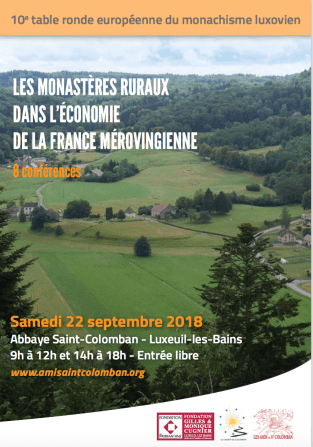
Colloque – Les monastères ruraux dans l’économie de la France mérovingienne

Samedi 22 septembre 2018
Abbaye Saint-Colomban – Luxeuil-les-Bains
9h à 12h et 14h à 18h
Entrée libre

Possibilité de restauration à l’abbaye le samedi midi 22 septembre sur réservation au 03 84 40 30 03 ou jacques.prudhon@wanadoo.fr

Les actes de cette Table ronde seront publiés en 2020 dans les Cahiers colombaniens 2018.

Capture d_écran 2018-09-07 à 22.16.41

Programme :

Président : Sébastien Bully, archéologue, chargé de recherche au CNRS, UMR ARTEHIS Dijon-Auxerre.

Les annales monastiques irlandaises : une collection précieuse pour l’étude des phénomènes climatiques extrêmes – Jean-Michel Picard, professor School of Languages and Literatures, University College Dublin
Réseaux monastiques et échanges économiques entre l’Irlande et le Continent au VIIe siècle – Mathilde Jourdan, doctorante Université Paris 1 Panthéon-Sorbonne. ATER, université d’Evry-Val-d’Essonne.
Au-delà des Alpes : Bobbio et les monastères du haut Moyen-Âge en Italie face à la gestion de leur patrimoine – Eleonora Destefanis, professore Université del Piemonte Orientale
Desertum : les paysages agricoles autour des monastères de Luxeuil et Annegray au haut Moyen-Âge – Emmet Marron, Emmet Marron, Marie Sklodowska Curie Research Fellow, Newcastle University.
Survie et fin de la fiscalité antique en Gaule mérovingienne – Étienne Renard, professeur, université de Namur, département d’Histoire.
Les grands bans des monastères du haut Moyen Age dans le massif des Vosges : territoires et économie – Damien Parmentier, Université de Strasbourg, docteur en histoire et civilisation européenne.

Source : Les Amis de saint Colomban

Publié dans Colloque | Laisser un commentaire

Appel à contribution – Text as object in the Middle Ages

The International Medieval Congress (IMC) is the largest medieval studies conference in the world. More than 2,900 medievalists from more than 60 countries participated in the 25th annual International Medieval Congress (IMC) from 2-5 July 2018.

In line with the Special Thematic Strand in 2019 “Materialities” (https://www.leeds.ac.uk/ims/imc/imc2019_call.html) and the recent creation of the strand “Manuscript studies”, we organize sessions on “Text as object in the Middle Ages”. Texts, indeed, are at the same time an idea and a form. The latter is the result of a combination of inherited social uses and specific intentions by the various actors involved in transmitting the text as idea. This process begins with the authors, continues to the craftsmen (parchment and paper makers, copyists and chancery clerks, painters and illuminators, sculptors and weavers, booksellers…) and then on to possessors, readers, archives and libraries. All textual artefacts are concerned: manuscripts, charters, inscriptions, tapestries, seals, coins, etc.

What scholars can study nowadays is however only one specific, if not final, state of those manuscripts, documents and inscriptions, from which they seek to reconstruct the respective intents of the actors. Under the topic “Text as object in the Middle Ages”, we intend to study the interplay of the original creation act, the possible transformations, and modern scholarship, especially along the following lines: “archaeology of a research concept”, “materiality in scholarly editions”, “genre and materiality”, “fragments”, “imaging techniques and physicochemical analysis”


Paris, Archives Nationales, JJ 145, fol. 193r [https://bvmm.irht.cnrs.fr/iiif/23834/canvas/canvas-2360446/view]

  • Archaeology of a research concept: awareness of materiality in the 15th-19th centuries

Medieval library catalogues started including dictiones probatoriae or secundo folio as identifiers of a given manuscript as object rather than as the bearer of a text; additional information on the physical appearance could also be indicated (size of the script, illumination, …). Cartularies and registers, but also inventories, sometimes include a description of the original charter, be it in a text form, be it as a  drawing (“copie figurée”), also for elements which are no validation signs. These are early examples of an awareness of material aspects in textual artefacts.  “materiality” as a term is rather new in historiographical research, however there is a complex archaeology of this research concept applied to texts. Starting in the Middle Ages, it became more prominent with the rise of the “auxiliary sciences” such as palaeography and diplomatics in the 17th and 18th century which were very much focused on the material aspects of written objects. By the 19th century it found its way into the bibliographic descriptions, either in a scholarly environment or in auction and sales catalogues as part of a bibliophilic interest.

This pre-historical time of “materiality” as a research concept is not well known. We welcome proposals dealing with examples of a “material” approach to manuscripts and documents in medieval and early modern times, and evidencing the consequences of this past material concern on modern scholarship (e.g. identification of well described manuscripts in past collections vs. apparently lost collections).

  • Materiality in Scholarly Editions

When doing editorial work, scholars may take the materiality of the text into account and either decide to discard their observations or communicate them to the user. From imitative, so-called “diplomatic” editions to very normalizing ones, several models coexist depending on editorial goals, national traditions, text genres, or witness tradition with regard to the nature of the textual work. Discussions of former editions and practices are welcome, as well as proposals discussing the current developments in scholarly editions. This could include reflections on the tensions resulting from tight schedules due to fixed-term contracts and the ideal of exhaustive material description and analysis.

  • Genre and materiality: literary genre and their influence on layout, decoration, and scripts

The connection between text and object is reflected by specific requirements for the written object in the fields of diplomatics, epigraphy, codicology (layout, material structure), art history (iconography, decoration), and palaeography (script types, abbreviations, script size and degree of formality).

Recurrent patterns in book production have already been identified, such as books of hours and prayers for lay people being small in size, illustrated, and written in long lines, or genealogies and universal histories being written in scroll format in order to stress the continuity. There are also illuminators working mainly in the production of one or two literary genres, for whom it is not always possible to ascertained if it is a consequence of being hired by one librarian or if they specialized into specific iconographic types. Illuminated charters as a category may also be connected with specific conditions in their creation.

Connexions between script types and text genres also may be a medieval reality uncovered by modern research (Beneventan/Caroline scripts depending on genres) or a historiographical construct (such as the misleading “gothic liturgical script” or Uncial as Christian script). In this regard, cultural divide and contact zones (Beneventan, Wisigothic vs. Caroline; Humanistic vs. Gothic) deserve special attention, as well as a further study of “pragmatic literacy” under the pragmatic aspect of writing.

Medieval autographs form a cross-genre domain, in which the intervention of the author may provide modern scholars with additional information. Yet, only a reciprocal analysis of text and handwriting in their context should allow the expertise of autography. Theoretical proposals and case studies demonstrating how material (here mainly palaeographic) and textual inquiries interact are welcome.

Papers could focus on new results within these known patterns or new connections between text and materiality.

  • Fragments and damaged text objects: an ex post decided layout and format definition

Fragments are a challenging form to study manuscripts both as texts and objects. They pose specific challenges for the identification of the textual contents as well as the objects’ origin and life. Proposals may present innovative tools and projects, as well as scholarly research based on virtual or physical reconstruction of dismembered or fragmentary text objects. The organizers particularly welcome proposals dealing with the fragment as source for the broader historical context (e.g. textual history, reception and cultural transfers).

  • Imaging techniques and physicochemical analysis of medieval text objects

The material analysis is not a new field any more. Imaging techniques available for manuscript research include those based on physicochemical properties (multispectral, X-ray fluorescence, etc.) as well as those that allow a better perception of the object (Reflectance Transformation Imaging, 3D scan). Recent technological advances now allow a better coordination of textual studies,imaging and physicochemical research. Examples include the Archimedes palimpsest, the manuscripts from Mount Sinai or the rolls from Herculanum and Ein Gedi. For this session we expect proposals illustrating how material analyses or imaging techniques can reveal hidden or illegible text layers and therefore have a direct impact on our understanding of the textual content and its history.

Papers of 20 minutes in length are invited. To propose a paper, please send a brief abstract (250 words max) to

  • dominique.stutzmann@irht.cnrs.fr
  • katharina.kaska@univie.ac.at
  • sebastien.barret@cnrs-orleans.fr
  • paul.bertrand@uclouvain.be
  • christoph.egger@univie.ac.at
  • georg.vogeler@uni-graz.at

The deadline for receipt of submissions is 25th September 2018.

Source : Oriflamms – Écriture médiévale et numérique

Publié dans Appel à contributions | Laisser un commentaire

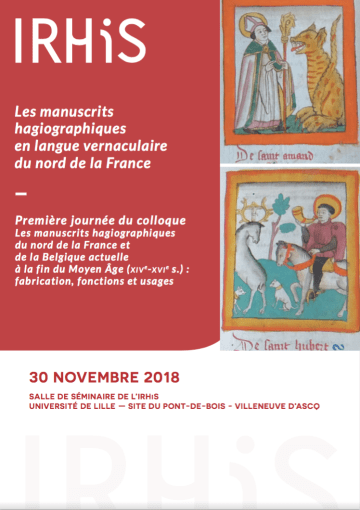
Colloque – Les manuscrits hagiographiques en langue vernaculaire du nord de la France

À la fin du Moyen Âge, la production hagiographique manuscrite se transforme et connaît son dernier âge d’or entre le succès éditorial de la Légende dorée et l’arrivée de l’imprimerie. De nombreux textes anciens sont abrégés pour intégrer de nouvelles collections. Ce phénomène est en par e responsable du relatif désintérêt des historiens à leur égard : à quoi bon s’intéresser à ces abrégés alors qu’il reste tant à découvrir dans les grands légendiers du Moyen Âge central, et qu’on commence à peine à mieux connaître les tout premiers manuscrits conservés ?

L’objectif de ce colloque en deux temps (Lille, 30 novembre 2018 et Namur/Louvain, 21-22 mars 2019) est de mieux saisir la place du manuscrit hagiographique, entendu ici au sens large, dans le nord de la France et l’espace belge à la n du Moyen Âge, en prolongeant notamment les réflexions de Guy Philippart sur la fabrique et les usages des légendiers, à une période où la documenta on susceptible de les appréhender est plus abondante.

L’objec f est aussi de saisir ensemble les légendiers la ns et vernaculaires, en moyen néerlandais comme dans les parlers d’oïl. La journée lilloise est exclusivement consacrée aux manuscrits hagiographiques en langue vernaculaire du nord de la France, en par e exhumés jadis par Paul Meyer. La situation linguistique du nord de la France et de la Belgique induit nécessairement un travail collaboratif, seul à même de faire réfléchir collectivement à la circula on des modèles et des traductions, aux conditions matérielles de la circula on des textes hagiographiques, mais aussi à l’usage de ces manuscrits, dans le cadre de la pastorale et des pratiques cultuelles collectives comme dans celui de l’affirmation de l’individu à la fin du Moyen Âge.

Capture d_écran 2018-09-07 à 21.52.38

Programme :

8h45 : Accueil
9h00 : Mot d’accueil par Charles Mériaux (IRHiS, Université de Lille)
Introduction par Fernand Peloux (Université de Namur) – Pourquoi s’intéresser aux derniers siècles de l’édition hagiographique manuscrite ?

10h15 : Présidente de séance Nicole Bériou (AIBL)

Catherine Vincent (Université de Paris Nanterre) – Pourquoi réécrire des Vies de saints en français à la fin du Moyen Âge ?
Florent Coste (Université de Lorraine) – Du local à l’universel. Modulations et transformations de la Légende dorée dans quelques légendiers vernaculaires du nord de la France
Discussion

12h15 : Déjeuner

13h00 : Président de séance Barbara Fleith (Université de Genève et Lausanne)

Anne-Françoise Labie-Leurquin (IRHT) – Composition, usage et diffusion du légendier picard
Marie-Geneviève Grossel (Université de Valenciennes) – Les copies des traductions des Vies des Pères du XIIIe s. : reprise, évolution, transformation aux XIVe et XVe s.
Discussion

16h00 : Bibliothèque municipale de Lille Présentation in situ de manuscrits lillois

Informations pratiques :

Première journée du colloque Les manuscrits hagiographiques du nord de la France et de la Belgique actuelle à la fin du Moyen Âge (XIVe-XVIe s.) : fabrication, fonctions et usages

30 novembre 2018
Salle de Séminaire de l’IRHiS
UNIVERSITÉ DE LILLE — SITE DU PONT-DE-BOIS – VILLENEUVE D’ASCQ

Comité scientifique :

Paul Bertrand (Université de Louvain)
Esther Dehoux (Université de Lille)
Jeroen Deploige (Université de Gand)
Monique Goullet (Paris)
Xavier Hermand (Université de Namur)
Anne-Françoise Labie-Leurquin (Paris)
Charles Mériaux (Université de Lille)
Fernand Peloux (Université de Namur)
Piotr Tylus (Cracovie)
Catherine Vincent (Université de Paris Nanterre)

Le programme des journées belges des 21 et 22 mars 2019, conclues par André Vauchez (AIBL), paraîtra en début d’année prochaine.

Contact : fernand.peloux@unamur.be

Publié dans Colloque | Laisser un commentaire

Conférence – André Vauchez, « Rome dans la pensée et l’imagination du Moyen Âge »

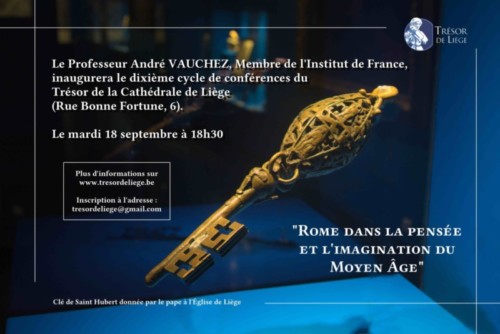
Cette année, dans le cadre de son dixième cycle de conférences, le Trésor de la Cathédrale de Liège l’honneur d’accueillir le Professeur André Vauchez, Membre de l’Institut de France, dont la communication s’intitulera « Rome dans la pensée et l’imagination du Moyen Âge ».

À cette occasion, le Trésor s’est associé avec les librairies Pax et Siloë afin de permettre la consultation de plusieurs ouvrages du Professeur Vauchez.

Exceptionnellement, cette conférence aura lieu dans la Cathédrale Saint-Paul. Afin que les organisateurs puissent prévoir le nombre de places, n’oubliez pas de vous inscrire.

Visuel-conférence-André-Vauchez-e1535914018985

Informations pratiques :

Professeur André Vauchez
« Rome dans la pensée et l’imagination du Moyen Âge »

Mardi 18 septembre 2018 à 18h30

Cathédrale Saint-Paul
Place de la Cathédrale, 6
4000 Liège
P.A.F. 5 €

Inscription à l’adresse : tresordeliege@gmail.com

Source : Trésor de Liège

Publié dans Colloque | Laisser un commentaire

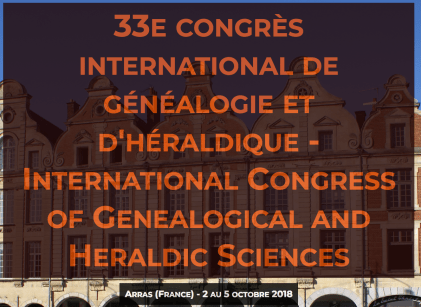
Colloque – 33e Congrès international des sciences généalogique et héraldique

Arras (France)
2-5 octobre 2018

Programme : ici

Capture d_écran 2018-08-20 à 21.57.27

Droits à l’inscription :

.. participation aux travaux du congrès pendant la durée du forfait (3 jours ou 1 jour)
.. libre accès aux expositions annexes
.. mallette du congressiste
.. catalogue du congrès
.. recueil des Actes du congrès (à paraître en 2019)
.. réception du 2 octobre 2018 incluant un buffet d’accueil et une visite guidée nocturne des places d’Arras
… Forfait 3 jours : 275 €
… Forfait 1 jour : 100 €

. A la charge des participants :

Tous les repas libres non mentionnés ci-dessus ; l’hébergement.

. En options :

.. Visite guidée des Archives nationales (Paris, 1 octobre 2018)* – sur réservation
.. Excursions et visites – sur réservation
.. Dîner de la soirée de gala (4 octobre 2018) – sur réservation

*incluant buffet d’accueil, entrée au musée de l’Histoire de France et pause-café

. Pré-inscription (13/03/2018) : complétez le formulaire en ligne

https://docs.google.com/forms/d/1kWKEbqM3wUm8nE__voyz-eVCvfs56UIw5QLKGw9TzqQ/edit?usp=sharing

Source : 33e Congrès international des sciences généalogique et héraldique

Publié dans Colloque | Laisser un commentaire

Appel à contribution – Medieval Barthes: Call for Papers for a One-Day Conference

Medieval Barthes: Call for Papers for a One-Day Conference
IAS Common Ground, UCL, 26 March 2019

Deadline : 1 octobre 2018

The aim of this one-day conference is to reflect in two different ways on the notion of a ‘Medieval Barthes’. On the one hand, we want to consider Barthes’s own engagement with medieval culture, in his reading of medieval authors and in his engagement with medieval styles of thought. On the other hand, we want to explore the uses of Barthes within medieval studies: what medievalists have learnt from Barthes; how Barthesian concepts have been adapted for different medieval contexts; how medievalists inflect and change the way we read Barthes’s texts.

In this conference, we will bring medievalists and modernists together in a productive dialogue. This dialogue will centre on a figure who is constantly evolving thanks to the continued publication of seminar notes and lecture transcripts. In searching for a medieval Barthes, the conference will build on the discussion of Barthes in: Carolyn Dinshaw, Getting Medieval: Sexualities and Communities, Pre- and Postmodern (Durham, N.C., 1999); Bruce Holsinger, The Premodern Condition: Medievalism and the Making of Theory (Chicago, 2005); Virginie Greene, ‘What Happened to Medievalists after the Death of the Author?’, in idem (ed.), The Medieval Author in Medieval French Literature (New York, 2006). A consideration of the various medievalist threads across the whole of Barthes’s œuvre, including posthumously published material, remains a desideratum that this conference hopes to address.

Topics might include, but are in no way limited to:

Barthes and: medieval authors; the body; medievalist contemporaries; material culture; death; etymologies; history; Latinity; love, desire, pleasure and affect; monasticism; mysticism; queerness; sexuality; (pre-modern) subjectivity; reading and hermeneutical practice(s); rhetoric; (inter)textuality; the visual.

The organisers would be delighted to receive proposals for 20-minute papers on any aspect of ‘Medieval Barthes’. Proposals, comprising an abstract of max. 200 words accompanied by a short biography, should be sent by 1 October 2018 via email to medievalbarthes@gmail.com.

Organised by Jennifer Rushworth (Lecturer in French and Comparative Literature, UCL) and Francesca Southerden (Associate Professor of Medieval Italian, Somerville College, Oxford), with the generous support of the UCL Institute of Advanced Studies, the MHRA, and the Society for French Studies.

Source : Fabula

Publié dans Appel à contributions | Laisser un commentaire

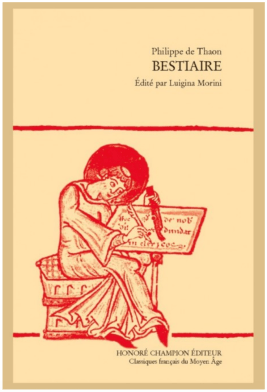
Publication – Philippe de Thaon, « Bestiaire », éd. Luigina Morini

Le Bestiaire en vers de Philippe de Thaon, composé entre 1121 et 1135, est la première adaptation dans une langue romane du Physiologus latin, à son tour traduction du célèbre opuscule homonyme grec, rédigé à Alexandrie par un auteur inconnu aux premiers siècles après J.-C. (IIe-IVe). Prolongeant la tradition ancienne, dont Philippe accueille la version la plus répandue, celle augmentée d’extraits des Étymologies d’Isidore de Séville, ce Bestiaire organise dans une quarantaine d’articles autant de “natures” réelles ou imaginaires, fantastiques, bizarres, de bêtes, oiseaux et pierres, chacune accompagnée de son interprétation morale et allégorique. C’est par ailleurs son but de vulgarisation, déclaré et passionné, d’où découle aussi le choix de la langue vernaculaire, ce qui détermine la physionomie très originale de cette oeuvre et qui la distingue de tout autre précédent connu. La vaste matière naturaliste est réorganisée selon un double classement, scientifique (bêtes, oiseaux, pierres) et typologique (types représentant le Christ, l’homme, le diable) ; la section lithologique est enrichie d’additions puisées dans les Lapidaires ; l’application symbolique-allégorique tend à devenir minutieuse et systématique. Entre tradition et nouveauté, ce témoignage parmi les plus précoces de la littérature anglo-normande représente une facette originale de la littérature séduisante et variée des bestiaires.

Capture d_écran 2018-08-26 à 19.02.26

Luigina Morini a enseigné la philologie romane à l’Université de Pavie. Ses recherches portent principalement sur la poésie italienne du XIIIe et du XIVe siècle et sur la littérature didactique du Moyen Âge, notamment la littérature morale et la tradition « scientifique » des Bestiaires et des Lapidaires.

Table des matières : ici

Informations pratiques :

Philippe de Thaon, Bestiaire, éd. Luigina Morini, Paris, Honoré Champion, 2018 (Classiques français du moyen Âge, 183). 11 X 17,5 CM, 400 pages. ISBN : 9782745347084. Prix : 35 euros.

Source : Honoré Champion

Publié dans Publications | Laisser un commentaire

Colloque – Ad Brudgias Portum Bruges’ medieval port system as a maritime cultural landscape

Sailing into the Zwin sea-arm along its urbanised fringes towards Bruges must have been the medieval equivalent of sailing now onto the rivers Hudson or Thames. As an international gateway for goods, people and thoughts, the Bruges’ harbour system can be considered as a complex, dynamic maritime cultural landscape. It represents an internally and externally interconnected network of small and larger ports, all lined along the Zwin tidal inlet, sheltering local people as well as resident or transient foreigners. As such, a specific cultural environment developed which is reflected in art, architecture but also in everyday material culture, the whole being highly dependent on the maritime connectivity of the system.

Interdisciplinary research conducted over the last 10 years and embracing a wide array of archaeological, historical and geomorphological methods, has now shed a new light on Bruges’ harbour network. The socio-economic development as well as the morphology and material culture of the harbour network along the tidal inlet have been at the centre of this study. With this international symposium the organisers wish to present their results to a wider scientific audience, but foremost they aim to frame the Bruges’ project into a wider, international maritime context of interdisciplinary research on maritime cultural port-landscapes.

cropped-logo_UGent_EN_RGB_2400_color-300x300

Programme :

Tuesday 23rd of October

Registration & Welcome @ City Hall (9h00 – 10h10)
Registration
Coffee & word of welcome offered by the Mayor of Bruges, Renaat Landuyt

Session 1: Bruges and its maritime cultural landscape (chaired by Wim De Clercq) @ Groeningemuseum (10h45 – 13h00)

Wim De Clercq – Introduction & opening of the conference
Christer Westerdahl – Keynote : Bruges and its corridor. The maritime cultural landscape
Jan Trachet – Inland Outports. An interdisciplinary study of medieval harbour sites in the Zwin region
Jan Dumolyn & Bart Lambert – Ports and Power: Bruges, the Zwin Mouth and the Staple System in the Later Middle Ages
Lunch (13h00 – 14h00)

Session 2: The Zwin and its tidal harbour system (chaired by Jari Mikkelsen) @ Groeningemuseum (14h00 – 17h30)

Adrie De Kraker – Keynote The dynamic landscape of the Zwin inlet or how to preserve the Sluis-Bruges access navigable, 1000 – 1600
Wim De Clercq & Roland Dreesen – Ballasting the Hanse. Baltoscandian Erratic Cobbles in the Later Medieval Port Landscape of Bruges
Kristiaan Dillen – Origins and consequences of subaltern relations in a medieval portuary system in Flanders: the case of Hoeke
Nathalie de Visser – Recycling the past. An assessment of recent archeaological research in the medieval ports of Flanders at Hulst, Axel and Sluis
Dante de Ruijsscher – Destroyed & Destructed. An interdisciplinary study of the drowned harbour of Coxyde
Ward Leloup – Cities, Counts and Merchants. Conflicts of Interest in the Zwin Region and the Foundation of Sluis (ca. 1280-1324)
Frederik D’Hondt – Title to be confirmed

Evelien Hauwaerts – A miserable Italian in Bruges and his manuscript with the oldest map of Flanders

Poster session (17u30 – 18h00) @ Groeningemuseum

Drink (18h -19h30) @ Groeningemuseum

Wednesday 24th of October

Excursion in the Zwin harbour landscape (9h00 – 13h00)

Coffee & word of welcome offered by the Mayor of Damme, Joachim Coens

Lunch @ Zwin Nature Reserve (13h00 – 14h00)

Session 3: Connection Ports & People (chaired by Jan Trachet) @ Zwin Nature Reserve (14h00 – 17h30)

Synnøve Midtbø Myking – Money deposits and shipwrecked saints: the Norwegian presence in medieval Bruges
Vincent Debonne – Architectural exchange between Hanseatic cities. Brick, Bruges and Lübeck
Dries Tys – Small-scale and local port infrastructure in coastal Flanders: about landing places, wharfs, hyths and Ydes in late-medieval Flanders
Marcel IJsselstijn – Markets and ports in perspective. The development of the town plans of Utrecht and Amsterdam until c. 1560.
Cosimo Damiano Diella & Sara Murgolo – The medieval ports of Barletta and Ariscianne between written, cartographic and archaeological sources
Francesca Carboni – Ad navigia trahenda vel veranda. The port of Recanati (Marche, Italy) between the 13th and the 15th century

Conference dinner @ Le Panier d’or, Bruges (20h00 – 22h00)

Thursday 25th of October

Session 4: The material culture of gateway communities (chaired by Maxime Poulain) @ Groeningemuseum (10h00 – 13h00)

Bieke Hillewaert – Keynote: The obvious, the barely suspected, and the unknown
Jeroen Vermeersch – Late medieval ships from the Scheldt basin. The cases of Doel and Hulst
Roland Dreesen, Michel Dussar & Vincent Debonne – Stony migrants in Bruges’ port landscape during medieval times
Geert Verbrugghe – Trade of stone mortars across the Channel and the North Sea
Ben Jervis – Keynote: Possessions and Maritime Identities: Archaeological and historical perspectives on the material culture of port households in medieval England
Stuart Whatley – Burghers, Merchants and Servants. Material culture in the Medieval Port community of Copenhagen
Kristof Haneca – Timber supply in a growing medieval city
Jan Dumolyn – Conclusions and closure of the conference

Informations pratiques :

Main Venue: Groeninge Museum. The main venue of this conference is the Groeninge Museum, home of many Flemish Masters, and situated in the heart of the historic centre of Bruges.

Second Venue: Zwin Nature Reserve. In the afternoon of day two, the Zwin Nature Reserve offers a venue for the conference afternoon session. This Nature Parc is situated near the North Sea coast and will give the ideal tidal landscape for this conference.

Please contact jan.trachet@ugent.be for questions and remarks.

Source : Universiteit Gent

Publié dans Colloque | Laisser un commentaire

Colloque – Ubi caritas : les établissements de soins au Moyen Âge

Théâtre Sauvageot et Centre Culturel et de Congrès – Boulevard du collège, Paray-le-Monial, France (71600).

Contact : Géraldine Ballot. courriel : geraldine [at] tourisme-paraylemonial [dot] fr

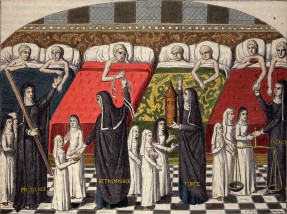
Dans l’Antiquité chrétienne, la caritas, c’est-à-dire l’amour du prochain, fait passer la sollicitude envers les faibles et les malades de la sphère privée au domaine public. Le cadre institutionnel de ce qui deviendra l’hôpital est défini dans le code de Justinien au VIe siècle. L’accueil des voyageurs, les soins donnés aux malades et l’assistance envers les indigents font partie des objectifs que l’Église se fixe très tôt (canon LXXV du concile de Nicée, 325). Dès le haut Moyen Age, les évêques ont obligation de créer et d’entretenir dans leur ville un hôpital : le xenodochium. Celui de Césarée de Cappadoce, fondé vers 370 par saint Basile, évêque de la ville, nous est connu grâce à une description de Grégoire de Nazianze. Dans le monde monastique, l’accueil des pauvres et le soin des malades sont un devoir sacré. Selon la règle de saint Benoît (VIe siècle), « l faut avant tout et surtout se préoccuper de l’assistance aux infirmes, de manière à les servir exactement comme on servirait le Christ en personne, car il a dit : j’étais malade et vous m’avez visité ».

F.-O. Touati a relevé la présence dans le monastère de Cormery (Touraine) d’un hospitalarius et d’un médecin, nommé Gérard dès les années 1020-1040. Comme tout établissement clunisien, le prieuré Paray-le-Monial possédait une infirmerie, qui devait normalement se trouver au sud-est de la basilique, en arrière de l’église mariale, avant d’être transférée à l’ouest à l’époque moderne. Apparus aux XIe-XIIe siècles, des ordres hospitaliers comme ceux de Saint-Jean de Jérusalem et de Saint-Lazare de Jérusalem, liés aux croisades, ou celui de Saint-Antoine-en-Viennois, se consacrent à des soins médicaux plus spécialisés, les blessures de guerre, la lèpre, le « feu saint Antoine » ; de ces vocations naîtra la médecine moderne. Les hospitaliers de Saint- Antoine vont rapidement s’étendre à toute l’Europe, appelés par les autorités locales pour leur compétence. Ils posséderont de nombreuses maisons, notamment à Lyon et, en Bourgogne du sud, à Mâcon et à Chalon. Des descriptions précises nous permettent de restituer les bâtiments de soins et leurs agencements.

soins

Programme :

Samedi 6 octobre 2018 :

8 h 00 : Accueil des participants au Centre Culturel et de Congrès 9 h 00 : Présentation et introduction du colloque, Etienne COURIOL, président de l’association, Nicolas REVEYRON, conseiller scientifique.

9 h 15 : Début des travaux

François-Olivier TOUATI, Doyen de la Faculté des Arts et Sciences humaines, Professeur d’Histoire du Moyen Âge, Université de Tours-EMAM-CNRS. L’hôpital au Moyen Âge : invention ou révolution ?
Géraldine MOCELLIN, Directrice du musée de Saint-Antoine-l’Abbaye (Isère), Sylvain DEMARTHE, Docteur en histoire de l’art du Moyen Âge, chercheur associé à l’UMR ArTeHiS, Université de Bourgogne. Hôpitaux, accueil et soins : le cas des chanoines hospitaliers de Saint-Antoine.
12 h 30 : Déjeuner (possibilité de déjeuner en commun – Restaurant des Trois Pigeons)

14 h 15 : Reprise des travaux

Daniel RUSSO, Professeur Université de Bourgogne Franche-Comté. L’art des retables et des objets dans les hôpitaux au Moyen Âge.
Jean-Noël BARNOUD, Historien. Histoire des Hôpitaux de Paray-le-Monial.
Nicolas REVEYRON, Professeur Université Lyon 2, IUF. L’évolution des plans des établissements hospitaliers de l’Antiquité au Moyen Âge.

18 h : Cocktail et rencontre avec les intervenants.

Dimanche 7 octobre 2018 :

Visites. Rendez-vous à 8h30 place de l’Europe : Visite du centre historique de Charlieu et du musée Hospitalier. Fin du programme à 12h.

Source : Blog de l’ApAhAu

Publié dans Colloque | Laisser un commentaire

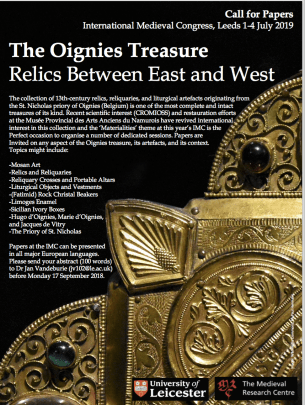
Appel à contribution – Le Trésor d’Oignies. Reliques entre Orient et Occident / The Oignies Treasure. Relics Between East and West

English version below

Dans le cadre de l’International Medieval Congress qui se tiendra à Leeds (Angleterre) du 1er au 4 juillet 2019, la Société archéologique de Namur co-organise, avec le Centre de recherche médiévale de l’Université de Leicester, des sessions spécifiques autour du Trésor d’Oignies (Namur, TreM.a. Coll. SAN, dépôt de la Fondation Roi Baudouin), intitulées Le Trésor d’Oignies. Reliques entre Orient et Occident.

Les reliques, reliquaires et artefacts liturgiques du 13e siècle originaires du prieuré Saint-Nicolas d’Oignies (Belgique, province du Hainaut) forment l’un des trésors les plus complets et intacts du genre.

Le récent intérêt scientifique qui lui a été porté au travers du projet CROMIOSS lancé par la SAN et les efforts de restauration consentis par la Fondation Roi Baudouin sur les deux mitres dites de Jacques de Vitry ont ravivé l’intérêt international porté sur cet ensemble exceptionnel.

Le prochain International Medieval Congress, qui mettra l’accent sur la thématique de la « Matérialité », est une occasion parfaite pour organiser des sessions dédicacées au Trésor d’Oignies.

Les communications pourront porter sur tous les aspects du Trésor d’Oignies, les personnalités qui ont contribué à son histoire, les oeuvres qui le composent et leur contexte de création et d’utilisation. Les sujets peuvent concerner (sans que ces critères soient limitatifs) :

• L’art de la vallée de la Meuse
• Les reliques et reliquaires
• Les croix-reliquaires et autels portatifs
• Les objets et vêtements liturgiques
• Les vases fatimides
• Les émaux
• Les boîtes en ivoire
• Hugo d’Oignies, Marie d’Oignies et Jacques de Vitry
• Le prieuré Saint-Nicolas d’Oignies, …

Les communications à l’International Medieval Congress peuvent être présentées dans toutes les principales langues européennes.

INFOS PRATIQUES

Pour plus d’information, consultez le site de l’Université de Leeds.

Si vous souhaitez proposer une communication, le résumé (100 mots) doit parvenir au Dr Jan Vandeburie pour le 17 septembre 2018 au plus tard : jv102@le.ac.uk

Capture d_écran 2018-08-25 à 15.04.19

The Oignies Treasure. Relics Between East and West

The collection of 13th-century relics, reliquaries, and liturgical artefacts originating from the St. Nicholas priory of Oignies (Belgium) is one of the most complete and intact treasures of its kind. Recent scientific interest (CROMIOSS) and restauration efforts at the Musée Provincial des Arts Anciens du Namurois have revived international interest in this collection and the ‘Materialities’ theme at this year’s IMC is the perfect occasion to organise a number of dedicated sessions. Papers are Invited on any aspect of the Oignies treasure, its artefacts, and its context. Topics might include:

-Mosan Art
-Relics and Reliquaries
-Reliquary Crosses and Portable Altars -Liturgical Objects and Vestments -(Fatimid) Rock Christal Beakers -Limoges Enamel
-Sicilian Ivory Boxes
-Hugo d’Oignies, Marie d’Oignies, and Jacques de Vitry
-The Priory of St. Nicholas

Papers at the IMC can be presented in all major European languages. Please send your abstract (100 words) to Dr Jan Vandeburie (jv102@le.ac.uk) before Monday 17 September 2018.

Publié dans Appel à contributions | Laisser un commentaire