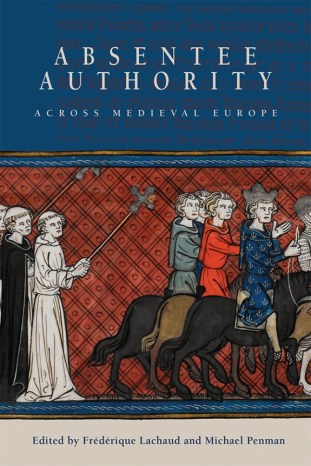
Publication – « Absentee Authority across Medieval Europe », dir. Frédérique Lachaud, Michael Penman

In the medieval world, what happened when a figure of recognised authority was absent? What terminology, principles and solutions of proxy authority were developed and adopted? Did these solutions differ and change over time depending on whether the absence was short or long and caused by issues of incapacity, minority, disputed succession, geography or elective absenteeism? Did the models of proxy authority adopted by ruling dynasties and large institutions influence the proxy choices of lesser authority?

The circumstances and consequences of absentee authority, a major aspect of the systems of medieval power, are the focus of this volume. Ranging across the realms of medieval Europe (but with a focus upon the British Isles and France), its essays embrace a wide variety of experience – royal, parliamentary, conciliar, magnatial, military, ecclesiastical (papal to parochial), burghal, household, minor or major, male or female, exiled, captive or infirm – and explore not merely political developments, but the dynastic, diplomatic, financial, ideological, religious and cultural ramifications of such episodes.

Frédérique Lachaud is Professor of medieval history at the Université de Lorraine, France; Michael Penman is Senior Lecturer in history at the University of Stirling, Scotland.

Contributors: James Bothwell Michelle Bubenicek, Léonard Dauphant , Bruno Dumézil, Laurent Hablot, Torsten Hiltmann, Tom Horler-Underwood, Robert Houghton, Olivier de Laborderie, Frédérique Lachaud, Hans Jacob Orning, Michael Penman. Norman Reid.
9781783272525_6

Table des matières :

Introduction: Absentee Authority across Medieval Europe
Incarnating Authority, Exercising Authority: The Figure of the King in the Merovingian Era
Ubi armae ibi princeps: Medieval Emblematics as the Real Presence of the Prince
While the Bishop’s Away… Absentee Bishops of Parma during the Investiture Conflict
An Inconceivable Absence: Usurpers and Illegitimate Rulers in the Genealogical Rolls of the Kings of England, from the late thirteenth to the early fifteenth centuries
Local Loyalty and Absentee Authority in Thirteenth-Century Normandy: the Evidence of the Querimoniae Normannorum (1247)
Representation and Authority in Thirteenth-Century England and Gascony
Internal Exiles: Exclusion from the Fourteenth-Century English Court and Kingdom
‘Si grant charté a Paris. par defaulte du roy’: Governmental Practice and the Customary Geography of the Absence
Was the Couple a Palliative to the Absence of the Prince? The Political Role and Influence of Margaret of Flanders during the Reign of Philip the Bold, Duke and Count of Burgundy (1384-1404)
Guardian – Lieutenant – Governor: Absentee Monarchy and Proxy Power in Scotland’s Long Fourteenth Century
Absentee Authority in Late Medieval Iceland, as Viewed from the Literary Sources
Representatives of Kings and ‘Kings’ as Representatives: Authority and its Representation in Professional Groups in Late Medieval and Early Modern France – The Example of the King of Minstrels and of the King of Mercers

Informations pratiques :

Frédérique Lachaud, Michael Penman (dir.), Absentee Authority across Medieval Europe, dir. , Boydell&Brewer, 2017. 2 black and white, 2 line illustrations. 266 pages
23.4×15.6 cm. ISBN: 9781783272525. Prix : 60£.

Source : Boydell&Brewer
Publié dans Publications | Laisser un commentaire

Publication – « Jean de Meun et la culture médiévale. Littérature, art, sciences et droit aux derniers siècles du Moyen Âge », dir. Jean-Patrice Boudet, Philippe Haugeard, Silvère Menegaldo et François Ploton-Nicollet

Qui était Jean de Meun, l’auteur de la seconde partie du Roman de la Rose, le plus grand succès – avec plus de trois cents manuscrits conservés – de la littérature médiévale française ? Un clerc originaire de Meung-sur-Loire, certes, mais encore? Un universitaire parisien, dont on sait qu’en 1305 la maison dite de la Tournelle fut léguée aux dominicains du couvent de Saint-Jacques? Est-il identifiable avec le fils d’un petit seigneur qui t des études de droit à Bologne de 1265 à 1269 ? Avec l’archidiacre de Beauce dont on conserve le testament daté de 1298? On sait en tout cas qu’auteur proli que, il traduisit du latin en français le De re militari de Végèce (traduction achevée en 1284 et adressée à Jean de Brienne, comte d’Eu), la Consolatio Philosophiae de Boèce, dédiée à Philippe le Bel (avant 1303), les lettres d’Héloïse et Abélard, ainsi que la Topographia Hibernica de Giraud de Barri et le De amicitia spirituali d’Aelred de Rievaulx, ces deux dernières traductions étant malheureusement perdues – et qu’il composa peut-être, à la n de sa vie, les poèmes religieux (Testament, Codicille et Sept articles de la foi) qu’on lui attribuait aux XIVe et XVe siècles.

1512482518

Ce n’est donc pas au seul Roman de la Rose mais à un auteur et à l’ensemble de ses écrits qu’est consacré le présent ouvrage, qui réunit autour de cette œuvre, de ses enjeux et de son impact sur la longue durée et jusqu’à la Renaissance, les réflexions d’historiens de la culture et de la littérature.

Table des matières : ici

Informations pratiques :

Jean-Patrice Boudet, Philippe Haugeard, Silvère Menegaldo et François Ploton-Nicollet (dir.), Jean de Meun et la culture médiévale. Littérature, art, sciences et droit aux derniers siècles du Moyen Âge, Rennes, Presses Universitaires de Rennes, 2017 (Interférences). 15,5 x 21 cm, 374 p. Illustrations : Couleurs. ISBN : 978-2-7535-5896-0. Prix : 25,00 €.

Source : Presses universitaires de Rennes

Publié dans Publications | Laisser un commentaire

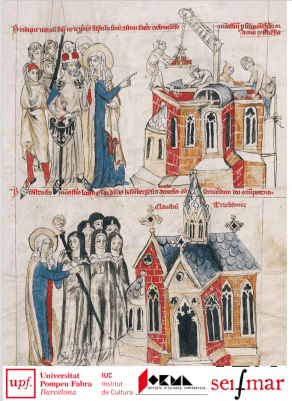
Appel à contribution – Medieval Women and the Arts. Literacy, Education, and Visual Culture

Interdisciplinary Workshop
3 – 4 April 2018 Universitat Pompeu Fabra, Barcelona

Coordinated by:
Yaosca Bautista (UPF)
Sergi Sancho Fibla (AMU / CNRS, TELEMMe)

Organized by:
Forma. Revista d’Estudis Comparatius Institut de Cultura (UPF)
Société d’Études Interdisciplinaires sur les Femmes au Moyen Âge et à la Renaissance

Medieval Women and The Arts

Presentation and goals

We are pleased to announce that the call for papers for the interdisciplinary workshop «Medieval Women and the Arts. Literacy, Education, and Visual Culture» has been opened. This event is conceived as a place of discussion and exchange for scholars, researchers, and postgraduate students who consecrate their work to the field of social, cultural, and intellectual history of women.

In order to avoid the historio- graphic borders that scar different periods, the chronologic frame for this workshop will encompass from the Low Middle Ages (12-13th centuries) until the Renaissance and the Early Modernity (16th c.).

The topic focuses on the cultural practices of production and reception within the feminine sphere: literacy, instruction, and visual culture. However, It should be stressed that, in this case, the concept of cultural practice goes beyond the customary meaning of these three notions. It will be rather considered as a vast variety of activities traditionally set aside from what have been granted as intellectual work. We are talking here about liturgical and paraliturgical habits, devotional practices, singing and music, image, contemplation, exercises linked to meditation, memory, or introspection, and also the assorted forms of teaching and learning.

Young researchers who are interested in the study of these notions within the field of Medieval and Modern Women Studies are welcome to send a proposal before February 26th, 2018.

Place

The workshop will take place in Pompeu Fabra University, Barcelona (Campus de Ciutadella) on April 3rd-4th 2018.

Ramon Trias Fargas, 25-27 Barcelona 08005
(+34) 93 542 20 00
METRO L4: Ciutadella – Vila Olímpica TRAM T4, T5: Wellington
BUS V27, V21, H16, 92, 36
https://www.upf.edu/campus/en/

Organization

This is not a conference, but a workshop. It means that the participant is engaged to prepare beforehand not only the presen- tation of his/her own research, but also a series of materials that are crucial for the proper functioning of the workshop. The workshop can only work if the participants achieve two basic tasks: sending the whole text of their presentation before March 20th 2018, and carefully reading all the documents that the organization will provide.

The meeting will be organized in four different sessions: talks, reading workshops, presentation of ongoing researches, and a seminar.
The talks and the seminar will be open events to a public audience, but the presentation of ongoing researches and the reading workshops will be spaces exclusively reserved for the participants: PhD students and invited researchers.

Applications

This event is open to all scholars and students from any discipline concerned by the topic. Applicants must send an abstract of their ongoing research (300 words) and a short bio before February 10th to the following email adresses:
ssfibla@gmail.com and revista.forma@upf.edu.

The positions for PhD students who are willing to present their ongoing researches are limited to 12. A scientific committee will evaluate the proposals and notify the decision to the candidates before March 3rd 2018.
The registration fee will be of 50€.

Important note: Spanish and English will be used for this workshop. At least a passive knowledge of both languages will be required.

Publié dans Appel à contributions | Laisser un commentaire

RMBLF – La Lettre du Réseau

Chers amis médiévistes,

Le RMBLF a le plaisir de vous faire parvenir, en pièce jointe, le dernier numéro de sa Lettre. Ce numéro inclut notamment un bref résumé de toutes les thèses en études médiévales défendues dans les universités francophones belges lors de l’année académique 2016-2017.

RMBLF - Lettre 13

Nous vous souhaitons une agréable lecture !

Télécharger la Lettre : Lettre du réseau Décembre 2017 n° 13.final

Bien cordialement,
L’équipe du RMBLF

Publié dans Activités du RMBLF, Publications, Web | Laisser un commentaire

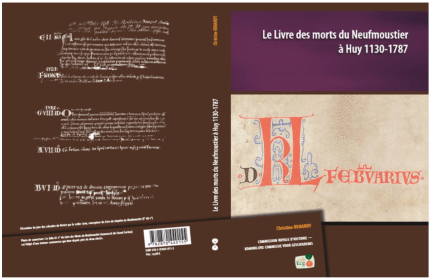
Publication – Christine Renardy (éd.), « Le livre des morts de l’abbaye du Neufmoustier à Huy, 1130-1787 »

Le Livre de l’office du chapitre régulier du Neufmoustier (Huy), manuscrit disparu à la Révolution française et retrouvé en 1835 par un des fondateurs de l’Institut archéologique liégeois, Joseph Grandgagnage (Namur, 1797 – Embourg, 1877), Premier Président de la Cour d’Appel de Liège, est aujourd’hui exposé au Grand Curtius.

Il contient notamment le répertoire nécrologique du Neufmoustier, annoté de 1130 à 1787 par l’inscription du décès de plusieurs milliers de personnes. Cette partie intitulée « Livre des morts » vient précisément de faire l’objet d’une édition scientifique signée par Christine Renardy, docteur en histoire et directrice honoraire de la ville de Liège, dans la collection Grand in-8° de la Commission royale d’Histoire (Académie royale de Belgique).

Les inscriptions de ce document ont alimenté plusieurs polémiques scientifiques, dont la fin de vie à Huy du prédicateur Pierre dit l’Ermite (mort en 1115) ou encore la mention de l’orfèvre Renier de Huy, très probable auteur des fonts baptismaux de Notre-Dame, aujourd’hui conservés à Saint-Barthélemy.

Capture d_écran 2017-12-09 à 17.29.41

Résumé de la publication :

Dans les premières années du XIIe siècle, une communauté mixte s’est spontanément constituée dans un faubourg de la ville de Huy, probablement en mémoire du prêtre Pierre dit l’Ermite. Le 21 septembre 1130, l’évêque de Liège Alexandre Ier consacre l’église du Neufmoustier, qui vient d’y être construite. Il est prouvé que, dès ce moment, les religieux suivent la règle de saint Augustin. Le manuscrit du liber capituli de ce chapitre régulier est heureusement conservé, mais a souffert de détériorations. Conçu vers 1130, il a été complété au fil des siècles ; pour ce qui regarde sa partie nécrologique, jusqu’en 1787.

Au Bas Moyen Âge, ce répertoire mortuaire compte de nombreuses don- nées permettant d’enrichir nos connaissances en matière d’histoire urbaine, éco- nomique et sociale, mais aussi pour l’étude des mentalités, du culte et de la litur- gie, sans oublier celle de l’orfèvrerie mosane. À partir de la fin du XVe siècle, les mentions se font en effet rares et épisodiques pour les laïcs  huit personnes seulement  le répertoire étant réservé de facto aux dignitaires et à quelques membres du chapitre hutois.

La présente édition du « Livre des morts du Neufmoustier » est pour l’es- sentiel basée sur le manuscrit original conservé au Grand Curtius ; les lacunes provoquées par la perte de certains folios ont pu être en grande partie compen- sées par des copies réalisées par un chantre du chapitre à la fin du XVIIe siècle et conservées aux Archives de l’État de Liège (fonds du Neufmoustier).

L’auteure :

Née le 6 février 1948, Christine Renardy a obtenu sa licence en Histoire à l’Université de Liège. Après avoir travaillé trois ans pour le compte de la Com- mission royale d’Histoire à la rédaction du « Nouveau Potthast » (Répertoire cri- tique des sources narratives du moyen Âge), elle est devenue en 1972 assistante des professeurs Fernand Vercauteren et André Joris au séminaire d’Histoire du Moyen Âge à l’Université de Liège. En octobre 1977, elle a défendu une thèse sur « le monde des maîtres universitaires du diocèse de Liège jusqu’en 1350 », publiée en deux volumes en 1979 et 1981.

Nommée archiviste de la Ville de Liège en avril 1978, elle a dirigé ce ser- vice jusqu’en 2007, moment où les autorités communales lui ont confié la gestion de l’ensemble des collections relevant du patrimoine culturel. Enfin, en 2009, elle a été chargée de la coordination générale du département de la Culture et du Tourisme.

Adresse de contact : chrenardy@hotmail.fr

Publié dans Publications | Laisser un commentaire

Exposition – To Live with Christ and Mary: Art and Private Devotion in the Netherlands 1460–1520

1 December 2017 – 28 February 2018

Muzeum Narodowe w Gdańsku
National Museum in Gdańsk

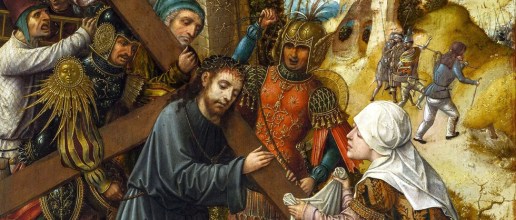
The exhibition To Live with Christ and Mary: the Art of Private Devotion in the Netherlands 1460–1520 presents a phenomenon of Late Medieval religious art that was made outside the liturgy, official worship, or direct Church control; that was borne of an emotional need for religious bond. The exhibits come from Polish state, Church and private collections. Professor Marcin Kaleciński from the University of Gdańsk is the curator of the exhibition.

rotator-zamieszkać-z

Geert Groote, the great 14th-century Netherlandish theologian, wrote the following about the need to surround oneself with holy pictures:
. . . all this in order to have a conversation, look for advice and ask questions of Him and the saints; to offer oneself to Him and them, just as obedient household servants do; so that we, faithful in this servitude and obedience [could] also ask for help and relinquish desire; indeed, to live in one house with Christ and the Virgin, make pilgrimages with the pilgrims, weep with the weeping, rejoice with the joyous and suffer with the suffering.

The exhibition features works of art to show Mary’s motherhood and Christ’s Passion in an intimate, but dramatic frame that shortened the distance between the worshiper and the worshiped. They would be held in hand, in fact clasped in arms, viewed face to face. They had a special cognitive dimension, provided a feeling of personal participation in the Passion, “intermediated” in the absolution of sins and guaranteed the advocacy of the Virgin. The art of private devotion (understood as the most noble piety) was an expression of religious customs, trends and practices, and its cornerstone was devotio moderna, the fourteenth-century religious movement which introduced a model of communal life and extra-liturgical private piety with clear mystical overtones. The exhibition will showcase the work of the Netherlandish masters of the Renaissance and the Late Gothic who specialised in painting for the purposes of private devotion, including pieces from the workshops of Albrecht Bouts, the Master of the Legend of St Mary Magdalene, Joos van Cleve and Quentin Massys.

The religious mentality in the Netherlands was especially determined by elaborately illuminated prayer books. Reading them piously every day gave the days their rhythm and a feeling of sanctified time and care for the soul’s fate in the hereafter to the praying person. The primary function of prayer books was to make men and women realise their sinful nature: the prayer practices were to overcome this sinfulness on the way to salvation and allowed the faithful to perform a spiritual pilgrimage at Christ’s side. The Gdańsk exhibition will be an extraordinary opportunity to see a broad assortment of most of the Netherlandish prayer books in Polish collections, mainly from the Czartoryski Library at the National Museum in Cracow.

Early Netherlandish devotional metalcuts and prints functioned in the private sphere and served religious reflection. They would often be pasted to walls, in codices and especially in private prayer books. The exhibition selection features unique metalcuts, inserts in incunables from the Polish Academy of Sciences’ Gdańsk Library and Passion prints by Master I A M van Zwolle. One especially valuable example of mobile devotional art is an early-16th-century tapestry depicting the Holy Family, one of only a dozen or so to have survived.

The exhibition will feature a reconstruction of an interior as depicted in Netherlandish iconography of the Annunciation, the first of its kind, filled with original Medieval furniture, devotional items and everyday household objects. In this special space the viewers can see such rarities (in Polish collections) as devotional figurines from Mechelen. These and other exhibits that were once testament to zealous faith, provide the viewers with a unique opportunity to reflect upon the art of private devotion in the Netherlands in the Late Gothic and Early Renaissance, a fascinating example of religious culture.

Source : Codart

Publié dans Exposition | Laisser un commentaire

Séminaire – Le remploi. Séminaire « Collections » 2017 – 2018

Le but du séminaire Collections est de tester in vivo la collaboration active entre deux unités partenaires du LabEx dont les domaines de compétence sont très différents mais complémentaires, pour réfléchir sur les problématiques que cette collaboration a déjà permis de faire émerger, et qu’elle permet d’étudier.

Il s’agit de confronter les questions et compétences respectives des chercheurs de DYPAC et du LAPA sur l’objet spécifique que sont les « collections » (de peintures, sculptures, livres, manuscrits, archives, curiosa et objets scientifiques, techniques ou du quotidien).

Ce séminaire s’inscrit dans l’axe transversal du laboratoire DYPAC (« Collections »).

Pour cette 4e année de programmation, le thème choisi est « Le remploi ». Il s’agit de confronter, dans chaque séance de 2 heures, le point de vue de deux spécialistes de sciences humaines, d’histoire de l’art et/ou sciences dures/archéométrie autour des modalités du remploi, dans l’espace et/ou le temps, des objets susceptibles d’être collectionnés, ou des lieux accueillant des collections.

YPAC - Remploi

Programme :

Jeudi 23 novembre 2017 : Remploi et écrit(s)

Susan Baddeley (UVSQ – DYPAC) : « Quelques cas de « remploi » dans des imprimés français et anglais (XVIe siècle) »
Clothilde Roullier (Archives Nationales) : « Archives, disparition, recréation : jeu et rejeu dans les arts »

Jeudi 8 février 2018 : Remploi d’œuvres, remploi de matériaux

Emmanuelle Rosso (Paris IV) : « Réappropriations romaines de l’art grec : remplois, collections, nouveaux contextes ».

Maxime L’Héritier (Paris VIII) :  » Remploi, récupération et recyclage des alliages ferreux au Moyen Age. Approches historique et archéométrique.  »

Jeudi 5 avril 2018 : travaux en cours des doctorants DYPAC/LAPA

Emilie Bérard (LAPA) : « Approche physico-chimique de la fabrication et de la circulation des armures médiévales »
Lucie Tryoen (UVSQ – DYPAC) : « L’écrit au chapitre de Notre-Dame de Paris au XIIIe sicle : chartrier, cartulaires, registres »

Jeudi 7 juin 2018 : Remploi dans l’architecture, espaces du remploi

Philippe Bernardi (Paris I-LAMOP) : « Le recyclage dans la construction médiévale »
Pierre-Xavier Hans (Château de Versailles) : « Le remploi des espaces dédiés aux collections royales sous le règne de Louis XV au château de Versailles »

Informations pratiques :

Le séminaire se tient le jeudi matin, de 10h à 12h
Auditorium de la Bibliothèque universitaire de l’UVSQ,
45, boulevard Vauban
78280 Guyancourt
(sauf le 8 février, salle à préciser).

Source : DYPAC – UVSQ

Publié dans Le réseau | Laisser un commentaire

Publication – « Bookbindings. Theoretical Approaches and Practical Solutions », éd. Nataša Golob et Jedert Vodopivec Tomažič

Bookbindings: Theoretical Approaches and PracticalSolutions is a collection of twelve studies encompassing considerations on bookbinding structures, practices of binders in the Middle Ages and the Renaissance, as well as theoretical reflections on the cataloguing of bindings, and on the choice of conservation and restoration methods. Much of the attention is on Portuguese, Estonian and Slovenian library and archive material – that is, on material that has rarely been the centre of attention. The volume opens with two contributions on bookbinding databases by Athanasios Velios and Sonja Svoljšak and others. These offer deliberations on the effective selection and coding of descriptive elements, while also expressing the need for the adoption of a rigorous and shared terminology to enhance compatibility among databases. Anja Dular discusses the historical aspects of life and labour conditions, along with the financial and legal frameworks in Carniola in the early post-medieval period. Georgios Boudalis, meanwhile, puts under scrutiny the established opinion of the « Coptic » origin of Early Christian bindings, while also drawing attention to the documentary expressiveness of images of books in early medieval paintings. Ines Correia presents results of first-hand extensive research on 15 illuminated manuscripts from the Portuguese monastery of Lorvão, analysing the various layers and the sequence of restorative procedures. Rita Castro and others discuss the results of fundamental investigation into re-bound Romanesque manuscripts from the monastery of Santa Cruz in Coimbra. Carlo Federici and Melania Zanetti contribute an exhaustive study on the bindings of books printed by Aldo Manutius (1494 to 1515). Their study deals with the question of whether this Venetian printer had his own preferred bookbinder, to which the answer is negative. Basing her observations on the reuse of fragments, Nataša Golob dedicates her article to matters surrounding the recognition of characteristics of individual bookbinders and their works. Gerth Kulemann, a bookbinder from Tallinn (prior to 1550), comes under the examination of Liia Rebane. Of interest in his works, which document the transition from the Gothic to the Renaissance, is the iconographically distinctive decoration. Bindings of Books of Hours from Portuguese collections, their problematic structural elements, and the iconography of their decorations, which express the connection to seamanship, are the topics of Rita Araújo’s contribution. The volume is brought to a close with two studies, each providing a detailed description of research and restoration efforts: Jedert Vodopivec Tomažič analyses the variance of bindings in Johann Weichard Valvasor’s Die Ehre dess Hertzogthums Crain (1689), made at the time as it was published. The study by Blanka Avguštin Florjanovič, meanwhile, follows the chronological sequence of steps and dilemmas in the restoration of a Gothic Pontifical in light of the principles of minimal interventions.

dIS-9782503574981-1

Table des matières :

Nataša GOLOB and Jedert VODOPIVEC TOMAŽIČ: Foreword

1. Athanasios VELIOS: Bookbinding descriptions in a linked data world: How the CIDOC-CRM can improve research in bookbinding history
2. Sonja SVOLJŠAK, Jasna MALEŠIČ, Andrej ŠTOLFA, Urša KOCJAN: Bookbinding Description in Library Catalogues, and Bibliographies. An Attempt at a Basic Metadata Scheme
3. Anja DULAR: The Ljubljana bookbinders of the 16th and 17th Centuries
4. Inês CORREIA: Archaeological Study of the illuminated Codices from the Portugese Medieval Monastery of Lorvão
5. Georgios BOUDALIS: The bindings of the early Christian codex: clarifying the Coptic contribution to bookbinding structures.
6. Rita CASTRO, Conceição Casanova, Lucinda OLIVEIRA and M. Adelaide MIRANDA: The Romanesque Collection of Santa Cruz Abbey in Coimbra: Revisiting the 12th and 16th C. Monastic Bookbindings
7. Carlo FEDERICI and Melania ZANETTI: How many Aldine Binderies?
8. Nataša GOLOB: Opera minora: Fragments within Bindings
9. Liia REBANE: Gerth Kulemann’s Decorative Bindings in Tallin, 1st Half of the 16th Century
10. Rita ARAÚJO: Examining the Books of hours in Portugese Collections
11. Jedert VODOPIVEC TOMAŽIČ: Valvasor’s Glory of the Duchy of Carniola, 1689, Vol III: Comparative analysis of binding structure and paper
12. Blanka AVGUŠTIN FLORJANOVIČ: Restoration of the Late-Gothic Pontifical by the Minimum Intervention Principle

Informations pratiques :

Nataša Golob et Jedert Vodopivec Tomažič (éd.), Bookbindings. Theoretical Approaches and Practical Solutions, Turnhout, Brepols, 2017 (Bibliologia, 45). 306 p., 67 b/w ill. + 26 colour ill., 210 x 270 mm. ISBN: 978-2-503-57498-1. Prix : 80 euros.

Source : Brepols

Publié dans Publications | Laisser un commentaire

Publication – Ludo Milis, « L’homme médiéval et sa vision du monde. Ruptures et survivances »

Le Moyen Âge semble une période mentalement très distante de notre époque. Est-ce vrai? L’auteur plonge dans les textes médiévaux, surtout les sources narratives, pour détecter les structures profondes des pensées et des sentiments. Il se sert de citations pour faire revivre les valeurs et normes de l’époque tel que les contemporains les ont formulées. Milis explore d’abord l’attitude vis-à-vis de Dieu, d’autres divinités et religions, et les problèmes qui en sont issus au sein des sociétés et civilisations médiévales. Ensuite il traite du rôle de l’honneur et de ses valeurs apparentées (gêne, honte, infamie, scandale et culpabilité) comme base de comportements sociaux et individuels. Enfin il lie le droit, tel qu’il est vécu, au rôle d’esprits et de l’au-delà dans la perception quotidienne. Il est étonnant de voir comment tant d’aspects qui semblaient à nos yeux passés pour de bon, reçoivent une nouvelle actualité et se montrent souvent reconnaissables dans la société multiculturelle qui se constitue aujourd’hui.

Ludo Milis est professeur émérite à l’Université de Gand, où il enseignait l’histoire médiévale jusqu’en 2003. Il s’est intéressé aux chanoines réguliers et à l’érémitisme, au paganisme, au rôle social du monachisme et plusieurs aspects de la culture et des mentalités des anciens Pays-Bas. Il est l’auteur et co-auteur de plusieurs volumes du Corpus Christianorum et d’autres publications de Brepols. Il a été président de l’Institut historique belge de Rome et de la Commission royale d’histoire de Belgique.

dIS-9782503573434-1

Table des matières :

Avant-propos

I Au Nom du Père

1 Quelques mots pour commencer
2 Une avancée difficile mais glorieuse
3 Repérons des variations
4 Frères dans la foi ?
5 La foi qui accomplit des miracles
6 Dynamique sociale et inventivité spirituelle
7 Tous dans le même sac
8 Contacts en cours de route
9 Vivre sans la Vraie Foi
10 Déclarations blessantes, imputations sans preuves
11 Un regard sur l’islam
12 Jérusalem, Ville Sainte en Terre Sainte
13 Les ‘juifs fourbes’
14 Le regard d’un laïc

II Le prix de l‘infamie

1 Honneur et rang
a Tueries à Laon et à Bruges
b L’honneur comme bien familial
c L’honneur comme enjeu
d Tout à fait au sommet
e Honneur entre sérieux et rire

2 Gêne
a Situer le sentiment
b Tension dans la société
c Un ermite à problèmes

3 Honte
a Nudité honteuse
b Honte et partage du même lit
c Rouge aux joues social

4 Infamie : au sujet des « níð » et « cacc »
a Le poteau de ‘níð’
b Pustules
c Injurier
d La mort n’est pas une frontière
e Infamie collective
f Le langage corporel de l’infamie
g Franchir les bornes

5 Scandale
a Une difficile définition du concept
b Scandale et amour, Abélard et Héloïse

6 Culpabilité

III Flirter avec l’Au-delà

1 Tords ce qui est Droit
a Justice non fiable
b Coutume, fourberie et charisme
c Des saints interviennent
d Blanc et noir
e Le regard d’un citadin

2 Les rêves ne sont pas tromperie

3 Donner un petit coup de main au Mauvais Œil

4 La Volupté de la Mode et la Mode de la Volupté

Postface
Présentation des textes et auteurs les plus utilisés
Abréviations utilisées
Index

Informations pratiques :

Ludo Milis, L’homme médiéval et sa vision du monde. Ruptures et survivances, Turnhout, Brepols, 2017 (Culture et société médiévales, 31). 179 p., 28 b/w ill., 156 x 234 mm. ISBN: 978-2-503-57343-4. Prix : 49 euros.

Source : Brepols

Publié dans Publications | Laisser un commentaire

Offre d’emploi – PostDoc Researcher (f/m; 75%) – ERC Grant project ‘Connected Clerics

Application Deadline : 31/12/2017 00:00 – Europe/Brussels

Funded post-doctoral position for the ERC-Starting Grant project ‘Connected Clerics. Building a Universal Church in the Late Antique West (380-604 CE)’ (CONNEC)

Background and rationale:

The Institute of Medieval History, Austrian Academy of Science (Vienna), is recruiting a post-doctoral researcher for a position within the ERC-Starting Grant project ‘Connected Clerics. Building a Universal Church in the Late Antique West (380-604 CE)’ (CONNEC). This project analyses the construction of the late antique Western Church using social network analysis and new institutional theory. CONNEC’s multidisciplinary team comprises two post-doctoral researchers, two PhD Students, one software developer, and the Principal Investigator, David Natal (https://usal.academia.edu/DavidNatal).

Responsibilities

The successful candidate will conduct the following tasks:

  • Collaborating with a Software Developer to build a database adapted to our data requirements
  • Extracting information of clerics’ connections and inputting it into the database.
  • This research will primarily focus on lists of council attendees, western clerical letter collections, chronicles and ecclesiastical histories.
  • Analysing clerical connections using CONNEC’s adapted network software.
  • Collaborating in CONNEC’s research activities, such as meetings and publications.

Training

The successful candidate will receive training targeting specialist skills in network analysis and new institutional theory, although some previous experience with databases and network software is highly desirable. The postdoctoral researcher will also be encouraged to participate in CONNEC’s scientific meetings and collective publications.

Facilities

Host of many Austrian-, overseas-, and EU-funded projects, the Austrian Academy provides outstanding facilities for research on Late Antique Studies and Digital Humanities. There is a long-standing tradition of collaboration between the Austrian Academy and the University of Vienna, and the successful candidate will also benefit from the excellent infrastructure and accumulated research expertise at the latter. Both institutions host some of the best-resourced academic libraries in Europe and numerous scientific conferences and workshops, providing opportunities to discover new approaches and establish collaboration with world-leading scholars.

Source : Euraxess

Publié dans Offre d'emploi | Laisser un commentaire