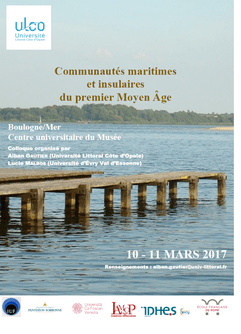
Colloque – Communautés maritimes et insulaires du premier Moyen Âge

Boulogne-sur-Mer, Centre universitaire du Musée
10-11 mars 2017
Renseignements : alban.gautier@univ-littoral.fr

Rencontre inscrite dans le programme de recherche « À la recherche des communautés du haut Moyen Âge. Formes, pratiques, interactions (VIe-XIe s.) ».

Colloque organisé par M. Alban Gautier (Université Littoral Côte d’Opale) et Mme Lucie Malbos (Université d’Évry Val d’Essonne), avec le soutien de l’université Littoral Côte d’Opale, de l’unité de recherche sur l’Histoire, les langues, la littérature et l’interculturel (HLLI, UR 4030, Université Littoral Côte d’Opale), de l’Institut universitaire de France, du Laboratoire de médiévistique occidentale de Paris (UMR 8589, Université Paris I Panthéon – Sorbonne/CNRS), de l’École française de Rome, du laboratoire Institutions et dynamiques historiques de l’économie et de la société (IDHES, UMR 8533, Université d’Évry Val d’Essonne/CNRS) et de l’Université Ca’ Foscari de Venise.
csm_communautes_maritimes_image_b39e90f193

Programme :

Vendredi 10 mars

10h30 : Accueil des participants en salle des Actes

Session 1

10h45 : Accueil
11h Introduction par Alban Gautier (Université Littoral Côte d’Opale)

11h30 : Conférence inaugurale. Stéphane Lebecq (Université de Lille SHS) – « En milieu littoral, sur l’eau et outre-mer. Regards sur les communautés et solidarités maritimes dans le bassin des mers du Nord du VIIe au XIe siècle »
12h30 : Déjeuner

Session 2, présidée par Régine Le Jan (Université Paris I Panthéon-Sorbonne)

14h00 : Søren M. Sindbaek (Aarhus Universitet) – « Communities on the edge: piecing together the North Sea emporia »
14h30 : Lucie Malbos (Université d’Évry Val d’Essonne) – « Femme de marchand ou marchande ? Présence, rôle et statut des femmes dans les emporia d’Europe du Nord-Ouest (VIIe-Xe siècle) »
15h00 : Discussion
15h30 : Pause

Session 3, présidée par Stéphane Lebecq (Université de Lille SHS)

16h00 : Stefano Gasparri (Università Ca’ Foscari, Venise) – « Une communauté à la fois maritime et territoriale : Venise jusqu’à l’an Mil »
16h30 : Sauro Gelichi (Università Ca’ Foscari, Venise) – « Communautés de lagune dans l’Adriatique pendant le haut Moyen Âge : Venise et Comacchio comparées »
17h00 : Chiara Provesi (Università Ca’ Foscari, Venise) – « La terre et la mer. La construction de la mémoire de Venise dans l’Istoria Veneticorum de Jean Diacre »
17h30 : Discussion

18h30 : Visite de la cathédrale de Boulogne
20h00 Dîner

Samedi 11 mars

Session 4, présidée par Wendy Davies (University of Oxford)

9h00 : André Marques (Universidade Nova, Lisbonne) – « An emerging periphery: maritime activities and communities on the Atlantic shores of Iberia (850- 1150) »
9h30 : Dries Tys (Vrije Universiteit, Bruxelles) – « The Maritimi Flandrenses: landscape, material culture and social and cultural dynamics of an early and high medieval maritime community »
10h00 : Discussion
10h30 : Pause

Session 5, présidée par Stefano Gasparri (Università Ca’ Foscari, Venise)

11h00 : Chris Loveluck (University of Nottingham) – « Maritime-oriented communities and networks of Atlantic and North-Sea Europe compared, c. AD 700-1100: archaeological and textual perspectives »
11h30 : Christer Westerdahl (Norges teknisk-naturvitenskapelige Universitet, Trondheim) – « Sharing boats, sharing thoughts »
12h00 : Discussion
12h30 : Déjeuner

Session 6, présidée par Geneviève Bührer-Thierry (Université Paris I Panthéon-Sorbonne)

14h00 : Isabelle Cartron (Université de Bordeaux Montaigne) – « De l’île au continent : la transition entre deux formes de monachisme dans la communauté de Saint-Philibert au IXe siècle »
14h30 : Charlotte Gaillard (Université Lumière Lyon II) – « La communauté monastique insulaire de l’Île-Barbe (Lyon) »
15h00 : Arnaud Lestremau (Université Paris I Panthéon-Sorbonne) : « Piscium quem vos haked nuncupatis. Communautés monastiques et imaginaire maritime dans l’Angleterre des Xe et XIe siècles »
15h30 : Discussion
16h00 : Pause
16h30 : Conclusion par Pierre Bauduin (Université de Caen Normandie)

Source : École française de Rome
Publié dans Colloque | Laisser un commentaire

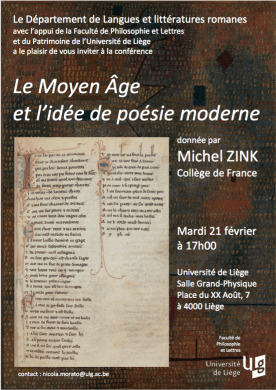
Conférence – Michel Zink, « Le Moyen Âge et l’idée de poésie moderne »

À l’invitation du Département de Langues et littératures romanes de l’Université de Liège, Michel Zink, Professeur émérite du Collège de France, fera une conférence sur le thème Le Moyen Âge et l’idée de modernité.

zink-poesie-moderne

Informations pratiques :

Cette manifestation se tiendra le mardi 21 février à 17h en la salle Grand Physique (Liège, pl. du XX Août).

Contact : nicola.morato@ulg.ac.be

Source : Transitions

Publié dans Colloque | Laisser un commentaire

Appel à contribution – Hybrids and Hybridity

University of Reading, Graduate Centre for Medieval Studies
20-21 April 2017

The deadline for paper proposals for University of Reading, Graduate Centre for Medieval Studies (GCMS) 2-day conference, ‘Hybrids and Hybridity’ has now been extended to the 17th of February.

Aimed at providing a platform for post-grad and early career researchers examining the idea of hybrids and hybridity in the medieval and early modern periods, the conference offers a chance to present your work within an informal environment – be that a fully-formed paper or a more exploratory questioning of these concepts through themes including, but not limited to:

  • Imagery
  • Identity
  • Gender
  • Transition
  • Liminality

For any questions or to submit an abstract, please feel free to contact the organizers at gcms.reading@gmail.com.

Source : Medieval Art Research

Publié dans Appel à contributions | Laisser un commentaire

Séminaire – Let’s Talk About History

L’Institut d’histoire de l’université de Luxembourg vous invite à son cycle de conférences intitulé « Let’s Talk About History! ». L’objectif de ces rencontres est d’initier un dialogue entre la science de l’histoire et le grand public en présentant les dernières tendances et les résultats récents dans la recherche historique non seulement au niveau luxembourgeois, mais aussi au-delà des confins en invitant des chercheurs internationaux.

Lets talk about history.png

Programme :

23 janvier 2017
Dr. Julien Demade (CNRS / Université Panthéon-Sorbonne)
Pourquoi (ne pas) étudier l’histoire (du Moyen Âge) ?

1er mars 2017
Prof. Dr. Teresa Pinheiro (Universität Chemnitz) / Dr. Elsa Peralta (Institute of Social Sciences, University of Lisbon)
Remembering Portuguese Empire Today: From Public Memory to Personal Testimony

4 avril 2017
Prof. Dr. Nicolas Offenstadt (Université Panthéon-Sorbonne)
L’histoire mobilisée. Roman national et identité dans un monde fragile

28 septembre 2017
Prof. Dr. John Scheid (Collège de France)
Religion et piété à Rome (titre précis reste à fixer)

Novembre/décembre 2017
Prof. Dr. Roger Chartier (Collège de France / University of Pennsylvania)
Le livre et la lecture à l’âge du numérique(titre précis reste à fixer)

Informations pratiques :
Campus Belval, Maison du Savoir, salle 3530 (3e étage) – 2, avenue de l’Université
Esch-sur-Alzette, Grand-Duché de Luxembourg (4365)

Source : Université du Luxembourg

Publié dans Séminaire | Laisser un commentaire

École d’été – Rijksmuseum and RKD Summer School

From 13 to 22 August 2017 the Rijksmuseum and the RKD – Netherlands Institute for Art History organize a Summer School which offers a unique, in-depth immersion into 17th-century Netherlandish art and history. The 2017 edition of the Summer School is themed around ‘Dutch art in an international perspective’.

As national institutions, The Rijksmuseum and the RKD share a mission to further develop the understanding of Netherlandish art and history for the future by conducting and facilitating high-level research. Dating back to 1992, the institutions have joined forces to organize a biennial Summer School with the goal of offering the next generation of art historians the opportunity to enrich and deepen their knowledge of Netherlandish art. The exclusive programme enables candidates to immerse themselves within the Dutch art world and museum field, and build up a relevant network.

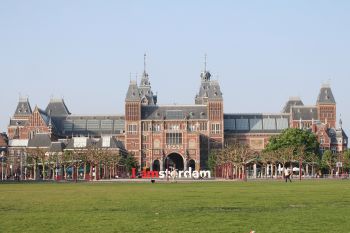
rijksmuseum-amsterdam-350x233

Theme

Traditionally Dutch art has been studied and shown as a national phenomenon, whereas the current globalization causes a new tendency to explore Dutch art in an international perspective. Only the study of international cultural and artistic exchanges will provide a balanced understanding of the production and collecting of art from the Low Countries. The aim of this Rijksmuseum & RKD Summer School is to give an in-depth immersion into Dutch art of the Golden Age, with a specific transnational focus.

Programme

A series of lectures, presentations, workshops and excursions will provide insight into the latest developments in Dutch art history, research and exhibition projects, as well as methodologies. A number of the sessions have been designed to encourage interactive discussion between the speakers and the course participants. There will be ample opportunity for discussion in front of the original works of art. Moreover, the participants are offered the possibility to build up a network of contacts with prominent scholars and museum professionals in The Netherlands.

Eligibility

The Summer School is primarily intended for young museum curators, recent MA graduates, PhD candidates and professional art historians specializing in 17th-century Dutch art. A total of 15 candidates will be selected based on CV and motivation. The ability to communicate in English is required.

Application and procedure

The closing date for all applications is 19 March 2017, at 6:00 p.m. (Amsterdam time/CET), but applications are reviewed on a rolling basis and we therefore encourage candidates to apply at their earliest convenience.

The Rijksmuseum and the RKD reserve the right to cancel the Summer School should the number of eligible applicants not meet the minimum requirement or due to unforeseen circumstances.

Further information

For more detailed information please visit https://www.rijksmuseum.nl/summer-school

Publié dans École d'été | Laisser un commentaire

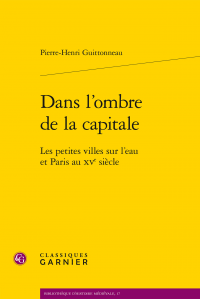
Publication – Pierre-Henri Guittonneau, « Dans l’ombre de la capitale – Les petites villes sur l’eau et Paris au XVe siècle »

Si la domination de Paris sur les petites villes alentours est incontestable à la fin du Moyen Âge, ces dernières ne sont pas soumises intégralement aux institutions et aux habitants de la capitale. Cet ouvrage montre qu’elles entretiennent avec celle-ci, sur de nombreux plans, des rapports d’interdépendance.

Table des matières : ici

phgms01b

While it is unquestionably true that Paris dominated the small outlying towns at the end of the Middle Ages, they were not wholly subject to its institutions and inhabitants. This work shows that in many respects the surrounding towns maintained a relationship of interdependence with the capital.

Table of contents : here

Informations pratiques :
Pierre-Henri Guittonneau, Dans l’ombre de la capitale – Les petites villes sur l’eau et Paris au XVe siècle, Paris, Classiques Garnier, 2017 (Bibliothèque d’histoire médiévale, 17). 15 x 22 x 3,9 cm, 829 pages. ISBN : 978-2-406-05894-6. Prix : 64 euros.

Prix Jean Favier de la Société des amis des archives de France (2016)

Source : Classiques Garnier

Publié dans Publications | Laisser un commentaire

Appel à contribution – Kings and Queens 6: At the Shadow of the Throne

Universidad Nacional de Educación a Distancia,
Geography and History Faculty, Paseo Senda del Rey, 7, Madrid (Spain).
September 12-15, 2017

The Kings & Queens conference series will be travelling to Madrid in 2017 for its sixth edition. In this occasion, we aim to connect scholars across the world whose research focuses on topics related to royal history, diplomacy, art history, political history, biographical studies or any other issues included in the scope of the royal studies. In particular, this edition of the Kings and Queens congress will be focused on the secondary members of royal families, such as siblings, spouses, cousins, as well as the people closest to the king, like lovers, favourites, members of the royal entourage, etc. We look especially for studies related to figures with family ties to a monarch, who were not kings or queens in their own right, but had a significant influence in spheres such as international politics, the court, the arts, the society or dynastic strategies during their time, with the objective of obtaining a better understanding of figures that are usually in the shadow of the throne. All kind of topics related to these issues will be welcomed, from diverse chronological periods and parts of the world.

CFP Kings and Queens.png

In the potential topics for papers or panels we may include, but are not limited to, the following:

-Biographical, dynastical and political studies of different members of the royal families who were not kings or queens on their own right.
-Power, role and importance of different people close to the monarch, like favorites, lovers, relatives with military, diplomatic or dynastic posts, ambassadors or diverse members of their entourage.
-The relationship between power and art. Patronage, collecting and diplomatic exchanges.
-Monarchy, high nobility and the representation of status, power and influence through art, culture and image.
-The importance of the dynasty and the “dynastic mirror”.
-Informal power, royal favour and disfavour.

Proposals should include a title, institutional affiliation, an abstract of around 500 words and a short, one page CV. In the case of panels, the proposal should include a maximum of three different papers accompanied by the same information required for individual proposals and the name, affiliation and short, one page CV of the sponsor (if they are not presenting a paper in the same panel). All the proposals should be submitted by March 30, 2017, to Kq6Madrid@gmail.com. Please, remember that English will be the official language of the congress.

Also, we are pleased to announce that we offer 20 bursaries for young researchers to help them with the costs. Those interested in said bursaries should write to the aforementioned email to obtain more details about them and what they cover. Those who want to apply must send us the title of the proposal, an abstract of around 500 words, institutional affiliation, a one page CV and one page report focusing on why this congress is relevant for them and how their research could improve the field of royal studies.

Publié dans Appel à contributions | Laisser un commentaire

Appel à contribution – Écrit et transferts culturels : pratiques et gouvernance princières (Lotharingie, France, Empire, XIIIe-début XVe sicle

Colloque international organisé dans le cadre du projet ANR-FNR TRANSSCRIPT
Nancy, 18-20 octobre 2017

Ouvert dans les années 1970, le chantier sur les pratiques médiévales de l’écrit est désormais bien installé dans l’historiographie internationale (Anheim-Chastang, 2009). Parallèlement, depuis les études de Hans Patze sur le « Geschäftsschriftgut » (c.-à-d. l’écrit administratif sous toutes ses variantes) des princes territoriaux (Patze 1971), il est bien connu que le développement de la pratique de l’écrit a largement contribué à l’essor des principautés territoriales à partir du XIIIe siècle. La multiplication de l’écrit au service du prince concerne toute une série de domaines qui sont autant de marques du développement de l’autorité princière et de la tentative progressive du pouvoir princier d’intégrer les différents éléments de la société médiévale dans les pré-États.

L’essor de la pratique de l’écrit concerne en effet aussi bien tous les aspects du fondement du pouvoir princier (« Machtgrundlagen »), que de sa mise en œuvre (« Herrschaftspraxis »). Il donne ainsi lieu à de nouvelles formes scripturales (à côté des documents diplomatiques, les censiers, les documents comptables, les livres de fiefs, les « records de justice », les lettres d’affranchissement) qui correspondent à autant de développements institutionnels (la chancellerie, les baillis, sénéchaux ou prévôts, les receveurs, la cour des nobles et chevaliers, les échevins et maires seigneuriaux et autres agents princiers).

L’étude de la pratique de l’écrit dans les principautés territoriales a fait de notables progrès suite aux travaux flamands sur les conditions de rédaction des actes princiers (Prevenier 1967 ; Kriusheer, 1979), allemands sur les chancelleries princières (Landesherrliche Kanzleien, 1983) et français sur les cartulaires (Cartulaires, 1991 ; Chastang, 2006). Depuis quelques années, des études régionales sont disponibles et une synthèse sur les pratiques des langues dans les chancelleries fait référence pour l’espace germanophone (Kanzleisprachenforschung, 2012). En zone frontière entre France et Empire, c’est l’étude de la langue des actes diplomatiques qui a été au cœur du renouveau. À l’Université de Trèves, le projet Urkundensprachen im Erzbistum Trier und in seinen deutschen und romanischen Nachbargebieten von 1250 bis 1350 a eu pour objectif l’étude des actes de la pratique et celle du premier usage des langues vernaculaires dans les grandes chancelleries de l’espace de la Grande Région, en particulier celle des archevêques de Trèves, au tournant des XIIIe et XIVe siècles, période charnière caractérisée par l’émergence des actes de la pratique rédigés en langue allemande (http://urts55.uni-trier.de/cgi-bin/iCorpus/CorpusIndex.tcl ). L’espace romanophone de la Grande Région a été le cadre d’études linguistiques et philologiques similaires menées par les chercheurs de l’Université de Zurich (http://www.rose.uzh.ch/docling).

Née pendant les années 1980, la notion de « transfert culturel » a été forgée pour rendre compte des échanges qui affectent les espaces culturels, du passage de certains éléments d’une culture à une autre. Les transferts ainsi analysés dans le sens d’influences et de mutations concernent des concepts, des représentations, des mentalités, des institutions entre autres. L’idée maîtresse était de sonder les motivations et les usages mais aussi les modalités, les vecteurs qui sous-tendent de tels transferts (Espagne – Werner, 1987), afin de proposer une alternative à l’approche, alors dominante, du comparatisme littéraire et historique. Jugeant caduque la tendance à poser l’existence de cultures nationales qui seraient distinctes par essence puis destinées à être dépassées par la construction artificielle d’un niveau méta-national, les tenants de la théorie du transfert culturel montrent au contraire avec insistance qu’un tel transfert implique la mise en relation de deux systèmes autonomes et asymétriques et que son objet est nécessairement transformé afin de répondre aux besoins spécifiques du système d’accueil. Aussi l’étude des transferts culturels s’intéresse-t-elle plus aux interactions entre les sociétés – ou fractions et groupes à l’intérieur d’une société – qu’aux objets de transferts, et s’emploie à rendre compte des conditions qui ont marqué leur déclenchement et leur déroulement, à analyser les phénomènes d’émission, de diffusion, de réception et de réinterprétation qui les constituent. Prenant en considération une conception la plus large possible de la culture, la méthode insiste sur deux analyses : celle des contextes et de la « localisation » d’accueil et de départ d’un transfert et celle de ses vecteurs.

Les équipes – française et luxembourgeoise – en charge du projet ANR-FNR TRANSSCRIPT, dont ces problématiques constituent l’un des axes principaux, souhaitent leur consacrer une réflexion élargie. À l’échelle de l’ancien espace lotharingien, et dans les principautés voisines, dans la chronologie des XIIIe-début XVe siècles, le travail d’analyse et d’interprétation, partant des documents diplomatiques, de gestion ou des documents issus de la pratique de l’arbitrage, pourrait porter sur les points suivants :

1. Étude du discours et de sa construction : exposé chronologique ou argumentatif, du formulaire, du vocabulaire politique et administratif; étude de la terminologie identitaire des acteurs, scripteurs et commanditaires ; circulation des thèmes… Une attention particulière sera portée à tous les éléments destinés à la visibilité de l’écrit, participant de la communication sociale et politique (format, mise en page, signes graphiques, armoiries…)

2. Pratiques d’enregistrement et de conservation, par exemple au travers de l’étude de la formation des chartriers princiers

3. L’usage des langues dans les zones de diglossie ou de polyglossie (latin/langues vernaculaires) : chronologie, passages d’une langue à l’autre, comparaison terminologique dans l’expression du pouvoir, de la décision juridique. La concurrence des langues peut relever d’une gouvernance pragmatique ou avoir une dimension identitaire. Elle doit aussi être envisagée ici comme le « milieu de la réflexivité » sur la structure du discours et la terminologie du pouvoir

4. Commanditaires, destinataires, scripteurs, en tant qu’acteurs et promoteurs des transferts : étude des bureaux d’écriture princier / de la chancellerie ; lieux de formation et carrières des scripteurs ; influences entre institutions ecclésiastiques et princières ; liens et politiques dynastiques, mobilité sociale des élites ; surface sociale et politique, réseau d’alliances des commanditaires

5. La résistance éventuelle aux transferts culturels : une « diplomatique de la différence » opposée à une « diplomatique de la conformité » (O. Guyotjeannin, « Écrire en chancellerie », p. 31)

Merci d’adresser avant le 18 avril 2017 votre proposition de communication en français ou en anglais (500 à 1000 signes) à :

Isabelle Guyot-Bachy, Université de Lorraine- CRULH
isabelle.guyot-bachy@univ-lorraine.fr

MichelMargue,Institutd’Histoire,Universitédu Luxembourg-IPSE
michel.margue@uni.lu

Publié dans Appel à contributions | Laisser un commentaire

Appel à contribution – People of the North Sea. European Association of Archaeologists Conference

The Migration period (4th-5th centuries AD) and its aftermath was a formative phase in the history of the lands bordering the North Sea. Migrations resulted in the formation of new societies. These groups not only developed new identities, but also a shared maritime culture that tied the North Sea communities together and placed them within a wider trading and exchange network that included Scandinavia and Continental Europe. Our knowledge of these developments is fragmented, since it is part of different fields (archaeology, language, toponomy, genetics, early literature studies) and it is often hidden in national and regional studies.

eaa-2017

Our aim is to come to a better understanding of the events and processes that took place in this period: Is the evidence indicative of migration of people or rather of ideas? Was migration ‘pushed’ by unfavourable circumstances or ‘pulled’ by attractions in the regions of destination? How large were the groups of migrants? Can we discern different phases and origins? How did new identities, polities and cultural expressions emerge from this patchwork of migrant and autochthonous groups?

In this session we seek papers that approach the early medieval history of the North Sea area from different angles and regions. They may focus on traces of migration and inter-regional contacts, such as imports or changing styles and customs, evidence of continuity and discontinuity, or water routes and landing places. Papers that combine archaeological and historical sources are very welcome.

This session complements session no. 20: Beyond migration: interdisciplinary approaches to mobility in early medieval Europe

Submission for papers & posters will be open 3rd February – 15th March 2017.
Go to http://www.eaa2017maastricht.nl for submitting your abstract and for further information on EAA 2017.

Please contact the organisers if you are interested in joining this session:
Annet Nieuwhof (a.nieuwhof@rug.nl), Pieterjan Deckers (pdeckers@vub.ac.be), Johan Nicolay (j.a.w.nicolay@rug.nl) or Annette Siegmüller (siegmueller@nihk.de).

Source : Academia.edu

Publié dans Appel à contributions | Laisser un commentaire

Bourse – Durham University Slater Fellowship in Medieval & Early Modern Studies, 2017/18

Durham University
Institute of Medieval and Early Modern Studies

Salary: Fellows are offered full board and accommodation at University College, with up to £200 available towards travel expenses.
Hours: Part Time
Contract Type: Contract / Temporary
Placed on: 24th January 2017
Closes: 4th March 2017
Job Ref: DU – Slater Fellowship

durham

Durham University’s Institute of Medieval and Early Modern Studies and University College are delighted to welcome applications from senior academics at other Universities for the 2017-18 Slater Fellowship.

The Slater Fellowship is designed to enable the postholder to carry out research in Durham for a period of one term, during which time fellows are offered full board and accommodation at University College, with up to £200 available towards travel expenses.

Applicants should submit a CV and a brief summary of what they propose to work on during their time at Durham (maximum one side of A4). They must demonstrate how their proposed research complements or ties in with existing IMEMS research strands, or the research of individual members of the Institute.

Proposals for projects involving Durham staff or postgraduate students and those which are interdisciplinary in nature are particularly welcome. Proposals for research using primary source material in the collections held in Palace Green Library, Durham Cathedral Library and Ushaw College Library are also encouraged.

Applications should be submitted no later than Saturday 4th March 2017 to admin.imems@durham.ac.uk and candidates will be notified of the outcome in early April 2017.

When applying, please indicate your availability during the academic year 2017/18, noting that the timing of the Fellowship is variable depending on the availability of accommodation.

For 2017/18 it is likely that the Fellowship will be for Michaelmas term (09 October – 15 December 2017). Some flexibility may be possible, but applicants should ideally be available during these dates.

Source : Jobs.ac.uk

Publié dans Bourse | Laisser un commentaire