Colloque – Hidden Treasure: Medieval Manuscript Fragments and Digital Research Methods

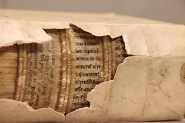
This colloquium is devoted to medieval text that is normally hidden from our eyes, such as palimpsests and manuscript fragments hidden in bindings. The principle subject matter is the manuscript fragment: paper and parchment pages that were recycled by post-medieval bookbinders and glued inside bindings for support. The colloquium aims to show that these fragments represent a stimulating topic for academic research, in spite of their damaged nature. In addition, the colloquium presents a new x-ray technique to make fragments visible without removing them from bookbindings.

fragment

Programme :

12.30 pm – Welcome and Short Introduction

12.45 – 1.25 pm – Jorien Duivenvoorde & Joris Dik (Delft University of Technology) – Visualizing Ferrous Inks of Hidden Manuscript Fragments in Early Printed Books Using Macro X-ray Fluorescence Spectometry
1.25 pm – 2.05 pm – Uwe Bergmann (Stanford University) – Synchrotron X-ray Fluorescence Imaging since the Archimedes Palimpsest
2.05 pm – 2.35 pm – Coffee break

2.35 pm – 2.55 pm – Erik Kwakkel (Leiden University) – Medieval fragments: An Incomplete Introduction
2.55 pm – 3.35 pm – Petra Sijpesteijn (Leiden University) – Voices from the Dust: Peoples and Pasts from Papyri Fragments
3.35 pm – 4.15 pm – Lieftinck Lecture in Medieval Manuscripts (previous lectures) – Judith Schlanger (Sorbonne, Paris) – Books within Books: Research Methods Applied to Recycled Hebrew Fragments

4.15 pm – 5 pm – Display of fragments from Leiden University Library collections
Please RSVP by sending an email to Erik Kwakkel (e.kwakkel@hum.leidenuniv.nl)

Informations pratiques :
Date : 27 September 2016
Time : 12:30 -17:00 hrs.
Explanation : Free and open to all

Location :
University Library
Witte Singel 26-27
2311 BG Leiden
Room Vossius

Source : Universiteit Leiden

Publié dans Colloque | Laisser un commentaire

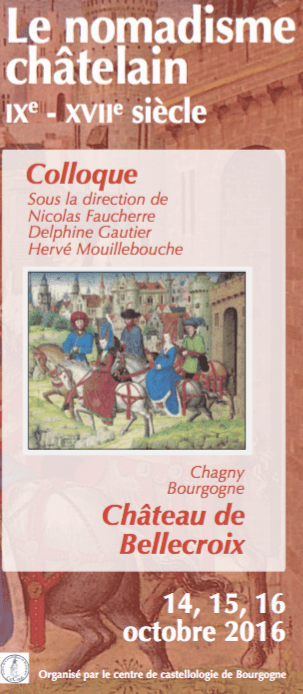
Colloque – Le nomadisme châtelain, IXe-XVIIe siècle

Le château est rarement un lieu de résidence permanente. Les rois, les princes, les seigneurs, mais aussi les ecclésiastiques se déplacent, en groupes plus ou moins importants, de châteaux en châteaux, ou de l’hôtel urbain au château rural.

Ce 6e colloque international du château de Bellecroix essaiera de comprendre les réseaux de châteaux à la lumière de l’itinérance aristocratique, et mesurera les conséquences de ce nomadisme sur la vie, l’organisation et l’équipement du château.

Nomadisme châtelain

Programme :

Vendredi 14 octobre

14h00 : Accueil des participants

14h30 : Nicolas Faucherre – Introduction

15h00 : Jean-François Boyer – « Palais » en mouvement : l’exemple du royaume carolingien d’Aquitaine
15h40 : Tristan Martine – Des mobilités contraires ? La naissance du nomadisme châtelain dans la Lotharingie méridionale des Xe et XIe siècles
16h20 : Pause

16h50 : Fanny Madeline – Logistique et approvisionnement des demeures royales en Angleterre au XIIe siècle
17h30 : Marlène Poirier – Hiérarchisation des demeures seigneuriales et nomadisme chez les seigneurs des Baux, aux XIIe et XIIIe siècles
18h10 : Vianney Müller – La mobilité des seigneurs de Neuchâtel-Bourgogne (XIIIe-XVIe siècle)
18h50 Verre de l’amitié

Samedi 15 octobre

09h00 : Pierre Schoeffler – Le détenu nomade ou gestion des prisonniers lors de l’itinérance du châtelain et de sa cour
09h40 : Jean-Michel Poisson – L’installation et la résidence des officiers châtelains dans les châteaux comtaux savoyards au XIVe siècle
10h20 : Pause

10h50 : Florentin Briffaz – Le nomadisme châtelain des sires de Thoire-Villars au miroir des registres de comptes ; pratiques seigneuriales et culture nobiliaire au XIVe siècle
11h45 : Charles Kraemer – Des châteaux de campagne des princes lorrains dans le Barrois mouvant (XIVe-XVIe siècle)
Déjeuner

14h30 : Victorien Leman – Mobilités et villégiatures princières : l’exemple des ducs Valois de Bourgogne (1363-1477)
15h10 : Hervé Mouillebouche – La cour ducale à Dijon : préparation, installation et départ
15h50 : Matthieu Pinette – Le château de Germolles : l’organisation d’une résidence de Marguerite de Flandre
16h30 : Départ en car pour le château de Germolles
17h00 : Visite du château de Germolles sous la conduite de Matthieu Pinette et de ses collaborateurs

Dimanche 16 octobre

09h00 : Alain Kersuzan – Le prince arrive, faisons le ménage…
09h40 : Emmanuel Litoux – Maîtrise d’ouvrage et itinérance : les chantiers angevins du roi René (1434-1480)
10h20 Pause

10h50 : Daniela Cereia – Les réseaux d’eau et les déplacements de la cour de Savoie (fin du XIVe – début du XVe siècle)
11h40 : Yves Coativy – D’un château l’autre : le nomadisme châtelain des ducs de Bretagne aux XIIIe et XIVe siècles
Déjeuner

14h30 : Jean Mesqui – Châteaux royaux et itinérance cynégétique : les résidences de Philippe le Bel dans la forêt des Loges (Orléans)
15h15 : Bruno Bentz – Les voyages de Marly sous Louis XIV
15h50 Pause

16h30 : Alain Salamagne – Louis XI, un roi SDF ?
17h10 : Monique Chatenet – Conclusion

Informations pratiques :

14, 15, 16 octobre 2016
Organisé par le centre de castellologie de Bourgogne

Coupon-réponse à renvoyer avec votre règlement à l’ordre du CeCaB avant le 1er octobre à :
Delphine Gautier
Château de Bellecroix 20, chemin de Bellecroix 71150 Chagny
Tel : 06 07 33 77 50
Mail : gautier.delphine@wanadoo.fr

Source : CECAB

Publié dans Colloque | Laisser un commentaire

Appel à contribution – Topographies of devotion. Visual cultures of pilgrimage in the 14th and 15th century

CFP: Topographies of devotion. Visual cultures of pilgrimage in the 14th and 15th century @International Medieval Congress 2017, Leeds, 3-6 July 2017

Organiser: Isabella Augart, University of Hamburg, Department of Art History
Deadline: 10th September 2016.

The medieval pilgrimage routes were spaces of cultural and material exchange upon which diverse travellers set off on a common path. The research focus on the link between geography and religion over the last few years has considerably broadened our understanding of medieval art and architecture. The proposed session seeks to provide perspectives on images, church spaces, sacred topographies and material culture of pilgrimage with a regional concentration on the Holy Roman Empire, focusing in particular on the following areas of interest:

  • accounts of pilgrimage journeys in illuminated manuscripts and prints
  • the relation of pilgrimage churches and routes to the surrounding landscape
  • social dimensions of accessibility and mediation in topographies of pilgrimage
  • visual and tactile practices of veneration related to churches and artworks

How to submit: Please send your abstract (max.150-words) for a twenty-minute paper and a short biography to the session organiser (isabella.augart@uni-hamburg.de) before 10th September 2016.

Source : Medieval Art Research

Publié dans Appel à contributions | Laisser un commentaire

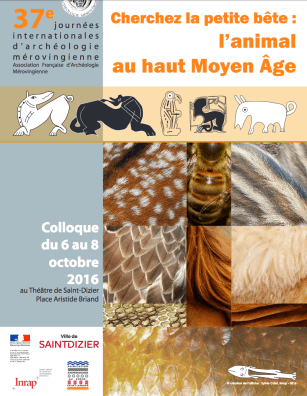
Colloque – Cherchez la petite bête : l’animal au haut Moyen Âge

Colloque du 6 au 8 octobre 2016
au Théâtre de Saint-Dizier Place Aristide Briand

37e journées internationales d’archéologie mérovingienne. Association Française

Pour tout renseignement : afamsaintdizier2016@gmail.com

Capture d’écran 2016-08-27 à 22.05.20

Lieu du colloque :
Théâtre municipal
Place Aristide Briand, 52100 Saint-Dizier
Cocktail dinatoire et pauses à l’hôtel de ville
1 Place Aristide Briand, 52100 Saint-Dizier

Exposition « Austrasie le royaume mérovingien oublié »
Espace Camille Claudel
9 Avenue de la République, 52100 Saint-Dizier
Exposition permanente des tombes « de chefs francs »
Musée municipal 17 Rue de la Victoire, 52100 Saint-Dizier

Inscription : ici

Tous ces lieux sont à moins de 5 minutes à pied les uns des autres. La gare SNCF est à 10 mn à pied du lieu du colloque. Pour venir en bus depuis la gare, prendre le bus n° 1 direction Chêne Saint-Amand ou le bus n° 2 direction Saint-Exupéry et descendre à l’arrêt Hôtel de ville. http://www.bus-ticea.com/

Programme : ici

Source : AFAM

Publié dans Colloque | Laisser un commentaire

Conférence – Une culture de l’Etat ? Lobbies, pétitions et prise de décision dans les Pays-Bas (15e-17e siècles)

Le professeur J.-M. Cauchies (USL-B), Nicolas Simon (FRS-FNRS, USL-B) et Yves Junot (Université de Valenciennes) proposeront un cours-conférence dans le cadre du programme du Collège Belgique pour l’année 2016.

1456937115

Voici l’argumentaire de ce cours-conférence :

Que n’entend-on pas en termes de commentaires négatifs sur la puissance des lobbies auprès de la Commission européenne ? Quels fantasmes ne sont-ils pas nourris concernant l’influence de tel ou tel secteur dans la prise de décision gouvernementale ? Si ces questions se posent avec acuité pour le 21e siècle, elles méritent aussi d’être envisagées à une autre échelle temporelle, celle des temps modernes. En effet, la mise en place d’institutions toujours plus centralisées et centralisatrices oblige alors les décideurs politiques (princes, conseillers, voire juges) à s’informer et à rassembler l’information avant de prendre la décision finale. Les deux cours proposés tenteront de déconstruire l’image encore prégnante selon laquelle les monarques modernes dits « absolus », décidaient seuls et unilatéralement. En se focalisant sur la période charnière des 15e-17e siècles, on montrera que les territoires de la Belgique actuelle constituent un bon terrain d’étude pour analyser les rapports de force entre principautés/provinces, entre le gouvernement central et divers groupes de pression (clergé, villes, marchands, métiers), voire les tensions internes au gouvernement central lui-même. Sur la base de dossiers nourris par les archives, on montrera qu’une véritable dynamique de communication existait entre les gouvernants et les gouvernés (envois d’avis, requêtes, notes, projets de lois, etc.) et permettait ainsi d’atteindre des compromis acceptables pour les parties impliquées.

Informations pratiques

Mercredi 28 septembre 2016 à 17h
Palais des Académies à Bruxelles
salle à confirmer

Inscription obligatoire via le site internet de l’Académie royale.

Le catalogue complet des cours-conférence du Collège Belgique est disponible en ligne ici.

Source : CRHIDI

Publié dans Colloque | Laisser un commentaire

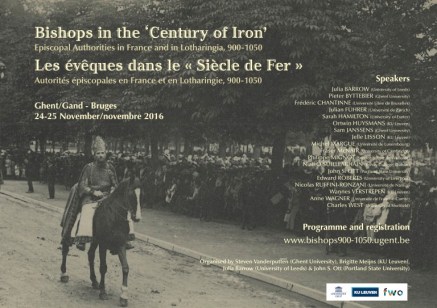
Colloque – Bishops in the ‘Century of Iron’. Episcopal Authorities in France and in Lotharingia, 900-1050 / Les évêques dans le « Siècle de Fer ». Autorités épiscopales en France et en Lotharingie, 900-1050

Ghent-Bruges (KULeuven Campus Bladelin), 24-25 November 2016

Recent years have witnessed strong academic interest in bishops of the tenth and early eleventh centuries. Long considered morally weak, deeply embroiled in worldly affairs, and culturally insignificant, these prelates of the ‘pre-Gregorian age’ are now undergoing reassessment via analysis of well-known sources and previously neglected ones. The objective of these studies is to understand bishops’ identities and agency in the context of their own time – an age marked by close entanglement of the ecclesiastical and secular spheres – instead of contrasting them with their ‘Gregorian’ successors. From this recent scholarship emerges a complex and varied understanding of episcopal office, and of the different ways in which its holders expressed their claims to political and religious authority.

The aim of this conference is to present state-of-the-art scholarship on tenth- and early- eleventh century bishops in France and Lotharingia, to consider the above developments, and to explore new paths for future research on episcopal authorities in the Post-Carolingian world. It situates itself at the intersection of different fields of medieval scholarship, including the study of institutions, reform, discourse, ritual and symbolic modes of (self-)representation, historiographical production, iconography, and material culture.

The conference is a joint organization of Steven Vanderputten (Ghent University) and Brigitte Meijns (Catholic University of Leuven), with support from the Research-Foundation Flanders (FWO) and in association with Episcopus (www.episcopus.org). Keynote lectures will be delivered by John S. Ott (Portland University), Charles West (University of Sheffield), and Julia Barrow (University of Leeds).
poster-conferentie-768x543

Programme :

Thursday/Jeudi 24 November/novembre
Het Pand, Ghent University

9.45: Registration and Coffee/Accueil et café
10.15: Introduction – Steven Vanderputten (Ghent University) and Brigitte Meijns (KU Leuven)

10.30-11.30: Keynote Lecture/Rapport introductif
Chair/Présidente: Brigitte Meijns (KU Leuven)

Prof. John S. Ott (Portland State University) – In Praise of Bishops

11.30-13.00: Session 1: Bishops in Peace and Conflict/Évêques entre paix et conflits
Chair/Président: Charles West (University of Sheffield)

Dr. Fraser McNair (University of Cambridge) – Nullus alicui clerico episcopatum conferre debeat nisi rex: Royal Authority in Conflicts over Bishoprics During Charles the Simple’s Reign
Drs. Sam Janssens (Ghent University) – Episcopal Authorities and the Peace of God in the Archdiocese of Reims (1023-1050)
Drs. Pieter Byttebier (Ghent University) – The Warring Bishop: Violent and Symbolic Representations of Episcopal Authority in Lotharingia Around 1000 AD
13.00-14.00: Lunch/Repas

14.00-15.30: Session 2: Bishops at the Edges of Empire 1/Évêques aux marges de l’empire 1
Chair/Président: Charles Mériaux (Université de Lille 3)

Dr. Julian Führer (Université de Zürich) – Pourquoi ne parle-t-on pas de Reichsbischöfe en Francie occidentale? Enquête sur l’identité des évêques du Xe – XIe siècle
Dr. Nicolas Ruffini-Ronzani (FNRS/Université de Namur) – Renforcement de la seigneurie épiscopale et intégration au royaume de Germanie à Cambrai-Arras (Xe-début XIe siècle)
Prof. Michel Margue (Université de Luxembourg) – Les Adalberon – un “lignage” d’évêques? L’autorité épiscopale au centre des intérêts religieux, familiaux et politiques en Haute-Lotharingie de la seconde moitié du Xe à la première moitié du XIe siècle
15.30-16.00: Coffee Break/Pause

16.00-17.00: Session 3: Bishops at the Edges of Empire 2/Évêques aux marges de l’empire 2
Chair/Président: Michel Margue (Université de Luxembourg)

Dr. Edward Roberts (Leverhulme Early Career Fellow/University of Liverpool) – Communication, Canon Law and Careerism: Rather of Verona at Liège
Prof. Anne Wagner (Université de Franche-Comté) – Mémoire épiscopale à Metz de Thierry Ier à Thierry II : entre sainteté et condamnation

Friday/vendredi 25 November/novembre
KU Leuven Campus Bladelin, Bruges

10.00: Keynote Lecture/Conférence
Chair/Président: Steven Vanderputten (Ghent University)

Dr. Charles West (University of Sheffield) – Many Good Things Happened. Lotharingian Bishoprics between Reforms: the Case of Verdun

11.00-12.30: Session 4 Exercise of Episcopal Authority/L’exercise de l’autorité épiscopale
Chair/Présidente: Julia Barrow (University of Leeds)

Drs. Ortwin Huysmans (KU Leuven) – The Nature of Episcopal Reform of Monasteries in the Ecclesiastical Province of Reims (c. 888-1073)
Drs. Wannes Verstrepen (KU Leuven) – Bishops and Church Property in the ‘Century of Iron’: Fulbert of Chartres (1006-1028)
Mr. Philippe Mignot (Service public de Wallonie, DGO4, Département du Patrimoine/Direction de l’archéologie) and Drs. Frédéric Chantinne (Université Libre de Bruxelles) – L’autorité de l’évêque face l’encadrement paroissial d’abbayes et de chapitres dans les anciens diocèses de Liège et de Cambrai. Une perspective archéologique.
12.30-13.30: Lunch/Repas

13.30-15.00: Session 5 Perception and Representation of Episcopal Authority/Perception et représentation de l’autorité épiscopale
Chair/Président: John S. Ott (Portland State University)

Prof. Sarah Hamilton (University of Exeter) – Liturgy and Episcopal Authority: the Evidence of the Noyon Sacramentary (London, British Library, MS Additional 82956, Formerly Phillipps MS 3340)
Drs. Jelle Lisson (KU Leuven) – Prosopography and Profiling Strategies. The Background of Episcopal Candidates in the Church Province of Reims (900-1050)
Drs. Niall Ó Suilleabhain (Trinity College, Dublin) – Inter Saeculum et Sacerdotium: The Bishops of Auxerre and Lay Power, 887 – 1054

15.00-15.30: Coffee break/Pause

15.30-16.30: Concluding Remarks/Conclusions

Prof. Julia Barrow (University of Leeds) – Authority and Reform: Historiographical Frameworks for Understanding Tenth- and Eleventh-Century Bishops

Informations pratiques :
Ghent-Bruges (KULeuven Campus Bladelin)
24-25 November 2016

Contact :
samjanss.janssens@ugent.be
pieter.byttebier@ugent.be

Registration : here

Organizing committee :
Brigitte Meijns (KU Leuven)
Steven Vanderputten (Ghent University)
Julia Barrow (University of Leeds)
John S. Ott (Portland State University)

Scientific committee :
Steven Vanderputten (Ghent University)
Brigitte Meijns (KU Leuven)
Julia Barrow (University of Leeds)
Michel Margue (Université de Luxembourg)
Charles Mériaux (Université de Lille 3)
John S. Ott (Portland State University)
Charles West (University of Sheffield)

Source : UGent

Publié dans Colloque | Laisser un commentaire

Bourse – Bourse Robert de Sorbon (LAMOP – Paris)

Public visé
Cette bourse s’adresse aux docteurs en histoire médiévale ayant soutenu leur thèse à l’étranger, depuis trois ans au maximum.

Contenu de la bourse
Cette bourse permettra au lauréat de réaliser un séjour d’un mois, toujours du 1er au 31 mars, au sein du Laboratoire de Médiévistique Occidentale de Paris, lequel prendra en charge son déplacement aller et retour, son logement à la cité internationale de Paris et lui versera une somme de 500 euros destinés à couvrir les frais courants du séjour. En outre, le lauréat obtiendra le statut de membre associé du Laboratoire pendant trois ans.

logo_bourse_lamop

Obligations
À son arrivée, le lauréat donnera une conférence publique destinée à faire connaître ses travaux. Cette conférence donne lieu à une publication en ligne sur le site du LAMOP.

Calendrier
Publication de l’appel : 6 juillet 2016
Clôture de l’appel : 30 septembre 2016
Réunion du jury : 20 octobre 2016
Publication des résultats : 24 octobre 2016

Composition du jury
La composition du jury est revue chaque année par le Conseil de Laboratoire du LAMOP. Ce jury comprend 8 membres :
– un président, choisi parmi le groupe de direction du LAMOP ;
– un secrétaire, choisi au sein du conseil de Laboratoire du LAMOP ;
– le vice-président des Relations internationales de Paris 1 ou son représentant ;
– deux membres du LAMOP, titulaires ou émérites ;
– deux extérieurs, chercheurs ou enseignants-chercheurs ;
– un acteur de la conservation du patrimoine (Archives nationales de France, Bibliothèque nationale de France…).

Pièces à fournir :
– Déclaration de candidature (format docx) ;
– Curriculum vitae ;
– Lettre de motivation en français, dans laquelle le candidat présentera les axes de ses recherches, la manière dont ceux-ci peuvent s’articuler aux champs et programmes du Laboratoire et les objectifs de son séjour ;
– Rapport de soutenance et/ou un résumé de la thèse ;
– Deux publications jugées représentatives publiées ou à paraître.

La procédure de candidature est dématérialisée. Ces pièces seront adressées, avant le 30 septembre 2016 à minuit, sous format pdf, dans cet ordre et au sein d’un seul et même fichier, au secrétariat de la bourse : bourselamop@univ-paris1.fr.

Olivier Mattéoni, secrétaire scientifique
Françoise Bornes, secrétaire administrative

Source : LAMOP

Publié dans Bourse | Laisser un commentaire

Appel à contribution – “Frater, Magister, Minister et Episcopus”. The Works and Worlds of Saint Bonaventure

The Franciscan Institute at St. Bonaventure University
July 12-15, 2017

The Franciscan Institute at St. Bonaventure University will host a major international conference dedicated to the intellectual heritage and contemporary significance of Saint Bonaventure.

Individual papers, panels, and workshop proposals are sought that engage the academic, pastoral, and socio-political aspects of this topic. Possible themes include, but are not limited to the following:

  • Bonaventure’s Theological Legacy and Contemporary Theology
  • Bonaventure’s Use of Philosophical and Theological Sources
  • Aesthetics, Art, and Bonaventure
  • The Franciscan Order under Bonaventure’s Leadership
  • Bonaventure as Preacher
  • Ecology, Pope Francis, and Bonaventure
  • The Image and Role of Women in Bonaventure’s Writings
  • Bonaventure, Franciscan Ministry, and Spirituality
  • Bonaventure and Thomas Aquinas
  • Bonaventure, Paris, and Medieval France

Proposals are due by November 18, 2016.  Notifications of acceptance, rejection or need for alterations will be sent to authors by January 13, 2017. Please send a paper proposal/ draft of your text via email no later than November 18, 2016, directly to:

Fr. David Couturier, OFM Cap.
Franciscan Institute St. Bonaventure University
Murphy Building – Room 100
St. Bonaventure, NY 14778
dcouturi@sbu.edu

Organizing Committee:

Joshua Benson (Catholic University)
Timothy J. Johnson (Flagler College)
Dominic Monti OFM (St. Bonaventure University)
Katherine Wrisley-Shelby (Boston College)
Marie Kolbe Zamora OSF (Silver Lake College)

Source : The Medieval Academy Blog

Publié dans Appel à contributions | Laisser un commentaire

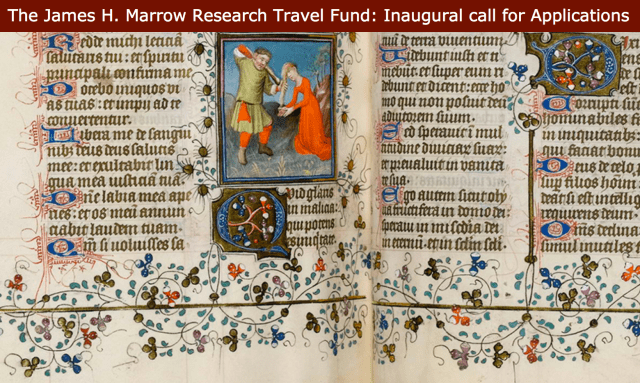
Bourse – The James H. Marrow Research Travel Fund: Inaugural call for Applications

As part of the Fitzwilliam Museum’s bicentenary celebrations, we are delighted to invite applications to the James H Marrow Research Travel Fund.

Fitzmuseum

The fund has been established in honour of Professor James H. Marrow, Honorary Keeper of Northern Illuminated Manuscripts at the Fitzwilliam Museum and Professor Emeritus of Art History at Princeton University, to provide financial assistance for students and independent scholars who need to travel to the Fitzwilliam Museum in order to undertake short term research on its collection of illuminated manuscripts.

The deadline for applications is Friday, 30 September. For details of eligibility and an application form, please email: james-marrow-fund@fitzmuseum.cam.ac.uk.

Source : The Fitzwilliam Museum

Publié dans Bourse | Laisser un commentaire

Appel à contribution – Walruses, Whales and Narwhals. Maritime Ivories in Western Europe, 900-1500

Session sponsored by the National Museum of Scotland
International Congress on Medieval Studies
May 11-14, 2017

Western Michigan University, Kalamazoo, Michigan

Argument

In the history of medieval ivory carving, the maritime mammals are often eclipsed by the elephant. Walrus tusks and whale bones are usually just seen as a poor substitute to the nobler African or Indian product, mostly used when trade disruptions created shortfalls.

But this historiographical view is not without shortcomings. Walrus hunting played a significant role in the first European explorations towards the west, to Iceland and Greenland. It also led to one of the first documented cases of overhunting with the disappearance of walruses from Iceland. And the trade went far. Just as the Islamic world played a role in providing Europe with elephant tusks, it coveted narwhal teeth and walrus tusks, which, much like the latter in the West, were used as an indicator of poison and possible antidote.

In Western Europe, as walrus ivory was not carved in the harvesting territories, trade was widespread. With evidence of active workshops as far south as Canterbury, and possibly even France (with a few scattered pieces attributed to artists of the Reims area), wide reaching trade routes were created, sometimes going both ways. This is demonstrated by the walrus ivory crozier found in the tomb of a 13th century bishop of Garðar (Greenland). On the contrary, it would seem that whale bone carving, found mainly in North-West Spain and England, was intimately linked with the main fishing zones; the Channel and the Bay of Biscay (where most of the whalers originated). As for the narwhal, although we know how coveted its tooth was, we are far less knowledgeable as to how it was collected. This is due to the animal habitat being far away from the zones used by medieval Basque whalers and remote even for the less expert Scandinavian ones.

As far as production is concerned, the maritime ivories are not limited only to the more prevalent chess pieces (sometimes mundane, sometimes of exceptional quality). Caskets (some of exceptional quality), reliquaries and liturgical instruments were also carved and circulated throughout Europe.

This session aims to gather papers addressing the variety of questions posed by the maritime ivories: how the raw material was collected, how it was traded, the workshops that carved them and their specific symbolic value in medieval treasuries.
Submission guidelines

To propose a paper, please send a 300 word abstract, C.V., and completed Congress Participant Information Form (available here) to

Xavier Dectot, Keeper of Art and Design, National Museums Scotland (x.dectot@nms.ac.uk).
Deadline : September 15, 2017

The selection will be done by Xabier Dectot

Source : Calenda

Publié dans Appel à contributions | Laisser un commentaire