Publication – Nancy Mandeville Caciola, « Afterlives. The Return of the Dead in the Middle Ages »

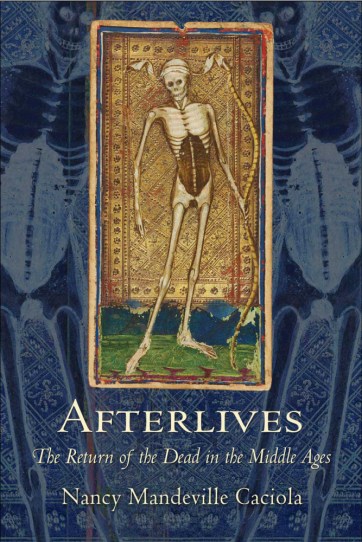
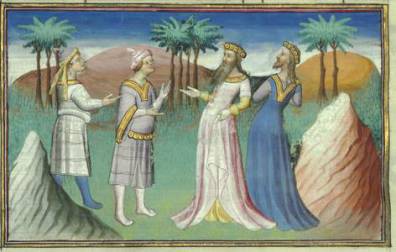
Simultaneously real and unreal, the dead are people, yet they are not. The society of medieval Europe developed a rich set of imaginative traditions about death and the afterlife, using the dead as a point of entry for thinking about the self, regeneration, and loss. These macabre preoccupations are evident in the widespread popularity of stories about the returned dead, who interacted with the living both as disembodied spirits and as living corpses or revenants. In Afterlives, Nancy Mandeville Caciola explores this extraordinary phenomenon of the living’s relation­ship with the dead in Europe during the five hundred years after the year 1000.

80140100427140L

Caciola considers both Christian and pagan beliefs, showing how certain traditions survived and evolved over time, and how attitudes both diverged and overlapped through different contexts and social strata. As she shows, the intersection of Christian eschatology with various pagan afterlife imaginings—from the classical paganisms of the Mediterranean to the Germanic, Celtic, Slavic, and Scandinavian paganisms indigenous to northern Europe—brought new cultural values about the dead into the Christian fold as Christianity spread across Europe. Indeed, the Church proved surprisingly open to these influences, absorbing new images of death and afterlife in unpredictable fashion. Over time, however, the persistence of regional cultures and beliefs would be counterbalanced by the effects of an increasingly centralized Church hierarchy. Through it all, one thing remained constant: the deep desire in medieval people to bring together the living and the dead into a single community enduring across the generations.

Table des matières :

Introduction
Part One: Imagining Mortality
1. Mors, A Critical Biography
2. Diagnosing Death

Part Two: Corporeal Revenants
3. Revenants, Resurrection, and Burnt Sacrifice
4. The Ancient Army of the Undead
5. Flesh and Bone: The Semiotics of Mortality

Part Three: The Disembodied Dead
6. Psychopomps, Oracles, and Spirit Mediums
7. Spectral Possession
Conclusion

Informations pratiques :
Nancy Mandeville Caciola, Afterlives. The Return of the Dead in the Middle Ages, Ithaca, Cornell University Press, 2016. 384 p. + 27 ill. ISBN : 978-1-5017-0261-7. Prix : 39,95 $.

Source : Cornell University Press

Publié dans Publications | Laisser un commentaire

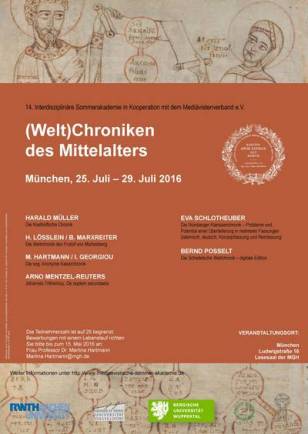
École d’été – (Welt)Chroniken des Mittelalters

14. Interdisziplinäre Sommerakademie der Universitäten Aachen, Düsseldorf und Wuppertal in Kooperation mit den MGH und dem Mediävistenverband e. V.

München, 25. – 29. Juli 2016

Die paläographisch-editorische Sommerakademie richtet sich vorrangig an Studierende der mittelalterlichen Geschichte mit Lateinkenntnissen. Anhand von Originalen sollen sich die Teilnehmer mit unterschiedlichen Formen von Schriftlichkeit auseinandersetzen: Im Zentrum der diesjährigen Sommerakademie stehen dabei (Welt)chroniken des Mittelalters. Wie wurde man zum Historiker? Welchen Blick hatte man auf die eigene Vergangenheit? Aus welchen Vorlagen schöpfte man? Welche Absichten und Tendenzen sind hinter den Geschichtswerken erkennbar? Diese und andere Fragen werden interdisziplinär in einem vom Früh- bis ins Spätmittelalter gespannten Bogen behandelt.

Ziel der Sommerschule ist eine Vertiefung paläographischer Kenntnisse anhand des genannten Materials, des an die Überlieferungssituation rückgebundenen quellenkritischen Umgangs mit diesem sowie die wissenschaftsadäquate Aufarbeitung des Quellenmaterials.

Das konkrete Lehrformat ist eine Mischung aus Einführungen in Themenbereiche durch ausgewie-sene Experten sowie die Übung an konkretem Material, an Handschriften sowie Briefen und Urkunden in ihrer originalen Gestalt sowie in Reproduktionen. Es ist eine Mischung aus Einfüh-rung in und Reflexion über konkrete Quellen sowie aus einem sehr praktisch ausgerichteten Übungsteil. Der konkrete Umgang mit den Materialien wird durch die Referentinnen und Referenten betreut.

a51487c66f

Programm:

Montagvormittag (25.7.): Anreise

Montagnachmittag: Martina Hartmann – Begrüßung, Einführung ins Thema (Weltchroniken, Editionen, MGH)

Montagabend: Abendempfang bei den MGH

Dienstagvormittag (26.7.): Arno Mentzel-Reuters – Arbeit an Handschriftenfragmenten aus den Beständen der MGH
Dienstagnachmittag: Harald Müller – Die Koelhoffsche Chronik

Mittwochvormittag (27.7.): Horst Lösslein, Benedikt Marxreiter – Die Weltchronik des Frutolf von Michelsberg
Mittwochnachmittag: Martina Hartman, Ioanna Georgiou – Die sog. Anonyme Kaiserchronik

Donnerstagvormittag (28.7.): Arno Mentzel-Reuters – Johannes Trithemius, De septem secundaeis
Donnerstagnachmittag: Eva Schlotheuber – Die Nürnberger Klarissenchronik – Probleme und Potential einer Überlieferung in mehreren Fassungen (lateinisch, deutsch, Konzeptfassung und Reinfassung

Freitagvormittag (29.7.): Bernd Posselt – Die Schedelsche Weltchronik – digitale Edition
Freitagnachmittag: Abreise

Veranstaltungsort:
Ludwigstraße 16, 80539 München
Lesesaal der MGH

Die Teilnehmerzahl ist auf 25 begrenzt, Bewerbungen mit einem Lebenslauf richten Sie bitte bis zum 15. Mai 2016 an:

Frau Professor
Dr. Martina Hartmann
Martina.Hartmann@mgh.de

Bei erfolgreicher Teilnahme können Sie durch die Sommerakademie 5 ECTS-Punkte erwerben. Die diesjährige Sommerakademie des Deutschen Mediävistenverbandes wird getragen von den Lehrstühlen Mittelalter an den Universitäten Aachen, Düsseldorf und Wuppertal in enger Kooperation mit den Monumenta Germaniae Historica.

Source : Monumenta Germaniae Historica

Publié dans École d'été | Laisser un commentaire

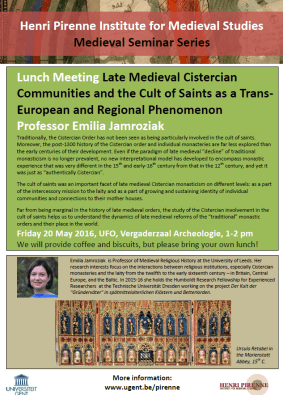
Conférence – Emilia Jamroziak, « Late Medieval Cistercian Communities and the Cult of Saints as a Trans-European and Regional Phenomenon »

Traditionally, the Cistercian Order has not been seen as being particularly involved in the cult of saints. Moreover, the post-1300 history of the Cistercian order and individual monasteries are far less explored than the early centuries of their development. Even if the paradigm of late medieval “decline” of traditional monasticism is no longer prevalent, no new interpretational model has developed to encompass monastic experience that was very different in the 15th and early-16th century from that in the 12th century, and yet it was just as “authentically Cistercian”.

Jamroziak - UGent

The cult of saints was an important facet of late medieval Cistercian monasticism on different levels: as a part of the intercessory mission to the laity and as a part of growing and sustaining identity of individual communities and connections to their mother houses.

Far from being marginal in the history of late medieval orders, the study of the Cistercian involvement in the cult of saints helps us to understand the dynamics of late medieval reforms of the “traditional” monastic orders and their place in the world.

Emilia Jamroziak is Professor of Medieval Religious History at the University of Leeds. Her research interests focus on the interactions between religious institutions, especially Cistercian monasteries and the laity from the twelfth to the early sixteenth century – in Britain, Central Europe, and the Baltic. In 2015-16 she holds the Humboldt Research Fellowship for Experienced Researchers at the Technische Universität Dresden working on the project Der Kult der « Gründerväter » in spätmittelalterlichen Klöstern und Betterlorden.

Informations pratiques :
When 20-05-2016
from 13:00 to 14:00
Where UFO, 1e verdieping, Vergaderzaal Archeologie
Language English
Contact Name Steven Vanderputten
Contact Email steven.vanderputten@ugent.be

Source : Henri Pirenne Institute for Medieval Studies

Publié dans Documentaire | Laisser un commentaire

Appel à contribution – Animaux aquatiques et monstres des mers septentrionales

Le colloque est consacré à l’histoire des poissons, monstres et mammifères aquatiques des mers septentrionales (Manche, mer du Nord, mer Baltique, Mer de Norvège, Atlantique Nord), de l’Antiquité à 1600. 1) Savoirs et transmission : savoirs thérapeutiques, savoirs zoologiques, descriptions, identifications ; 2) Savoir-faire et exploitations : élevage, pêche, cuisine, médecine ; 3) Imaginaires et explorations.

Le colloque est organisé par le laboratoire CRAHAM (UMR 6273) dans le cadre du programme ICHTYA et des travaux du GDRI Zoomathia. Cette rencontre prend place dans le cycle de colloques La Normandie Médiévale organisé en partenariat par l’Office Universitaire d’Études Normandes et le Centre Culturel International de Cerisy-la-Salle. Dans la suite des travaux fondateurs d’Aristote et de Pline l’Ancien sur l’ichtyologie, leurs continuateurs ont privilégié l’étude de la faune aquatique des zones connues par ces auteurs, de l’Atlantique au Gange et du Nil au Rhin. En s’efforçant d’intégrer progressivement les animaux de leurs propres habitats, situés dans des zones plus septentrionales, les savants du Moyen Âge témoignent de l’importance des animaux aquatiques dans leur quotidien et de leur volonté de décrire les espèces qu’ils connaissent par l’observation et l’expérience ; ils ouvrent ainsi un nouveau champ d’étude à l’ichtyologie. Le présent colloque s’intéressera à cette évolution et sera dédié aux animaux et monstres des mers boréales.

I. Savoirs et transmission : savoirs thérapeutiques, savoirs zoologiques, descriptions, identifications

Une première approche concernera les savoirs relatifs aux poissons et animaux des mers du nord et la transmission de ces connaissances, tant sur le plan spatial, d’une région à l’autre, que chronologique. Quels animaux connaît-on ? Que sait-on d’eux ? Comment les décrit-on ? Comment les nomme-t-on ? Dans quel type de discours apparaissent-ils ? Quelle est la part de la tradition et de la nouveauté ? Existe-t-il des classifications ? Dans cette perspective, on pourra également étudier le contenu informatif des sources disponibles, non seulement dans le domaine de la zoologie, mais aussi de la thérapeutique ou de la géographie, par exemple.

II. Savoir-faire et exploitations : élevage, pêche, cuisine, médecine

Mais les poissons ne sauraient constituer qu’un objet littéraire ; ils entrent dans le quotidien des hommes qui ont su tirer parti des ressources des mers et des fleuves. Une seconde approche privilégiera donc les divers domaines d’exploitation que sont, parmi d’autres, la pêche, l’élevage, les modes de consommation, la cuisine ou encore la médecine.

III. Imaginaires et explorations

Enfin, le monde aquatique, mal connu et difficile à observer, est un domaine où la curiosité des hommes a toujours trouvé à se déployer largement. On s’intéressera par exemple aux animaux présents dans les récits des explorateurs qui ont sillonné les mers boréales et repoussé vers le nord les limites du monde connu. Mais on pourra aussi étudier le versant fantasmatique de ces quêtes, dont le prototype fut la navigation de Saint Brendan, et les créatures imaginaires dont les hommes ont peuplé les mers du nord, de l’île-poisson Jasconius au Kraken d’Olaus Magnus. On envisagera ces problématiques sur la longue période, de l’Antiquité à la Renaissance (jusqu’à 1600), dans laquelle le discours zoologique demeure largement sous l’influence d’Aristote et de Pline.

Approches disciplinaires

La réflexion s’enrichira de la diversité des approches et de la variété des sources prises en compte : études archéologiques et archéo-zoologiques, textes (récits, fables, traités techniques, encyclopédies, livres de comptes ; dans les domaines latin, roman, scandinave, germanique, anglo-saxon, etc.), objets matériels, iconographie (enluminures, chapiteaux historiés, etc.).

Aire géographique considérée

  • Manche
  • Mer du Nord
  • Atlantique (du Golfe de Gascogne au Pôle Nord)
  • Mer de Norvège
  • Mer baltique

Langues des communications : français et anglais

Soumission des propositions de communications

Les propositions de communications doivent être déposées sur le site du colloque : http://ichtya2017.sciencesconf.org/. Ce dépôt nécessite une inscription sur le site (il est néanmoins possible de se connecter avec son identifiant Hal). Le résumé de votre communication doit faire au maximum 3000 signes. Il est conseillé de déposer en plus en fichier attaché une CV ou une bibliographie au format PDF.
La liste des contributions acceptées sera publiée le 20 juin 2017.

Calendrier

  • 7 mars 2016 : lancement de l’appel à contributions
  • 31 mai 2016 : clôture de l’appel à contributions
  • 20 juin 2016 : Sélection finale des contributions et réponse aux participants
  • 31 mai – 3 juin 2017 : Dates du colloque à Cerisy-la-Salle

Organisation et comité scientifique

  • Catherine Jacquemard (CRAHAM, Université de Caen)
  • Brigitte Gauvin (CRAHAM, Université de Caen)
  • Marie-Agnès Lucas-Avenel (CRAHAM, Université de Caen)
  • Benoît Clavel (Muséum national d’histoire naturelle, Archéozoologie et archéobotanique)
  • Thierry Buquet (CRAHAM, CNRS)

Source : Université de Caen

Publié dans Appel à contributions | Laisser un commentaire

Offre d’emploi – Appel à candidatures pour un contrat doctoral en partenariat avec l’École française de Rome

Offre de contrat doctoral d’une durée de trois ans à compter du 1er septembre 2016
Réception des candidatures jusqu’au 3 mai 2016

csm_banner_web_appel_candidatures_contrat_doctoral_2016_014c252e36

Dans le cadre du soutien apporté aux actions de coopération internationale, le ministère de l’Éducation nationale de l’enseignement supérieur et de la recherche (MENESR) flèche chaque année cinq contrats doctoraux en partenariat entre une École Doctorale et une des cinq Écoles françaises à l’étranger (EFE) : École française d’Athènes, École française de Rome, Institut français d’Archéologie orientale, École française d’Extrême-Orient, Casa de Velázquez (École des hautes études hispaniques).

Cette année, les dossiers de candidatures devront parvenir directement à celle des EFE concernée, sous forme d’un document pdf. comprenant :

  • un projet de thèse de cinq pages au maximum ;
  • le CV du candidat pressenti pour entreprendre cette recherche ;
  • une lettre de présentation du ou des directeur(s) de thèse pressenti(s) ;
  • l’avis du directeur de l’École doctorale.

Cette proposition concerne uniquement les étudiants qui ne sont pas déjà inscrits en thèse au cours de la présente année universitaire (2015-2016).

L’École française de Rome a vocation à accueillir des doctorants préparant une thèse dans les champs disciplinaires qui relèvent de sa sphère de compétence telle qu’elle est définie dans le décret du 10 février 2011 relatif aux écoles françaises à l’étranger. Elle « développe à Rome et en Italie, au Maghreb et dans les pays du Sud-Est européen proches de la mer Adriatique des recherches dans le domaine de l’archéologie, de l’histoire et des autres sciences humaines et sociales, de la Préhistoire à nos jours ». En outre, sa situation particulière dans une capitale de rayonnement mondial depuis plus de 2000 ans, à travers l’empire romain puis la papauté, la rend également apte à accueillir de jeunes chercheurs travaillant sur d’autres sphères du globe (de l’Asie aux Amériques, en passant par l’Afrique) dont une partie des terrains et des sources sont situés en Italie. Les recherches qu’elle mène en archéologie la prédisposent enfin à l’accueil de doctorants travaillant dans des disciplines dialoguant avec l’archéologie (sciences de la terre, physique…).

L’EFR est donc prête à recevoir à compter de septembre 2016, en convention avec une École doctorale, un doctorant travaillant en archéologie, histoire ou sciences sociales dont le projet s’inscrirait dans ce cadre. Nous nous permettons de souligner, car la tradition dans ce domaine est plus récente, que l’EFR a aussi vocation à favoriser les recherches en sciences sociales et examinera donc avec un égal intérêt les dossiers qui relèveraient des disciplines comprises dans ce champ.

Les documents de candidature pour l’EFR devront être envoyés sous format électronique (pdf. unique jusqu’à 20 MO si le serveur de départ supporte ce poids) à l’adresse : candidaturedoctorant(at)efrome.it, jusqu’au 3 mai 2016 à 12h.

Les résultats seront transmis au cours de la semaine du 20 juin 2016, soit avant la réunion des conseils des Écoles doctorales pour l’attribution des contrats ministériels.

Source : École française de Rome

Publié dans Offre d'emploi | Laisser un commentaire

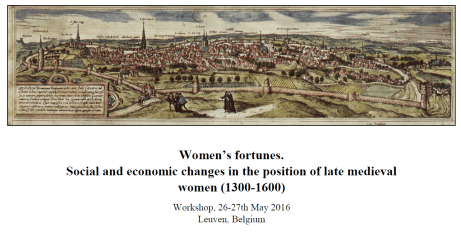
Colloque – Women’s fortunes. Social and economic changes in the position of late medieval women (1300-1600)

Workshop, 26-27th May 2016
Leuven, Belgium

This workshop aims at bringing together a number of scholars to reflect on the changes in the social and economic position of women at the end of the middle ages. According to most historians, the opportunities for female agency diminished in post-Black Death Europe, especially in terms of their socioeconomic empowerment. To explain this, scholars point to changing production conditions and labour markets (Wenksy 1980, Howell 1986, McIntosh 2005, Stabel 2014), the growing control of labour in the male-dominated craft guilds (Bennett and Kowaleski 1989, Stabel 1999), and an increased emphasis on patrilineal preservation of property in family strategies (Howell 1998, Hanawalt 2007, Hutton 2011). However, according to other scholars the late middle ages were a time of expanding opportunities for women (Barron 1989, Goldberg 1992, De Moor and Van Zanden 2010). In the most recent hypothesis, the demographic decline caused by the Black Death gave rise to the proliferation of the European Marriage Pattern (EMP) in northwestern Europe. The EMP is said to have empowered women in late medieval society, especially women in the lower and middle ranks. This occurred in particular in the North Sea regions, where it is alleged to have stimulated economic growth. Although both views ultimately agree on a negative trend for women’s participation in the urban economy in the early modern period, their timing differs strongly: whereas the first group of historians argues that women’s possibilities were already in continuing degradation in the fourteenth century, the second maintains that the decrease only started to take place from the sixteenth century onwards. Moreover, the early modern decline thesis itself has been challenged for certain regions, such as the ubiquitous Northern Netherlands, but also in France (Crowston 2008; Van der Heijden, Van Nederveen-Meerkerk & Schmidt 2009).

The regional and chronological variations in women’s economic opportunities across late medieval Europe have recently been linked to differences in the economic development of regions. High degrees of female economic participation may have been beneficial to economic growth. This hypothesis has attracted a lot of debate, but remains in dire need of more diverse case studies, both geographically and thematically. First, the debate on women’s economic opportunities has chiefly been considered from the perspective of female labour, although gender differences on property and credit markets are considered equally central to explaining the relationship between women’s position and economic development. Besides labour, this workshop, therefore, wants to include investments strategies of women in a variety of markets (real property, credit, annuities, …), as well as the social, cultural and institutional contexts of women’s participation in these markets (social networks, creditworthiness, gender roles, …). Second, the binary geographical divide between marriage patterns in northwestern Europe (with the North Sea areas at its core), and southern and eastern Europe has been challenged (Dennison & Ogilvie 2014), thereby undermining the causal role of the EMP in women’s position and economic development. Regional differences therefore need further scrutiny, as women’s economic position across northwestern Europe differed greatly, even in the North Sea areas. Regional divergences in women’s position equally prevailed across southern Europe. Consequently, geographically diverse case studies are needed to assess the causes and consequences of regional and chronological variations in women’s economic participation. For that reason, this workshop aims at bringing together scholars working on a variety of regions across Europe.
wOMENS FORTUNE

Programme :

Thursday 26 May 2016

13u-14u : Lunch

14u-16u – Session 1

Introduction
Ellen Kittell (University of Idaho) – What is in a First Name? Evidence from mortmain payment in late medieval Courtrai and Tielt
James Shaw (University of Sheffield) – Women as creditors, debtors and brokers: the informal economy of credit in seventeenth-century Venice
16u-16u30 : Coffee Break

Session 2

Jeremy Goldberg (University of York) – Material girls revisited: problematising the social and economic position of women in later medieval England
Andrea Bardyn (University of Leuven, University of Antwerp) – Crediting women? A comparative perspective on credit markets and gender inequality in late medieval Brabant.

Friday 27 May 2016

9u-11u – Session 3

Lies Vervaet (University of Ghent) – Women and the rural lease market in coastal Flanders, 14th – 16th century
Anna Bellavitis (University of Rouen) – Dowry, women’s wealth and women’s work: the case of Venice in the European context

11u-11u30 : Coffee Break

11u30-13u30 – Session 4

François Rivière (EHESS) – Female craft organizations in Rouen and Paris in the Middle Ages: how could women control their own economic activity?
Shennan Hutton (University of California, Davis) – Growing the Nest-Egg: women’s investments in fourteenth-century Ghent.
Conclusions

13u30-14u30 : Lunch
14u30 : City walk (optional)
Guided walk through medieval Louvain

Practicalities :
Workshop location (to be confirmed)
Pauscollege Leuven Room MTC 00.59 Hogeschoolplein 3, 3000 Leuven

Enrolment
The workshop is open for interested researchers. An enrolment fee of 20 € is requested. For registrations, please register by e-mail before May 12, 2016. More information and registration: andrea.bardyn@kuleuven.be.

Source : Vlaamse Werkgroep Mediëvistiek

Publié dans Colloque | Laisser un commentaire

Offre d’emploi – Allocations doctorales de 3 ans au labex ‘Les passés dans le présent’

Le laboratoire d’excellence Les passés dans le présent : histoire, patrimoine, mémoire, attribuera en juillet 2016 trois contrats doctoraux pour des thèses préparées, selon le sujet, dans l’une ou l’autre des écoles doctorales de l’Université Paris Ouest Nanterre La Défense:

  • ED 138 Lettres, Langues, Spectacles
  • ED 139 Connaissance, Langage, Modélisation
  • ED 395 Milieux, Cultures et Sociétés du Passé et du Présent
  • ED 396 Economie, Organisation, Société
  • ED 141 Sciences juridiques et politiques

Durée : 3 ans à compter du 1er octobre 2016.

Logo

Les candidats doivent nécessairement être inscrits dans une des unités d’accueil, porteuses d’un projet au sein du labex au 1er janvier 2016, proposées ci-dessous.

Les unités d’accueil, partenaires du labex sont :

Peuvent également accueillir des doctorants les unités associées suivantes :

Les projets de thèse devront relever de la thématique générale du labex.

Le labex Les passés dans le présent : histoire, patrimoine, mémoire porte sur les représentations du passé et sur les médiations de l’histoire. Son programme scientifique est conçu en deux grands chantiers étroitement interdépendants. Le premier, «Relations au passé : représentations et évaluations», se propose de conduire une analyse globale des représentations du passé à toutes les époques (de la Préhistoire au temps présent). Il s’attache aussi à comprendre les appropriations sociales du passé en amont et en aval des politiques patrimoniales, des actions mémorielles, des dispositifs documentaires d’accès aux sources. Le second, «Connaissance active du passé : pratiques et outils de transmission», s’appuie sur des fonds documentaires, des collections, des archives conservés par les différents partenaires du labex. Il vise la mise à disposition et la large diffusion de nouveaux corpus numériques se rapportant à des époques variées, et qui, pour certains, contribuent à l’histoire des disciplines (ethnologie et ethnomusicologie, histoire de l’art, histoire des textes). Les Humanités numériques, avec les questions de modélisation, de référentiels, d’usages, de culture numérique qu’elles déclinent sont transversales à ces deux approches.

Les recherches se déclinent en quatre thèmes, qui, à l’intersection entre histoire, patrimoine et mémoire, donnent lieu à des dynamiques interdisciplinaires et à des transversalités entre métiers de la recherche et métiers du patrimoine :

  • Représentations et usages du passé à toutes les époques (du plus ancien au plus contemporain) : historiographies, histoire des représentations à différentes époques, migration des œuvres et des images, politiques de la mémoire, politiques du patrimoine, etc.) ;
  • Effets de la médiation du passé, abordés sous l’angle des appropriations sociales et culturelles des politiques mémorielles et patrimoniales, d’une part, des nouveaux usages numériques des sources pour l’histoire, d’autre part (devenir du patrimoine numérisé en ligne, pratiques des réseaux sociaux, etc.) ;
  • Histoire, patrimoine, mémoire : nouvelles sources, nouvelles pratiques (nouveaux déposants d’archives, collectes pour l’histoire orale, dynamiques de recherche-action, etc.) ;
  • Histoire, patrimoine, mémoire : nouveaux accès numériques, nouvelles mises en perspective (histoire des sciences, épistémologie, fabrique des savoirs ; sources pour l’histoire et Web de données ; impact de l’accès numérique aux sources pour l’histoire sur la construction des savoirs ; processus de patrimonialisation en contexte numérique, etc.).

 Éligibilité :

  • Peuvent être candidats les étudiants non encore inscrits en thèse et qui ont soutenu leur M2 à la date de dépôt des candidatures ainsi que les étudiants qui ne sont pas inscrits en thèse depuis plus de 6 mois à la date du début de leur contrat d’allocation (1er octobre 2016). Ces candidats sont éligibles à une allocation doctorale d’une durée de 3 ans.
  • Exceptionnellement, peuvent être candidats les étudiants inscrits en thèse depuis au maximum un an à la date du début de leur contrat d’allocation (1er octobre 2016). Ces candidats sont éligibles à une allocation doctorale d’une durée de 2 ans.
  • Les candidats peuvent avoir suivi leur curriculum à l’Université Paris Ouest Nanterre La Défense ou dans toute autre université de France ou de l’étranger.

Critères scientifiques :
L’excellence des résultats au master et la qualité scientifique du projet de thèse sont des critères essentiels pour évaluer la candidature. Le caractère interdisciplinaire du sujet retiendra l’attention de la commission de sélection qui sera, aussi, attentive à retenir des candidats s’inscrivant dans les cadres académiques propres à mener ensuite une carrière dans la recherche, l’enseignement, les institutions patrimoniales ou services patrimoniaux.

Une attention particulière sera portée aux candidatures des étudiants ayant obtenu leur master dans une université étrangère, dans l’optique de favoriser des co-tutelles.

Rémunération :
Le montant annuel du contrat doctoral est de 20 220€ brut. Les missions complémentaires d’enseignement sont possibles selon les règles en vigueur à l’Université Paris Ouest Nanterre La Défense.

Date limite de candidature : 17 juin 2016

Pour plus d’informations, consultez le site du labex : www.passes-present.eu

Source : blog de l’ApAhAu

Publié dans Offre d'emploi | Laisser un commentaire

Appel à contribution – Warburg Institute Postgraduate Symposium

Tensions and Polarities of Transmission from the Late Middle Ages to the Enlightenment

London, UK
17 November 2016

b84e669807

The Warburg Institute will host its first Postgraduate Symposium on 17 November 2016. It will explore the concept of cultural encounters and focus particularly on their productive outcomes. We are interested, above all, in the dynamics of cultural change across time and space. The Symposium will be multidisciplinary, and will cover topics that fall into the unique classification system of the Warburg Library: Image, Word, Orientation and Action.

The aim of the Symposium will be to map the diverse and intricate forces which have driven cultural encounters in the past and which also help define contemporary societies. Amongst the questions that we hope to address are: the degree to which productive outcomes can be seen as a conscious reception and reformulation of external ideas and models; resistances to exchange and in what form; the long-term implications of such encounters and their outcomes.

The Symposium is intended for postgraduate students and early career researchers. It will bring together speakers from different backgrounds in the humanities and draw on a variety of disciplinary tools and methodologies. Submissions are invited across a wide range of topics represented by the global cultural interests of the Warburg Institute, including but not limited to:

– Artistic creations: forms, models, styles;
– Literary productions and transmission of texts: translations, adaptations, copies;
– Philosophy, rhetoric and transmission of ideas;
– Personal encounters: Academies, universities and epistolary exchanges;
– Encounters with the ancient past: reception, interpretation, visualisation;
– Religious encounters, propaganda and politics;
– Geographical discoveries: new continents, new cultures and animal species, etc.
– Scientific innovation: findings, theories, inner contradictions, etc.

Proposals for papers should be sent to warburg.postgrad(at)gmail.com by 31 May 2016:

– Maximum 300-word abstract, in English, for a 20-minute paper, in PDF or Word format.
– One-page CV, including full name, affiliation, contact information.

All candidates will be notified by 31 July 2016. Limited funding to help cover travel expenses is available. Attendance is free of charge.

For more information and news about The Warburg Institute Postgraduate Symposium 2016 visit https://warburgpostgrad.wordpress.com/

Organisers: Desirée Cappa, Maria Teresa Chicote Pompanin, James Christie, Lorenza Gay, Hanna Gentili, Federica Gigante, Finn Schulze-Feldmann.

Source : Medieval Art Research

Publié dans Appel à contributions | Laisser un commentaire

Colloque – Les communautés dans le haut Moyen Âge. Formes, pratiques, interactions (Ve-XIe s.) : Réflexions historiographiques et études de cas

Vendredi 10 juin – Samedi 11 juin à Paris
Au LAMOP, en salle Perroy,
1 rue Victor Cousin, galerie Dumas, esc. R

LAMOP logo

Programme :

Vendredi 10 juin

9h30 Geneviève Bührer-Thierry (Paris1/LAMOP) et Régine Le Jan (Paris1/LAMOP), Introduction

10h00 Joseph Morsel (Paris1-LAMOP), « Communautés ? Quelles communautés médiévales ? Observations historiques et notionnelles »
10h30 Massimo Vallerani (université de Turin), « Les villes comme communautés : éléments identificatifs de l’appartenance à la commune en Italie (XIIe- XIIIe siècle) »
Discussion

11h30 Walter Pohl (ÖAW Vienne), “Visions of Community in a Eurasian Perspective – a Viennese project”
12h00 Stéphane Gioanni (EFR/LAMOP), « Les communautés de l’empire romain tardif »
Discussion
Buffet sur place

14h00 Wendy Davies (UCL), « A view of the historiography of early medieval community »
Discussion

15 h 00 : Études de cas

15h00 Alban Gautier (université du Littoral/IUF), « Le comitatus d’Edwin chez Bède et dans la Vita Gregorii »
15h30 Philippe Depreux (université de Hambourg), « Les amis de Liudger et leurs parents : communautés charnelles et spirituelles en lien avec l’abbaye de Werden (fin VIIIe- milieu IXe s.) »
16h00 Charles West (université de Sheffield), “’People of so many different tongues’: The expedition to Lisbon, 1147”
16h30 François Bougard (université Paris-Ouest/IRHT), « Le dossier de Varsi (VIIe-XIe s.) »
Discussion

Samedi 11 juin

9h00 Thomas Lienhard (Paris1/LAMOP), « Les communautés festives (VIe-VIIIe s.) »
9h30 Martin Gravel (Paris VIII), « Les communautés dans les échanges épistolaires à l’époque carolingienne »
10h00 Warren Pezé (Université de Tübingen), « Les clercs de Lyon sous l’épiscopat d’Agobard »
10h30 Laurent Jégou (Paris1/LAMOP), « Les communautés hérétiques du XIe s. »
Discussion

Source : LAMOP

Publié dans Colloque | Laisser un commentaire

Offre d’emploi – Two Post-Doctoral Assistants in Digital Humanities at Ghent Centre for Digital Humanities

The Ghent Centre for Digital Humanities, is currently looking for two full-time digital humanities post-doctoral assistants in areas of a) Geo-humanities and b) Digital Textual Analysis. Amongst the activities of these two positions is the coordinating related DARIAH Working Groups, in both Belgium and Europe.
Full details of these vacancies are available (below) and on Ghent Centre for Digital Humanities website: http://www.ghentcdh.ugent.be/content/job-opportunities-2-post-doctoral-assistants-digital-humanities
The closing date for applications is: 11 May 2016 at 23:59 (CET)
Job Opportunities: 2 Post-Doctoral Assistants in Digital Humanities at Ghent Centre for Digital Humanities

The Ghent Centre for Digital Humanities, is currently looking for two full-time digital humanities post-doctoral assistants in areas of a) Geo-humanities and b) Digital Textual Analysis. Amongst the activities of these two positions is the coordinating related DARIAH Working Groups, in both Belgium and Europe. 
1) Geo-humanities
*To undertake academic research in the methodological fields of geo-spatial and temporal-spatial analysis (at least 70% of your working time will be dedicated to academic research);
*To coordinate the development of a service infrastructure for geo-spatial and temporal-spatial analysis;
*To coordinate a Belgian and European DARIAH Working Group on geo-humanities.
2) Digital textual analysis
*To undertake academic research in digital textual analysis (at least 70% of your working time will be dedicated to academic research);
*To coordinate the development of a service infrastructure for digital textual analysis;
*To coordinate a Belgian and European DARIAH working group on ‘Text-mining literary and historical texts’.
What we are looking for
*You hold a PhD or equivalent degree in the humanities, social sciences or geography
*You have conducted academic research using a) GIS and data visualisation or b) digital textual analysis within the humanities
*You have relevant programming skills, e.g. Python
*You are interested in working in an multi-displinary expert team
*You have excellent verbal and written communication skills in English and preferably, also in Dutch.
What we can offer you
*We can offer you a three-year appointment, which is not renewable. (Please note: If you have been previously appointed as a post-doctoral assistant at a university within the Flemish Community, you cannot apply for this position.)
*Your appointment will start on 1.10.2016 at the earliest.
*Your remuneration will be determined according to salary scale AAP5.
*All Ghent University staff members enjoy a number of benefits, such as 38 days of paid leave, a wide range of training and education opportunities, bicycle commuting reimbursement, ecocheques, etc. A complete overview of all our fringe benefits can be found on the Ghent University website.
Interested?
Applications must be received no later than 11/05/2016 at 23:59 (CET) at recruitmentaap@ugent.be, with the following documents attached as one file:
*application letter
*CV
*a transcript of the required degree
*an overview of your relevant scientific publications
Please indicate clearly what position and department you are applying for, as well as the following reference numbers: Geo-humanities: 2016-04-02 and Digital Textual Analysis: 2016-04-03.
You will get a confirmation e-mail as soon as we have received your application.  Please note: Late applications are not accepted. As Ghent University maintains an equal opportunities and diversity policy, everyone is encouraged to apply for this position.
Further information
For more information about these vacancies, please contact:
*Geo-humanities: Prof. Christophe Verbruggen (Christophe.Verbruggen@UGent.be, +32 9 331 02 76)
•Digital Textual Analysis: Prof. Gunther Martens (gunther.martens@ugent.be, +32 9 264 40 93)
The full details of these vacancies are available on the websites of the Ghent Centre for Digital Humanities and Ghent University:
*Geo-humanities in English and Dutch.
*Digital Textual Analysis: in English and Dutch.
Publié dans Offre d'emploi | Laisser un commentaire