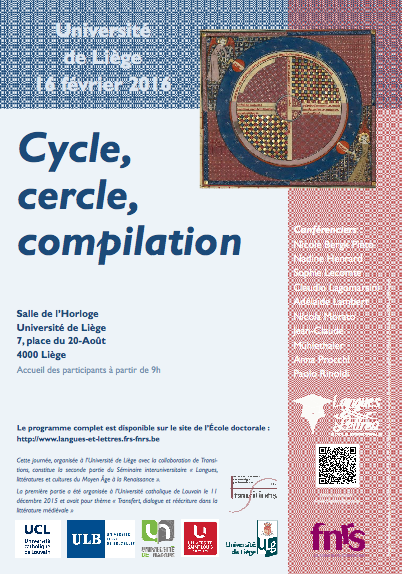
Journée d’étude – Cycle, cercle, compilation

Université de Liège
16 février 2016

Salle de l’Horloge Université de Liège 7, place du 20-Août 4000 Liège
Informations et inscriptions : Nadine Henrard
Nadine. Henrard@ulg. ac. be

Cette journée, organisée à l’Université de Liège avec le soutien de Transitions, constitue la seconde partie du Séminaire interuniversitaire « Langues, littératures et cultures du Moyen Âge à la Renaissance ». La première partie a été organisée à l’Université catholique de Louvain le 11 décembre 2015 et avait pour thème « Transfert, dialogue et réécriture dans la littérature médiévale »

Séminaire interuniversitaire « Langues, littératures et cultures du Moyen Âge à la Renaissance ».

ULg - AfficheProgramme :

9h00 : Accueil des participants

Introduction de la journée, par Nadine Henrard

9h15 | La littérature arthurienne et le cycle de Guiron le Courtois

Nicola Morato(Université de Liège), « Qu’est-ce qu’un cycle arthurien en prose ? »
Sophie Lecomte (Université de Namur), «Jeux d’échos et interférences : la construction du héroséponyme du Roman de Méliadus »
10h30 | Pause café

10h50 | Les procédés de cyclisation et de compilation

Claudio Lagomarsini (Università degli Studi di Siena), « « Ordre et intervalles ». Un « nouvel » ouvrage de Rusticien de Pise et ses procédés de compilation »
Paolo Rinoldi (Università degli Studi di Parma), « Modes de constitution des grands et petits cycles épiques »
Adélaïde Lambert (Université de Liège), « L’art de la greffe dans la compilation épique : le prologue fierabrasien de Gerard du Frattre »
12h45 | Repas de midi

14h15 | Organisation et constitution des recueils

Nadine Henrard (Université de Liège), « Dans l’atelier des fatistes : constitution des compilations dramatiques (l’exemple du Cycle des Mystères rouergats et des Nativités wallonnes du ms. 617 de Chantilly) »
Nicole Bergk Pinto (Université Libre de Bruxelles et École nationale des Chartes), « Le Tournoiement Antecrit dans ses contextes manuscrits. Organisation et dialogues des œuvres au sein des recueils »

15h30 | Pause café

15h50 | La question des cercles littéraires : l’exemple de la cour de Blois

Jean-Claude Mühlethaler (Université de Lausanne), « Le cercle de Blois : lyrisme et culture curiale »
Anna Procchi (Université Libre de Bruxelles), « Rondeaux, ballades et autres poèmes des « amis » de Charles d’Orléans »

17h15 | Conclusions

Publié dans Colloque | Laisser un commentaire

Appel à contribution – Sexualités et interdits au Moyen Âge

Eve en entraînant Adam dans le péché originel lui fait prendre conscience de sa nudité, et donc de sa sexualité. Ce sentiment de culpabilité se rencontre dans les trois religions du Livre, et aboutit à une série de règles, allant de la prohibition de l’adultère à celle de certaines positions sexuelles. Nous souhaitons approfondir les relations entre les sexualités et les interdits qu’elles ont entraînés. Ceux-ci seront vus surtout sous l’angle du pouvoir religieux et du pouvoir politique qui s’en est emparé. Qui dit interdit, dit aussi stratégies de contournement : il s’agira aussi de déconstruire l’image d’un Moyen Âge réprimant la sexualité, pour laisser la place à toutes les formes de jeu avec les normes qu’impliquent ces règles et leurs applications.

Les normes

Le premier épisode du Livre qui marque avec force les règles sexuelles dans la société est Sodome et Gomorrhe, cités détruites par Dieu en raison de la débauche de leurs habitants. Plus encore, le respect du dixième commandement est un interdit majeur des religions monothéistes, comme en atteste l’épisode de Bethsabée et de David. Pourtant, selon les travaux de David Biale, la religion juive oscille bien souvent entre la promotion de l’ascétisme et une théologie de la procréation. Les débuts du christianisme proposent un nouveau modèle de vie : l’abstinence. Celle-ci est promue par les premières saintes à l’image de Marguerite d’Antioche qui fait le vœu de rester vierge et, pour cette raison, subit le martyre. Plus tard au contraire, la bonne épouse est mise en avant, respectant les périodes d’interdits sexuels tout en accomplissant ses devoirs conjugaux, à l’image de Brigitte de Suède. Enfin, le Coran reprenant la figure de Loth, condamne la débauche, liste une série d’interdits visant directement l’inceste, mais donne somme toute une vision bien plus hédoniste de la sexualité.
Ces normes religieuses s’adaptent ensuite à la société ; elles sont commentées, interprétées et diffusées à travers les traités théologiques, les sermons, la pastorale, et les lois.

Les représentations

Ces interdits sexuels sont aussi mis en image ou en texte. Les scènes de Jugement Dernier, des mystères de de la Passion et des tentations des saints dévoilent des pratiques interdites, sous couvert de raisons religieuses, comme c’est le cas du fameux tableau de Jérôme Bosch, La Tentation de saint Antoine conservé à Lisbonne. On retrouve la même ambiguïté dans la littérature, entre les sermons et les récits hagiographiques d’une part, les romans courtois ou les fabliaux d’autre part. L’amour adultère de Lancelot et Guenièvre ou d’Héloïse et Abélard est condamné mais sert en même temps de modèle. La littérature arabe n’est pas en reste : certains pans de la poésie hispanique arabe jouent avec l’interdit de l’homosexualité en proposant un modèle d’amour chaste entre hommes, l’amour udri. La littérature, transgressant certains interdits moraux et religieux, finit par proposer une autre vision de la sexualité.

Les pratiques

Comment les pratiques naviguent-elles ensuite entre ces normes et leurs représentations ? Tout d’abord par le passage de normes religieuses à des normes civiles, puis la reprise en main de la moralité par les autorités publiques qui s’effectue surtout à partir de la moitié du Moyen Âge. Les statuts de corporations, de confréries, ou de villes, les textes juridiques, ou encore les institutions ad hoc contrôlant la moralité, notamment sexuelle, de la population, en sont de bons exemples. Alors que la prostitution est mise sous tutelle par les autorités, l’homosexualité en revanche devient davantage réprimée. Ainsi, les archives judiciaires nous informent sur les procès pour sodomie, viol, et autres actes illicites punis par la loi. Elles permettent d’éclairer de façon bien plus concrète la marge de manœuvre des hommes médiévaux par rapport aux interdits et leur capacité à suivre d’autres normes.

Ces problématiques, comme on le voit, peuvent donner lieu à de multiples approches, de l’histoire à la théologie, de l’histoire de l’art à la littérature. Les propositions de toutes ces disciplines seront les bienvenues.

Questes est une association de jeunes chercheurs médiévistes (http://questes.hypotheses.org/). Les séminaires sur ce thème se tiendront les 20 mai et 10 juin 2016, de 18 à 20h, à la Maison de la Recherche de la Sorbonne (28 rue Serpente, 75005), en salle D116. Merci de nous envoyer les propositions de communication d’une page maximum avant le 15 mars à ces adresses : elo.guilhem@gmail.com et catherine_kikuchi@hotmail.fr.

Les communications retenues pourront ensuite donner lieu à publication dans le bulletin de Questes, publié en version papier et numérique, sur revues.org (https://questes.revues.org/).

Publié dans Appel à contributions | Laisser un commentaire

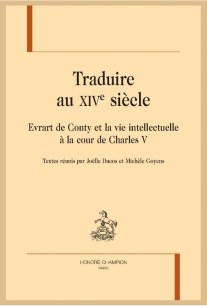
Publication – Joëlle Ducos et Michèle Goyens (dir.), « Traduire au XIVe siècle. Evrart de Conty et la vie intellectuelle à la cour de Charles V »

Pouvoir, savoir et traduction, ces trois mots caractérisent le règne de Charles V et sa contribution si particulière à la vie intellectuelle de la fin du Moyen Âge : si d’autres rois ont pu aider les lettres, les arts ou les sciences ou créer des institutions importantes pour l’essor de la culture et de l’écrit, il a favorisé la création d’une bibliothèque royale, ancêtre de la Bibliothèque Nationale de France, et permis l’expansion du français dans des domaines multiples. Œuvre de transmission, la traduction devient l’illustration de la politique royale et son emblème, en particulier quand il s’agit d’ouvrages savants qui permettent de démontrer la culture royale et princière.

book-08532849

Ce livre, organisé par Joëlle Ducos, professeur à Paris- Sorbonne et spécialiste de la vulgarisation scientifique au Moyen Âge, et Michèle Goyens, professeur à la Katholieke Universiteit Leuven, qui a consacré de nombreux travaux à la traduction aristotélicienne, permet d’en montrer les facettes en se centrant sur quelques traducteurs de cette période, dont Evrart de Conty, médecin, ou Jean Golein, et met en évidence la convergence entre l’entreprise linguistique et intellectuelle et la volonté royale.

Table des matières : ici

Informations pratiques :
Joëlle Ducos et Michèle Goyens (dir.), Traduire au XIVe siècle. Evrart de Conty et la vie intellectuelle à la cour de Charles V, Paris, Honoré Champion, 2015 (Colloques, Congrès et conférences – Sciences du langage, 16). 15,5 x 23,5 cm, 504 pages. ISBN : 9782745328496. Prix : 75 euros.

Source : Honoré Champion

Publié dans Publications | Laisser un commentaire

Appel à contribution – The Matter of Objects’: Medieval and Renaissance Materiality in Contemporary Conversation

Queen Mary University of London 26th May 2016
Deadline for Proposals: 15th February 2016.

Following the ‘Material Turn(s)’ of the last few decades the place of objects and their materiality has received invigorated attention within humanities research. Yet, approaches to the material often remain stifled by the abstract ways in which they are approached. In the words of social anthropologist Tim Ingold, the engagement of historians with the material is ‘not with the tangible stuff of craftsmen and manufacturers but with the abstract ruminations of philosophers and theorists.’

This project, culminating in a temporary exhibition, aims to juxtapose Medieval and Renaissance objects with contemporary artistic responses in order to challenge traditional narratives of the role of objects in academic research. Taking current humanities research as the launch pad for investigation the event aims to create an open space for conversation between researcher and practitioner. Proposed Medieval and Renaissance objects, and their narratives, will serve as inspiration for artists to create a response piece. The contemporary response will be displayed during an exhibition at Queen Mary, University of London, where a launch event will encourage artists and researchers to come together to discuss their processes of deconstruction, interpretation and creation.

The exhibition will be accompanied by short but critical introductions to each piece, from historian and artist, with room for questions and thought. By creating a space for dialogue with practitioners who approach and experience their knowledge of the material from a different angle, we might open the way for reinvigorated readings of objects from the past. To allow a greater reach and extend the life of the project the temporary exhibition will be supported by an online exhibition that will serve as an on going discussion space.

We are seeking proposals from doctoral or early career researchers in history/art history/literary studies who work on Medieval, Renaissance or Early Modern period and would be prepared to write a synopsis of their research project (accessible to a general audience) and select an object that can serve as a gateway into their research. If your research does not generally use objects (but you have an object in mind) we would still like to hear from you, as we are keen to hear about less traditional integration of objects into histories of the period.

Please contact us if you have further questions and send proposals of 250 words, including an image of your chosen object, its location, dimensions, and material (as far as they are known) and a brief biography to: matterofobjects@gmail.com by 15th February 2016.

The event is supported by the Centre for Renaissance and Early Modern Studies at Queen Mary University of London.

Source : Medieval Art Research

Publié dans Appel à contributions | Laisser un commentaire

Appel à contribution – Zwischen Sacrum und Profanum. Sakrale Topografie der Stadt in Mitteleuropa

Ort : Würzburg
Veranstalter : Polnische Historische Mission an der Julius-Maximilians-Universität Würzburg – Dr. Renata Skowrońska; Stadtarchiv Würzburg; Nikolaus-Kopernikus-Universität Toruń, Institut für Geschichte und Archivkunde, Lehrstuhl für Geschichte der Baltischen Länder – Prof. Dr. Andrzej Radzimiński; Julius-Maximilians-Universität Würzburg, Philosophische Fakultät I, Lehrstuhl für Fränkische Landesgeschichte – Prof. Dr. Helmut Flachenecker
Datum : 19.09.2016 – 20.09.2016
Bewerbungsschluss : 10.02.2016
Url : http://historicus.umk.pl/pmh/strona/index.php?mact=News,cntnt01,detail,0&cntnt01articleid=92&cntnt01returnid=77&hl=de_DE

Kontakt :
Renata Skowronska
Polnische Historische Mission an der Julius-Maximilians-Universität Würzburg
Am Hubland, 97074 Würzburg
+49 931/31-81029
r.skowronska@uni-wuerzburg.de

Die Polnische Historische Mission veranstaltet in Zusammenarbeit mit dem Stadtarchiv Würzburg, der Nikolaus-Kopernikus-Universität in Toruń sowie der Julius-Maximilians-Universität Würzburg am 19. und 20. September 2016 in Würzburg eine internationale wissenschaftliche Tagung unter dem Titel: Zwischen Sacrum und Profanum. Sakrale Topografie der Stadt in Mitteleuropa.

Die Stadt bildete seit jeher ein eigenes Universum für ihre Bewohner. Diese Feststellung betrifft alle Städte Mitteleuropas. Die architektonische Beschreibung ihrer Örtlichkeiten folgte den Erwartungen des Stadtgründers, der späteren Stadtherren und der städtischen Eliten. Eine sehr wichtige Rolle spielten oft bereits bei der Entstehung einer Stadt und in ihrer weiteren Entwicklung sakrale Gebäude, vor allem Kirchen und Klöster. In den Stadtgrundriss wurde zum Beispiel im Mittelalter gern ein durch die Kirchen gebildetes Kreuz komponiert, die „in modum S. Crucis“ gebaut wurden – ein „Kirchenkranz“ entstand, der den Bewohner den Beistand Gottes sichern sollte und auch zu einem wichtigen Element der Stadtbefestigung werden konnte. Die Städte dehnten sich in der Folge mehr oder weniger in die erwarteten Richtungen hin aus. Das führte oft zur Verschiebung des Stadtzentrums, so dass sich einige geistliche Bauten nicht mehr im Zentralbereich befanden. Andere ursprünglich am Rande lokalisierte Gebäude, wie zum Beispiel Klöster der Bettelorden, konnten dagegen dann topografisch „avancieren“. Die Konzepte der Stadtplanung haben in den Jahrhunderten die jeweilige Situation aufgenommen und nach unterschiedlichen Regeln versucht, die alte und neue Bebauung zu verbinden. Die sakralen Gebäude blieben aber meistens wichtige Elemente des Stadtbildes und somit zentrale öffentliche Räume. Erst im 20. Jahrhundert zeichneten sich deutliche Tendenzen einer Entsakralisierung der städtischen Räume ab, sowohl im Zusammenhang mit der Etablierung von Regimen, die einen eigenen Weltanschauungsanspruch erhoben, als auch im Kontext der zunehmenden Säkularisierung auch demokratisch verfasster Gesellschaften.

Programm

Ziel der Tagung ist es, die Gründung und Entwicklung der Städte in Mitteleuropa (Polen, Deutschland, Österreich, Schweiz, Luxemburg, Liechtenstein, Slowakei, Tschechien, Ungarn) im Hinblick auf die Rolle der sakralen Gebäude und Orte darzustellen. Im Besonderen sollen die überregionalen und transkulturellen Faktoren der geistlichen Einflüsse (inkl. ihres Schwindens im Zuge der Säkularisierung) auf die Entwicklung der Städte beleuchtet werden.

Dieser Call for Papers richtet sich insbesondere an Wissenschaftlerinnen und Wissenschaftler aus dem Bereich der Geisteswissenschaften, aber auch an Interessierte aus anderen Forschungsrichtungen. Einführende Beiträge sind explizit erwünscht. Ebenso können Einzelbeispiele mit entsprechender Signifikanz für die Tagung vorgestellt werden.

Die Tagungssprachen sind Deutsch und Englisch. Für jeden Vortrag ist eine Dauer von ca. 20 Minuten vorgesehen. Honorare können leider nicht gezahlt werden; dafür wird eine Unterkunft vor Ort gestellt. Die Veranstalter bemühen derzeit überdies, die Reisekostenerstattung der Referierenden sicherzustellen. Die Veröffentlichung der Vorträge ist zeitnah im Jahrbuch „Bulletin der Polnischen Historischen Mission“, Nr. 12/2017, vorgesehen.

Die Veranstalter bitten um die Einreichung von Vortragsvorschlägen im Umfang von maximal einer halben DIN A4-Seite nebst einigen biographischen Angaben. Diese Unterlagen können in deutscher oder englischer Sprache gehalten sein. Bitte richten Sie Ihre Vorschläge bis zum 10. Februar 2016 per E-Mail an Dr. Renata Skowrońska (E-Mail: r.skowronska@uni-wuerzburg.de).

Die Tagung wird in Verbindung mit dem Kolleg « Mittelalter und Frühe Neuzeit » veranstaltet.

Source : H-Soz-Kult

Publié dans Appel à contributions | Laisser un commentaire

Offre d’emploi – Stipendiary Junior Research Fellow in Islamic Art and Architecture

Location: Oxford
Salary: £16,072 and free college basic single accommodation or housing allowance from £6,033 pa
Hours: Full Time
Contract Type: Contract / Temporary
Placed on: 26th January 2016
Closes: 21st March 2016

102

Wolfson College, a postgraduate college of the University of Oxford, proposes to appoint one stipendiary Junior Research Fellow in Islamic Art and Architecture.  The post will run for three years from October 2016.

The University of Oxford has a long tradition of research on and teaching of Islamic art and architecture, beginning with Robert Hamilton in the 1950s. Today, Oxford is one of the foremost international centres for the study of the history of the material and visual cultures of Islamic societies and of their non-Muslim members and neighbours. Recent and current events in the Middle East and North Africa highlight the importance of the dissemination of knowledge about, and of further research into the art and architecture of pre-modern Islamic societies. To strengthen this research, Wolfson College is seeking to appoint an exceptional scholar as a stipendiary Junior Research Fellow working on any aspect of the material and visual culture of Islamic societies before circa 1900. Wolfson has an outstanding Ancient World Cluster whose interests overlap with Islamic art and architecture. Wolfson thus offers a unique interdisciplinary environment in which to pursue research in this field.

Main tasks of the post:

  • to undertake research on any aspect of the material and visual culture of Islamic societies before circa 1900.
  • to be based in Oxford
  • to act as College Advisor to a number of Wolfson students, meeting them on arrival and at least once a term thereafter, to offer pastoral advice and support.
  • to participate actively in the academic life of the College, for example by attending lectures and seminars and, where appropriate, by organizing conferences, lectures and seminars.

Qualifications and experience required:

  • substantial experience in in the field of the material and visual culture of Islamic societies before circa 1900
  • to hold, or be near completion of, a doctorate in Islamic art and architecture
  • sufficient command of Arabic, Persian or Ottoman Turkish to use primary sources for research

The Fellowship will be for three years, to commence on 1 October 2016, and is not renewable.  The person elected will be based in Oxford, and will carry out research and publish in the above field.

The full job description and selection criteria should be consulted before submitting an application.

To apply for this post and to download the further details and application instructions, please click on the link: http://www.wolfson.ox.ac.uk/fellowships/

Applications and references must reach the College by 4pm on Monday 21 March 2016. Interviews will be held on Thursday 5 May 2016 in the afternoon, and no alternative date will be offered. Enquiries should be addressed to: The President’s PA, Wolfson College, Oxford OX2 6UD, UK, Tel: (01865) 274102  email:  iaa-stip@wolfson.ox.ac.uk

This is a College vacancy and the terms and conditions of the post are available at Wolfson College fellowships page: http://www.wolfson.ox.ac.uk/fellowships/

The University terms and conditions shown elsewhere on this site do not apply to this post.

Source : jobs.ac.uk
Publié dans Le réseau | Laisser un commentaire

Appel à contribution – “Imperialis Ecclesia”: Frederick II Hohenstaufen and sacred architecture between Italy and Germany

Bibliotheca Hertziana, Max Planck Institute for Art History, Rome, June
30 – July 1, 2016
Deadline: Feb 15, 2016

International Conference organised by Francesco Gangemi and Tanja Michalsky

frederick-ii

Art under Frederick II is commonly held to be mainly a secular phenomenon, a product of imperial authority in open conflict with the Church. In fact, the activity of Frederick as a builder of castles is well known, while religious buildings are doubtless a secondary aspect
of his patronage. As a consequence, the artistic evidence related to the emperor and belonging to the sacred sphere is among the most disregarded and controversial aspects of his reign. Paradoxically, the sacred character of the sovereign has long been the subject of debate in research on the imperial ideology of Frederick.

Many historical, philosophical and philological studies – from Kantorowicz’s messianic interpretation to Abulafia’s demystification and to more recent contributions – have developed around the concept of an «imperialis Ecclesia» (according to Pier della Vigna) as a fundamental theme in the historiography on Frederick. Religious buildings are neglected in these studies, both because of the difficulty in identifying sacred architecture explicitly related to the emperor and because of the emperor’s assumed indifference to religious patronage. Despite the reticence to acknowledge a Frederician sacred art, however, it is indisputable that a medieval sovereign needed temples in order to represent his own authority and as an instrument of ideological and political propaganda.

This conference aims to define the role of Frederick II for the sacred architecture of his time in Italy and Germany. For that matter it investigates the dialectic between the two countries as a reflection of his dual identity – Holy Roman Emperor and King of Sicily – and considers his Norman and Hohenstaufen heritage. The primary purpose of the symposium is to define Frederick’s concern for religious buildings, their functions in the representation of the imperial power or vice versa the possibility that this function was not fulfilled, by discussing their historical and political contexts. At the same time, we want to discuss the role of Frederick and the Hohenstaufen with respect to the spread of Gothic style in Italy and Germany against the background of the great changes that took place in architecture and sculpture during the first half of the 13th century.

Especially encouraged are presentations that refer to the following themes:

  • the sacred character of the emperor in Frederick’s imago publica and the contexts where it was eventually manifested
  • the religious buildings commissioned by Frederick, the buildings that attracted his interest, and those that were influenced by his political, artistic and territorial strategies
  • the manifestation of imperial power in the church: the use of its space for liturgy, coronation ceremonies, burials, and assertions of the sovereign’s presence
  • the relationship between church and palace: palatine chapels and churches used by the Emperor
  • the foundations belonging to religious orders supported by Frederick II, such as the Teutonic Order and the Cistercians
  • Frederick’s policy concerning sacred art in comparison to his Norman and Hohenstaufen predecessors

Proposals for talks should be sent in the form of an abstract (max 1 page) with a brief CV by February, 15th, 2016 to gangemi@biblhertz.it

Source : Medieval Art Research

Publié dans Appel à contributions | Laisser un commentaire

Appel à contribution – Illuminated Charters – from the Margins of two Disciplines to the Core of Digital Humanities

Among the entire production of acts throughout the Middle Ages, illuminated charters, i. e. legal documents featuring drawn or painted decoration, never had more but a marginal share of the entire production of acts throughout the Middle Ages, yet through their sumptuous external make-up they were undoubtedly adding to the solemnity and publicity of the deeds. In spite of their outstanding and precious character, decidedly remote from the everyday business of issuing charters in princely, ecclesiastic and private chanceries, they are a diplomatic phenomenon common to the whole of Europe.

Considering their ambiguous status as a legal document and a piece of art at the same time, their study challenges skilled historians and diplomatists and able art historians alike. In contrast to illuminated manuscripts whose date can often only roughly be determined, they are usually bearing their precise date of issue, thus offering to experts of book painting extraordinary possibilities of dating and localising artistic production of sometimes remarkable quality.

Whereas the esthetic and decorative aspects of illuminated charters ensured these documents at least from the 19th century onwards an overproportioned appearance in exhibition catalogues, profound scholarly interest in the topic from the viewpoint of history and diplomatic as well as art history remained rather weak or restricted to certain types of relevant sources such as collective indulgences or grants of arms.

Only in the last years research has become more conscious of the richness and scholarly potential of the topic and the impact of more detailed and broad-scale investigations. Attention was paid to the representative function of decorated charters and the (mutual) engagement of issuer and recipient/beneficiary/commissioner of the act in the process of decoration. On the one hand, any attempt to describe the relation of text and image in order to determine the performative impact of illuminated charters in general remains provisional, due to the wide temporal and regional dissemination of relevant stocks which still require deep-digging exploration of archival holdings and collections of libraries and museums wordwide. With, on the other hand, an ever increasing number of online resources provided by archives and consequently improved research tools as well as new fields of research, studies into illuminated charters prove to be a rewarding topic for the whole range of the Digital Humanities and Digital Diplomatic research area. The use of modern information technologies for structured data creation and archival storage helps to maintain consistency and enables linking between data resources and user defined visualization. Building upon digital tools this aim can be achieved in collaborative virtual research environments.

The forthcoming conference, organised within the project “Illuminated Charters as Gesamtkunstwerk” (http://illuminierte-urkunden.uni-graz.at), funded by the Austrian Science Fund FWF (P 26706) and run at the Institute for Medieval Research of the Austrian Academy of Sciences and the Centre for Information Modeling at the University of Graz, aims to take serious the variety of the topic, to bring together the multitude of scholarly attitudes towards illuminated charters and to explore the range of methods applied for their investigation. It is settled at the intersection of diplomatic, art history and Digital Humanities. All relevant paper proposals are welcome, but special focusses are expected to be on:

  • The representative, commemorative and performative function of illuminated charters
  • The involvement of issuer and recipient into the process of drawing up and decorating the acts, specific from case to case
  • Illuminated charters emanating from the papal chanceries or from the environment of the Curia (e.g. collective indulgences) or grants of arms from the imperial chancery as mass phenomena
  • The application of pattern recognition tools for automatic queries of illuminated charters in databases
  • New (statistical) approaches towards the temporal and regional distribution of different types of decorated acts
  • Signs of authentication and graphic symbols (esp. notarial signs) displayed by charters as an artistic problem
  • The design of (archival) databases of illuminated charters and similar objects

The conference languages are German and English. The admission of papers in other languages is up to the organisers. Papers should not exceed 30 minutes in length. Please send an abstract of no more than 300 words and a short CV (of five lines max.) with the reference “paper conference illuminated charters” to illuminierteurkunden@gmail.com by 30 march 2016. Travel and accommodation costs will be reimbursed to speakers by the organisers.

Source : H-Soz-Kult

Publié dans Appel à contributions | Laisser un commentaire

Appel à contribution – Circulations, connexions et dynamiques sociales : la Méditerranée centrale et occidentale entre mondes chrétiens et islamiques (VIIe-XVe siècles)

Université de Catane
11-15 juillet 2016

La session sera ouverte à l’analyse de contextes de contacts variés : conquêtes et changements de dominations, évolutions de la culture matérielle et transformations sociales qu’ils entraînent ; relations diplomatiques, commerciales, artistiques ou intellectuelles ; représentations de l’altérité ; on prendra enfin en compte les espaces partagés (zones frontalières, lieux de transactions, etc.). La discussion et la confrontation de configurations différentes, mais aux historiographies consolidées (études sur les processus d’islamisation, sur les « reconquêtes », sur les cultures et pratiques partagées, etc.), devraient permettre de ne pas s’enfermer dans des schémas interprétatifs. La réflexion parallèle sur la culture matérielle et les représentations, sur les sources archéologiques et textuelles apparaît également comme une occasion d’ébranler quelques idées admises.
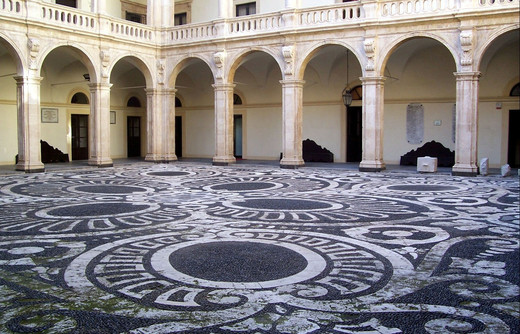
csm_Univ_Catania_Palazzo_centrale_Cortile_2c8c11f932

Il s’agit, en comparant les différents types de sources et champs de recherches mobilisés pour penser les contacts et leurs effets, d’engager une réflexion sur les modèles interprétatifs les plus pertinents en vue de penser les types de contacts entre mondes chrétiens et islamiques dans la Méditerranée occidentale et centrale. Diverses propositions ont été avancées récemment qui vont des transferts culturels à la notion de transculturalité, en passant par l’histoire interconnectée. Toutes insistent sur les dynamiques de transformations sociales à l’œuvre en amont et en aval des contacts proprement dits, parmi lesquelles figurent révolutions scientifiques et évolutions techniques ; évolution des relations de connaissance et d’interconnaissance, transformation de l’appréhension de l’espace et de ses habitants, évolution des conceptions du beau et du goût ; transformation des modes de vie (alimentation, vêtement, hygiène, comportement…) ; évolution des normes juridiques et politiques.

Les conférences seront données autant que faire se peut en français et en italien, et éventuellement en espagnol et en anglais (mais avec un powerpoint en français ou en italien).

L’Atelier comprendra deux sections pendant les 4 premiers jours. Le séminaire doctoral se déroulera de la manière suivante : les matinées seront animées chacune par un conférencier et un discutant qui se pencheront sur les thématiques de l’atelier, alors que les après-midis seront consacrés à la présentation des travaux des doctorants, trois pour chaque jour. Les présentations des travaux des étudiants (durée : 20 minutes chacune) seront ensuite discutées par les conférenciers et feront l’objet d’un débat général.
Le dernier jour sera consacré à une excursion à Catane et autour de la ville.

L’École française de Rome propose 12 bourses pour de jeunes chercheurs et chercheuses (doctorant-e-s et post-doctorant-e-s de la Communauté européenne et d’autres pays) ayant effectué ou effectuant un travail de recherche sur des thèmes et des problèmes concernant les circulations, connexions et dynamiques sociales en Méditerranée centrale et occidentale entre mondes chrétiens et islamiques (VIIe-XVe siècles). Ces bourses couvrent les frais de séjour.

Les candidat-e-s devront envoyer par e-mail, avant le 3 avril 2016, à l’adresse secrma(at)efrome.it, un dossier constitué de :

  • une lettre de motivation ;
  • un bref curriculum vitae précisant les compétences linguistiques et, le cas échéant,
  • une liste de publications ;
  • un résumé du projet (2 pages au max., env. 6000 signes) ;
  • une lettre de recommandation.

Le Comité scientifique se réserve la possibilité d’accueillir, comme auditeurs, d’autres participants qui prendraient à leur charge les frais de séjour et prouveraient leur intérêt à suivre l’Atelier.

Les candidat-e-s seront choisi-e-s en considération de leur projet par le Comité scientifique. Ils seront prévenus de l’obtention de la bourse avant le 10 avril 2016. Ils devront ensuite fournir un texte d’environ 10 pages (30 000 signes) dans une des langues de conférence avant le 15 mai 2016. Les meilleures communications pourront être proposées à la publication dans les Mélanges de l’École française de Rome. Moyen Âge (http://mefrm.revues.org/).

Les personnes admises à l’Atelier seront tenues d’assister à l’ensemble des séances.

Comité scientifique :
Lucia Arcifa ; Stéphane Gioanni ; Claudia Guastella ; Sonia Gutiérrez Lloret ; Mohamed Hassen ; Daniel König ; Annliese Nef ; Roser Salicrú i Lluch ; Carmelina Urso ; Jean-Pierre Van Staëvel, Dominique Valérian.

Conférenciers annoncés

Lucia Arcifa (Università di Catania)
Sonia Gutiérrez Lloret (INAPH-Instituto Universitario de Investigación en Arqueología y Patrimonio Histórico-Universidad de Alicante)
Mohamed Hassen (Université de Tunis)
Daniel König (Université de Heidelberg, Cluster « Asia and Europe in a Global Context »)
Annliese Nef (Université Paris 1-Panthéon Sorbonne, UMR 8167)
Roser Salicrú i Lluch (Institució Milà i Fontanals – Consejo Superior de Investigaciones Científicas ; Barcelona)
Jean-Pierre Van Staëvel (Université Paris-Sorbonne, UMR 8167)
Dominique Valérian (Université Lyon 2, UMR 5648)

Contacts
École française de Rome
Stéphane Gioanni, Directeur des études médiévales
Grazia Perrino, Secrétariat des études médiévales
Piazza Farnese, 67
I – 00186 Roma
Tel. (+39) 06 68 60 12 48
secrma(at)efrome.it

Source : École française de Rome

Publié dans Appel à contributions | Laisser un commentaire

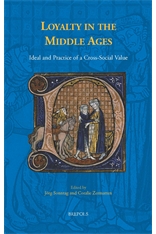
Publication – J. Sonntag, C. Zermatten (eds.),  » Loyalty in the Middle Ages. Ideal and Practice of a Cross-Social Value »

Although ‘loyalty’ is in itself a relatively modern term, as a phenomenon it has long been recognised as a fundamental element of social relationships. The essays collected in this volume address the concept of loyalty as it was understood in the Middle Ages, exploring the theme of loyalty from three separate angles — the ties between individuals (such as marriage or feudal ties), the ties between individuals and groups (for example, the role of the individual in their wider family), and the ties between institutions and groups (such as monastic orders or guilds) — and questioning how, when, and why the phenomenon of loyalty first developed.

This volume, which draws together contributions from leading historians, explores how loyalty was manifested, both in public and in private, in the medieval world. Covering topics as diverse as religious orders, royal courts, and funeral customs, the essays collected here explore the interplay between loyalty and love, friendship, obedience, and justice, and question how the value of loyalty functioned both in theory and in practice across a range of social spaces. Together, these articles offer a unique new perspective on medieval society and provide a framework that also promises to be fruitful for future research.

dIS-9782503551036-1

Table des matières :

Loyalty in the Middle Ages: Introductory Remarks on a Cross-Social Value — Coralie Zermatten and Jörg Sonntag

Part I: Individual Bonds of Loyalty: Friendship and ‘Treue’ Here and Hereafter

Siegfrieds verlorene Siege: Oder: Loyalität der Schwachen? Tödliche Spiele im ‘Nibelungenlied’ — Rudolf Kilian Weigand
Der loyale Freund ist eine feste Burg. Loyalität als Charakteristikum der Freundschaft späten Mittelalter — Klaus Oschema
‘Leal souvenir’ — Jean-Claude Schmitt
Burials, Benefactions and the Bohuns: Dynastic and Monastic Loyalties in Medieval England — Brian Golding
‘Nos qui cum eo fuimus‘: Gefährten und Mitstreiter der franziskanischen Reformatoren im 15. Jahrhundert. Das Beispiel von Johannes Kapistran — Ludovic Viallet

Part II: Political Expressions of Loyalty: Commitments as Stabilizers of Order

Schreckensherrschaft: Urteile und Bewertungen von der späten Antike bis zum hohen Mittelalter — Hans-Joachim Schmidt
The Oaths of Strasbourg (842) and their Implications in the Light of Recent Scholarship — Rosamond McKitterick

Fides — fiducia — fedus im politischen Sprachgebrauch der lombardischen Kommunen im 13. Jahrhundert — Maria Pia Alberzoni
Loyalität und Illoyalität an spätmittelalterlichen Fürstenhöfen im Reich — Karl Heinz Spiess
The Papacy, the French Monarchy, and Reciprocal Loyalty — David D’Avray
Englische Ordenshäuser in der Anfangsphase des Hundertjährigen Krieges — Jens Röhrkasten
Zur Loyalität interkultureller Makler im Mittelmeerraum: Christliche Söldnerführer (alcayts) im Dienste muslimischer Sultane — Nikolas Jaspert

Part III: Loyalty and Faith: Obedience and Pragmatism in Religious Communities

Communities of Practice and Emotional Aspects of Loyalty in Tenth- and Eleventh-Century Monasticism — Steven Vanderputten
Loyalty and Betrayal in Bernard of Clairvaux — Brian Patrick McGuire
The Religious Profession in the Order of the Canons Regular of Prémontré: A Challenge of Loyalty — Bernard Ardura
Divided Loyalties in Religious Orders: Structures and Patterns in Cistercian Wales and Ireland — Anne Müller
Cucullus non facit monachum? The Controversy over the Franciscan Habit in the Early Fourteenth Century — Michael Cusato

Part IV: Concluding Reflections and Perspectives

Felix Dahn’s Deutsche Treue: Loyalty and its Alternatives in the Tenth Century — Patrick Geary
Reziprozität und institutionelle Risikoverminderung: Soziologische Anmerkungen zur „Loyalität » — Karl-Siegbert Rehberg

Index of Names and Places

Informations pratiques :
J. Sonntag, C. Zermatten (eds.), Loyalty in the Middle Ages. Ideal and Practice of a Cross-Social Value, Turnhout, Brepols, 2016 (Brepols Collected Essays in European Culture, 5). XXI+467 p., 5 b/w ill., 156 x 234 mm. ISBN: 978-2-503-55103-6. Prix : 110 euros.

Source : Brepols

Publié dans Publications | Laisser un commentaire