Appel à contribution – Les croisades en Afrique

English version below

Volume dirigé par Benjamin Weber, pour la collection « Croisades tardives », aux Presses universitaires du Midi, à Toulouse.

Les propositions de contribution doivent être envoyées à Benjamin Weber (benjamin.weber (at) laposte.net avant le 31 décembre 2015.

Sans nier la spécificité des expéditions vers Jérusalem, à la fois modèle et référence, la diversité des fronts de croisade est aujourd’hui bien mise en valeur, avec le réemploi plus ou moins complet des théories et pratiques de la croisade en Péninsule Ibérique, dans le sud de la France, en Prusse, en Mer Égée, dans les Balkans, voire en Inde ou Amérique. Le continent africain, entendu dans son acception actuelle de la Mer Rouge à l’Atlantique et de la Méditerranée au Cap Horn, est cependant trop resté à l’écart de cette ouverture historiographique.Si le rôle fondamental de l’Égypte a été reconnu depuis longtemps, les projets et expédition sur le reste du continent sont en général traités rapidement entre deux tendances contradictoires : une assimilation sans nuance aux expéditions vers Jérusalem ou, au contraire, le rejet de rêves fous d’individus isolés avant tout portés par une attente eschatologique.

Ce volume se propose d’examiner en détail ces différents fronts de croisade : Mer Rouge, Nubie, Éthiopie, Maghreb et façade atlantique entre le XIIIe et le XVIe siècle. Un tel sujet implique une conception large de la croisade mais se doit d’être attentif aux nuances, ne pas réduire la croisade à une catégorie essentialisante qui oublierait la diversité des situations. Il ne s’agit bien sûr par de produire une synthèse définitive, mais bien de montrer la diversité et la vitalité de la recherche et l’intérêt d’étendre les problématiques de la croisade au continent africain.

À titre d’exemple et sans prétendre établir une liste définitive, les sujets suivants pourront être abordés :

  • Les réalisations concrètes et leurs échos en Occident : offensives castillanes au Maroc, expéditions en Tunisie de Louis IX ou de Mahdia, entreprises portugaises à Ceuta puis le long de la côte Atlantique…
  • Les projets d’expéditions ou d’alliances avec la Nubie, l’Éthiopie, les rêves de conversion des souverains du Maghreb, les espoirs de contrôle de la routes des épices en mer Rouge ou de l’or sur l’Atlantique.
  • Le rôle et la vision des chrétiens africains, communautés chrétiennes d’Afrique du nord (« chrétiens d’Orient » mais aussi marchands, mercenaires…) ou royaumes chrétiens de Nubie et d’Éthiopie.
  • La réception et la réaction à ces expéditions ou projets par les pouvoirs musulmans africains ; Leur impact sur les sociétés d’un point de vue politique, économique, idéologique, artistique…
  • La compréhension de ces expéditions en Occident, notamment les relations précises (dans les pensées et les faits) qui unissent ces réalités aux autres fronts de croisade, Terre sainte et Reconquista.
  • Toutes les actions qui ont pu être rattachées ou associées à la croisade (mission, piraterie, rachat des captifs…) en étant attentif à la rhétorique légitimatrice de toute assimilation sans pour autant dénigrer la référence à la croisade comme une vulgaire phraséologie justificatrice.

Les propositions de contribution doivent être envoyées à Benjamin Weber (benjamin- weber@laposte.net) avant le 31 décembre 2015. Le texte final des contributions, en français, anglais, italien ou espagnol devra être rendu avant le 31 janvier 2017.

Crusading in Africa

Volume edited by B. Weber, collection « croisades tardives », Presses Universitaire du Midi, Toulouse

Even if the military expeditions toward Jerusalem always kept a specific status as a model or reference, diversity of crusading fronts is nowadays well studied. Theories and praxis of crusading were reemployed, more or less completely, in the Iberian Peninsula, South-Western France, Prussia, the Aegean, the Balkans, and even in India and America. However, Africa, understood in its modern sense, from the Red Sea to the Atlantic Ocean and from the Mediterranean to the Cape of Good- Hope, has been largely left aside in this historiographical renewal. The importance of Egypt has long been well known but expeditions and projects on the rest of the continent are usuallybriefly studied, with two contradictory tendencies: a complete assimilation with the expedition toward Jerusalem, or, on the contrary, criticism against foolish dreams led by eschatological hopes.

This volume aims to examine closely these various crusading fronts: the Red Sea, Nubia, Ethiopia, the Maghreb and the Atlantic Coast from the 13th to 16th century. It implies a large understanding of crusading but must give a close examination to nuances. The term ‘Crusade’ must not be reduced into a theoretical category, overlooking the diversity of crusading. This study is not proposing any definitive synthesis, but rather showing the research’s variety and richness and the importance of enlarging the crusading studies to the African continent.

As examples, without excluding any other proposal, the following themes could be studied:

  • Concrete realizations and their significance in the West: Castilian offensives in Morocco, Tunisian expeditions of Louis 9th or of Mahdia, Portuguese undertakings in Ceuta or along the Atlantic Coast…
  • Projects of expeditions or alliances with Nubia, Ethiopia, dreams of conversion of Muslim kings, hopes of dominating the spice or gold trade.
  • The role and perception of African Christians, whether Christian communities in North Africa or Christian kingdoms in Nubia and Ethiopia.
  • Reception and reaction to these expeditions and projects by Muslim African powers; their impact on local societies from a political, economical, ideological, artistic… point of view
  • Understanding of these expeditions in the West, most of all their relations with the other crusading fronts, Holy Land and Iberia.
  • All actions which have been related to crusade (conversion, piracy, redeeming of captives…), keeping in mind the legitimizing role of every assimilation without rejecting the crusading reference as mere phraseology.

Paper proposals must be submitted to Benjamin Weber (benjamin-weber@laposte.net) before December 1st, 2015. Final papers in French, English, Italian or Spanish must be submitted before January 31st, 2017.

Source : Diwan

Publié dans Appel à contributions | Laisser un commentaire

Publication – Albert Derolez, « The Making and Meaning of the Liber Floridus. A Study of the Original Manuscript, Ghent, University Library, MS 92 »

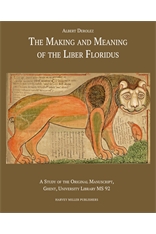
The Liber Floridus (1121), composed, written and illustrated by Canon Lambert of Saint-Omer, is the earliest illustrated encyclopedic compilation of the Latin West. Its autograph (Ghent, University Library, MS 92), a masterpiece of Romanesque book art and one of the most complicated manuscripts ever made, has been studied by the author for almost half a century. The present book is the culmination of this research and provides a detailed codicological and textual analysis, showing how this wonderful book was put together and which are the hidden ideas Lambert sought to develop in its hundreds of texts and pictures dealing with astronomy, geography, natural history, history, religion and countless other subjects.

dIS-9781909400221-1The book is illustrated with some 100 colour reproductions and numerous diagrams of quire structures. Three tables help the reader to understand the author’s argument, and full indices give access to the text and provide the basis for further investigation of individual chapters and pictures.

Informations pratiques :
Albert Derolez, The Making and Meaning of the Liber Floridus. A Study of the Original Manuscript, Ghent, University Library, MS 92, Turnhout, Brepols, 2015 (Studies in Medieval and Early Renaissance Art History, 76). IV+355 p., 22 b/w ill. + 98 colour ill., 148 b/w line art, 240 x 280 mm. ISBN: 978-1-909400-22-1. Prix : 125,00 euros.

Source : Brepols

Publié dans Publications | Laisser un commentaire

Colloque – Journées d’Archéologie en Wallonie 2015

Du 18 au 20 novembre 2015

Centre culturel des Roches
5, rue de Behogne,
B-5580 Rochefort

ImgColloqueWallo

Service public de Wallonie
Direction générale opérationnelle – Aménagement du territoire, Logement, Patrimoine et Energie
1, rue des Brigades d’Irlande
5100 Jambes
Tel.: +32 (0)81 33.21.37 / +32 (0)81 33.23.41 / +32 (0)81 33.21.67 / +32 (0)81 33.22.59
E-MAIL : evenements.dgo4@spw.wallonie.be

Support scientifique :
Christian Frebutte
Tél: +32 (0) 81/250.270.
E-MAIL : christian.frebutte@spw.wallonie.be

Inscriptions : ici

Programme : ici

Source : SP Wallonie – DGO4

Publié dans Colloque | Laisser un commentaire

Offre d’emploi – Internship in the Medieval Manuscripts Team (British Library)

The British Library is pleased to be able to offer a nine-month internship in the Ancient, Medieval and Early Modern Manuscripts section of the Western Heritage Department for a post-graduate or post-doctoral student in History, Art History, Medieval Language or Literature or other relevant subject.

B. Britsh LibraryThe intern will be involved in all aspects of the work of the Ancient, Medieval and Early Modern Manuscripts section, including responding to enquiries, providing talks for students and patrons, selecting and presenting manuscripts for display in our exhibition gallery, and cataloguing, thereby gaining insight into various curatorial duties and aspects of collection care. During the internship at the Library, the intern will enjoy privileged access to printed and manuscript research material, and will work alongside specialists with wide-ranging and varied expertise.

The primary focus of the internship will be to enhance the online Digitised Manuscripts site by creating and supplementing catalogue entries for medieval manuscripts and accompanying images. The intern will also assist in researching and answering inquiries, preparing manuscripts for exhibition and writing exhibition labels, writing blog posts, and assisting in presentations to students and visitors, working under the supervision of the Lead Curator, Illuminated Manuscripts.

The internship is designed to provide an opportunity for the student to develop research skills and expertise in medieval history, and in presenting manuscripts to a range of audiences.

Previous interns have given feedback that they felt a valued member of the team, gained professional confidence and developed their career by carrying out a ‘real’ job with specific duties.

This is a full-time paid internship for nine months starting in January 2016, or as soon as relevant security checks have been completed.

How to Apply

The programme is only open to students who are engaged actively in research towards, or have recently completed a PhD in a subject area relevant to the study of medieval manuscripts and who have a right to work in the UK full time.

To apply, please visit our careers website with details of your experience of medieval manuscripts.

Closing Date: 7 November 2015

Interview Date: 23 November 2015

The selection process may include questions about the date and origin of a particular manuscript to be shown at the interview.

See more at: http://britishlibrary.typepad.co.uk/digitisedmanuscripts/2015/10/internship-in-the-medieval-manuscripts-team.html#sthash.x1rQ8s4O.dpuf

Source : British Library

Publié dans Offre d'emploi | Un commentaire

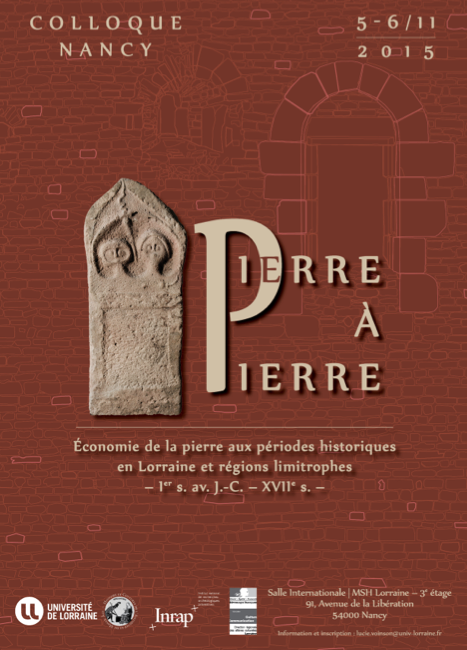
Colloque – Pierre à Pierre. Économie de la pierre aux périodes historiques en Lorraine et régions limitrophes (Ier s. av. J.-C.–XVIIe s.)

Nancy,
5-6 novembre

Pour toute question, s’adresser à pierreapierre@sciencesconf.org
ou par téléphone : +33(0)3 54 50 42 30

De pierre à pierreProgramme :

08:30 – 09:00 Accueil
09:00 – 09:10 Ouverture du colloque (Salle Internationale) – Frédéric Villiéras (vice-président du Conseil Scientifique de l’Université de Lorraine)
09:10 – 09:20 Introduction (Salle Internationale) – Karine Boulanger (INRAP) et Cédric Moulis (Université de Lorraine)

09:20 – 09:40 Corpus Lapidum Burgundiae : une plateforme numérique mutualiste sur la nature et l’usage de la pierre de Bouroggne (Salle Internationale) – Stéphane Büttner, Marion Foucher
09:50 – 10:10 Spécificité des sites carriers des environs de Reims : diversité des matériaux, contraintes d’exploitation et de mise en oeuvre (Salle Internationale) – Gilles Fronteau, Aurélie Turmel, Laurent Chalumeau, Bruno Decrock, Olivier Lejeune, Alain Devos
10:20 – 10:40 Pause café

10:40 – 11:00 De la carrière à la domus : exploitation et utilisation de la craie à Reims durant l’Antiquité (Salle Internationale) – Sébastien Pechart, Mathilde Arnaud, Emilie Jouhet, Philippe Rollet, Gilles Fronteau, Sébastien Laratte
11:10 – 11:30 Architecture monumentale et approvisionnement en pierres en Haute-Savoie (Salle Internationale) – Anne Baud, Anne Schmitt
11:40 – 12:00 Les calcaires du Bajocien dans l’architecture gothique de l’ancien diocèse de Liège : origines, diffusion et usages d’un « matériau d’importation » médiéval (Salle Internationale) – Mathieu Piavaux, Frans Doperé, Frédéric Boulvain, Gilles Fronteau, Marie-Xavier Lecuit, Johan Yans, Elise Baillieul
12:00 – 14:00 Déjeuner

14:00 – 14:20 Les « pierres blanches » dans les monuments publics et funéraires de la cité des Tongres (province de Germanie inférieure) (Salle Internationale) – Catherine Coquelet, Roland Dreesen, Eric Goemaere, Guido Creemers
14:30 – 15:30 Session posters 1 – Voir programme détaillé

15:30 – 15:50 Pause café
15:50 – 16:10 Du « marbre noir » au sol et sur les murs ! L’emploi du schiste dans le décor des édifices gallo-romains, une spécificité éduenne ? (Salle Internationale) – Nicolas Delferrière
16:20 – 16:40 La couverture d’ardoise à l’époque romaine à la lumière des découvertes récentes. (Salle Internationale) – Gaël Cartron
16:50 – 17:10 Blocs architecturaux gallo-romains remployés dans une motte castrale (Vioménil, Vosges). (Salle Internationale) – Pierre Fetet

vendredi 6 novembre 2015

09:00 – 09:20 Un exceptionnel atelier gallo-romain de fabrication de pierres à aiguiser découvert à Châtelet-sur-Sormonne (Ardennes, France) : mise en évidence de la châine opératoire, caractérisation du matériau et circuits commerciaux (Salle Internationale) – Aurélie Thiébaux, Marc Feller, Bruno Duchêne, Eric Goemaere
09:30 – 09:50 Les supports et les outils en pierre associés au broyage dans l’Antiquité et au Haut Moyen Âge. Exemples de sites lorrains et d’un site ardennais fouillé récemment. (Salle Internationale) – Sophie Galland
10:00 – 10:20 Les mortiers en pierre : un aspect méconnu de la culture matérielle médiévale et gallo-romaine. – Geert Verbrugghe
10:30 – 10:50 Pause café

10:50 – 11:10 Production, commercialisation et consommation de pots en pierre ollaire, aspects d’une vaisselle originale à travers l’exemple du Saint-Mont. (Salle Internationale) – Martine Aubry-Voirin, Thomas Chenal, Nadia Botalla Buscaglia
11:20 – 12:00 Session posters 2 – Voir programme détaillé

12:00 – 14:00 Déjeuner
14:00 – 14:20 L’économie de la pierre à Metz à la fin du XVe siècle : l’apport des comptes des « Gouveneurs des murs » à Metz. (Salle Internationale) – Mylène Didiot
14:30 – 14:50 Construire un château dans les Vosges cristallines (Vosges du sud) XIIe-XIIIe s. (Salle Internationale) – Jacky Koch
15:00 – 15:20 Usages et origines des matériaux géologiques découvertes à la forteresse de Rodemack (Moselle) – résultats des fouilles Inrap 2012 à 2014. (Salle Internationale) – Jean-Denis Laffite
15:30 – 15:50 Pause café

15:50 – 16:10 Les remplois de l’abbaye Saint-Vanne de Verdun : du matériau brut à l’usage mémoriel (XIe-XXe s). (Salle Internationale) – Isabelle Mangeot, Nicolas Mangeot
16:20 – 16:40 L’économie de la pierre sur le chantier expérimental de Guédelon. (Salle Internationale) – Florian Renucci
16:50 – 17:10 Conclusions (Salle Internationale) – Jean-Claude Bessac

Source : Pierre à pierre

Publié dans Colloque | Laisser un commentaire

Offre d’emploi – Professor of Medieval History (University of Oxford)

Faculty of History
in association with All Souls College
Chichele Professor of Medieval History

Start date: 1 October 2016 or as soon as possible thereafter.

A. OxfordThe University of Oxford is seeking an outstanding candidate to fill the Chichele Professorship of Medieval History on the retirement of Professor Chris Wickham. Applications are welcome from scholars working in any aspect of the era ca. 500 – 1500.

The Professorship is a member of the Faculty of History, and the Professor will also be a Fellow of All Souls College. The successful candidate will be a scholar of the highest international standing, with an outstanding record of research and publication in medieval history, the ability to teach and inspire students at all levels, and the ability and willingness to undertake senior administrative duties.

Deadline for applications: Monday 14 December 2015. For more details about the post and full application instructions, see http://www.ox.ac.uk/about_the_university/jobs/fp/.

Applications are particularly welcome from women and black and minority ethnic candidates, who are under-represented in academic posts in Oxford.

Committed to equality and valuing diversity

Source : University of Oxford

Publié dans Offre d'emploi | Laisser un commentaire

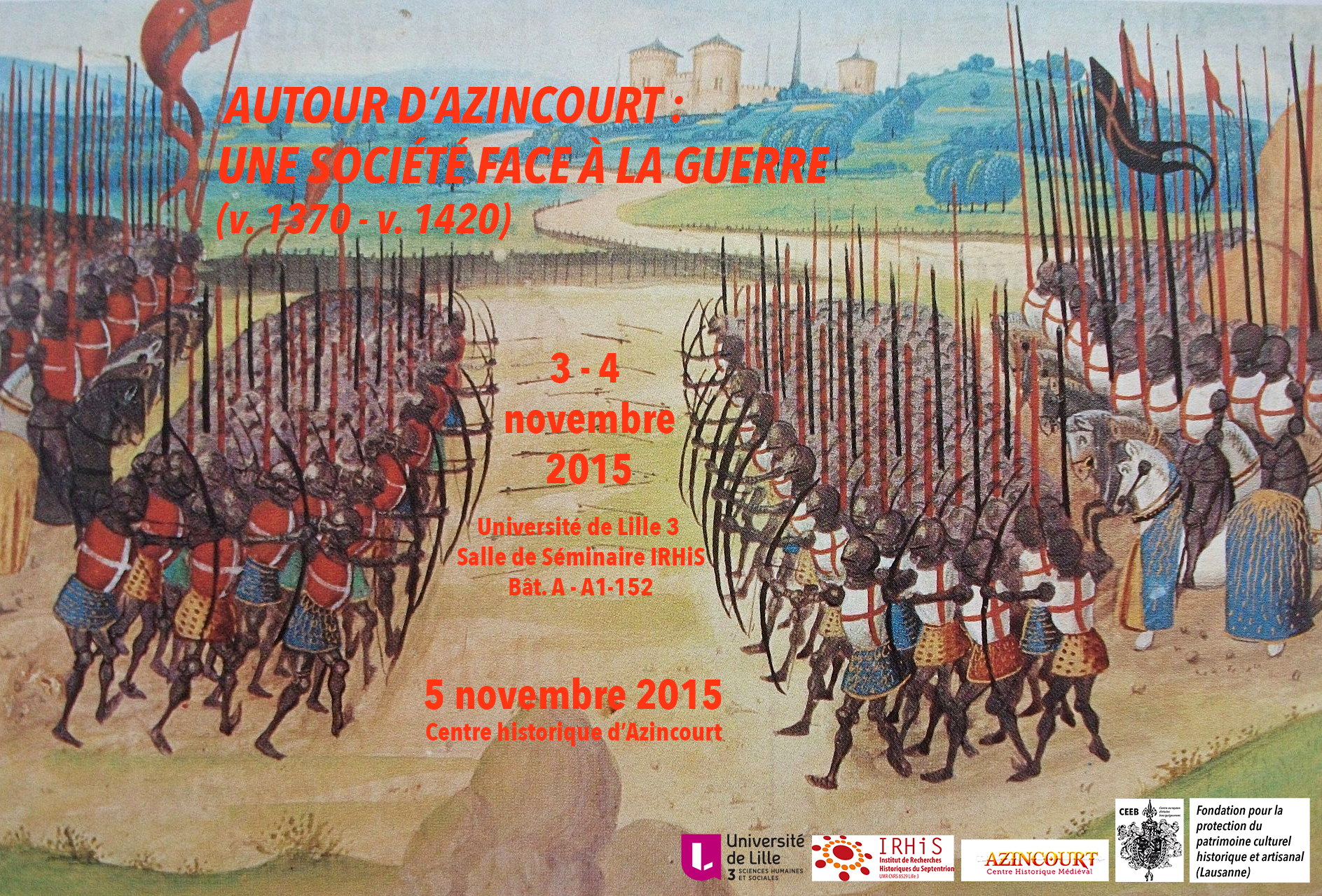
Colloque – Autour d’Azincourt : une société face à la guerre (v. 1370-v. 1420)

3-5 novembre 2015

Université de Lille 3
Rue du Barreau – Villeneuve d’Ascq
Salle de séminaire de l’IRHiS – A1-152

Centre Historique d’Azincourt

D. AzincourtProgramme :

10 h 00 – Accueil des participants
10 h 30 – Valérie Toureille (Université de Cergy-Pontoise), Introduction

Guerre et historiographie

11 h 00 : Jean Devaux (Université du Littoral), Pour principalement ramener à mémoire les haulx fais d’armes : représentations de la guerre dans la Chronique d’Enguerran de Monstrelet
11 h 45 : Elisa Mantienne (Université de Lorraine), Comment un moine anglais jugeait la guerre en France. Azincourt et ses suites dans l’Ypodigma Neustriæ de Thomas Walsingham

12 h 30 – Déjeuner

Guerre, Église et sentiment religieux

14 h 00 : Esther Dehoux (Université de Lille 3-IRHiS), Saint George, noble chevalier, tres humblement, je vous requier. La dévotion aristocratique à saint Georges (France, Angleterre, espace bourguignon)
14 h 45 : Fabien Roucole (Université Aix-Marseille), La mort d’un ecclésiastique sur le champ de bataille. Jean de Montaigu, archevêque de Sens, et la bataille d’Azincourt

15 h 30 – Pause

Art de la guerre et technique de combat

16 h 00 : Philippe Contamine (membre de l’Institut), Christine de Pizan, cheftaine de guerre
16 h 45 : Loïs Forster (Université de Lille 3-IRHiS) : Les apertises d’armes, du champ clos au champ de bataille

Soir : Dîner offert aux orateurs

Mercredi 4 novembre
Université de Lille 3

Président de séance : Valérie Toureille

Retour sur les événements de 1415

9 h 00 : Gilles Lecuppre (Université Catholique de Louvain) et Élodie Lecuppre-Desjardin (Université de Lille 3-IRHiS), Le comté de Hainaut et la guerre anglaise en 1415
9 h 45 : Alain Marchandisse (FNRS – Université de Liège) et Bertrand Schnerb (Université de Lille 3-IRHiS), Le gouvernement royal face à l’invasion anglaise de l’été 1415
10 h 30 : Laurent Vissière (Université de Paris IV), Une ville assiégée : Harfleur en 1415

11 h 15 : Pause

Les combattants d’Azincourt

11 h 30 : Anne Curry (Université de Southampton), L’archer anglais

12 h 15 : Déjeuner

13 h 45 : Christophe Masson ((Université de Liège) : À Gênes autour de Boucicaut. L’armée royale française face à la révolte de 1409-1410
14 h 30 : Christophe Gilliot (Centre Historique d’Azincourt), Le Galois de Fougières, prévôt des maréchaux de France

Prisonniers et rançons

15 h 15 : Pauline Bord (Université de Lille 3-IRHiS), Au lendemain d’Azincourt. Jean, bâtard d’Orléans (1403-1468) : l’enjeu de la captivité du duc Charles

16 h 00 – Pause

16 h 30 : Bertrand Haquette (Université de Lille 3-IRHiS) : Rançons, décès, honneurs, disgrâce et trahison : La Viesville, un lignage artésien mis à l’épreuve de la guerre
17 h 15 : Rémy Ambühl (Université de Southampton) : Jeanne d’Arc, prisonnière de guerre

Jeudi 5 novembre 2015
Centre Historique d’Azincourt

8 h 00 – 9 h 30 – Déplacement de Lille à Azincourt

Armées et organisation militaire

9 h 45 : Michael Depreter (Université Libre de Bruxelles), Le prince face à l’artillerie communale dans les Pays-Bas au début du XVe siècle : Flandre, Brabant, Hainaut
10 h 30 : Jean-Baptiste Santamaria (Université de Lille 3-IRHiS), La mise en défense du comté d’Artois sous Marguerite de France: 1361-1382
11 h 15 : David Fiasson (Université de Lille 3-IRHiS), Pour la tuition et garde du Mont Saint Michiel. Le système défensif montois au temps d’Azincourt

12 h 00 : Jean-Marie Cauchies (Université Saint-Louis de Bruxelles), Conclusions

12 h 30 – Déjeuner

14 h 00 – Présentation du Centre historique et visite du champ de bataille (par Christophe Gilliot)

15 h 00 – 17 h 00 – Déplacement d’Azincourt à Lille

Source : IRHiS

Publié dans Colloque | Laisser un commentaire

Colloque – 21st Dutch-Flemish Medieval Studies Day: Civitas

Programme :

10:30 Registration (with coffee/tea)

10:50 Welcome (Wim Verbaal, Director of the Henri Pirenne Institute)
11:00 VWM Pirenne Lecture: Julia M H Smith (University of Glasgow): Multiculturalism in the early Middle Ages? Material Religion in 8th-century Rome
12:00 Katell Lavéant (University of Utrecht): Building Communities through Parody? Joyful Culture in the Late Middle Ages
13:00 Lunch with optional short city walk

14:15 PhD student presentations in parallel sessions (see below)
15:45 Break
16:00 Marc Boone (Ghent University): Urban society in the late middle ages: communal ideal and ‘herrschaftsfremde Charisma’
17:00 Closing (Catrien Santing, Director of the Dutch Research School for Medieval Studies)
17:10 Reception offered by the VWM
Civitas - UGent21st Dutch-Flemish Medieval Studies Day, organised by the Henri Pirenne Institute for Medieval Studies, the Dutch Research School for Medieval Studies and the Flemish Medievalist Association

In 2015, the Dutch-Flemish Medieval Studies Day will be hosted by Ghent University. We will focus on the concept of civitas for this day, and thus refer to the long tradition of research into the medieval city, which ever since Henri Pirenne’s pioneering work is still very much alive at Ghent University.

The concept of civitas has a broad range of meanings and can be studied from a variety of angles. In Antiquity, civitas stood for a political community, the civil rights that were connected with this, and urban settlements and their surroundings. In the Middle Ages, the term civitas became more associated with the actual city, in particular with episcopal towns, fortresses, etc. From the High Middle Ages onwards, urban environments gave rise to communal ideals and political emancipation, organised trade and craftsmanship, new religious ideals, and artistic development expressed in architecture, art and literature.

The concept of civitas, however, was also central to the development of a particular kind of symbolic urbanism, often Christian. We find this symbolic urbanism for instance expressed in Augustine’s De civitate Dei, in Lambert of Saint-Omer’s representation of the Heavenly Jerusalem, and Christine de Pisan’s allegorical Cité des dames. It also inspired the early-medieval idea of civitates as Christian communities around rural monastic communities modeled after the ideal of Jerusalem or Rome, in particular in the British Isles. Meanwhile the ideal of the city was not limited to the West or to the Christian world. As can be noticed in, for example, the Muqaddimah by Ibn Khaldun, reflections on the meaning of the city also circulated in the Islamic world.

As such civitas has the potential to bring together a wide range of medievalists to discuss urban development, communities in religious and secular context, literature, political representation, etc.

Keynote Strand: Ideals and practices of urban life

Three keynote lectures will offer different approaches to the theme:

Multiculturalism in the early Middle Ages? Material Religion in 8th-century Rome

Julia M H Smith is Edwards Professor of Medieval History at the University of Glasgow. She holds a Leverhulme Trust Major Research Fellowship for the project Christianity in Fragments. She gives the first keynote and Pirenne lecture of the Vlaamse Werkgroep Mediëvistiek.

This paper tells a story of wealth, love, jealously, and revenge in early eighth-century Rome. It uses an eyewitness account of these events to explore how Christians of different cultural and linguistic backgrounds expressed their beliefs in material form, notably through amulets, curses, relics and icons. By examining responses to this Christian multiculturalism, the second half of the paper traces the emergence of a normative set of expectations, first in Constantinople and then in Rome. In so doing, it probes the tension between Rome as a city of lived religion and ‘Rome’ as an idealised reference point of correct Christianity. It closes by reflecting on how this affects characterisations of ‘early medieval Christianity’ as distinct from ‘late antique Christianity’.

Building Communities through Parody? Joyful Culture in the Late Middle Ages

Katell Lavéant is Assistant Professor in French Language and Literature at the Universiteit of Utrecht and coordinator of a new Vidi-project on parodies in the Low Countries.

During the late Middle Ages and the early modern period, a vibrant festive culture existed in the towns of Western Europe. An important part of it was what can be called ‘joyful culture’, a shared system of sociability for groups and individuals organising playful performances and activities in a ritualised way, in which parody had a central role. This is especially noticeable in the Burgundian Low Countries and in France, in the many theatrical contests and festivals that were organised in and by the cities, as well as in many manuscripts and printed material circulating joyful literature.

In my lecture, I will present important features of this festive culture, among which the central notion of parody, and investigate its value for urban communities, as a mean to secure civil stability and cohesion. Which ideals are revealed by parodic practices and texts? How could parody and joyfulness be inclusive and bind a community together?

Urban society in the late middle ages: communal ideal and ‘herrschaftsfremde Charisma’

Marc Boone is Professor Medieval History at Ghent University. He coordinates the collaborative IUAP research project City and Society in the Low Countries (ca. 1200-ca. 1850). The ‘condition urbaine’: between resilience and vulnerability.

Ever since urban societies imposed themselves as an essential power in the medieval society, they were looked upon in a twofold way. On the one hand they were seen as a threat to the existing feudal order, on the other hand they offered opportunities for economic growth and expansion and became soon a phenomenon society had to take into account. The burgher or citizen therefore developed into a essential persona within medieval society. At least so we think given a strong historiographic tradition reaching back to Pirenne, Max Weber and their like. The question to be asked is whether this opinion is still valid in the context of the new comparative insights urban history has developed.

PhD Student presentations

At the Medieval Studies Day, doctoral students in any field of Medieval Studies present short papers on their research topic in parallel sessions. Speaking time for presentations will be c. 15-20 minutes, followed by discussion.

Session 1. ‘Urban Citizenship’

Ben Eersels (KU Leuven): Participation and Peaceful Protests. Common Citizens and Urban Politics in Late Medieval Brabant and Liège (ca. 1300-1500)

During the waves of social upheaval in the 14th and 15th centuries, common citizens in Western Europe protested to demand rights of political participation. In some towns of the Low Countries, they succeeded and obtained representation in the town councils. Existing research on these commoners strife for political emancipation, however, has focused too much on their violent confrontations with the authorities. Yet, some recent case studies suggest that townsmen also caused substantial political changes by only using peaceful means of resistance. Still, a systematic enquiry of the commoners peaceful actions to influence politics has never been carried out. Furthermore, the commoners impact on urban policy-making after their acceptation to power, remains understudied, even though there is proof of their collaboration with urban authorities. In this paper, I will present my doctoral research, in which I try to fill these two gaps in the existing historiography. By studying several towns in Late Medieval Brabant and Liège, I will discuss the commoners political agenda and the peaceful means they used to affect urban policy.

Janna Everaert (VUB): Power in the Metropolis. Urban elite formation during the demographic and commercial expansion of Antwerp (c. 1400-c. 1550)

During the late 15th and early 16th century, Antwerp replaced Bruges as gateway city. In this period, Antwerp transformed from a medium-sized Brabantine city into the leading metropolis of the Burgundian-Habsburg Netherlands. Most post-war historians focused on the demographic and economic aspects of Antwerp’s growth, but devoted less attention to the impact on the political elite and to the question how this group or aggregate of groups dealt with the opportunities and challenges that accompanied the urban expansion process. The central objective of this project is an in-depth study of the Antwerp political elite, proceeding from an analysis of the composition and evolution of the Antwerp magistrate between c. 1400 and c. 1550.

Hannelore Franck (KU Leuven-KULAK: Parochial Poor Relief in the Late Middle Ages: Expression of Sincere Piety, Example of Conspicuous Consumption or Exhibit of Civic Solidarity?

The poor relief in the late middle ages and the underlying rationale has been researched intensely but the debate is still ongoing. Some researches define the medieval poor relief as an expression of sincere piety in which the first concern of the donor was their own faith after death. Others interpret the poor relief mainly as a possibility to assert the donor’s own social position and thus can be seen as an example of conspicuous consumption. The judgement in both cases is harsh: the poor relief was inadequate because helping the poor was not the prime goal but rather a tool to reach a different goal. Other research, however, noticed that the ‘middle class’ was the main participant in the poor relief system of the late medieval town. The explanation is that these people faced the threat of poverty themselves and therefore this system was actually an exhibit of civic solidarity. In my own PhD research, which I will present in this paper, I will try to offer new insights by focusing on the interaction between poor relief and memorial services in the parochial poor relief in late medieval Bruges.

Session 2.

Nanouschka Wamelink (University of Amsterdam): Interpreting the unseen spectacle of the past

In my recently started research project, I will analyse the alleged food abstinence of medieval female saints from a performative point of view. In practice this means that I will look at the ways in which medieval sources present this fasting as public behaviour. By comparing these fasts with other forms of public self-starvation, I will try to reconstruct these medieval performances as they are narrated in the sources. In this presentation I will discuss some of the methodological concerns with regard to using a performative approach to study Medieval religiosity.

Claudia Daiber (University of Amsterdam): The Reformation on stage: protestant influence on the passion play

Generally scholarly research holds the opinion that the passion play as it originates from the Middle Ages as a theatrical performance came to an end with the Reformation (1517-1648) on the European continent. This observation, however, needs some refinement as far as the passion plays are concerned which are comprised in the so-called Alemannic group which originate from the Southern part of present day Germany and the German speaking part of present day Switzerland. These passion plays are not only characterized by a common linguistic feature but likewise by their participation in the discourses stirred up by the Reformation. The Catholic Donauesching Passion Play (ca. 1480) for example, introduces the notion of plurality of beliefs, the, as well, Catholic Lucerne Easter Play (1545-1616) appropriates certain Protestant positions and last but not least the genuinely Protestant Zurich Passion Play (1545) conveys religious positions in the Zwinglian tradition. This contribution elaborates on the way the genre of the passion play communicates these challenges.

Cora Zwart (University of Groningen): Weaving the Religious Civic Web: A socio-historical analysis of fifteenth-century religious city life in Utrecht, Leiden and Bruges

This project aims at writing a social history of late medieval city life in Utrecht, Leiden and Bruges from a religious perspective, to uncover the societal role of religion in the cities as a whole. To pinpoint the religious civic web, religiously-coloured networks will be studied that connected lay and religious people and groups that today too often are considered as not connected. Using the Actor-Network-Theory, networks of social relations, religious objects and buildings, and religious actions will be examined. Hypothetically these materials taken together show city-specific dynamic religious societal webs.

The investigations start bottom up, at the level of a few selected citizens of each of these cities, people of whom religious books with personal notes have been preserved, and of whom social activities and private and public connections can be traced in archives, museums, and libraries. Later, the scope widens to their families, friends, social and religious contacts. Eventually the cities will be compared.

As an example I will focus here on one of the citizens selected for the casus of the city of Utrecht, Dirck Borre van Amerongen (ca. 1438-1527), alderman and mayor. Using textual, visual, and archival sources, the role of religion in his personal and public life will be presented.

Session 3.

Jan Trachet (UGent): Measuring Monnikerede. An interdisciplinary research for a medieval outport of Bruges

The Zwin tidal inlet functioned as the Medieval gateway to the port of Bruges. Along the banks of this linear harbour-hub, a series of smaller landing sites soon acquired city and staple privileges. Thus, the fishing village of Monnikerede got engaged in transshipment and commerce, was integrated into international trade networks and soon transforming it into a miniature city. However, economic, geomorphological and military developments in the troubled 16th century showed that smaller landing sites were inviable without the port network in which they sprout. Consequently, they were gradually deserted and disappeared from the landscape.

In order to detect and assess the location, morphology and state of preservation of these deserted ports, we apply a double-layered methodology. First, the broader port area was approached from a macro-scaled historical-geographical framework in which both historical as oblique aerial photographs and LiDAR were combined with cartographical and geological data. Then, the focus narrowed to a micro-scaled high-resolution scan of the outports themselves, starting with a full-scale geophysical survey and a comprehensive DGPS-mapped fieldwalking campaign. Furthermore, we managed to plot and visualize non-cartographic proto-cadastral documents, using retrogressive techniques. The GIS-integration of these highly detailed datasets provides us with various layers of subsoil-information at the scale of the individual Medieval allotment. The combination of these traditional and innovative techniques delivers a promising methodology for non-invasive research on Medieval (landing) sites.

Isabel Kimmelfield (Radboud Universiteit): A Geographical Approach to Defining the Suburbs of Constantinople

The development of Constantinople’s suburbs in its early centuries was strongly influenced by the geography of the region. The major waterways of the Sea of Marmara, the Bosporos, and the Golden Horn bounded the city on three sides, separating the city centre from many of its major suburban sites. But, at the same time, these bodies of water provided easier (and more pleasant) means of transportation to these (often shoreline) suburbs than road travel. Even the landscape around Constantinople, which was punctuated by numerous hills and rocky regions, making land-travel more challenging, did not merely divide the city from its hinterland. This hilly landscape also provided vantage points from which panoramic views of the city could be attained and vice versa. Thus, while practically obstructing easy travel to the city, these hills nonetheless brought the hinterland of Constantinople closer to the city visually.

This visual component is important – it is expressed in the words of visitors arriving at the city, viewing it from outside, but it also appears in the words of inhabitants describing the view from the city of the regions beyond the walls. Constantinople itself was a hilly city, and there were numerous points from which inhabitants could view the city’s surroundings. Evidence both explicit and implicit of frequent movement between the suburbs and the city centre further suggests that inhabitants did not simply ignore these surroundings, but rather the city’s immediate hinterland served numerous key functions, both practical and symbolic. This paper will explore some of the ways in which geography contributed to these uses and meanings of the suburbs, while elaborating on the liminal role of the suburbs as places that were both separate from, and yet near to the Queen of Cities.

Jerem van Duijl (Leiden University): The possessions of the Teutonic House in Utrecht (1231-1620)

In 1219 Sweder van Dingede participated in the siege of Damiate during the fifth crusade. Being impressed by the work of the Teutonic Order there, he donated some of his possessions to these knights. His son, also called Sweder van Dingede, promised to go on crusade as well. But instead he and his wife Beatrix in 1231 redeemed their vow by donating land to the Teutonic Order. Properties just outside the city walls of Utrecht were part of this gift. A year later a convent house for the brethren was built there. The acquisition of more possessions, either by gifts or by buying land, contributed to the growing importance of the Teutonic house. During the 14th century it became the regional headquarters of the Teutonic Order, the so-called bailiwick of Utrecht.

The aim of this research project is to reconstruct the possessions of the Teutonic house and the way they were managed, from 1231 until the transformation into a protestant organization about 1620. Following these possessions from the well-documented 16th century back in time, we encounter the times of prosperity and stagnation of the Teutonic Order.

Researchmaster students

It is possible for Researchmaster students of the Dutch Research School for Medieval Studies who participate as part of their training to complete an assignment for 1 ECTS. For more information about his please contact Martin de Ruiter.
Optional

Ghent is a lovely city, and especially interesting for a medievalist. If you would like to spend the weekend Ghent, we have some options for you:

On Friday 30 October, we can arrange to have dinner together (at own expense).
When there is sufficient interest, on Saturday 31 October, we can provide a guided tour of the medieval collection of the STAM, which is then also hosting the exhibition Het verloren koninkrijk: Willem I en België.

Practical

More information about the location.

Accommodation tip: The new Backstay Hostel

Other Youth Hostels: Hostel Uppelink and Youth hostel De Draecke

For hotels see: http://www.visitgent.be

Registration

The Medieval Studies Day is free of charge for speakers, as well as Doctoral and Research Master students who are a member of the Flemish Medievalist Association or the Dutch Research School Medieval Studies. For other participants, a registration fee of 10 euros is payable. This includes lunch and a reception.

Online registration has now closed, but late registration is possible by sending an email to Marjolein Stern.

Publié dans Colloque | Laisser un commentaire

Offre d’emploi – Maître assistant en histoire de l’art (Pomona, Californie, 2016)

The Department of Art at California State Polytechnic University, Pomona (Cal Poly Pomona) invites applications for a tenure-track position at the rank of Assistant Professor to begin Fall 2016. Candidates specializing in art history, particularly in Classical, Medieval, Renaissance or Baroque with strong commitment to teaching are especially welcomed to apply.

The Position:

The faculty member will teach a wide range of lower and upper division courses art in the Art History curriculum. The successful candidate must have an expertise in Classical, Medieval, Renaissance or Baroque art history. The candidate should have professional and scholarly achievements. The position requires excellence in teaching and advising, and a commitment to service to the university. A full-time faculty member will be fully invested in all aspects of program development and assessment, engage in service activities at the department, college, and university levels, and provide academic and professional advice to students. Applicants whose work incorporates a global perspective and a commitment to diversity in higher education are particularly encouraged to apply.

Minimum Qualifications:

  • Earned Ph.D. in art history or visual studies by June 30, 2016.
  • Evidence of scholarly specialization in at least one of the following areas of Western art history: Classical, Medieval, Renaissance, Baroque.
  • Evidence of scholarly engagement and potential.
  • Experience teaching undergraduates at a college or university.

Preferred/Desired Qualifications:

  • Experience teaching the lower-division Western art history survey (Prehistory through Modern) as instructor-in-charge.
  • Experience teaching upper-division courses in at least two of the following areas of Western art history: Classical, Medieval, Renaissance, Baroque.
  • A record of scholarship in at least one of the scholarly areas listed above.

Application Procedure:

A completed application will consist of the following:

By regular mail:

By e-mail:

  • a cover letter that describes the candidate’s teaching and research experience and interests as well as addresses the qualifications articulated in the position description;
  • a curriculum vitae comprised of at least those elements specified on the application form plus the names, titles, addresses, and telephone numbers of at least five individuals who can speak to the candidate’s potential for success in this position;
  • an example of a representative scholarly article or book chapter or the equivalent; and
  • a copy of a transcript showing the highest degree earned.

Note: Finalists will be required to provide three sealed letters of reference (dated 2014 or later) and an official transcript before the campus interview.

The position is open until filled. First consideration will be given to completed applications received no later than December 3, 2015. Please address all nominations, inquiries, requests for application forms, and application materials to:

Faculty Search Committee
c/o Patricia Martinez, Administrative Coordinator
Department of Art
California State Polytechnic University, Pomona
3801 W. Temple Ave. Pomona, CA 91768
Phone: 909.869.3508 FAX: 909.869.4939
Email: pmartinez@cpp.edu

The University: Cal Poly Pomona, one of two polytechnic universities in California, is a member of the 23-campus California State University system. Our student population of approximately 23,000 enrolls in 51 baccalaureate, 30 master’s degree programs, 11 credential and certificate programs, and a doctorate in Educational Leadership, presented by 1,200 faculty. We recruit successful and career-focused students from throughout California and beyond. We are proud of our status as a Hispanic Serving Institution. We have a strong commitment to supporting scholarship, research, and student achievement. Our scenic and historic 1,400-acre campus, once the winter ranch of cereal magnate W.K. Kellogg, is located about 30 miles east of downtown Los Angeles. Southern California is one of the most dynamic economic and cultural environments in the country, and the campus is within an hour’s drive of beaches, mountains, and desert. The university is committed to diversifying its faculty and staff and has made educational equity one of its highest priorities. The mission of the university is to advance learning and knowledge by linking theory and practice in all disciplines, and to prepare students for lifelong learning, leadership, and careers in a changing, multicultural world.

The College: The College of Environmental Design is one of eight colleges at California State Polytechnic University, Pomona and was established in 1970. The College offers professional degree programs at the graduate level in Regenerative Studies; undergraduate and graduate levels in Architecture, Landscape Architecture, Urban and Regional Planning; and at the undergraduate level in Graphic Design and Art History. The mission of the College of Environmental Design is to provide an outstanding academic and professional learning experience within a multidisciplinary structure. The College philosophy embodies a passion for creative excellence, environmental sustainability, and social responsibility in each of the College’s departments.

The Department: The Department of Art, fully accredited by the National Association of Schools of Art and Design (NASAD), offers a B.F.A. in Graphic Design, B.A. in Art History, and B.A in Fine Art. The department has 10 full-time tenure-track faculty members and 12-15 temporary faculty members. There are approximately 550 department majors.

California State Polytechnic University, Pomona is an Equal Opportunity, Affirmative Action Employer. The University seeks to recruit and retain a diverse workforce as a reflection of our commitment to serve the people of California, to maintain the excellence of the University, and to offer our students richly varied disciplines, perspectives and ways of knowing and learning. Cal Poly Pomona subscribes to all state and federal regulations and prohibits discrimination based on race, color, religion, national origin, sex, gender identity/gender expression, sexual orientation, marital status, pregnancy, age, disability, genetic information, medical condition, and covered veteran status. The University hires only individuals lawfully authorized to work in the United States. As required by the Clery Disclosure Act, the university’s annual security report is available at http://www.cpp.edu/~police/annual-security-report.shtml. The person holding this position is considered a ‘mandated reporter’ under the California Child Abuse and Neglect Reporting Act and is required to comply with the requirements set forth in CSU Executive Order 1083 as a condition of employment. A background check (including a criminal records check) must be completed satisfactorily before any candidate can be offered a position with the CSU. Failure to satisfactorily complete the background check may affect the application status of applicants or continued employment of current CSU employees who apply for the position.

Source : ApAhAu

Publié dans Offre d'emploi | Laisser un commentaire

Publication – Sylvain Piron, « Dialectique du monstre. Enquête sur Opicino de Canistris »

Fonctionnaire de l’administration des papes d’Avignon, Opicino de Canistris (1296-1355) a produit, pour son propre compte, des diagrammes déconcertants où se mêlent cartes et corps, symboles astraux et religieux. Exhumés peu à peu au cours du siècle passé, ses manuscrits suscitent encore de nombreuses interrogations. Sous la forme d’une enquête, Dialectique du monstre explore les différentes facettes d’une œuvre complexe et fascinante.

Prêtre séculier de Pavie, fuyant les conflits politiques qui déchiraient la Lombardie des premières décennies du XIVe siècle, Opicino s’est réfugié à la cour papale à Avignon où ses talents d’écrivain lui ont valu un poste de scribe à la Pénitencerie pontificale. Tourmenté par ses responsabilités sacerdotales, souffrant des paradoxes d’une Église romaine riche et puissante qui prône la pauvreté et l’humilité, il a trouvé dans l’écriture et le dessin un moyen d’apaiser ses angoisses. Ayant appris à dresser des cartes marines selon la technique des cartographes génois, la géographie du bassin méditerranéen devient entre ses mains le support d’une symbolisation de tous les conflits qui le déchirent.

L’hypothèse de troubles psychotiques chez Opicino a plusieurs été plusieurs fois formulée et souvent rejetée. Elle est ici affrontée sans fard et fait l’objet d’une postface d’un spécialiste des psychoses (Philippe Nuss). S’il est illusoire de formuler un diagnostic rétrospectif précis, sa souffrance psychique ne fait du moins aucun doute. C’est pour en comprendre les raisons que cet ouvrage tente de restituer le sens de la production graphique et textuelle du scribe des papes. Afin de donner à entendre sa voix, des traductions de différents passages de ses écrits sont intercalées entre chaque chapitre. Une vingtaine de reproductions en couleurs et trois dépliants hors-texte font entrer dans l’intimité de ces manuscrits étonnants.

« Dialectique du monstre » (Dialektik des Monstrums) : par cette expression, Aby Warburg désignait le drame psychique fondamental de la culture, dont les réalisations ne viennent au jour qu’en surmontant un chaos originaire, dont elles laissent cependant affleurer la trace. Les dessins d’Opicino de Canistris exposent au grand jour, de la façon la plus explicite, la bataille qu’il livre contre ses monstres. Dialectique du monstre est le premier ouvrage au monde à proposer une introduction poussée à l’œuvre d’Opicino, sans jugement ni parti-pris idéologique.

Opicino de casrtisSylvain Piron est historien, directeur d’études à l’École des hautes études en sciences sociales, membre du Groupe d’Anthropologie Scolastique. Il a notamment traduit et édité Le traité des contrats de Pierre de Jean Olivi (Les belles Lettres).

Table des matières :

Chapitre 1. Travaux d’approche
– Notes autobiographiques
Chapitre 2. Dans le labyrinthe
– Comment cette œuvre a été composée
– De la conservation du trésor caché jusqu’au temps voulu
Chapitre 3. La confession infinie
– Des nombreuses tentations par lesquelles je suis passé, et les perplexités qu’elles m’ont causées
Chapitre 4. Combat contre soi-même
– Comparaison du corps personnel au corps de l’Europe
– De la disposition spirituelle de l’Europe comparée à celle de l’homme
– Les propriétés du cœur de la mer, de la poitrine et du ventre de l’Europe
Chapitre 5. Les mondes superposés
– Du savoir naturel
Chapitre 6. Dans un miroir
Chapitre 7. Dialectique du monstre
Postface. Esquisse d’une cartograhie psychologique
Notes
Bibliographie
Table des illustrations
Remerciements
Index

Informations pratiques :
Sylvain Piron, Dialectique du monstre. Enquête sur Opicino de Canistris. 208 p. ISBN 978 293 0601 18 2. 26 euros.

40 illustrations. Jaquette dépliable de 40 x 60 cm en couleur. 3 dépliants de 60 x 21 cm.

Ouvrage publié avec le concours du Centre de recherches historiques (UMR 8558-EHESS-CNRS),de l’Association de recherche en biologie humaine et de l’Ecole supérieure d’art de Cambrai.

Source : Dialectique du monstre

Publié dans Publications | Laisser un commentaire